Architect’s Guide to Better Project Planning, Design, and Client Results
Architect’s Guide to Better Project Planning, Design, and Client Results: Most project management guides for architects are written from inside a large Western firm, assuming a formal contract, a general contractor, and a single decision-making client. In my years running projects across Akwa Ibom, Lagos, Abia, Calabar, Asaba, Oyo and Rivers States, almost none of that matches the reality on the ground: clients funded by extended family with competing opinions, contractors who work informally without a single unified GC contract, diaspora clients managing an entire build from another continent, and a planning authority timeline that can make or break your schedule regardless of how well you managed everything else. This guide covers the full, honest version of what it actually takes to plan, design, and deliver a project well here.
Quick Answer: Better project results come from treating planning, design, and client management as one connected system, not three separate skills getting client expectations, decision-makers, and payment structure clear from day one; treating planning-authority approval as a scheduled project phase rather than an afterthought; and building enough client understanding of the drawings themselves that disputes get caught on paper, not on site.
What’s in This Guide
- Why most project management guides don’t fit a real Nigerian practice
- The real project lifecycle, phase by phase
- Getting client expectations right from day one
- Planning approval as a project milestone, not an afterthought
- Managing the real construction site
- Serving diaspora and remote clients well
- Client education as risk management
- Delivering results that keep clients coming back
- A real-life example
- Common mistakes
- FAQs
Why Most Project Management Guides Don’t Fit a Real Nigerian Practice
Read enough of these guides and you’ll notice they all assume the same setup: one signed client, one general contractor accountable for the whole build, and a predictable regulatory timeline. In practice here, a single residential project might have a client whose uncle is quietly funding the roof and has opinions about it, a mason handling structural work separately from an electrician handling MEP with no single point of coordination between them, and a planning authority whose approval timeline is one of the biggest variables in your whole schedule. None of that makes the fundamentals of good project management wrong it just means they need a layer most guides skip entirely.
The Real Project Lifecycle, Phase by Phase
Every well-run project moves through the same core phases, whether the guide admits it or not:
Pre-design / programming. Understanding the client’s actual needs, the site conditions, the budget reality, and critically here who all the actual decision-makers are before a single line is drawn.
Schematic design. Rough layout and massing options, presented in a way the client can genuinely understand and react to, not just admire.
Design development. Refining the chosen direction into a coordinated design architectural, structural, and MEP starting to talk to each other.
Construction documentation. The full drawing set site plan, floor plans, elevations, sections, schedules, structural and MEP drawings ready for both the builder and the planning authority.
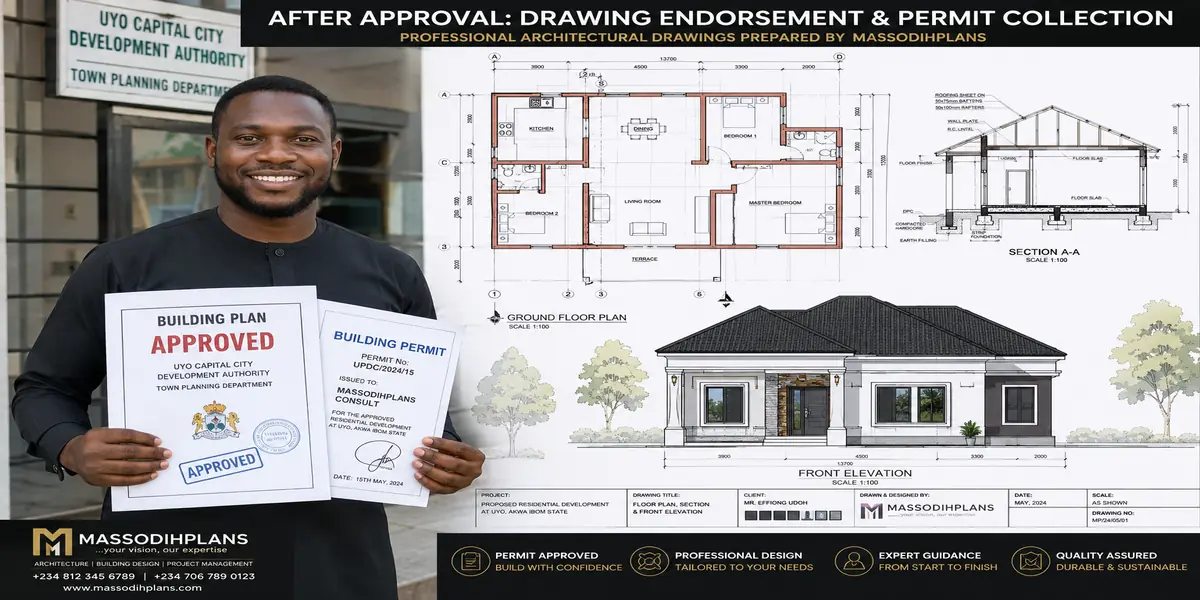
Approval and submission. Getting the design through your state’s planning authority a phase with its own timeline, its own document requirements, and its own risk of rejection if not planned for properly.
Construction administration. Site visits, answering builder queries, catching deviations early, and managing change requests as they inevitably arise.
Handover and follow-up. Confirming the finished building matches design intent, and staying in contact afterward this last step is where long-term reputation is actually built.
Expert Note: Skipping straight from pre-design to construction documentation, without a proper schematic and design development conversation with the client, is one of the most common causes of late-stage “I don’t like this” moments that cost everyone time and money.
Getting Client Expectations Right From Day One
This is where most disputes actually start, long before a single wall goes up.
Identify every real decision-maker upfront
On a Nigerian residential project, the person paying the architect’s fee is often not the only person with a real say a parent, a spouse, or a family member contributing funds may have significant, sometimes conflicting, input later. Ask directly at the start: who else needs to be consulted before decisions are considered final? This single question prevents an enormous amount of late redesign.
Put scope and fee structure in writing, plainly
Whether your fee is a percentage of construction cost or a fixed fee for defined phases, write down exactly what’s included how many design revisions, how many site visits, what counts as an “additional service” versus what’s already covered. Vague scope is where “just one small change” requests multiply until they’ve quietly consumed weeks of unpaid rework.
Structure payments around real milestones
Tying payment stages to actual project phases say, at concept approval, at construction documentation completion, and at intervals through construction administration protects both sides and gives the client a natural checkpoint to review progress rather than being surprised by a lump invoice.
Set expectations about the approval process itself
Many clients assume design and construction start immediately after drawings are done. Tell them plainly, early, that planning approval is its own phase with its own timeline this alone prevents a large share of the “why haven’t you started building yet” conversations.
Planning Approval as a Project Milestone, Not an Afterthought
This is a phase that almost every generic project management guide skips because the concept barely exists in the markets where those guides originate. In Nigeria, however, this phase deserves its own line item in every project schedule. Each state’s planning authority sets its own submission requirements, including multiple signed and sealed drawing sets, specific sheet sizes, fixed scale bands for site plans, sections, and details, as well as its own processing timeline.
Many authorities process complete applications in about 30 working days, although the exact timeline varies by state. Include this approval period in the project schedule you present to the client from the very beginning instead of introducing it later as an unexpected delay. A beautiful design cannot secure approval if you omit a required drawing, use an unregistered drafter to sign the documents, or submit the drawings at the wrong scale. Any of these mistakes restarts the approval timeline and damages the client relationship, even though the problem stems from poor project procedures rather than poor design.
Managing the Real Construction Site
Formal general-contractor arrangements are common on larger commercial jobs, but a large share of residential work here runs on a looser structure a mason, an electrician, and a plumber coordinated somewhat independently, sometimes directly by the client rather than through a single GC.
Be the Coordination Point, Even Without a Formal GC Contract
If no one checks for conflicts between the plumbing run and the structural beam before construction begins, the architect usually assumes that responsibility by default, whether the contract includes it or not. Decide deliberately whether you will take on that role, then explain clearly to the client exactly what your responsibilities include and exclude.
Document Every Site Visit
Take dated photos and write a brief note after every site visit. Those records protect you if disputes arise later over decisions made on site or differences between the approved work and the completed construction. This practice becomes even more important when no single general contractor manages and accepts responsibility for the entire project.
Handle change requests as a formal, not casual, process
A verbal “can we just move this wall a bit” on site, agreed informally, is exactly how projects quietly drift over budget and schedule. Even a simple written confirmation what changed, what it affects, whether it affects cost or timeline protects the relationship far better than a friendly verbal agreement that nobody remembers the same way six months later.
Serving Diaspora and Remote Clients Well
A meaningful share of residential projects here are funded and directed by clients living abroad, managing the entire build without being physically present a client type almost no generic project management guide addresses at all.
Set a reporting rhythm before the client asks for one. A regular cadence of photo and short video updates weekly or at each major milestone builds far more trust at a distance than waiting for the client to chase you for news.
Translate technical decisions into plain terms every time. A remote client can’t walk the site to “just see” what a structural or design decision means. Every update should briefly explain what changed and why, in language that doesn’t assume they’re standing there with you.
Build in a trusted local point of contact. Even with excellent remote communication, having someone the diaspora client trusts able to physically verify progress occasionally reduces anxiety on both sides, and reduces the temptation for a remote client to make snap decisions based on a single confusing photo.
Client Education as Risk Management
This connects directly back to something I’ve written about separately: a client who genuinely understands their site plan, floor plan, and at least one elevation and section before construction begins asks better questions, catches problems earlier, and disputes far less later. Walking a client through their own drawings properly at the start isn’t just good service it’s one of the cheapest risk-management tools available to an architect, because most disputes originate from a misunderstanding that was entirely preventable on paper.
Delivering Results That Keep Clients Coming By
The projects that generate genuine referrals aren’t necessarily the most architecturally ambitious ones they’re the ones where the client felt informed, respected, and rarely surprised throughout. A short follow-up visit or call a few months after handover, just to check how the finished space is actually performing for the client day to day, costs almost nothing and does more for long-term reputation than almost any marketing effort.
A Real-Life Example
On a duplex project in Uyo, the client’s brother abroad was quietly funding a significant portion of the build and had strong opinions about the kitchen layout that only surfaced after construction documentation was already complete. Because we’d asked at the start who else needed to be consulted, we already had his contact details and had been copying him on major design milestones from day one. The late-stage kitchen concern was resolved in a single call, rather than becoming a full redesign dispute after the walls were already up.
Common Mistakes
Assuming the person paying your fee is the only real decision-maker on a family-funded project.
Treating planning-authority approval as a quick formality instead of a scheduled phase with its own realistic timeline.
Agreeing to site changes verbally without any written confirmation of what changed and what it affects.
Leaving remote or diaspora clients to chase you for updates instead of setting a reporting rhythm from the start.
Rushing clients through the drawings instead of taking the time to walk them through what they actually mean.
Frequently Asked Questions
Q: How do I handle a client whose family members keep changing decisions mid-project?
Identify every real decision-maker at the very start of the project, and keep them informed at major milestones from day one this prevents late-stage surprises far more effectively than trying to manage it after a dispute has already started.
Q: How long does planning approval typically take, and how should I plan for it?
Timelines vary by state and authority, but building a realistic approval window into the schedule you present to the client from day one rather than treating it as an afterthought prevents most of the frustration that comes from unexpected delays.
Q: What’s the biggest project management gap most architects here face that international guides don’t cover?
Coordinating an informal team of separate tradespeople without a single general contractor holding overall accountability a structure most Western project management guides simply don’t assume exists.
Q: How often should I update a diaspora client during construction?
A regular, predictable rhythm weekly updates or updates at each major milestone builds far more trust than occasional updates only when something significant happens.
Q: Does spending time educating a client on their drawings really reduce disputes?
Yes, a client who understands their site plan, floor plan, and at least one section before construction begins is far more likely to catch a misunderstanding on paper, where it’s cheap to fix, rather than on site, where it’s expensive.
Finally
Good project results come not only from good design but also from managing the entire system around the design effectively: identifying the real decision-maker, aligning the approval timeline with the project schedule, documenting site changes as they happen, and keeping remote or family-funded clients fully informed throughout the process. Build that system well, and you will see the design work you value most become reality exactly as you intended.
If you are currently planning a project and want a design process that manages the client relationship and the approval timeline properly from day one, you can explore our full plans library for ready designs, or check our design services if you need something custom-drawn and properly managed from concept to handover. If you’re new to reading drawings or want to help your own clients understand theirs better, our Plan School section breaks things down for beginners. And if this is your first time here, feel free to look around the homepage for more practical guides like this one.
Drop your questions in the comments if you’re navigating a tricky client or project situation right now I read every one, and I’d genuinely love to help you think it through. Best practices for architects, project delivery, contracts, ethics, and client management.
Read the following articles to complete the lesson:
- Architectural Design Principles Every Architect and Homeowner Should Know
- Building Design Guide for Safety, Functional, and Cost-Effective Buildings
- Architecture Ideas That Match Global Design Trends and Modern Living
- Building Design Guide for Safety, Functional, and Cost-Effective Buildings
- House Interior Design Ideas for Every Room, Style and Budget
- Architectural Drawings Guide: Types, Symbols, Standards, Dimensions and Examples
- Building Drawings Explained: Types, Symbols and Real Construction Examples
- AutoCAD House Plan Tutorial for Beginners: Learn to Draw Plans Step by Step
- How to Draw a Roofing Plan Step by Step (Manually and in AutoCAD): Complete Guide with Practical Examples
- Best 4 Bedroom House Plan for Small Plots in Abuja
- 4 Bedroom Duplex Plan for 100×150 Plot in Nigeria
- Cost of Building a 4 Bedroom Duplex in Lagos (Complete Guide)
- ArchDaily Inspired Designs for Modern Homes and Contemporary Architecture
- Modern House Design Ideas for Every Budget, Style and Lifestyle
- Duplex vs Bungalow in Benin City: Which Should You Build?
Others
- I Don’t Know Which Location to Buy In: How to Choose the Best Location
- I Don’t Know What Type of Property I Should Buy: Here’s How to Actually Decide
- Can’t Find a Property Within Your Budget? Here’s the Part Nobody’s Telling You
- I Don’t Know Where to Find the Right Property in Nigeria | Buyer Guide
- I Need a Real Estate Agent to Help Me Buy a Property in Nigeria Safely
- Property for Sale in Nigeria: The Buyer’s Guide Nobody Publishes Today
- How Do I Get Natural Ventilation? Best Ways to Improve Airflow at Home
- Where Should My House Face? Best Direction for Sun, Wind and Comfort
- I Can’t Understand or Visualize My Floor Plan — Let’s Fix That Right Now
- My Floor Plan Has Poor Circulation: How to Fix It and Improve Flow
- I Don’t Know How to Arrange My Rooms: Here’s How to Actually Figure It Out
- My Rooms Are Too Small: How Big Should Each Room Be in a House?
- I Don’t Know How Big Each Room Should Be: Standard Room Size Guide
- How Much Building Can I Put on My Plot? Building Coverage and Setbacks
- My House Plan Doesn’t Fit My Land: What to Do Before You Build
- I Need a House Plan That Fits My Plot with Exact Dimensions and Layout
- I Don’t Know What House Plan to Build? Here’s How to Decide
Author
Massodih Okon is a Nigerian built-environment professional with academic and professional experience in urban and regional planning, geography, architectural design, Landscape Design, GIS and land development.
He holds a Master’s degree in Urban and Regional Planning from the University of Uyo and a first degree in Geography and Regional Planning.
Through MassodihPlans, he publishes practical guides on Nigerian house plans, building design, physical planning, site planning, development approval and residential construction. Read the full author profile →