Your Family Home in Nigeria Is Closer Than You Think. Here Is How to Do It Safely

How to Invest in Nigerian Real Estate from Abroad: Complete Guide for Diaspora Investors
You Can Do This. Let Me Show You How.
Yes, you can invest in Nigerian real estate from abroad safely even without being physically present in Nigeria. The key is knowing exactly what to do, step by step, and who to trust. That is what this guide is for. If you are a Nigerian living in the UK, USA, Canada, Germany, or anywhere in the world and you have been dreaming of owning land or building your family home back home, this article will take you through the entire process honestly from buying land safely, to verifying documents, getting the right house plan, managing construction, and protecting your investment from the very common scams that target diaspora Nigerians.
I will not waste your time with grammar or theory. And I am Massodih Okon, a Planner and Architectural Designer with over 15 years of field experience working across South-South Nigeria mainly in Akwa Ibom and Rivers States. I trained at the University of Uyo and I have helped many Nigerians, including those in the diaspora, navigate this exact journey. What you are about to read is practical, real, and honest.
The single biggest mistake diaspora Nigerians make is sending money home without a clear system. They trust the wrong person, they skip document verification, they choose the wrong location, and then they cry later. Let us make sure that does not happen to you.
Quick Answer Box If You Need It Fast
- Step 1: Define your investment goal (build, buy, or rent out)
- Step 2: Choose a trustworthy location and verified agent
- Step 3: Verify all land documents before paying anything
- Step 4: Get an approved house plan from a certified professional
- Step 5: Use a trusted site supervisor for construction
- Step 6: Explore NHF and FMBN mortgage options if needed
- Step 7: Protect yourself from the most common diaspora scams
- Read the full guide below for every detail on each of these steps.
Step 1: Define Your Investment Goal Before You Send One Naira
Before you begin anything, you need to be clear about what you actually want. I have worked with clients who sent money home without answering this basic question, and they ended up with land they cannot use or a building that does not suit their actual needs.
Ask yourself:
- Are you building a personal family home to retire into?
- Are you buying land to hold for future value appreciation?
- Are you building a rental property to generate monthly income?
- Are you developing an estate or commercial property?
- Are you buying a completed house or apartment?
Each of these goals requires a completely different approach, different locations, different budgets, and different document requirements. For example, if your goal is rental income, you want to be in a high-demand area close to universities, markets, or government offices. If your goal is a family home, you want a quiet, residential layout with good road access, drainage, and security. If you are building to sell later, you want to choose fast-growing areas with rising land values.
In my experience, the clients who get the best results are the ones who come to me already knowing exactly what they want. That clarity shapes every decision that follows. Visit our Plans Library to explore house plan options and get a clear sense of what type of building suits your goal and your land size.
Step 2: Choosing the Right Location: The Most Important Decision You Will Make
Location is everything in Nigerian real estate. I have seen people buy land in flood-prone areas, government acquisition zones, or disputed community land simply because the price looked attractive. That mistake is very costly.
What to Look for When Choosing a Location from Abroad
- Road accessibility: Can vehicles and construction materials easily reach the land? A plot buried in an unmotorable path is more trouble than it is worth.
- Drainage and flooding: In South-South Nigeria especially, flooding is a very real problem. Ask about the land’s elevation and whether the area floods during rainy season. I have seen beautiful houses become swimming pools because nobody checked this.
- Infrastructure: Is there access to electricity mains, a water supply network, or at least the realistic possibility of borehole installation?
- Security of tenure: Is the land in a government-recognized layout? Is it in a known estate or a free-for-all bush acquisition? Government-approved layouts are much safer.
- Proximity to services: Schools, hospitals, markets, and major roads add long-term value.
- Distance from government acquisition areas: Some areas have been acquired by government for road expansion or public projects. Always verify.
Based on projects I have worked on, the best approach for diaspora investors is to choose areas that are already established or in active development not virgin bush land being sold cheaply. Yes, virgin land is cheaper. But it comes with higher risk: unclear ownership, community disputes, and future government acquisition.
Some of the most reliable locations for diaspora investment in South-South Nigeria right now include structured layouts in Uyo (Akwa Ibom State), GRA areas in Port Harcourt, and satellite towns around Benin City. If you want to understand how to evaluate these layouts properly, our Plan School section has detailed guides that explain planning concepts in plain language.
Step 3: How to Buy Land Safely from Abroad: The Real Process
This is where most diaspora Nigerians get hurt. Let me be very direct with you.
Never Pay Before You Verify
I have encountered this situation multiple times, someone in the diaspora sends money through a relative or friend, buys land, and discovers years later that the land was already sold to three other people. The seller collected money from everyone. This is not rare. It is unfortunately very common in Nigeria.
Here is the process that protects you:
- Engage a registered estate surveyor or a trusted licensed agent — not just any person who calls themselves a property consultant.
- Request a copy of all land documents before any payment whatsoever. Do not let anyone rush you.
- Travel home or send a trusted representative (a lawyer or registered surveyor) to physically verify the land exists and is what was described.
- Search the land title at the relevant land registry in the state.
- Confirm there are no government acquisition notices on the land.
- Engage a property lawyer to handle the deed of assignment or contract of sale.
Documents You Must Demand Before Paying
One lesson I learned early in my practice is that document verification is not optional. It is the foundation of everything. Here are the documents that matter:
- Certificate of Occupancy (C of O): This is the strongest land title in Nigeria. It is issued by the State Governor and gives you the legal right to occupy the land. If the seller has a genuine C of O, that is a very strong sign.
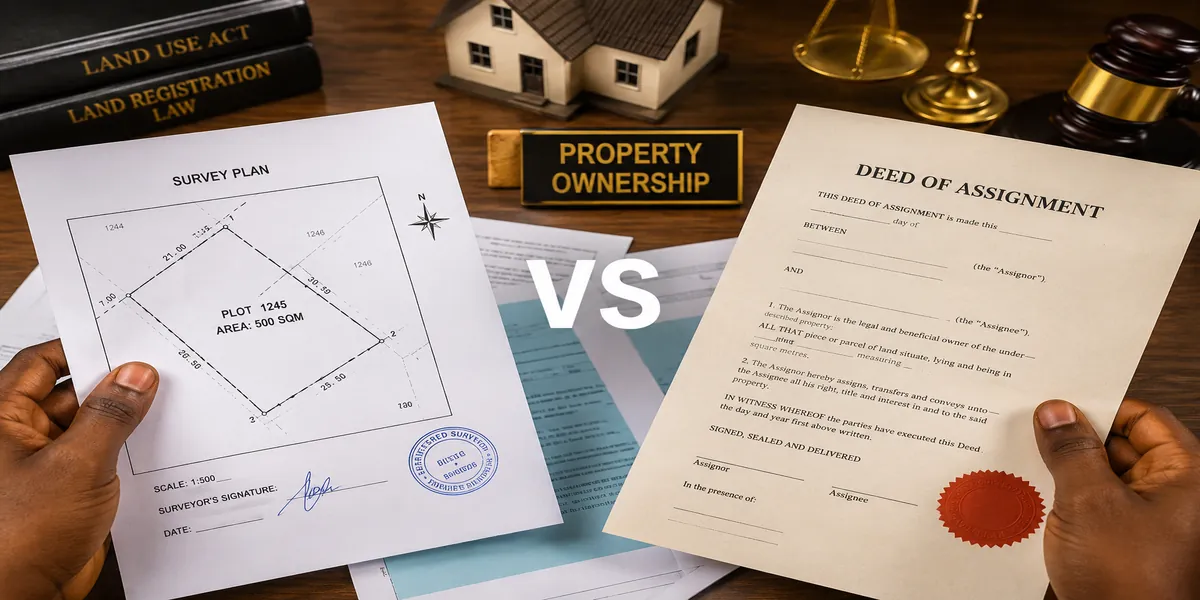
- Deed of Assignment: If the land has been transferred from one person to another, there must be a registered Deed of Assignment. Verify it at the state land registry.
- Registered Survey Plan: This shows the exact dimensions and boundary of the land. It must be signed and stamped by a licensed surveyor and registered with the state surveyor general’s office.
- Governor’s Consent: When land is transferred in Nigeria under the Land Use Act, the new owner must get Governor’s Consent. Without this, the transfer may not be legally complete.
- Power of Attorney: If the person selling is not the original owner, they must have a registered Power of Attorney authorizing them to sell.
- Receipt and Agreement: Always get a written receipt and a properly drafted Agreement of Sale, signed by both parties and witnessed by a lawyer.
Once you have purchased the land, you will need a properly prepared survey plan and a physical development plan for building approval. This is where professional services become very important. You can explore our full range of services to understand how we help diaspora clients prepare the right documents for their Nigerian property.
Step 4: Verifying the Survey Plan: Do Not Skip This
At the University of Uyo, one thing our lecturers constantly emphasized was that a survey plan is not just a piece of paper. It is the legal identity of that land. A bad or forged survey plan can make you lose your land in court, even if you paid genuine money.
Here is how to verify a survey plan from abroad:
- Ask the seller to provide the plan number and the name of the licensed surveyor who prepared it.
- Contact the Surveyor General’s office in the relevant state and request a search on that plan number.
- Hire a registered surveyor in Nigeria to physically visit the land and confirm the beacons and boundaries match the plan.
- Confirm the plan shows the correct area in square metres or hectares, and that the measurements match what you paid for.
Many people in the diaspora buy land without ever verifying the survey plan. I have seen cases where the plan showed 600 square metres but the actual land was barely 400 square metres. The seller was simply dishonest. Verification costs very little. Not verifying can cost you everything.
If you need help understanding what a survey plan shows and how to read it, our Plan School articles explain planning documents in very plain language designed for ordinary Nigerians.
Step 5: Getting Building Approval: What Diaspora Investors Often Skip
This is one of the most skipped steps in Nigerian building projects and it is one of the most dangerous to skip. In my experience, at least six out of ten diaspora housing projects I have encountered have no building approval. The building goes up fast, and then years later the owner faces demolition threats, fines, or court action.
Building approval in Nigeria means getting your architectural and structural drawings approved by the State Urban Planning Authority or Local Government planning office before you start construction. Here is what is usually required:
- Architectural drawings prepared by a registered architect or architectural designer
- Structural drawings prepared by a registered structural engineer
- Survey plan of the land
- Title documents of the land (C of O, Deed of Assignment, etc.)
- Application letter and relevant fees
- Development control clearance (depending on the state)
The approval process typically takes between four and twelve weeks depending on the state. In Akwa Ibom State, for example, the processing is handled through the Ministry of Physical Planning. In Rivers State, the Rivers State Urban Development Authority (RSUDA) handles approvals.
Without this approval, you cannot legally begin construction. But more importantly, unapproved buildings are difficult to sell later, cannot be used as collateral for bank loans, and are at risk of demolition.
If you are building in Nigeria from abroad, let us prepare your architectural and structural drawings and help you through the entire approval process. Visit our Services page to see exactly how we support diaspora clients.
Step 6: Choosing the Right House Plan for Your Nigerian Land
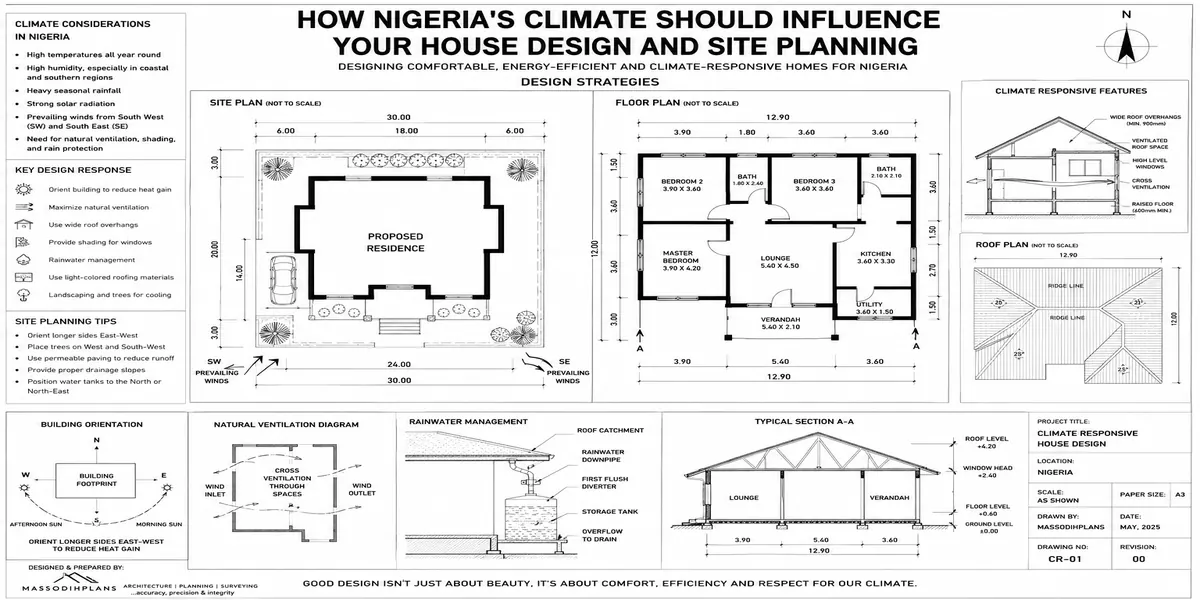
Now this is where I get very excited, because house plans are my world. Choosing the right house plan is not just about how the building looks. It is about how it fits your land, how it serves your family, how it performs in the Nigerian climate, and how much it will cost you to build.
What Your House Plan Must Address for Nigerian Conditions
- Ventilation and cross-ventilation: Nigeria is hot. A good house plan must allow natural airflow through strategic window placement and room orientation. Without this, your house becomes an oven during hot season.
- Roof design for tropical rainfall: Nigerian rain can be very heavy. The roof must have proper overhang, the right pitch, and good drainage channels (fascia and gutter design).
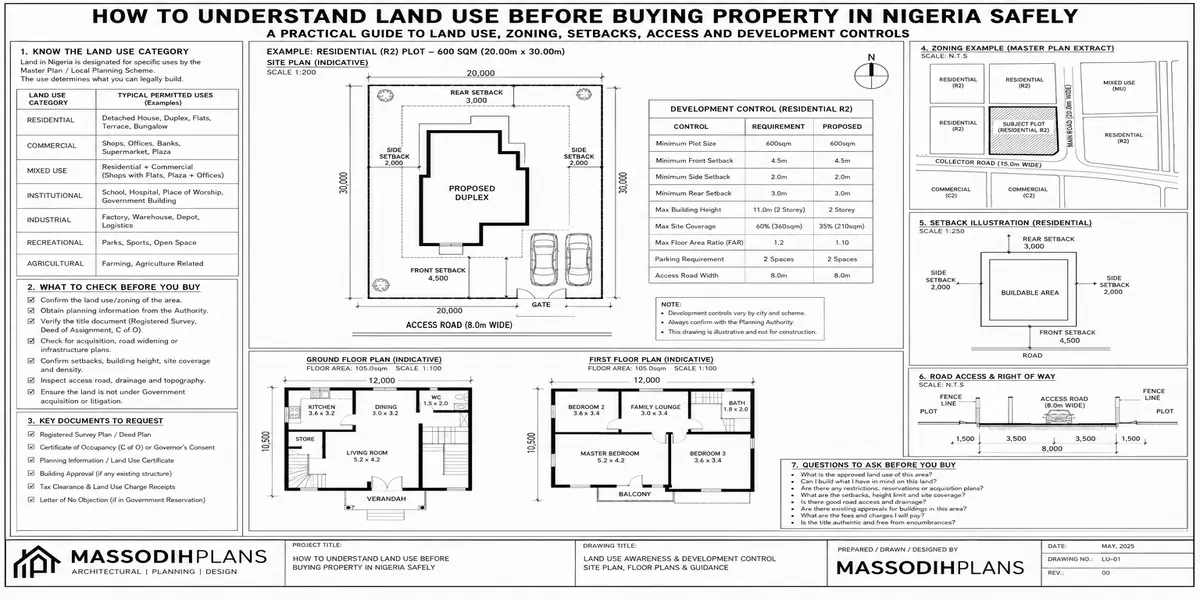
- Setbacks and plot coverage: Every state has minimum setback requirements how far your building must sit from the boundaries of your land. Your plan must comply with these or it will not get approval.
- Orientation: Your house should ideally face north or south to minimize direct sun hitting the main living areas. This is especially important for houses in the South-South where heat and humidity are high.
- Generator space: Generator noise and fumes require the generator to be housed in a ventilated room or enclosure away from sleeping areas. Your plan must show this.
- Borehole and water tank: Almost every Nigerian house needs a borehole and overhead water tanks. The plan must account for these positions.
- Security: Perimeter fence, security gate, and gatehouse positioning must all be included in the site plan.
- Drainage: Surface water drainage must be properly channeled to avoid flooding your compound and neighbouring properties.
During my undergraduate studies in Town Planning, one thing our lecturers constantly emphasized was that a building that ignores its climate and context is always a problem no matter how beautiful it looks on paper. I have seen this confirmed many times on real projects. Visit our Plans Library to browse house plans that are specifically designed for Nigerian land conditions, plot sizes, and tropical climate requirements.
Small Plot Strategies for Nigerian Land
One very common challenge I see with diaspora investors is that they often own standard Nigerian plots 450 sqm, 300 sqm, or even smaller and they want to build a three-bedroom or four-bedroom house on it. This is absolutely possible when the plan is designed correctly.
Here is how compact Nigerian plots can be maximized:
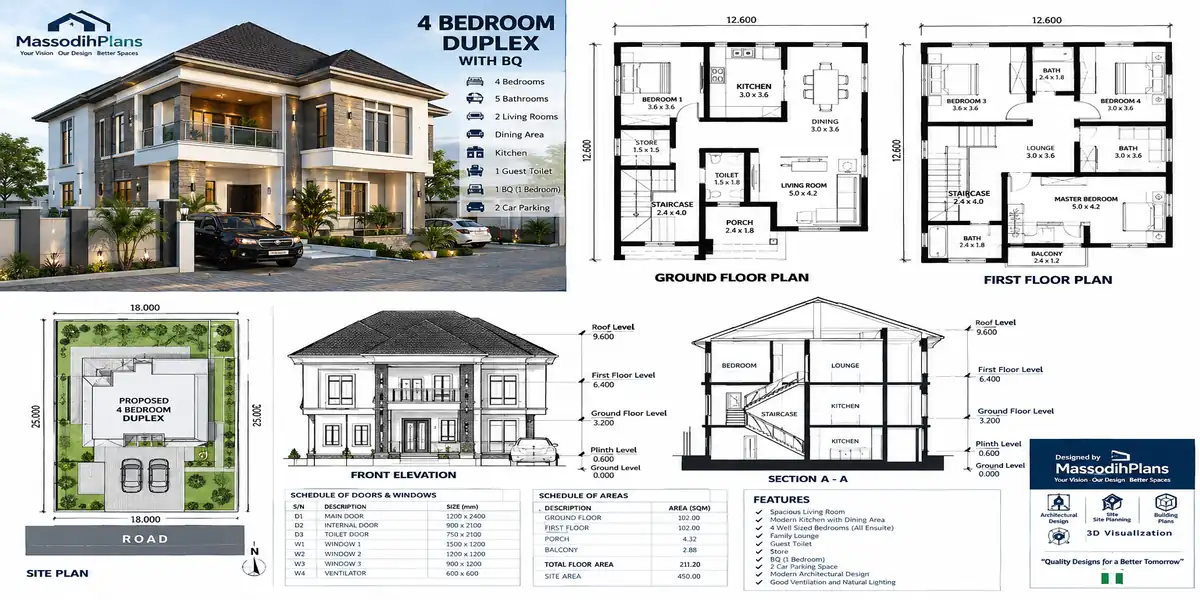
- Go vertical: A duplex or two-storey building uses the ground footprint efficiently and gives you more rooms on a smaller plot.
- Open plan living: Combining the living room and dining area reduces corridor space and makes smaller homes feel larger.
- Dual-purpose rooms: A study that doubles as a guest room, or a store room that can later become a small apartment, adds value without adding footprint.
- Narrow frontage designs: For plots with narrow street frontage, long-and-narrow building designs work very well. We design these regularly for plots as narrow as 10 metres.
- Rear extension planning: Design the initial building with planned rear extension positions so future expansion does not require demolishing walls.
From a planning perspective, I strongly recommend that every diaspora investor gets their house plan tailored to their specific plot dimensions not a generic plan copied from the internet. Generic plans often ignore your exact plot size, orientation, setbacks, and drainage conditions. You can request a custom plan through our services page and we will design something that fits your land perfectly.
NIGERIAN REALITY LAYER — What Most Guides Never Tell You
This section covers the real-world conditions that affect every building project in Nigeria.
Read it carefully. These are the things builders discover on site often too late.
The Nigerian Building Realities Nobody Warns You About
Material Prices Are Unstable. Plan for It
In my experience, Nigerian building material prices can change significantly within a single month. Cement, iron rods, timber, tiles, roofing sheets all of these fluctuate. During the 2022 to 2024 period, we saw cement prices double within months. This is not exceptional. It is the Nigerian construction reality.
How to protect yourself:
- Always add a 20 to 30 percent contingency buffer to your total construction estimate
- Lock in material prices with your supplier before construction begins, if possible
- Buy materials in bulk when prices dip, especially iron rods and roofing sheets
- Never release your full budget at once release in stages tied to construction milestones
Power Supply and Generator Space
Nigeria’s power supply situation remains a serious reality for every homeowner. Do not design or build a house without planning for:
- A dedicated generator room or enclosure with proper ventilation and a lockable door
- Conduit and wiring for a generator changeover switch
- A solar energy system space either rooftop panels or a dedicated inverter battery room
- Extra electrical sockets for appliances that must run on generator/inverter
Based on projects I have worked on, I always recommend that diaspora clients budget for solar as part of the initial build. The cost of installing solar during construction is much lower than retrofitting later. The infrastructure conduit, wiring routes, battery room, roof mounting provision should all be in the original plan.
Flooding, Drainage, and Site Preparation
This is something I have encountered many times in South-South Nigeria, especially in Akwa Ibom and Rivers States where rainfall is very heavy and the water table is high. A house without proper drainage preparation is a disaster waiting to happen.
From a planning perspective, I strongly recommend:
- Always raise the finished floor level of your building at least 600mm to 900mm above the natural ground level
- Design proper surface water channels around the building and within the compound
- Ensure your perimeter fence has drainage openings to prevent compound flooding
- If your site has poor natural drainage, incorporate a soak-away pit or soakage trench system
- Plant compound with proper ground cover to reduce water runoff velocity
Borehole, Water Tank, and Water Planning
Almost every Nigerian residential building requires a borehole or water well even in urban areas where pipe-borne water supply exists, because that supply is unreliable. Position the borehole at least 15 metres away from any septic tank or soakaway pit to prevent contamination. Your house plan should show overhead tank positions, pump house location, and pipe routes so your plumber does not have to improvise on site.
Step 7: Mortgages and Financing. The NHF Option for Diaspora Nigerians
Many Nigerians in the diaspora do not know that they may qualify for mortgage financing in Nigeria. The National Housing Fund (NHF) operated by the Federal Mortgage Bank of Nigeria (FMBN) offers one of the most accessible mortgage products available to ordinary Nigerians.
What Is the National Housing Fund (NHF)?
The NHF is a compulsory contributory scheme that allows Nigerian workers to access affordable mortgage loans for housing. As a Nigerian in the diaspora, you can contribute to the NHF and access loans for building or buying a house in Nigeria.
Key NHF facts you need to know:
- NHF loans currently offer interest rates of around 6 percent per annum much lower than commercial bank rates
- Maximum loan amount through FMBN has been increased in recent years to accommodate higher property values
- You must have been contributing to the NHF for at least six months before you can apply
- You need a registered title document (C of O or equivalent) as collateral
- You need approved building plans and a bill of quantities from a registered professional
The NHF route works best for Nigerians who already have a formal employer contributing to their NHF on their behalf, or who voluntarily contribute as self-employed individuals. For diaspora Nigerians, voluntary NHF contribution is possible through FMBN’s designated contribution channels. You can find more information at the Federal Mortgage Bank of Nigeria official website (fmbn.gov.ng) where they have updated information on diaspora mortgage options.
Commercial Bank Mortgages for Diaspora Nigerians
Several Nigerian commercial banks now offer diaspora mortgage products including First Bank, Access Bank, and UBA. These typically require:
- Proof of regular income in foreign currency (payslips, bank statements)
- A valid Nigerian passport and BVN
- Land title documents for the property
- Approved building plan and valuation report
- Equity contribution (usually 20 to 30 percent of property value)
From what I have seen in practice, diaspora clients who prepare all their property documents properly title deed, approved house plan, bill of quantities have a much smoother experience with bank mortgage applications. If your documents are incomplete or unapproved, most banks will reject your application immediately.
Step 8: Managing Construction from Abroad. Practical Advice
CONSTRUCTION EXPERIENCE LAYER
These are the real lessons from years of supervising and reviewing Nigerian building projects.
Most diaspora investors skip these steps. The ones who follow them build successfully.
Hire a Qualified Site Supervisor — This Is Non-Negotiable
This is the single most important advice I can give any diaspora investor building in Nigeria without being physically present. You must hire a qualified site supervisor a registered building technologist, architect, or town planner who is not the contractor.
Your contractor’s job is to build. Their financial interest is in spending as little money as possible on materials and labour while collecting as much from you as possible. A good site supervisor protects your interest by:
- Checking that the right grade of cement and the right ratio of concrete is being used
- Verifying that iron rods are the correct diameter and spacing as specified in the structural drawings
- Confirming that column bases, ring beams, and slab thicknesses are correct
- Ensuring that the building is being erected according to the approved plan not improvised
- Reporting progress with photos and videos at agreed intervals
- Verifying quantity of materials delivered vs materials actually used in the building
I have seen this mistake repeatedly diaspora investors wire money based on contractor reports without independent verification, only to discover that the contractor built a smaller structure, used substandard materials, or diverted funds. A site supervisor prevents this. If you need help selecting a trusted construction supervision arrangement, visit our services page and let us discuss what your project needs.
What Builders Usually Get Wrong on Nigerian Sites
During field inspections, I discovered that these are the most common contractor mistakes on Nigerian building sites:
- Wrong concrete mix ratios — contractors often reduce the cement content to save money, especially in the foundation and columns where it cannot easily be seen
- Undersized iron rods — the plan may specify 12mm rods but the contractor uses 10mm to save money
- No curing of concrete — concrete must be kept wet for at least seven days after casting, but contractors often move on too quickly
- Incorrect setbacks — the building is placed too close to the boundary fence, violating planning regulations
- Windows positioned without considering ventilation — rooms end up dark and poorly ventilated
- Drainage not coordinated — surface water has no outlet and floods the compound
My internship experience reinforced the importance of having a professional who understands both the planning standards and the construction requirements checking the work at every major stage.
Stage-by-Stage Construction Release Schedule
If I were advising a client today, I would recommend this payment release structure for diaspora investors:
- Stage 1 Foundation: Release first tranche (typically 20 to 25 percent) only after site clearing, setting out, and foundation work is complete and verified by supervisor
- Stage 2 Walling (DPC to lintel level): Release second tranche after blockwork up to window and door lintel level is complete
- Stage 3 Roofing: Release third tranche after roof structure and roofing sheets are complete and building is weather-tight
- Stage 4 Plastering and first fix: Release fourth tranche after internal plastering, electrical first fix, and plumbing first fix are complete
- Stage 5 Finishing: Release final payment after tiling, painting, second fix of electrical and plumbing, and final clean-up is completed
Never release 100 percent of any stage payment in advance. Always hold back at least 10 percent of each stage payment until you verify the work is done correctly through your supervisor’s report and photos.
Step 9: Common Scams Targeting Diaspora Nigerians and How to Avoid Them
I will be very direct here because this is a real problem. Diaspora Nigerians are specifically targeted by land and property scams in Nigeria. This observation comes from practical field experience and from conversations with many clients who came to me after being defrauded.
The Most Common Diaspora Property Scams
- Double-selling: The same land is sold to multiple buyers. The first one to complete legal documentation usually wins — but the legal battle can take years.
- Government land fraud: Land that has already been acquired by government is sold to diaspora buyers who do not know about the acquisition.
- Community land without individual title: Family or community land is sold without proper legal authority from all family members. This leads to disputes later.
- Fake survey plans: Forged or unregistered survey plans are presented to buyers. The plan looks authentic but does not exist in the state survey register.
- Inflated building costs: Contractors give diaspora investors far higher quotes than they would give local clients, knowing that the investor is far away and cannot easily compare prices.
- Ghost construction: Contractors collect money and do very little or no work, sending old photos to deceive the owner.
- Fake estate companies: Non-existent or illegitimate estate development companies collect deposits for estates that are never developed.
How to Protect Yourself
- Always use a registered professional licensed surveyor, registered architect, or registered town planner not just any agent
- Never pay without receiving and verifying physical documents
- Conduct a land registry search before payment, not after
- Use a licensed property lawyer for all transactions
- Verify contractor credentials with the Council of Registered Builders of Nigeria (CORBON)
- Install CCTV on your building site if the budget allows it significantly reduces contractor dishonesty
- Join Nigerian diaspora property investment groups online to learn from others’ experiences
- Get your construction contract properly drafted and signed our professional services team can help you prepare the right documentation
INVESTMENT LAYER — Is Nigerian Real Estate Still Worth It?
Short answer: Yes, but only if you do it right.
Nigerian real estate has consistently delivered long-term capital appreciation despite currency fluctuations.
The key is buying in the right location, with clean documents, and building properly.
Is Nigerian Real Estate a Good Investment from Abroad?
This is a question I get very often. My honest answer is: Nigerian real estate is one of the best long-term wealth strategies available to Nigerians domestic or diaspora when done correctly. Here is why:
The Case for Nigerian Real Estate Investment
- Population growth: Nigeria has over 220 million people and a rapidly growing urban population. Housing demand consistently outstrips supply. This keeps property values and rents rising.
- Naira exchange rate advantage: For diaspora Nigerians earning in Pounds, Dollars, or Euros, the Naira exchange rate means your foreign currency goes very far in Nigeria. A modest diaspora income can fund a house that would take decades to afford abroad.
- Rental income: A well-located three-bedroom flat in Uyo or Port Harcourt can generate between N400,000 and N1,200,000 per year in rent and this is growing. For a diaspora investor who spent N8 million to N15 million building, this represents a meaningful return.
- Land value appreciation: Land in emerging Nigerian urban areas has appreciated significantly over the past ten years. Areas that were remote and cheap a decade ago are now highly sought-after.
- Legacy and family: Many diaspora Nigerians want to own property at home for retirement, family gatherings, or to leave something for their children. This is a deeply real motivation and a legitimate one.
Locations Currently Showing Strong Investment Potential
Based on my experience and field observations across South-South Nigeria:
- Uyo (Akwa Ibom State): Infrastructure investment has been strong. The city is growing rapidly with improved roads, airports, and services. Rental demand is high near the university and government quarters.
- Port Harcourt (Rivers State): The commercial capital of the South-South. Oil sector demand keeps property values and rents high in GRA areas and new estates.
- Calabar (Cross River State): A beautiful, well-planned city with strong potential for tourist accommodation investment and residential development.
- Satellite towns around Lagos: Ibeju-Lekki, Epe, and the Lekki-Epe corridor are experiencing massive infrastructure development. Long-term land value appreciation is strong.
If you are considering investment in Nigerian real estate for long-term value, start by exploring house plans that are suitable for rental or multi-unit development. Our Plans Library includes duplex plans, flat designs, and multi-unit layouts designed specifically for Nigerian urban land conditions.
Designing for Your Family’s Real Lifestyle Not Just What Looks Nice
A house plan must reflect how your family actually lives not just what looks impressive in a 3D render. Over the years, I have noticed that diaspora clients sometimes choose house plans based on aesthetics alone, then discover the layout does not suit how they actually want to live.
Questions to Ask Before Choosing Your House Plan
- How many people will live in the house at any one time?
- Do you have elderly parents who will visit or live with you? (Consider ground floor bedroom with en-suite bathroom and no steps)
- Do you have or plan to have children? (Consider safe compound space, room for future bedrooms)
- Do you run any business from home or plan to? (Consider a separate study or home office space)
- Will you have live-in domestic staff? (Consider a separate boys’ quarters or staff room)
- How important is guest privacy to you? (Consider guest room placement relative to main bedrooms)
- Are you planning to rent out part of the building? (Consider a self-contained flat design)
Working alongside experienced planners taught me that the best house plans are the ones designed around real lives, not ideal lives. A compact three-bedroom bungalow that perfectly suits your family is far better than a sprawling five-bedroom mansion that is half-empty and expensive to maintain. Browse our Plans Library to find plans organized by bedroom count, plot size, and building type.
Frequently Asked Questions. Diaspora Real Estate in Nigeria
Can I buy land in Nigeria without being physically present?
Yes, you can. You need a trusted lawyer with a registered Power of Attorney to act on your behalf. The lawyer can conduct land searches, execute documents, and represent you during the transaction. However, I always recommend that you or a trusted family member visit the land physically at least once before final payment.
How do I verify if a C of O is genuine from abroad?
You can engage a property lawyer in the relevant state to conduct a search at the state land registry. The registry will confirm whether the C of O number exists, who it is registered to, and whether there are any encumbrances on the title. This search typically costs a small administrative fee.
What is the safest way to send money for land purchase from abroad?
Always send through a reputable international transfer service Wise, Western Union, or bank transfer directly into the seller’s account after signing a proper Agreement of Sale. Never send cash through a third party. Always keep transfer receipts.
How long does it take to build a house in Nigeria from abroad?
A standard three-bedroom bungalow with proper supervision typically takes between eight and eighteen months from foundation to completion, depending on funding continuity, material availability, and weather. Delays usually happen when funds are released irregularly or supervision is inadequate.
Do I need to register my property after purchase?
Yes. After buying land, you must register the transaction at the state land registry and get Governor’s Consent for the transfer. Without this, you do not have the full legal title. Your lawyer handles this process, and it is an important step that many diaspora buyers skip to their own detriment.
Can I get a Nigerian bank mortgage if I live abroad?
Yes, some Nigerian banks offer diaspora mortgage products. You will need proof of foreign income, a valid Nigerian passport, BVN, and a registered land title. NHF loans are also available if you are a voluntary contributor to the National Housing Fund.
How do I find a trustworthy contractor from abroad?
Ask for referrals from trusted family members or friends who have built recently. Request portfolios of completed projects. Verify the contractor’s registration with CORBON. Never use a contractor recommended solely by the land vendor. And always hire an independent site supervisor separate from the contractor. You can also engage our professional services for recommendations and project management support.
Mistakes Diaspora Investors Must Avoid. Expert Summary
TOP MISTAKES Read These Carefully
- 1. Sending money before verifying all land documents
- 2. Trusting a single person (agent, relative, or friend) without professional verification
- 3. Starting construction without building approval
- 4. Paying a contractor in full before work stages are completed
- 5. Choosing a generic house plan not tailored to your specific plot
- 6. Not hiring an independent site supervisor
- 7. Ignoring drainage and flooding conditions of the site
- 8. Not including generator, borehole, and solar provisions in the building plan
- 9. Failing to register the property and obtain Governor’s Consent after purchase
- 10. Choosing location based on price alone without infrastructure assessment
Conclusion: Your Nigerian Home Is Achievable But Only If You Do This Right
If there is one thing I want you to take away from this entire guide, it is this: investing in Nigerian real estate from abroad is absolutely achievable, but it requires discipline, verification, and professional support. The people who get burned are the ones who cut corners skipping document verification, skipping building approval, skipping professional supervision.
The people who succeed are the ones who build their process on a proper foundation: clean documents, an approved house plan, a qualified site supervisor, and a clear payment schedule. It takes a bit more time at the beginning, but it saves enormous pain later.
You have already done something smart by reading this far. The next smart step is to get the right house plan for your specific plot one designed by a professional who understands Nigerian conditions, climate, planning regulations, and your family’s needs. Browse our Plans Library to explore plans designed for Nigerian plots of all sizes.
If you want to understand more about planning concepts, building regulations, and how to read architectural drawings, our Plan School is full of practical articles written exactly for people in your position diaspora Nigerians who want to build wisely.
And if you are ready to talk about your specific project land size, budget, building type, location our professional services team is here to help you through every step, from house plan design to building approval documentation.
Finally, visit our MassodihPlans homepage for the full range of resources available to help you build your Nigerian dream home from wherever you are in the world. Share this article with another Nigerian in the diaspora who needs it because this kind of clear, honest information is exactly what people deserve.
Reference
Nigerian Investment Promotion Commission (NIPC) – Investing in Nigeria
Related Posts
- Building Regulations Every Nigerian Property Developer Must Know
- GIS Applications in Urban Planning: Real-World Examples That Work
- How to Read a Survey Plan in Nigeria Without Hiring an Expert
- Cost of Building a House in Uyo: Honest Budget Guide for Property Owners
- Cost of Building a 4 Bedroom Duplex in Lagos (Complete Guide)
- Best Roofing Sheets for Nigerian Weather: Complete Guide
- What Makes a Good Estate Layout Plan? A Practical Guide for Nigeria and Beyond
- Housing Estate Layout Plan: Why Every Estate Needs One in Nigeria and Beyond
- 2 Bedroom Flat Plan for Narrow Plots in Nigeria: Complete Layout, Dimensions, and Building Guide
- Layout Plan Cost in Nigeria and Abroad: What Every Landowner Must Budget Before Building
- Industrial Estate Layout Design in Nigeria: Smart Master Plan for Small Industrial Plots