About the Author (Massodih Okon)


Massodih Okon, built environment professional behind MassodihPlans
The person behind MassodihPlans, and why this platform exists
MassodihPlans was not built because its founder saw a gap in the market. It was built because Massodih Okon kept watching people make expensive, painful, and completely avoidable mistakes with their land and their buildings and he had the knowledge to help them but no platform to reach them at scale.
That is the honest reason this site exists for people.
If you have ever wondered who is writing these articles, who produced these plans, and whether the person behind this platform actually knows what they are talking about, this page is for you.
Where Massodih Comes From
Massodih Okon was born and raised in Uya Oro, a community in Oron Local Government Area of Akwa Ibom State, Nigeria.
His education began at Government Primary School, Uya Oro, a small government school like the kind that hundreds of thousands of Nigerian children attend. Nothing fancy. Just teachers who showed up, a blackboard, and a community that believed education was the way forward.
From there he went to Government Secondary School, Okuko, in Urue Offong Oruko Local Government Area of Akwa Ibom State. Again, a regular Nigerian secondary school not a private school in Lagos with swimming pools and foreign curriculum. A public school in Akwa Ibom, where you either chose to learn or you went home with nothing.
He chose to learn.
This background is not mentioned to impress anyone. It matters. Massodih learned everything about Nigerian built-environment challenges in Nigeria, on real plots, in real planning offices, and among real families working to build their homes.
He is not someone who studied abroad and came back to tell Nigerians how to design houses. He is someone who grew up in Akwa Ibom, studied in Uyo, and has spent years working in the Nigerian built environment with both hands on the desk.
Academic Background
After secondary school, Massodih attended the University of Uyo, the same university many readers of this site attended or are currently attending.
He earned his first degree in Geography and Regional Planning from the University of Uyo. This is where he first understood, at a formal academic level, why Nigerian cities look the way they look. Why flooding is predictable in certain areas before the first raindrop falls. Why land use decisions made at the state level determine whether a neighborhood thrives or decays twenty years later. Geography is not just about knowing where places are, it is about understanding the relationship between land, people, climate, and development. That foundation changed how Massodih sees every plot of land he encounters.
After earning his first degree, he returned to the University of Uyo to pursue a Master’s degree in Urban and Regional Planning. This is where he developed real depth in the profession. At the postgraduate level in Nigeria, town planning goes far beyond drawing attractive layouts. The discipline covers legislation, policy, population projection, infrastructure provision, land-use analysis, development control, and the systems that determine whether authorities approve or demolish a building. He studied these subjects seriously and thoroughly at the University of Uyo.
His academic background is Nigerian through and through. He earned both degrees from the same university in Uyo, Akwa Ibom State. Some people might see that as a limitation. Massodih sees it as a strength. Lecturers who live and work in Nigerian cities trained him to understand Nigerian urban challenges. They taught with examples from real planning problems across the country and prepared graduates for work within Nigerian planning systems. That specificity matters every time he sits down to write an article about setbacks or drainage challenge in Nigeria.
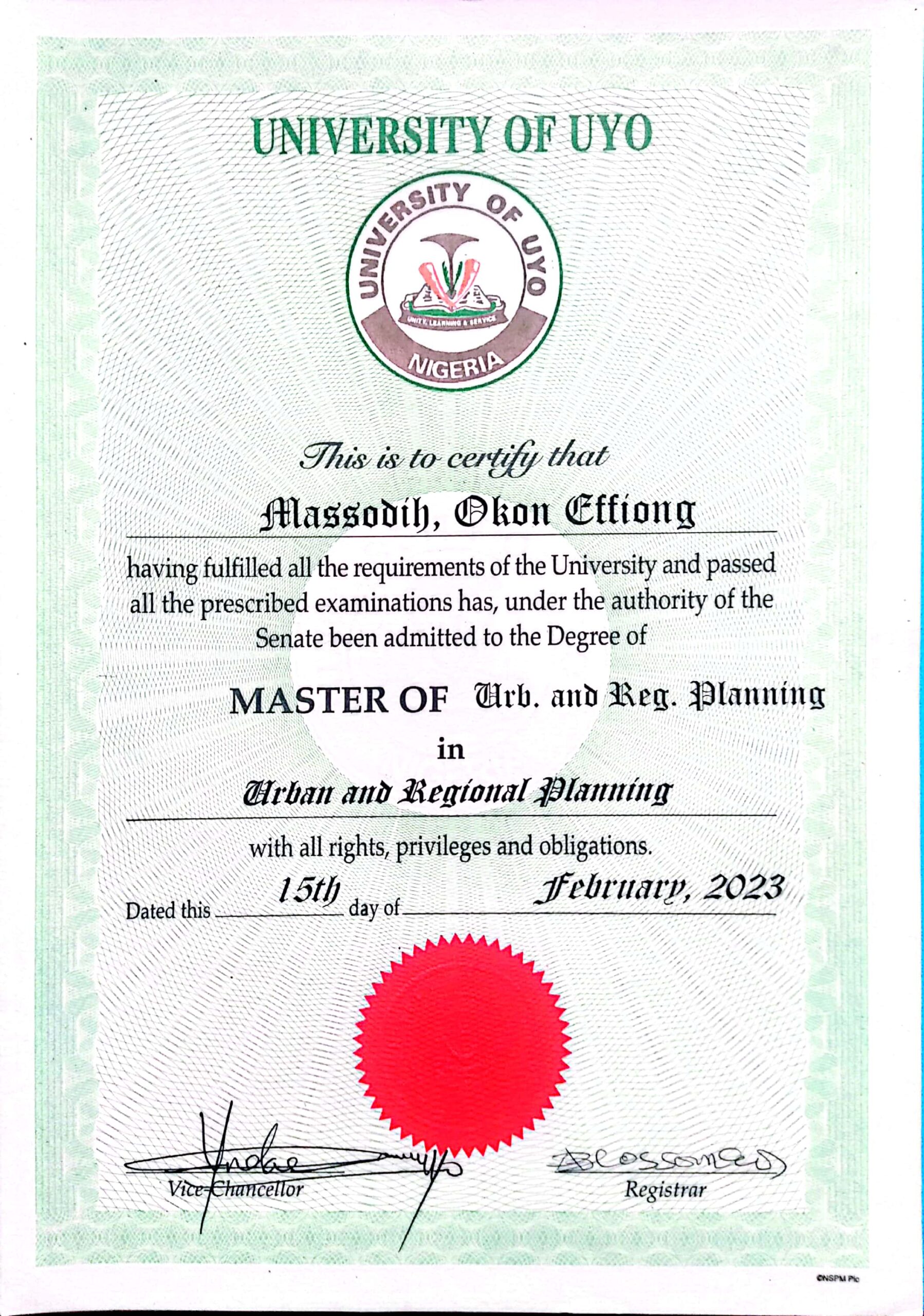
Massodih Masters (MURP)
Professional Certifications
Beyond his academic degrees, Massodih has pursued several professional certifications that directly shape the work published on MassodihPlans.
He holds a professional certificate in Architectural Design and Landscaping. This means he does not just understand the theory of how buildings should be designed, he can actually produce the drawings. The floor plans, the elevations, the sections, the site layout plans, the landscape planting schemes. These are practical skills, not just classroom knowledge.
He holds a certificate in GIS (Geographic Information Systems) and Land Use Planning and Evaluation. GIS is the technology that planning authorities use to map land, track development, evaluate site suitability, and make spatial decisions. When MassodihPlans publishes content about land suitability or site analysis, it is drawn from real GIS skills applied to real Nigerian projects.
He holds certificates in AutoCAD and Revit, the two most important software tools in the Nigerian architectural and planning drawing environment. AutoCAD is the standard platform for producing construction drawings in Nigeria. Revit brings the third dimension and the building information modeling level. For any student looking to build a career in the Nigerian built environment, these two tools are not optional, they are foundational. Massodih teaches both.
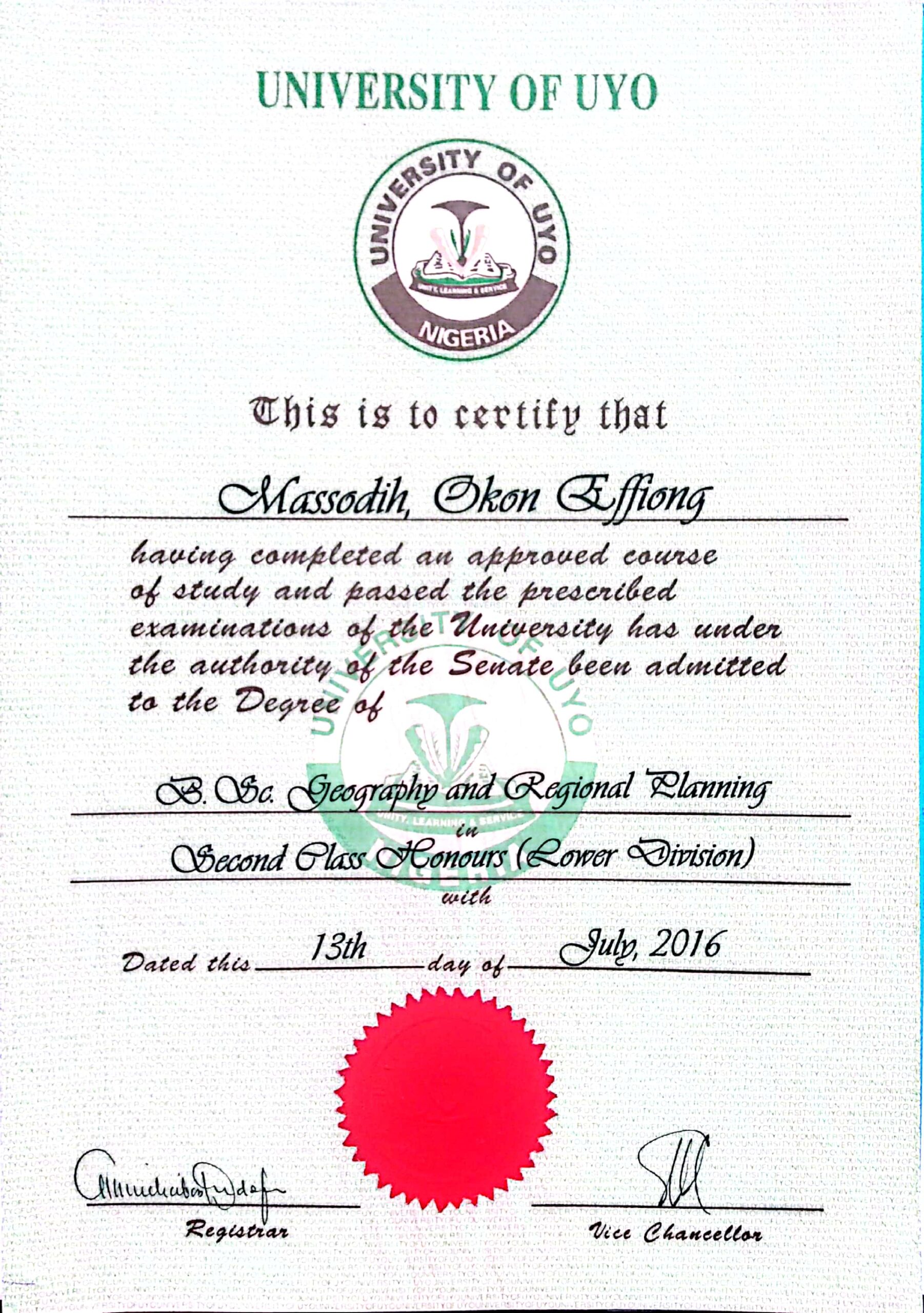
B.Sc Geography and regional Planning
What Massodih Actually Teaches
For years, Massodih Okon has been teaching, training, and transferring knowledge in the Nigerian built environment across subjects that connect spatial science, planning, mapping, and design.
He teaches Quantitative Geography, the analytical side of spatial science. This involves measuring distance, density, distribution, and change using data and mathematics. These concepts help determine whether communities are becoming overcrowded and whether infrastructure can support growth.
He teaches GIS (Geographic Information Systems), showing students how to use spatial software to map land, assess suitability, and support planning decisions. GIS remains one of the most practical and employable skills in Nigeria’s built environment sector today.
He teaches Urban Planning and Urban Design, explaining how cities should be structured, how land-use zones are created and enforced, and how development control operates within Nigerian local governments. And he also examines why planning systems sometimes fail and how property owners can make informed decisions despite those challenges.
He teaches Cartography and Mapping, the art and science of producing clear and accurate maps. Students learn how to present spatial information in ways that planners, builders, and communities can easily understand and apply.
He teaches Land Suitability Studies, which involve evaluating land before development. This includes assessing soil bearing capacity, flood risks, and zoning compatibility. These are critical questions many property owners overlook, and he teaches people how to find reliable answers.
He also teaches Architectural Design and Urban Planning Drawings and Designs, including floor plans, elevations, sections, site layouts, landscape schemes, and urban structure plans. Training covers both hand-drawing and software-based production, guiding learners from foundational principles to professional-quality output.
Published Research
Massodih Okon has a publication in the Journal of Environmental Design (JED). A Journal of Faculty of Environmental Studies University of Uyo, Uyo, Nigeria. Vol. 16, No. 1, February, 2021, Page 127-134. The research is titled: “Uyo Urban Imageability and Implications For Environmental and Cultural Values.” Massodih Okon & Jacob Atser.
In plain language, because the academic title can sound intimidating, here is what it means.
City imageability is a concept from urban planning theory that describes how memorable, readable, and emotionally resonant a city or urban space is to the people who live in or move through it. Kevin Lynch, one of the great urban thinkers of the 20th century, developed this framework in his work “The Image of the City.”
The research explored how a city’s visual and spatial quality, how it looks, how it feels to walk through, and how its neighborhoods connect and function directly affects three things: the community’s cultural identity, the urban environment’s quality, and the economic value of property and activities within that space.
In practical terms for Nigerian readers: a well-planned neighborhood with clear streets, quality public spaces, maintained buildings, and human-scale design is not just more pleasant to live in. It is also more economically productive, more culturally stable, and more environmentally functional than a chaotic, overcrowded, poorly serviced urban area.
This is exactly why Massodih cares so deeply about small-plot design in Nigeria. Because a single house designed poorly affects not just the family inside it, it affects the street, the drainage, the microclimate, and the property values of every neighbor. And when an entire estate is designed poorly, it affects the city.
That research was not done for a journal citation. It was done because these questions matter in real Nigerian cities, and the answers deserve academic documentation.
Years of Hands-On Experience: What That Actually Means
“Years of experience” is a phrase everyone uses, but few define. Here is what years of desk experience in the Nigerian built environment has actually looked like for Massodih Okon.
It means sitting at a drawing desk and producing architectural plans for residential buildings on real Nigerian plots. Plots in Uyo, plots with tight setbacks, waterlogged sites, and irregularly shaped land that does not fit standard templates. Virtually every design challenge Nigerian property owners face has appeared on projects he has handled.
It means reviewing development plans submitted for approval and identifying the errors that could lead to rejection. Knowing what a common mistake looks like on a floor plan not because it was studied in a textbook, but because it appeared on actual drawings that required correction.
It means teaching students who arrived without understanding setbacks and watching them leave capable of producing complete residential site layouts with proper setback annotations, drainage channels, and orientation indicators. That transformation from confusion to competence remains one of the most rewarding parts of the profession.
It means working on GIS mapping projects that involved evaluating land suitability across real Nigerian terrain using satellite imagery, soil classification data, and infrastructure proximity analysis. Not theory. Real projects with measurable outputs.
It also means having the same conversation many times with Nigerian property owners who purchased land, paid contractors, started construction, and only consulted a professional after problems emerged. A foundation cracking after the rainy season. A building unable to secure planning approval because setbacks were ignored. A roof that collects water instead of draining it.
The consequences of building without professional guidance are real, costly, and recurring. That reality is a major reason MassodihPlans exists today.
Why Massodih Built MassodihPlans
When you have years of knowledge in a field that directly affects how millions of Nigerians live, the buildings they sleep in, the streets they walk on, the compounds they raise their children in, you have a choice.
You can keep that knowledge in the professional sphere. Charge consultancy fees, take private clients, teach in a university classroom, and let everyone else figure it out on their own.
Or you can put it somewhere that anyone can find it.
Massodih chose the second option.
MassodihPlans brings together years of expertise in Nigerian house plans, small-plot design, building approval, construction costs, urban planning, and physical development drawing through articles, tutorials, and downloadable plans that Nigerians can access free of charge.
The student in Uyo who wants to learn how to draw an architectural floor plan from scratch. The property owner in Lagos who just bought a 50 by 100 foot plot and does not know what can legally and practically fit on it. The young professional in Abuja who wants to understand the planning approval process before they start building. The family in Port Harcourt who is being quoted wildly different prices by contractors and does not know which one is honest.
These are the people this platform was built for.
The articles on MassodihPlans are not written to rank on Google. They are written to help specific people in specific situations solve real problems. That is a different thing entirely, and you can feel the difference when you read the content.
What Readers Can Expect From This Platform
MassodihPlans will always tell you the honest thing, even when the honest thing is not what you want to hear.
If your plot is too small for a 4-bedroom duplex, we will explain why it creates problems and show you a practical alternative. We do not produce designs simply because a client requests them when those designs can create approval or construction challenges.
If a building material is substandard or a construction practice is unsafe in the Nigerian context, we will identify it and explain why, even when it costs less.
If planning regulations in your state lack clarity or authorities enforce them inconsistently, we will state that honestly and provide guidance that helps you protect yourself despite the uncertainty.
Every article on this platform uses plain language, real examples, real dimensions, and realistic cost estimates that reflect actual Nigerian market conditions, not figures copied from foreign textbooks or inflated to sound impressive.
And the learning never stops. The Nigerian built environment is not static. Building material prices change. Planning regulations are updated. New construction technologies become available. MassodihPlans keeps pace with those changes and updates its content accordingly.
Start Here
If you are on this page, you are probably trying to build something, a house, a skill, an understanding of how the Nigerian planning system works.
MassodihPlans is here to help you do it right.
Start with the Plans Library to see real plans for Nigerian plots. Visit Plan School to learn how to produce those plans yourself. Check the Services page if you have a real project that needs a real plan.
And if you have a question that none of those sections answer, the Contact page is always open. Every message is read personally.
Massodih Okon is from Uya Oro, Akwa Ibom. He has spent years working in the Nigerian built environment and built this platform because he believes that every Nigerian family deserves to build their home correctly and that good knowledge, shared freely, makes that possible.
Welcome to MassodihPlans.
Massodih Okon holds a Bachelor’s degree in Geography and Regional Planning and a Master’s degree in Urban and Regional Planning, both from the University of Uyo. He holds professional certificates in Architectural Design and Landscaping, GIS and Land Use Planning, AutoCAD, and Revit. He has years of teaching and practice experience in the Nigerian built environment and is published in the Journal of Environmental Design, University of Uyo.