Layout Plan Cost in Nigeria and Abroad: What Every Landowner Must Budget Before Building
Introduction
If you are a landowner preparing to build, one of the first questions you will probably ask is: “How much will my layout plan cost?” The answer is that there is no single price for a layout plan in Nigeria or abroad. The amount depends on your land size, location, development type, level of detail, professional services required, site conditions, and whether the plan must be prepared for planning approval.
More importantly, the cheapest quotation is not always the cheapest option. A poorly prepared layout can force you to redesign your building, lose usable land, create drainage problems, violate setbacks, or spend more during approval and construction. Official requirements also vary between jurisdictions, which is why a fee quoted for one Nigerian state or another country should never be applied to your property. For example, government schedules can separately identify site-plan, survey and building-plan approval charges, while development-permit requirements may also demand architectural, engineering, survey and other documents.
In this guide, I want to take you beyond a “layout plan costs ₦X” answer. We will break down what you are paying for, the difference between a site plan, layout plan and house plan, the professionals who may be involved, approval-related expenses, factors that increase or reduce your bill, and how pricing can differ from Nigerian practice. We will also look at the questions you should ask before accepting any quotation.
If you are building your house, developing land for sale, planning an estate, or preparing a project for approval, stay with me. By the end, you should know what to budget for, what to check in a quotation, and where cutting costs could become a mistake.
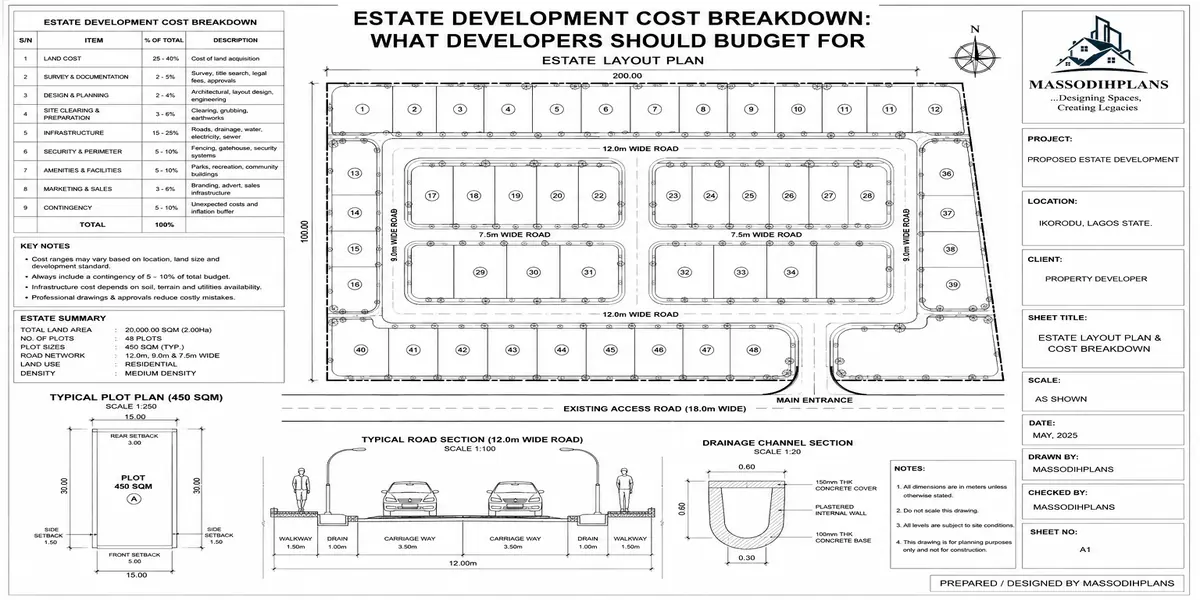
Before building, every landowner should budget for:
1. Site Survey
A current survey plan is usually required to determine the land’s dimensions, boundaries, and physical characteristics.
2. Layout Design and Planning Fees
These cover professional planning services such as plot subdivision, road design, drainage planning, open spaces, utility corridors, and regulatory compliance.
3. Government Approval Fees
Many developments require official approvals before implementation. Fees vary by location and authority.
4. Environmental and Technical Studies
Some projects require environmental assessments, drainage studies, traffic evaluations, or infrastructure assessments.
5. Infrastructure Planning
A good layout must show how roads, drainage, water supply, electricity, and public spaces will function efficiently.
6. Professional Coordination
Projects often involve planners, surveyors, architects, engineers, environmental consultants, and government agencies.
In Nigeria, costs may range from tens of thousands to millions of naira depending on project size and complexity. The same principle applies abroad, although costs are often higher due to stricter regulations and service fees.
The real question is not, “How much does a layout plan cost?” but “What must I budget before development starts?”
A well-prepared layout plan helps prevent costly mistakes, approval delays, disputes, and investment losses while providing a clear roadmap for successful development.
What Is a Layout Plan and Why Should You Even Care?
Before we talk about cost, let me make sure we are speaking the same language.
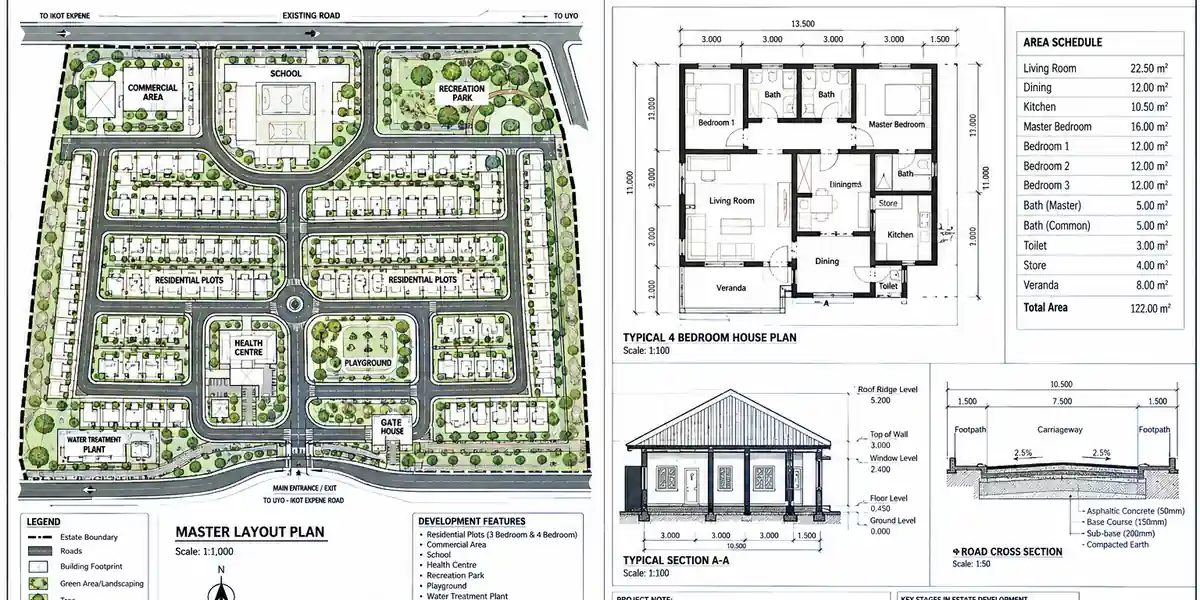
A layout plan is a professionally prepared drawing that shows how a piece of land whether one plot or an entire estate is to be organized, subdivided, and used. It shows where buildings will sit, where roads will run, where drainage channels will go, where public facilities like markets and schools will be located, and how utilities like water and electricity will be distributed.
Some people call it a site layout. Some call it a subdivision plan. In professional Nigerian town planning, it is formally called an estate layout plan or a physical development plan, depending on the scale.
One lesson I learned early in my career is that many Nigerians think a layout plan is just a drawing. It is not. And it is a legal document. It is a planning tool. And in most Nigerian states, it is a regulatory requirement before any significant development can commence.
This is not just theory. I have seen it happen: a developer in Rivers State built an estate without an approved layout. The roads were too narrow. Drainage was completely absent. When the rainy season came, the entire estate flooded. Government came in. Court injunctions followed. Properties were eventually demolished. That estate cost its developer more than three times what a proper layout would have cost from the beginning.
The Real Urban Planning Crisis Behind Layout Plans
I want you to understand something deeper before we get to the numbers.
Nigeria and many countries across the developing world is facing a massive urban planning crisis. Towns are growing faster than they are being planned. People are building on floodplains. Roads are too narrow. Markets appear in residential streets. Industries sit beside primary schools. Water supply networks cannot reach houses because nobody planned the network before the buildings came.
These are not random problems. Every single one of them is a direct consequence of settlements developing without proper layout plans.
During my undergraduate studies in Town Planning at the University of Uyo, one thing our lecturers constantly emphasized was this: an unplanned settlement is not just ugly it is dangerous. It breeds flooding, disease, crime, and poverty. And it depresses property values. It makes infrastructure impossible to provide. And once a settlement grows without a plan, correcting it costs twenty times more than planning it from the beginning would have.
I am not exaggerating. Urban renewal tearing down and rebuilding unplanned areas is one of the most expensive activities any government undertakes. Lagos has spent billions trying to redevelop Makoko. Abuja’s satellite towns face the same crisis. Port Harcourt’s unplanned waterfront communities are a public health emergency.
A layout plan is not a bureaucratic requirement. It is the difference between a livable community and a slum.
What a Professional Layout Plan Must Contain
Before you pay anyone for a layout plan, understand what you are actually buying. A proper layout plan prepared by a qualified planner should include all of the following.
1. Land Use Distribution
This shows which parts of your land are for what purpose residential, commercial, industrial, recreational, institutional. Every square metre of land should have a defined use. In my experience, landowners in Nigeria often underestimate how much land must be set aside for non-residential uses. Nigerian planning standards typically require between 15 and 30 percent of an estate layout to be dedicated to roads, open spaces, drainage, and public facilities.
2. Zoning Hierarchy
Professional layouts define zones within the plan. A residential zone may be further divided into high-density, medium-density, and low-density areas. Each zone has its own standards for plot sizes, building heights, coverage ratios, and permitted activities.
At the University of Uyo, we were taught that zoning is the backbone of development control. Without it, your estate will slowly turn into something you did not intend. A zoning hierarchy gives every part of the layout a clear identity and protects that identity through regulation.
3. Road Hierarchy and Circulation System
Roads are not just paths. They are a system. A proper layout plan shows a road hierarchy major collector roads, minor residential roads, and service lanes. Each road class has a minimum width standard.
In Nigeria, the minimum residential road width for a properly planned estate is typically 7.5 metres carriageway with setbacks. Major collector roads should be at minimum 15 to 18 metres right-of-way. From what I have seen in practice, many privately prepared layouts in Nigeria use roads that are far too narrow as little as 4 or 5 metres which means garbage trucks, ambulances, and fire engines cannot function in those estates.
The road hierarchy also determines pedestrian walkways and cycling paths where appropriate. In well-planned communities, pedestrian movement is separated from vehicle movement for safety.
4. Plot Arrangements and Setbacks
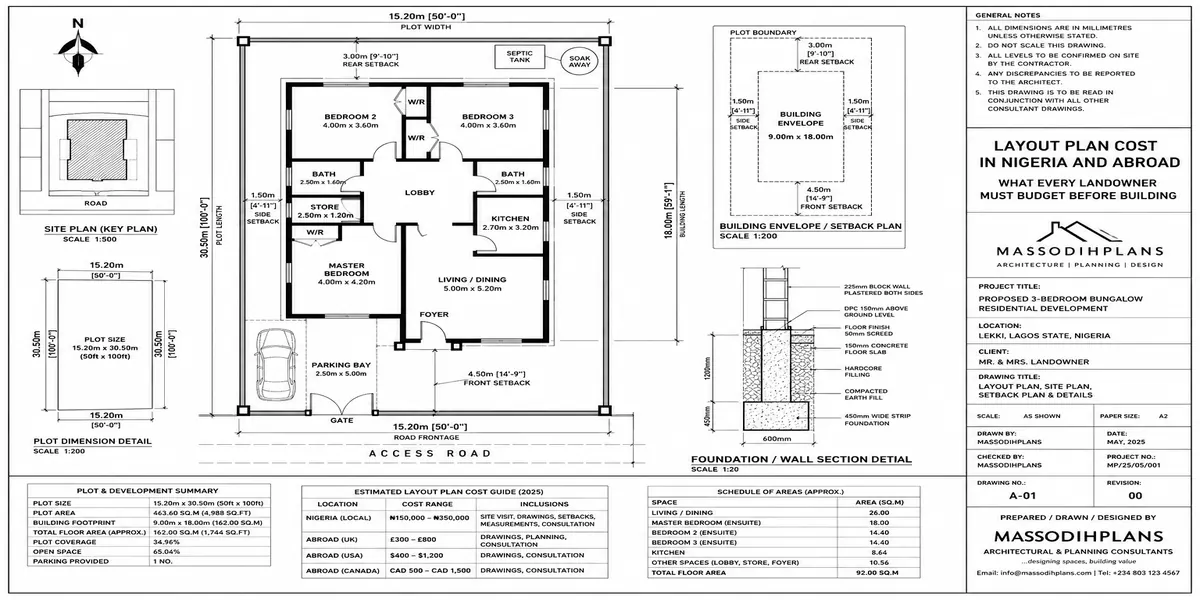
Individual plot arrangements must conform to planning standards. Each plot must have a defined setback the minimum distance between the building and the plot boundary. In most Nigerian states, the front setback minimum is 3 metres from the plot line, with rear setbacks of 3 metres and side setbacks of 1.5 metres.
During my internship, I witnessed firsthand how many layouts submitted for approval were rejected because setback provisions were inadequate. Planners at the state ministry would literally rule a red line across layouts that tried to maximize plot sizes by eliminating setback margins. You cannot negotiate setbacks. They are safety and ventilation requirements.
5. Open Space Allocation
Every good layout plan allocates a defined percentage of land to open spaces parks, playgrounds, neighbourhood gardens, and sports areas. Open spaces are not decorative. They are environmental infrastructure. And they manage surface water runoff. They provide cooling in urban heat islands. Also, they give communities places for children to play, for elderly residents to rest, and for community gatherings to happen.
In practice, one of the first things a community loses when layouts are prepared without professional input is open space. Every square metre becomes a saleable plot. And the estate slowly becomes a concrete jungle with no breathing room.
6. Drainage System Planning
This is the section that saves lives.
A professional layout plan must show a complete surface water drainage network how rainwater will flow from every plot through channels and culverts to an outfall point. Drainage design must account for the natural topography of the land, the volume of rainfall in the area, and the impermeability of the built surfaces.
I remember a project in Akwa Ibom where a layout was prepared without a proper drainage study. The estate developer assumed the naturally sloping land would take care of water flow. When the estate was built and the land was compacted, water had nowhere to go. The result was catastrophic flooding every wet season. Remediation cost the developer millions of naira and destroyed relationships with buyers.
Over the years, I have noticed that drainage is the most under-resourced element in Nigerian layout planning. It is also the one that causes the most visible and devastating consequences when it fails.
7. Infrastructure Planning
Beyond roads and drainage, a layout plan should show the planned locations and routes for water supply mains, electricity distribution lines, telecommunications infrastructure, and sewage systems where applicable. In areas without public water supply, the layout should show borehole locations and their distribution network within the estate.
Infrastructure planning requires collaboration between town planners, engineers, and utility providers. When infrastructure is planned from the beginning, the cost of provision is dramatically reduced compared to retrofitting utilities into a built estate.
8. Environmental Management
Modern layout plans must address environmental considerations protection of natural vegetation, prohibition of building on wetlands and floodplains, preservation of buffer zones around water bodies, and management of tree cover. The Environmental Impact Assessment (EIA) requirements for large estates and the Environmental Impact Statement (EIS) for smaller ones feed directly into the layout plan.
My academic training exposed me to environmental planning as an integral component of layout design not an afterthought. The best layouts I have worked on are the ones where environmental considerations shaped the layout from the first pencil stroke, not layouts where trees were drawn in at the end to make the plan look green.
9. Development Control Regulations
A layout plan is incomplete without the accompanying development control regulations a set of rules that govern how each zone and plot in the layout may be developed. These regulations specify permitted building heights, plot coverage ratios, uses allowed and prohibited, parking requirements, and aesthetic guidelines.
In Nigeria, development control regulations are enforced by state ministries of urban development, lands, and housing. A layout plan without accompanying regulations is like a rulebook with blank pages.
10. Population Projections and Planning Standards
For large-scale layouts, a planner must project the expected population of the development and plan facilities to meet that population’s needs. How many school places will be required? And how many healthcare facilities? How much market space? These projections are based on recognized planning standards ratios of facilities to population.
During studio exercises at university, we were required to prepare population projection tables and facility allocation schedules for every layout project we designed. This is real-world planning, not artistic drawing. A layout plan that does not account for population is planning for the present and ignoring the future.
Layout Plan Cost in Nigeria: The Honest Breakdown
Now let us talk about money. And I am going to be very honest with you more honest than most articles you will find on this topic.
The cost of a layout plan in Nigeria depends on several factors. There is no single universal price. Anyone who gives you a fixed number without seeing your land is either guessing or undercharging you in ways that will cost you later.
Here are the primary factors that determine cost:
Factor 1: Size of the Land
This is the most obvious determinant. A layout plan for a single residential plot is very different from a layout plan for a 50-hectare estate. Size determines the time required, the survey data required, and the complexity of the planning exercise.
As a general guide and I must emphasize this is a guide, not a quotation layout plan fees in Nigeria currently range as follows:
| Land Size | Approximate Professional Fee Range |
|---|---|
| Single plot (up to 500 sqm) | ₦50,000 – ₦150,000 |
| Small estate (1–5 hectares) | ₦250,000 – ₦800,000 |
| Medium estate (5–20 hectares) | ₦800,000 – ₦3,000,000 |
| Large estate (20–100 hectares) | ₦3,000,000 – ₦15,000,000+ |
| Master plan (100+ hectares) | ₦15,000,000 – ₦100,000,000+ |
These figures are professional fees only. They do not include government approval fees, survey costs, environmental study costs, or administrative charges.
Factor 2: Government Approval Fees
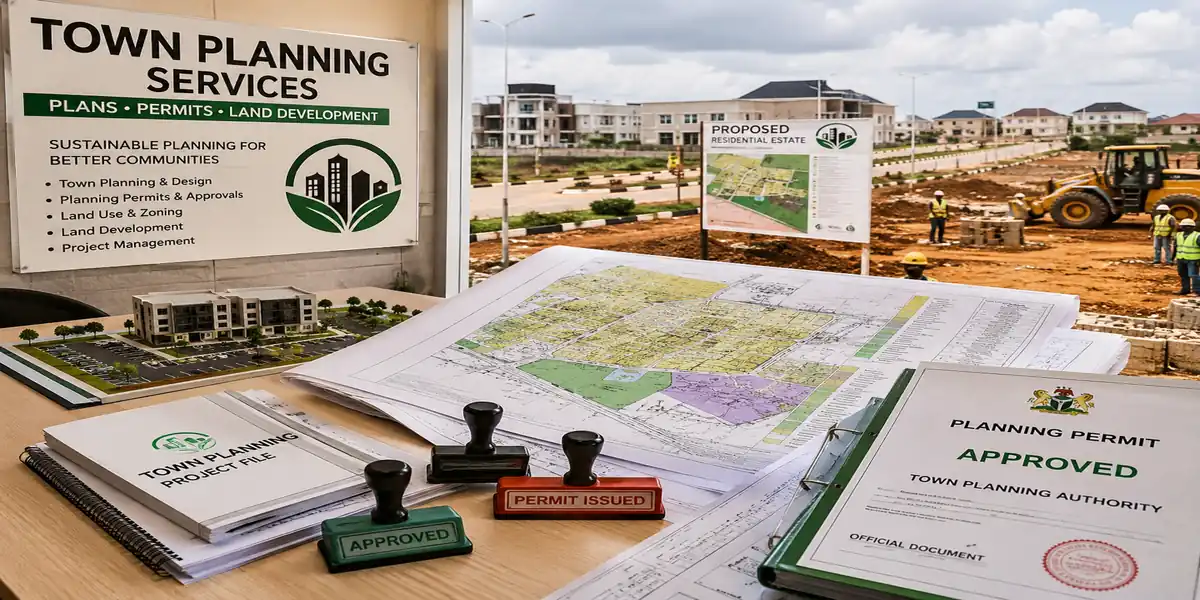
A layout plan prepared by a town planner is only the beginning. To be legally valid, it must be submitted to the appropriate government agency usually the State Urban Development Board, Town Planning Authority, or Ministry of Lands and Housing and approved.
Government approval fees vary enormously by state. Based on projects I have worked on across Nigerian states:
| State | Approximate Approval Fee Range (Small to Medium Estate) |
|---|---|
| Lagos State | ₦500,000 – ₦5,000,000+ |
| Abuja (FCT) | ₦1,000,000 – ₦10,000,000+ |
| Rivers State | ₦300,000 – ₦2,000,000 |
| Akwa Ibom State | ₦150,000 – ₦1,500,000 |
| Cross River State | ₦150,000 – ₦1,200,000 |
| Other states | ₦100,000 – ₦2,000,000 |
These are approximate ranges based on my professional experience and should not be treated as current official rates. Always verify with the relevant government agency before budgeting.
Factor 3: Survey Costs
Before a layout plan can be prepared, the land must be accurately surveyed. A survey plan defines the boundaries, dimensions, and coordinates of the land. Without a survey plan, a town planner cannot prepare a proper layout.
Survey costs in Nigeria currently range from:
Simple single plot survey: ₦80,000 – ₦250,000
Estate survey (1–20 hectares): ₦300,000 – ₦2,000,000
Large survey with GPS/GIS integration: ₦1,000,000 – ₦5,000,000+
The survey must be done by a licensed surveyor registered with the Surveyors Council of Nigeria (SURCON).
Factor 4: GIS and Digital Mapping
Modern layout planning increasingly involves Geographic Information System (GIS) data satellite imagery, topographic data, aerial photography, and digital elevation models. GIS data acquisition and processing can add significant cost, particularly for large projects, but it dramatically improves the quality and accuracy of the final plan.
From what I have seen in practice, smaller developers in Nigeria often skip GIS work to reduce costs. This is a false economy. GIS data reveals drainage patterns, land contours, existing vegetation, and utility infrastructure that cannot be seen by eye alone. A layout plan prepared without GIS data in complex terrain is a plan prepared partially blind.
Factor 5: Environmental Study
For estates above a certain threshold typically 2 hectares in most Nigerian states an Environmental Impact Assessment (EIA) or Environmental Impact Statement (EIS) is required alongside the layout plan. This study assesses the potential environmental effects of the proposed development and recommends mitigation measures.
Environmental study costs in Nigeria range from:
Environmental Impact Statement (small projects): ₦150,000 – ₦500,000
Full Environmental Impact Assessment (large projects): ₦500,000 – ₦5,000,000+
Layout Plan Cost Abroad: How Nigeria Compares
Many of my readers ask me how Nigerian layout plan costs compare to what obtains in other countries. This is a fair question, and the comparison is quite illuminating.
United Kingdom
In the UK, planning applications are regulated by local planning authorities. Professional fees for a town planner or planning consultant to prepare and submit a planning application for a residential development typically range from:
Small residential plot: £1,500 – £5,000 (approximately ₦2.5 million – ₦8.5 million)
Small housing development (5–20 units): £5,000 – £25,000 (approximately ₦8.5 million – ₦42 million)
Large development: £25,000 – £100,000+ (approximately ₦42 million – ₦170 million+)
Government planning application fees in England are currently set at £578 per dwelling for major residential applications.
United States
In the United States, subdivision planning and layout approval processes vary enormously by state and county. Professional planning consultant fees typically range from:
- Simple residential subdivision: $5,000 – $30,000
- Complex subdivision (50+ lots): $30,000 – $200,000+
Municipal review and permit fees add thousands more, varying by jurisdiction.
South Africa
South Africa has a well-developed planning regulatory framework. Township establishment (the South African equivalent of estate layout approval) professional fees typically range from:
- Small township (5–20 erven): R50,000 – R200,000
- Medium township (20–100 erven): R200,000 – R800,000
Government application fees and procedural costs add significantly to these figures.
What This Comparison Tells Us
The conclusion is clear: Nigerian layout plan costs are significantly lower in absolute terms than what obtains in comparable countries. This reflects Nigeria’s lower professional fee structures, lower government charges, and the varying capacity of local planning systems.
However, and this is critical lower absolute cost does not mean lower relative value. A proper layout plan, even at Nigerian prices, is still a significant investment for most landowners. And the consequences of skipping it are just as severe in Uyo as they are in London.
The Hidden Costs Nobody Tells You About
This is where my experience as a practitioner adds real value. Because beyond the obvious fees, there are costs that most landowners do not anticipate.
1. Cost of Revisions and Resubmissions
In my experience, very few layout plans sail through government approval without revisions. Planners at approval agencies routinely require amendments additional setbacks, road widening, drainage improvements, facility allocations. Each revision cycle costs time and, in most cases, additional professional fees.
Budget an additional 20 to 30 percent above your initial professional fee for revision costs.
2. Cost of Delays
This is the one that hurts most. Government approval processes in Nigeria are notoriously slow. A layout plan approval that should take 3 months can take 12 months or more. During that time, your construction is on hold. If you are a developer, your investors are waiting. If you are a homeowner, your family may be paying rent elsewhere.
This is not just theory. I have encountered situations where clients waited 18 months for layout approval because of administrative backlogs at the state ministry. Always budget time cost into your planning.
3. Cost of Using Unqualified Professionals
One of the most common mistakes I encounter is landowners paying draughtsmen or unregistered individuals to prepare layout plans. These individuals charge far less than registered town planners. They may produce a drawing that looks convincing. But it will fail at the approval stage, because government agencies require plans prepared and signed by registered professionals specifically, town planners registered with the Nigerian Institute of Town Planners (NITP) and registered with the Town Planners Registration Council of Nigeria (TOPREC).
I have seen this mistake repeatedly: a landowner pays ₦80,000 to an unregistered person, gets a rejected plan, then pays a registered planner ₦300,000 to redo the entire exercise. Total cost: ₦380,000 for one approved plan. If they had gone to a registered planner from the beginning, they might have paid ₦250,000 and been done.
4. Future Infrastructure Costs
A poorly planned layout imposes permanent infrastructure cost penalties. Narrow roads can never be widened without demolishing buildings. Inadequate drainage channels cannot be enlarged without destroying what was built beside them. These future costs borne by the estate, the local government, or individual homeowners are the true long-term price of a bad layout.
Based on my experience in planning and design, the cost of correcting an unplanned settlement is typically 15 to 25 times the cost of planning it correctly from the beginning. This is not a statistic from a textbook. I have seen it happen on real projects.
How to Choose the Right Professional for Your Layout Plan
If I were advising a client today, I would give them this checklist before paying any planner or architectural designer.
Before you engage anyone, verify:
NITP Membership Is the planner a registered member of the Nigerian Institute of Town Planners? Ask to see their NITP membership certificate or registration number.
TOPREC Registration Is the planner registered with the Town Planners Registration Council of Nigeria? This is the statutory body that legally authorises planners to practice. Only TOPREC-registered planners can legally sign and seal layout plans for government submission in Nigeria.
Track Record Has the planner prepared and successfully gotten approved layout plans before? Ask for examples. Ask for client references.
Fee Structure Does the planner give you a detailed breakdown of what their fee covers? Professional fees, government charges, survey costs, revision rounds these should all be clearly stated in writing.
Timeline Does the planner give you a realistic timeline for approval? Anyone who promises you approval in 4 weeks for a large estate is either uninformed or being dishonest with you.
Expert Note from Massodih: I always tell clients do not choose your planner by price alone. Choose by competence, registration, and track record. A cheap, unqualified plan costs more than an expensive, qualified one. Every single time.
Nigerian Reality Layer: What Actually Happens on Ground
I want to be real with you here, because this is not a sanitized textbook.
In many parts of Nigeria, layout plans are prepared but not enforced. People build on open spaces reserved in the layout. They construct on road setbacks. They convert drainage reserves into market stalls. Government development control officers appear occasionally, issue notices, collect unofficial fees, and disappear. The situation is improving in states with stronger governance, but it remains a widespread challenge.
This reality does not mean layout plans are useless. It means they are even more important as a reference document for legal disputes, for future infrastructure provision, for property transactions, and for holding developers and governments accountable.
A client once asked me: “If government will not enforce the layout, why do I need one?” My answer was simple: “The layout is your evidence. When your neighbour builds on the open space that was supposed to serve your community, the layout plan is what you bring to court. Without it, you have no legal basis for any objection.”
Human Lifestyle Layer: How a Layout Plan Affects How You Actually Live
People think about layout plans in abstract terms. Let me make it concrete.
With a properly planned layout:
- Your road is wide enough for a delivery truck to pass without mounting your fence
- Rainwater drains away from your property instead of pooling in your living room
- Your children have a playground within 500 metres of home
- The neighbour who wants to open a mechanic workshop in a residential zone cannot legally do so
- Emergency services can reach your home in a crisis
- Your property value appreciates because the estate retains its character and quality
Without a properly planned layout:
- You buy a plot and discover the road in front is 4 metres wide barely enough for one car to pass
- Every rainy season, your compound floods because there is no drainage plan
- A market gradually colonizes the open space that was “reserved” but never gazetted
- A petrol station opens three plots away from your bedroom
- Your property value stagnates or drops because the estate becomes chaotic
This is not a hypothetical. This observation comes from practical field experience across Nigerian urban areas.
What a Good Layout Does to Property Values
Based on projects I have worked on, there is a clear and consistent relationship between the quality of layout planning and property performance.
Estates with approved, professionally prepared layout plans consistently show:
- Faster sales and quicker absorption of plots by buyers
- Higher resale values compared to unplanned areas in the same city
- Greater ease of obtaining mortgage finance (banks require approved layout plans)
- Lower insurance premiums for properties in planned estates
- Better access to government infrastructure provision
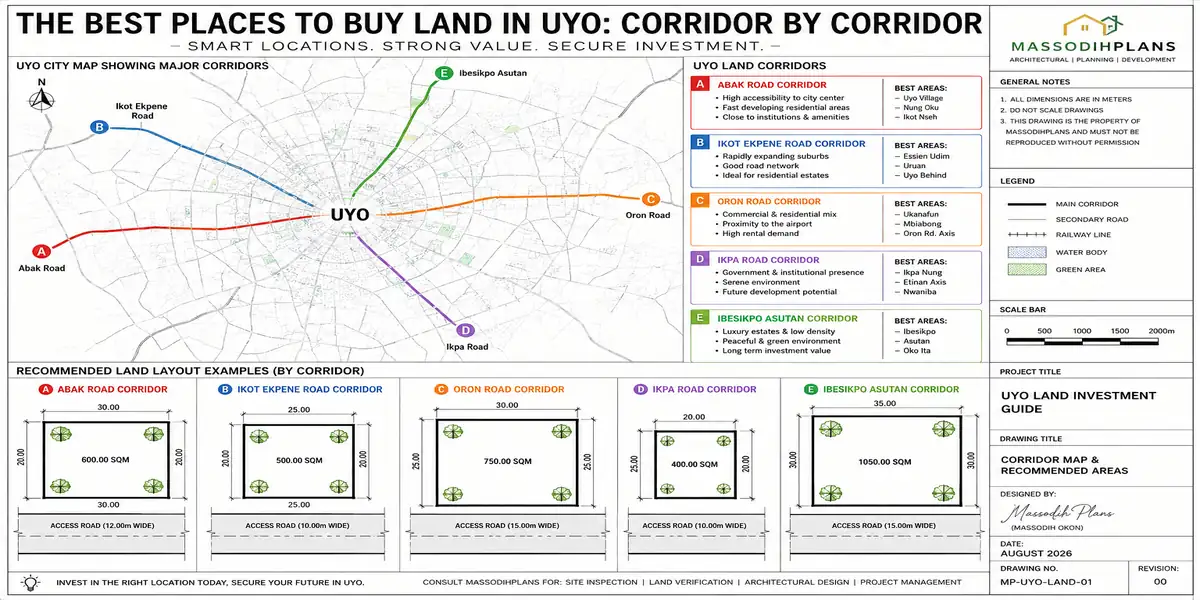
In Uyo, where I am based, the price difference between a plot in an approved estate layout and a plot of comparable size in an unplanned settlement can be as much as 200 to 400 percent. That is not a marginal difference. That is a four-times multiplier on value.
If you are investing in land whether for personal use or commercial development the layout plan is not a cost. It is a value-creation tool.
Planning Approval Process: What You Are Getting Into
Many landowners are shocked when they discover how involved the layout approval process actually is. Let me walk you through it as it exists in most Nigerian states.
Stage 1: Pre-Application Consultation
Before submitting your layout plan, you (or your planner) should consult with the relevant planning authority to understand what they require, what standards apply to your specific location, and what zoning classification your land currently holds.
During my internship, I observed that planners who skipped pre-application consultation consistently had more problems at the submission stage. A 30-minute consultation can save months of revision.
Stage 2: Survey Plan Preparation
Your licensed surveyor prepares a survey plan showing the exact boundaries and dimensions of your land. This becomes the base document on which the layout plan is drawn.
Stage 3: Layout Plan Preparation
Your registered town planner prepares the layout plan in accordance with applicable planning standards. For large developments, this is a multi-stage process involving data collection, analysis, scheme design, internal review, and final drawing production.
Stage 4: Environmental Study (Where Required)
For estates above the threshold size, your environmental consultant prepares the required EIS or EIA document. This is submitted alongside the layout plan.
Stage 5: Application Submission
The completed application layout plan, survey plan, environmental study, application form, fees is submitted to the planning authority. The authority issues an acknowledgment and assigns the file to a reviewing officer.
Stage 6: Technical Review and Site Inspection
Planning authority officers review the submission and typically conduct a site inspection. They verify that the land exists as described, that no existing structures contradict the proposed layout, and that environmental conditions are as represented.
Stage 7: Approval or Revision Request
The authority either approves the layout issuing a formal approval letter and stamped plans or requires revisions. Revision requests must be addressed and resubmitted for further review.
Stage 8: Gazettal (For Large Estates)
For large estate layouts and formal township development, the approval is published in the government gazette. This is the formal legal instrument that gives the layout its regulatory status.
Common Mistakes to Avoid
I have seen this issue firsthand so many times. Here are the mistakes that cost landowners the most:
Engaging unregistered professionals Always verify NITP and TOPREC registration
Skipping pre-application consultation Always talk to the planning authority before drawing anything
Underbudgeting for government fees Government fees often exceed professional fees. Budget realistically
Ignoring drainage Drainage failure is the single most costly planning omission
Maximizing plot yield at the expense of open space Estates without open space lose value over time
Not budgeting for revision rounds Budget an additional 25 percent for revision costs
Rushing the process Quality layout planning takes time. Rushing produces errors that get rejected
Quick Summary: What You Should Budget
Here is a realistic total budget for a layout plan in Nigeria, bringing together all cost elements:
| Cost Element | Small Estate (2 hectares) | Medium Estate (10 hectares) |
|---|---|---|
| Survey plan | ₦200,000 – ₦500,000 | ₦500,000 – ₦1,500,000 |
| Professional planning fee | ₦300,000 – ₦800,000 | ₦800,000 – ₦3,000,000 |
| Environmental study | ₦150,000 – ₦400,000 | ₦400,000 – ₦1,500,000 |
| Government approval fees | ₦200,000 – ₦1,500,000 | ₦500,000 – ₦5,000,000 |
| Revision contingency (25%) | ₦160,000 – ₦800,000 | ₦550,000 – ₦2,500,000 |
| Total Estimated Budget | ₦1,010,000 – ₦4,000,000 | ₦2,750,000 – ₦13,500,000 |
Development Phases and Smart Growth
A properly planned layout is not just about what you build today. It accounts for how the development will grow over time.
Phase 1: Core infrastructure major roads, drainage, primary utilities. This phase makes the land serviceable and creates confidence for buyers.
2nd Phase 2: Residential development plots are released in phases, ensuring infrastructure keeps pace with population growth.
3rd Phase 3: Commercial and institutional facilities markets, schools, health centres, and commercial plots are developed as the residential population reaches critical mass.
Phase 4: Expansion zones the layout should designate areas for future expansion, preserving land corridors and road alignments that will connect future phases.
This is what planning professionals call smart growth development that is incremental, infrastructure-led, and sustainable. Without a layout plan, there can be no phasing. Every decision becomes reactive and ad hoc. The result is the urban sprawl and slum formation that characterizes so much of Nigeria’s unplanned urban growth.
Climate Responsiveness in Modern Layout Planning
A topic that is gaining increasing attention among planning professionals is climate-responsive layout design designing layouts that can withstand changing rainfall patterns, rising temperatures, and increased storm intensity.
In practice, this means:
- Larger drainage reserves to accommodate increased rainfall volumes
- Preservation of natural watercourses and flood pathways
- Green buffer zones that reduce urban heat island effects
- Permeable paving in parking areas and secondary roads to increase water infiltration
- Tree planting along roads and in open spaces to provide shade and reduce surface temperatures
Both classroom learning and field experience support this conclusion: layouts designed without climate considerations are increasingly vulnerable to weather events that were once considered exceptional but are becoming routine.
FAQs: Layout Plan Cost in Nigeria and Abroad
Q: Can I build without an approved layout plan in Nigeria?
A: On a single existing plot in an already-approved estate, you generally build using your building plan approval, not a new layout plan. But if you are developing a new estate or subdivision, you must get layout plan approval before selling plots or commencing development. Building without approval exposes you to demolition orders and legal liability.
Q: How long does layout plan approval take in Nigeria?
A: In my experience, 3 to 18 months, depending on the state, the completeness of your submission, and the current capacity of the approval agency. Lagos and Abuja tend to be faster due to stronger institutional capacity, but no state guarantees quick turnaround.
Q: Is a layout plan the same as a survey plan?
A: No. A survey plan defines your land boundaries and is prepared by a licensed surveyor. A layout plan shows how the land will be used and developed, and is prepared by a registered town planner. Both are required, and one cannot replace the other.
Q: Who legally approves layout plans in Nigeria?
A: Depending on the state, approval is granted by the State Urban Development Board, Town Planning Authority, Ministry of Lands and Housing, or similar government body. In the FCT, the Federal Capital Development Authority (FCDA) handles layout approvals.
Q: Can a draughtsman prepare my layout plan?
A: A draughtsman can assist in drawing, but a layout plan submitted for government approval must be prepared and sealed by a registered town planner a professional registered with both NITP and TOPREC. Plans not bearing a registered planner’s seal are rejected at submission.
Q: How much does a layout plan cost for a single residential plot?
A: For a single plot, you are typically applying for a building plan not a full estate layout. Building plan approval costs vary by state and typically range from ₦30,000 to ₦300,000 for professional preparation plus government charges. Contact MassodihPlans for a specific quote.
Q: What happens if I buy a plot in an unapproved estate?
A: This is one of the biggest risks in Nigerian real estate. An unapproved layout means the developer did not get government planning approval. Your plot may face demolition, future boundary disputes, difficulty obtaining mortgage finance, and challenges with services connections. Always ask for the layout approval letter before paying for any plot.
Q: Can I do a layout plan myself to save money?
A: You cannot legally prepare a layout plan for government submission yourself unless you are a registered town planner. And even if you have planning knowledge, the professional seal of a TOPREC-registered planner is what makes the document legally acceptable.
Conclusion: The Layout Plan Is Not Your Biggest Cost, Ignoring It Is
I want to leave you with this.
In over 15 years of professional work in town planning and architectural design across multiple Nigerian states, I have never met a landowner who regretted investing in a proper layout plan. I have met many who deeply regretted not doing so.
The layout plan is not just a regulatory requirement. It is the document that makes your land legally buildable, commercially valuable, and physically livable. It protects your investment from flooding, from encroachment, from land use conflicts, and from the chaos that engulfs unplanned Nigerian neighbourhoods.
If you are buying land, developing an estate, or planning a community get the layout done properly, by a registered professional, with proper government approval. Budget for it from day one. Include it in your project cost, not as an afterthought.
If you need a registered town planner to prepare your layout plan, prepare your building plan, or guide you through the approval process anywhere in Nigeria MassodihPlans is here to help. I work with clients across Akwa Ibom, Rivers, Cross River, Lagos, Abuja, and other Nigerian states.
You can also explore our Plans Library for residential and commercial building plans that have been prepared to Nigerian planning standards, and visit Plan School if you want to understand the planning process better before engaging a professional.
The city you want to live in starts with the layout plan someone decides to prepare today. Let that someone be you. And let it be done right.
Related Articles
- Small Residential Estate Layout Design in Nigeria: Smart Master Plan Ideas for Limited Land
- Cost of Building a 4 Bedroom Duplex in Lagos (Complete Guide)
- Affordable Bungalow Plan for 40×80 Plot in Port Harcourt
- Cost of Blocks, Cement, Iron Rod and Roofing Sheets in Uyo: Real Prices From the Field Now
- Current Cost of Building a House in Port Harcourt (Professional Analysis)
- Smart Ways to Reduce Building Costs in Nigeria Without Reducing Quality
- Smart Duplex Design for Narrow Plots in Lekki, Nigeria: Complete Practical Guide
- Full Cost Breakdown for Building a Duplex on a Small Plot in Kano Nigeria
- How a State Master Plan Works: A Complete Guide to Modern Infrastructure Development
- Building Approval in Nigeria: Costs, Requirements, Process and How to Get Your House Plan Approved Fast
- MassodihPlans Homepage
- Survey Plan Cost in Nigeria: Fees, Process and Hidden Expenses
- Environmental Management Plan Cost Guide for Developers in Nigeria and Beyond
- Site Development Plan Cost: What Every Property Owner Must Know Before Building
- Why District Planning Is Important for Urban Development
- Commercial Development Planning Costs: What Every Investor Must Know Before Spending a Kobo
- Housing Estate Layout Plan: Why Every Estate Needs One in Nigeria and Beyond
- Master Plan Preparation Process Explained Step by Step
- Cost of Master Plan Preparation for Communities and Institutions
- How Natural Water Flow Can Affect Your Building Site and House Plan Today
- How Drainage Should Influence Your House Site Planning in Nigeria Today
- How Topography Influences Flooding Around Nigerian Homes and Cities Today
- How to Understand Land Use Before Buying Property in Nigeria Safely
- How Land Use Affects the Type of Building You Can Develop in Nigeria Today
- 10 Things to Check Before Building a House on Any Plot in Nigeria Today
Reference Nigerian Institute of Town Planners (NITP)
About Author
Massodih Okon is a Nigerian built-environment professional with academic and professional experience in urban and regional planning, geography, architectural design, Landscape Design, GIS and land development.
He holds a Master’s degree in Urban and Regional Planning from the University of Uyo and a first degree in Geography and Regional Planning.
Through MassodihPlans, he publishes practical guides on Nigerian house plans, building design, physical planning, site planning, development approval and residential construction. Read the full author profile →