Affordable Bungalow Plan for 40×80 Plot in Port Harcourt
How to Build a Smart Affordable Bungalow on a 40×80 Plot in Port Harcourt
Yes, a well-designed modern 3-bedroom bungalow can fit comfortably on a 40×80 plot in Port Harcourt, with space for two-car parking, proper ventilation, drainage, a borehole, generator area, and usable outdoor circulation. But getting the rooms onto the land is only the beginning. The real challenge is creating a house plan and building design that uses the available space efficiently without making the home feel cramped.
A good floor plan should do more than show where the bedrooms, kitchen and living room will be located. It should show how people will move through the house, where natural light and ventilation will enter, how vehicles will access the compound, and how rainwater will be managed. On a 40×80 plot, these decisions must be made together because a few poorly positioned rooms can affect the entire building design.
Port Harcourt also demands extra attention. Heavy rainfall, flooding risks in some locations, high humidity, inadequate ventilation and rising construction costs can expose weaknesses that may not be obvious when looking at a simple floor plan. A house may look attractive on paper but become uncomfortable or expensive to maintain when the building plan does not respond to the actual site conditions.
That is why this guide goes beyond showing you a 3-bedroom layout. You will discover the practical plot arrangement, setbacks, room dimensions, ventilation strategy, parking configuration, drainage approach, roofing considerations, service spaces, construction-cost factors and mistakes to avoid.
By the end, you will understand what makes a 40×80 bungalow truly practical not merely possible and how to evaluate a house plan before construction begins.
Understanding What a 40×80 Plot Actually Gives You in Port Harcourt
A 40×80 plot is 40 feet wide by 80 feet deep. In metric measurement, that is approximately 12.2 metres wide by 24.4 metres deep, giving a total site area of approximately 297 square metres. Some people see that number and immediately worry it is too small. It is not.
To put it in perspective, a well designed 3 bedroom bungalow in Nigeria typically has a built floor area of 130 to 160 square metres. On a 40×80 plot, even after you apply setbacks and allow for parking, drainage, and utility areas, you can fit a 150 to 180 square metre bungalow with room left for compound function. The constraint is not area. The constraint is width.
The 40-foot width is the design challenge on this plot. After applying side setbacks of 4 to 5 feet on each side, the available building width drops to approximately 30 feet. That 30-foot dimension shapes every decision about room arrangement, corridor positioning, and parking strategy. Any architect who does not acknowledge this width constraint early in the design process will produce a plan that either violates setbacks or forces you into an uncomfortable layout.
In many parts of Port Harcourt, including areas in Rumuola, Rumuigbo, Woji, Rumuokoro, and other medium density residential zones, a 40×80 plot is very common. The building regulations in Rivers State specify setback requirements that affect how much of your plot the building can occupy. Before you begin any design, verify the specific setback rules with the Rivers State Ministry of Physical Planning and Urban Development or the relevant local authority, because requirements vary by location and zone classification.
Recommended Setbacks for a 40×80 Plot in Port Harcourt
Setbacks are the minimum distances you must maintain between your building walls and the plot boundaries. Many Nigerian homebuilders treat setbacks as obstacles. They are actually one of the most useful tools in small plot design because they force the discipline that creates a properly functioning compound.
For a 40×80 plot in Port Harcourt, the practical setback arrangement that balances regulation, ventilation, drainage, and compound function is as follows.
Front Setback
Keep a front setback of 15 to 18 feet from the front fence to the building face. This creates room for the gate to swing or slide without obstructing the parking area, gives drainage a proper slope away from the road, and provides enough compound depth for two cars to park facing the house without blocking each other.
Some homebuilders push the building too close to the front fence to maximize interior space. The result is a dark living room that gets no morning ventilation, a compound too shallow for parking, and no drainage buffer between the road and the building. The 15 to 18 foot front setback is not wasteful. It is what makes the compound function as a compound.
Rear Setback
A rear setback of 6 to 8 feet is adequate on this plot. This space handles washing area activities, external maintenance access to the back wall, downpipe discharge onto a splash pad, and future utility connections. It also allows air movement around the back of the building, which matters enormously for rear bedroom ventilation.
Side Setbacks
Maintain 4 to 5 feet on each side. This is where many Port Harcourt homebuilders make their worst mistake. They push the building to the boundary on one or both sides to gain interior width, and the result is a building that bakes in its own heat because no air can reach the side windows. Four feet of clear space on each side is the minimum that allows a casement window to open and draw cross air. Five feet is better.
Many Nigerian homes become unbearably hot not because they have bad air conditioning but because the building was pushed to the fence and the windows have nowhere to breathe. Natural ventilation, which I will cover in detail shortly, requires clear space around the building. The setbacks create that space.
The Site Plan: Sort Everything Out Before You Draw a Single Room
Before you place one room on paper, draw a rough site plan that shows your entire 40×80 plot and marks where every element will sit. This step takes one afternoon and saves you from months of expensive regret.
A practical site plan for a 40×80 plot in Port Harcourt should account for all of the following:
- The building footprint positioned with all setbacks observed.
- The gate position on the front fence and the driveway path from the gate to the parking area.
- Parking positions for two vehicles with enough forward clearance to reverse out without a multi-point turn.
- The borehole position, which should maintain a minimum 15 metre separation from the septic tank and soakaway.
- The septic tank and soakaway position, located where a maintenance evacuation tanker can access them.
- The generator enclosure, positioned away from bedroom windows and the borehole, ideally in a rear corner of the compound.
- Surface drainage channels on the perimeter of the building, running from the building face to the front compound drain.
- A service area behind or beside the building for washing, storage, and external utility activities.
- The overhead tank stand position, which should be close to the service connection point and clear of the building’s structural footprint.
On a 40-foot plot, poor planning causes generator noise, septic issues, and wasted space that proper site sketches prevent
If you want to understand how professional planners think through this kind of coordination on constrained Nigerian plots, the Plan School section of MassodihPlans goes through these decisions step by step with practical Nigerian examples.
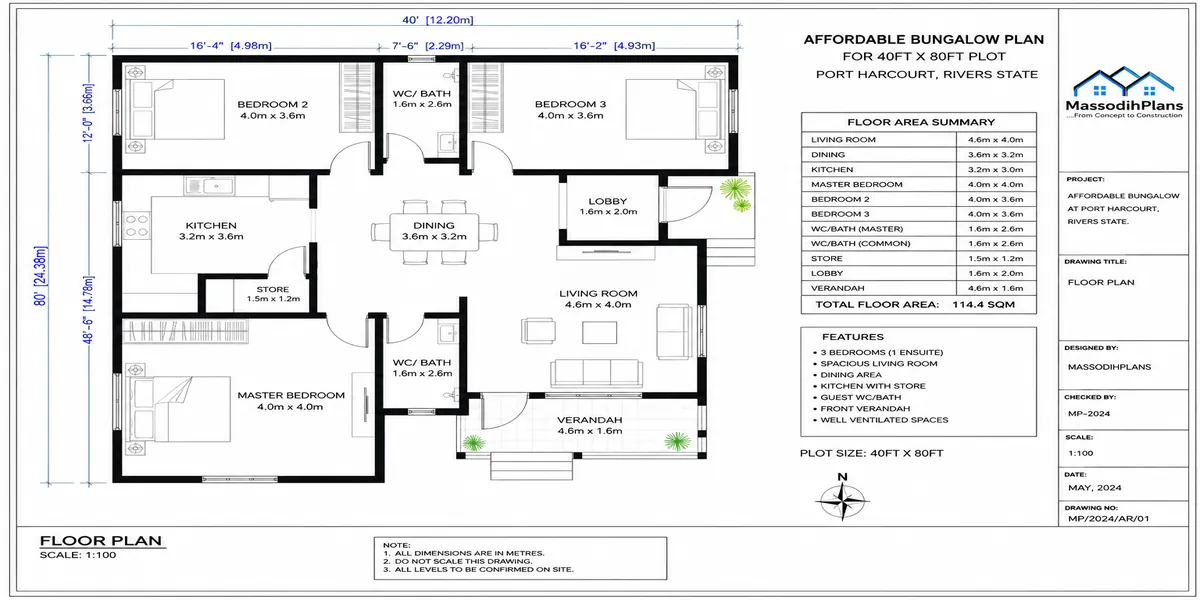
Recommended Floor Layout Arrangement for a 40×80 Plot Bungalow
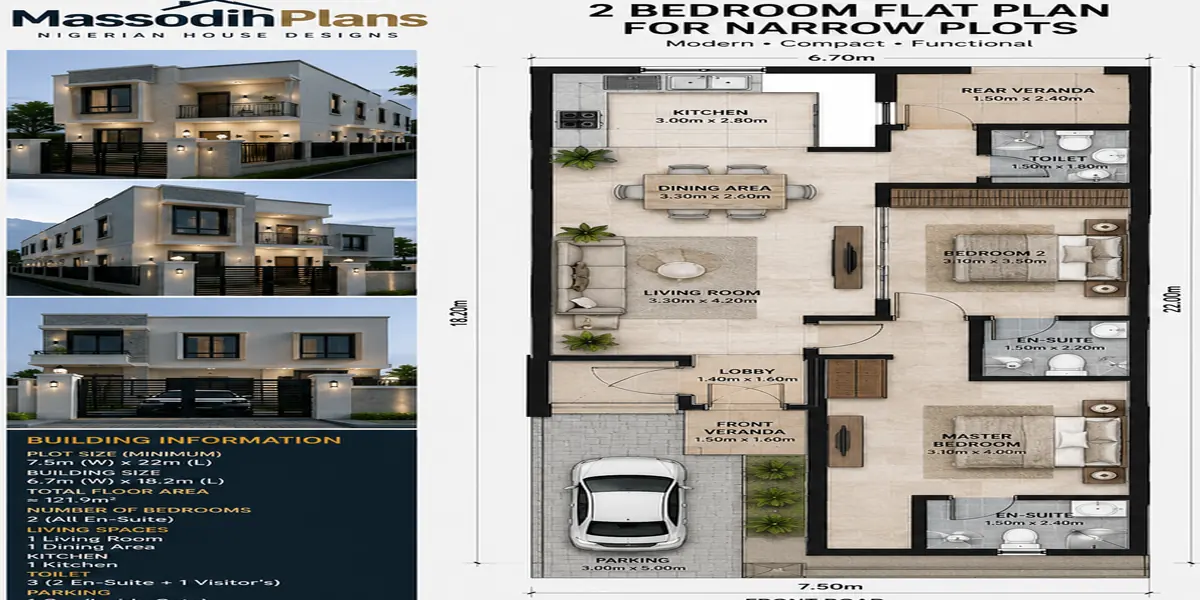
The layout of a bungalow on a 40×80 plot must be organized from front to rear in a logical sequence that manages privacy, separates noise from sleep, keeps kitchen service away from formal living, and creates a natural movement path through the house without awkward corridors that waste space.
Front Section: Public Zone
The front section of the bungalow should contain the porch, the main entrance foyer, the living room, and a visitors toilet. This entire front section faces the street and handles guest arrival, daily social interaction, and family relaxation.
The porch should be at least 5 feet deep so it functions as a genuine transition space between the outdoor compound and the interior. A shallow 2-foot canopy over the door is not a porch. It is decoration. A proper 5-foot porch gives you a place to remove shoes, wait for the door to open, shelter briefly from rain, and sit outside in the evening.
The living room should connect directly to the foyer without requiring guests to turn a corner. The visitors toilet should be accessible from the living or foyer area without passing through any private section of the house.
Middle Section: Service Zone
The middle section should contain the dining area, the kitchen, and the store. Positioning the dining and kitchen in the centre of the plan solves several problems at once. Food moves from the kitchen to the dining table without crossing the living room. The kitchen rear service door opens to the back compound for deliveries, gas cylinder changes, and waste removal. The store sits adjacent to the kitchen where it functions.
The dining area should open visually to the living room so that the two spaces feel like one generous connected zone rather than two separate tight rooms. This visual connection makes a modest floor area feel larger than it is.
Rear Section: Private Zone
The rear section should contain the master bedroom with its ensuite bathroom, two secondary bedrooms, and a shared bathroom for the secondary bedrooms. Positioning all bedrooms at the rear means guests in the living room do not look down a corridor into the sleeping area. The noise of a late evening gathering does not travel directly into the rooms where children or elderly family members are sleeping.
The master bedroom should always be at the back of the rear section, furthest from the front gate. This gives it the most privacy, the least road noise, and typically the best access to rear compound air for ventilation.
Room Dimensions That Actually Work in Real Life
Many Nigerian house plans look functional on paper and feel cramped in real life because the room dimensions were chosen to fit the drawing rather than to fit the furniture and the people. I am going to give you the dimensions that work when furniture is inside and human beings are moving around it.
Living Room: 14ft x 16ft
This accommodates an L-shaped sofa arrangement or a 3-seater and 2-seater combination, a television wall unit, a coffee table, and a 1-metre circulation path behind the seating. Anything shorter than 14 feet in either direction makes the living room feel like a lobby. At 14 by 16 feet you have a functional, comfortable living room that does not dominate the plan.
Dining Area: 10ft x 10ft
A 10 by 10 foot dining area fits a 6-seater dining table with enough clearance on three sides to pull chairs out and walk behind seated guests. This size is tight but workable. If you can push it to 10 by 12 feet you will notice the difference at every family gathering.
Kitchen: 10ft x 12ft
A kitchen of 10 by 12 feet accommodates a cooker in its own alcove, a refrigerator position, a minimum of 4 feet of counter space on at least two walls, storage above and below the counter, and enough floor area for two people to work simultaneously. This is the minimum practical kitchen for a Nigerian family home. Smaller than this and you are creating daily frustration.
The kitchen must have at least one window for ventilation, preferably opening toward the rear compound. Port Harcourt humidity combined with cooking heat makes a poorly ventilated kitchen genuinely difficult to work in.
Kitchen Store: 5ft x 7ft
The kitchen store is one of the first spaces cut when budgets are squeezed and one of the spaces most missed after the house is occupied. Nigerian households buy food in bulk quantities. Cooking gas is stored. Cleaning equipment needs a home. Extra appliances need storage. A 5 by 7 foot store adjacent to the kitchen solves all of this.
Master Bedroom: 13ft x 14ft
A 13 by 14 foot master bedroom accommodates a king-size bed with two bedside tables, a built-in wardrobe of at least 6 feet width, a dressing area, and clear floor space on the non-wall sides of the bed. The ensuite bathroom should be a minimum of 6ft x 8ft to hold a WC, wash hand basin, and shower with comfortable movement between them.
The master bedroom should have windows on at least two walls for cross ventilation. In Port Harcourt, a bedroom with only one window is a problem. The difference between a room with cross ventilation and a room without it is the difference between sleeping without a generator and lying awake with a fan that is just moving hot air around.
Secondary Bedrooms: 11ft x 12ft
At 11 by 12 feet, a secondary bedroom accommodates a double bed or two single beds, a wardrobe, and a small desk or study area. This is the practical minimum for a room that will be occupied by adults or teenagers. For a dedicated children’s room, 12 by 13 feet allows bunk beds and toy storage without making the room feel like a storeroom.
Shared Bathroom: 5ft x 8ft
A 5 by 8 foot bathroom for shared use between two secondary bedrooms holds a WC, wash hand basin, and shower with adequate floor clearance. Keep the bathroom door swinging into the corridor rather than into the bathroom so the door does not collide with the WC when opened.
Visitors Toilet: 4ft x 6ft
A standalone visitors toilet needs only enough space for a WC and wash hand basin. Four by six feet is adequate and a visitors toilet of this size is genuinely one of the best investments in a Nigerian home because it keeps guests out of private family bathroom areas entirely.
Ventilation Strategy for Port Harcourt Weather: The Design Decision That Determines Daily Comfort
Port Harcourt is one of the most humid cities in Nigeria. The combination of coastal proximity, high rainfall, and dense urban development means that poorly ventilated buildings in Port Harcourt are not just uncomfortable. They are unhealthy. Mould grows. Ceilings show moisture stains within a year. Respiratory problems increase. Inverter and air conditioning loads become unsustainable.
Natural ventilation, designed correctly from the beginning, addresses all of this without requiring electricity.
Cross Ventilation in Every Bedroom
Every bedroom must have windows on at least two walls, preferably opposite walls. A window on one wall and a louvre vent on an adjacent wall is the minimum. Without cross ventilation, a bedroom in Port Harcourt traps heat and moisture and does not release them regardless of how many ceiling fans you install.
Position windows high enough on the wall that they can be left open overnight for security reasons without creating an obvious entry point. A high-level casement window of 18 inches height positioned 6 feet above floor level provides ventilation while maintaining reasonable security.
Ceiling Height: 10 to 11 Feet
This is not a luxury specification. It is a climate response. A ceiling height of 10 to 11 feet creates a larger air volume in the room that takes longer to heat. It also puts the occupied zone further from the ceiling, which is the hottest surface in a poorly ventilated building under a sun-heated roof. The additional cost of building 6 to 12 extra inches of wall height across the whole building is modest. The comfort improvement is permanent.
Roof Space Ventilation
The gap between your ceiling and the underside of your roofing sheets is where the greatest heat accumulates in a Nigerian home. On a sunny afternoon in Port Harcourt, an unventilated roof space can reach 65 to 70 degrees Celsius. That heat radiates through the ceiling into the rooms below and makes air conditioning units work continuously just to maintain liveable temperature.
Ridge vents along the apex of the roof allow hot air that rises into the roof space to escape. Soffit vents at the eave level allow cooler air to enter and replace it. This ridge-to-soffit ventilation circuit is the single most effective heat management strategy for a Nigerian bungalow and it costs almost nothing compared to the alternatives.
For a full technical breakdown of roofing sheet performance and heat management in Nigerian weather conditions, the guide on best roofing sheets for Nigerian weather on this site covers everything from Aluzinc gauge specifications to underlay insulation options.
Avoid Furniture Against Windows
This sounds too simple to mention but it destroys the ventilation design in a significant number of Nigerian homes. A wardrobe installed against the ventilation window of a bedroom blocks airflow as effectively as bricking up the window. Plan furniture placement during the design stage and position windows where they will not be obstructed by wardrobes, kitchen cabinets, or built-in storage.
Internal Light Court Option for Deep Plans
If the bungalow plan is arranged such that the kitchen or central corridor has no window access to outside air because the building width consumes the available space, a small internal light court of 6 by 6 feet cut into the middle of the plan creates a ventilation shaft that draws air through central rooms. This is the same principle used in traditional Yoruba and Igbo compound architecture, and it works just as well in a modern bungalow.
Orientation and Sun Exposure on a 40×80 Plot in Port Harcourt
The direction your building faces affects how much heat it absorbs and how much natural light it receives at different times of day. In Port Harcourt, the most problematic sun exposure comes from the western direction in the afternoon. Western-facing walls and windows absorb direct afternoon sun that heats the building fabric and drives up indoor temperature from approximately 2 pm to 6 pm.
Where your plot orientation allows, position the long axis of the bungalow facing north-south rather than east-west. This means the larger wall surfaces face north and south, receiving less direct sun than the east and west faces. When plot orientation does not allow this, use deep overhangs on the west-facing side to shade the wall face and windows.
Avoid placing the master bedroom on the western side of the building if the plot orientation makes this possible. A west-facing master bedroom in Port Harcourt collects afternoon heat and releases it slowly through the night, which is exactly the wrong direction for sleeping comfort.
Roofing Style Recommendation: Why the Hip Roof Wins for Port Harcourt
Port Harcourt receives some of the highest annual rainfall volumes of any major Nigerian city. The city’s rainfall season is long and intense, and the roof of any building there must handle enormous quantities of water reliably and without leakage for decades.
The Hip Roof
A hip roof slopes on all four sides down toward the eaves, with no vertical gable end walls. For Port Harcourt conditions, the hip roof outperforms every other option for the following practical reasons.
Rainwater control on a hip roof is superior because every side of the building has an overhang. There are no vertical gable ends where rain can drive against the wall surface and eventually penetrate through cracks in the render. The hip geometry directs water to the gutters on all four sides rather than concentrating it at two points.
Wind resistance is better on a hip roof because the aerodynamic form produces lower uplift forces in high winds. Gable roofs can suffer gable-end lift in strong seasonal winds.
The consistent overhang around all four sides shades the wall face below, reducing solar heat gain into the masonry. This directly reduces indoor temperature.
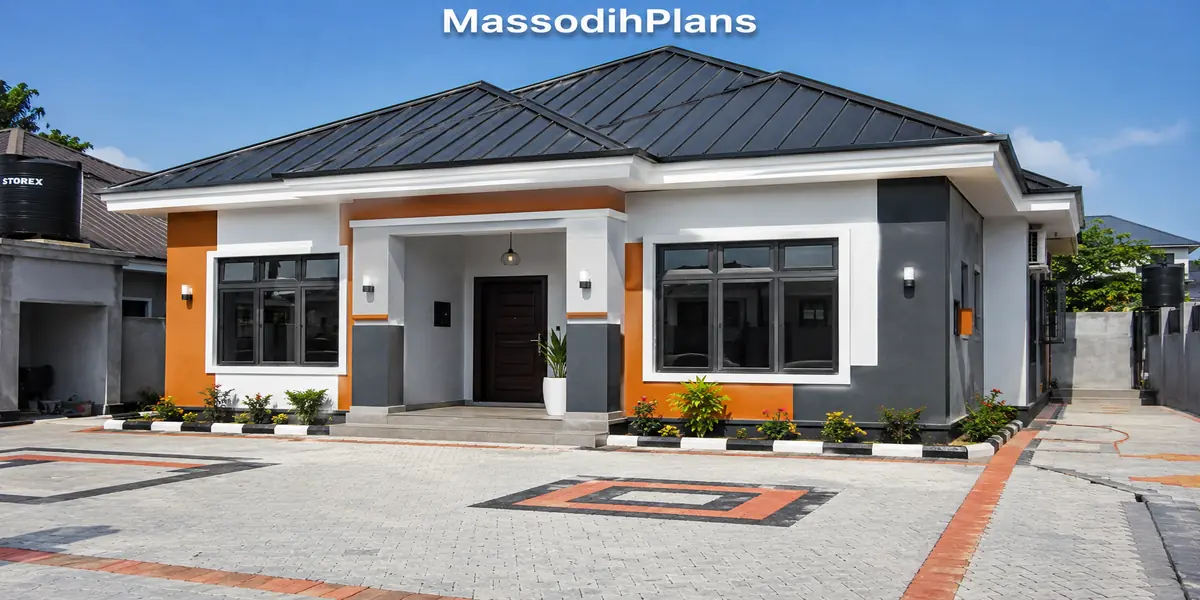
Visually, a hip roof gives a Port Harcourt bungalow a compact, settled, premium appearance from the street that works well with both traditional and contemporary exterior finishes.
The limitation is cost. A hip roof uses approximately 10 to 15 percent more roofing material than a gable roof of equivalent footprint because the geometric complexity increases sheet area and installation labour time.
Roofing Sheet Selection
For an affordable build in Port Harcourt, quality long-span Aluzinc roofing sheets in 24-gauge minimum are the practical choice. The 24-gauge specification matters because thinner sheets (26 gauge) dent more easily during installation and begin to lose material integrity sooner under heavy rainfall impact.
Stone-coated steel roofing tiles are quieter during rain, visually premium, and significantly more durable. They cost considerably more than Aluzinc and are appropriate for mid-range to upper-end builds. If budget is the primary constraint, a properly installed 24-gauge Aluzinc roof with a quality underlay insulation layer below the sheets is an excellent performing and affordable solution.
Never allow the roofing contractor to reduce sheet gauge to save cost without your explicit knowledge and agreement. The difference in material cost between 24-gauge and 26-gauge sheets across a full bungalow roof is modest. The difference in performance over 10 years is significant.
For a complete comparison of roofing materials available in Nigeria with current prices and performance data, read the best roofing sheets guide before finalizing your roofing specification.
Roof Overhangs
Overhangs of 600mm to 900mm around the full perimeter of the building serve three functions simultaneously. They shade the wall surface below from direct sun. They prevent the top of the external wall from being wetted repeatedly by rain, which reduces long-term moisture damage to the render. And they shade the windows from harsh overhead midday sun while still allowing lower-angle morning and evening light through.
Do not allow the roofing contractor to reduce overhang depth to save on sheet material. The thermal and moisture protection value of a proper overhang is worth many times the saving in sheet area.
Parking Strategy on a 40×80 Plot: Plan It First, Not Last
On a 40-foot wide plot, parking arrangement is not something you can leave to chance or to the contractor. It must be resolved on the site plan before any dimensions are fixed, because the gate width, driveway angle, and front setback depth all affect whether the parking actually works or just looks like it works on paper.
Two-Car Arrangement
The standard car parking bay is 8 to 9 feet wide and 16 to 18 feet long. Two cars parked side by side require 17 to 18 feet of width minimum. After accounting for the perimeter fence thickness and a comfortable clearance on each side, this is achievable on a 40-foot frontage.
The option of tandem parking (one car directly behind the other) also works on this plot. The advantage of tandem parking is that it leaves the full compound width clear. The disadvantage is that the car at the back cannot exit without the front car moving first. For a single-car household or a household where one car belongs to a spouse who leaves first in the morning, tandem parking is perfectly practical.
Gate Width and Type
A gate opening of 10 to 12 feet is adequate for a single-car driveway. For two-car side-by-side parking, a 12 to 14 foot gate opening allows easier entry and exit.
Sliding gates are the most practical gate type for a 40-foot frontage because they do not swing into the compound and restrict parking space. A sliding gate requires a proper concrete foundation track and quality steel fabrication. A badly fabricated sliding gate is worse than a swing gate because it derails frequently and becomes a permanent security concern.
Drainage Strategy for Port Harcourt: This Is Not Optional
Flooding is the single most destructive environmental force acting on residential buildings in Port Harcourt. Entire neighborhoods in areas like Rumuola, Elimgbu, and Rumuigbo flood regularly during peak rainfall. Even buildings on elevated ground suffer from poor compound drainage that allows water to pool against the foundation for days after a storm.
This is not about fear. It is about designing a building that will still be standing in good condition in 30 years.
Raise the Finished Floor Level
The finished floor level inside the building should be a minimum of 18 inches (450mm) above the highest external adjacent ground level at the front of the plot. In areas of Port Harcourt that have documented flooding history, I recommend 600mm to 900mm of raised floor level. This appears significant when you see the steps from the compound into the house, but it is the difference between staying dry and mopping floodwater off your ceramic tiles annually.
Raising the finished floor level adds to the filling and hardcore cost during construction. It is still one of the most cost-effective investments in any Port Harcourt build because it protects the entire building indefinitely.
Surface Drainage Channels
Concrete-lined drainage channels on each side of the building and along the front compound collect roof runoff from the downpipes and surface water from the compound and direct them to the street drain. On a 40×80 plot in Port Harcourt, these channels should be a minimum of 8 inches wide by 10 inches deep.
All gutters on the roof must connect to downpipes and the downpipes must discharge onto concrete splash pads that lead into the surface channels. A downpipe that discharges directly onto bare soil beside the foundation will erode the soil away from the foundation over years of heavy rainfall. A splash pad to a channel costs almost nothing and prevents that erosion permanently.
Compound Surface Gradient
The entire compound surface must slope away from the building in every direction at a minimum gradient of 1 in 50. This means for every 50 feet you move away from the building, the ground drops 1 foot. This gradient is subtle enough that it is invisible to the eye but sufficient to direct water away from the foundation after rainfall.
Many Nigerian contractors level the compound perfectly flat because it looks neat during construction. A perfectly flat compound in Port Harcourt becomes a shallow lake during rain. Insist on proper grading.
Septic Tank and Soakaway
Position the septic tank in the rear compound where a maintenance evacuation vehicle can access it without entering through the main gate. The soakaway pit should be positioned downhill of the septic tank and as far from the borehole as the plot allows. On a 40×80 plot, achieving the full 15-metre separation between borehole and soakaway requires deliberate site planning.
In densely developed areas of Port Harcourt where neighboring buildings are close and soil saturation from multiple nearby soakaway pits reduces soil permeability, consider a more compact engineered septic system rather than a conventional soakaway pit. Discuss this with your structural engineer during the foundation design stage.
Foundation and Structural Considerations for Port Harcourt Soil
Port Harcourt sits on sedimentary coastal soil that varies significantly across the city. Some areas have firm laterite-topped subsoil within a meter of surface. Other areas have soft waterlogged clay at shallow depth that requires either deep foundation design or soil improvement.
Before any foundation design is produced, commission a soil investigation. This is not a suggestion. It is the most important technical step in building on any Port Harcourt plot. A soil investigation involves boring or hand-digging test holes to a depth below the proposed foundation level, collecting soil samples, and testing them for bearing capacity and moisture content. The cost in Port Harcourt is approximately 80,000 to 200,000 naira depending on the number of test points and the depth required.
If the soil investigation reveals poor bearing capacity, the foundation design must respond. Options include strip foundation with increased depth, pad and beam foundation, or raft foundation. Your structural engineer decides which is appropriate based on the investigation results and the building load.
Building on Port Harcourt soil without a soil investigation and then discovering during construction that the subsoil is unexpected is one of the most expensive mistakes a Nigerian homebuilder can make. Foundation remediation after construction has started costs many times the price of a soil investigation done correctly at the beginning.
Wall and Finish Material Recommendations for Port Harcourt Climate
External Walls
Sandcrete block walling with sand and cement render is the standard and practical external wall construction for Port Harcourt residential buildings. Use 9-inch (225mm) blocks for external walls where the structural design requires it, and 6-inch (150mm) blocks for internal partition walls.
The external render should be a two-coat system: a base coat of 15mm applied to the block surface, followed by a 5mm finish coat. Paint the external walls with a textured masonry paint product such as Sandtex, Roughcast, or equivalent. These textured exterior paints have significantly higher solid content than standard emulsion and last 5 to 8 years between repaints under Port Harcourt conditions compared to 2 to 3 years for standard emulsion.
Floor Finishes
60cm by 60cm porcelain tiles are the right choice for all internal floor areas in a Port Harcourt bungalow. They are hard, non-porous, easy to clean, and resistant to moisture. The 60cm format reduces the number of grout joints, which is important in a high-humidity environment where grout joints accumulate mould if not regularly cleaned.
For outdoor areas including the front porch, rear service area, and driveway approach, use non-slip ceramic or porcelain tiles specifically rated for external use, or interlocking concrete paving blocks. Avoid smooth polished tiles in any outdoor area. They become dangerously slippery when wet and Port Harcourt is wet regularly.
Ceiling
PVC ceiling boards are the most practical ceiling specification for a Port Harcourt bungalow. They are moisture-resistant, which matters in a coastal city with persistent humidity. And they do not absorb condensation from the roof space the way POP (Plaster of Paris) ceilings can in humid conditions. They are also significantly cheaper than POP and easier to repair if damaged.
If mid-range finish is the target and budget allows, POP ceilings give a more premium appearance and can accommodate more elaborate lighting arrangements. If budget is tight, a well-installed PVC ceiling looks clean and modern and performs better in Port Harcourt humidity than POP.
Windows
Aluminium framed casement windows with a minimum extrusion thickness of 1.2mm are appropriate for Port Harcourt residential construction. Casement windows open fully to catch air and are significantly more effective for natural ventilation than louvre windows, which only allow partial airflow.
Ensure every window frame has a proper water bar at the sill to prevent capillary water entry under the frame during heavy rain. The gap between the window frame and the block opening should be filled with cement mortar and sealed with flexible silicone sealant on the external face. Port Harcourt rainfall is intense enough to drive water through any improperly sealed window joint.
Install powder-coated aluminium mosquito screens in separate frames behind each casement window. This allows the window to open fully for ventilation without admitting mosquitoes.
How to Compare a Bungalow to a Duplex Decision on This Plot
Some homebuilders ask whether a 40×80 plot in Port Harcourt can support a duplex instead of a bungalow. The honest answer is: it depends on why you are building and what you want the building to do.
A bungalow on this plot has clear advantages for accessibility, construction simplicity, and maintenance cost. There is no staircase. All rooms are on one level. Elderly parents can move freely. Children cannot fall down stairs. Maintenance access to every part of the building is straightforward. Construction cost for the same floor area is lower on a bungalow than a duplex because a duplex requires a reinforced concrete slab between floors.
A duplex doubles the total floor area without increasing the building footprint, which is valuable when the ground-floor footprint is constrained by plot width. If you need 5 bedrooms or want a rental unit on one floor and family living on another, the duplex option may justify the additional structural and construction cost.
For a thorough comparison of the two approaches including cost analysis and which works better for specific Nigerian family situations, the bungalow versus duplex guide on this site walks through the decision systematically.
Realistic Cost Estimate for a 40×80 Bungalow in Port Harcourt
Material and labour prices in Nigeria change frequently. The figures below reflect 2026 market conditions in Port Harcourt and are realistic planning estimates to help you budget, not fixed contractor quotations. Always get a bill of quantities prepared from your working drawings and use it to compare contractor quotes item by item.
Basic Standard Finish (Functional, clean, modest)
Estimated total: 28 million to 40 million naira.
This level of finish includes standard ceramic floor tiles, basic sanitary fittings, standard aluminium windows, Aluzinc long-span roofing, and emulsion paint on walls.
Mid-Range Modern Finish (Quality materials, modern appearance)
Estimated total: 40 million to 60 million naira.
This level of finish includes 60cm porcelain floor tiles, quality sanitary fittings, casement aluminium windows with mosquito screens, textured exterior paint, PVC or POP ceiling, and stone-coated or quality Aluzinc roofing with ridge vents.
Factors That Drive Cost Higher in Port Harcourt
Construction in Port Harcourt costs more than in most Nigerian cities for the following specific reasons.
- Soil conditions frequently require deeper or more elaborate foundations than are needed in other cities.
- Rainfall interruptions extend construction timelines and increase site overhead costs.
- The elevated flood risk requires raised floor levels and more extensive drainage construction.
- Logistics for material delivery into some areas of Port Harcourt adds to supply chain cost.
- Skilled labour rates in Port Harcourt are higher than in cities like Uyo, Enugu, or Ibadan.
For a comprehensive breakdown of current material prices across Nigeria that you can use to stress-test your contractor’s quotes, the building materials price guide on this site covers cement, blocks, steel, roofing, tiles, and fittings with 2026 pricing.
Smart Cost Reduction Strategies That Do Not Compromise Quality
Reducing construction cost does not mean building cheaply. It means eliminating waste, avoiding unnecessary complexity, and spending money where it genuinely improves the building.
Use a Simple Rectangular Footprint
A rectangular building footprint uses less material per square metre of floor area than any other shape. Every projection, indentation, bay window, or plan complexity adds external wall area, additional foundation perimeter, increased roofing geometry, and more construction time. These additions cost money without adding liveable floor area. Design for a clean rectangle and spend the saving on better materials.
Avoid Oversized Corridors
Circulation space should be as efficient as possible on a 40×80 plot. A corridor that is 5 feet wide when 3.5 feet is adequate is consuming floor area that could be bedroom space or kitchen space. Design corridors at the minimum workable width and increase room areas instead.
Specify Materials in Standard Sizes
Materials cut to non-standard sizes generate waste and increase cost. Tiles, ceiling boards, and sheet materials all come in standard dimensions. Design room sizes that accommodate standard tile and sheet layouts without excessive cutting.
Build the Structure Weathertight Before Purchasing Finishes
Finishing materials purchased before the building is roofed are exposed to site conditions, rain damage, theft, and the risk of price changes that make it impossible to match if you later need additional quantities. Complete the roof and close all openings before purchasing a single floor tile or sanitary fitting.
Get a Quantity Surveyor to Prepare Your Bill of Quantities
A bill of quantities prepared by a quantity surveyor from your working drawings is the document that makes contractor quote comparison meaningful. Without it, two contractors quoting different figures may be quoting different scopes of work and you have no way to know. With a bill of quantities, you can see exactly where each contractor is pricing high or low and negotiate on a level basis.
Common Mistakes Nigerian Homebuilders Make on Small Plots in Port Harcourt
Understanding where other people have gone wrong is one of the fastest ways to avoid going wrong yourself. These are the most consistent mistakes I see on Port Harcourt small-plot builds.
Oversized Living Room That Compresses Everything Else
The living room is the first room many Nigerian homebuilders fix in their minds. They want it to be large and impressive. The consequence on a 40×80 plot is that every room behind it gets compressed. Bedrooms end up at 9 by 10 feet. The kitchen has no store. The corridor is so narrow that wardrobes cannot be moved in on delivery day. Design the living room to be adequate, not dominant.
Ignoring Drainage Until After Construction Begins
Drainage design is not a construction site detail. It is an architectural and civil engineering decision made at the design stage. If drainage is not on the drawings, the contractor will improvise, and improvised drainage in Port Harcourt reliably fails. Every compound drain channel, every gradient, every splash pad and downpipe discharge point should be specified on the drawings before a block is laid.
Complicated Roof Geometry with Hidden Valleys
Complex roof designs with multiple intersecting slopes, hidden valleys, and intricate gutter arrangements look impressive on a computer rendering. In Port Harcourt rainfall, every valley intersection and hidden gutter is a future leakage point. Rainfall here is heavy enough and sustained enough to overwhelm any drainage detail that is not engineered specifically for tropical intensity. Simple roof geometry is not a design failure. It is the right answer for this climate.
Pushing the Building to the Boundary Fence
The temptation on a 40-foot wide plot is to maximize interior width by reducing side setbacks to nothing. The result is a building where the windows have nowhere to breathe, maintenance workers cannot access the side walls, and repairs to the external render require scaffolding over the fence. Maintain the side setbacks.
No Visitors Toilet
A house without a visitors toilet means every guest who needs the bathroom must pass through the private bedroom area of the home. This is a daily discomfort that is entirely avoidable with a 4 by 6 foot room near the living area.
Wrong Septic and Borehole Positioning
The borehole and septic system are the two elements most consistently located by convenience during construction when they should have been located by deliberate planning before construction. Their positions are fixed permanently in concrete. Getting them right requires a site plan. The 7 small plot design mistakes guide on this site covers this and other positioning errors in detail.
Security Planning for a 40×80 Plot in Port Harcourt
Security should shape the design from the early stages, not be added as an afterthought through burglar-proof bars bolted to finished windows.
The compound perimeter wall should be a minimum of 2.4 metres high with a plastered and coped finish. Broken glass or anti-climb profile coping can be added on top where the local security environment requires it.
The main gate should be fabricated from heavy-duty steel box sections with solid infill panels. The gate should be impossible to open from outside without the internal release mechanism. Sliding gates are more practical than swing gates on a 40-foot frontage because they do not require compound clearance space to swing open.
External security lighting on all four corners of the building and at the gate should be specified during the electrical design. Motion-activated lights at the rear compound and side passages eliminate dark blind spots that create security vulnerabilities.
Position the gate such that a person at the front of the building can see who is at the gate without walking to it. A clear sightline from the front porch to the gate is a basic security design feature.
Burglar-proof window bars should be integrated into the window frame design during construction rather than being added as external fixtures afterward. Properly integrated burglar-proof bars look better, are harder to remove, and do not create mounting holes in the finished render.
Future Expansion Possibilities on a 40×80 Plot
A well-designed bungalow on a 40×80 plot can accommodate future additions without requiring demolition of existing work, but only if the expansion possibilities are thought through during the initial design.
A rear Boys Quarter of 12 by 16 feet can be added to the back compound within the rear setback area once the main building is complete. This accommodates domestic staff, a security guard, a relative, or a potential rental unit. Position the septic system and borehole during the initial build with the BQ in mind so their positions do not conflict with future construction.
A gatehouse integrated into the front perimeter wall is achievable on this plot if the design allows for it from the beginning. A compact gatehouse of 8 by 10 feet at one front corner of the plot does not significantly reduce compound space and adds meaningful security management capability.
Roof extension for a future solar panel installation should be planned during the initial structural design. Solar panels add roof loading that must be carried by the rafter structure. If the rafter sizing during initial construction accounts for future panel loading, the retrofit cost is reduced to electrical installation only.
Investment and Resale Value of a 40×80 Bungalow in Port Harcourt
A properly designed and well-finished bungalow on a 40×80 plot in a good Port Harcourt neighborhood is a strong residential investment. The combination of practical footprint, manageable maintenance cost, single-level accessibility, and compact compound makes this property type attractive to a wide range of buyers and tenants.
In medium-density residential areas of Port Harcourt, rental demand for well-finished 3 bedroom bungalows is consistently strong. Families with elderly parents, young couples, and small families without the budget for a full duplex all represent rental market demand for exactly this property type.
The bungalow form is particularly attractive to older buyers who want to avoid staircases, and to parents with young children who want all family activity on one accessible level. These demographics represent the majority of residential property buyers in Nigerian urban markets and their preference for bungalow living supports capital value regardless of broader market fluctuations.
Browse the Plans Library to explore completed architect-approved designs for bungalows and other residential types on standard Nigerian plot sizes. Seeing finished plans at the research stage helps you understand what your budget can realistically achieve before you commit to design fees or construction costs.
Working With Professionals: What You Actually Need Before Construction Starts
Many Nigerian homebuilders underestimate how much professional input is required before construction starts and then discover during construction that the absence of proper documentation is costing them money in contractor disputes, rework, and material waste.
The documents you need before your contractor begins any ground work on a 40×80 plot in Port Harcourt are as follows.
An architectural drawing set including the site plan, floor plan, elevations on all four sides, and sections through the building at key points.
A structural engineering drawing set covering the foundation design, column positions and sizes, beam layouts, and roof structure specification.
A bill of quantities prepared by a quantity surveyor from the architectural and structural drawings.
Planning approval from the relevant Rivers State planning authority.
A soil investigation report from a geotechnical engineer.
Without these documents, you are building on goodwill and assumption. Experienced contractors can execute a building to a very high standard when they have proper drawings to work from. The same contractors will take shortcuts and cut costs where they can when drawings are vague or absent, because that is the logical response to unclear instruction.
If you want to understand how these professional drawing types are prepared and what each one should contain, the how to draw and design a duplex for small plots tutorial on this site walks through the drawing preparation process from site plan to structural layout in practical detail.
For professional architectural design, site planning analysis, or PDF plan downloads tailored specifically for Nigerian plots, the Services section offers options suited to different budgets and project stages.
Site Supervision: The Step Most Nigerian Homebuilders Underestimate
The best architectural drawings in the world do not build a house. Human beings build the house, and human beings make mistakes, take shortcuts when unsupervised, and occasionally substitute materials to increase their margin. Site supervision is the mechanism that keeps the construction faithful to the design.
These are the supervision checks that matter most on a Port Harcourt bungalow build.
Verify all foundation dimensions against the structural drawing before any concrete is poured. A foundation positioned 6 inches off-centre may seem minor. It cascades into misaligned walls, off-square room corners, and door frames that cannot be fitted plumb.
Monitor concrete mixing ratios on-site. A mix of 1:2:4 (cement:sand:aggregate) produces concrete of adequate structural strength for most residential applications. A mix diluted to 1:3:6 to save cement will pass visual inspection at the time of pouring and begin to show weakness years later when rebar corrosion accelerates through the porous concrete.
Check the depth of all foundation excavations before concrete is poured. This requires a measuring tape, not a visual estimate. A foundation dug 6 inches too shallow in soft Port Harcourt subsoil may be insufficient for the design bearing capacity.
Monitor blockwork wall plumb and level at each course. A wall that leans by 10mm at 2 metres height will be significantly worse by 4 metres. Plumbing each course before mortar sets is the only way to catch this before it becomes irreversible.
Confirm that roofing sheet gauge matches the specification before sheets are fixed. Once sheets are nailed down, gauge cannot be verified without lifting them.
Quick Reference Summary
- Plot size: 40 feet by 80 feet (approximately 297 square metres)
- Recommended design: Modern 3 bedroom compact bungalow
- Built floor area: 150 to 180 square metres
- Front setback: 15 to 18 feet
- Rear setback: 6 to 8 feet
- Side setbacks: 4 to 5 feet each side
- Parking: 2 cars (side by side or tandem arrangement)
- Recommended roof type: Hip roof
- Recommended roofing material: 24-gauge Aluzinc minimum, or stone-coated steel for premium finish
- Recommended ceiling height: 10 to 11 feet
- Recommended floor finish: 60cm by 60cm porcelain tiles
- Cost estimate (basic standard finish): 28 million to 40 million naira
- Cost estimate (mid-range modern finish): 40 million to 60 million naira
Frequently Asked Questions
Can a 3 bedroom bungalow fit comfortably on a 40×80 plot in Port Harcourt?
Yes. With proper setbacks of 4 to 5 feet on each side, 15 to 18 feet at the front, and 6 to 8 feet at the rear, a bungalow footprint of 150 to 180 square metres fits comfortably. The plot also accommodates two-car parking, compound drainage, borehole position, and a rear service area within the remaining space.
Is a bungalow or duplex better for a 40×80 plot?
For a 40×80 plot, a bungalow is typically the more practical and cost-effective choice. The single-level layout is easier to ventilate, cheaper to construct, and simpler to maintain. A duplex is worth considering if you need more than 4 bedrooms or want a rental unit on a separate floor, but the additional structural and finish cost must be weighed against the benefit.
What roofing type handles Port Harcourt rainfall best?
A hip roof with 24-gauge Aluzinc sheets and a minimum 600mm overhang on all sides handles Port Harcourt rainfall conditions best. The hip geometry eliminates gable ends that can allow wind-driven rain penetration, and the full-perimeter overhang shades walls and directs runoff to gutters effectively.
How many cars can park on a 40×80 plot?
Two cars fit comfortably in a properly planned compound on a 40×80 plot, arranged either side by side or in tandem depending on the driveway and gate configuration.
Is ventilation really that important in Port Harcourt homes?
Port Harcourt is one of the most humid cities in Nigeria. Poor ventilation in Port Harcourt is not a discomfort. It is a health risk. Mould growth, respiratory problems, and the inability to sleep without continuous air conditioning are the consistent results of poorly ventilated homes in this city. Cross ventilation in every bedroom, roof space ventilation, and a ceiling height of 10 to 11 feet are the non-negotiable ventilation provisions for any permanent residential building in Port Harcourt.
What is the biggest mistake homebuilders make on small plots?
The most damaging and most consistent mistake is not planning drainage before construction begins. In Port Harcourt particularly, a building with poor drainage design will have standing water against its foundation every rainy season. The cumulative damage from persistent moisture contact with the foundation, external walls, and lower render is severe and expensive to remediate. Drainage design belongs on the architectural drawings, not on the contractor’s improvisation list.
How do I compare this plan with designs for larger plots?
A 40×80 plot requires tighter planning discipline than a 50×100 or 60×120 plot, but the fundamental principles of layout, ventilation, drainage, and setback management are the same. The smart house design ideas for 50×100 plots in Nigeria guide on this site covers those larger plot decisions in comparable detail and helps you understand the scaling logic between different plot sizes.
External Reference: For international standard guidance on tropical residential building design including climate-responsive ventilation, solar shading, and moisture management in hot humid climates, the ASHRAE Handbook of Fundamentals provides the engineering science behind the practical recommendations in this guide.
Call to Action
A small plot is not an excuse for a poor building. It is a reason for a smarter plan. If you are building in Port Harcourt on a 40×80 plot, the decisions you make before your contractor arrives on site will determine whether the house works for your family for the next 30 years or becomes a source of expensive corrections and regret.
Browse the Plans Library for architect-approved Nigerian house plans designed specifically for small plots across Port Harcourt, Lagos, Abuja, Uyo, and other major Nigerian cities. If you want to develop your own ability to read, evaluate, and contribute to the design decisions for your own building project, the Plan School covers the practical knowledge every Nigerian homebuilder needs. For personalized professional support including customized house design, site planning analysis, and architectural consultation, the Services page explains how to work with experienced professionals who understand real Nigerian building conditions.
Related Posts
- House Plan Selection Guide: How to Choose the Right House Plan for Your Land, Budget and Lifestyle
- Land-Buying Checklist: 100+ Things to Check Before Buying Land in Nigeria
- Building Project Budget Template: Complete House Construction Cost Planner
- Homeowner’s Construction Checklist: 150+ Things to Check Before and During Building
- Building Materials Checklist: 100+ Materials You May Need When Building a House
- Site Analysis Checklist: 50+ Things to Check Before Building on Your Land
- House Planning Checklist: 50+ Essential Things to Check Before Building a House (Complete Guide)
- Building Cost Calculator Nigeria: Estimate Your House Cost in 60 Seconds
- Nigerian House Plans for Family Homes in Makurdi, Benue State, Nigeria
- Cost of Roofing a Bungalow and Duplex in Abuja Small Plot Now
- Best Nigerian Duplex Designs for 40×80 Plots
- Cost of Building a 3 Bedroom Bungalow in Umuahia, Abia State (Current Price Guide)
- How Do I Get Land Survey and Building Approval in Nigeria From Switzerland? A Step-by-Step Guide for Diaspora Property Owners
- What Nigerian House Plans Are Best for Swiss Property Investors?
- How Can I Build a House in Nigeria From Switzerland on a Small Plot?
- Smart House Design Ideas for 50×100 Plots in Nigeria
Author
Massodih Okon is a Nigerian built-environment professional with academic and professional experience in urban and regional planning, geography, architectural design, Landscape Design, GIS and land development.
He holds a Master’s degree in Urban and Regional Planning from the University of Uyo and a first degree in Geography and Regional Planning.
Through MassodihPlans, he publishes practical guides on Nigerian house plans, building design, physical planning, site planning, development approval and residential construction. Read the full author profile →