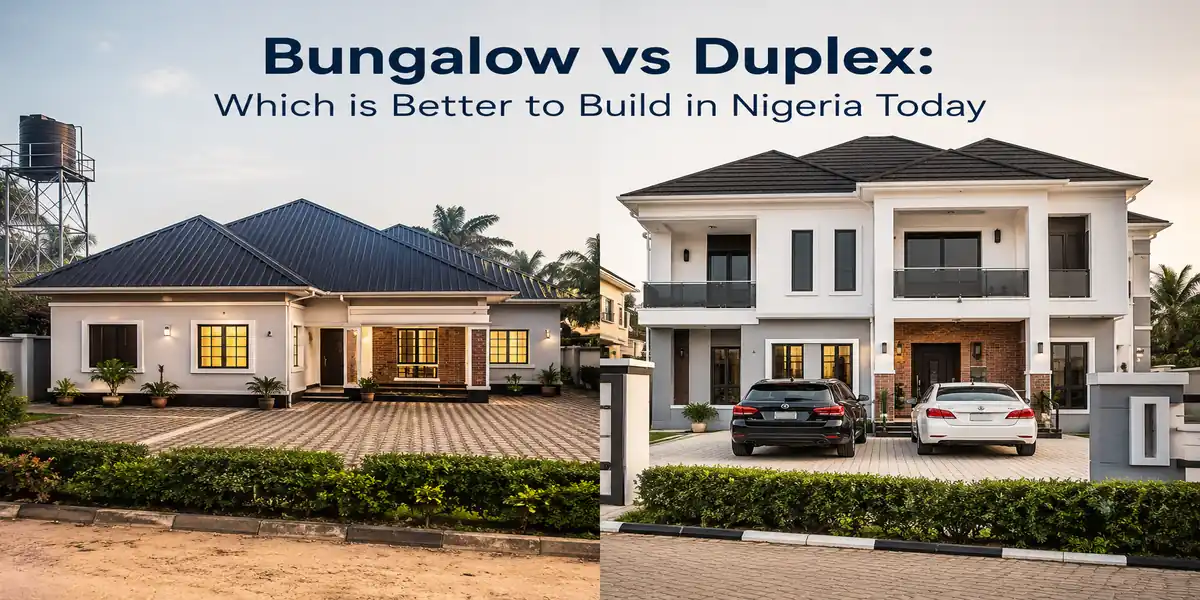
Bungalow vs Duplex: Which is Better to build in Nigeria Today?
The short answer is this: if your plot is smaller than 600 square metres and you are building in Lagos, Abuja, or Port Harcourt, Uyo, Ibadan, Kaduna, Kano a duplex will almost always serve you better. If your plot is generous, your land is relatively affordable, or you have elderly family members living with you permanently, a bungalow remains a deeply practical and dignified choice.
Now let me show you exactly why, so you can make this decision based on your own specific situation rather than what your neighbour built or what your contractor is pushing.
I have worked through this comparison more times than I can count across Nigerian cities, and every time, the right answer depends on the same set of factors: your plot size, your budget, your family structure, your location, and your long-term plan for the property. This guide walks you through every one of them.
What a Bungalow Actually Means in Nigerian Terms
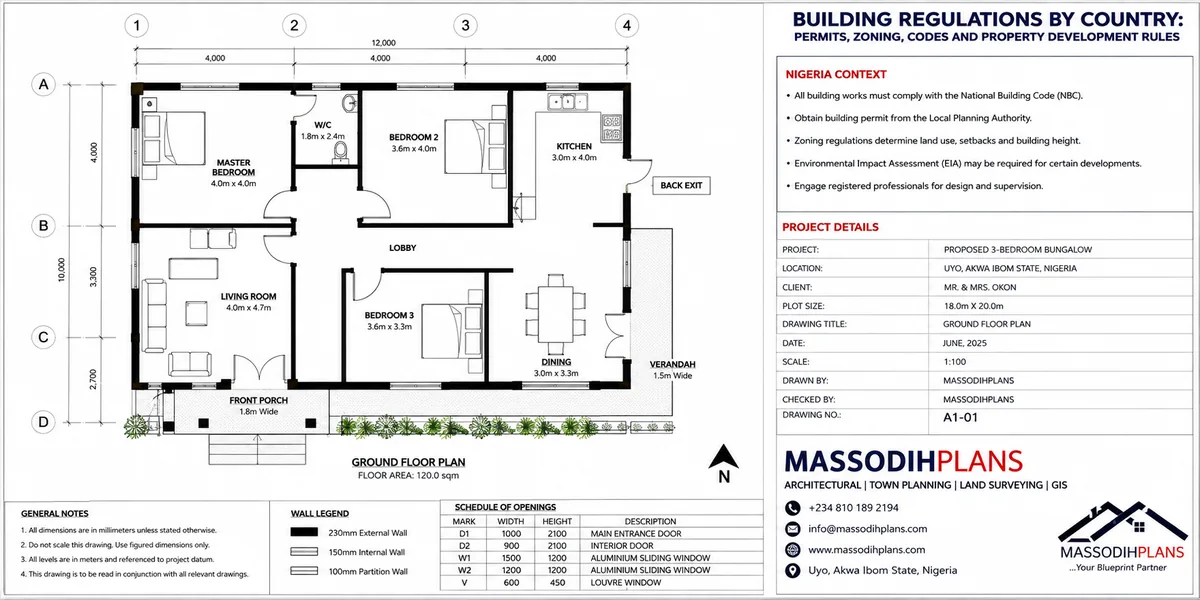
A bungalow is a single-storey residential building where every living space, bedrooms, living room, kitchen, and toilets, all sit on one ground floor level. In Nigeria, bungalows range from modest two-bedroom structures to sprawling four and five-bedroom homes depending on how much land is available.
The bungalow has deep roots in Nigerian residential culture. Families across the South South, South East, and large parts of the North built bungalows as their primary family homes for generations, and that tradition carries genuine practical value today, particularly in lower-density towns and areas with generous land availability.
Typical recommended plot sizes for Nigerian bungalows:
Two-bedroom bungalow: 300 square metres to 450 square metres Three-bedroom bungalow: 450 square metres to 650 square metres Four-bedroom bungalow: 600 square metres to 900 square metres.
Important: “Duplex” Means Something Different Outside Nigeria
If you are building with input from family abroad, or reading advice from international sources, this distinction matters. In Nigeria, a duplex means a standalone two-storey house built for one family. In the UK, the US, and Canada, the same word describes something completely different: a building split into two separate, independently rentable units, one per floor, each with its own entrance. If a relative in Toronto or London hears you’re “building a duplex” and pictures a rental property with two tenants, that confusion is common and worth clearing up early, before it shapes their expectations of what they’re contributing to.
What a Duplex Actually Means in Nigerian Terms
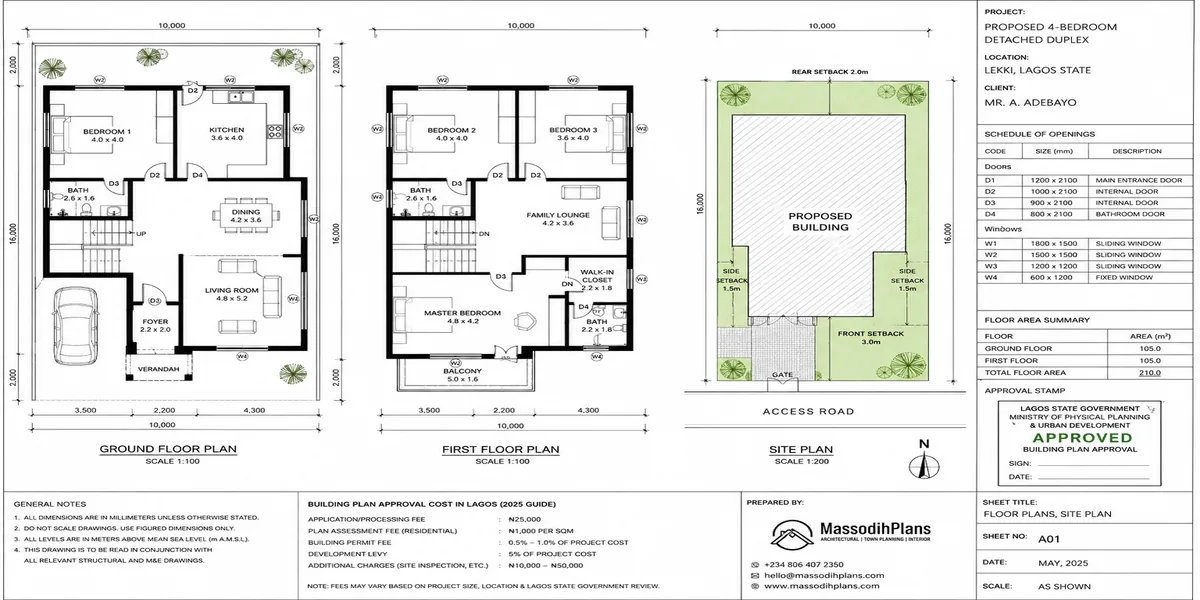
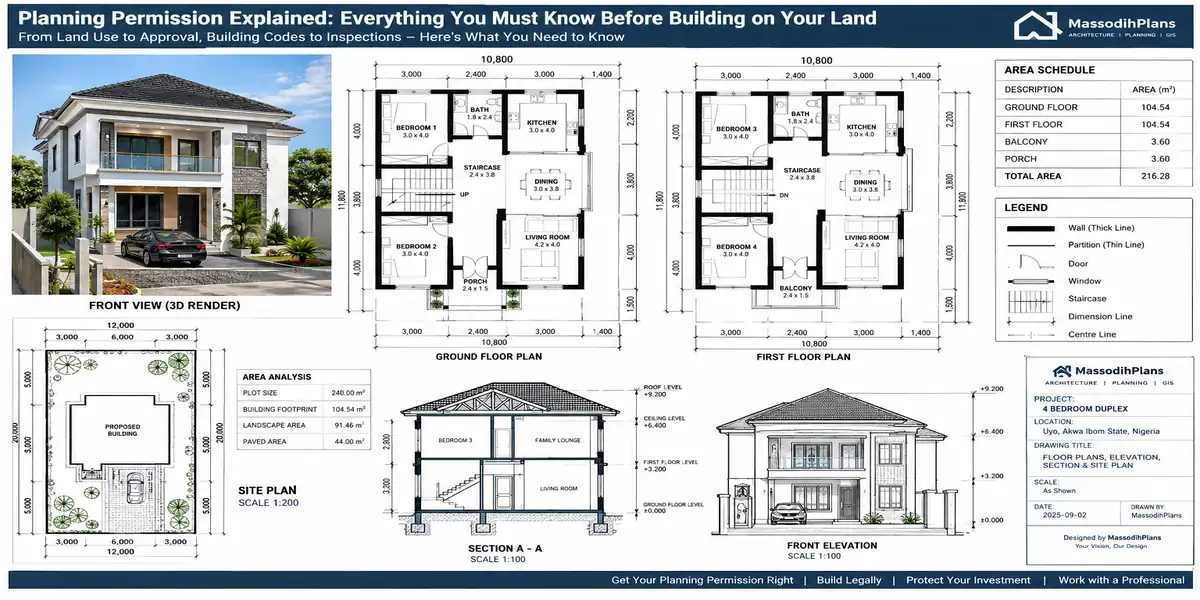
A duplex is a two-storey residential building. The ground floor holds the public and semi-public spaces: living room, dining area, kitchen, guest toilet, and sometimes a guest room or home office. The first floor holds the private spaces: master bedroom, children’s rooms, and sometimes a family lounge or study area.
In Nigeria’s increasingly land-scarce cities, the duplex has become the dominant aspirational building type. It allows you to fit significantly more living space onto a smaller footprint, which makes tremendous sense in locations where land prices can reach N500,000 per square metre in premium areas.
Typical recommended plot sizes for Nigerian duplexes:
Three-bedroom duplex: 400 square metres to 600 square metres Four-bedroom duplex: 450 square metres to 700 square metres Semi-detached duplex pair: 300 square metres to 450 square metres per unit
The Core Difference That Shapes Every Other Decision
A bungalow spreads horizontally. A duplex grows vertically. That single difference shapes everything else: your construction cost per square metre, your roofing expense, your drainage layout, your ventilation strategy, and how your family moves through the house every day.
A bungalow on a 600 square metre plot might give you 250 square metres of living area. A duplex on that same 600 square metre plot, with two floors, can deliver 400 to 500 square metres of living area, nearly double, while leaving more compound space for parking, a garden, a borehole area, and a generator shed.
This is why the duplex wins on paper in land-scarce urban Nigeria. But winning on paper and winning in real life are two different things, and that is what the rest of this guide unpacks.
Plot Size and Land Use: How Each Building Type Uses Your Land
How a Bungalow Uses Your Plot
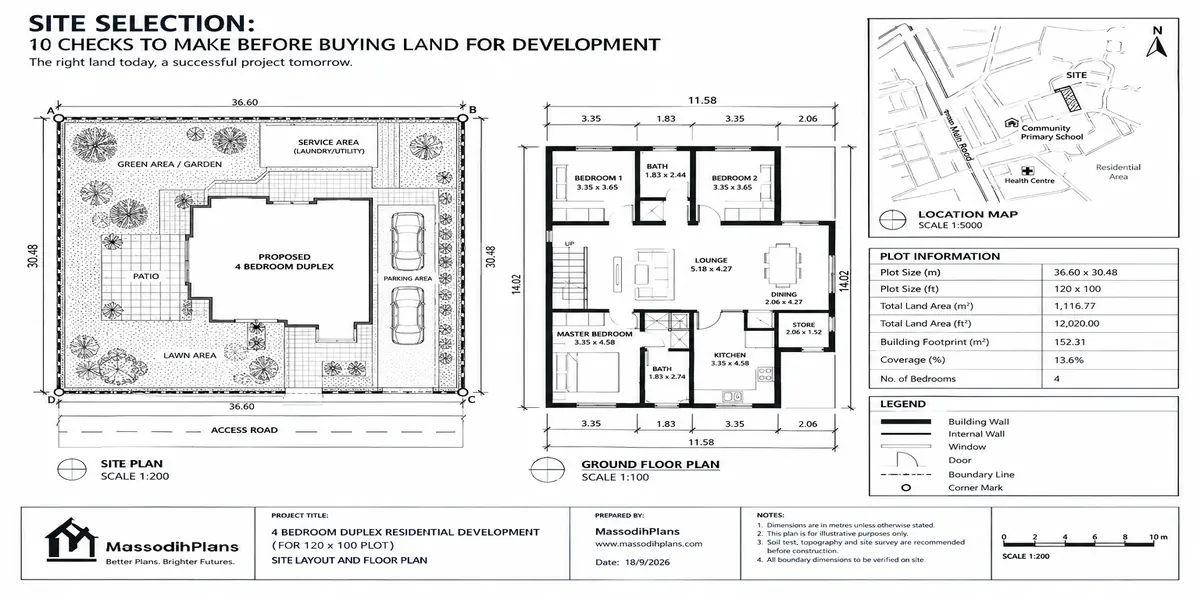
A bungalow requires more ground coverage. In Nigerian urban planning terms, the Ground Coverage Ratio, which is the proportion of your plot that the building footprint actually occupies, runs significantly higher for bungalows than for duplexes. This means less compound space, less room for parking, less buffer against street flooding, and tighter setbacks around the structure.
In Lagos, many plots in Surulere, Yaba, Mushin, and newer estates in Ikorodu fall between 400 and 600 square metres. Trying to fit a proper four-bedroom bungalow on a 400 square metre plot, after accounting for the required setbacks of typically 3 metres from the road, 1.5 metres from side boundaries, and 3 metres at the rear, leaves you with a building footprint of perhaps 14 metres by 10 metres at best. That is workable, but it is tight, and everything around the building suffers for it.
On a 600 square metre plot, a bungalow works much more comfortably. You get real compound space, proper drainage channels, room for a vehicle, and breathing space on all sides of the structure.
How a Duplex Uses Your Plot
A duplex is a land efficiency machine. Because the bedrooms go upstairs, the ground floor footprint shrinks while the total living area expands. On a 450 square metre plot, a well-designed duplex can include parking for two vehicles, a small front garden, a rear service area, and proper setbacks on all sides. A bungalow on the same plot would struggle enormously to achieve any of that without serious compromise.
| Feature | Bungalow | Duplex |
|---|---|---|
| Minimum recommended plot | 450 sqm | 350 sqm |
| Ground floor coverage | High | Low to moderate |
| Total living area on 600 sqm plot | 200 to 280 sqm | 380 to 500 sqm |
| Compound space remaining | Less | More |
| Parking feasibility on small plots | Tight | Comfortable |
Construction Cost Comparison: Bungalow vs Duplex in Nigeria
This is the question on every builder’s mind, so let me be direct and practical about it.
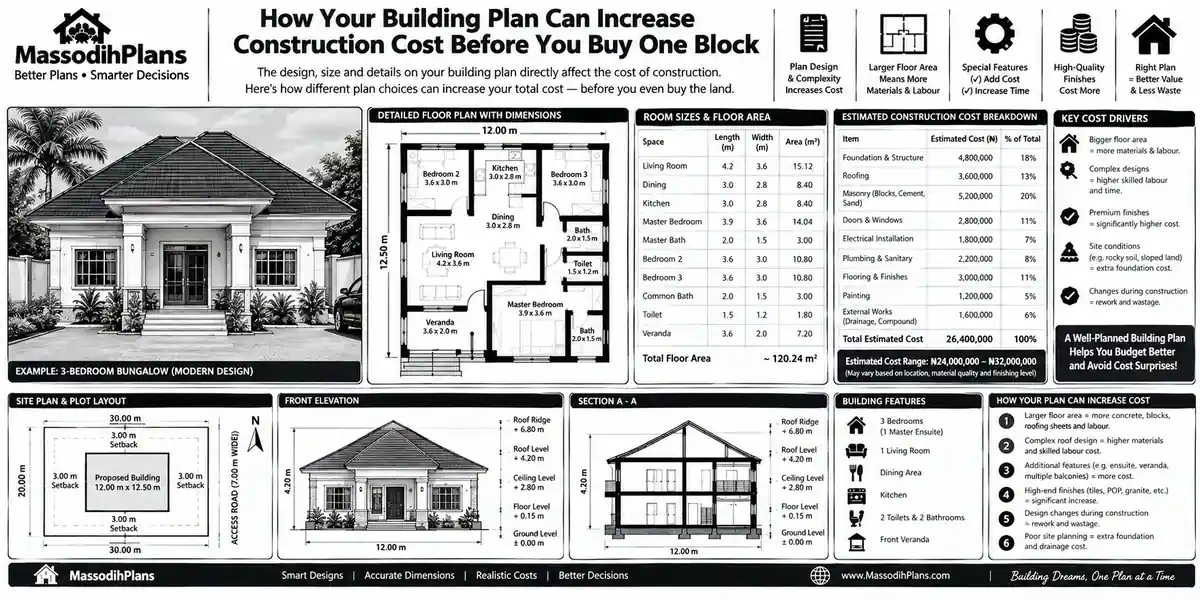
Three-Bedroom Bungalow Construction Cost Estimate (Mid-Range Finish)
| Item | Estimated Cost |
|---|---|
| Foundation strip or raft | N2.5 million to N4.5 million |
| Blockwork ground floor only | N2 million to N3.5 million |
| Roofing large footprint | N3.5 million to N6 million |
| Windows and doors | N1.5 million to N2.5 million |
| Plumbing and drainage | N800,000 to N1.5 million |
| Electrical works | N700,000 to N1.2 million |
| POP ceiling and finishing | N1.2 million to N2 million |
| Tiling all floors | N1.5 million to N2.5 million |
| Labour | N2 million to N3.5 million |
| Estimated Total | N16 million to N27 million |
Three-Bedroom Duplex Construction Cost Estimate (Mid-Range Finish)
| Item | Estimated Cost |
|---|---|
| Foundation deeper reinforced | N3.5 million to N6 million |
| Blockwork ground and first floor | N3.5 million to N6 million |
| Concrete slab first floor | N2.5 million to N4.5 million |
| Roofing smaller footprint | N2.5 million to N4.5 million |
| Windows and doors | N2 million to N3.5 million |
| Staircase concrete or steel | N600,000 to N1.2 million |
| Plumbing and drainage | N1.2 million to N2 million |
| Electrical works | N1 million to N1.8 million |
| POP ceiling and finishing | N1.5 million to N2.8 million |
| Tiling all floors | N2 million to N3.5 million |
| Labour | N3 million to N5 million |
| Estimated Total | N23 million to N40 million |
What These Numbers Actually Tell You
A bungalow costs less to build upfront. That is true and straightforward. But a duplex delivers significantly more square metres of finished living area for a proportionally smaller cost increase. When you calculate cost per square metre of usable space, the duplex frequently delivers better value, particularly in cities where land prices are high and every square metre of living area has real financial weight.
Never compare bungalow and duplex costs in isolation. Always calculate cost per square metre of usable living space. That number tells you the real story of which building type is actually more efficient for your situation.
For a detailed breakdown of what each construction stage costs for a full four-bedroom duplex specifically in Lagos, including foundation, blockwork, roofing, plumbing, and external works, the Plan School Section has a complete stage-by-stage cost guide that covers 2025 prices across different Lagos locations.
Construction Timeline: How Long Each Type Actually Takes
Cost is only half the planning picture. Timeline matters just as much, especially if you’re managing the build remotely or working against a fixed move-in date. A three-bedroom bungalow, built with steady funding and no major delays, typically completes in three to five months from foundation to finishing. A comparable duplex typically takes six to twelve months, because the first-floor slab must be properly cured before work above it continues, and every trade essentially repeats itself on a second level. If you need a functional home quickly, or you’re funding construction in stages as money becomes available, this timeline gap is often just as important as the cost gap.
Room Arrangement and How the Family Actually Lives
Inside a Nigerian Bungalow
In a bungalow, everything happens on one level. You step from bedroom to corridor to living room without ever touching a staircase. For a Nigerian family with elderly parents or grandparents permanently in the home, this is genuinely invaluable. No stairs to negotiate, no upper floor to worry about, no daily physical challenge for someone with limited mobility.
A typical three-bedroom bungalow layout in Nigeria moves like this: a sitting room facing the road at the front, a central corridor connecting all rooms, the master bedroom with ensuite on one wing, two additional bedrooms sharing a common bathroom on the opposite wing, and the kitchen, utility room, and domestic staff accommodation at the rear with a separate exit.
This is clean, logical, and easy to supervise. A parent can monitor the entire house from the kitchen or sitting room with minimal movement. That matters when children are young.
Inside a Nigerian Duplex
A duplex separates public and private life across two floors, and that separation is one of its greatest social and functional advantages in the Nigerian context.
Ground floor: living room, formal dining area, guest toilet, kitchen and store, and optionally a guest room or home office.
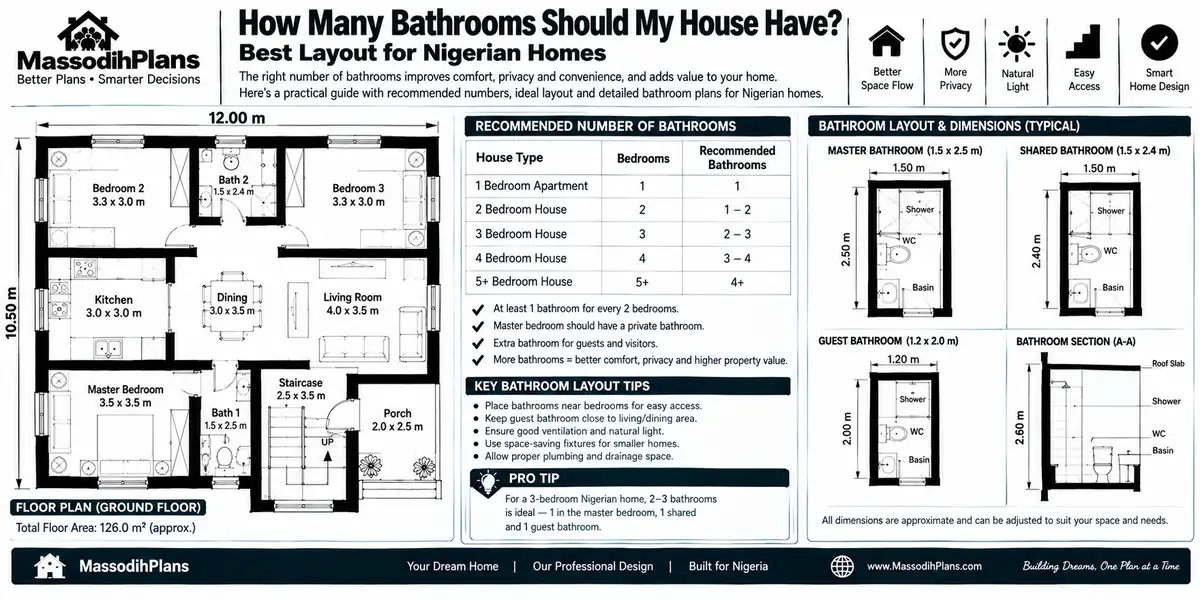
First floor: master bedroom with ensuite and balcony access, two to three additional bedrooms, a family lounge or study area, and the children’s shared bathroom.
What this separation achieves in practice is significant. Guests never walk through your bedroom corridor. Children have their own world upstairs while parents entertain downstairs. The home office remains accessible without disturbing anyone sleeping. The family kitchen operates without cooking smells drifting directly into sleeping areas. For the modern Nigerian family, particularly professionals increasingly working from home, this layout resolves real daily friction that a bungalow cannot.
Ventilation in Nigerian Conditions: Which Building Type Breathes Better
Nigeria’s climate demands a serious ventilation strategy regardless of which building type you choose. Cross-ventilation, where air enters the building from one side and exits from the opposite side, must be designed into every major room. This is not optional in a country where air conditioning is expensive to run, power supply remains unreliable, and the heat during the dry season is genuinely serious.
Bungalow Ventilation
A bungalow has one genuine ventilation advantage: the roof is close to all living spaces. With proper ceiling height of at least 3 metres in Nigerian conditions, good window placement on opposite walls, and louvre panels at high level where necessary, a bungalow can catch ground-level breezes effectively. Rooms oriented east to west benefit from morning and evening wind movement.
Practical ventilation rules for Nigerian bungalows: place bedroom windows opposite each other across corridors to create cross-flow, use casement windows on the prevailing wind side and louvre windows near the ceiling level to pull hot air out, and avoid placing the kitchen directly adjacent to the sleeping wing because cooking heat migrates through shared walls.
Duplex Ventilation
The first floor of a duplex sits higher than surrounding obstructions that might block ground-level airflow. In dense urban neighbourhoods where neighbouring buildings reduce ground-level breeze, this elevation is genuinely noticeable. A first-floor bedroom in Lagos Island or Port Harcourt GRA will feel cooler naturally than a ground-floor room in the same compound, simply because the wind has less obstruction at that height.
The challenge a duplex must address is roof heat. The first-floor ceiling absorbs significant solar radiation coming down through the roofing. This is why I always recommend proper roof insulation boards underneath the roofing sheets, ceiling cavity ventilation, and light-coloured roofing materials for duplexes in hot Nigerian climates. Without these, the first floor becomes noticeably hotter than the ground floor from mid-morning onward, which defeats one of the duplex’s natural advantages.
Roofing: The Cost Difference That Surprises Most Nigerian Builders
Roofing is where bungalow owners often get surprised by cost, and it is a comparison that deserves specific attention because the numbers run counter to what most people assume.
A bungalow’s roof covers the entire building footprint. On a three-bedroom bungalow with a 14 metre by 10 metre footprint, that roof covers 140 square metres of surface area. Roofing costs scale directly with surface area, and with a hip roof, which is the most appropriate style for Nigerian climates given its resistance to wind uplift and rain penetration, that becomes a substantial cost.
A duplex’s roof covers only the top floor footprint, which might be 10 metres by 9 metres. The first-floor concrete slab handles weather protection for everything below it. This means a duplex’s roofing cost is often 30 to 40 percent lower than a comparable bungalow, and that is a counterintuitive fact that surprises a significant number of Nigerian homebuilders every year.
The best roof types for Nigerian conditions are the hip roof for wind resistance and rain shedding in coastal cities like Lagos, Calabar, and Port Harcourt, gable roofs with wide overhangs in high-rainfall inland zones, flat parapet roofs for modern urban duplexes when properly waterproofed and drained, and long-span aluminium or stone-coated steel sheets for longevity in Nigerian heat and rainfall.
For a full practical comparison of Nigerian roofing types, their costs, and which one suits different building types and locations, the Plan School Section has a dedicated guide that covers this topic in the depth it deserves.
Setbacks, Parking, and Compound Planning
Setback Requirements in Nigerian Urban Areas
Most Nigerian state planning authorities require a front setback of 3 to 6 metres from the road depending on road classification, side setbacks of 1.5 to 3 metres from boundary walls, and a rear setback of 3 metres minimum. These setbacks eat into your buildable area before a single design decision is made.
On a 400 square metre plot in Lagos, once setbacks are subtracted, your actual buildable footprint might be only 150 to 200 square metres. A bungalow trying to fit three bedrooms into 150 square metres becomes uncomfortably cramped and leaves no room for functional circulation. A duplex on the same footprint spreads those three bedrooms comfortably across two floors while the ground level handles shared living spaces with proper proportions.
Parking
A duplex’s smaller footprint leaves significantly more compound space for vehicles. On a 450 square metre plot, a duplex can comfortably accommodate two vehicles side by side with a 6-metre clearance width in front, which is the standard needed for comfortable manoeuvring in a Nigerian compound layout. The same plot with a bungalow would likely allow parking for only one vehicle or require awkward multi-point reversals every day.
Practical compound planning elements every Nigerian homebuilder should incorporate from the design stage: a generator shed of minimum 1.5 metres by 2 metres that is properly ventilated and positioned away from bedroom windows, a borehole pump housing, a gatehouse or security post near the entrance, a perimeter drainage channel around the compound, and a soakaway pit positioned well away from both the borehole and the building foundation.
If you want to see how these compound elements fit together practically on a real Nigerian plot layout, the Plans Library includes duplex and bungalow plans with full compound layouts showing parking, generator bay, borehole positioning, and drainage channels drawn to scale.
The Nigerian Reality Layer: What the Standard Guides Never Tell You
Flooding and Drainage
Flooding is a non-negotiable planning consideration in Nigerian cities. Lagos, Port Harcourt, Warri, Benin City, and Aba all experience serious seasonal flooding, and even cities like Abuja and Ibadan have significant flood-prone pockets.
A bungalow sits entirely at ground level. If your compound floods, or if street flooding rises above your compound drainage level, a bungalow’s ground floor absorbs water damage directly: tiles, POP ceilings, electrical fittings, furniture, and all. I have spoken with families in Lagos Island who lost significant amounts in ground-floor rooms during October flood seasons while their upper-floor rooms in the same building were completely untouched.
This flood resilience advantage makes the duplex significantly more protective of your household and your possessions in flood-prone Nigerian neighbourhoods. It does not eliminate the need for proper site drainage, but it means your sleeping areas and most valuable rooms have a physical elevation buffer that a bungalow cannot provide.
Power Supply
Nigeria’s power supply reality means every serious homebuilder must plan for a generator, a solar inverter system, or both from day one of the design process. Duplexes have a practical advantage here: first-floor rooms catch more natural light and breeze, which reduces dependence on air conditioning. A lower cooling load means a solar panel system can cover a higher proportion of the home’s energy needs compared to a ground-floor bungalow where residents depend on fans or air conditioning for most of the day.
Monthly Running Cost: Which One Costs Less to Live In
Construction cost is a one-time number. Running cost follows you for as long as you live in the house, and it’s rarely discussed alongside the build-versus-build decision. A bungalow’s single-level layout, combined with a large roof surface absorbing heat all day, often means more rooms need active cooling for longer hours. A well-designed duplex, with first-floor rooms catching more natural breeze and less ground-level heat retention, can genuinely reduce daily air conditioning or fan running hours in the upstairs bedrooms but only if the roof insulation and ceiling ventilation described earlier in this guide are actually done properly. A poorly insulated duplex loses this advantage entirely and can end up costing more to cool than a well-ventilated bungalow. The building type doesn’t decide your electricity bill on its own the execution of ventilation and insulation does.
Security
A duplex creates natural security depth. Bedrooms on the upper floor are physically separated from ground-level entry points. An intruder who breaches the ground floor still faces the staircase and first-floor landing before reaching any sleeping area. Many Nigerian families who have dealt with security incidents appreciate this physical layering in a way that is difficult to replicate in a single-storey structure.
A bungalow has all rooms on one directly accessible level. This makes perimeter security even more critical: a quality fence, secure burglar-proof windows on all ground-level openings, a reinforced security door at the bedroom corridor entrance, and a capable gatehouse become essential investments rather than optional additions.
Which Is Better for Your Family’s Daily Life
Bungalow Is the Better Choice When:
You have elderly family members who live with you permanently and cannot manage stairs daily. The absence of stairs removes fall risk entirely and makes daily movement through the home comfortable regardless of mobility level.
You have children under five who need constant ground-level supervision. Being able to see and reach a toddler from any room without climbing stairs is a genuine daily safety advantage.
You are building in a lower-density area where land is relatively affordable and single-storey living is practical without significant space sacrifice.
Your budget is under N20 million and you need to complete a functional structure as quickly as possible.
You prioritise open compound and garden space over interior square footage, particularly if outdoor space is important for your family’s daily lifestyle.
Duplex Is the Better Choice When:
Your plot is between 300 and 600 square metres and land cost is high enough that maximising usable floor area matters significantly.
You want maximum living area from a smaller ground footprint while still maintaining proper compound space, parking, and drainage.
And you are in an urban area where seasonal flooding is a real concern, and having bedrooms elevated above ground level gives meaningful protection.
You are thinking about long-term rental value or resale appreciation, particularly in Lagos, Abuja, or Port Harcourt where duplexes consistently command higher rents and stronger resale prices than bungalows on equivalent plots.
Your household includes school-age children who need separated bedroom space from the parents, or someone who works from home and needs a dedicated ground-floor room that can be a true office without disrupting family life upstairs.
Investment Value: Rental Income and Resale Potential
If you are building with investment thinking, and in Nigeria’s property market you should always be, the duplex holds a clear advantage in most urban locations.
On the rental market, a three or four-bedroom duplex in Lekki, Ajah, Gwarinpa, Wuse 2, or GRA Port Harcourt consistently commands higher annual rent than a same-bedroom bungalow in the same area. Tenants in these markets perceive the duplex as more prestigious, more private, and more modern. Annual rents for decent duplexes in Lagos suburbs currently run from N2 million to N8 million depending on location and finishing quality. Comparable bungalows in the same areas typically rent for 20 to 40 percent less.
On resale, duplexes in Nigerian urban centres appreciate faster than bungalows in the same location, primarily because of their floor area advantage on the same land size. A buyer who is land-constrained, which describes most serious buyers in Lagos and Abuja today, will pay a meaningful premium for a duplex that maximises usable space on a standard plot.
Estate suitability matters too. If you are building within a structured estate or planning a subdivision, duplexes are the preferred typology for medium and high-income Nigerian estates today. Building a bungalow in a duplex-dominant estate can actually suppress your resale value relative to your neighbours because the property appears less developed relative to the land it sits on.
If you need professional help thinking through the financial case for your specific plot, location, and budget, the Services Page explains how to get tailored guidance that starts with your actual numbers rather than generalised comparisons.
Can You Rent Out Part of Your Duplex While You Live In It?
This is one of the more practical financial angles many first-time builders overlook. A duplex’s floor separation makes it possible, with the right design from the start, to live on one floor while renting out the other as a self-contained space, generating rental income that can help offset your mortgage, loan repayment, or the cost of finishing the rest of the building. If this is part of your plan, it needs to be a design decision from day one: a separate entrance, an independent water and electricity metering point, and a genuinely private layout for the rented floor. Adding this after construction is far more expensive than designing it in from the beginning.
One caution worth stating plainly: a beautifully finished bungalow will often outsell or outrent a poorly finished duplex in the same neighbourhood. Building type sets your ceiling on potential value, but finishing quality is what a buyer or tenant actually judges standing in your compound. Don’t assume “duplex” alone guarantees a premium if the budget for quality finishing isn’t there.
What Builders in Nigeria Consistently Get Wrong on Each Type
Common Bungalow Construction Mistakes
Underestimating roofing cost due to the large footprint. Contractors regularly give a low initial quote and revise upward significantly once roofing materials actually arrive on site. Get a detailed roofing quote that specifies the sheet type, gauge thickness, and total area before you commit.
Neglecting ceiling height. A 2.7-metre ceiling in a Nigerian bungalow turns the interior into an oven by midday. The minimum ceiling height for comfortable living in Southern Nigeria is 3 metres. In the South South and Southwest, 3.2 metres is even better.
Poor kitchen positioning, allowing cooking smells and heat to migrate directly through the wall into bedroom wings. The kitchen should be oriented toward the eastern or northern side of the building and separated from sleeping areas by at least one other room.
Building too close to the rear boundary and leaving no usable service yard for a borehole, soakaway, generator, and laundry area. These functional spaces are not optional. They must be in the design from the beginning.
Common Duplex Construction Mistakes
Inadequate reinforcement in the ground-floor columns and beams before casting the first-floor slab. This is a structural failure risk that I have seen cause serious long-term problems. The structural engineering for the slab support system must be done by a qualified engineer, not improvised by the contractor on site.
A staircase positioned as an afterthought, eating into the circulation space of the ground floor and making the living areas feel cramped. The staircase position is one of the first decisions that should be made in the floor plan, not one of the last.
Forgetting dedicated electrical conduit runs for upper-floor air conditioning units during the first-floor slab casting stage. Once the slab is poured and cured, adding conduit paths through it is expensive and disruptive. Plan the conduit positions before the slab is cast.
Balcony waterproofing neglect. A leaking balcony slab destroys the ceiling of the room directly below it within one or two rainy seasons. A proper waterproofing membrane at balcony slab level is not a luxury finish. It is essential maintenance protection.
For practical guidance on how to evaluate contractor quotes, what to check at each construction stage, and how to avoid being misled on structural specifications, the Plan School section has guides specifically covering the Nigerian contractor relationship and construction quality management.
Material Recommendations That Apply to Both Building Types in Nigeria
Foundation: Reinforced concrete strip foundation is standard for bungalows on stable soil. Duplexes in Lagos, Port Harcourt, and coastal cities with soft or waterlogged subsoil frequently require a raft foundation or pile foundation. This is a significant cost addition that must be included in the budget from day one, not discovered after the contractor has already begun excavation.
Walls: Sandcrete hollow blocks, 225 millimetres for external walls and 150 millimetres for internal partitions, remain the Nigerian residential standard. In coastal high-humidity areas, use water-resistant mortar mixes and established cement brands to resist the efflorescence and surface deterioration that lower-quality cement produces in humid conditions.
Roofing: For longevity in Nigerian tropical conditions, stone-coated steel roofing tiles or long-span aluminium sheets with a minimum gauge thickness of 0.55 millimetres. Avoid very thin-gauge sheets in coastal areas where salt air accelerates corrosion significantly faster than inland locations.
Windows: Aluminium-framed windows with tinted glass reduce solar heat gain through the glazing. In high-security urban areas, combine these with quality burglar-proof steel frames on all ground-floor openings. Avoid purely decorative louvres on ground-floor windows facing street level because they provide inadequate security in most Nigerian urban environments.
Flooring: Porcelain tiles in a minimum 600 by 600 millimetre format for all main living areas. Locally sourced ceramic tiles work well for bathrooms and service areas. Avoid very light-coloured tiles in high-traffic corridors because they show scuff marks and ground-in dirt within months of occupancy and require constant maintenance to look presentable.
Financing Your Build: What Lenders and Loan Programs Consider
If you’re financing part of your build through a mortgage, a National Housing Fund (NHF) loan, or a cooperative housing loan, building type can affect how a lender values your project as collateral. Multi-storey duplexes in urban centres are generally viewed as stronger collateral by mortgage lenders, since their resale value tends to hold up better in land-scarce cities. This doesn’t mean a bungalow is unfinanceable it means if financing is central to your plan, it’s worth discussing directly with your specific lender how each building type affects loan terms, valuation, and required equity contribution before you finalise your design.
A Simple Decision Guide for Nigerian Homebuilders
As a quick starting rule: if your total construction budget is under roughly ₦25 million, or your plot is under 450 square metres with no urgent flooding concern, a bungalow gets you into a finished, functional home faster and with less financial risk. If your budget comfortably covers ₦35 million and above, and your plot sits between 300 and 600 square metres, a duplex will generally deliver more usable space and stronger long-term value for the same land.
Choose a bungalow if your plot is 600 square metres or larger and land is relatively affordable in your location, if you have elderly family members who live with you permanently, if you are building in a low-density area where single-storey living is the neighbourhood norm, if your budget is under N20 million and you need to complete a functional structure within a defined timeframe, or if open compound and garden space matters more to your family than interior square footage.
Choose a duplex if your plot is between 300 and 600 square metres and land cost is high, if you want maximum living area from a smaller footprint without sacrificing compound functionality, if you are in an urban area where flooding is a seasonal concern, if rental value or resale appreciation over time is part of your thinking, or if your household includes school-age children, a home-based worker, or extended family members who would benefit from the floor separation a duplex provides.
Reading the Right Plan Before You Commit
The single most expensive mistake in this entire bungalow versus duplex decision is not choosing the wrong building type. It is starting construction of either type without proper architectural drawings, without understanding your plot’s setback requirements, and without a realistic stage-by-stage construction budget.
A plan that works in Nigeria is not just a room arrangement. It is a document that shows setback compliance, structural column positions, drainage direction, ventilation strategy, staircase proportions for a duplex, roof overhang dimensions, and the positioning of every infrastructure element from the generator bay to the borehole.
Before you finalise your decision on building type, browse the Plans Library to look at actual floor plans for both bungalows and duplexes on Nigerian plot sizes. Seeing the real room dimensions, the actual compound layout, and the circulation patterns of each building type at your specific plot size will make this decision significantly clearer than any comparison article can on its own.
If you want to understand how to read those plans confidently before you take them to a contractor or submit them for council approval, the Plan School section has a practical guide on reading Nigerian architectural drawings that walks you through every element of a floor plan in plain language.
And if your plot has specific conditions, unusual dimensions, a difficult soil report, or a family size that standard plans do not address well, the Services page explains how to commission a custom design that starts from your actual site and your actual family needs rather than adapting a generic template.
What Nigerian Building Regulations Say About Both Building Types
The National Building Code of Nigeria sets minimum standards for structural design, materials quality, fire safety, ventilation requirements, and minimum room dimensions for all residential buildings, whether bungalow or duplex. Every home built in Nigeria should be designed to meet these standards regardless of how consistently local authorities enforce them in your specific area.
For professional standards on building practice and contractor verification in Nigeria, the Nigerian Institute of Building (NIOB) maintains a register of certified building practitioners and publishes professional practice guidelines. If you want to verify whether a contractor or building professional you are considering is legitimately registered and certified, NIOB is the credible reference point to use.
Frequently Asked Questions
Is a bungalow cheaper to build than a duplex in Nigeria?
Yes, a bungalow typically costs less upfront. A standard three-bedroom bungalow in Nigeria currently ranges from N16 million to N27 million at mid-range finish, while a comparable duplex runs from N23 million to N40 million. However, the duplex delivers significantly more living area per naira spent when you calculate the cost per square metre of finished usable space.
Which is better for a small plot in Lagos, a bungalow or a duplex?
On plots between 300 and 600 square metres in Lagos, a duplex is almost always more practical. It allows you to meet all setback requirements, include proper parking, and still achieve three to four bedrooms with rooms of comfortable proportions, which a bungalow on the same plot would struggle to deliver.
Can I start with a bungalow and convert it to a duplex later?
This is possible, but your foundation and ground-floor columns must support first-floor loads from the construction’s beginning. Converting an under-designed bungalow foundation into duplex support later becomes structurally risky and usually costs significantly more overall. If future expansion is possible, inform your structural engineer before designing the foundation to ensure adequate structural capacity.
Which building type is better for elderly parents living in the same house?
A bungalow is significantly more suitable for households with elderly members. The absence of stairs removes daily fall risk entirely and makes movement around the home comfortable regardless of mobility level. If you have elderly parents or grandparents permanently in the home, a bungalow or a duplex with a well-designed ground-floor bedroom and bathroom suite for them specifically is the right approach.
Does a duplex hold better resale value than a bungalow in Nigeria?
In urban centres like Lagos, Abuja, and Port Harcourt, duplexes consistently outperform bungalows in resale value and rental income per square metre. This performance gap is most pronounced in land-scarce, high-demand neighbourhoods where the duplex’s floor area advantage on the same plot size translates directly into higher buyer willingness to pay.
What is the minimum plot size for a three-bedroom duplex in Nigeria?
A three-bedroom duplex can be designed on a plot as small as 300 square metres in Lagos or Abuja, though 400 to 500 square metres gives a significantly more comfortable result with proper compound space, parking clearance, and full setback compliance on all sides.
What is the difference in roofing cost between a bungalow and a duplex?
This surprises most people: a bungalow’s roof is typically 30 to 40 percent more expensive than a duplex’s roof of equivalent quality. Because the bungalow’s roof must cover the entire building footprint while a duplex roof covers only the top floor area. The first-floor concrete slab handles weather protection for everything below it on a duplex. On large bungalow footprints, the roofing cost advantage of a duplex can amount to N1.5 million to N3 million on a comparable build.
How does flooding affect the choice between a bungalow and a duplex in Lagos?
In flood-prone Lagos areas, duplexes protect bedrooms and valuables upstairs, safely elevated above dangerous ground-level floodwater during heavy rains.
A bungalow keeps all living spaces at ground level, leaving the entire home vulnerable when flooding overwhelms compound drainage systems.
This flood-resilience advantage strongly influences many Lagos families in low-lying, waterlogged neighbourhoods to prefer duplex residential developments.
Does “duplex” mean the same thing in Nigeria as it does abroad?
No. In Nigeria, a duplex is a standalone two-storey house for one family. In the UK, US, and Canada, a duplex is a building split into two separate rentable units, one per floor. If you’re getting input or funding from relatives abroad, clarify this early to avoid confusion about what’s actually being built.
How much longer does a duplex take to build compared to a bungalow?
A three-bedroom bungalow typically takes three to five months to complete with steady funding. A comparable duplex typically takes six to twelve months, largely because the first-floor slab must cure properly before construction continues above it.
Planning to Build a Bungalow or Duplex in Nigeria?
Make the right decision before spending money on construction. MassodihPlans can help you with architectural house plans, building design drawings, cost-conscious planning, site layout plans, and professional guidance to help you build smarter.
Ready to start your building project? Contact MassodihPlans today for professional architectural design and building planning services tailored to your land, budget, and needs.
Visit MassodihPlans.com to explore our services and take the first step towards building your dream home.
Author
Massodih Okon is a Nigerian built-environment professional with academic and professional experience in urban and regional planning, geography, architectural design, Landscape Design, GIS and land development.
He holds a Master’s degree in Urban and Regional Planning from the University of Uyo and a first degree in Geography and Regional Planning.
Through MassodihPlans, he publishes practical guides on Nigerian house plans, building design, physical planning, site planning, development approval and residential construction. Read the full author profile →
Related Posts
- Cost of Building a 4 Bedroom Duplex in Lagos (Complete Guide)
- Smart House Design Ideas for 50×100 Plots in Nigeria
- Small Residential Estate Layout Design in Nigeria: Smart Master Plan Ideas for Limited Land
- Building Materials Price Guide in Nigeria (Full Cost Guide)
- Best Roofing Sheets for Nigerian Weather: Complete Guide
- How to Practically Draw and Design a Duplex for Small Plots
- Modern Duplex House Plan for 50×100 Plot in Lagos
- 7 Small Plot Design Mistakes Nigerians Make (And How to Fix Them)
- Building Materials Price Guide in Nigeria (Full Cost Guide)
- Smart House Design Ideas for 50×100 Plots in Nigeria
- Affordable Bungalow Plan for 40×80 Plot in Port Harcourt
- Cost of Roofing a Bungalow and Duplex in Abuja Small Plot Now
- Best 4 Bedroom House Plan for Small Plots in Abuja
- Current Cost of Building a House in Port Harcourt (Professional Analysis)
- Full Cost Breakdown for Building a Duplex on a Small Plot in Kano Nigeria
- Building Approval in Nigeria: Costs, Requirements, Process and How to Get Your House Plan Approved Fast
- Modern Nigerian House Plan for a 30×60 Plot in Ibadan: The Complete Practical Guide
- Best Small Plot House Designs for Modern Urban Living
- House Plans for Small Plots in Yola: Modern Nigerian Designs Explained
- Architectural Design Principles Every Architect and Homeowner Should Know
- Building Design Guide for Safety, Functional, and Cost-Effective Buildings
- House Interior Design Ideas for Every Room, Style and Budget
- Cost of Building a Modern Bungalow in Calabar (Updated Guide)
- Cost of Roofing a 4 Bedroom Duplex in Abakaliki (Complete Guide)
- Step-by-Step Tutorial for Drawing a Bungalow Plan
- Best Nigerian Duplex Designs for 40×80 Plots
- Nigerian duplex plans with modern roofing