Last Updated: October 2026: Cost estimates reflect current Lagos material and labour rates.
Modern Duplex House Plan for 50×100 Plot in Lagos
Modern Duplex House Plan for 50×100 Plot in Lagos
Yes, a 50×100 plot is enough for a proper 4-bedroom duplex in Lagos and if someone told you otherwise, that advice has cost people years, sometimes forever, of delayed building. Here’s the real answer: 5,000 square feet of raw land, handled with a disciplined layout and proper respect for LABCA setbacks, comfortably fits a four-bedroom duplex, a double driveway, a functional rear compound, and every single thing a Nigerian family actually needs. Not a compromise. Not a squeeze. A genuinely good house.
I have worked with Nigerian house plans and built environment design long enough to know exactly where this myth comes from, and it isn’t the plot size. It’s landowners consistently underestimating what their land can carry, guided by contractors who default to the safest, laziest layout instead of a properly engineered one. I have watched people sit on perfectly buildable land for years, convinced they needed to buy more, because someone told them their plot was too small. It wasn’t. It was badly designed for.
This guide gives you the exact floor plan for this plot size, room by room, with real dimensions in feet. How to ventilate the house properly for Lagos heat and humidity. Which roof to choose and why, with the honest tradeoffs. Drainage that actually protects your foundation instead of failing in the first heavy rain. A realistic, current cost breakdown. And the kind of practical building advice most Lagos contractors keep to themselves unless a client specifically knows to ask.
If you own a 50×100 plot in Lagos and someone has told you to think smaller, keep reading. By the end of this guide, you’ll know exactly why they were wrong and exactly what to build instead.
What a 50×100 Plot Actually Gives You After Lagos Setbacks
Before you plan anything, you need to understand what you are working with after mandatory setbacks. The full 5,000 square feet is not your buildable area. Lagos State planning law takes a portion of that away before you lay the first block.
Lagos State, through the Lagos Building Control Agency and the Urban and Regional Planning Law, sets the following minimum setbacks for residential buildings:
- Front setback: 3 metres from the boundary to the face of the building
- Rear setback: 3 metres minimum
- Side setbacks: 1.5 metres on each side
Once those setbacks are applied, here is what you are left with:
| Dimension | Full Plot | After Setbacks |
|---|---|---|
| Width | 50 ft (approx. 15.2 m) | ~38 ft (11.6 m) |
| Depth | 100 ft (approx. 30.5 m) | ~80 ft (24.4 m) |
| Buildable Area | 5,000 sq ft | ~3,040 sq ft |
That remaining footprint is generous. A well-proportioned duplex floor needs between 900 and 1,100 square feet. After the building occupies its footprint, you still have room for a driveway, a front compound, and a rear service area provided the layout is disciplined from the beginning and nothing is wasted.
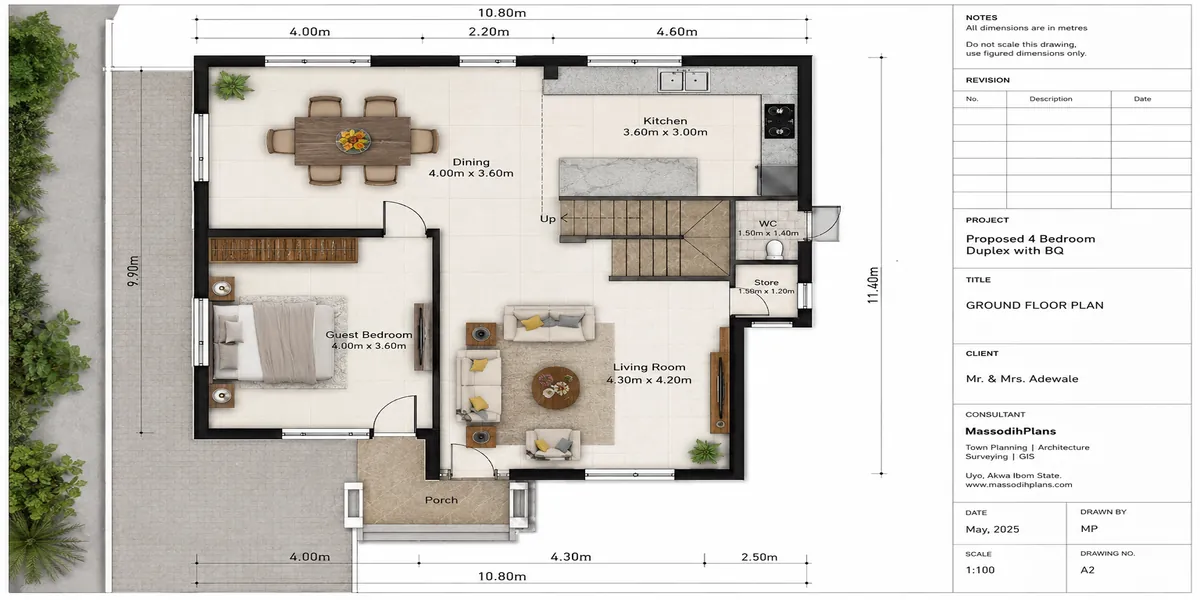
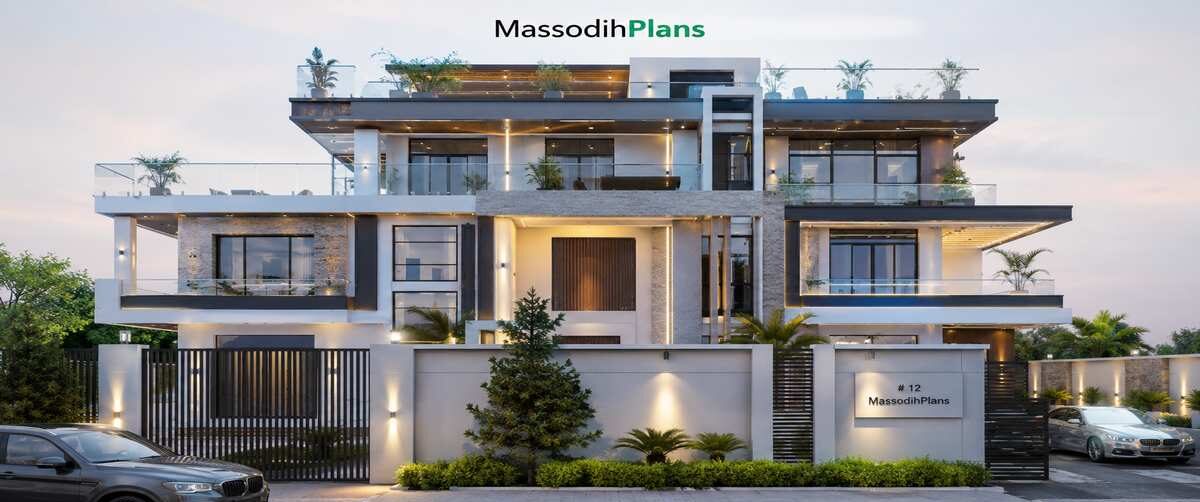
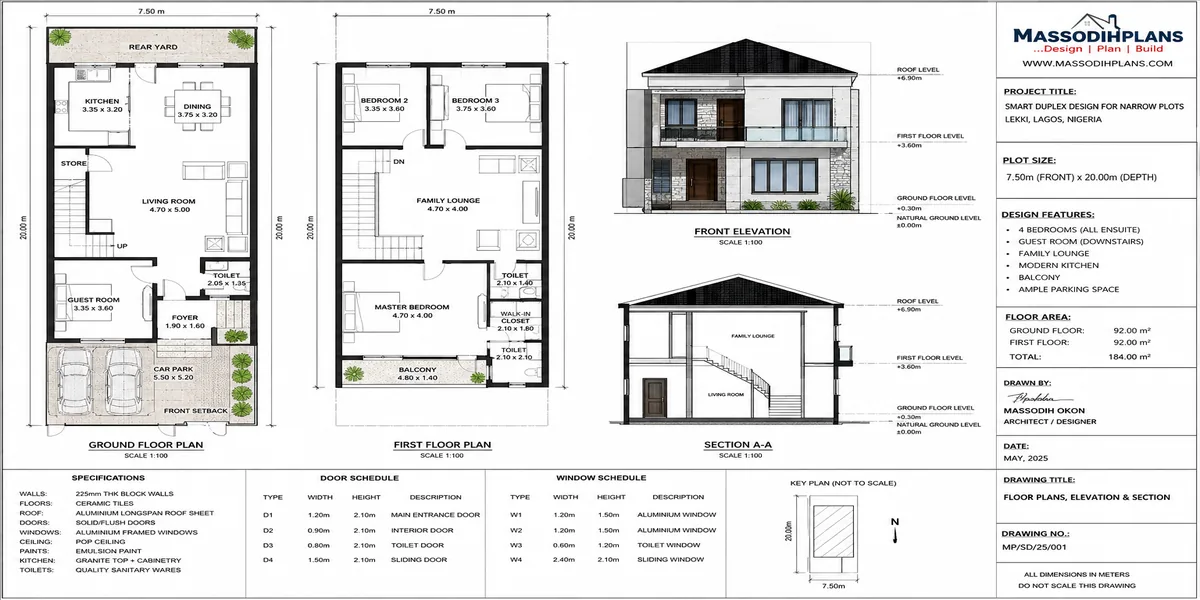
Every room on this plan is sized exactly as described below see it, then read the reasoning behind it
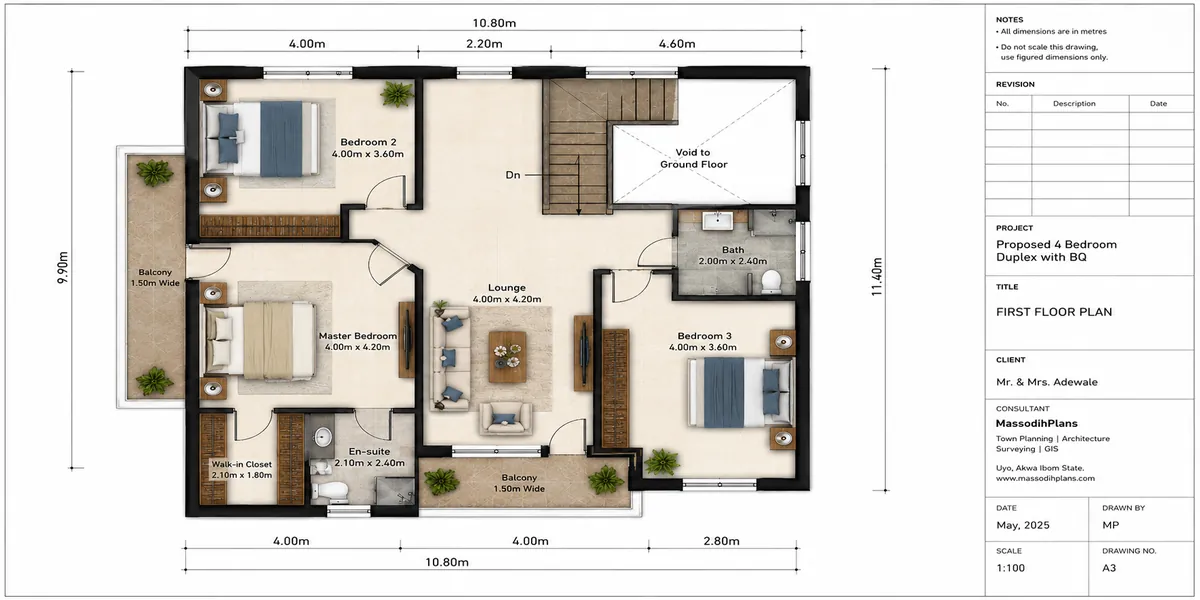
The private floor no guest ever needs to walk through here
The Floor Plan: A Modern 4-Bedroom Duplex on a 50×100 Lagos Plot
Ground Floor
The ground floor handles everything that happens publicly in a Nigerian home. Receiving guests, cooking, family movement, service access. I designed it so all of these happen simultaneously without one disrupting another.
Living and Social Spaces
- Entrance porch with a small landing step
- Living room: 18 ft × 14 ft wide enough for a standard three-seater sofa set, a centre table, and a wall-mounted television with room to move freely
- Dining area: 12 ft × 10 ft in open flow from the living room
- Kitchen: 12 ft × 9 ft with back-door access directly to the rear compound
- Pantry and storage cupboard next to the kitchen
Bedrooms and Toilets
- Ground-floor guest bedroom: 12 ft × 11 ft
- Visitor’s toilet and bathroom: 5 ft × 7 ft
- Family toilet: 5 ft × 6 ft
Utility and Transition Spaces
- Central staircase: straight-flight design, positioned away from the main entrance
- Under-stair storage cupboard fully enclosed
- Short entrance corridor with a coat storage niche
The ground floor covers roughly 950 to 1,000 square feet. The kitchen, dining room, and living room flow into each other because in Nigerian family life, cooking and conversation happen at the same time. You do not want a solid wall separating those spaces.
First Floor
The first floor is entirely private. It belongs to the family. No guest traffic reaches here. The rooms are quieter and more personal.
Bedrooms
- Master bedroom with en-suite: 14 ft × 13 ft with built-in wardrobe space
- Master bathroom: 8 ft × 6 ft bath, shower cubicle, WC, and vanity basin
- Bedroom 2: 12 ft × 11 ft
- Bedroom 3: 11 ft × 10 ft
- Shared family bathroom: 7 ft × 6 ft
Additional Spaces
- Study or home office nook: 8 ft × 7 ft doubles as a prayer room or children’s reading space
- Landing corridor connecting all rooms
- Front-facing balcony: 12 ft × 6 ft, accessible from the master bedroom or the landing
The first floor covers roughly 980 to 1,020 square feet.
Building Dimensions at a Glance
| Item | Measurement |
|---|---|
| Building footprint | ~40 ft × 25 ft |
| Ground floor built area | ~1,000 sq ft |
| First floor built area | ~1,000 sq ft |
| Total built area | ~2,000 sq ft |
| Front compound depth | ~12 ft |
| Rear compound depth | ~15 ft |
| Parking capacity | 2 cars side by side |
Why I Designed Each Room the Way I Did
The Living Room
At 18 × 14 ft, this room comfortably holds a standard sofa set, a centre table, a 55-inch wall-mounted television, and healthy movement space. I positioned it at the front of the building deliberately morning and evening natural light flows in from the front, which reduces daytime electricity use. In Lagos, that matters.
The Nigerian living room is not just for the immediate family. It is where extended family visits happen, where business conversations take place, where guests form their first impression of your home. I designed this room to feel welcoming and dignified while keeping every private area of the house completely out of reach from it.
The Kitchen
I placed the kitchen at the rear of the ground floor. This is a deliberate decision. Rear kitchen placement keeps cooking heat and smells away from the living and dining area. It allows kitchen traffic grocery deliveries, waste removal, gas cylinder changes to use the back door without crossing the main social spaces. And it puts the kitchen directly next to the rear compound where the generator, borehole, and service area sit.
A 12 × 9 ft kitchen fits a single-row or L-shaped cabinet layout, a four-burner cooker, under-counter refrigerator space, and a small breakfast bar if you want one. Do not go smaller than this in a family home. Anything below this size becomes genuinely frustrating to cook in over time. I have seen it.
The Master Suite
This is the most important room in the entire building from a financial standpoint. A well-executed master suite proper dimensions, attached bathroom, natural light is the single feature that most affects rental price and resale value in Lagos middle-income housing.
The master bedroom at 14 × 13 ft fits a king-size bed, two bedside tables, and a full-width built-in wardrobe with comfortable movement space remaining. The attached bathroom at 8 × 6 ft gives you a full bathtub, a separate shower cubicle, a WC, and a vanity unit. That combination is what tenants and buyers in Lekki, Surulere, Gbagada, Ojodu, and Ipaja now expect as standard. If you compromise on this room, you compromise the investment value of the entire building. I have seen it happen too many times.
The Balcony
I included a front-facing balcony at 12 × 6 ft because when it is added as an afterthought, it almost always turns out wrong too narrow, structurally weak, or badly positioned. When I design it in from the beginning, it does several things at once: it shades the ground-floor entrance from direct afternoon sun, it extends usable square footage on the first floor, it improves cross-ventilation through the master bedroom, and it gives the building a clear architectural character that sets it apart from generic construction on neighbouring plots.
A well-detailed balcony raises the perceived value of a property noticeably. That is not a small thing in Lagos real estate.
The Study
The 8 × 7 ft study nook reflects modern Nigerian household reality. Remote work is no longer unusual. Children need a reading space separate from the bedroom. A small private room for prayer or early morning devotion matters in most Nigerian Christian and Muslim households. This room handles all of that without consuming a bedroom.
Ventilation Strategy for Lagos Climate
Lagos sits in a humid tropical zone. Temperatures run from 24°C to 33°C and humidity exceeds 85% for much of the year. A house that does not actively address ventilation will be expensive to cool, uncomfortable to live in, and will deteriorate faster than it should.
Here is how this plan addresses it.
Cross-ventilation: Every room has at least one window on an external wall. I recommend orienting the building with its longer face running north-south where the plot allows, so that Lagos’s prevailing south-westerly winds flow through the building laterally. Use casement windows rather than fixed louvres casement windows capture and direct wind far more effectively.
High-level windows: In the living room and bedrooms, install a second row of smaller windows above standard window height. Hot air rises. If you give it an exit near the ceiling, it leaves the room naturally and takes heat with it. This single feature which costs almost nothing to implement during construction noticeably reduces indoor temperature without electricity.
Kitchen exhaust: Always specify a dedicated exhaust vent or extractor fan directly above the cooking position. Without it, cooking heat and steam travel into the corridor and up the staircase into the upstairs bedrooms. Your bedrooms should not smell like your kitchen.
The staircase as a thermal chimney: The central staircase position is partly a passive ventilation decision. Hot air rises naturally through the stairwell, drawing cooler air in from ground-floor windows. This is an old tropical architecture technique and it works.
Roof ventilation: Specify roof insulation and a ventilated roof void. In Lagos, a poorly ventilated roof traps solar heat all day and radiates it into the top-floor ceiling all through the night. Ventilated fascia boards, ridge vents, or a roof ventilator tile reduce this problem significantly.
Roofing: What to Choose and Why
Hip Roof (My Primary Recommendation)
A hip roof where all four sides slope downward is structurally superior for Lagos wind and rain conditions. It presents no flat gable ends for wind to push against. And it sheds stormwater efficiently in every direction. It produces clean, modern geometry that ages well.
For this plan, I specify a 20 to 25 degree pitch. That is enough to drain stormwater quickly without making the roof mass look visually heavy on a two-storey building.
Flat Roof With Parapet (Terrace Option)
If you want to use the roof as a usable outdoor terrace and I think this is an underused opportunity in Lagos urban homes a flat roof with a raised parapet wall is a valid option. It gives you additional outdoor living space and a strong contemporary roofline.
But I want to be honest with you about this: flat roofs in Lagos require very careful waterproofing treatment IsoTech membrane, Sika waterproofing, or equivalent and they require regular maintenance. Without proper treatment, water pooling causes ceiling damage within two to three rainy seasons. Do not choose a flat roof unless you are genuinely committed to maintaining it.
Recommended Roofing Material
For the hip roof, use long-span aluminium roofing sheet in a rib-type or step-tile profile at a minimum gauge of 0.55mm. Dark charcoal or terracotta colouring ages well and complements modern render finishes. Do not accept under-gauge sheets from your contractor. Thin aluminium corrodes faster in coastal Lagos humidity and is extremely noisy during heavy rain.
For premium builds, stone-coated steel tiles are excellent for durability, weather resistance, and long-term visual quality. The upfront cost is higher, but the maintenance cost over twenty years is considerably lower.
Compound, Driveway, and Setback Planning
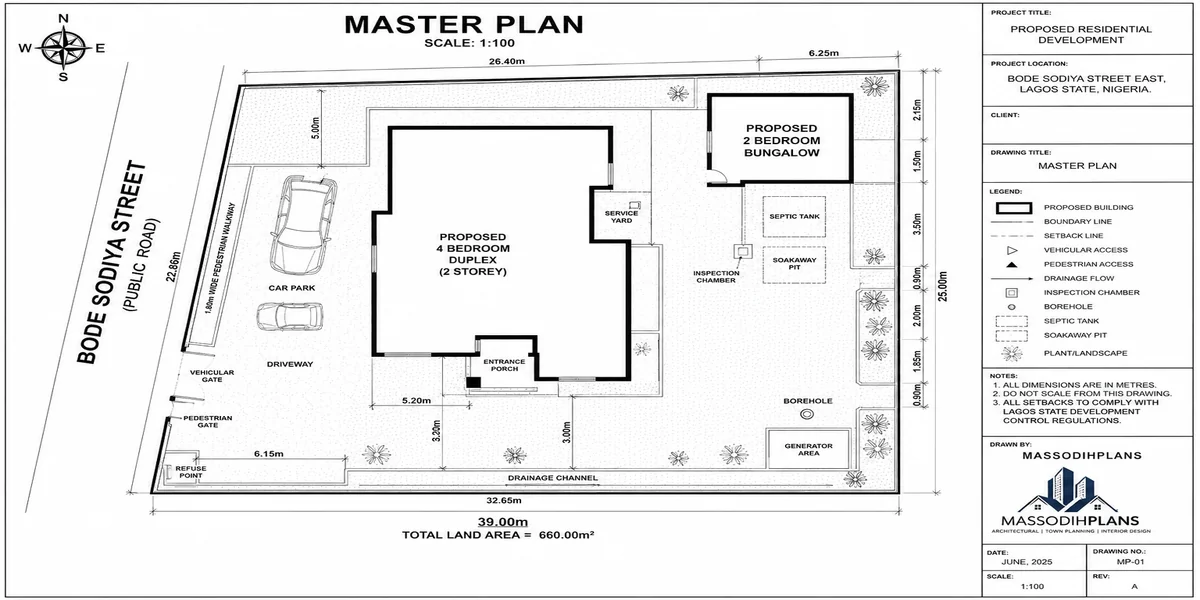
After Lagos setbacks, a 50-foot plot gives you roughly 38 to 40 feet of usable width. A comfortable double driveway needs 18 to 20 feet. That leaves enough width for the driveway, a narrow planting strip or drainage channel on one or both sides, and a side access path to the rear compound.
Front compound: Keep it paved or gravelled. Minimal raised planters. I see too many homeowners install elaborate front gardens that eat into parking space. Keep the front simple, clean, and functional.
Rear compound: This is your service area. Position the generator housing, the borehole headwork, and the septic tank access point here. Always leave at least 6 feet of clearance between the rear wall of the building and the boundary wall. You will need it for maintenance access and rear ventilation.
Gatehouse: A full gatehouse is impractical on a 50×100 plot it consumes driveway width you cannot afford to lose. What I recommend instead is a guard room built into the compound wall near the entrance: a 6 × 8 ft structure with a viewing window facing the gate. Compact, functional, and it does not compromise the driveway.
For a more detailed look at how to plan your compound before construction starts, see the 7 Small Plot Design Mistakes Nigerians Make (And How to Fix Them).
Cost Estimate: What This Duplex Will Realistically Cost in Lagos
These figures reflect mid-range quality construction at current Nigerian market conditions. Construction costs in Lagos shift with exchange rates, cement prices, and labour availability. Always get at least three site-specific quotes from registered builders. These numbers are for orientation not for signing contracts.
| Component | Estimated Cost (₦) |
|---|---|
| Foundation and substructure | ₦4,500,000 – ₦6,500,000 |
| Blockwork and columns (both floors) | ₦6,000,000 – ₦9,000,000 |
| Roofing (hip roof, long-span aluminium) | ₦3,500,000 – ₦5,500,000 |
| Electrical installation | ₦1,800,000 – ₦3,000,000 |
| Plumbing (internal and external) | ₦2,000,000 – ₦3,500,000 |
| Tiling (floors and bathrooms) | ₦2,500,000 – ₦4,500,000 |
| Doors and windows | ₦2,000,000 – ₦4,000,000 |
| Plastering and painting | ₦2,000,000 – ₦3,500,000 |
| Staircase (concrete and finish) | ₦900,000 – ₦1,800,000 |
| Compound wall and gate | ₦1,500,000 – ₦3,000,000 |
| Total Estimate | ₦26,700,000 – ₦43,800,000 |
This excludes land cost, professional fees (typically 5 to 8% of total project cost), LABCA approval fees, and furniture. Premium finishes Italian tiles, engineered wood flooring, imported bathroom fittings add 30 to 40% to the finishing line items.
The Nigerian Reality Layer: What Most Contractors Will Not Tell You
Power Supply
Plan for the power supply you actually have, not the one you wish you had. Lagos has improved in some areas, but reliable uninterrupted supply is not guaranteed anywhere.
Your building plan must include:
- A concrete generator pad and louvred enclosure at the rear compound, minimum 5 × 5 ft
- A dedicated changeover switch automatic or manual in your electrical panel
- Wiring conduit routed for an inverter and battery system
- Conduit routing for solar panel cabling installed during construction. Even if you are not going solar now, running the conduit costs almost nothing and saves serious money when you are ready
Water Supply
I have never worked on a Lagos residential project where I recommended relying on Lagos Water Corporation supply as a primary source. Budget for:
A borehole: ₦400,000 to ₦900,000 depending on depth and location
Overhead water tanks: minimum 3,000-litre capacity. Two 1,500-litre tanks linked in series is the standard approach
Position the tank at the rear, not the front. A poly tank on a concrete tower at the front of your compound undermines everything the building’s design is trying to achieve
Drainage and Flooding
Flooding is not a minor inconvenience in Lagos. It is a genuine construction risk, particularly in low-lying areas of Ikorodu, Ojo, Alimosho, and parts of the Mainland. Poor drainage planning causes real, expensive structural damage over time.
Here is what I specify:
Raise your finished floor level at least 600mm that is 24 inches above the surrounding ground level. This single decision protects your ground floor from stormwater intrusion during heavy rainfall events.
Install perimeter drains around the compound wall, draining to the street gutter or adjacent drainage channel.
Do not pave your entire compound with impermeable concrete. Allow at least 30% of the rear compound to remain permeable gravel, grass paver, or planted ground. This allows rainwater absorption and reduces surface flooding within your own compound.
Before construction begins, visit the site during or immediately after a heavy rainstorm and watch what the water does. If it pools significantly, factor drainage engineering into the project before you lay the first block.
Security
I work security requirements into the design from the beginning, not as additions bolted on after the building is finished. For this plan:
Perimeter wall minimum 6 feet with a wall cap that discourages climbing
Conduit for security lights at all four wall corners and above the gate, installed during construction so there is no hacking into plasterwork later
Steel or reinforced door frames for all external doors wooden frames offer almost no resistance to forced entry
Security grilles on all ground-floor windows, designed as part of the building aesthetic rather than screwed on separately as afterthoughts
How I Maximise Every Inch on a 50×100 Plot
When I design for a constrained plot, every decision must earn its space.
Circulation efficiency: The staircase sits centrally, not at the end of a long corridor. This eliminates dead-end passages and ensures every room on both floors is reachable within a few steps from the landing. Dead-end corridors waste space and make the house feel smaller than it actually is.
Open-plan living and dining: The wall between the living room and dining area is removed. Both spaces flow freely into each other, which makes both feel larger than their individual measurements suggest. It also lets the combined space handle Nigerian family life flexibly gatherings, celebrations, informal business meetings, children’s homework without requiring a dedicated extra room for each.
Under-stair storage: Every square foot matters on this plot. I fully enclose the space beneath the staircase as a fitted storage cupboard. Storage is chronically underplanned in Nigerian homes. This cupboard handles cleaning equipment, spare gas cylinders, luggage, and bulk items without claiming any room space.
The balcony as real outdoor living: The first-floor balcony adds roughly 72 square feet of covered outdoor space. Nigerian households consistently need this for morning prayers, outdoor seating, children’s play, or catching the evening breeze but modern apartment buildings almost never provide it. On your own house, it is there from the first day.
Who Is This Duplex Best Suited For?
Growing Families
A family with two to four children benefits directly from the floor separation. Children move freely between floors without disturbing guests below. Parents have a private master suite that genuinely feels separate from the rest of the house. The study gives a working parent a quiet, dedicated space without the cost of a separate building.
Multi-Generational Households
The ground-floor bedroom is positioned specifically for elderly parents. It avoids stair navigation entirely, sits next to a ground-floor toilet, and can be given a separate entrance with minimal modification if needed. Many Lagos families build specifically to accommodate a parent within the compound while maintaining independent daily space for each generation.
Rental Investment
A well-finished duplex on a 50×100 Lagos plot particularly in Ogba, Gbagada, Ejigbo, Ikorodu, or Abule-Egba commands annual rents of ₦600,000 to ₦1,800,000 depending on location and finishing quality. At a mid-range construction cost of ₦30 to ₦35 million, the rental return is achievable over 20 to 25 years, comparable to many Lagos real estate products and without estate management fees.
Current resale prices for a well-built 4-bedroom Lagos duplex in middle-income neighbourhoods range from ₦55,000,000 to ₦120,000,000 and above depending on location and finishing. If you factor in land cost of ₦15 to ₦30 million and a construction cost of ₦30 to ₦40 million, you are still building strong equity particularly if the plot is in a growth corridor.
Common Construction Mistakes on This Build and How to Avoid Them
These are real, recurring errors on Lagos residential sites. Learning them before you build is far cheaper than fixing them after.
Guessing at foundation depth. Lagos soil varies clay, sand, and laterite can occur on the same site at different depths. Do not allow a contractor to guess at foundation depth. Commission a basic soil test (₦80,000 to ₦150,000) and specify a strip or raft foundation based on actual bearing capacity data, not assumption.
Accepting substandard blocks. Many Lagos block moulders produce 6-inch hollow blocks that do not meet the minimum 3.5 N/mm² strength standard. Test blocks before accepting them on site. A 24-hour water absorption test gives a good indication of quality. Specify blocks from a certified supplier and put it in your contract.
Skipping lintel reinforcement. Every window and door opening must have a properly reinforced concrete lintel above it. Contractors sometimes omit or undersize lintels to reduce material cost. The result is cracking above openings that starts cosmetically and becomes structural over time.
Narrowing the staircase. The minimum clear width for a residential staircase is 900mm approximately 3 feet. A narrow staircase makes furniture movement impossible and reduces the habitability of the entire first floor. Do not allow it regardless of what a contractor tells you about saving materials.
Skipping waterproofing treatment. Apply waterproof additive SikaProof, Penetron, or equivalent to all substructure concrete and blockwork below floor level. Many homeowners skip this to save ₦200,000 to ₦400,000 during construction and then spend ten times that amount remediating rising damp three to five years later. The numbers do not support skipping it.
What to Supervise Closely During Construction
If you cannot be on site daily, hire a resident site foreman with verifiable experience not simply someone the contractor recommends. These are the stages where you should be present or arrange a third-party inspection:
- Foundation excavation and base preparation
- Reinforcement cage arrangement before any concrete pour
- Column casting any honeycombing or inadequate vibration must be identified and remediated immediately, not covered over
- Slab reinforcement before the first-floor concrete pour
- Roof truss and purlin installation
- Waterproofing application on all bathroom floors and the kitchen before tiling begins
On payment: never pay more than 30 to 40% of any stage cost before visible, verifiable work has been completed to earn it. Structure your payment milestones around site progress, not around contractor requests.
Investment and Resale Value: The Honest Picture
The key value drivers for this build are:
Location within Lagos. The same floor plan in Lekki Phase 1 and in Ikorodu are not the same investment. Location creates a 2× to 3× price difference on identical construction quality.
Finishing quality. Mid-range to premium finishing in the bathrooms, kitchen, and flooring adds disproportionate value to the asking price. Buyers and tenants remember the finishes long after they have forgotten the square footage.
Master suite quality. The master bedroom and en-suite bathroom are the rooms that sell the property. Buyers and tenants inspect these rooms first and most carefully. Do not cut costs here.
Security provisions. A well-secured compound with a solid perimeter wall, an automatic gate, and visible security fittings adds measurable buyer confidence and directly affects rental willingness.
A Real Build on This Exact Plot Size
A client in Ogba came to us with a 50×100 plot and an earlier plan from a different designer that ignored setbacks entirely the original layout would have required demolishing part of a completed perimeter wall to comply with LABCA requirements. We redesigned the ground and first floor to fit properly within the compliant footprint, without losing a single bedroom from the original brief.
Final build cost came in at ₦34.2 million, within the mid-range estimate in this guide. The client’s biggest comment after moving in: the balcony and the study nook, both treated as “extras” in the original plan, ended up being the two spaces the family uses most.
Quick Plan Summary
| Feature | Detail |
|---|---|
| Plot size | 50 ft × 100 ft |
| Building footprint | ~40 ft × 25 ft |
| Total floors | 2 (Ground + First) |
| Total bedrooms | 4 |
| Bathrooms and toilets | 4 |
| Parking | 2 cars |
| Balcony | Yes — first floor, front-facing |
| Roof type | Hip roof (recommended) or flat terrace |
| Study or home office | Yes |
| Rear compound service area | Yes |
| Estimated build cost | ₦27M – ₦44M |
| Suitable for | Family home, rental investment |
Why This Plan Beats a Generic 50×100 Layout
Most 50×100 plans circulating online, including many templates copied from Indian or generic international house-plan libraries, ignore three things that matter specifically in Lagos:
They don’t account for Lagos setbacks. A plan designed without LABCA’s 3m/1.5m/3m setback rules in mind often looks perfect on paper and becomes illegal or physically impossible once your surveyor marks the real boundaries.
They ignore Nigerian infrastructure reality. Generator bays, borehole positioning, and inverter conduit routing are treated as afterthoughts in most generic plans, if they’re mentioned at all.
They don’t design for Lagos ventilation and climate. A plan built for a temperate or dry climate rarely accounts for cross-ventilation, roof heat buildup, or Lagos humidity details that directly affect your comfort and your electricity bill for as long as you live in the house.
This plan was built site-first, climate-first, and regulation-first for Lagos specifically not adapted from a generic template afterward.
Frequently Asked Questions
Can I build a duplex on a 50×100 plot in Lagos?
Yes. A 50×100 plot is adequate for a well-designed four-bedroom duplex after mandatory Lagos setbacks are applied. The buildable footprint comfortably fits the building, a double driveway, and a functional rear compound provided the plan is disciplined and no space is wasted.
What is the cost of building a 4-bedroom duplex in Lagos?
At mid-range finishing quality, total construction costs fall between ₦27,000,000 and ₦44,000,000. This excludes land, professional fees, and LABCA approval costs. Premium finishing can raise the total to ₦55,000,000 or above.
How do I get LABCA approval for a duplex in Lagos?
You need approved architectural and structural drawings from an ARCON-registered architect, payment of the applicable development levy, and formal submission through your local government planning authority or LABCA directly. The process typically takes two to six months. Do not begin construction without approval unapproved structures face demolition orders.
What roofing material is best for Lagos homes?
Long-span aluminium roofing sheets at a minimum 0.55mm gauge in a rib or step-tile profile. Stone-coated steel tiles are the premium recommendation for durability and long-term value. Under-gauge aluminium corrodes in coastal Lagos humidity and creates significant noise during heavy rain.
How many floors can I build on a 50×100 plot in Lagos?
Most residential zones permit two floors ground plus first without special approval. Some zones permit three floors with additional applications. Always confirm the permitted development height with your local planning authority before designing beyond two floors.
Should I build this duplex to live in or to rent?
Design it for flexibility from the beginning. A well-designed duplex on this plot can be occupied as a single-family home, rented entirely, or configured as two semi-independent units one occupied, one rented. That flexibility is built into the investment from day one.
What is the minimum setback for residential buildings in Lagos?
The standard minimum is 3 metres at the front, 3 metres at the rear, and 1.5 metres on each side for medium-density residential plots. These vary by zone and local government area, so confirm with LABCA or your registered architect before finalising any site plan.
Ready to Move From Reading to Building?
This plan gives you a strong, proven starting point for a 50×100 Lagos plot. But every site is different. Soil conditions vary. Orientation differs. Your family has specific requirements that no general guide fully captures.
At MassodihPlans, I provide the design support that takes you from a plot to a building you can actually construct:
- Browse ready-to-use duplex and bungalow designs in the Plans Library
- Learn what every homeowner should know before they build in Plan School
- Get a customised plan, LABCA-ready drawings, or a design consultation through Services
If this guide helped you see your plot differently, share it with someone who is planning to build. Most building mistakes happen not because people lack money, but because nobody gave them the right information before they started. That is exactly what this platform is here to change.
About
Massodih Okon is a Nigerian built-environment professional with academic and professional experience in urban and regional planning, geography, architectural design, Landscape Design, GIS and land development.
He holds a Master’s degree in Urban and Regional Planning from the University of Uyo and a first degree in Geography and Regional Planning.
Through MassodihPlans, he publishes practical guides on Nigerian house plans, building design, physical planning, site planning, development approval and residential construction. Read the full author profile →
Related Post
- House Plan Design Services in Nigeria: What They Cover, Who Needs Them, and How to Choose Right
- 25 Narrow PLot House Plans That Maximize Every Inch of Your Plot
- Best Nigerian Duplex Designs for 40×80 Plots
- Beginner’s Guide to House Plan Drawing in Nigeria
- Nigerian duplex plans with modern roofing
- Affordable Architectural Drawing Services in Nigeria
- 4 Bedroom Duplex Plan for 100×150 Plot in Nigeria
- 7 Cheapest Areas to Buy Affordable Land in Uyo Before Prices Increase
- Best Places to Buy Land in Uyo for Fast Development and High Property Value
- How a State Master Plan Works: A Complete Guide to Modern Infrastructure Development
- Cost of Building a Modern Bungalow in Calabar (Updated Guide)
- House Plans for Sloping Land in Jos, Plateau State, Nigeria: Smart Nigerian Designs
- Best Roofing Options for Houses in Gusau city of Zamfara State, Nigeria: Prices and Durability
- 7 Small Plot Design Mistakes Nigerians Make (And How to Fix Them)
- Bungalow vs Duplex: Which is Better to build in Nigeria Today?
- Best Roofing Sheets for Nigerian Weather: Complete Guide
- How to Practically Draw and Design a Duplex for Small Plots
- Building Materials Price Guide in Nigeria (Full Cost Guide)
- Smart House Design Ideas for 50×100 Plots in Nigeria
- Affordable Bungalow Plan for 40×80 Plot in Port Harcourt
- Cost of Roofing a Bungalow and Duplex in Abuja Small Plot Now
- Best 4 Bedroom House Plan for Small Plots in Abuja