The Floor Plan Secret Most Builders Never Learn until It’s Too Late
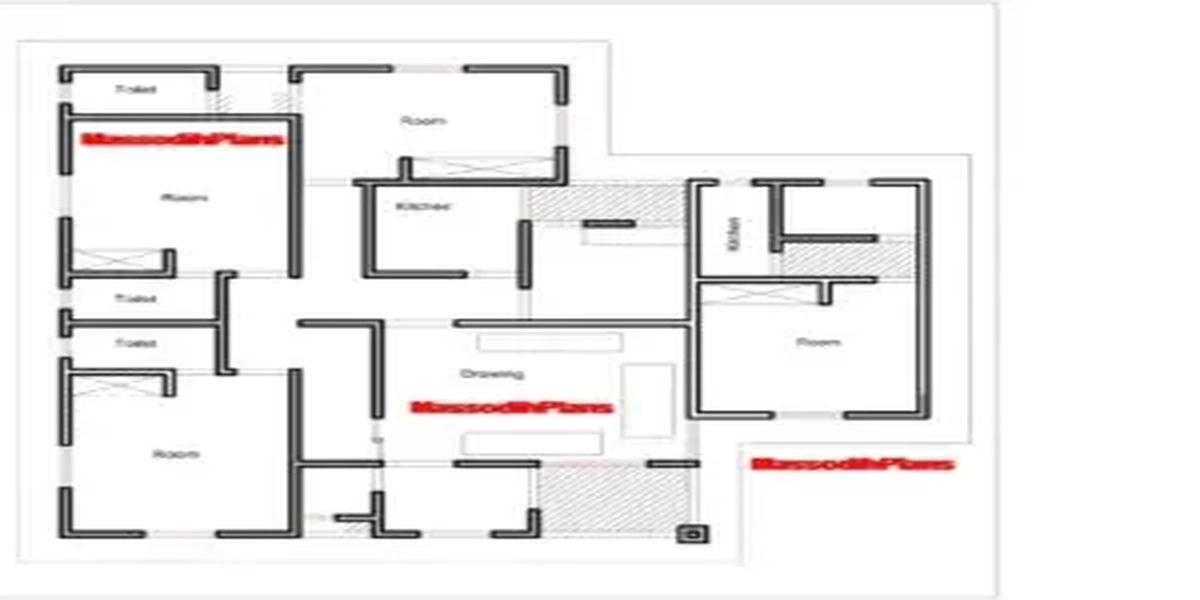
How to Draw a 3 Bedroom Floor Plan in a Small Plot
If you want to draw your own 3-bedroom floor plan, start by deciding how the rooms must fit together not by randomly drawing walls. A good floor plan begins with your plot size, household needs, room dimensions, circulation, doors and windows, then turns those requirements into a practical layout that can actually be built. Get this wrong on paper, and the mistake can become an expensive concrete-and-block problem on site.
That is why learning how to draw a 3-bedroom floor plan is about far more than making rooms look attractive. You need to understand space planning, dimensions, circulation, orientation, natural lighting, ventilation, privacy and structural considerations before the first foundation is dug.
In this guide, I will take you through the process step by step from deciding what your house needs to positioning bedrooms, bathrooms, kitchen, living spaces, doors and windows. You will also see why professionals make certain layout decisions, not simply what they draw.
Whether you are a homeowner planning your first house, a student learning architectural drafting, or a self-builder trying to control costs, this guide will help you understand the thinking behind a functional 3-bedroom design.
More importantly, I will point out the common mistakes that can make a seemingly beautiful plan uncomfortable, waste valuable floor area or become unnecessarily expensive to construct.
By the end, you will understand how house plans, floor plans and building design work together and, most importantly, how to look at a 3-bedroom plan with the eyes of someone who intends to build it, not merely admire it.
What Is a Floor Plan and Why Does It Matter?
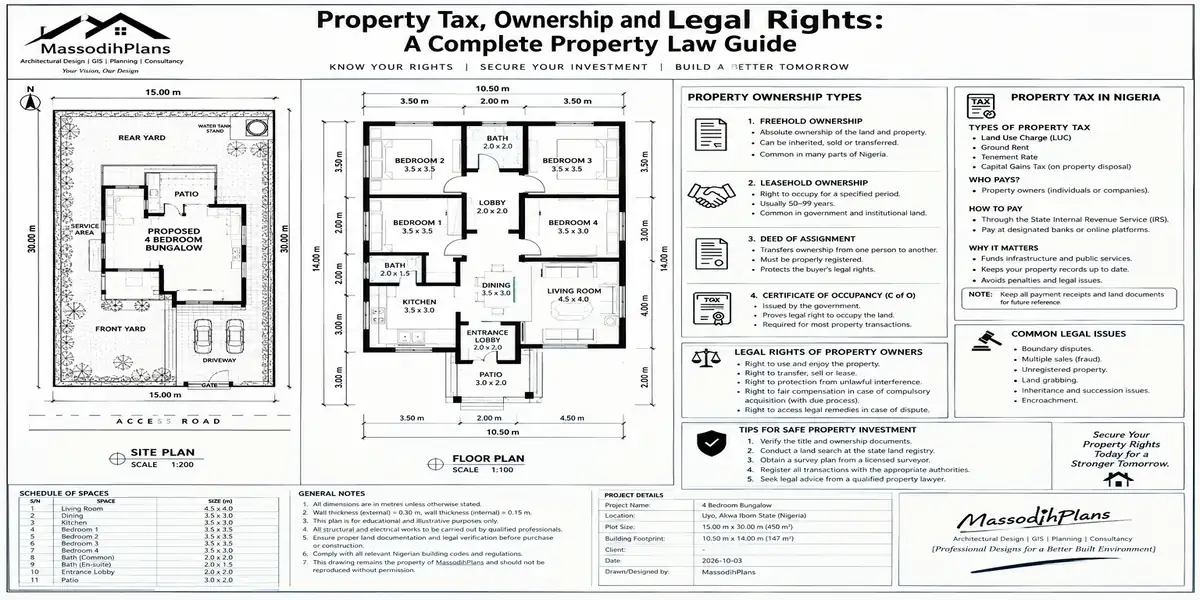
A floor plan is a scaled, top-down drawing that shows the layout of a building as if the roof were removed and you were looking straight down. It shows walls, openings, rooms, corridors, doors, windows, and sometimes furniture arrangement.
For a 3 bedroom house, the floor plan is the most important document you will produce before construction begins. It determines how your rooms relate to each other, how air moves through the building, how much material your builder needs, and ultimately how much your house costs.
A well-drawn floor plan for a home does several things at once:
- It fits realistically within the available plot with proper government setbacks
- It accounts for climate, specifically heat, humidity, and the need for strong cross-ventilation
- It positions rooms to match how a family actually lives, including provisions for guests, security, generator placement, and future extension
- It gives your contractor a document that is impossible to misinterpret
Step 1: Understand Your Plot Before You Draw Anything
Before pencil touches paper, you must fully understand your land. This is the step most self-builders in different parts of the world including Nigeria skip, and it causes serious problems later.
Measure Your Plot Accurately
Residential plots commonly come in these sizes:
| Plot Size | Approximate Dimensions | Common Location |
|---|---|---|
| Full plot | 18m x 36m (648 sqm) | Many southern states |
| Half plot | 18m x 18m (324 sqm) | Urban and peri-urban areas |
| Standard plot | 15m x 30m (450 sqm) | Urban and peri-urban areas |
| Small plot | 10m x 20m (200 sqm) | High-density urban areas |
Get a surveyor to confirm your actual plot boundaries and topography before you draw. Do not rely on a deed alone.
Apply Government Setbacks
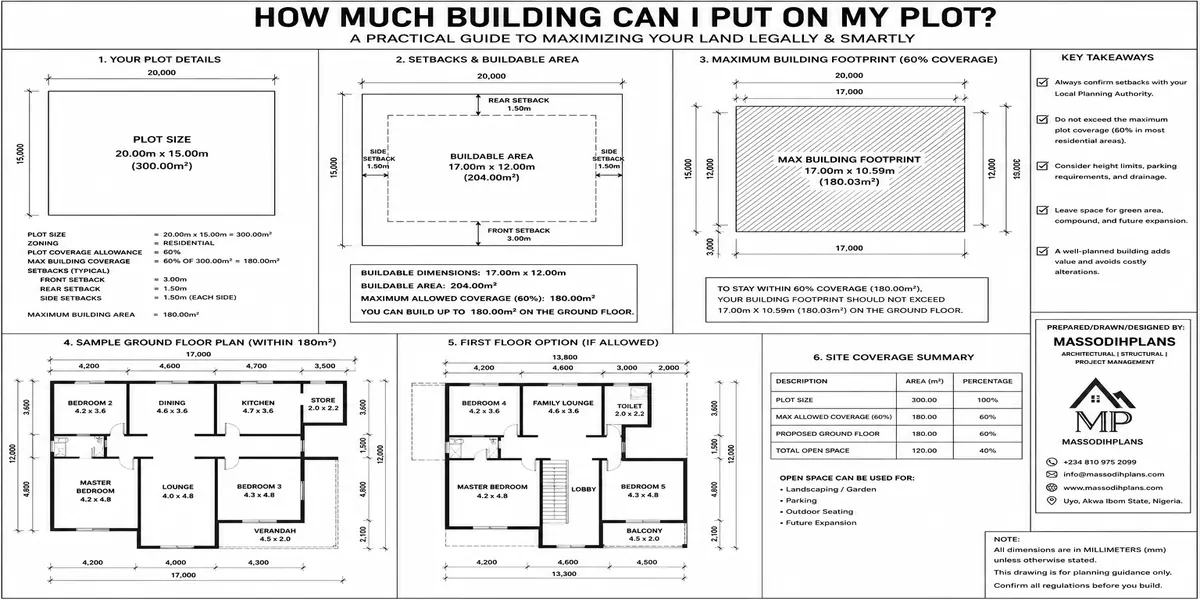
Setbacks are the minimum distances your building must maintain from plot boundaries. These vary by state and by the zoning classification of your land, but common standards include:
- Front setback: 3m to 6m from the road or front boundary
- Side setbacks: 1.5m to 3m from each side boundary
- Rear setback: 3m minimum from the back boundary
For a 15m x 30m plot with standard setbacks applied, your actual buildable area becomes approximately 9m wide by 21m deep, giving you roughly 189 square metres to work within. Understanding this before drawing saves enormous rework.
Note Drainage Flow and Natural Light Direction
In Nigeria for example, most states sit in tropical and sub-tropical zones. The sun rises roughly from the east and sets in the west. The main wind direction in southern Nigeria comes from the south and southwest (the Atlantic-sourced harmattan and monsoon winds).
Orient your plan so that:
- Living rooms and bedrooms face away from the harsh western afternoon sun where possible
- Windows on opposite walls are positioned to create through-ventilation
- Low-lying areas of your plot are avoided for structural foundations unless properly addressed with fill and drainage design
Step 2: Define the Room Programme for Your 3 Bedroom House
The room programme is simply the list of rooms and spaces your house must contain. For a 3 bedroom house in Nigeria, the typical programme includes:
Primary Spaces:
- Master bedroom with en-suite bathroom
- Bedroom 2 (children or guest)
- Bedroom 3 (children, guest, or study/work)
- Living room
- Dining area (may combine with living)
- Kitchen
Secondary Spaces:
- Main bathroom for bedrooms 2 and 3
- Guest toilet (near living area)
- Store or pantry
- Corridor and circulation space
- Verandah or covered entrance porch
External Service Areas:
- Back service yard (for laundry, generator, water pump)
- Borehole / water storage area
- Car parking (at minimum, one car space)
- Side access path for security rounds
Write this list down before drawing. It will guide every decision you make in the layout.
Step 3: Choose Your Drawing Method
You have three practical options, each with real advantages depending on your skill level and budget.
Option A — Manual Drawing (Pencil and Graph Paper)
This is still widely used in many part of the world including Nigeria, especially for initial concept work. You need:
- A4 or A3 graph paper (available at any stationery shop in major markets)
- A sharp 2H pencil for light construction lines
- An HB pencil for final lines
- A ruler, set square, and compass
- An eraser
Scale to use: 1:100 (meaning 1 centimetre on paper equals 1 metre on the actual building). For a 10m x 12m footprint, your drawing will be 10cm x 12cm on paper, a manageable size.
Option B AutoCAD (Industry Standard)
AutoCAD is what licensed architects use for professional drawings. It requires a computer and software investment. The free student version is available at autodesk.com. It has a steep learning curve but produces the most precise and professional output.
Option C Free Online Floor Plan Tools
For non-professionals, these tools require no drawing skills:
- Floorplanner.com: Free, browser-based, easy to use
- RoomSketcher.com: Good 3D preview feature
- Planner5D.com: Nigerian users find this particularly intuitive
I recommend beginners start with Floorplanner.com to understand spatial relationships, then graduate to AutoCAD if they are studying architecture or frequently drawing plans.
Step 4: Set Up Your Drawing Sheet
Whether manual or digital, set up your drawing sheet correctly before placing a single wall.
For manual drawing:
- Draw your title block at the bottom right (project name, date, drawn by, scale)
- Mark your north arrow in a clear position — this is not optional
- Leave a margin of at least 15mm on all sides
- Write your scale clearly: e.g., SCALE: 1:100
For digital tools:
- Set your units to metres
- Set your scale before drawing any walls
- Name your project and save a backup immediately
The discipline of setting up your sheet properly forces you to think about the full drawing before you begin. Professionals never skip this.
Step 5: Draw the External Walls First
This is where the actual floor plan begins.
Determine Your Building Footprint
For a 3 bedroom house on a 15m x 30m plot (with setbacks applied), a practical building footprint might be:
- 9m wide x 12m deep = 108 square metres of internal floor area
- Or 10m wide x 11m deep = 110 square metres
These dimensions comfortably accommodate a full 3-bedroom programme without wasted space.
Draw the Outer Wall Rectangle
On your paper or screen, draw the outer boundary of your building as a rectangle. At scale 1:100, a 9m x 12m building draws as a 9cm x 12cm rectangle.
Standard external wall thickness using 225mm (9-inch) sandcrete block construction is typically shown at 225mm (0.225m). At 1:100 scale, this line thickness represents 2.25mm on paper draw it as a thick line or double line showing wall depth.
Critical note on wall thickness in drawings:
Many self-builders confuse internal room dimensions with overall building dimensions. Always remember:
- External wall thickness eats into internal floor area on all four sides
- For a 9m x 12m external footprint with 225mm walls, your internal clear space is 8.55m x 11.55m
- Your corridor and room dimensions must fit within that internal dimension
Step 6: Divide the Interior with Internal Walls
Now you position your internal walls to create individual rooms and spaces. This is the most design-intensive step and where layout skill truly matters.
Start with the Bedroom Zone
Position the three bedrooms together in one wing or along one side of the building. This gives you:
- A private sleeping zone separated from the noisy living areas
- The ability to close off the bedroom corridor at night for security
- A shared bathroom wall between bedrooms 2 and 3, reducing plumbing run lengths
Recommended minimum room dimensions for 3-bedroom houses:
| Room | Minimum Width | Minimum Length | Minimum Area |
|---|---|---|---|
| Master bedroom | 3.6m | 4.0m | 14.4 sqm |
| Bedroom 2 | 3.0m | 3.6m | 10.8 sqm |
| Bedroom 3 | 3.0m | 3.0m | 9.0 sqm |
| Living room | 4.0m | 4.5m | 18.0 sqm |
| Kitchen | 2.4m | 3.0m | 7.2 sqm |
| Master en-suite | 1.5m x 2.4m | — | 3.6 sqm |
| General bathroom | 1.5m x 2.0m | — | 3.0 sqm |
| Corridor | 1.0m min width | — | — |
These dimensions are functional minimums. Where your plot allows, push bedroom widths to 3.6m minimum for real comfort.
Position the Living and Dining Area
The living room should occupy a front or central position, ideally accessible directly from the main entrance. In home culture, the living room receives guests, and its positioning communicates the social hierarchy of the building.
A combined living and dining in an open plan arrangement is the most space-efficient choice for medium plots. A 4.5m x 6.0m open-plan living-dining space feels generous even in a compact 3-bedroom house.
Position the Kitchen
The kitchen in homes serves as a working and semi-social space. Position it:
- Adjacent to the dining area for food service efficiency
- With direct access to a rear service yard where possible
- Away from the main entrance guests should not enter through the kitchen
- With at least one window to the outside for ventilation and natural light
Kitchen work creates heat and steam. In a hot climate like Nigeria’s, a kitchen with poor ventilation makes the entire house uncomfortable. Never place a kitchen at the building’s hot western wall without compensating with cross-ventilation.
Position Bathrooms and Toilets
Plumbing runs are among the most expensive parts of construction when done wrong. Position your wet rooms bathrooms, toilets, and the kitchen to share or cluster plumbing walls where possible. A master en-suite sharing a wall with the general bathroom cuts your pipe run costs significantly.
The guest toilet should sit near the living area, ideally accessible without passing through private bedroom zones.
Step 7: Add Doors and Door Swings
Every door you draw must answer two questions: which direction does it open, and does it interfere with anything when it opens?
Door Conventions for Floor Plans
- External doors: typically 900mm (0.9m) wide minimum, show as a thick arc indicating swing direction
- Bedroom doors: 800mm to 900mm
- Bathroom doors: 700mm to 750mm
- Door swing arcs must not clash with each other or with furniture positions
A Common Building Mistake
Many contractors and draftsmen position bathroom doors so they open directly toward a sleeping area or directly face a bedroom door. This is poor design practice. Stagger door positions or use short lobby spaces to create privacy transitions.
Step 8: Add Windows and Ventilation Strategy
In many places, windows are not decoration. They are a functional survival tool for managing heat and humidity. A poorly ventilated house becomes oppressively uncomfortable eight months of the year.
Cross-Ventilation Rule
Every habitable room, bedroom, living room, dining room, must have windows on at least two walls, or on walls that face different outdoor directions, to allow air to flow through the space. This is called cross-ventilation.
Practical window sizing guidelines:
- Bedroom windows: minimum 900mm wide x 1200mm high, positioned at approximately 900mm from floor level (sill height)
- Living room windows: 1200mm to 1500mm wide recommended
- Louvred windows in kitchens and bathrooms supplement fixed windows for continuous air movement
What Architects Call the “Hot Wall” Problem
In some places like Lagos, Akwa Ibom, Delta, and Ogun, Nigeria the western wall of any building receives direct afternoon sunlight from approximately 1pm to sunset. A bedroom on this wall without external shade or cross-ventilation becomes a heat trap.
Strategies to manage this:
- Plant fast-growing trees on the western boundary (neem, teak, or flamboyant trees)
- Add a 600mm to 900mm overhanging roof eave on the western wall to shade the windows
- Use louvred or adjustable shutters rather than fixed glass on western-facing windows
Step 9: Add the Roof Type and Roof Projection
The roof type affects your floor plan because roof overhangs (eaves) affect setbacks, rainwater drainage paths, and sun shading.
Roof Types Common in Residential Buildings
Hip roof: All four sides slope downward. Provides the best all-round wind and rain protection. Ideal for areas prone to strong coastal winds. Slightly more expensive to construct due to complex raftering.
Gable roof (Gablet): Two sloping sides meeting at a central ridge. Common and economical. Allows good attic ventilation through gable vents. Very popular in southeastern a place like Nigeria.
Flat roof with parapet: Used increasingly in urban homes for a contemporary look. Requires excellent waterproofing and adequate drainage slope. Poorly done flat roofs are the number one source of chronic roof leaks in cities.
Mono-pitch (lean-to): One-directional slope. Common for extensions, garages, and service areas.
For a standard 3-bedroom house on a medium plot, I recommend a hip or gable roof at a minimum pitch of 25 to 35 degrees. This pitch sheds rainfall volumes effectively and resists harmattan wind uplift.
On your floor plan, show roof overhang as a dashed line extending 600mm to 900mm beyond the external walls. This tells the builder exactly where rainwater will fall and where the ground drainage channel must be dug.
Step 10: Show Parking, Service Areas, and External Features
A floor plan is not complete without showing how the building relates to its compound.
Car Parking
Minimum one parking space per dwelling is the practical standard. A single parking bay requires:
- 2.4m wide x 5.0m long for a standard saloon or SUV
- 3.0m wide if you want door-opening clearance on both sides
Show the parking bay on your plan with a simple outline. Indicate whether it is covered (carport) or open. Position it so the car does not block pedestrian movement to the entrance.
Generator Space
Power supply remains unreliable in most locations outside major grid-serviced GRAs. Every home design should include:
- A dedicated generator enclosure or slab, minimum 1.5m x 2.0m, located at least 3m from bedroom windows to reduce noise and exhaust penetration
- Cable conduit route shown from generator position to your distribution board location
- Ventilation louvres in any generator enclosure wall
This is a detail most generic floor plan tutorials , especially foreign ones, completely ignore. In some part of the world, it is a necessity.
Borehole and Water Tank
Show the borehole position on your site plan and the overhead tank location. The overhead tank pedestal is typically positioned near the kitchen and bathroom wet wall cluster to minimise pipe run distances. A 1.0m x 1.0m concrete pedestal at 2.0m to 3.0m height is standard for a 1,000 to 2,000 litre polytank.
Drainage
Your floor plan should indicate:
- Roof gutter positions and downpipe locations
- The surface drain channel running around the building perimeter
- Soak-away pit or septic tank location (minimum 3m from building, minimum 10m from borehole)
Some places experience intense seasonal flooding. A drainage design drawn into your floor plan from the start saves enormously compared to retrofitting drainage after construction.
The Reality Layer
This section addresses the uniquely conditions that affect every floor plan decision.
Material Price Instability
Cement, iron rods, and roofing sheets fluctuate significantly due to dollar exchange rates, import duties, and seasonal demand. A floor plan that minimises material waste, through compact layout, regular wall grid, and minimal long wall spans, directly reduces your exposure to price surges.
When drawing your plan, aim for walls that land on a 225mm block module (multiples of 0.225m) wherever possible. This reduces cut blocks and waste on site.
Heat Management in the Layout
The tropical climate demands active heat management in floor plan design. Beyond cross-ventilation, consider:
Ceiling height: Minimum 3.0m clear floor-to-ceiling height reduces heat build-up. A 2.7m ceiling feels uncomfortably warm in some locations in March and April.
Thermal mass: Sandcrete block walls have moderate thermal mass, they absorb daytime heat and release it at night. This is why evenings feel warm even after sunset in concrete buildings. Roof insulation and ceiling voids help reduce this effect.
Shade before glass: External shading (overhangs, trees, louvres) is more effective than glass-based solutions at the typical construction budget.
Security in the Layout
Home security is a practical concern reflected directly in floor plan decisions.
- Position the master bedroom where the main entrance is audible
- Avoid ground-floor bedroom windows that face quiet side or rear boundaries without adequate grille protection
- Plan for a gate and perimeter fence from the beginning, the compound is part of your security system and needs space within the plot
Compound Size and Future Extension
Many families build in phases. Draw your floor plan with future extension in mind:
- Leave the rear of the building structurally prepared for an additional room or boys’ quarters
- Position your soak-away away from the likely extension direction
- Design the roof hip or gable so that a rear extension can be added without demolishing the primary roof structure
Small Plot Strategies for 3 Bedroom Houses
If your plot is smaller, say 10m x 20m or 12m x 24m, you can still achieve a fully functional 3 bedroom layout by applying these principles.
Eliminate the dedicated dining room: Integrate dining into the living room as an open plan. You recover 8 to 10 square metres without sacrificing function.
Use a single-loaded corridor: A corridor with rooms only on one side wastes less space per metre than a central corridor with rooms on both sides. On a narrow plot, a side-loaded layout with rooms arranged linearly down one side allows full cross-ventilation.
Push bathrooms inward: Internal bathrooms without exterior windows are acceptable when mechanical ventilation is planned (an exhaust fan). This frees exterior wall space for habitable rooms that need natural light.
Use a flat or mono-pitch roof on a rear extension: This allows a smaller footprint main block with a lower-cost rear service wing, reducing the overall structural cost while maintaining a full room programme.
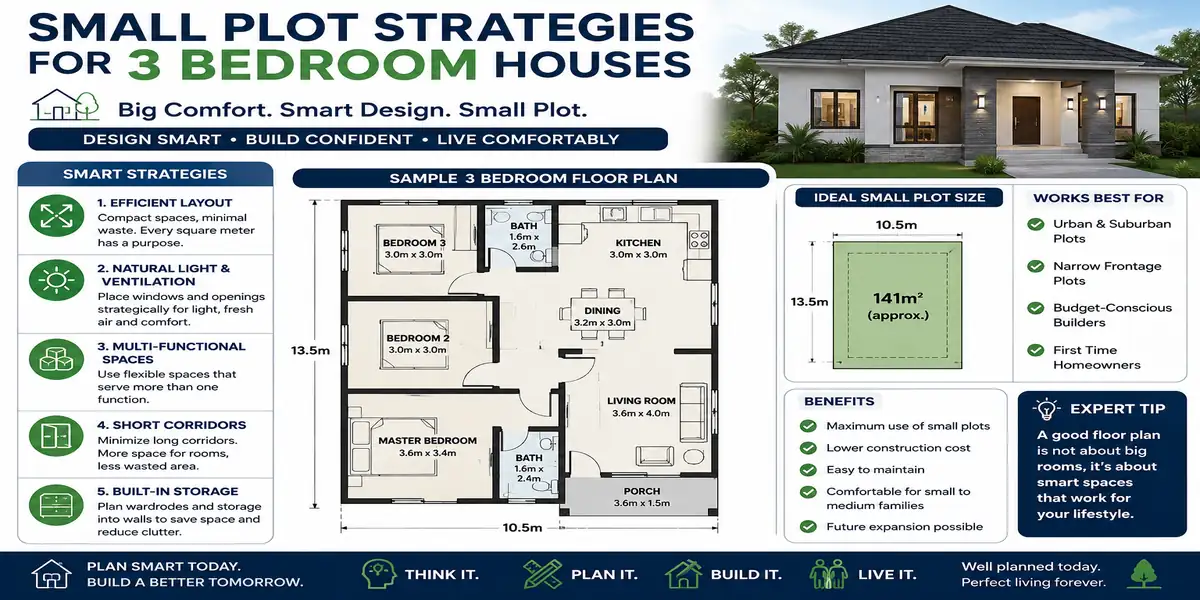
Small Plot Strategies for 3 Bedroom Houses
Family Lifestyle Suitability
A good floor plan anticipates how your family will actually live in the house.
For families with young children: Position children’s bedrooms adjacent to the master bedroom, not separated by the living room. Night-time supervision is easier when the sleeping zone is consolidated.
For families expecting frequent guests: Provide a guest bedroom that is accessible from the living area without passing through the family’s private zone. Position it near the guest toilet.
For elderly parents: Avoid split-level designs and steep internal ramps. Plan doorways at 900mm minimum width for wheelchair access if mobility issues are likely. Ground floor bedrooms are always preferable for older family members.
For work-from-home situations: The pandemic years taught many households that bedroom 3 works well as a home office when it is positioned away from the kitchen noise and children’s movement routes. A separate access point to bedroom 3 is a premium addition on medium and large plots.
Construction Experience: What Builders Often Get Wrong
I have seen the following mistakes occur repeatedly on building sites when the floor plan is unclear or misread.
Wall centre-line errors: Inexperienced site supervisors sometimes build walls to the outside edge rather than to the centreline, causing room dimensions to be consistently undersized by half a wall thickness. Always mark your critical internal room dimensions clearly on your drawing.
Door opening position shift: A door shown at one end of a wall gets built at the wrong location because the mason estimated rather than measured. Dimension door positions from fixed reference points, corners, on your drawing.
Bathroom slope omission: The floor plan does not show toilet floor slope, so the builder lays a flat bathroom floor. Water pools. Fungus grows. The owner re-tiles within two years. Always include a note on your drawing: “All bathroom floors to slope at 1:50 toward floor drain.”
Roof rafter bearing confusion: When the floor plan does not show the roof overhang correctly, the contractor builds the wall plate at the wrong position, cutting into internal room height. Show your lintel and wall plate levels in a section drawing to accompany the floor plan.
Cost Estimate Reference for a 3 Bedroom House For example in Nigeria
Cost estimates are indicative and vary significantly by state, material prices, and contractor quality. These figures assume a medium-quality finish (sandcrete block walls, ceramic floor tiles, aluminium windows, metal fascia roofing sheets).
| Item | Approximate Cost Range |
|---|---|
| Foundation and substructure (per sqm of floor area) | ₦35,000 to ₦55,000 |
| Superstructure walls (per sqm of wall area) | ₦18,000 to ₦28,000 |
| Roof structure and covering (per sqm of roof area) | ₦22,000 to ₦38,000 |
| Doors and windows (per unit) | ₦45,000 to ₦120,000 |
| Electrical installation (full 3-bed) | ₦350,000 to ₦700,000 |
| Plumbing installation (full 3-bed) | ₦280,000 to ₦550,000 |
| Floor and wall tiling (per sqm) | ₦8,000 to ₦18,000 |
| Painting (per sqm wall area) | ₦1,500 to ₦3,500 |
| Total for a 108 sqm 3-bed house (basic to medium) | ₦14 million to ₦28 million |
These figures are rough indicators only. Get three contractor quotations with a bills of quantity prepared by a registered quantity surveyor before committing to any figure.
Investment Value of a Well-Designed 3 Bedroom House
A correctly drawn and well-built 3 bedroom house in a serviceable Nigerian location represents one of the most reliable investment vehicles available to middle-income Nigerians.
Rental yield: In cities like Uyo, Onitsha, Enugu, Ibadan, and Abuja satellite towns, a 3-bedroom fully detached house commands ₦600,000 to ₦1,800,000 per year in rent depending on location and finish level.
Resale value: A well-planned 3-bedroom house on a full plot in a developing area typically appreciates at 15 to 25 percent annually in high-demand corridors.
Estate suitability: A floor plan that follows standard room dimensions and has a proper documentation set (architectural drawings, structural drawings, approval drawings) is far more attractive to buyers and more financeable under NHF and FMBN schemes.
The design quality premium: Homes with identifiable modern design qualities, large windows, open-plan living, covered parking, covered entrance, quality tiling, and a contemporary roofline, consistently command 20 to 35 percent higher market values than their plain box equivalents on comparable plots.
Common Beginner Mistakes When Drawing 3 Bedroom Floor Plans
- Drawing rooms too small, always check against minimum dimension standards before finalising
- Forgetting the corridor and circulation space, rooms cannot float in space; they need connecting paths
- Ignoring wall thickness, external walls are 225mm; internal walls are typically 150mm
- Placing wet rooms randomly, cluster plumbing to control costs
- Omitting the north arrow, orientation is functional, not cosmetic
- Drawing without setbacks applied, you may be designing a building that cannot receive approval
- Making bedrooms accessible only through other bedrooms, every bedroom needs independent access from a corridor
- Placing the kitchen with no exterior wall, it will be poorly ventilated and hot
- Designing parking as an afterthought, it must be integrated into the site plan from the start
- Not dimensioning the drawing, an undimensioned floor plan cannot be built from
Quick Summary: 10 Steps to Draw a 3 Bedroom Floor Plan
- Measure and confirm your plot with a surveyor
- Apply the correct government setbacks for your state
- Write out your full room programme before drawing
- Choose your drawing tool, paper, AutoCAD, or free online software
- Set up your drawing sheet with scale, north arrow, and title block
- Draw the outer wall rectangle to your building footprint dimensions
- Divide interior with internal walls using minimum room dimension standards
- Add all doors with swing arcs, checking for clashes
- Add windows positioned for cross-ventilation in every habitable room
- Complete with parking, generator space, drainage, and service areas
Expert Note
The floor plan is not just a technical document. It is a prediction of how a family will live for the next thirty years. Every door position, every window, every corridor width is a decision about daily comfort or daily frustration. Draw it carefully, then draw it again. by MassodihPlans.
FAQs
Q: What is the standard size of a 3 bedroom house floor plan?
A floor plan for a 3 bedroom house ranges from 95 to 140 square metres of internal floor area. On a 15m x 30m plot, a footprint of 9m x 12m (108 sqm) is practical and comfortable.
Q: Can I draw my own floor plan without being an architect?
Yes. For personal understanding and concept development, you can draw your own floor plan using graph paper or free tools like Floorplanner.com. However, for submission to state building approval authorities, the drawings must be signed and stamped by a registered architect (ARCON-registered).
Q: How much does it cost to have a 3 bedroom floor plan drawn?
Professional architectural drawings for a 3 bedroom house in a country like Nigeria typically cost between ₦80,000 and ₦350,000 depending on the firm, the state, and the complexity of the design. This usually includes floor plan, elevations, sections, site plan, and approval documentation.
Q: What scale should I use to draw a 3 bedroom floor plan?
Use 1:100 for general arrangement drawings (floor plan, elevations, site plan). Use 1:50 for detail drawings of bathrooms, kitchens, and staircases where more precision is needed.
Q: What software do architects use to draw floor plans?
AutoCAD is the industry standard. Revit is used by larger firms for Building Information Modelling. For students and beginners, ArchiCAD, SketchUp, and free web-based tools like Floorplanner and Planner5D are practical alternatives.
Q: How do I ensure my 3 bedroom floor plan gets building approval?
Submit your drawings through a registered architect who is a member of Architects Registration Council. The approval is processed through your state’s Ministry of Physical Planning or the relevant local government planning authority. Requirements vary by state.
Q: What is the minimum plot size for a 3 bedroom house?
A 3 bedroom house can be designed on a plot as small as 10m x 18m (180 sqm) with careful planning and compact layout strategies. However, a 15m x 30m plot gives far greater design freedom, adequate setbacks, parking, and room for future extension.
Related Posts
- Building Approval in Nigeria: Costs, Requirements, Process and How to Get Your House Plan Approved Fast
- Full Cost Breakdown for Building a Duplex on a Small Plot in Kano Nigeria
- Small Residential Estate Layout Design in Nigeria: Smart Master Plan Ideas for Limited Land
- Industrial Estate Layout Design in Nigeria: Smart Master Plan for Small Industrial Plots
- Smart Duplex Design for Narrow Plots in Lekki, Nigeria: Complete Practical Guide
- 7 Small Plot Design Mistakes Nigerians Make (And How to Fix Them)
- Best Small Plot House Designs for Modern Urban Living
- Modern Nigerian House Plan for a 30×60 Plot in Ibadan: The Complete Practical Guide
- Full Cost Breakdown for Building a Duplex on a Small Plot in Kano Nigeria
- House Plan Selection Guide: How to Choose the Right House Plan for Your Land, Budget and Lifestyle
- Land-Buying Checklist: 100+ Things to Check Before Buying Land in Nigeria
- Homeowner’s Construction Checklist: 150+ Things to Check Before and During Building
- Building Materials Checklist: 100+ Materials You May Need When Building a House
- Site Analysis Checklist: 50+ Things to Check Before Building on Your Land
- Building Cost Calculator Nigeria: Estimate Your House Cost in 60 Seconds
- House Planning Checklist: 50+ Essential Things to Check Before Building a House (Complete Guide)
- What Principles Guide the Design of an Air Force Base Master Plan?
- Nigerian House Plans for Family Homes in Makurdi, Benue State, Nigeria
- Cost of Building a 3 Bedroom Bungalow in Umuahia, Abia State (Current Price Guide)
- Nigerian House Plans Suitable for Hot Weather in Sokoto
Ready to Build? Start With the Right Plan
You now understand the process. You know how setbacks work, how rooms should be arranged, how ventilation protects your family, and how a floor plan is the single most important investment you make before construction begins.
At MassodihPlans, I provide premium, fully documented 3 bedroom house plans designed specifically for Nigerian plots compact, climate-smart, approval-ready, and built around how Nigerian families actually live.
What you get with every MassodihPlans design:
- Complete floor plan with dimensions
- Four elevation drawings
- Site plan with setbacks and drainage
- Structural notes
- Material specification guide
Explore the plan library → [Browse 3 Bedroom Plans]
If you want a custom floor plan drawn for your specific plot, reach out via the contact page. I work with clients across Lagos, Abuja, Port Harcourt, Uyo, Enugu, Onitsha, and all states.
Let your building start with a plan that was drawn, not copied from somewhere else.
Written by the Massodih
About Author
Massodih Okon is a built environment professional with a background in architecture and urban planning. He specializes in practical Nigerian house design guidance through MassodihPlans.com.. He has a Master’s degree in Urban and Regional Planning, a first degree in Geography and Environmental Management, and professional certificates in Architectural Design, Landscape Design, and GIS. With over 15 years of hands‑on experience in architecture, town planning, GIS, and building economics across Nigerian residential and institutional projects, he understands the real challenges Nigerians face when planning and building homes.
At MassodihPlans, Massodih shares practical Nigerian building guides, modern bungalow and duplex house plans, and built environment resources created specifically for Nigerian homeowners, developers, and property investors. His work is based on real‑life conditions in Nigeria, climate‑responsive design, and cost‑effective planning, aimed at helping everyday Nigerians make smarter, more confident building decisions.