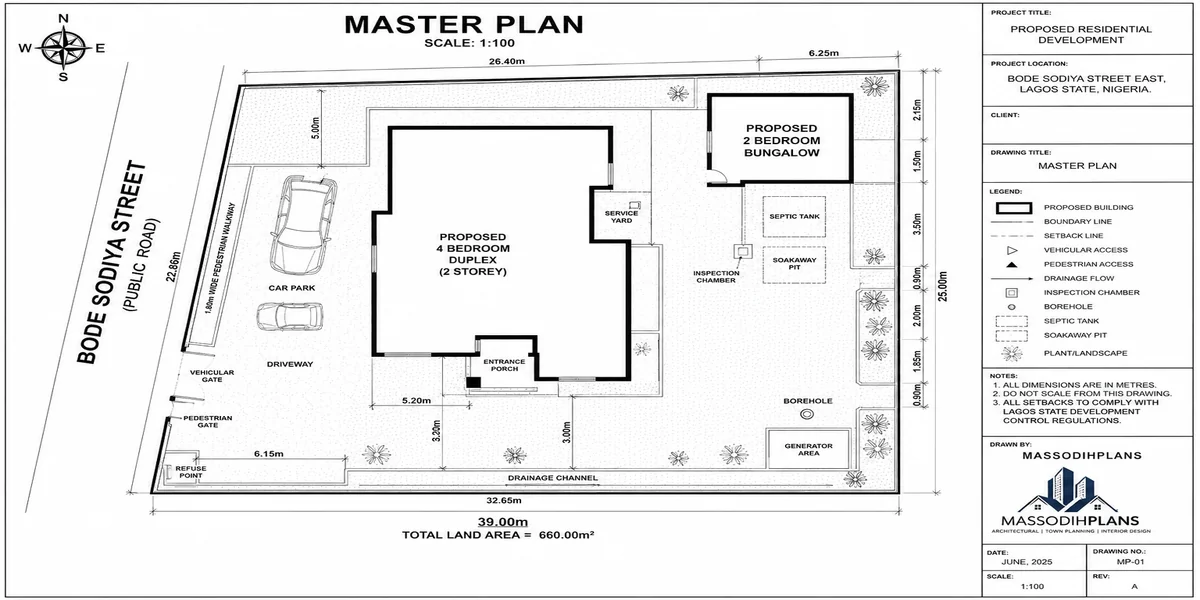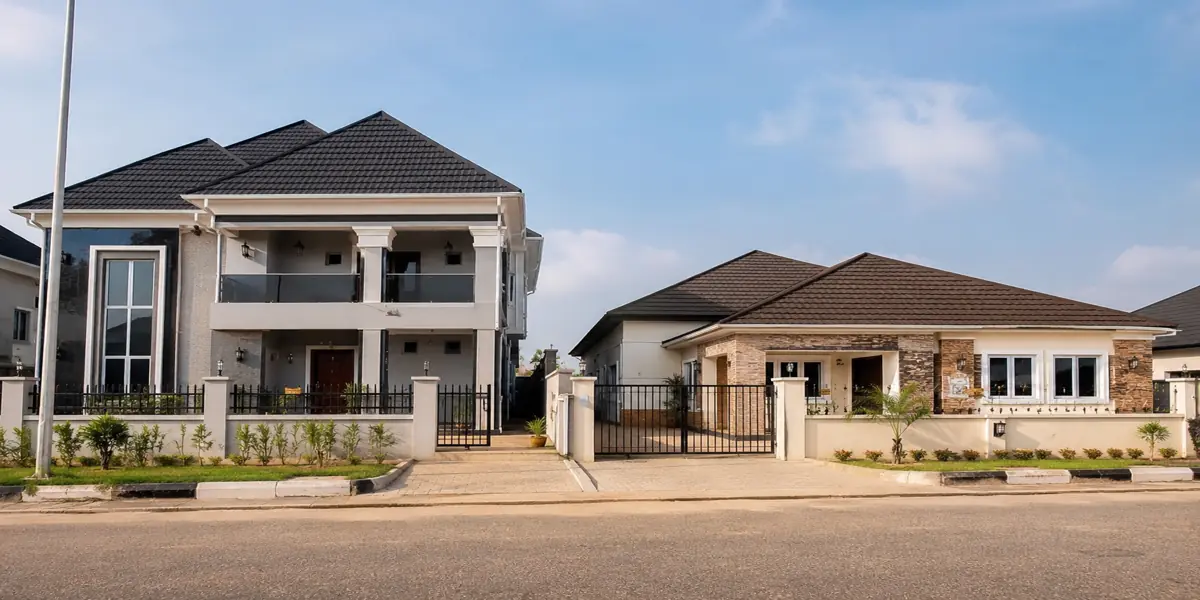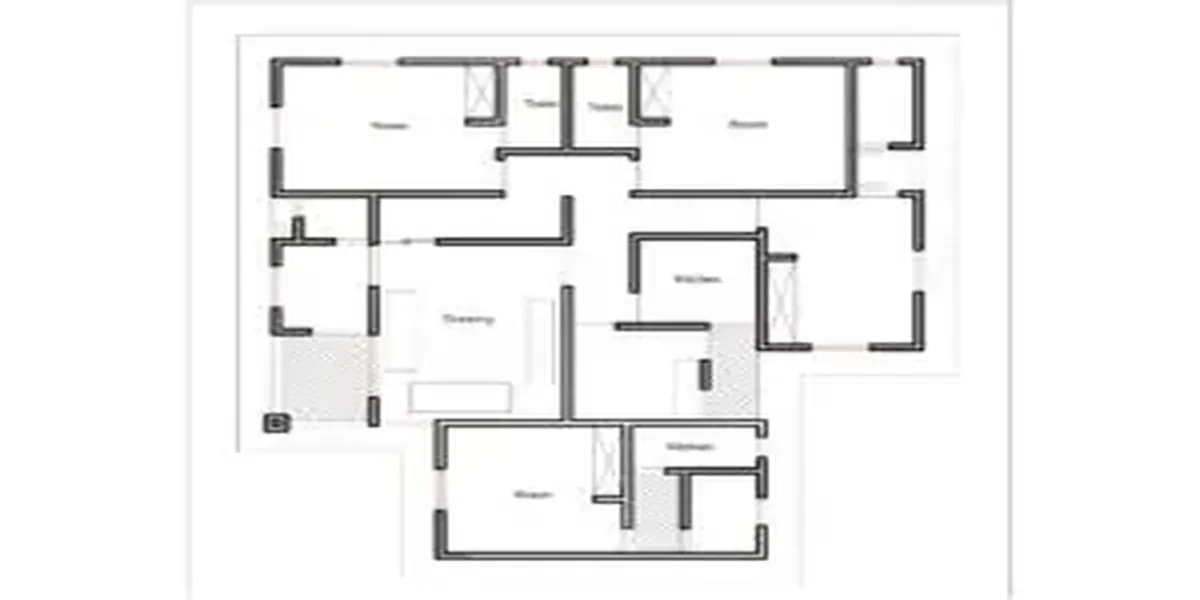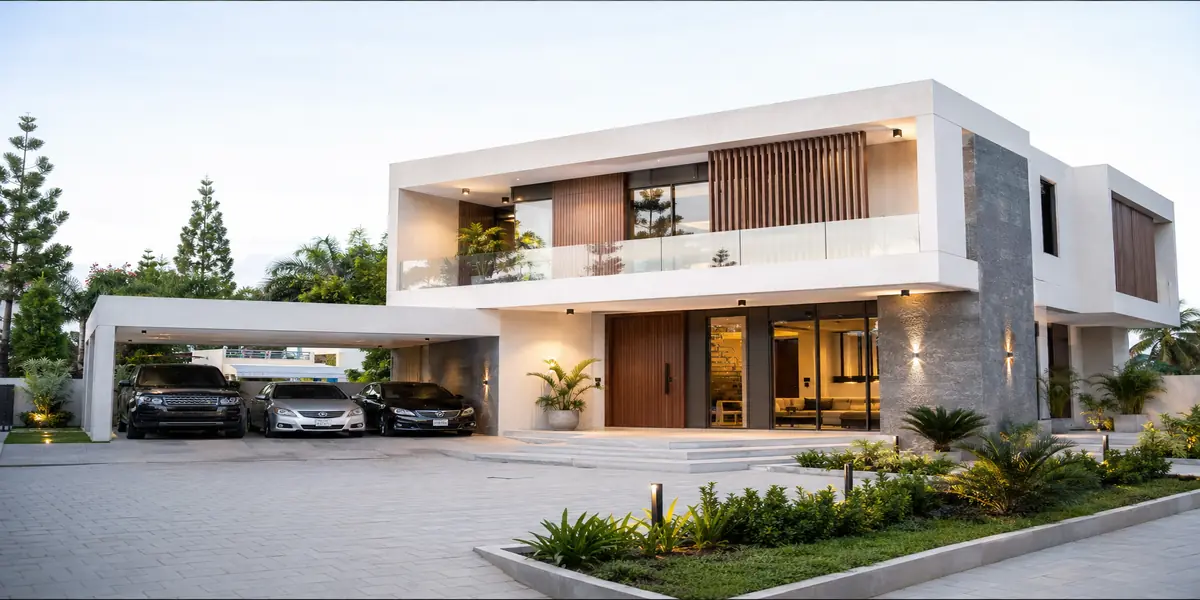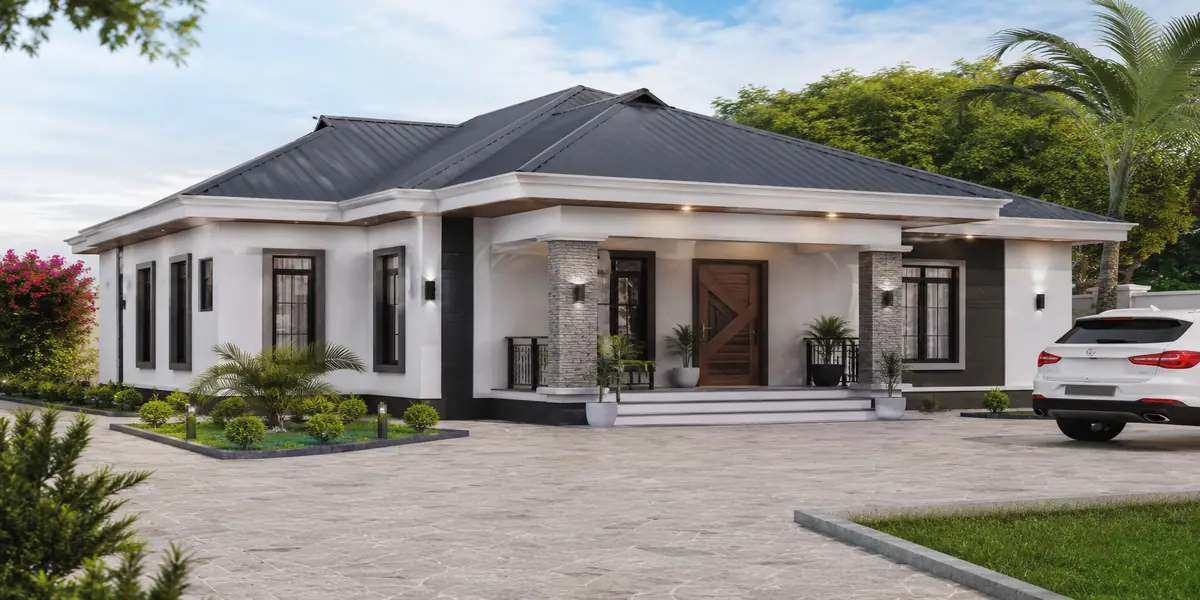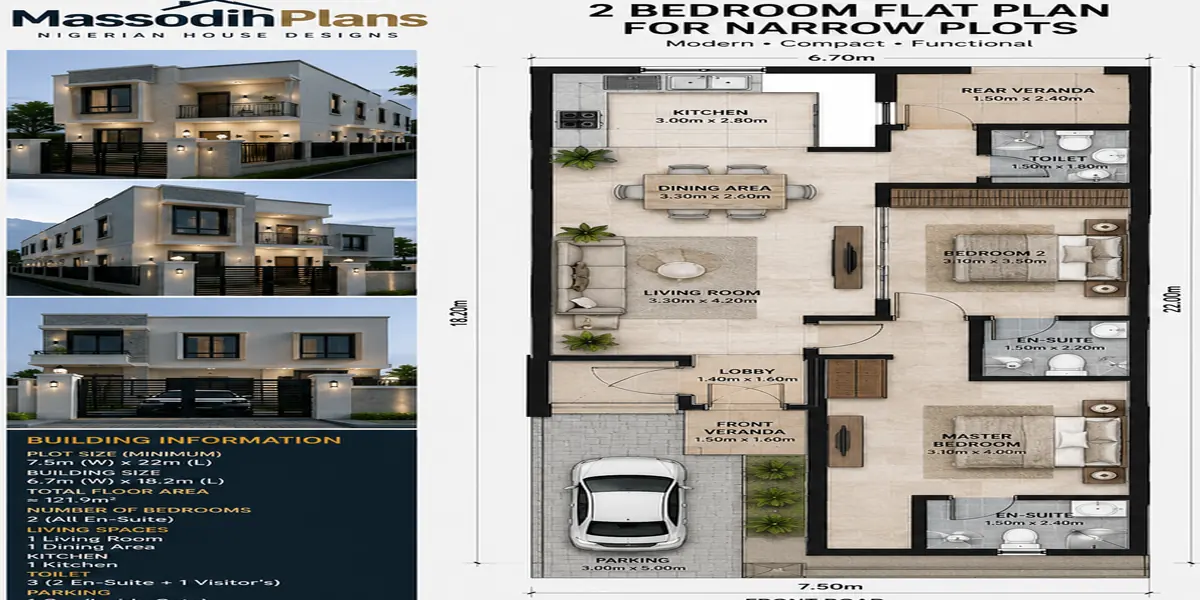
2 Bedroom Flat Plan for Narrow Plots in Nigeria
2 bedroom-flat-plan for narrow plot
If you have a narrow plot in Nigeria and you want a comfortable 2-bedroom home, the biggest question is not simply, “How many rooms can I fit?” It is, “How can I fit the right rooms without creating a dark, cramped, poorly ventilated house?” That is what this guide solves.
A well-designed 2 bedroom flat plan for a narrow plot can give you a proper living room, functional kitchen, dining space, two genuinely usable bedrooms, bathrooms, storage, circulation and outdoor space even when the site is much tighter than a conventional residential plot. The secret is not squeezing everything together. It is controlling the building width, room proportions, door positions, window locations, service zones, setbacks and movement through the house from the beginning.
In this guide, I will walk you through practical Nigerian layout options, recommended room dimensions, example plot sizes, efficient floor-plan arrangements, ventilation and daylight strategies, privacy considerations, kitchen and bathroom placement, parking and entrance planning, and the mistakes that make narrow houses feel smaller than they really are.
You will also see how to decide whether a single-storey 2-bedroom flat, semi-detached arrangement or compact two-storey solution makes more sense for your plot, budget and future plans. Most importantly, I will explain which dimensions are starting points rather than universal rules, because your actual site, local planning requirements, structure and services must determine the final drawing.
So, whether you own a 30×60 ft, 40×60 ft, 40×80 ft or another non-standard plot, don’t start drawing walls yet. Start with the site and the way you want the house to work. By the end, you should be able to recognise a genuinely efficient narrow-plot plan and know exactly what to ask for before construction begins, before spending money on detailed architectural drawings.
What Plot Size Are We Talking About?
When I say narrow plot, I am referring to any plot that is 9 to 12 metres wide. In many Nigerian cities, especially in older residential areas of Port Harcourt, Aba, Uyo, Calabar, and parts of Lagos Island, you will find a lot of these plots. They were laid out years ago in layouts that were not always well planned.
The typical land sizes where this 2 bedroom flat plan works well include:
- 9m x 30m plots (approximately 270 sqm)
- 10m x 20m plots (approximately 200 sqm)
- 12m x 18m plots (approximately 216 sqm)
- Any plot where the narrow side (frontage) is between 7.5m and 12m
EXPERT NOTE: The Nigerian Urban and Regional Planning Act and many state planning laws require minimum setbacks of 1.5m to 3m from plot boundaries. On a narrow 9m-wide plot, once you set back 1.5m on each side, you have only 6m of buildable width. Your plan must work within that. This is where most people get stuck and where an experienced planner makes the real difference.
2 Bedroom Flat Plan for Narrow Plots in Nigeria
The Recommended Floor Layout
For a narrow plot that is roughly 9 to 12 metres wide, here is the layout that works best. I have used a similar arrangement in multiple projects across Southern Nigeria, and it consistently delivers comfort within a small footprint.
Overall Building Footprint
| Space/Area | Approximate Dimension |
| Total building width | 6.5m to 8.0m |
| Total building length | 12.0m to 15.0m |
| Total floor area | 78 sqm to 110 sqm |
| Bedroom 1 (master) | 3.6m x 3.9m = 14 sqm |
| Bedroom 2 | 3.0m x 3.6m = 10.8 sqm |
| Living/Sitting Room | 3.6m x 4.5m = 16.2 sqm |
| Kitchen | 2.4m x 3.0m = 7.2 sqm |
| Bathroom/WC (Master) | 1.5m x 2.1m = 3.15 sqm |
| Bathroom/WC (Shared) | 1.5m x 1.8m = 2.7 sqm |
| Corridor/Passage | 1.2m to 1.5m wide |
| Porch/Veranda (front) | 1.5m x 3.6m = 5.4 sqm |
| Setback (each side) | 1.5m minimum |
| Setback (front from fence) | 1.5m to 3.0m (state-specific) |
| Setback (rear) | 3.0m minimum |
Those dimensions may look tight on paper, but let me tell you from experience: when a skilled designer plans the circulation properly and the rooms are oriented correctly, 10.8 sqm for a bedroom is not uncomfortable. It is actually a standard size in many European and Asian compact housing models that Nigerians are now increasingly familiar with through Airbnb and hotel stays.
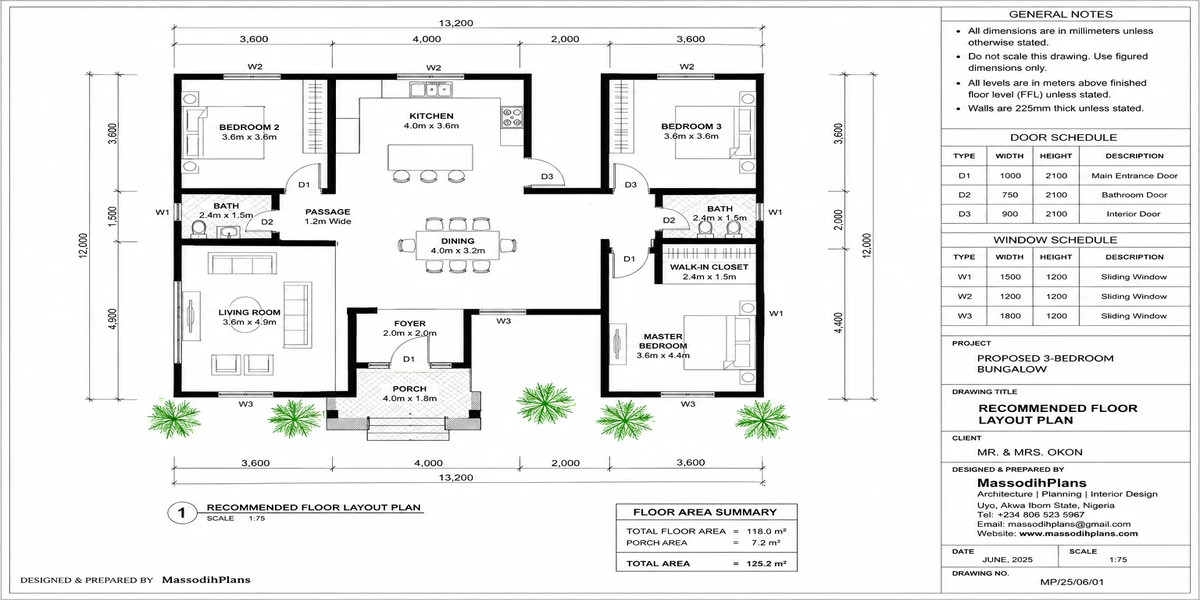
2 Bedroom Flat Plan for Narrow Plots
How the Rooms Are Arranged and Why It Matters
Room arrangement on a narrow plot is not just about fitting things in. It is about how people actually live inside the building. During my undergraduate studies in Town Planning at the University of Uyo, one thing our lecturers constantly emphasized was circulation efficiency. How people move inside a building determines whether it feels spacious or suffocating.
Here is the recommended arrangement from front to back:
Porch or small veranda at the front. This gives the building a breathing space and is important for Nigerian climate. It also creates a transition zone between outside and inside, which helps with security.
Living room immediately behind the porch. This is the first room you enter. It should face the front of the plot so it gets morning light and breeze. On a narrow plot, a rectangular living room running the length of the building works better than a square one.
Kitchen at the rear or side of the living area. Placing it at the rear keeps cooking smells away from guests and takes advantage of rear ventilation. A small dining alcove next to the kitchen saves space compared to a separate dining room.
Bedrooms in the middle and rear portion of the building. The master bedroom can go at the rear for privacy. Bedroom 2 can sit between the living area and master bedroom along the passage.
Bathrooms tucked between bedrooms or at the rear. This keeps wet areas consolidated and reduces plumbing length, which directly saves money during construction.
PRACTICAL TIP FROM THE FIELD: I have worked with clients who insisted on putting the master bedroom at the front because they wanted a window facing the street. I understand the appeal. But in most Nigerian residential areas, a bedroom facing the street means noise, dust, headlights at night, and security concerns. Always push the bedrooms to the rear or middle where possible. Your tenants and family members will thank you.
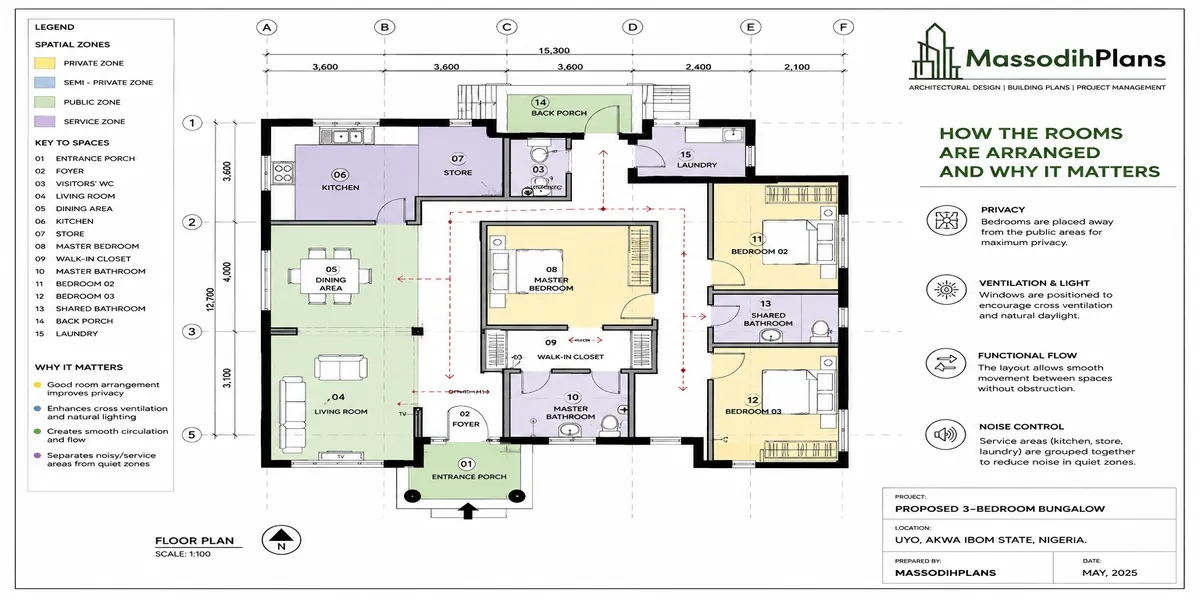
2 Bedroom Flat Plan for Narrow Plots in Nigeria: How the Rooms Are Arranged and Why It Matters
Ventilation on a Narrow Plot: This Is Where Many Builders Get It Wrong
This is the section most architecture blogs skip over, but I am going to be very direct with you because I have seen what happens when ventilation is ignored.
In a narrow building, if you have full walls on both long sides and small windows, the inside becomes an oven. Nigeria is a tropical country. Temperatures in cities like Port Harcourt, Warri, and Aba can sit comfortably in the high 30s during the dry season. Without good ventilation, a building becomes unliveable without constant generator-powered air conditioning. And we all know what NEPA is like.
Ventilation Strategies That Work on Narrow Plots
Cross ventilation through the building, not across it. On a narrow plot, windows on the front and rear walls are your primary ventilation path. Align your openings so air flows from front to back.
Louvred windows on the long side walls even if they are close to the boundary. Where the setback allows, a louvred window 900mm above floor level on each side provides valuable supplementary airflow.
High-level openings. Windows placed at ceiling level (clerestory windows) allow hot air, which rises, to escape. This one detail alone can reduce indoor temperature by several degrees.
The corridor as an air channel. A central corridor running the length of the building creates a pressure path for air movement. Keep the corridor door and windows aligned.
Roof ventilation. Install a ridge vent or soffit vents under your eaves. This allows hot attic air to escape rather than radiating heat down into your living spaces.
Ceiling height. Do not compromise on ceiling height. A minimum of 2.7m finished ceiling height is strongly recommended for hot zones. Higher ceilings mean more air volume and a cooler feel.
From what I have seen in practice, the biggest ventilation mistake on narrow plots is installing full solid walls on the long sides because the builder wants to save cost on materials. What they are actually doing is creating a pressure vessel. The building heats up quickly and cools down slowly. The long-term cost in electricity and discomfort far outweighs any short-term material savings.
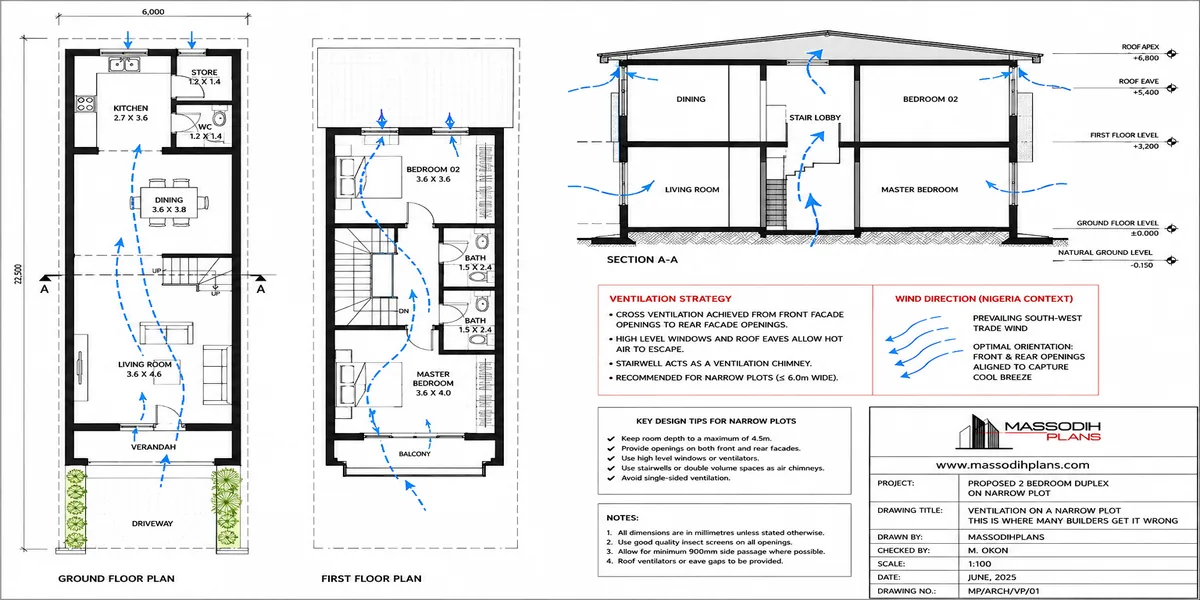
Ventilation on a Narrow Plot
Natural Lighting: Brightness Without Burning Your Budget
Natural light is free. But you have to design for it deliberately, especially on a narrow plot where side windows may be restricted by the setbacks.
South-facing or east-facing living rooms get the best light in the morning without the brutal afternoon western sun.
Bedroom windows facing east give you gentle morning light. Bedroom windows facing west can make a room unbearable by 4pm.
Use glass louvres or jealousy windows in bathrooms and secondary spaces to bring in light without sacrificing privacy.
Consider a small skylight or translucent roofing sheet in the kitchen or corridor to bring in diffused natural light.
Light-coloured interior walls (cream, off-white, pale yellow) reflect natural light and make narrow rooms feel wider.
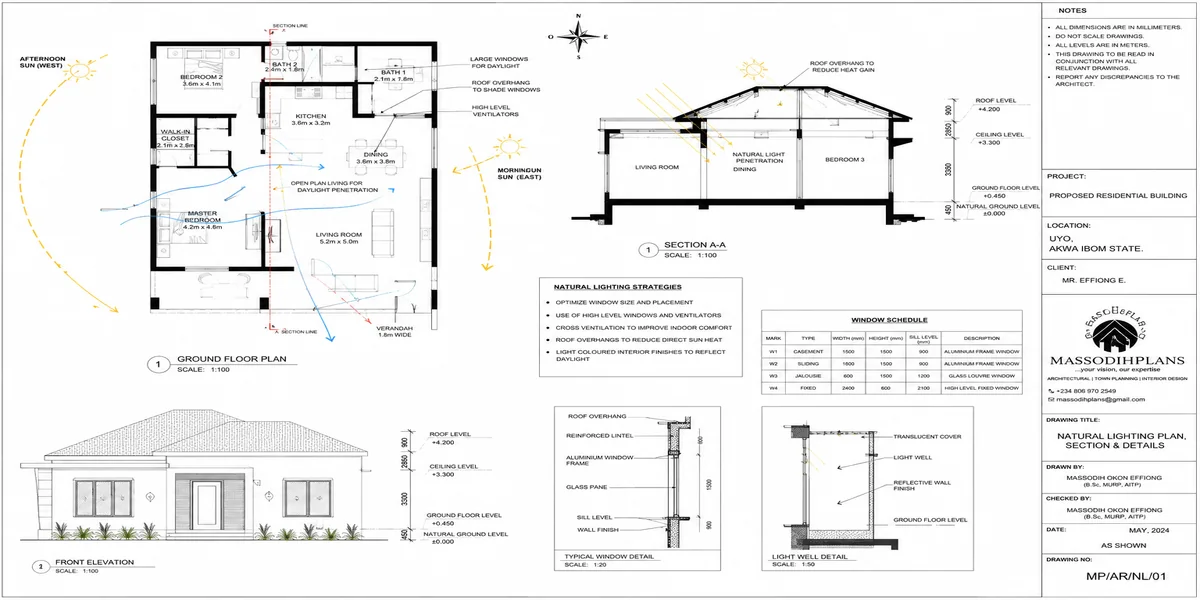
2 Bedroom Flat Plan for Narrow Plots in Nigeria: natural lighting autocad plan
Plot Orientation: Which Direction Should the Building Face?
In Nigerian climate conditions, orientation matters more than most people realise. The ideal orientation for a building on a narrow plot is with the long axis running east to west. This means:
The narrow front and rear faces north and south, which reduces direct sun exposure on the largest wall area.
The long sides face east and west. While west-facing walls still receive afternoon sun, good eave overhang and external shading can manage this.
This orientation also aligns well with the prevailing south-western wind pattern in the Niger Delta and southern Nigeria, promoting cross ventilation.
In my experience, when a client has a north-south running narrow plot, meaning the long axis goes from north to south, the building must be designed so that the living spaces face south or east, never west. The afternoon western sun beating directly into your living room is something no amount of ceiling fan can fix.
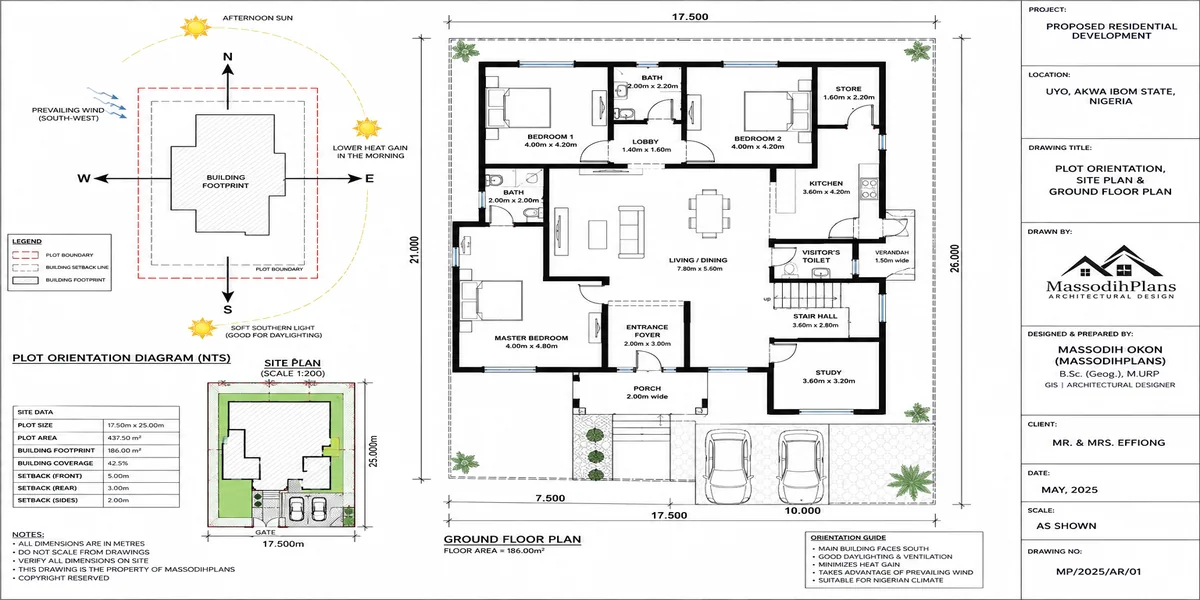
2 Bedroom Flat Plan for Narrow Plots in Nigeria: plot orientation plans and design
Setbacks and What the Law Says
I want to spend a little time on this because during my internship and in the many planning applications I have worked on since, setback compliance is one of the most common reasons a building plan gets rejected by the local planning authority.
| Setback Type | Recommended Minimum |
| Front setback (from fence/road reserve) | 3.0m in many states (check local law) |
| Rear setback | 3.0m (bungalow), 4.5m (two-storey) |
| Side setback (each side) | 1.5m minimum |
| Side setback for windows | 1.5m from boundary wall |
| Setback from drainage channels | Check with local authority |
IMPORTANT PLANNING NOTE: These are general guidelines based on common Nigerian planning standards. Your specific state or local government may have different requirements. In Akwa Ibom State, for example, the Uyo Capital City Development Authority (UCCDA) and Akwa Ibom State Physical Planning Board have their own setback schedules. Always confirm with your local planning authority or hire a registered Town Planner to guide you before you start building.
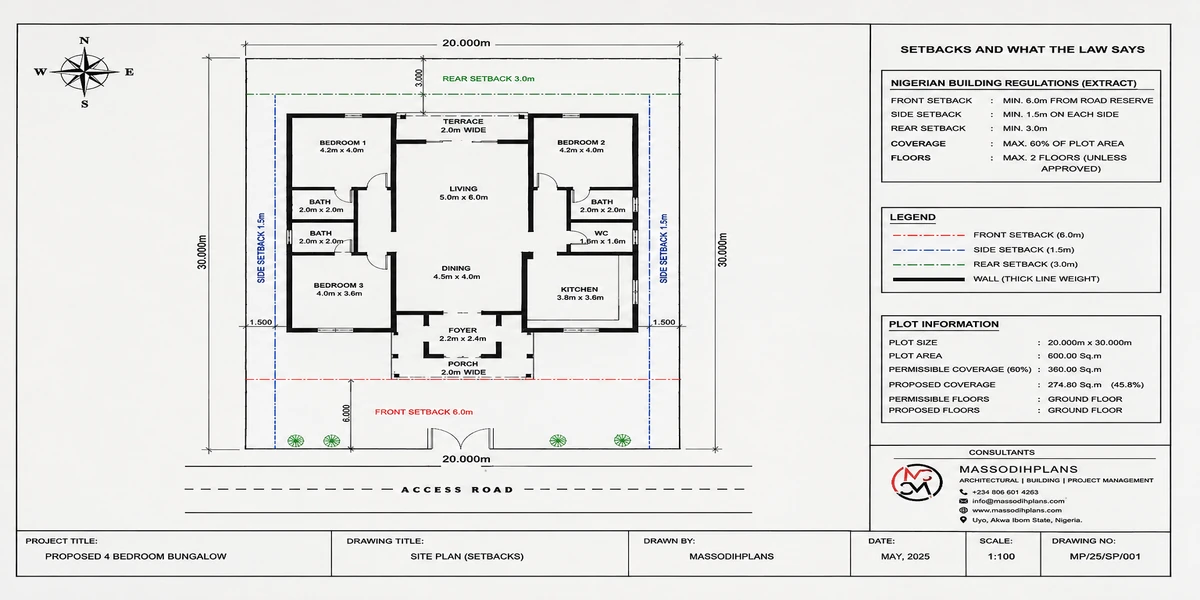
building setbacks plan
Roofing Style: What Works Best on a Narrow Plot
The roof is not just a covering. On a narrow plot, the roof design directly affects how the building looks from the street, how well it handles rainwater drainage, and how comfortable the interior temperature is.
Recommended Roof Types for Narrow Plots in Nigeria
Gable roof (two slopes facing front and rear): This is the most practical and common choice for narrow plots. It drains rainwater efficiently to both sides and creates good attic ventilation. From the street, a well-designed gable roof looks clean and modern.
Hip roof with extended eaves: A hip roof that extends 900mm to 1.2m beyond the wall provides excellent shade on all sides, which is critical for the Nigerian climate. The downside is slightly higher cost due to more complex carpentry.
Mono-pitch (lean-to) roof: For a very tight budget or a flat extension, a mono-pitch roof is the cheapest and fastest option. It works well for extensions or servant quarters but looks cheap as a primary roof unless designed carefully.
Avoid flat roofs in most parts of Nigeria. They collect rainwater, crack with thermal expansion, and lead to serious leakage problems within five years in a high-rainfall zone like the Niger Delta.
For a 2 bedroom flat on a narrow plot, my personal recommendation is a gable roof with 1.2m eave overhang on both long sides and pre-painted long-span aluminium roofing sheets. The long-span sheets reduce the number of joints and therefore the chances of leakage. Colour-wise, a grey or terracotta colour reflects less heat than darker tones.
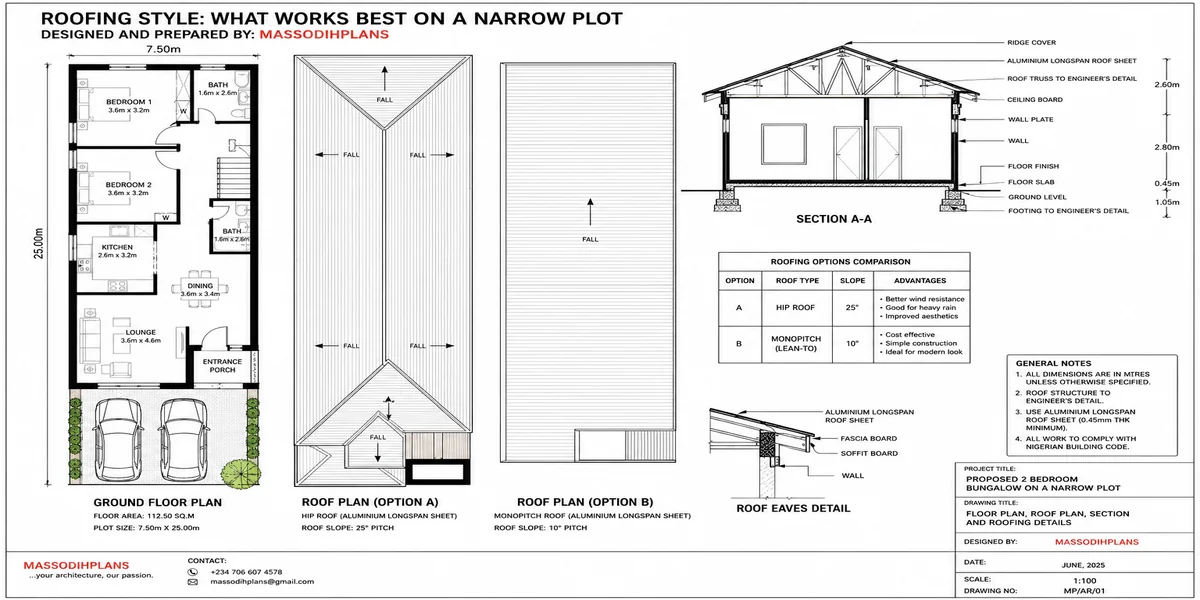
roofing style narrow plot
Parking on a Narrow Plot: Is It Possible?
This is where most people lose hope. They assume that a narrow plot means no parking. But that is not always true.
A single car parking space requires a minimum of 2.5m width and 5.0m length. On a 9m wide plot with 1.5m side setbacks, you have 6m of usable width. A 2.5m parking bay fits within that with 3.5m remaining for pedestrian access and landscaping.
For a 12m wide plot, two parking spaces (5m wide total) can fit side by side in the front setback area, leaving a comfortable circulation path.
If the plot is very narrow and parking in front is not possible, consider a rear access arrangement where a gate at the back of the plot allows a vehicle to park in the rear setback area.
Parking on the side is another option. A 2.5m wide side parking lane can be created along one side of the building if the side setback is generously increased to 3m on that side.
REAL PROJECT EXPERIENCE: I once reviewed a plan where the client had a 9.5m wide plot and absolutely insisted on two parking spaces at the front. The only way to achieve it was to push the building right to the rear of the plot, which reduced the usable compound space significantly and compromised the rear setback. We eventually settled on one covered parking space at the front and a motorcycle/bicycle bay at the side. The client was initially disappointed but after construction, they agreed it was the right call. You have to be practical.
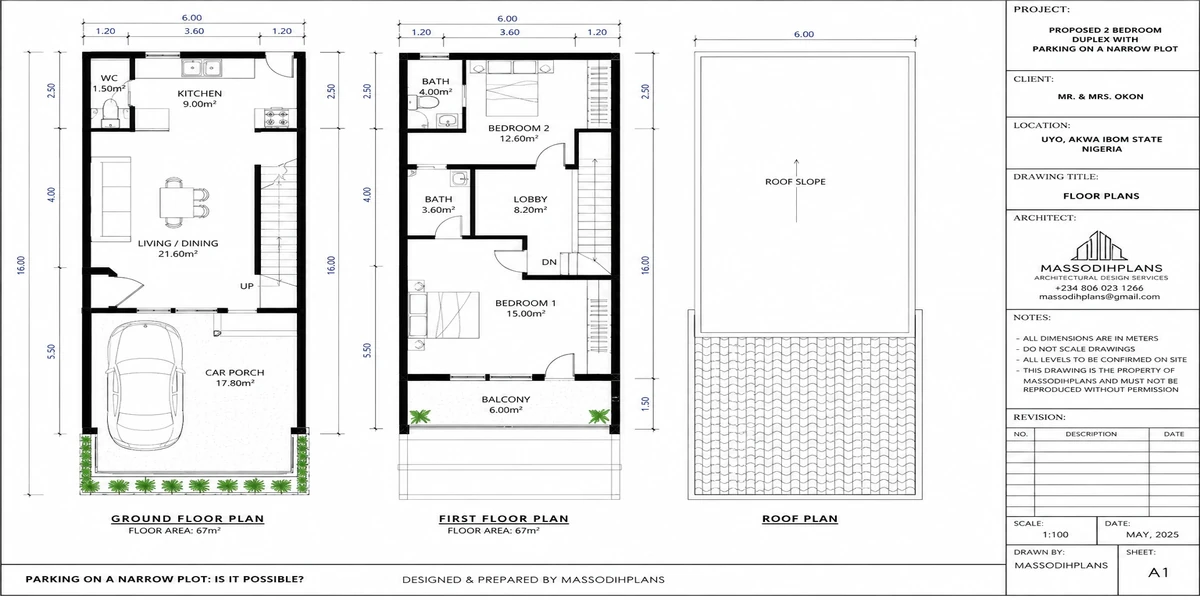
parking narrow plot
Nigerian Reality: What the Other Plans Websites Do Not Tell You
Every country has its own building realities. Nigeria has its own, and they must be planned for from day one. Ignoring these will cost you money, comfort, and peace of mind.
Generator Space
In Nigeria, generator space is not optional. It is mandatory. Plan a dedicated generator shed or alcove at least 1.5m x 1.5m, usually at the rear or side of the building. The generator should be sheltered from rain but well ventilated to prevent carbon monoxide buildup. Keep it away from bedroom windows.
Borehole Planning
Most Nigerian residential plots need a borehole. A borehole requires a minimum of 3m clearance from septic tanks, soakaway pits, and drainage lines. On a narrow plot, decide early where your borehole will go. The front or rear corner is usually the best option. Trying to find borehole space after the building is up is a real headache.
Drainage and Flooding
Nigeria loses billions of naira every year to avoidable flood damage. Before you even design your building, investigate the drainage pattern of your plot. Which direction does rainwater naturally flow? Is there a low point where water collects? Your finished floor level should be raised at least 600mm above the surrounding ground level in flood-prone areas like Port Harcourt, Warri, and parts of Lagos. This is not decoration. It is survival.
During field inspections as part of my planning work, I have seen beautiful, expensive buildings sitting in pools of water during every rainy season because nobody thought about drainage during design. Do not let that be your story.
Compound Security and Gate Position
On a narrow plot, compound security requires careful thought. A well-positioned gate that can be seen from the main sitting room window is ideal. The porch or veranda should allow you to see who is at the gate before opening. Consider incorporating a small guard point or gatehouse if the budget allows, even just a covered area by the gate.
Septic Tank and Soakaway
Your septic tank should be positioned in the rear of the compound, minimum 3m from the building and from the borehole. On a narrow plot, a pre-cast concrete septic tank with a connected soakaway pit is the most space-efficient option. Confirm with your plumber the required tank size based on the number of rooms and expected occupants.
Power Supply Planning
Install conduit pipes in every wall during construction. Do not allow your electrician to plaster cables on the surface. Pre-wire for inverter/solar battery systems from the beginning. The additional cost of conduit installation during construction is tiny compared to the cost of rewiring later.
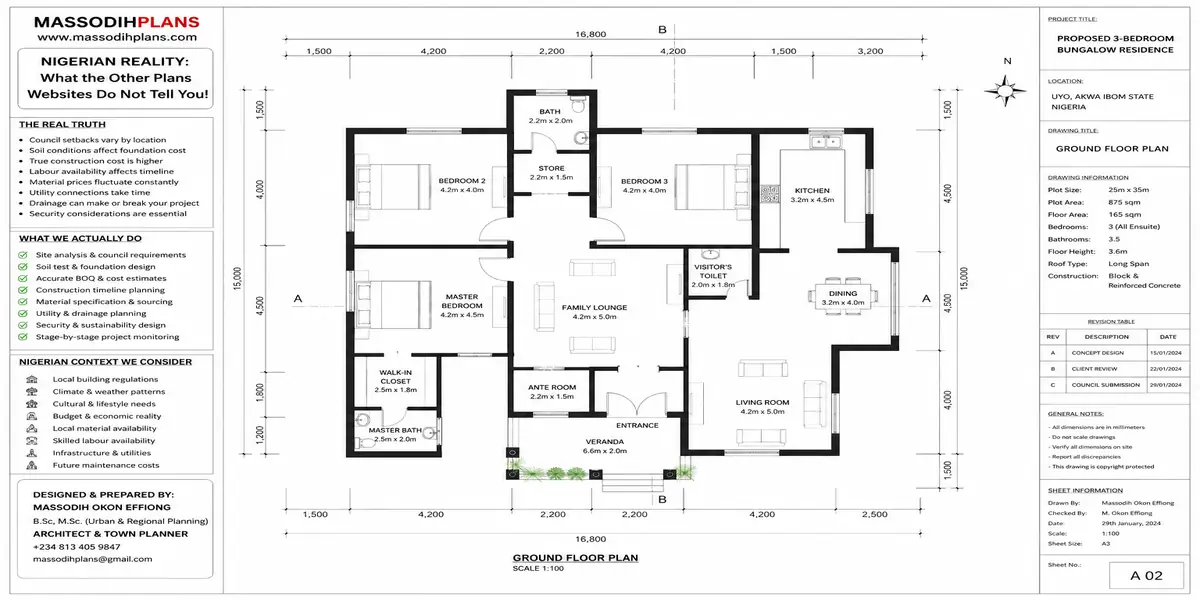
nigerian building plans reality
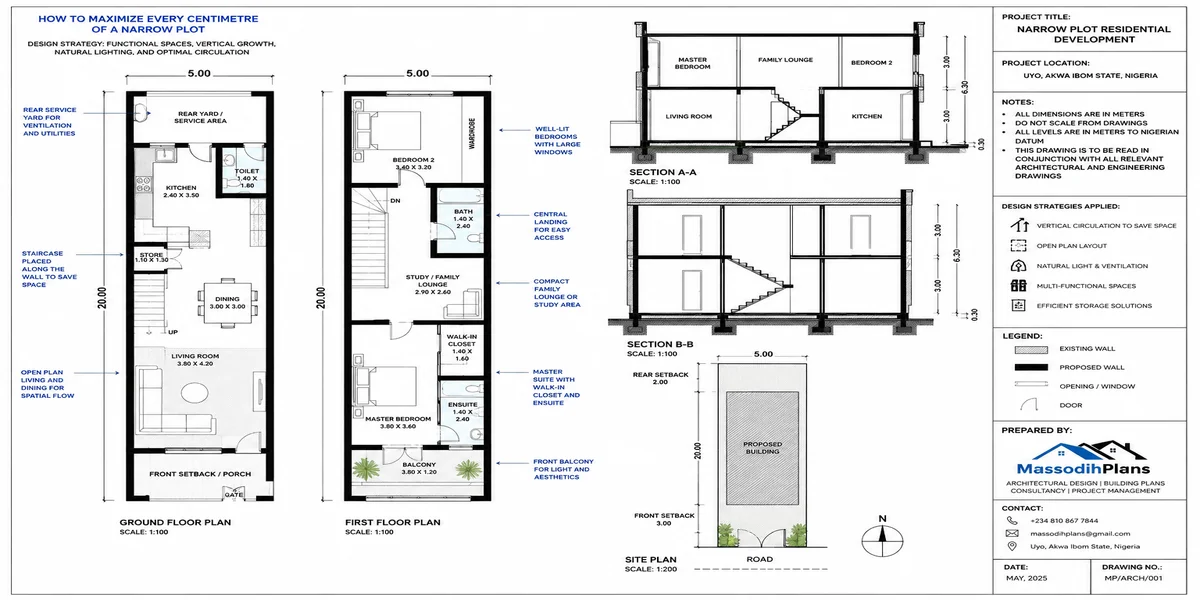
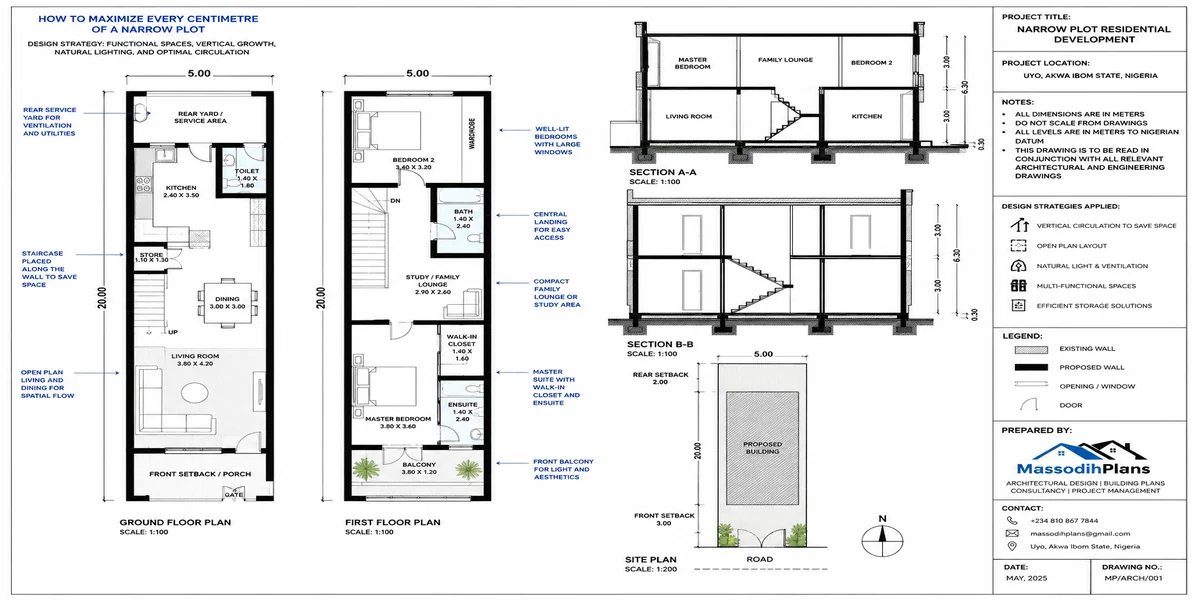
How to Maximize Every Centimetre of a Narrow Plot
Compact design is a science. When done well, a small flat feels spacious. When done poorly, a large flat feels cramped. Here are the specific strategies I apply when working on narrow plot designs.
Open-Plan Living and Dining
On a narrow plot, combining the living and dining into one open space rather than two separate rooms saves at least 4 to 6 sqm without sacrificing any function. The space flows better, feels bigger, and is easier to furnish.
Built-In Storage
Wardrobes that are built into the wall rather than standalone furniture can recover 400mm to 600mm of floor space in each bedroom. On a narrow bedroom, that 400mm is the difference between a room that feels right and a room that feels like a corridor.
Sliding Doors and Pocket Doors
A standard hinged door swings through 700mm to 900mm of floor space when opening. In tight rooms or corridors, this is wasted space. Sliding doors or pocket doors (doors that slide into the wall) eliminate this completely. They cost more but are well worth it in key areas like bathrooms and bedrooms.
Multi-Functional Porch
The front porch on a narrow building can double as a laundry drying area, a relaxation space, and a visitor reception area. A porch depth of 1.5m is the minimum. Go to 1.8m if the front setback allows.
Upward Expansion
If your budget or current needs cannot accommodate everything now, design the ground floor slab and columns strong enough to carry an additional floor in the future. This is called building for vertical expansion. On a narrow plot, going up is almost always more practical than spreading sideways.
narrow plot
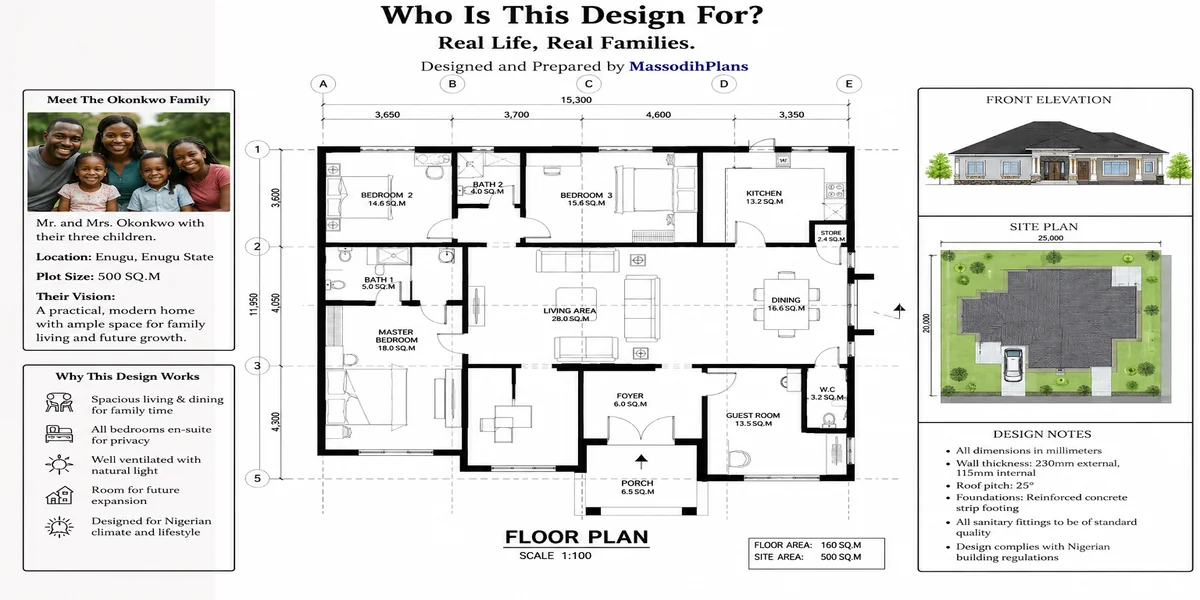
Who Is This Design For? Real Life, Real Families
A house plan is not just a set of lines on paper. It is a framework for how real people live. Let me walk you through how different families can use this plan.
Young Couple or New Family
A 2 bedroom flat is the classic starter home for a young Nigerian couple. The master bedroom is your private space. The second bedroom serves as a baby room initially, then a child’s room as the family grows. The open-plan living area is great for entertaining and family gatherings. This layout works very well for this stage of life.
Family with School-Age Children
As children get older, their need for defined personal space increases. The bedroom 2 in this layout is big enough for two children sharing bunk beds. The corridor arrangement keeps the children’s movement between bedroom and bathroom from disturbing the master bedroom at night.
Elderly Occupant or Accessibility
If an elderly parent will be living here, a few modifications make a big difference. Keep the master bedroom door wide (minimum 900mm clear opening) to accommodate a walking frame. Install a grab rail in the bathroom. Avoid steps at the porch entrance, use a gentle ramp instead. Ground floor living is always preferred for elderly accessibility.
Work-From-Home Arrangement
The second bedroom can function very well as a home office. A 10.8 sqm bedroom is sufficient for a desk, chair, storage, and a daybed for occasional guests. If you work from home regularly, plan for a dedicated power circuit and internet conduit to that room.
Guest Privacy
The bedroom 2, positioned between the living area and the master bedroom, provides a decent privacy buffer for guests. They do not need to walk through your bedroom to reach theirs. This is something many cheap narrow plot designs get wrong.
Building floor plans for nigerian
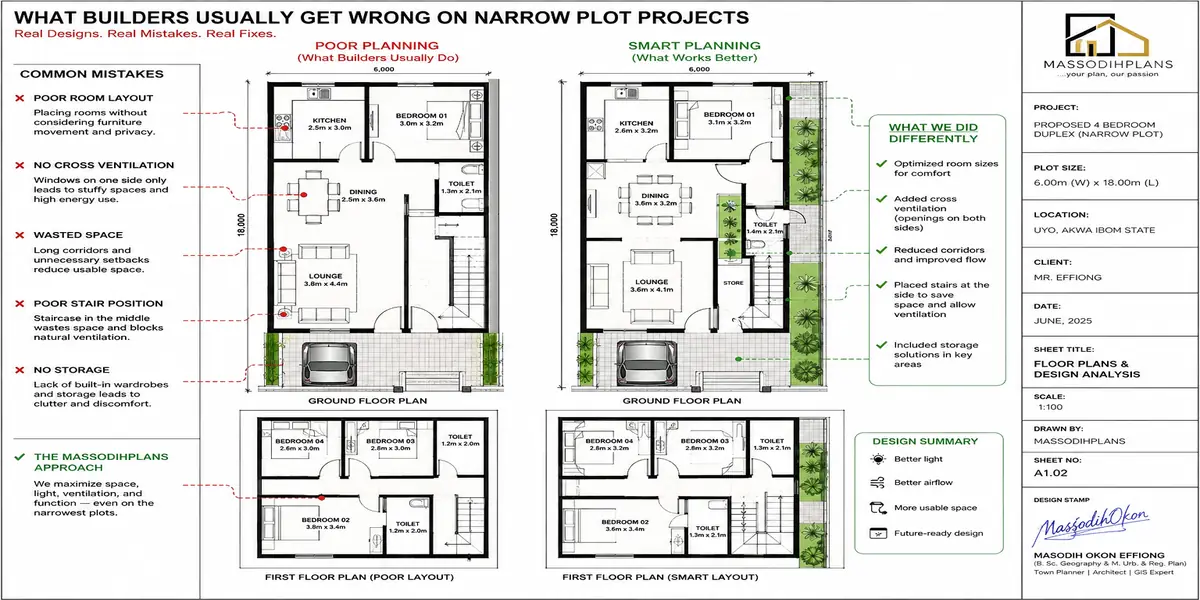
What Builders Usually Get Wrong on Narrow Plot Projects
I did not learn all of this from a textbook alone. Some of these lessons came from watching projects go wrong and understanding why.
Underestimating the Foundation
On a narrow plot, the temptation to cut costs on the foundation is high. Builders sometimes reduce the foundation trench width or use fewer reinforcement bars. This is a serious mistake. A narrow building that is longer than it is wide has a specific structural behaviour, and the foundation must account for differential settlement, especially in areas with soft, waterlogged soils like parts of Port Harcourt and the Niger Delta. Always consult a structural engineer before setting out the foundation.
Starting Without a Plan Approval
Based on projects I have worked on, I can tell you with complete confidence: building without an approved plan in Nigeria is one of the most expensive risks a homeowner can take. The local planning authority can stop your project mid-construction, impose heavy fines, or in extreme cases, order demolition. The approval process is not complicated if you work with a registered Town Planner from the beginning. Do not skip it.
Copying Plans From Social Media Without Adjusting for the Actual Plot
This is one of the most common mistakes I encounter. Someone sees a beautiful plan on Facebook or WhatsApp and asks their builder to replicate it exactly, without checking if the dimensions match their actual plot boundaries, soil conditions, or local planning requirements. A plan that works for a 15m wide plot in Lekki will not work for a 9m wide plot in Aba. Always adapt.
Poor Supervision Leading to Material Waste
On a narrow site, material storage space is limited. If you are not on site regularly or have not hired a competent site supervisor, cement bags get rained on, tiles get broken, and steel gets stolen. My internship experience reinforced the importance of daily site supervision. Even visiting every two days can mean the difference between a well-executed plan and an expensive mess.
Overloading the Ground Floor Slab Without Planning for It
If you intend to build a second floor later, you must tell your structural engineer at the design stage. The ground floor beams, columns, and slab must be designed for the future load. Trying to add a second floor to a slab that was not designed for it is either impossible or extremely expensive to fix.
narrow plot design
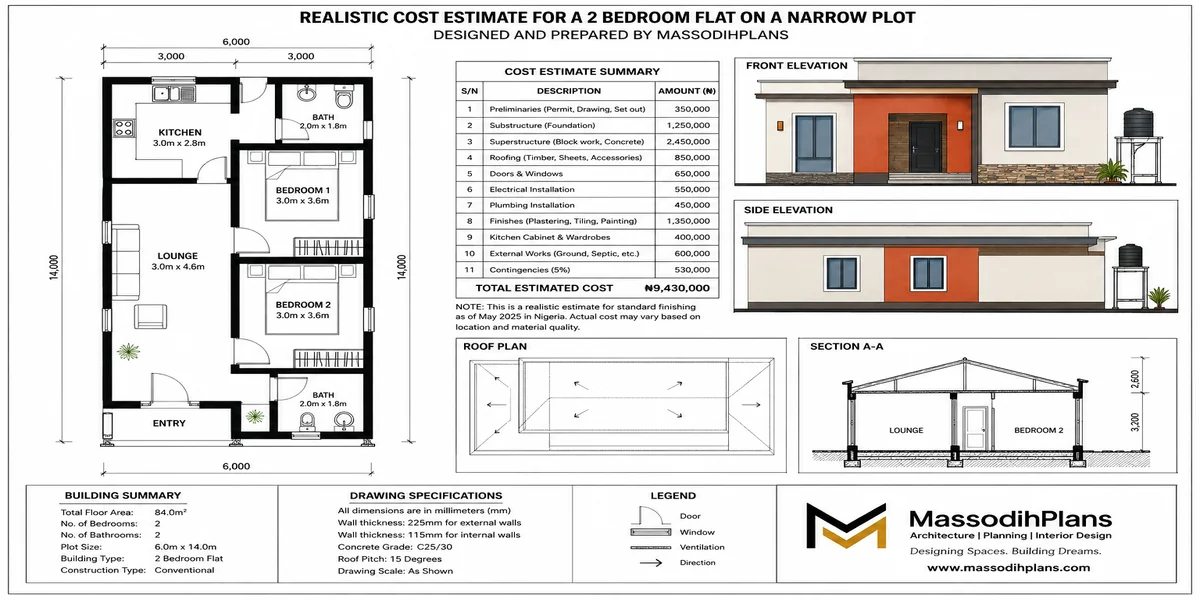
Realistic Cost Estimate for a 2 Bedroom Flat on a Narrow Plot
I want to be very honest with you here. Building costs in Nigeria change with material prices, location, and contractor choice. What I will give you are realistic ranges based on current market realities as of mid-2025. These are not exact quotes. They are informed estimates to help you plan.
| Cost Item | Approximate Range (Naira) |
| Plan and approval fees (Town Planner + Authority) | N200,000 – N600,000 |
| Foundation and substructure | N1,500,000 – N3,000,000 |
| Block work (walls) | N1,200,000 – N2,200,000 |
| Roofing (gable, long-span sheets) | N800,000 – N1,800,000 |
| Electrical installation | N400,000 – N900,000 |
| Plumbing and sanitary works | N350,000 – N800,000 |
| Plastering and rendering | N500,000 – N900,000 |
| Tiling (floors and wet areas) | N600,000 – N1,200,000 |
| Doors and windows | N500,000 – N1,200,000 |
| Painting (interior and exterior) | N350,000 – N700,000 |
| Septic tank and soakaway | N250,000 – N600,000 |
| Borehole (if needed) | N400,000 – N1,000,000 |
| Generator shed and miscellaneous | N150,000 – N400,000 |
| TOTAL ESTIMATE | N7,000,000 – N15,500,000 |
COST REALITY CHECK: This estimate is for a quality but not extravagant 2 bedroom flat on a narrow plot. Material prices in Nigeria change frequently. Cement, steel, tiles, and roofing sheets have all seen sharp price increases in recent years. Always add a 15 to 20 percent contingency buffer to any budget estimate. And please, get at least three separate bills of quantities from contractors before choosing one.
Location matters significantly. Building the same design in Abuja FCT will cost more than in Uyo. Building in a densely urban area with poor access roads will cost more than in a peri-urban area where materials can be delivered easily.
2 bedroom narrow plot cost estimate
Material Recommendations for a Narrow Plot Build
Walls
Nine-inch (225mm) hollow sandcrete blocks for external walls. Six-inch (150mm) blocks for internal partitions. Do not use only hollow blocks throughout for structural reasons. Solid blocks or ring beams at specific points are required where indicated by your structural engineer.
Roofing
Pre-painted long-span aluminium roofing sheets in 0.55mm thickness. Avoid cheap 0.45mm sheets that buckle and warp quickly. Fix with neoprene-washered roofing screws, not loose nails that pull out during storms.
Flooring
Ceramic tiles or porcelain tiles are the most practical choice for Nigerian residential buildings. They are easy to clean, durable, and widely available. For bedrooms, some clients prefer laminate or vinyl wood-look flooring for a warmer feel. Avoid marble or granite in budget projects as they are expensive and cold to walk on.
Windows
Aluminium frame windows are the standard in most of Nigeria and are practical. However, if budget allows, consider uPVC frames which provide better thermal performance and require no painting. Louvred windows for bathrooms and auxiliary spaces. Fixed glass or casement windows for living areas.
Ceiling
PVC ceiling panels or gypsum board (plasterboard) with a suspended grid system are both good options. PVC panels are more moisture resistant, which matters in a country like Nigeria. Avoid asbestos ceiling boards, which are still sold in some markets but are a health hazard.
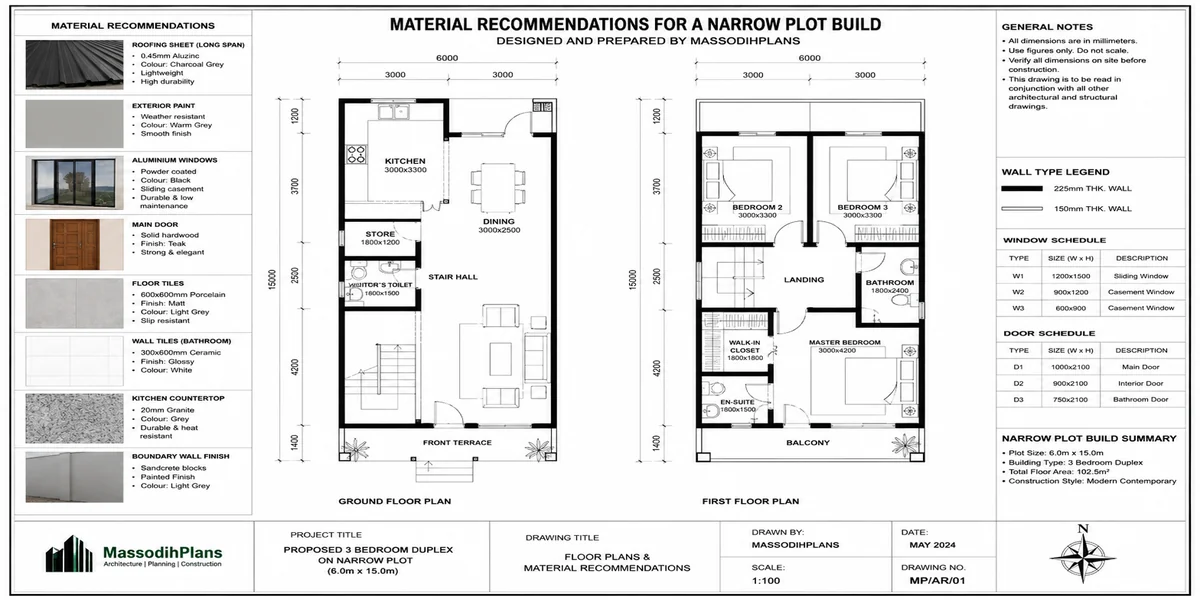
Material Recommendations for a Narrow Plot Build
Is a 2 Bedroom Flat on a Narrow Plot a Good Investment?
Let me answer this honestly, the way I would answer a client sitting across from me.
A 2 bedroom flat on a narrow plot in a good location is an excellent investment in Nigeria. Here is why.
Rental Profitability
2 bedroom flats are the most demanded rental category in urban Nigeria. Young professionals, young couples, and small families all target this size. In cities like Uyo, Port Harcourt, and Abuja, a well-built 2 bedroom flat in a decent neighbourhood can earn N400,000 to N1,200,000 per year in rent depending on location and finish. Against a total build cost of N7m to N15m, that is a respectable yield.
Resale Potential
A properly built flat on a titled plot in a good location appreciates steadily over time in Nigeria. The key word is titled. Make sure your land documentation is complete before and after construction. A Certificate of Occupancy (C of O) or Right of Occupancy (R of O) is your most important asset.
Urban Investment Value
Narrow plots tend to be in inner urban areas where land is scarce. As cities grow, inner urban land becomes more valuable. Building now on a narrow plot that others have ignored is actually a smart contrarian move. In many Lagos neighbourhoods, plots that people considered too small ten years ago are now extremely sought-after.
Estate Suitability
If you are developing within a private estate, a well-designed 2 bedroom flat on a narrow plot gives you the ability to offer a premium product at an affordable price point. This is a very popular strategy among small-scale estate developers in South-South and South-East Nigeria.
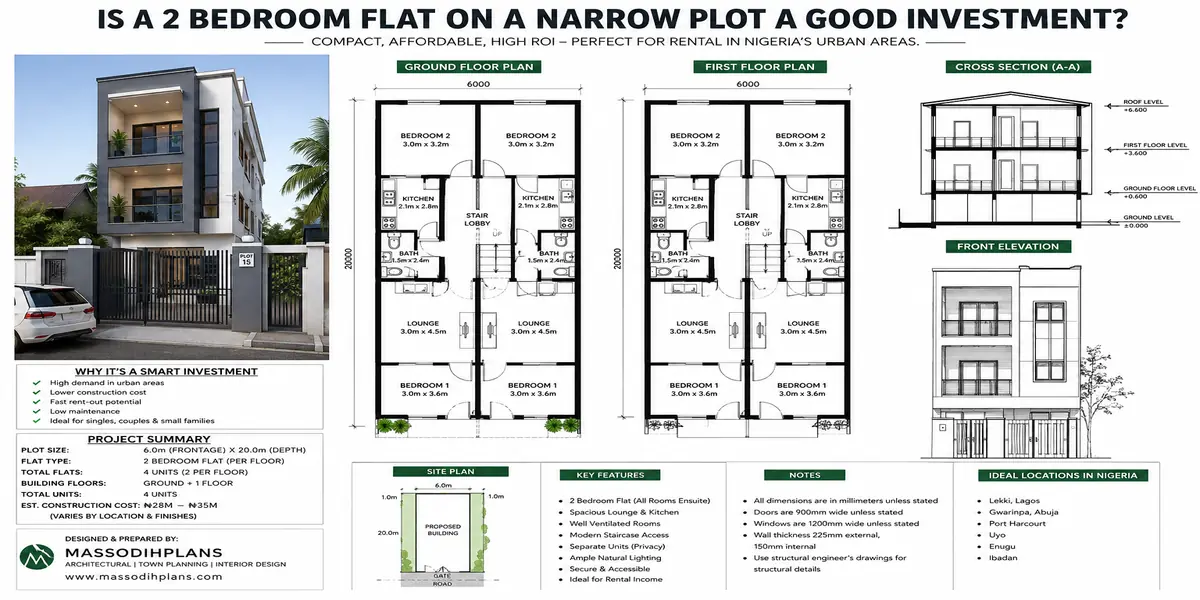
Is a 2 Bedroom Flat on a Narrow Plot a Good Investment
Common Mistakes to Avoid When Building on a Narrow Plot
Building without engaging a registered Town Planner or Architect. Your builder is skilled at construction. But designing a plan that is legal, safe, and functional requires professional planning input.
Ignoring the drainage flow pattern of the plot before choosing the floor level. This is a flooding mistake I have seen people make repeatedly.
Reducing room dimensions below practical minimums to fit everything in. A 2.4m wide bedroom is not really a bedroom. It is a corridor with a bed in it.
Choosing cheap roofing to save money. Roof leakages are the number one cause of premature building deterioration in Nigeria. Do not save money here.
Not planning for a second floor from the start if you think you might need one later. The cost of strengthening columns and beams after the fact is enormous.
Blocking natural ventilation with security concerns. Yes, you need security. But a design that uses burglar-proof grilles on ventilation windows, combined with louvred inserts, can give you both security and airflow.
Building right up to the setback line without allowing for any margin. Planning approvals are sometimes redrawn. A building that sits exactly at the approved limit has no room for any future adjustments.
Future Expansion Possibilities
One beautiful thing about a compact 2 bedroom flat on a narrow plot is that if designed correctly, there are realistic expansion paths.
Second floor addition: If the ground floor structure is designed for it, a second floor with an additional 1 or 2 bedrooms can be added later. This effectively doubles your living space or rental income.
Rear extension: If the rear setback is generous (4m or more), a rear kitchen extension, utility room, or laundry area can be added without affecting the primary structure.
Rooftop terrace: In urban areas, a concrete flat roof section (even if the main roof is pitched) can create a rooftop terrace for relaxation. This adds lifestyle value without additional land.
Conversion to self-contained units: A 2 bedroom flat can be restructured over time to become two self-contained studio units, each with a private entrance. This changes the rental dynamic from a family rental to an individual rental and can increase monthly income.
Interior Flow and Guest Privacy
The way you enter a house and move through it matters. On a narrow plan, poor interior flow creates a feeling of being in a corridor the entire time.
The best layouts for 2 bedroom flats on narrow plots separate guest zones from private zones. The living room, kitchen, and guest toilet should be accessible without walking through the bedroom area. Bedrooms and bathrooms are private territory. A design that forces guests to walk past your bedroom to reach the bathroom has failed a basic privacy test.
A good corridor of 1.2m to 1.5m width serves as the spine of the plan. Bedrooms open off this corridor. The corridor should be naturally lit where possible, either by a window at the end or a skylight above.
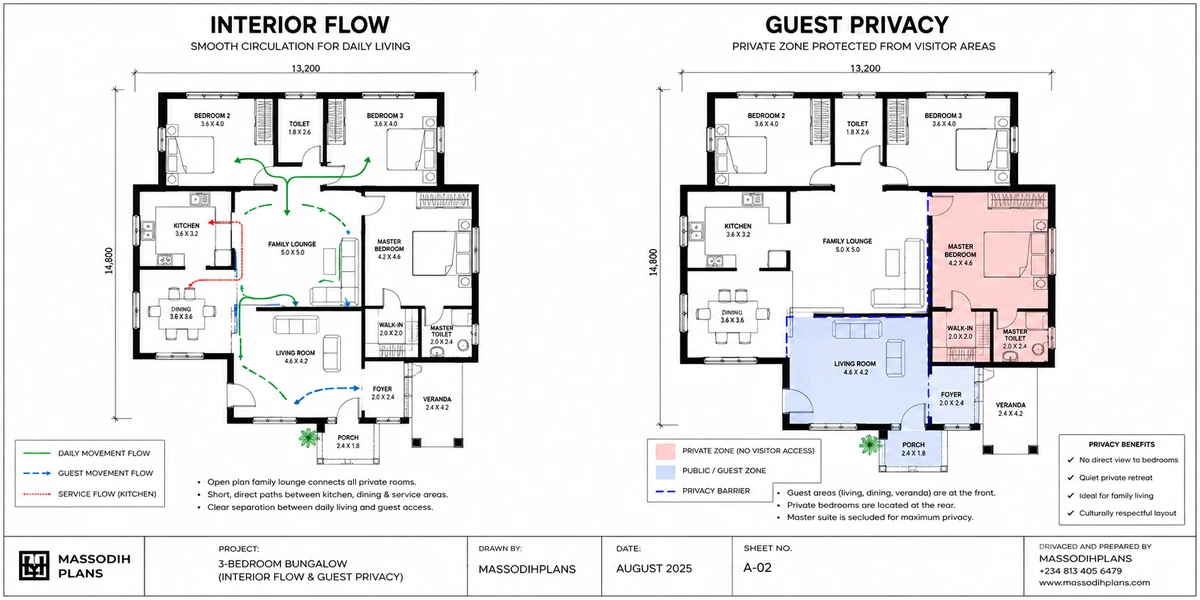
interior flow guest privacy plans
Frequently Asked Questions
Q: Can I build a 2 bedroom flat on a 50 by 100 feet plot in Nigeria?
A: Yes, absolutely. A 50 x 100 feet plot is approximately 15m x 30m. That is actually a generous size for a 2 bedroom flat. You will have comfortable setbacks on all sides, space for parking, borehole, and septic tank, with room left over for landscaping. The narrow plot challenge begins at 9m to 12m wide, so a 15m wide plot gives you considerably more design freedom.
Q: What is the minimum plot size for a 2 bedroom flat in Nigeria?
A: Technically, a 2 bedroom flat can be designed for a plot as narrow as 7.5m, but you will be working with very tight dimensions and you need an experienced designer. More comfortably, a 9m x 20m plot (180 sqm) is a reasonable minimum. Always confirm minimum plot standards with your state planning authority.
Q: How many blocks does it take to build a 2 bedroom flat in Nigeria?
A: For a single-storey 2 bedroom flat of approximately 80 to 100 sqm floor area, you will need roughly 2,500 to 3,500 nine-inch blocks for the external walls, plus additional six-inch blocks for internal partitions. This varies based on wall heights, number of openings, and design. Your contractor should provide a detailed bill of quantities.
Q: Do I need a planning approval for a 2 bedroom flat on a small plot in Nigeria?
A: Yes. Planning approval is required for any permanent building in Nigeria, regardless of size. Without it, you risk having the building stopped, fined, or even demolished. The process involves submitting your architectural and structural drawings to the relevant state or local planning authority, stamped by a registered Town Planner and Architect.
Q: How long does it take to build a 2 bedroom flat in Nigeria?
A: With adequate funding, good supervision, and no disruptions, a single-storey 2 bedroom flat in Nigeria can be completed in 6 to 10 months. In practice, funding gaps and material price fluctuations often extend this. Budget-conscious builders who build in stages may take 18 to 36 months from foundation to finishing.
Q: Is a narrow plot plan the same as a small plot plan?
A: Not exactly. A narrow plot refers specifically to one with a small width (frontage), typically 7.5m to 12m, even if it is long. A small plot refers to one with a small total area. You can have a small plot that is not narrow (e.g., a 12m x 12m square plot), or a narrow plot that is not small (e.g., a 9m x 40m plot). Both require careful design thinking, but the design solutions are different.
Explore More
Now that you understand how to plan and build a 2 bedroom flat on a narrow plot in Nigeria, here are other helpful resources on MassodihPlans that will take your knowledge further:
- Plans Library
- Plan School
- Services
- Site Development Plan in Nigeria: What It Is and When You Need One
- Survey Plan in Nigeria: Complete Guide for Landowners
- Commercial Development Planning Costs: What Every Investor Must Know Before Spending a Kobo
- Why District Planning Is Important for Urban Development
- Site Development Plan Cost: What Every Property Owner Must Know Before Building
- Environmental Management Plan Cost Guide for Developers in Nigeria and Beyond
- Survey Plan Cost in Nigeria: Fees, Process and Hidden Expenses
- Layout Plan Cost in Nigeria and Abroad: What Every Landowner Must Budget Before Building
- Smart Ways to Reduce Building Costs in Nigeria Without Reducing Quality
- Cost of Blocks, Cement, Iron Rod and Roofing Sheets in Uyo: Real Prices From the Field Now
- Estate Development Cost Breakdown: What Developers Should Budget For
- Estate Layout Design Services for Property Developers in Nigeria
- What Is a Master Plan and Why Does Every Growing Community Need One?
- How to Design an Estate Layout Plan That Works in Nigeria and Abroad
- How Much Does It Cost to Develop an Estate in Nigeria? A Town Planner’s Honest Breakdown
- Current Cost of Building a House in Port Harcourt (Professional Analysis)
- Bungalow vs Duplex: Which is Better to build in Nigeria Today?
- Full Cost Breakdown for Building a Duplex on a Small Plot in Kano Nigeria
Others
- 4 Bedroom House Construction Cost in Lagos: Standard, Mid-Range, and Luxury Building Budget Explained
- 3 Bedroom House Construction Cost in Lagos: Complete Budget Breakdown From Foundation to Final Finishes
- 2 Bedroom House Construction Cost in Lagos: Complete Budget, Materials, Labour, and Finishing Cost Guide
- How Much Does It Cost to Build a House in Lagos? Complete Construction Budget and Cost Breakdown Guide
- Nigeria House Plan Approval Costs: Complete Guide to Getting Building Approval Faster Without Costly Delays
- Lagos Building Plan Approval: Complete Guide to Fees, Documents, Application Process, Timeline, and ePPPS
- Cost of Building a House in Lagos: Complete Budget Guide to Materials, Labour, Design, and Approval Costs
- Architecture & Architectural Design: Complete Guide to Modern Houses, Building Design and Modern Architecture
- Sustainable Landscaping: Complete Guide to Xeriscaping, Landscape Lighting and Water-Efficient Gardens
- Landscaping Services: Complete Guide to Landscape Design, Hardscaping, Garden Planning and Outdoor Improvements
- Landscape Architect: What They Do, What They Design and When You Need One
Conclusion: Small Plot Is Not a Problem. It Is an Opportunity.
If you came here wondering whether a narrow plot can accommodate a comfortable 2-bedroom flat in Nigeria, I hope this article has made one thing clear: limited width does not mean limited possibilities.
The real challenge is not fitting two bedrooms onto the land. It is making every part of the plan work together. Living areas, bedrooms, bathrooms, kitchen, circulation, parking, ventilation, natural light, setbacks, drainage, privacy, and future maintenance all need to be considered before construction begins. A plan that looks attractive on paper can become frustrating when it ignores the actual dimensions, orientation, road access, or planning requirements of your plot.
This is why I would never recommend taking a random 2-bedroom plan from the internet and building it without adapting it to your site. Your survey plan should come first. And your local planning requirements should guide the building footprint. Your designer should then develop the rooms around the land you actually own—not around someone else’s plot.
Whether your land is in Uyo, Lagos, Abuja, Port Harcourt, or another Nigerian city, a well-designed narrow-plot home can still feel open, comfortable, private, and practical. Sometimes, the restrictions even produce a better design because they force you to eliminate wasted space.
So before you spend money on blocks, foundation work, or a contractor, spend time getting the design right. A few hours of proper planning can prevent expensive changes later. Good planning becomes an investment, not an unnecessary construction expense.
And if you have a narrow plot and need a 2-bedroom design prepared around its actual dimensions, survey plan, lifestyle, and local requirements, MassodihPlans can help you develop a practical solution rather than forcing a generic plan onto your land.
Your plot is ready. Now let us build something worth living in.
Written by Massodih Okon Effiong
About Author
Massodih Okon is a Nigerian built-environment professional with academic and professional experience in urban and regional planning, geography, architectural design, Landscape Design, GIS and land development.
He holds a Master’s degree in Urban and Regional Planning from the University of Uyo and a first degree in Geography and Regional Planning.
Through MassodihPlans, he publishes practical guides on Nigerian house plans, building design, physical planning, site planning, development approval and residential construction. Read the full author profile →