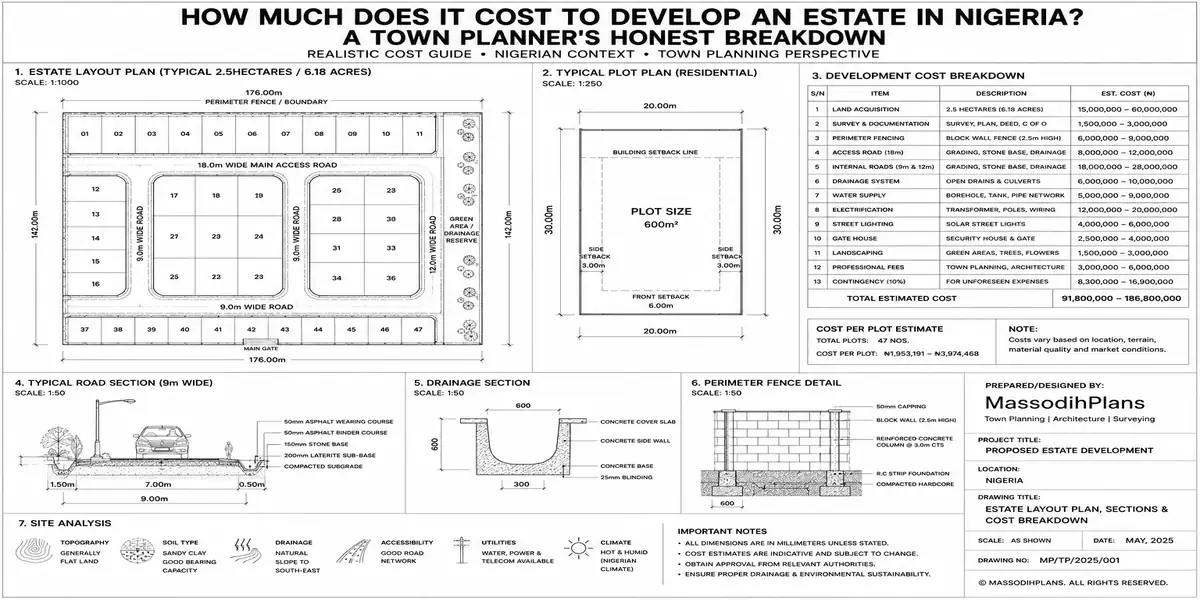
estate development cost nigeria
If you are asking, “How much does it cost to develop an estate in Nigeria?”, the honest answer is this: there is no single price. A small serviced estate can cost tens of millions of naira, while a larger development with extensive roads, drainage, utilities, security, landscaping and houses can run into hundreds of millions or billions. The final figure depends heavily on location, land price, site conditions, number of plots, infrastructure standard, approvals and whether you are selling serviced plots or constructing the houses yourself.
Let me explain it the way I would explain it to a client or a student sitting across my desk, because estate development is where many Nigerian developers make expensive mistakes. They calculate the price of land, add the cost of fencing, then assume whatever remains will cover everything else. It usually does not.
A proper estate budget must account for land acquisition and documentation, survey and site investigation, master planning, professional fees, planning approvals, earthworks, internal roads, storm-water drainage, water supply, electricity and street lighting, waste management, security, landscaping, marketing, finance and contingency. Government requirements and fees also differ by location; for example, planning authorities calculate charges according to factors such as land use, site location and development size, while Abuja has its own development-control procedures.
In this guide, I will take you beyond a “cost per hectare” estimate. We will build the budget from the ground up, compare small, medium and larger estate scenarios, identify the hidden costs that destroy profit, and show you how location, density, soil, road design and infrastructure specifications can change your numbers dramatically.
If you are planning an estate, this is the part you should not skip.
What Does “Developing an Estate” Actually Mean in Nigeria?
Before we talk numbers, let us agree on what we are actually talking about.
In Nigerian context, developing an estate means acquiring a piece of land, planning it properly, obtaining all necessary government approvals, installing infrastructure (roads, drainage, water, electricity), and either building housing units or selling off serviced plots to individual buyers.
It is not the same as buying land and fencing it.
A proper estate development involves:
- Land acquisition and documentation
- Topographic and boundary surveys
- Environmental and geotechnical site investigations
- Master plan and layout preparation
- Physical planning approval from the relevant authority
- Road construction and drainage works
- Water supply and utilities provision
- Landscaping and open space development
- Estate management and plot sales
Every one of these steps costs money. Every one of them is necessary. If you skip any of them, you will pay for it later either through government demolition, buyer disputes, flooding problems, or legal battles.
I have seen this issue firsthand. Developers who skipped the master plan ended up with road alignments that made it impossible to connect properly to the main road network. And developers who skipped drainage works ended up with estates that flooded every rainy season. Developers who skipped planning approval ended up with distress sales and court cases.
The cost of doing things properly is always less than the cost of fixing what was done wrongly.
The Major Cost Components of Estate Development in Nigeria
Let me walk you through every cost head, one by one, the way I would explain it to a new developer sitting in my office.
1. Land Acquisition Cost
This is usually the biggest single cost item in any estate development project.
Land prices in Nigeria vary dramatically based on location, accessibility, and existing infrastructure. Here is a realistic picture:
Urban core areas (Lagos Island, Victoria Island, Lekki Phase 1, Maitama Abuja): You can be looking at N100 million to N500 million per hectare or even more for prime commercial land. Residential land in these areas runs N50 million to N300 million per hectare, depending on exact location and title.
High-density urban fringe (Sangotedo, Ajah, Lugbe, Karu, Rumuola, Trans-Amadi corridor): Expect N10 million to N80 million per hectare for raw land, depending on whether it has a Certificate of Occupancy or only a deed of assignment.
Secondary cities (Uyo, Owerri, Calabar, Benin City, Ibadan outskirts): Land typically runs N2 million to N20 million per hectare depending on location. I have seen land in Uyo’s development corridors like Onna Road, Nsit Atai Road, and Eket corridor sell anywhere from N3 million to N15 million per hectare for bulk acquisition.
Peri-urban and satellite areas (rural-urban fringe towns within 30-60km of major cities): Raw land can go as low as N500,000 to N5 million per hectare in some cases. However, the cost of opening up infrastructure to these areas can erase that savings very quickly.
Practical advice from my experience: Always budget for land beyond what you think you need. In practice, when you apply proper setbacks, road reserves, open spaces, and infrastructure corridors, you typically lose 30 to 45 percent of gross land area before you start counting sellable plots. I have worked on layouts where a developer bought 10 hectares thinking they would get 200 plots, only for the final approved layout to yield 115 to 130 after all planning standards were properly applied.
That is not a mistake by the planner. That is proper planning. And it is something every developer must factor into their cost model from day one.
2. Survey and Documentation Costs
Before any planning work begins, you need a proper survey of the land.
Topographic Survey: This gives you contours, spot levels, drainage channels, trees, and all physical features on the site. For a 5-hectare site, a proper topographic survey currently costs N300,000 to N1.2 million depending on the surveying firm, location, and complexity of terrain.
Boundary Survey and Beaconing: This establishes and marks the exact boundary corners of the land. Cost depends on the state and the complexity of the boundary. Budget N200,000 to N800,000 for most sites.
Certified Survey Plan: This is the formal survey plan filed with the state surveyor-general’s office. It is a legal requirement for planning approval in most states. Cost varies by state but expect N150,000 to N600,000 excluding government fees.
Title Documentation: If the land does not have a registered title, you will need to process one. This could mean a Certificate of Occupancy (C of O), a Deed of Assignment, or a Registered Survey Plan, depending on what is available. The cost of perfecting title in Lagos, for example, can run into several million naira when you factor in all state government charges, consent fees, and professional fees.
I have worked with clients who bought land on a family receipt and did not know they needed to go further. When they brought me the file, the first thing I had to tell them was: we need to process proper documentation before we can begin any planning work. The land is yours, but on paper it is not yet fully yours.
3. Geotechnical and Environmental Investigation
Many developers skip this step. This is a very expensive mistake.
A geotechnical investigation (soil test) tells you the load-bearing capacity of the soil, the depth to groundwater, the presence of expansive clay or weak soils, and the appropriate foundation type for buildings. For a 5-hectare estate site, a basic soil test with borehole drilling and laboratory analysis costs N300,000 to N1.5 million.
An Environmental Impact Assessment Report or its simpler cousin, the Environmental Impact Statement, is required in many states before development approval is granted, especially for large estates. This is prepared by a registered environmental consultant and costs N500,000 to N3 million depending on the complexity of the site and the requirements of the relevant state Environmental Protection Agency.
I have reviewed plans for sites that were developed without soil tests. Some of them are sitting on weak alluvial soils close to streams. The buildings are cracking. The roads are failing. The drainage is undermined. These are not small problems. They are problems that now require millions more to fix if they can be fixed at all.
In my experience, the cost of a proper soil test is the best money a developer can spend early in the project.
4. Master Plan and Layout Design Costs
This is where my professional work begins. A proper estate master plan is not just a drawing. It is a document that answers every spatial question about your development: where the roads go, how plots are arranged, where drainage channels are, where open spaces are located, where the gate house and estate management facilities sit, and how the estate connects to the existing road network.
A good master plan for a residential estate layout in Nigeria typically involves:
- Land use distribution and zoning
- Road network design with proper hierarchy
- Plot arrangement and numbering
- Open space allocation
- Drainage network design
- Infrastructure corridor allocation
- Development control standards (setbacks, plot coverage, building lines)
- Population projection and density analysis
Cost of master plan preparation:
For a small estate of 1 to 3 hectares, professional fees for a complete layout plan from a registered town planner typically range from N300,000 to N1 million.
And for a medium estate of 5 to 20 hectares, expect N800,000 to N3 million.
For large estates of 50 hectares and above, fees can range from N3 million to N15 million or more, especially when the work includes a full Environment and Social Impact Assessment, GIS mapping, and phased development programming.
These fees cover the services of the registered town planner and may or may not include survey costs, architectural input for the gate house or estate facilities, or structural engineering for roads and drainage.
One lesson I learned early in my career is that clients who try to minimize professional fees on layout preparation almost always end up spending more on revisions, rejections by planning authorities, and corrections during construction. A well-prepared layout plan saves money throughout the project. A poorly prepared one costs you at every stage.
5. Physical Planning Approval Costs
This is a non-negotiable step. In Nigeria, you cannot legally develop land for estate purposes without obtaining planning permission from the relevant physical planning authority.
Depending on your state, this could be:
- The Lagos State Physical Planning Permit Authority (LASPPPA) in Lagos
- The Development Control Department under the Federal Capital Development Authority (FCDA) in Abuja
- The State Urban Development Board or Ministry of Lands in your specific state
- The Local Government Planning Authority in some instances
The cost of planning approval includes:
- Application fees (government schedule charges)
- Development levy or development charge (often calculated per plot or per square metre of planned development)
- Infrastructure contribution fees (in some states)
- Professional fees for the registered town planner preparing and processing the application
- Town Planning Regulations compliance inspection fees
For a modest residential layout of 30 to 50 plots in a state like Akwa Ibom, Rivers, Anambra, or Ogun, the total government charges and professional fees for planning approval processing can run from N500,000 to N3 million.
In Lagos, the government charges alone for a medium estate can run into N5 million to N15 million and above, depending on the size, location, and development type.
In Abuja under the FCDA, the charges are structured differently and can be similarly significant for estate-scale developments.
A practical note from field experience:
The approval process in Nigeria is not always fast. Budget time, not just money. From application submission to approval letter, the process can take anywhere from 3 months to 2 years depending on the state, the completeness of your documents, and whether your proposed development triggers higher-level review. I have worked on approvals that moved in 4 months and ones that stretched to 18 months. Plan for this in your project timeline and your financing.
6. Road Construction Costs
Roads are the skeleton of an estate. Without good roads, nothing else works properly.
A well-designed estate road network typically consists of a hierarchy of roads:
Estate entrance road (primary collector road): This is the main road from the public road into the estate. It is usually wider 9 to 12 metres carriageway plus walkways and built to a higher standard. Cost per kilometre for a properly paved estate entrance road with drainage, kerbing, and street lighting: N15 million to N40 million depending on terrain, soil conditions, and specification.
Internal distributor roads (secondary roads): These carry traffic from the main estate road to residential streets. Typical width is 6 to 9 metres. Cost per kilometre: N8 million to N25 million depending on pavement type (asphalt or interlocking paving), drainage, and ground conditions.
Access streets (residential streets, cul-de-sacs): These lead directly to individual plots. Typical width is 4.5 to 6 metres. Cost per kilometre: N5 million to N15 million.
For a 10-hectare estate, total internal road length is typically 1.5 to 2.5 kilometres depending on layout efficiency. At mid-range costs, you could be spending N30 million to N80 million on roads alone.
This does not include the cost of the access road from the public highway to your estate entrance, which may require negotiation with the state government, local government, or Road Safety authorities depending on the highway category.
7. Drainage System Costs
This is one area where Nigerian developers consistently underestimate costs — and where the consequences of cutting corners are most visible.
Proper estate drainage consists of:
- Surface drains running along road edges (kerb drains or open channel drains)
- Cross culverts at road intersections
- Outfall channels connecting to natural drainage pathways
- Retention ponds or detention basins where site topography requires them
For an estate in a flat or low-lying terrain (which describes much of the Niger Delta, Lagos, and coastal areas), drainage becomes a major design and cost item.
Rough costs:
- Precast concrete roadside drains: N2,000 to N6,000 per linear metre
- Reinforced concrete box culverts: N15,000 to N50,000 per linear metre depending on size
- Earth channel outfall drains: N800 to N2,500 per linear metre
- Retention ponds (earth excavation and lining): N2 million to N15 million depending on capacity
For a 10-hectare estate, total drainage construction cost typically runs N10 million to N40 million.
I remember a project where we designed a beautiful estate layout in a low-lying area. The developer got the layout approved, sold plots, and started construction. But he decided to “manage drainage later.” Two rainy seasons in, half the estate was flooded during every heavy rain. Two years later, he was spending N35 million on remedial drainage work that could have been done for N18 million during original construction. Buyers were threatening court action.
The drainage was not optional. It never is.
8. Water Supply System Costs
Most Nigerian estates cannot rely on public water supply systems, which means the developer must provide either:
- A borehole with motorized pump and elevated storage tank
- A packaged water treatment plant for larger developments
- A piped reticulation system distributing water from the central source to each plot
Borehole drilling: A standard 6-inch diameter borehole to 100-150 metres depth typically costs N2.5 million to N8 million in most Nigerian states, including pump, casing, and development.
Elevated storage tank: A 50,000-litre steel or plastic sectional tank on a 10-metre elevated steel structure costs N3 million to N8 million.
Reticulation pipework: Running water pipes from the central pump station to all plots: N1,500 to N4,000 per linear metre of pipe, depending on pipe diameter and depth.
For a 50-plot estate, total water supply infrastructure cost typically runs N8 million to N25 million.
9. Electricity and Street Lighting Costs
Estates must be served by electricity, and this involves:
- A dedicated transformer and substation (for larger estates)
- HV/LV cabling from the nearest distribution point
- Internal distribution cables and metering cabinets
- Street lighting along roads and common areas
Transformer and substation: A 300KVA transformer with installation typically costs N8 million to N20 million in Nigeria.
LV cabling and metering: For a 50-plot estate, internal electrical reticulation including cables, poles or trenches, and metering points costs N5 million to N15 million.
Street lighting: Solar-powered street lights are now common in Nigerian estates. A 60-watt solar street light unit fully installed currently costs N150,000 to N350,000 per unit. For an estate with 30 to 50 street lights, that is N4.5 million to N17.5 million.
In many parts of Nigeria, connecting to the state electricity company’s network requires additional application, processing, and supply fees that can add N2 million to N5 million or more to your budget.
10. Security Infrastructure and Gate House
A gated estate in Nigeria without security infrastructure is not a real estate. Buyers expect:
- A proper gate house at the entrance
- Perimeter fencing or wall
- Security booth and lighting
Gate house construction: A decent gate house with security office, toilet, and waiting area costs N3 million to N8 million.
Perimeter fencing: Sandcrete block wall fencing typically costs N8,000 to N18,000 per linear metre (including foundation, blocks, plastering, and coping). For a 10-hectare estate with roughly 1.3km of perimeter, fencing cost runs N10 million to N23 million.
Some developers use live hedges, chain-link, or BRC fencing instead of block walls to reduce cost on less sensitive boundaries. These options can bring perimeter cost down by 40 to 60 percent.
11. Landscaping and Open Space Development
Physical planning standards in Nigeria require that a certain percentage of estate land be set aside for open spaces, parks, and recreational areas. The standard varies by state and development type, but 10 to 20 percent of gross site area is a typical requirement.
Developing these spaces properly includes:
- Clearing, grading, and topsoiling
- Grass planting and tree planting
- Children’s play equipment where required
- Pathway construction
- Perimeter planting and hedges
Budget N1 million to N8 million for open space development depending on the size of the estate and the specification required.
12. Professional and Consultancy Fees
Beyond the town planner, a comprehensive estate development requires input from other professionals:
- Architect: For estate gate house, estate management office, and any residential prototypes
- Civil and Structural Engineer: For road design, drainage design, culvert design
- Building Services Engineer: For water supply and electrical design
- Quantity Surveyor: For Bill of Quantities preparation and cost monitoring
- Environmental Consultant: For EIA or environmental assessment
- Lawyer: For land documentation, title processing, and buyer agreements
Total professional fees across all disciplines for a medium-scale estate development (5 to 20 hectares) typically run N2 million to N10 million, in addition to the town planner’s fees already discussed.
This is not a place to cut corners. Working without a qualified structural engineer on your roads and drainage is how you end up with failed road bases after one rainy season.
Summary Cost Table: Developing a Residential Estate in Nigeria
Let me now put this together in a practical summary so you can see the full picture.
Small Estate: 5 Hectares, Approximately 60 to 80 Plots
| Cost Item | Low Range | High Range |
|---|---|---|
| Land Acquisition (5 ha, secondary city) | N5,000,000 | N40,000,000 |
| Survey and Documentation | N500,000 | N1,500,000 |
| Geotechnical and Environmental Investigation | N400,000 | N1,500,000 |
| Master Plan and Layout Design | N500,000 | N1,500,000 |
| Planning Approval Charges and Professional Fees | N600,000 | N3,000,000 |
| Road Construction | N15,000,000 | N45,000,000 |
| Drainage Works | N8,000,000 | N25,000,000 |
| Water Supply System | N6,000,000 | N18,000,000 |
| Electricity and Street Lighting | N5,000,000 | N18,000,000 |
| Gate House and Perimeter Fencing | N8,000,000 | N25,000,000 |
| Open Space and Landscaping | N1,000,000 | N5,000,000 |
| Other Professional Fees | N1,500,000 | N5,000,000 |
| Contingency (10%) | N5,100,000 | N18,800,000 |
| TOTAL ESTIMATE | N56,100,000 | N207,300,000 |
So for a 5-hectare residential estate in a secondary Nigerian city with proper infrastructure, you are looking at roughly N56 million to N207 million before any building construction.
Medium Estate: 20 Hectares, Approximately 250 to 350 Plots
At this scale, the economics begin to shift. Infrastructure costs do not scale linearly because you gain efficiency on road lengths, shared utilities, and bulk procurement. However, planning requirements become more stringent — phased development plans, more detailed EIA requirements, and higher development charges.
Rough total development cost (excluding land): N250 million to N800 million
With land in a developing urban corridor: N350 million to N1.2 billion total
What Factors Most Affect Cost?
From projects I have worked on, these are the factors that create the biggest cost swings:
1. Location: Urban core estates cost 3 to 10 times more per plot to develop than peri-urban estates, primarily because of land cost and infrastructure specification requirements.
2. Terrain and Soil Conditions: A flat, well-drained site can cost 30 to 50 percent less to develop than a marshy, low-lying site that requires fill material, dewatering, and heavy drainage works. I have worked on sites in coastal areas where the cost of site filling alone exceeded the cost of all other infrastructure combined.
3. Access to Existing Infrastructure: An estate 200 metres from an existing public road, water supply, and electricity grid costs significantly less to open up than one 3 kilometres from any existing infrastructure.
4. Regulatory Environment: Some states have significantly higher development charges and more complex approval processes than others. Lagos and Abuja tend to be the most complex and expensive from a regulatory standpoint. States with weaker development control systems may have lower upfront charges but higher risk of post-construction enforcement actions.
5. Infrastructure Specification: An estate with asphalt paving, underground drainage, piped water to each plot, and high-specification security walls costs significantly more than one with graded laterite roads, surface drains, a shared water point, and wire-mesh perimeter fencing.
Both approaches serve a market. The key is matching your specification to your target buyer’s expectations and budget.
The Master Plan: Why It Changes Everything
I want to spend some time on this because it is something I am passionate about as a professional and as someone who has seen what happens without it.
In my experience, the single most important document in any estate development project is the master plan. Not the architecture. Not the sales brochure. The master plan.
The master plan determines:
- How efficiently you use your land
- Whether roads align properly with adjacent streets
- Whether drainage flows naturally off the site
- Whether plot sizes and shapes meet planning standards
- Whether you get planning approval without major revisions
- Whether future expansion of the estate is possible without demolishing existing works
- Whether utilities can be efficiently extended as the estate grows
- Whether the estate holds its value over time
Land Use Distribution in a Typical Residential Estate Master Plan:
In a well-designed Nigerian residential estate, land is typically distributed roughly as follows:
- Residential plots: 50 to 60 percent of gross site area
- Roads and road reserves: 20 to 30 percent
- Open spaces, parks, and recreation: 10 to 15 percent
- Utility corridors, drainage reserves, and public facilities: 5 to 10 percent
This means that when you buy 10 hectares for estate development, typically only 5 to 6 hectares will be residential plot area. The rest is infrastructure and community space. This is not waste. This is what makes an estate function as a community and not just a collection of buildings.
Developers who do not understand this often underestimate how many sellable plots they will realistically get from a given land parcel and consequently underestimate how much they need to charge per plot to recover their development costs.
Road Hierarchy in Nigerian Estate Design
During my undergraduate studies in Town Planning, one concept our lecturers constantly emphasized was road hierarchy. It is a deceptively simple idea: not all roads in an estate are the same, and they should not be designed the same way.
A proper estate road hierarchy includes:
Access Roads (estate entrance and exit): These connect the estate to the public road network. They must be wide enough for two lanes of traffic plus pedestrian walkways. Standard width: 9 to 12 metres. These are the roads that must meet the requirements of the relevant state highway authority.
Collector Streets: These distribute traffic within the estate from the access road to the residential streets. Standard width: 6 to 9 metres.
Residential Streets: These serve individual plots directly. Standard width: 4.5 to 6 metres.
Cul-de-sacs: Short dead-end streets serving small clusters of plots. Maximum length is typically 75 to 100 metres per planning regulations. These are efficient for plot yield and create quieter residential environments.
Getting road hierarchy right has a direct impact on cost. An estate where every road is designed to collector standard wastes money and reduces plot yield. An estate where the main entrance road is built to residential street standard will fail it cannot handle the traffic volumes generated by dozens or hundreds of households.
Setbacks, Plot Coverage, and Development Control
Every estate development in Nigeria must comply with the physical planning standards of the relevant state, including setback requirements.
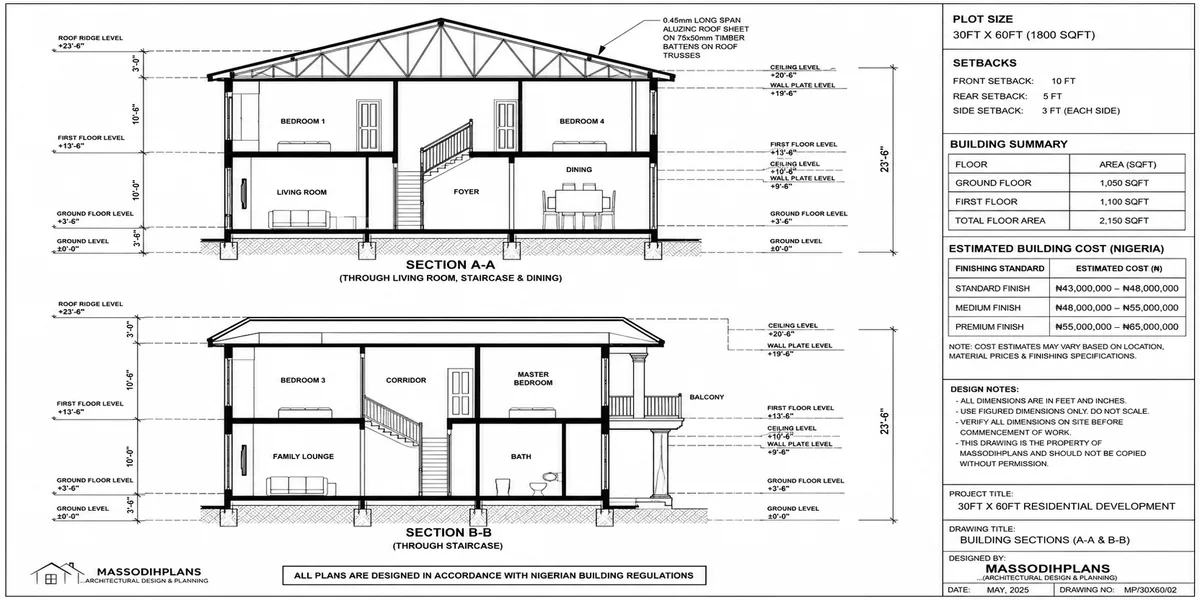
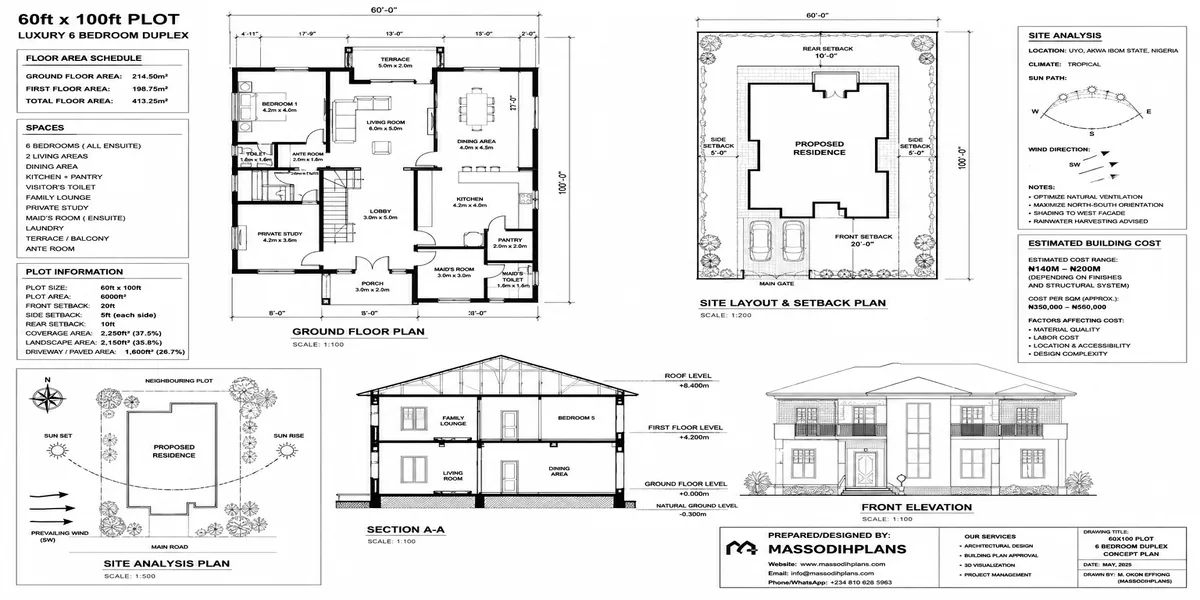
Setbacks are the minimum distances that must be maintained between a building and the plot boundaries. Typical standards in Nigerian residential estates include:
- Front setback (from road boundary): 3 to 6 metres
- Rear setback: 3 metres minimum
- Side setbacks: 1.5 to 3 metres on each side
Plot coverage refers to the percentage of a plot that can be covered by buildings. For residential development in Nigeria, this is typically 40 to 60 percent of plot area, leaving the remainder for parking, gardens, and open space.
Building height restrictions also apply. Most residential estate regulations limit buildings to 2 to 3 floors (ground plus one or two upper floors) without special approval.
These standards exist for good reasons they ensure adequate light and air to buildings, provide emergency access, create space for landscaping, prevent overcrowding, and maintain road visibility. They also protect property values. Estates with well-enforced setbacks and development control remain attractive and hold their value better over time.
GIS and Mapping in Modern Estate Planning
Over the years, I have noticed that estate developers in Nigeria increasingly need to integrate GIS (Geographic Information System) tools into their planning process. This is not optional for serious developers anymore.
GIS integration in estate development includes:
- Satellite imagery analysis to understand site context, drainage patterns, and vegetation
- Topographic mapping using drone surveys (now cheaper and faster than traditional survey methods in some cases)
- Flood risk mapping to identify areas that should not be developed
- Accessibility analysis to understand proximity to roads, markets, schools, and employment centres
- Cadastral mapping to verify land titles and avoid boundary overlaps
Drone-based topographic surveys now cost N200,000 to N1 million for most estate-scale sites, significantly faster and often more accurate than traditional levelling for large sites.
Working alongside experienced planners and GIS professionals taught me that the most common mistakes in estate siting flooding, poor access, encroachment on public land are almost entirely preventable if proper spatial analysis is done before land is purchased.
Common Mistakes to Avoid in Nigerian Estate Development
I have seen these mistakes repeatedly. I am listing them here so you do not make them.
Mistake 1: Buying land without a proper title search I have worked with clients who discovered after buying land and starting construction that the land had multiple claimants, or was in a government acquisition zone, or had a registered easement running through it. Title investigation before purchase is not optional.
Mistake 2: Developing without a master plan Without a master plan, you will not get planning approval. Even in areas with weak enforcement, developing without a plan means your road alignments may conflict with neighbouring developments, your drainage may send water onto someone else’s land, and your plot dimensions may not meet bank finance requirements for buyers.
Mistake 3: Underestimating infrastructure costs This is the most common financial mistake. Developers typically budget for land and buildings and assume infrastructure will be a small percentage. In reality, infrastructure can cost as much as the land itself or more.
Mistake 4: Ignoring drainage design Every site drains somewhere. If you do not design where it drains, nature will design it for you usually across roads, into basements, and through poorly constructed foundations.
Mistake 5: Selling plots before approval is obtained This is both legally problematic and ethically wrong. Buyers should receive properly approved layout plans when they purchase plots. Selling before approval exposes both developer and buyer to significant legal and financial risk.
Mistake 6: Not phasing the development properly Large estates should be developed in phases so that cash generated from plot sales in Phase 1 funds infrastructure development in Phase 2. Trying to develop everything at once with borrowed funds is a very common route to financial distress.
Urban Planning Problems That Estates Solve and Create
As a town planner, I need to be honest with you about something that most estate developers do not want to hear: estate development, when done improperly, can contribute to the very urban problems it is supposed to solve.
Uncontrolled estate development estates built without proper master plans, without adequate road networks, without drainage infrastructure, without adequate open spaces contributes directly to:
- Urban sprawl as development leaps beyond planned areas
- Traffic congestion because poorly designed internal roads cannot accommodate generated traffic
- Flooding because drainage was inadequately designed
- Slum-like conditions as buildings crowd together without proper setbacks
- Poor infrastructure provision because utilities cannot be efficiently extended to irregular plot arrangements
- Land use conflicts when incompatible uses are not properly separated
- Environmental degradation when wetlands are filled and green areas eliminated
But when estate development is done properly with a rigorous master plan, proper infrastructure, adequate open spaces, compliant road hierarchy, and good development control it becomes a powerful solution to these same problems. It creates ordered, serviced communities. And It reduces pressure on congested city centres. It provides quality housing in a managed environment.
This is why I believe so strongly that every naira spent on proper planning at the beginning of a project is money well spent. The master plan is not a bureaucratic requirement. It is the foundation of everything that follows.
Investment Potential and Return on Estate Development
I want to address this directly because it is what most developers are ultimately thinking about.
In my experience, properly developed estates in Nigerian growth corridors yield significant returns for developers who do it right. Here is a realistic framework:
Example: 5-hectare estate in a secondary Nigerian city growth corridor
- Total development cost (including land): N80 million to N150 million (using mid-range estimates from our table above)
- Number of 600sqm serviced plots yielded after planning: approximately 55 to 70
- Realistic plot selling price for fully serviced plots in that corridor: N1.5 million to N4 million per plot
- Gross sales revenue: N82 million to N280 million
- Net developer profit margin (assuming full sales): 15 to 50 percent depending on location, timing, and specification
The range is wide because location and market timing matter enormously. The strongest returns come from developers who:
- Correctly identify growth corridors 3 to 5 years before the market peaks
- Acquire land at a reasonable price while the area is still emerging
- Develop to a standard that exceeds what buyers expect at that price point
- Phase their investment so they are not fully exposed before recovering initial capital
The worst returns come from developers who buy land at peak prices in congested areas, develop to minimum standards, and are unable to differentiate their product in a crowded market.
From a planning perspective, I strongly recommend that every estate developer conduct a full feasibility analysis before committing to land acquisition. This analysis should cover: land cost, total development cost, achievable plot prices, absorption rate (how fast you can sell), financing costs, and time to recovery of capital.
Development Phasing: The Smart Way to Develop
On a project I worked on for a developer in Uyo, we divided a 12-hectare site into three phases.
Phase 1 covered the front 4 hectares, closest to the existing road. We installed all roads, drainage, water, and street lighting for this phase, and the developer sold all 45 plots within 8 months. Revenue from Phase 1 funded the bulk of Phase 2 infrastructure.
Phase 2 was developed 14 months later, covering the middle 5 hectares. Plot prices had already appreciated by 22 percent because Phase 1 buyers were living in their plots and the estate was visibly functional.
Phase 3, the rear 3 hectares, was developed last, and plot prices were 55 percent higher than Phase 1 launch prices — without any additional marketing spend.
That is what proper phased development looks like in practice. The developer did not start with a big loan for the entire site. He started with proper planning, sold his first phase, and let the estate’s own success fund its growth.
This is not a theory. It is a real project, and it worked because the planning was done right from the beginning.
Flood Control and Climate Considerations in Nigerian Estates
Climate responsiveness is not a luxury concept for Nigerian estate developers. It is a financial and legal necessity.
Nigeria’s rainy seasons have become more intense in many areas. Flash flooding, erosion, and drainage failure now affect estates that were considered safe when they were originally developed 10 to 15 years ago.
In estate planning, flood control considerations include:
- Site selection: avoiding floodplains, river corridors, and natural drainage paths
- Grading design: shaping the estate so surface water drains efficiently to outfall points
- Retention ponds: temporary storage basins that capture peak rainfall and release it gradually
- Pervious surfaces: designing open spaces, parking areas, and walkways with materials that allow water to infiltrate the ground
- Building platform levels: raising finished floor levels above the 1-in-10-year flood level, or higher for low-lying sites
- Community drainage agreements: coordinating with neighbouring landowners so drainage outfalls are properly managed beyond your estate boundary
Both classroom learning and field experience support this conclusion: the most expensive problem you can hand a buyer is a flooded property. It destroys property value, creates legal liability for the developer, and erodes buyer trust permanently.
Mixed-Use Integration in Estate Development
Many of the best-performing estates in Nigeria today incorporate some degree of mixed land use. This is not accidental it is good planning.
A purely residential estate without shops, schools, clinics, or places of worship forces residents to drive out for every daily need. This adds to road congestion, reduces the convenience of living in the estate, and ultimately reduces its desirability and value.
Well-designed mixed-use integration in a Nigerian residential estate typically includes:
- A neighbourhood shopping cluster near the entrance (supermarket, pharmacy, salon, fast food)
- A nursery and primary school within walking distance of most plots
- A place of worship (plot reserved and sold to a church or mosque at a premium)
- A community centre or estate club house
- A medical consultation facility for large estates
The key principle from both planning theory and field experience is that incompatible uses must be separated by buffer zones, building setbacks, or physical barriers to prevent conflict. An industrial workshop should not be next to a residential plot. A bus depot should not be beside a primary school. Good zoning within the estate master plan handles this.
The Approval Process: What You Actually Need to Submit
Based on my experience processing planning applications in several Nigerian states, here is what a typical estate development approval application requires:
- Completed application form from the planning authority
- Proof of land ownership (C of O, deed of assignment, survey plan)
- Five sets of the layout plan (prepared and signed by a registered town planner)
- Environmental Impact Assessment or Environmental Impact Statement (where required)
- Geotechnical investigation report
- Drainage and infrastructure design (signed by a registered civil engineer)
- Development brief or planning statement
- Aerial photograph or satellite image of the site and surroundings
- Evidence of payment of processing fees
In some states, additional documents are required for large-scale developments including traffic impact assessments, infrastructure contribution agreements, and phased development programmes.
The layout plan submitted for approval must show: north point, scale bar, plot boundaries with dimensions, plot numbers, road widths and names, drainage channels, open spaces, setback lines, building lines, and the signature and seal of the registered town planner.
During my internship, I discovered that incomplete submissions are the number one reason for processing delays. A well-prepared, complete submission almost always moves faster through the system than a rushed one with missing documents.
Sustainability and Smart Growth in Nigerian Estates
The concept of smart growth is increasingly relevant to Nigerian estate developers, and not just as a buzzword.
Smart growth in Nigerian estate planning means:
- Locating developments near existing infrastructure rather than leaping over undeveloped land
- Designing for walkability rather than total car dependence
- Providing a mix of housing types and plot sizes within a single estate
- Incorporating affordable housing units alongside premium ones
- Designing streets for pedestrians and cyclists, not just vehicles
- Preserving trees and natural drainage features within the estate
- Planning for future growth directions so expansion is orderly
My academic training exposed me to these principles in theory. What field experience has taught me is that they make business sense, not just planning sense. Estates near existing urban fabric sell faster and at higher prices than remote estates. Walkable estates with community facilities hold their value better than car-dependent ones. Estates that preserve mature trees and natural features consistently command premium prices over those that clear everything.
Good planning and good business are not opposites in estate development. They align closely when you take the long view.
FAQs: Estate Development Costs in Nigeria
Q: How much does it cost to develop a small estate of 50 plots in Nigeria?
It depends heavily on location, infrastructure specification, and land cost. A realistic total project cost for a 50-plot serviced estate in a secondary Nigerian city (excluding any building construction) ranges from N50 million to N150 million. In Lagos or Abuja, the same project could cost N300 million to N800 million due to land prices and higher regulatory charges.
Q: Can I develop an estate in Nigeria without a town planner?
Legally, no. Physical planning applications for estate layouts must be prepared and signed by a registered town planner (registered with the Nigerian Institute of Town Planners and ARCON in applicable cases). Beyond the legal requirement, attempting to develop without a qualified town planner almost always leads to layout inefficiencies, planning rejections, and costly redesigns.
Q: How long does planning approval take for an estate in Nigeria?
It varies significantly by state. In a well-functioning state planning authority with a complete application, 3 to 6 months is realistic. In complex jurisdictions or with incomplete submissions, 12 to 24 months is not unusual. Engaging a registered town planner familiar with the specific authority and requirements can significantly reduce approval time.
Q: What is the minimum plot size allowed in a Nigerian residential estate?
Minimum plot sizes are set by individual state planning authorities and vary by location and estate type. Common minimum standards are 300 to 450 square metres for urban residential plots and 600 to 900 square metres for suburban and low-density residential plots. Your town planner will advise on the applicable standards for your specific location.
Q: What percentage of an estate site should be roads and open space?
Nigerian physical planning standards typically require 25 to 35 percent of gross site area for roads and road reserves, and 10 to 15 percent for open spaces and public facilities. This means that of every 100 hectares acquired, only 50 to 65 hectares will typically be available as residential or commercial plots. This is a crucial number for project feasibility calculations.
Q: Is estate development in Nigeria profitable?
Yes, when properly planned and executed. The key profitability drivers are: buying land at the right price in a growth corridor, correctly estimating total development costs before committing, developing in phases to manage cash flow, and delivering a product that meets or exceeds buyer expectations for the price point. Projects I have worked on that followed this model have delivered developer profits of 25 to 60 percent on total investment over 3 to 5 year periods.
Q: What is the role of a master plan in estate development?
The master plan is the foundational document that determines how every square metre of your estate land is allocated and how the development will function as a community. It guides road layout, plot arrangement, drainage design, utility routing, and open space distribution. Without a proper master plan, you cannot obtain planning approval, cannot guarantee infrastructure will work properly, and cannot protect the long-term value of your investment.
Conclusion: Build It Right or Pay Twice
If there is one thing I want you to take away from this article, it is this: proper estate development in Nigeria is not cheap, but it is significantly cheaper than developing poorly and then fixing it.
The cost estimates I have shared here are realistic figures based on real projects, not textbook numbers. They will vary based on your location, your land cost, your infrastructure specification, and the specific regulatory requirements of your state. But the categories are consistent, and the logic is consistent.
Develop with a proper master plan. Engage a registered town planner. Budget accurately for infrastructure. Phase your development intelligently. Get your planning approval before you sell a single plot.
Done this way, estate development in Nigeria is one of the most profitable and impactful investments available. It creates ordered communities. And it solves housing problems. It generates wealth for developers and value for buyers. It contributes to solving the urban planning challenges that continue to hold our cities back.
This is not just what I do professionally. It is what I believe in. Nigeria deserves better-planned communities, and estate developers have the power to build them one properly approved layout at a time.
About Author
Massodih Okon is a Nigerian built-environment professional with academic and professional experience in urban and regional planning, geography, architectural design, Landscape Design, GIS and land development.
He holds a Master’s degree in Urban and Regional Planning from the University of Uyo and a first degree in Geography and Regional Planning.
Through MassodihPlans, he publishes practical guides on Nigerian house plans, building design, physical planning, site planning, development approval and residential construction. Read the full author profile →
Explore Further:
- Browse our Nigerian House Plans Library find approved residential plans for various plot sizes and locations
- Visit our Plan School learn the fundamentals of Nigerian physical planning
- Request Professional Planning Services layout plans, planning approval processing, and development consultancy
- Read our Estate Layout Design Guide step-by-step guidance for Nigerian developers
- Understand Nigerian Building Approval Requirements what you need to know before you build
- Why Local Development Plans Matter for Communities
- What Is a Structure Plan and Why Does It Matter for Nigerian Towns?
- 10 Problems Border Communities Face Without Proper Planning
- What Happens When a City Develops Without a Master Plan
- How to Build Cities That People Actually Want to Live In: The 2050 Urban Growth Blueprint
- How a State Master Plan Works: A Complete Guide to Modern Infrastructure Development
- The MegaRegion FlowPlan for Balanced Urban Expansion
- The Proposed FutureGrid Nation Blueprint for Smarter Land Development
- Industrial Estate Layout Design in Nigeria: Smart Master Plan for Small Industrial Plots
Others
- Small Residential Estate Layout Design in Nigeria: Smart Master Plan Ideas for Limited Land
- Nigerian Estate Master Plan for Small Plots: Modern Residential Layout Strategies That Maximize Space
- Labour Cost to Build a House in Nigeria: Complete Mason, Carpenter, Plumber, Electrician and Finishing Cost Guide
- How to Draw a Neighbourhood Plan (SPAR): Step-by-Step Guide to Roads, Plots, Land Use, Setbacks and Layout Design
- How to Draw a House Layout Plan: 10 Step-by-Step Guide From Plot Dimensions to Rooms, Doors, Windows and Setback
- Semi-Detached House Plans: Modern Duplex and Bungalow Designs With Shared Walls, Dimensions, Costs and Layout Ideas
- Courtyard House Plans: Beautiful 2–6 Bedroom Designs With Private Outdoor Spaces, Floor Plans and Dimensions
- Contemporary House Plans: Modern 2–6 Bedroom Designs With Open Layouts, Large Windows, Dimensions and Costs
- How to Design an Estate Layout Plan That Works in Nigeria and Abroad
- What Is a Master Plan and Why Does Every Growing Community Need One?
- Estate Layout Design Services for Property Developers in Nigeria
- Estate Development Cost Breakdown: What Developers Should Budget For
- Environmental Management Plan Cost Guide for Developers in Nigeria and Beyond
- Site Development Plan Cost: What Every Property Owner Must Know Before Building
Reference: Nigerian Institute of Town Planners (NITP) the professional body regulating town planning practice in Nigeria