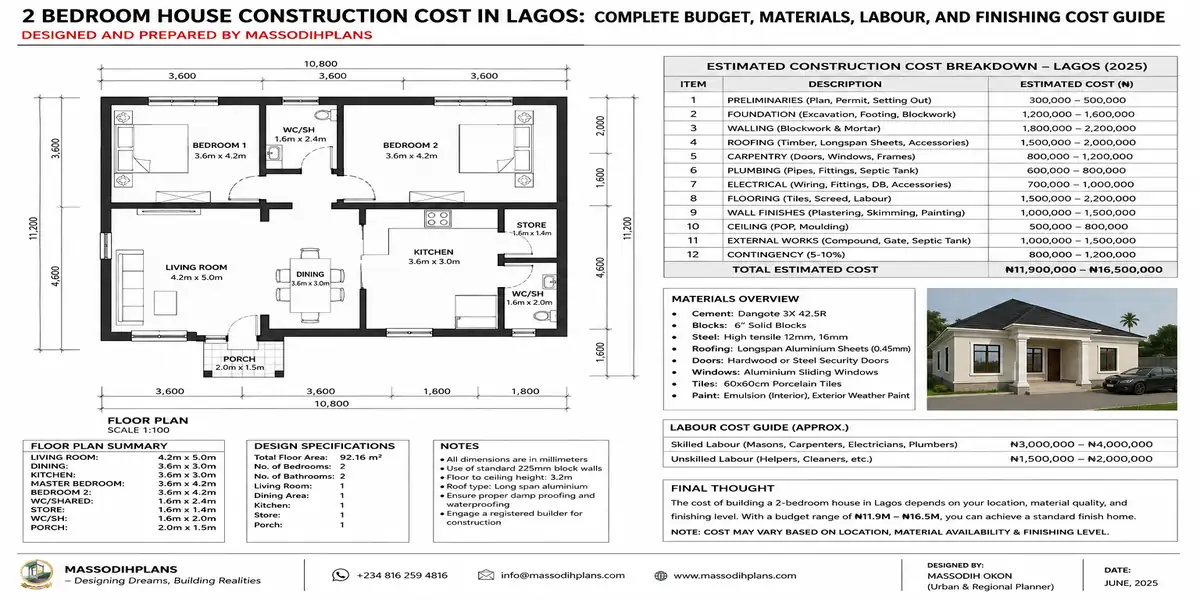
2 bedroom house construction cost lagos
If you are asking, “How much will it cost to build a 2-bedroom house in Lagos?”, the honest answer is: there is no single price. For a modest 2-bedroom bungalow, a sensible 2026 planning budget can fall around ₦20 million–₦35 million for the building itself, depending on floor area, soil condition, location, material prices, labour, design and finishing. Land is not included, and a difficult site, premium neighbourhood, expensive foundation or luxury finish can push the figure much higher.
That is why I did not write this guide to give you one attractive number and send you to site. I want you to understand where every naira can go before you start buying cement, blocks, iron rods or roofing materials.
In this guide, I will take you from a 2-bedroom floor plan to foundation, blockwork, concrete, reinforcement, roofing, windows, doors, electrical work, plumbing, tiling, ceiling, painting, kitchen, bathrooms, external works, professional fees and contingency. You will see how labour changes the budget, what you can safely economise on, and which “cheap” decisions can become expensive later.
Most importantly, I will show you how the size and design of the house affect the quantity of materials required. A 2-bedroom house is not automatically cheap: circulation space, bathrooms, kitchen size, roof shape, foundation requirements and finishing specifications all matter.
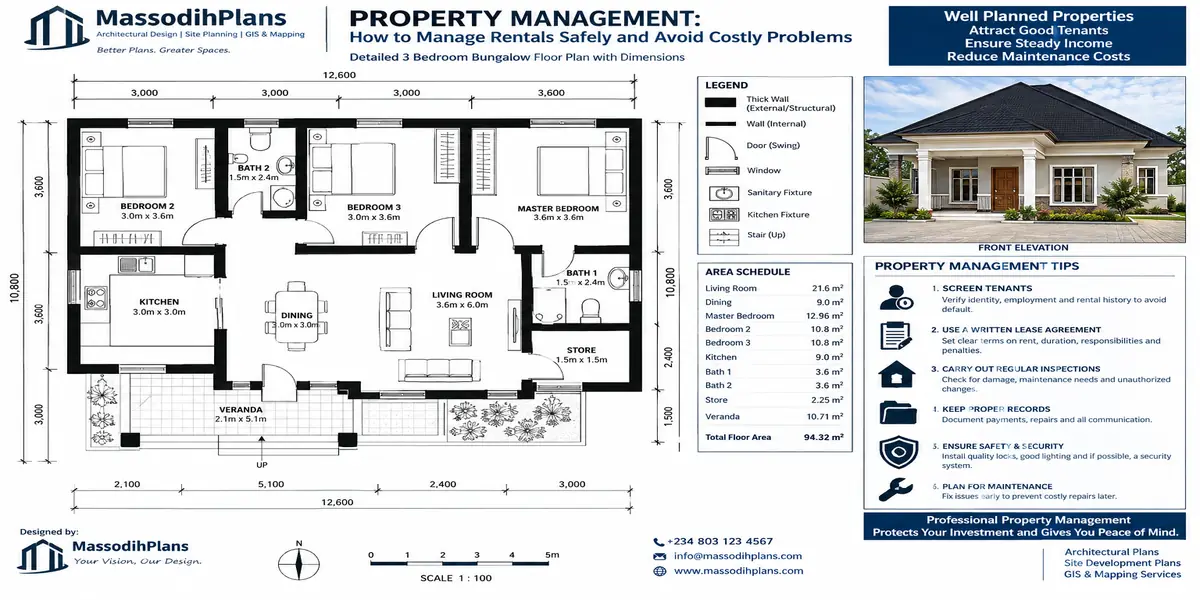
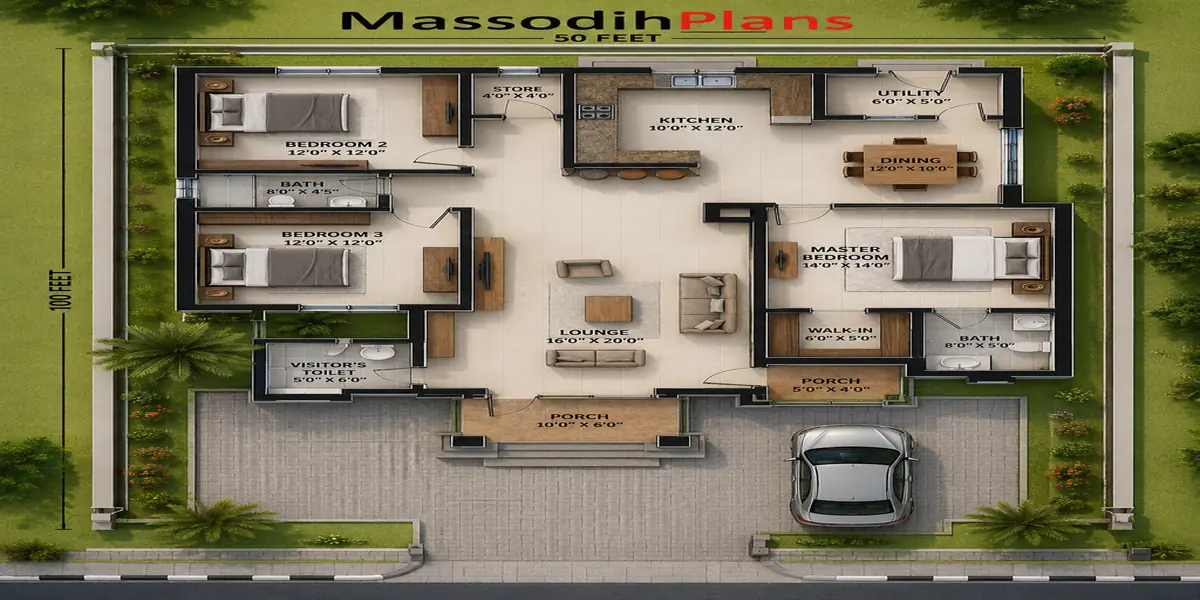
I have also included an annotated 2-bedroom floor plan prepared by MassodihPlans so you can connect the numbers to a real building on paper before construction.
If you are building in Lagos, budgeting for a family home, planning a rental property, or preparing funds in stages, read this guide fully. By the time you finish, you should know what to budget, what to question, and where your money is most likely to disappear.
Why a 2-Bedroom House Doesn’t Cost Exactly Half of a 4-Bedroom
Here’s something that genuinely surprises first-time builders, and I want to correct it immediately: your 2-bedroom house will very likely cost more per square metre than a larger 4-bedroom house, not less. This feels counterintuitive, but it’s consistently true, and understanding why changes how you budget.
Fixed-cost items don’t shrink with house size. A kitchen needs a full sink, cabinetry run, and cooking area regardless of whether the house has two bedrooms or five. A bathroom needs full sanitary fittings whether it’s one of two or one of five. These fixed-cost spaces represent a proportionally larger share of a small house’s total area and budget than they do in a larger house, where the same fixed costs get spread across more overall square metres.
The Real Math: In a 100 sqm 2-bedroom house, your kitchen and bathrooms might represent 20% of total floor area but 30–35% of your finishing budget. In a 250 sqm 4-bedroom house, those same rooms might be 15% of floor area and only 20% of finishing budget the fixed-cost rooms simply matter less, proportionally, as the house grows.
Roofing and foundation carry similar logic. A roof structure has genuine minimum complexity and material requirements regardless of house size, and foundation work involves fixed setup costs (excavation mobilization, formwork setup) that don’t scale down proportionally for a smaller footprint.
This isn’t a reason to avoid building small a 2-bedroom house remains genuinely the most affordable entry point into building rather than renting or buying in Lagos. It’s simply a reason to budget accurately rather than assuming a naive “half the size, half the cost” calculation, which is exactly the miscalculation I see trip up first-time 2-bedroom builders most often. With that reality set, let’s get into the actual numbers.
Realistic 2-Bedroom Cost Range in Lagos (2026)
Let’s anchor this properly. A typical 2-bedroom bungalow in Lagos runs roughly 90–110 square metres, including bedrooms, living/dining area, kitchen, bathrooms, and a small store.
At basic finishing (₦150,000–₦250,000/sqm), expect roughly ₦13.5–27.5 million in core construction cost. AAt medium finishing (₦300,000–₦500,000/sqm), expect roughly ₦27–55 million. At high-end finishing (₦600,000+/sqm), expect ₦54 million and upward, particularly in premium zones.
2-Bedroom Cost Snapshot (90–110 sqm)
Basic finishing → ₦13.5M–₦27.5M
Medium finishing → ₦27M–₦55M
High-end finishing → ₦54M+
Add separately: land, design fees, LASPPPA/LASBCA approval, external works
These figures cover construction only structure, roofing, and finishing exactly as clarified in our broader cost guides. Land, architectural and structural design fees (commonly ₦150,000–₦500,000 combined for a project this size), and approval costs (realistically ₦400,000–₦1,200,000 for a modest 2-bedroom permit, on the lower end of the ranges detailed in our Lagos approval guide) sit on top.
Location moves this range significantly, following the same zone logic covered in our pillar guide a 2-bedroom build in Ikorodu or outer Badagry can land meaningfully below this range on land cost specifically, while the same house in Lekki Phase 1 or near VI will see both land and labour push toward the top end and beyond. With the overall range set, let’s break down exactly where this money goes, material by material.
Material Quantities: What a 2-Bedroom House Actually Consumes
This is the layer I think genuinely helps you evaluate a contractor’s quote, because vague line items like “cement ₦X million” are impossible to verify. Let’s get specific about actual quantities.
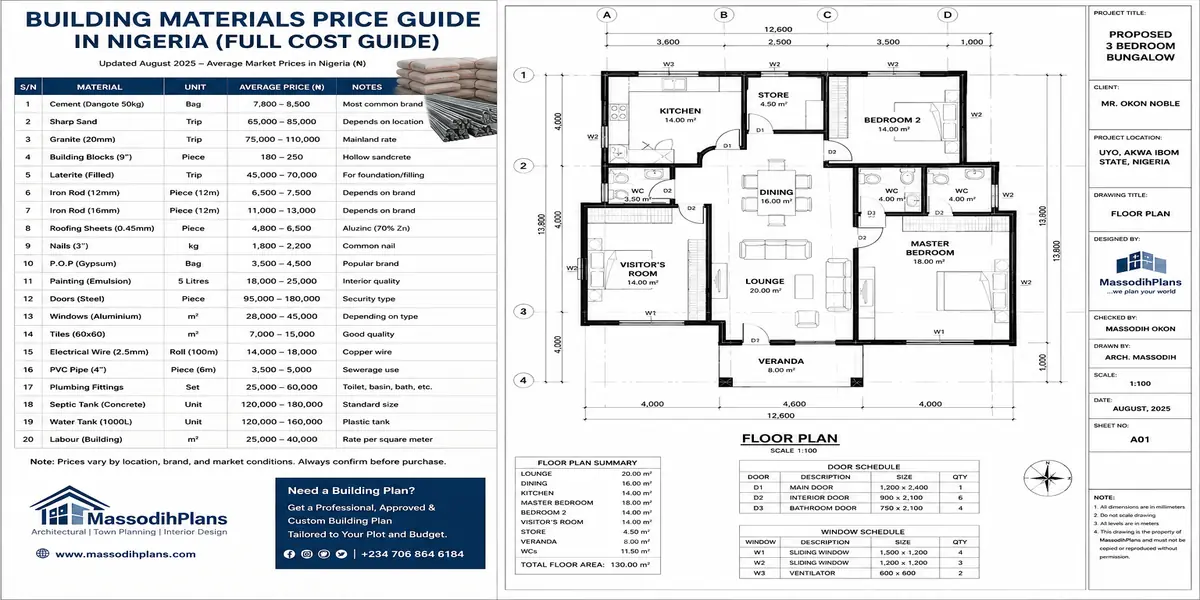
Cement for a 2-bedroom bungalow of this size typically requires somewhere in the range of 350–500 bags across foundation, blockwork mortar, plastering, and flooring, depending on foundation type and wall specification. At 2026 prices of roughly ₦9,500–₦13,000 per bag, that’s approximately ₦3.3–6.5 million on cement alone.
Verification Tip
Ask your contractor or quantity surveyor for the exact bag count in their quote, not just a lump cement cost. If they can’t tell you roughly how many bags they’ve budgeted, that’s a sign the estimate wasn’t built from real quantities.
Blocks typically 9-inch sandcrete blocks for a bungalow this size commonly run 2,500–3,500 pieces depending on wall height, opening count, and whether you’re moulding on-site or buying finished blocks, with on-site moulding usually cheaper but requiring more site space and time.
Iron rods (reinforcement) for a single-storey 2-bedroom bungalow are relatively modest compared to a duplex, needed primarily for foundation, lintel, and roof beam reinforcement get current pricing directly from your supplier, since this material moves faster than almost any other in the current market.
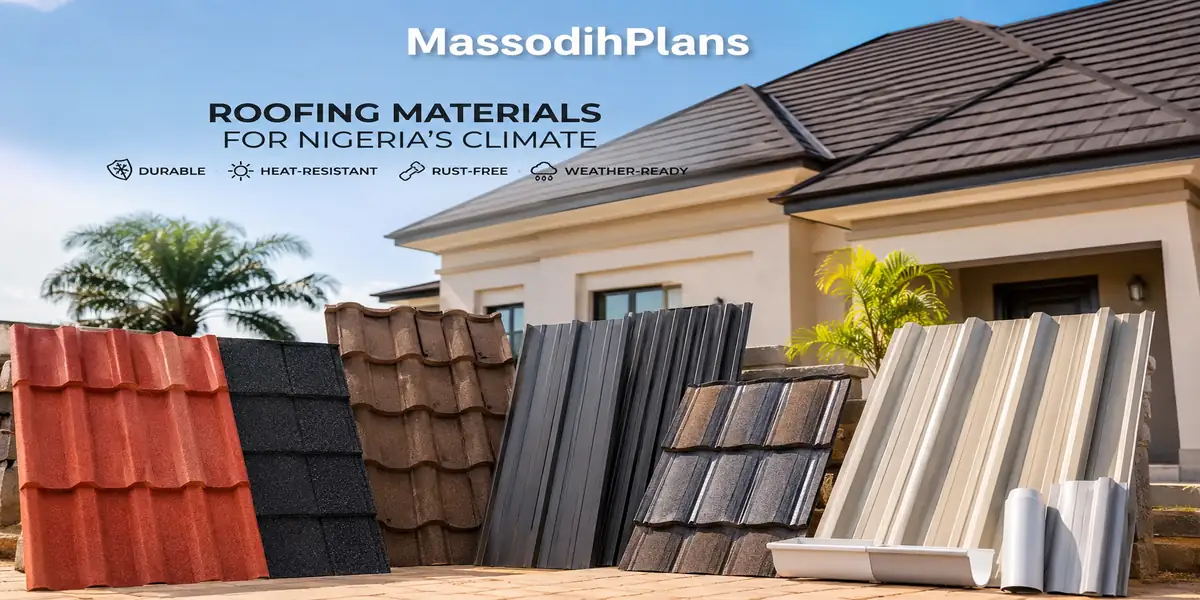
Roofing materials aluminum or long-span sheets, trusses, and associated fittings for a footprint this size typically represent a meaningful but contained portion of your structural budget, scaling with roof complexity as discussed in our broader budget breakdown guide.
Sand and granite, sourced locally, complete your core structural material list, with cost varying by proximity to source and current transport pricing.
2-Bedroom Structural Material Checklist
☐ ~350–500 bags cement
☐ ~2,500–3,500 blocks (9-inch)
☐ Iron rods per structural drawing specification
☐ Sand and granite per foundation and concrete requirements
☐ Roofing sheets, trusses, and fittings per roof design
☐ Doors and windows per room count and specification
Having these real quantities in hand means you can request itemized quotes and genuinely compare them, rather than accepting a single opaque number. With materials covered, let’s move to labour where a 2-bedroom build has its own specific dynamics worth understanding.
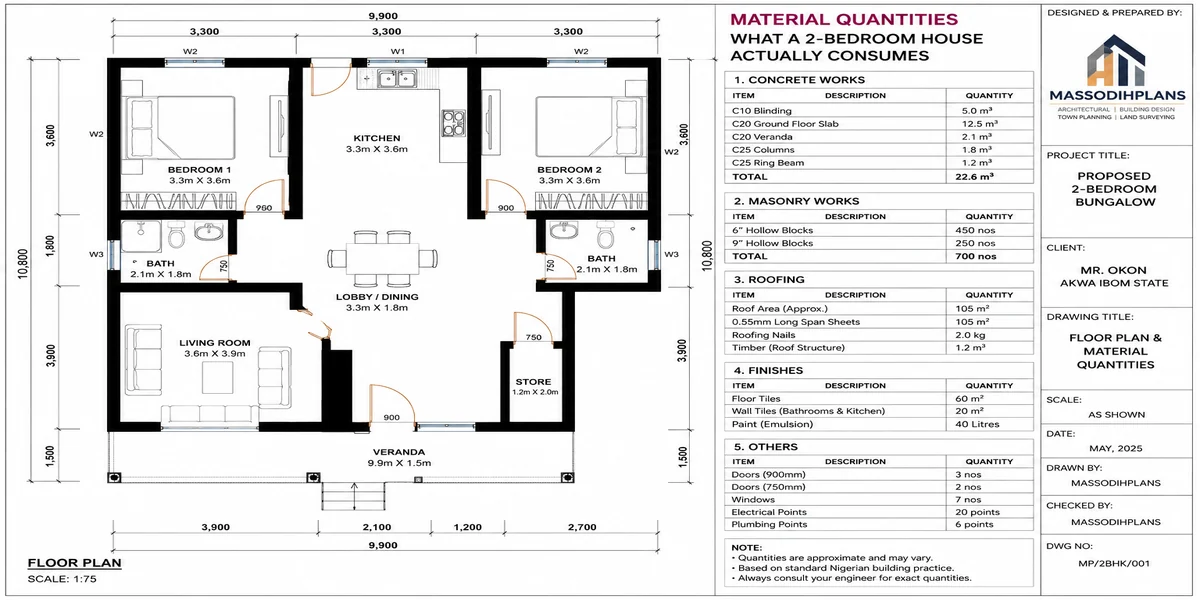
2bedroom material quantities
Labour for a 2-Bedroom Build: What’s Different at This Scale
Labour on a smaller build carries its own genuine considerations that differ from the larger projects covered in our broader guides.
Mobilization cost is proportionally higher. Skilled tradespeople bricklayers, iron benders, carpenters often price small jobs with a similar mobilization or setup cost to larger ones, since showing up, organizing tools, and coordinating a site involves similar overhead regardless of project size. This is part of why small builds sometimes feel “expensive per room” compared to larger projects.
Practical Labour Tip: For a project this size, consider a small, dedicated contractor or a trusted individual project supervisor rather than a large construction firm geared toward bigger developments the overhead and management fee structure of larger firms is often disproportionate to a 2-bedroom project’s genuine complexity.
Structural-phase labour foundation, blockwork, roofing still represents your largest labour cost bucket, following the same 35–40% structural allocation pattern covered in our budget breakdown guide, even at this smaller scale.
Finishing-phase labour tiling, painting, plumbing, electrical scales with room count and finish complexity more than raw floor area, meaning a 2-bedroom house with elaborate tiling patterns or built-in carpentry can see finishing labour costs approach what you’d expect from a considerably larger, simpler-finished house.
Payment structure matters just as much here as on larger builds staged payments tied to genuine milestones (foundation complete, roofing complete, finishing complete), agreed and documented before work begins, protect you regardless of project size.
With labour understood, let’s get genuinely practical and walk through cost room by room because this is where a 2-bedroom budget either holds together or quietly overruns.
Room-by-Room Finishing Cost Breakdown
This is, I think, the most genuinely useful section for anyone actually planning a 2-bedroom build, because finishing decisions get made room by room, not as one abstract lump sum.
Master bedroom and second bedroom. Flooring (tiles or, less commonly now, wood-effect finishes), wardrobe or built-in storage if included, doors, windows, and paint represent the core cost here relatively contained compared to wet areas, since bedrooms carry no plumbing or complex fittings.
Living and dining area. Typically your largest single finished space, and often where clients choose to invest more in flooring quality and ceiling detail (POP or simpler alternatives) since this is the space guests actually experience most.
Where Finishing Money Concentrates in a 2-Bedroom House
Kitchen → highest cost per square metre (cabinetry, sink, tiling, sometimes built-in cooker space)
Bathrooms (typically 2) → second-highest concentration (sanitary fittings, wall tiling, plumbing fixtures)
Living/dining → largest single space, moderate cost per sqm
Bedrooms → lowest cost per sqm (flooring, paint, doors, windows only)
Kitchen. As flagged in section one, this is genuinely where finishing cost concentrates disproportionately cabinetry, countertop, sink and fittings, wall tiling, and often a designated cooker and extraction point. Even a modest kitchen in a 2-bedroom house commonly represents one of your top two or three finishing line items.
Bathrooms (typically two master ensuite and a shared one). Sanitary fittings (WC, sink, shower or bathtub fixtures), wall and floor tiling, and plumbing represent the second major concentration point and this is doubled in a house with two bathrooms, which is standard even at this modest size.
Store and utility spaces, where included, add modest additional finishing cost but genuinely improve day-to-day livability, and I’d encourage clients not to cut this space purely to save a small amount, given how much daily frustration a missing storage area causes over years of actual living.
Understanding where your finishing budget concentrates helps you make deliberate trade-off decisions perhaps investing more in kitchen and bathroom quality while keeping bedroom finishes simpler, rather than spreading a limited finishing budget evenly and ending up with a compromised result everywhere. Let’s close with the specific mistakes I see most often on 2-bedroom projects specifically.
Common 2-Bedroom Build Mistakes (And How to Avoid Them)
Let me give you the patterns I’ve genuinely observed repeatedly on smaller residential projects mistakes specific to this scale, not the general points already covered in our broader guides.
Underestimating fixed-cost rooms
As covered in section one, clients frequently budget kitchen and bathroom finishing as if they scale down proportionally with house size. They don’t. Budget these rooms against their actual fixed requirements, not a percentage of a smaller total.
Skipping professional design “because it’s just a small house
I’ve seen this reasoning lead to genuinely poor space planning awkward room proportions, missed storage opportunities, poor natural light that a properly designed larger house would never suffer from. Professional design fees on a 2-bedroom project are proportionally small relative to total cost; skipping them saves little and risks a lot.
Rental-Income Specific Tip
If you’re building this 2-bedroom house specifically for rental income rather than personal occupation, prioritize durable, low-maintenance finishing over premium aesthetic choices tenants are genuinely harder on finishes than owner-occupants, and your material choices should reflect that reality from the design stage.
Treating approval as optional for a “small” project
As emphasized throughout our Lagos approval guide, building size doesn’t exempt you from LASPPPA and LASBCA requirements a 2-bedroom bungalow needs the same fundamental approval process as a larger house, just at a proportionally lower assessment fee.
Building without a genuine contingency
Small budgets feel tight already, tempting clients to skip the 15–20% contingency covered throughout our broader cost guides but a small budget is exactly where an unexpected cement price movement or a discovered soil issue hurts most proportionally, making contingency arguably more important, not less, on a project this size.
Compromising structural quality to afford finishing ambitions
As covered in our construction budget guide, this trade-off should never happen a 2-bedroom house with solid, safe structure and simple, honest finishing will always outlast and outperform one where structural corners were cut to afford a more impressive-looking finish on day one.
A 2-bedroom house, built properly, is genuinely one of the smartest entry points into Lagos property ownership affordable relative to larger builds, quick to complete, and, done right, a genuinely comfortable, durable home or a solid rental asset for years to come. The mistakes above aren’t inevitable; they’re avoidable with the right information going in, which is exactly what this guide has aimed to give you.
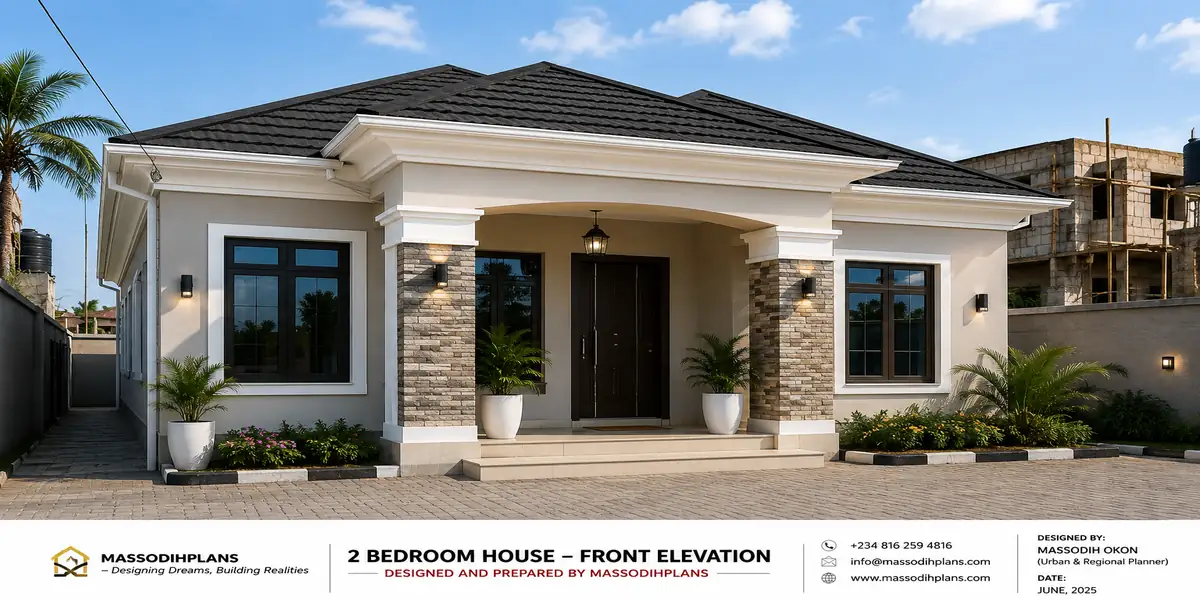
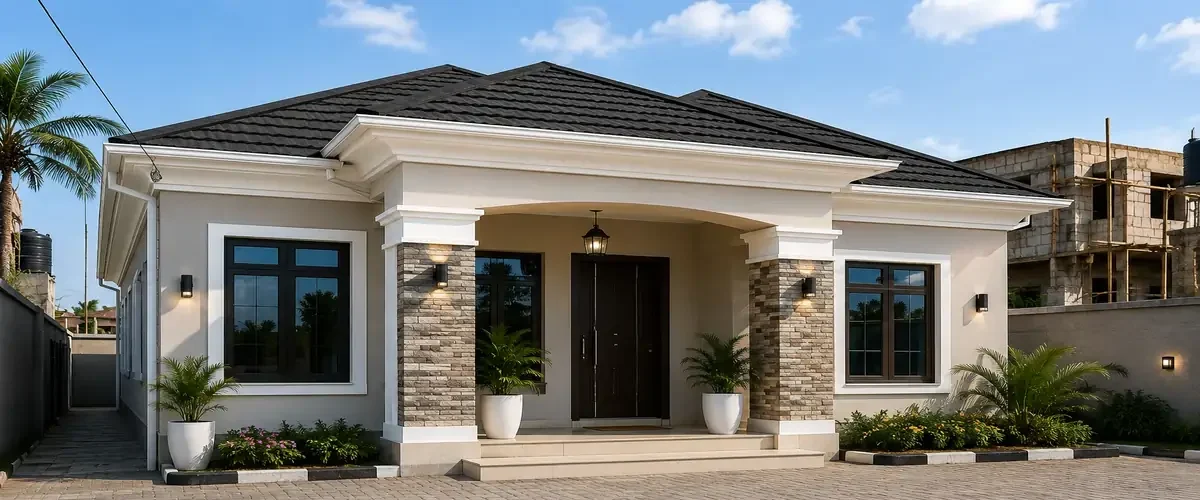
2 bedroom house front elevation
If you’re planning a 2-bedroom build and want a realistic, room-by-room costed budget for your specific plot, our Services page connects you directly with our team. For the fuller picture on materials, labour, and stage-by-stage budgeting across all house types, revisit our construction budget breakdown guide, and for everything on Lagos approval costs and the ePPPS process, see our Lagos building plan approval guide. To explore 2-bedroom house plans already designed with these cost realities in mind, browse our Plans Library, or return to our Homepage for more guides like this one.
Related Guides
- How Much Does It Cost to Build a House in Lagos? Complete Construction Budget and Cost Breakdown Guide
- Nigeria House Plan Approval Costs: Complete Guide to Getting Building Approval Faster Without Costly Delays
- Lagos Building Plan Approval: Complete Guide to Fees, Documents, Application Process, Timeline, and ePPPS
- Cost of Building a House in Lagos: Complete Budget Guide to Materials, Labour, Design, and Approval Costs
- Architecture & Architectural Design: Complete Guide to Modern Houses, Building Design and Modern Architecture
- Sustainable Landscaping: Complete Guide to Xeriscaping, Landscape Lighting and Water-Efficient Gardens
- Landscaping Services: Complete Guide to Landscape Design, Hardscaping, Garden Planning and Outdoor Improvements
- Landscape Architect: What They Do, What They Design and When You Need One
- Cost of Roofing a 4 Bedroom Duplex in Abakaliki (Complete Guide)
- Cost of Blocks, Cement, Iron Rod and Roofing Sheets in Uyo: Real Prices From the Field Now
- Cost of Building a 3 Bedroom Bungalow in Umuahia, Abia State (Current Price Guide)
- Cost of Building a Modern Bungalow in Calabar (Updated Guide)
- House Plans for Sloping Land in Jos, Plateau State, Nigeria: Smart Nigerian Designs
- Best 4 Bedroom House Plan for Small Plots in Abuja
- Nigerian House Plans for Family Homes in Makurdi, Benue State, Nigeria
- Best Roofing Options for Houses in Gusau city of Zamfara State, Nigeria: Prices and Durability