Why Smart Investors Budget for Planning Before Anything Else: Commercial Development Planning Costs: What Every Investor Must Know Before Spending a Kobo
Commercial development master plan layout in Nigeria showing zoning and road network
Let Me Give You the Answer First
If you are about to invest in a shop complex, office building, plaza, hotel, warehouse or mixed-use property in Nigeria, let me tell you something before you spend your naira: the cost of planning is not another bill to pay. It is one of the best ways to protect the larger investment that comes after it.
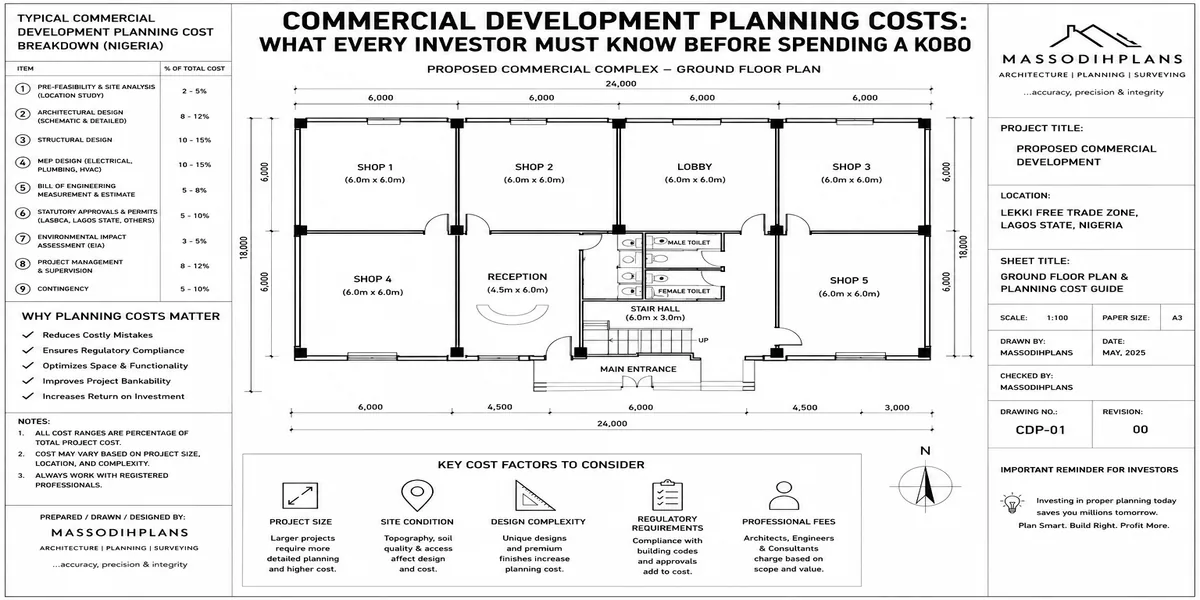
Commercial development planning costs can include site analysis, feasibility studies, architectural design, structural and MEP designs, surveying, planning consultancy, environmental studies, approvals, statutory fees, project management and other professional services. The exact amount is never a universal figure because location, land size, building type, floor area, complexity, regulations and the level of professional service required can change the final cost dramatically.
And this is where many investors get it wrong. They ask, “How much will the plan cost?” when the better question is, “What will it cost me if I plan badly?” A cheap drawing that ignores setbacks, access, parking, drainage, circulation, orientation, services, development-control requirements or the commercial purpose of the property can become an expensive mistake long before construction is complete.
In this guide, I will break down what commercial development planning covers, the cost components, the factors that push fees up or down, the hidden expenses investors often overlook, what you should expect from each professional, and how to compare quotations without choosing the cheapest option blindly.
Most importantly, I will show you how to think about planning costs as an investment decision not merely a design expense so you can protect your capital, reduce avoidable redesigns, improve approval readiness and create a development that makes commercial sense. By the end, you should know what to ask before spending a kobo.
What Is a Commercial Development Master Plan and Why Does It Cost Money?
A master plan is not just a drawing. That is the first thing I tell every client.
A commercial development master plan is a comprehensive document that guides how a piece of land will be developed over time. It covers land use, road design, infrastructure, utilities, zoning, drainage, open spaces, and future expansion. When done properly, it saves the developer enormous money in the long run.
During my undergraduate studies in Town Planning at the University of Uyo, one thing our lecturers constantly emphasized was this: a plan that is not comprehensive is not a plan. It is a sketch. And sketches cannot guide sustainable development.
The costs associated with commercial master planning cover several professional activities:
- Site survey and mapping (GIS and topographic analysis)
- Land use zoning and distribution studies
- Road hierarchy and circulation design
- Infrastructure and utility planning
- Environmental impact assessment
- Drainage and flood control design
- Regulatory approval fees and statutory submissions
- Professional consultation fees for multiple specialists
Each of these is a legitimate cost. Cutting any of them is where investors get into trouble.
The Nigerian Reality: Why Commercial Layouts Often Fail Without a Master Plan
Let me be completely honest with you. Nigeria has a serious problem with unplanned commercial development. I have seen it in Uyo, Port Harcourt, Lagos, Abuja, Owerri, and many other cities. The pattern is always the same.
Someone buys land, divides it into plots, sells to investors, construction begins. Within a few years, you have a commercial area with:
- Roads too narrow for trucks and delivery vehicles
- No parking spaces, so customers park on the road and cause congestion
- Open drains that become garbage dumps and flood during rainy season
- Shops built right up to the boundary with no setbacks
- Power and water supply that was never planned to serve the population density
- Land use conflicts where a generator workshop sits beside a crèche
This is not theory. I have encountered this situation multiple times on site visits and development control inspections. The economic loss is staggering. Property values drop. Tenants leave. The investor ends up with a development nobody wants to rent in.
A master plan prevents all of this. And yes, it costs money. But that cost is an investment, not an expense.
From what I have seen in practice, the cost of fixing a poorly planned commercial development is usually five to ten times more than what it would have cost to plan it properly from the beginning.
Land Use Distribution: How a Commercial Master Plan Divides Your Land
One of the first things I do when I receive a brief for a commercial development is study the land use distribution. This means deciding what percentage of the land goes to what purpose.
In a typical commercial layout in Nigeria, here is a realistic distribution you should expect:
- Commercial plots: 40 to 55 percent of total land area
- Roads and circulation: 20 to 30 percent
- Open spaces and landscaping: 5 to 10 percent
- Public facilities (toilets, security posts, waste collection points): 2 to 5 percent
- Drainage reserves and setbacks: 5 to 8 percent
- Parking areas: 5 to 10 percent
These percentages are not guesses. They come from physical planning standards established by regulatory bodies like the Nigerian Institute of Town Planners (NITP) and the Town Planners Registration Council of Nigeria (TOPREC). They are also guided by state urban development laws.
When someone tells you they are giving you 90 percent of a commercial land as sellable plots, be suspicious. That means very little has been set aside for roads, drainage, and open space. And that commercial layout will become a nightmare in 5 years.
In one housing layout project I handled, the original promoter had allocated barely 12 percent to road infrastructure. We had to redesign the entire plan before the Ministry of Land and Housing would approve it. The developer was not happy about the revised plot numbers. But that plan is now a functioning, liveable estate.
Understanding Zoning Hierarchy in Commercial Layouts
Zoning is how you separate different types of commercial activity from each other and from other land uses. It is one of the most important parts of any commercial master plan.
In my experience, when zoning is ignored or poorly done, you end up with a commercial area where every kind of business is mixed together in ways that create conflict, noise, safety hazards, and inefficiency.
Common Commercial Zones in Nigerian Development Plans
General Commercial Zone (C1): Shops, offices, banking halls, retail outlets, small food businesses
Heavy Commercial Zone (C2): Warehouses, large supermarkets, automobile workshops, hardware stores
Mixed Commercial-Residential Zone (C/R): Ground floor commercial with upper floor residential, common in Nigerian urban centres
Service Commercial Zone: Filling stations, mechanics, welding shops, vulcanizers, separated from light commercial for safety
Institutional Commercial Zone: Schools, clinics, churches, mosques with commercial elements, subject to special setback requirements
Each zone has its own development standards. Height limits differ. Setbacks differ. Parking requirements differ. Signage rules differ. A commercial master plan should specify all of these clearly.
During my internship, I observed that most layout disputes and approval rejections in the Ministry happened because zone boundaries were either unclear or not respected during construction. Getting zoning right at the design stage saves enormous pain later.
Road Hierarchy and Circulation: The Skeleton of Your Commercial Layout
Roads are the skeleton of any development. Get the road hierarchy wrong and your commercial layout will die slowly from congestion, delivery problems, and accessibility failure.
A properly designed commercial master plan uses a clear road hierarchy:
The Four Levels of Road in a Commercial Layout
Primary Access Road (Collector Road): The main entry and exit road. Usually 18 to 24 metres wide in a commercial setting. This connects the development to the external road network.
Secondary Roads: Internal distribution roads, typically 12 to 18 metres wide. These connect different commercial zones within the development.
Service Roads and Access Lanes: Narrow roads, usually 6 to 9 metres wide, giving direct access to individual plots, loading bays, and parking areas.
Pedestrian Walkways and Cycling Paths: Often forgotten in Nigerian commercial layouts but critically important for safety and business activity.
One practical example comes from a project I handled in Akwa Ibom State. The developer wanted to maximize plot numbers by narrowing the internal roads to 7.5 metres. I advised against it strongly. We compromised at 12 metres for secondary roads and 9 metres for service lanes. Today, that commercial area handles daily delivery trucks without blockage.
If the roads had been 7.5 metres, a single parked truck would have closed the entire lane. Shops would have lost customers. Rents would have dropped. The developer would have lost more money in reduced rent income than the few extra plots would have generated.
Based on my experience, the safest approach is to never sacrifice road width for plot numbers in a commercial layout. A well-circulated commercial area generates more rental income per plot than a congested one with more plots.
Plot Arrangements and Physical Planning Standards
How plots are arranged within a commercial layout directly affects business functionality, safety, and aesthetic quality.
At the University of Uyo, we were taught that plot arrangement is not just about fitting as many units as possible. It is about creating a functional, safe, and commercially viable environment. That lesson has proven itself true on every project I have worked on.
Standard Commercial Plot Arrangements in Nigeria
Strip Commercial Layout: Plots arranged in a linear strip along a road. Common for roadside commercial developments. Simple but can create parking and circulation problems.
Block Commercial Layout: Plots grouped in blocks with roads on multiple sides. Better for internal circulation and parking. More expensive to service but more commercially viable.
Market Square Layout: Plots arranged around a central open space or market area. Very common in Nigerian market developments and town centres. Creates a natural commercial focal point.
Mixed-Use Tower Layout: Vertical commercial development where ground floor is retail, upper floors are offices or residential. Becoming more common in Nigerian city centres.
Key Physical Planning Standards to Know
Minimum commercial plot size: Typically 450 to 900 square metres depending on the state and zone
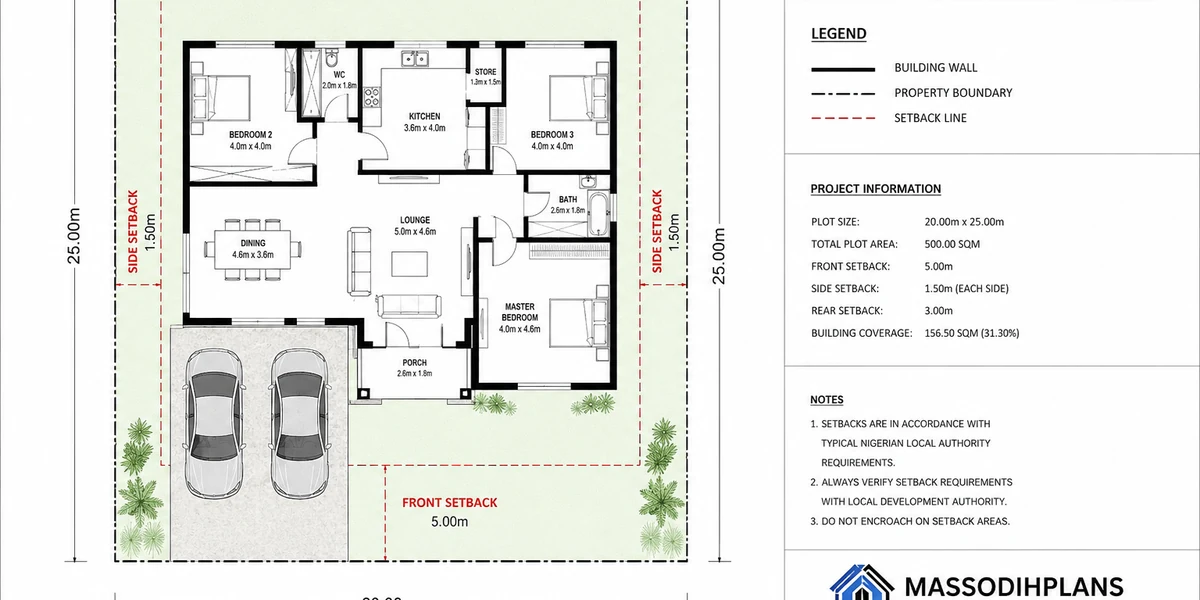
Building setback from road: Minimum 3 metres for secondary roads, 6 metres for primary roads in most Nigerian states
Side setbacks: Minimum 1.5 to 3 metres from plot boundary, depending on state regulations
Rear setbacks: Minimum 3 metres in most states, more for buildings above one storey
Maximum plot coverage: Usually 60 to 70 percent of plot area for commercial buildings
Maximum building height: Varies by zone, typically 2 to 6 floors for general commercial in most Nigerian states
These standards are not optional. They are enforceable under state urban development laws. I have seen developments demolished or stalled because the developer ignored setback requirements. It is a painful lesson to learn after spending money on construction.
Infrastructure Planning: The Systems That Keep a Commercial Area Alive
Infrastructure is what separates a functional commercial area from a failed one. It covers power, water, drainage, waste management, telecommunications, and sewage.
In Nigeria, infrastructure planning for commercial developments is particularly complex because you cannot always rely on public utility networks. A good master plan must account for this reality.
Power Infrastructure Planning
Every commercial master plan in Nigeria must plan for both public power connection and private power generation. This means:
- Dedicated transformer allocation with the Distribution Company serving your area
- Central generator house for the development if it will be managed as a scheme
- Adequate cable routes and distribution points designed into the road reserves
- Solar power integration for lighting, security systems, and common area services
Water Supply Planning
In most Nigerian cities, pipe-borne water from public utilities is unreliable. A commercial master plan must provide for:
- Borehole drilling locations that respect setback distances from drains and septic systems
- Overhead tank positions and structural support requirements
- Water reticulation network connecting to individual plots
- Fire hydrant provisions at regular intervals as required by Nigerian fire safety standards
Sewage and Waste Management
This is an area many Nigerian developers ignore, and it causes serious public health and environmental problems. A proper master plan must specify:
- Septic system locations and capacity calculations based on population projection
- Waste collection points designed for easy vehicle access
- Grease traps for food service zones
- Environmental management provisions under NESREA guidelines
Drainage Systems and Flood Control: The Most Ignored and Most Critical Element
I want to spend extra time on this because I have seen so much damage caused by poor drainage planning in Nigerian commercial developments. Flooding destroys property, discourages customers, spreads disease, and reduces property value faster than almost anything else.
This observation comes from practical field experience. During site analysis assignments at university and confirmed many times in professional practice, I noticed that drainage is almost always the last thing a developer thinks about and the first thing that causes problems.
Components of a Commercial Drainage Plan
Surface Water Drainage: Open drains, covered drains, and underground pipes designed to collect rainwater from rooftops, parking areas, and roads and direct it safely away from the development.
Natural Drainage Channels: Preservation and design of natural water flow paths. You must never block natural drainage channels when developing a commercial site.
Detention Ponds or Retention Basins: Where land allows, designing water retention features that slow down runoff and prevent flooding downstream. This is smart planning and adds aesthetic value.
Erosion Control Measures: Retaining walls, vegetation covers, and paved surfaces at critical points to prevent soil erosion, especially in hilly or sloped commercial sites.
Flood Risk Assessment
Before any commercial master plan can be completed, the site must be assessed for flood risk. In Nigeria, this means:
- Reviewing topographic survey data to understand water flow patterns
- Checking if the site is within a floodplain (development is prohibited or heavily restricted on floodplains in most Nigerian state planning laws)
- Analysing soil permeability to understand how quickly the ground absorbs water
- Designing floor levels above the 100-year flood line
One lesson I learned early is that you cannot design a drainage system without a proper topographic survey. I have reviewed plans where drainage was drawn without any survey data. Those developments flooded on the first heavy rain. Never skip the survey.
Environmental Management in Commercial Development Planning
Every commercial development in Nigeria above a certain scale requires an Environmental Impact Assessment (EIA) or Environmental Impact Statement (EIS) submitted to NESREA (National Environmental Standards and Regulations Enforcement Agency) or the relevant State Ministry of Environment.
This is not a box-ticking exercise. Environmental management planning covers:
- Tree preservation and replanting obligations
- Buffer zones between commercial development and watercourses
- Noise management for commercial activities that generate significant sound
- Air quality management for commercial uses that produce emissions
- Waste management infrastructure for both solid and liquid waste
- Green space allocation as a percentage of total site area
In my experience, developers who take environmental management seriously not only get approval faster but also end up with commercial developments that people actually want to be in. Green spaces, shade trees, and well-managed drainage make a commercial area attractive. Attractive commercial areas attract premium tenants. Premium tenants pay better rents.
This is not just theory. I have seen this happen on projects. Both classroom learning and field experience support this conclusion.
Development Control: The Rules You Cannot Ignore
Development control is the regulatory framework that governs how buildings are constructed within a planned area. It is enforced by the state Ministry of Lands, Housing and Urban Development, or its equivalent in each state.
While assisting with development control activities during my internship, I discovered that the most common reason commercial development approvals are rejected or revoked in Nigeria is not the quality of design. It is non-compliance with development control standards.
Key Development Control Requirements for Commercial Layouts in Nigeria
Certificate of Occupancy (C of O): The legal title over the land, without which no approval can be issued
Approved Building Plan: Structural drawings approved by a registered engineer and architectural drawings approved by a registered architect or ARCON-certified designer
Town Planning Permit: The layout approval from the state Ministry of Lands or Urban Development Authority, required before any site works begin
EIA Clearance: For commercial developments above a defined scale in each state
Fire Safety Certification: Required before occupation, issued by the state fire service
Structural Completion Certificate: Issued after inspection confirms the building was built according to the approved plan
Missing any of these is not just a legal problem. It is a financial one. I have worked with clients who completed construction without all approvals and then discovered they could not legally sell or lease the property. Getting retroactive approvals is expensive, time-consuming, and sometimes impossible.
Population Projections and Planning Standards
One thing that separates a professional commercial master plan from an amateur layout drawing is population projection. This means calculating how many people will use the commercial area on a daily basis and designing all facilities to serve that population.
This principle formed a major part of our coursework at the University of Uyo. Population projection guides every infrastructure decision, from road width to the number of toilet facilities to the capacity of the sewage system.
How Population Projections Work in Commercial Planning
Floor space per person standards: Nigerian planning standards typically allow for 4 to 6 square metres of retail floor space per daily visitor in high-activity commercial zones.
Peak hour traffic estimates: Used to design parking areas and road widths. A commercial area with 500 daily visitors may have 150 vehicles arriving in the 2-hour peak period.
Water demand calculations: Based on projected visitor numbers and commercial activity types. Food courts need far more water per person than clothing shops.
Sewage generation estimates: Based on population served and Nigerian sewage generation standards (usually 80 to 100 litres per person per day for commercial uses).
These calculations directly influence how much the infrastructure components cost. And infrastructure costs are a major part of commercial development planning costs.
Transportation Integration: Connecting Your Commercial Development to the World
A commercial development that is not easily accessible is a commercial development that will struggle. Transportation integration is about ensuring your commercial layout connects properly to the external road network and accommodates all modes of transport that your customers and tenants will use.
Key Transportation Integration Elements
Junction Design: How your primary access road meets the public road. Poor junction design creates traffic buildup at your entrance and discourages customers.
Public Transport Access: Provision for bus stops, keke-napep loading bays, and minibus drop-off points near commercial entrances.
Parking Standards: Nigerian commercial development standards typically require one parking space per 50 to 100 square metres of retail floor space, depending on state.
Loading Bays: Dedicated areas for trucks and delivery vehicles that do not interfere with customer parking and pedestrian movement.
Pedestrian Access: Safe, shaded walkways connecting parking areas to shops, and from public transport stops to the commercial area.
Working alongside experienced planners taught me that transportation integration is where commercial developments most commonly fail in Nigeria. Parking is almost always undersized. Loading bays are almost always absent. Public transport access is almost always unplanned.
The result is the Nigerian commercial area we all know: traffic chaos at the entrance, vehicles parked everywhere, pedestrians walking on the road, delivery trucks blocking half the layout. It does not have to be this way.
GIS and Mapping Integration in Modern Commercial Planning
My academic training exposed me to GIS (Geographic Information Systems) as a core tool in modern planning. Today, GIS is not optional for serious commercial development planning. It is essential.
GIS allows planners to:
- Map topographic features accurately and identify flood risks before design begins
- Analyse surrounding land use and identify compatibility issues
- Model traffic flow and identify congestion pressure points
- Track utility infrastructure and avoid design conflicts
- Generate precise area calculations for land use distribution
- Produce maps that satisfy planning authority requirements
The cost of proper GIS work is typically factored into the professional fees of the planning team. Do not accept a commercial master plan that was designed without any topographic or GIS data. It is a sign that shortcuts were taken and that the plan may not survive regulatory scrutiny.
Planning Implementation and Development Phases
A commercial master plan is not just a vision. It must be phased to allow implementation over time as capital is available. This is something I have encountered many times in projects where developers tried to build everything at once and ran out of money halfway.
Typical Commercial Development Phases
Phase 1 (Foundation): Land clearing, road construction, drainage infrastructure, perimeter fencing, utility connections, and serviced plot creation. This phase makes the land ready for development and is the most capital-intensive.
Phase 2 (Core Commercial): Construction of anchor commercial units, market buildings, or office blocks that generate initial rental income. This phase partially funds subsequent phases.
Phase 3 (Secondary Commercial): Development of smaller commercial units, service bays, and mixed-use buildings once the area is established and attracting tenants.
Phase 4 (Completion): Landscaping, public facilities, additional parking, and any community amenity infrastructure. This phase improves quality and increases property values across the development.
If I were advising a client today, I would recommend planning your phasing based on cash flow, not ambition. Many commercial developments in Nigeria stall permanently at Phase 1 or Phase 2 because Phase 1 was underfunded.
Smart Growth Concepts for Nigerian Commercial Developments
Smart growth is not a Western concept that does not apply to Nigeria. It is a set of planning principles that help any development use land more efficiently, cost less to service, and remain viable longer.
Smart Growth Principles Relevant to Nigerian Commercial Planning
Mixed-Use Integration: Combining commercial, residential, and office uses in the same development reduces travel distances for tenants and workers and increases viability.
Compact Development: Higher plot coverage and reduced road reserves where appropriate, reducing infrastructure costs without sacrificing functionality.
Transit Orientation: Designing commercial areas so that public transport users are well served, not just private car owners. This expands your customer base enormously in Nigerian cities.
Green Infrastructure: Using vegetation for shade, flood control, and aesthetics rather than purely engineered solutions. Cheaper, more effective, and more attractive.
Community Integration: Designing commercial areas to serve surrounding residential communities, not just attract external visitors. This creates sustainable demand.
Over the years, I have noticed that Nigerian commercial developments that apply smart growth principles outperform those that do not, even in the same market. The difference shows up in occupancy rates, rental income, and how quickly the area becomes self-sustaining.
Open Space Allocation and Urban Sustainability
Open spaces in a commercial development are not wasted land. They are operational assets.
Nigerian planning standards typically require a minimum of 10 percent of any commercial development area to be set aside as open space. This includes:
- Public plazas and sitting areas that encourage customers to stay longer
- Children’s play areas for commercial developments in mixed-use zones
- Landscaped buffer zones that reduce noise and dust
- Storm water gardens that serve both drainage and aesthetic functions
- Tree-lined walkways that reduce heat and make the commercial environment more comfortable
From a planning perspective, I strongly recommend not reducing open space allocation to gain more plot area. The evidence from projects I have worked on is clear: commercial areas with adequate open space have better customer dwell time, higher footfall, and stronger tenant retention.
What Commercial Development Planning Actually Costs in Nigeria
Now let us talk numbers plainly.
The cost of a commercial development master plan in Nigeria depends on:
- The size of the land (smaller land, smaller fee, but minimum charges still apply)
- The complexity of the development (market layout versus tech park versus shopping mall)
- The number of professionals involved (town planner, architect, civil engineer, environmental consultant, surveyor)
- The number of government approvals required
- The state and local government where the development is located (some states have higher regulatory fees)
Realistic Cost Ranges for Commercial Planning in Nigeria (2024/2025)
Professional Planning and Design Fees: N500,000 to N3,000,000 for a small to medium commercial layout (1 to 5 hectares). Larger developments or complex mixed-use schemes can exceed N10,000,000.
Topographic Survey: N150,000 to N800,000 depending on land size and location
Environmental Impact Assessment: N300,000 to N2,000,000 depending on scale and regulatory requirement
Government Approval Fees (Ministry of Lands, Urban Development): N200,000 to N2,000,000 depending on state and land size
Building Plan Approval Fees: Separate from layout approval, typically 0.5 to 1.5 percent of estimated construction cost
Utility Connection Fees (DISCOS, PHCN, Water Board): Variable, can add N500,000 to N3,000,000 to total costs
In my experience, developers who budget only for professional fees and forget about regulatory costs and utility connections end up overspending badly at the implementation stage. Budget for all categories from the beginning.
A practical lesson from my field experience: the government fees and utility connection costs in Nigeria can equal or exceed the professional planning fees. Never leave these out of your development budget.
The Human Lifestyle Layer: What Good Commercial Planning Means for Real People
I want to step back from the technical for a moment and talk about what all of this means for real people.
A well-planned commercial development is not just a financial asset. It is a place where people work, buy things, earn their livelihoods, and spend significant parts of their day. When the planning is good, those people have:
- Safe walkways so they do not have to dodge vehicles
- Shade from trees so walking between shops in Nigerian heat is bearable
- Clean, accessible toilets because basic human dignity matters in a commercial area
- Good drainage so their shops do not flood every rainy season and destroy their stock
- Reliable power because a commercial area with constant darkness loses customers every night
- Proper waste collection points so the area does not smell and look like a dump
These things do not happen by accident. They happen because someone sat down and planned for them. That is what a commercial master plan does.
I did not learn this from a textbook alone. I learned it by watching what happens in well-planned versus poorly planned commercial areas across Nigeria and seeing the human difference it makes.
Investment Layer: Why Master Plan Quality Directly Affects Your Returns
If you are reading this as an investor, this section is for you.
The quality of the master plan for a commercial development directly determines the financial returns from that development. This conclusion is based on both academic training and real-world observation.
How Master Plan Quality Affects Investment Returns
Rental Income: Well-planned commercial areas with good road access, adequate parking, and proper utilities command significantly higher rents than congested, poorly serviced alternatives. The difference can be 30 to 100 percent in the same market.
Occupancy Rates: Tenants stay longer in well-planned commercial areas. Lower tenant turnover means lower income gaps and lower re-letting costs.
Capital Appreciation: Commercial land and property within a properly planned and approved commercial scheme appreciates faster than informal or poorly planned commercial areas.
Resale Value: If you ever want to exit your investment, a development with a complete set of planning approvals, a current C of O, and a well-maintained commercial environment will sell at a premium.
Financing Availability: Banks and financial institutions are more willing to provide loans for commercial developments with complete planning approvals than those without. Your master plan quality directly affects your access to capital.
I have worked with clients who initially resisted spending money on proper master planning and later wished they had. I have also worked with clients who invested in proper planning from the start and are now receiving excellent returns on that investment. The evidence from projects I have worked on points clearly in one direction.
Common Mistakes Investors Make in Commercial Development Planning
Let me share the mistakes I have seen repeatedly, so you can avoid them.
Paying for the cheapest plan instead of the best plan. A plan that costs N200,000 instead of N800,000 may save you money today and cost you N5,000,000 in problems later.
Not engaging a registered Town Planner. TOPREC-registered town planners are legally qualified to prepare and sign commercial development plans in Nigeria. Using unregistered practitioners risks approval rejection.
Skipping the topographic survey. I have seen this mistake repeatedly. Without survey data, your drainage design is guesswork. And guesswork floods.
Rushing the approval process. Government approvals in Nigeria take time. Building before all approvals are in place is a serious legal and financial risk.
Ignoring future expansion. A good master plan reserves land and design capacity for future phases. I once reviewed a plan where the only possible expansion direction was blocked by the developer’s own drainage canal. Expansion became impossible without demolition.
Cutting road widths to create more plots. I have covered this already but it bears repeating. Narrow roads kill commercial areas.
Assuming public infrastructure will serve your development. In Nigeria, plan for yourself. Design your own power, water, and waste management.
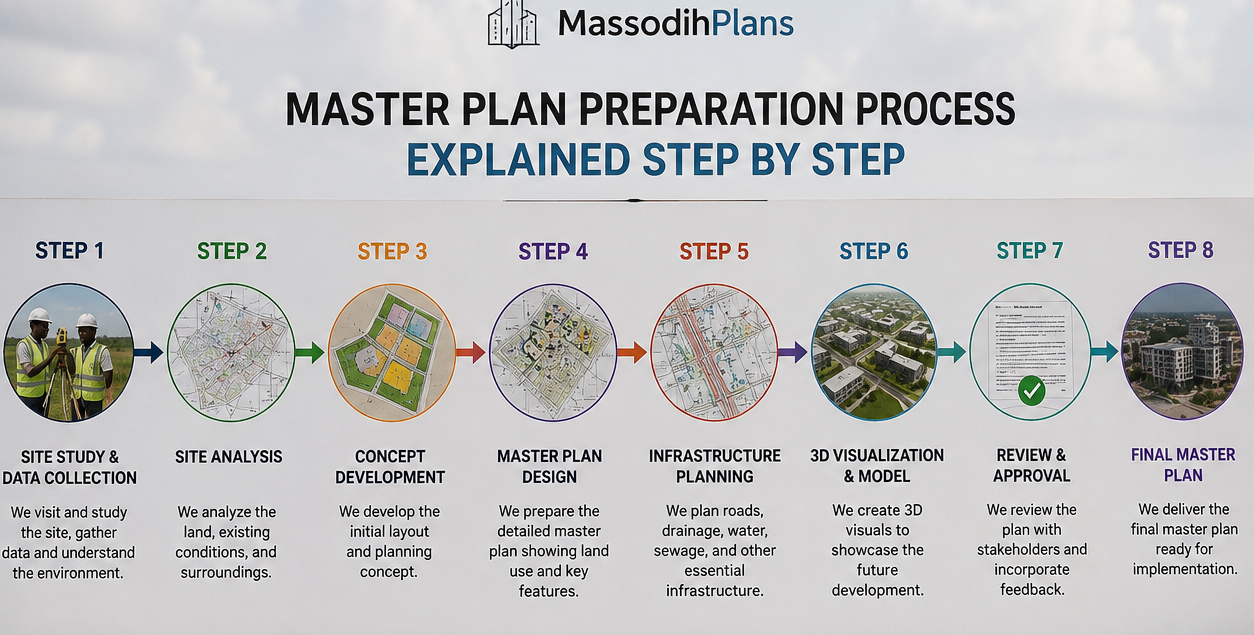
Planning Approval Process: Step by Step
Many developers are confused about the approval process for commercial development in Nigeria. Here is a plain walkthrough of how it typically works, based on my experience across multiple Nigerian states.
Engage Your Professional Team: Registered town planner, architect, structural engineer, environmental consultant, and surveyor. Each has a specific role in the approval process.
Commission the Topographic Survey: Get the land surveyed by a SURCON-registered surveyor. This produces the survey plan and topographic data that everything else is built on.
Prepare the Master Plan and Development Brief: The town planner prepares the layout plan and development control regulations. The architect prepares building drawings.
Submit to Ministry of Lands and Housing (or Urban Development Authority): For layout approval and development permit. Required documents vary by state but typically include the survey plan, layout plan, environmental statement, and proof of land ownership.
Ministry Review and Site Inspection: The Ministry reviews the submission and conducts a site inspection. Queries are raised and responded to. This process can take weeks to months depending on the state.
Layout Approval Issued: Once satisfied, the Ministry issues the approved layout plan and development permit.
Commence Infrastructure Works: Only now should you begin site clearing, road construction, and drainage installation.
Apply for Building Plan Approvals: For each commercial unit as construction begins, separate building plan approvals are required.
Post-Construction Certification: Completion certificate issued after inspection confirms the buildings match the approved plans.
This is the right process. Cutting any step creates legal exposure and financial risk.
Future Expansion Opportunities: Planning for What is Next
The best commercial master plans do not just plan for today. They plan for the next 20 to 30 years.
Urban growth strategy in commercial planning means:
- Reserving land corridors for future road expansion without demolishing buildings
- Designing utilities at a capacity that can serve a larger development than you are initially building
- Zoning areas at the edge of your development for future phases
- Identifying off-site infrastructure that will need upgrading as the development grows
- Planning integration with surrounding communities so your commercial area grows with them rather than in conflict with them
My experience in planning and design has shown me that developers who think generationally get far better long-term returns than those who think in terms of the current construction phase alone.
Frequently Asked Questions
How much does a commercial master plan cost in Nigeria?
For a small to medium commercial development (1 to 5 hectares), professional fees range from N500,000 to N3,000,000. Add government approval fees, surveys, and utility connections, and total planning costs for a medium commercial development typically fall between N1,500,000 and N8,000,000. Larger or more complex developments cost significantly more.
Do I need a registered town planner for a commercial development plan in Nigeria?
Yes. Under Nigerian law, town planning layouts and development permits must be prepared and signed by a TOPREC-registered Town Planner. Using unregistered practitioners risks rejection of your approval application and legal liability.
What is the difference between a layout plan and a building plan in Nigeria?
A layout plan shows how the land is divided, zoned, and serviced. It is the master plan for the whole development. A building plan shows how individual structures on the plots are designed. Both require separate approvals from different authorities in most Nigerian states.
How long does commercial development approval take in Nigeria?
In my experience, layout approvals take 3 to 12 months in most Nigerian states, depending on the completeness of the submission, the responsiveness of the Ministry, and whether queries are raised. Building plan approvals typically take 1 to 3 months per unit.
What regulations govern commercial development in Nigeria?
Commercial development in Nigeria is governed by the Nigerian Urban and Regional Planning Act (now largely replaced by state equivalents), individual state urban development laws, NESREA regulations for environmental compliance, ARCON regulations for architectural practice, and TOPREC regulations for town planning practice.
Can a commercial area be built without a master plan?
Not legally in Nigeria. Any commercial layout development requires an approved layout plan from the relevant state authority before construction can begin. Without this approval, buildings are liable to demolition. And beyond legality, building without a master plan creates the exact congestion, flooding, and land use conflict problems that make many Nigerian commercial areas dysfunctional.
Finally: Plan Well, Build Well, Prosper Well
If there is one thing I want you to take away from this article, it is this: commercial development planning costs are not an expense. They are the foundation of your investment.
Having seen the consequences of poor planning, I advise every investor and developer to budget properly for professional planning from the very beginning. The cost of doing it right is always less than the cost of fixing it later.
Nigeria needs more properly planned commercial areas. Areas where traders can work without flooding every rainy season. And areas where customers can park and walk safely. Areas where businesses can thrive and communities can grow. That is what a good master plan delivers.
And that is what we build at MassodihPlans.
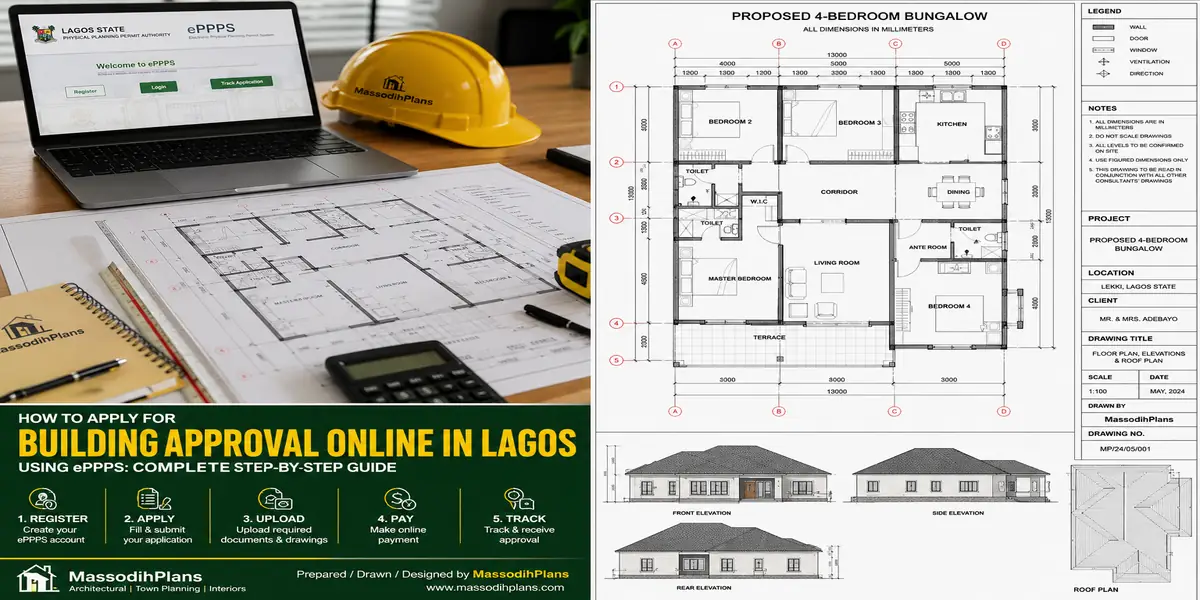
If you are planning a commercial development and need expert guidance on master planning, layout design, regulatory approvals, or feasibility assessment, MassodihPlans is here to help. Visit our Services page or contact us directly to discuss your project. Real help from a registered Town Planner and Architectural Designer who has walked the exact path you are about to take.
Explore More
- MassodihPlans Plans Library
- Plan School
- professional Services
- Read our guide on Estate Layout Design Costs in Nigeria
- Read our guide on Building Approval Processes in Akwa Ibom State
- Explore Land Corridors in Uyo: What Investors Need to Know
- Best Places to Buy Land in Uyo for Fast Development and High Property Value
- Residential Estate Development Cost Guide for Nigeria
- Nigerian Estate Master Plan for Small Plots: Modern Residential Layout Strategies That Maximize Space
- Small Residential Estate Layout Design in Nigeria: Smart Master Plan Ideas for Limited Land
- Industrial Estate Layout Design in Nigeria: Smart Master Plan for Small Industrial Plots
- What Is a Master Plan and Why Does Every Growing Community Need One?
- Housing Estate Layout Plan: Why Every Estate Needs One in Nigeria and Beyond
- Master Plan Preparation Process Explained Step by Step
- Cost of Master Plan Preparation for Communities and Institutions
- What Is a Master Plan and Why Does Every Growing Community Need One?
- Master Plan vs Site Plan: Key Differences Every Property Owner Must Know
Others
- What Principles Guide the Design of an Air Force Base Master Plan?
- How Natural Water Flow Can Affect Your Building Site and House Plan Today
- How Drainage Should Influence Your House Site Planning in Nigeria Today
- How Topography Influences Flooding Around Nigerian Homes and Cities Today
- How to Understand Land Use Before Buying Property in Nigeria Safely
- How Land Use Affects the Type of Building You Can Develop in Nigeria Today
- 10 Things to Check Before Building a House on Any Plot in Nigeria Today
- How to Evaluate Land in Lagos Before Choosing a House Plan to Build Safely (15 Best Ways)
- How to Choose the Right Residential Location in Abuja Before You Build (20 Best Areas Ranked for Buildability)
- How to Choose the Right Residential Location in Lagos Before You Build
- 10 Best House Plans for Small Plots in Nigeria: What Buyers Should Consider
- How to Choose the Right House Plan Based on Your Plot Size in Nigeria Today
- How GIS Can Help You Choose the Right Land for Your Dream House in Nigeria
- How to Identify Flood Risk Before Building a House in Nigeria Today, Safely
- How to Analyse a Building Site Before Choosing a House Plan in Nigeria
- How to Check a Plot of Land Before Buying It in Nigeria: Complete Guide
- How to Choose the Right Land for Building a House in Nigeria Safely Today
- How Much Does It Cost to Build a House in Nigeria? Full Guide to Materials, Labour, Foundation, Roofing and Finishing
Reference: Nigerian Institute of Town Planners (NITP)
Author
Massodih Okon is a Nigerian built-environment professional with academic and professional experience in urban and regional planning, geography, architectural design, Landscape Design, GIS and land development.
He holds a Master’s degree in Urban and Regional Planning from the University of Uyo and a first degree in Geography and Regional Planning.
Through MassodihPlans, he publishes practical guides on Nigerian house plans, building design, physical planning, site planning, development approval and residential construction. Read the full author profile →