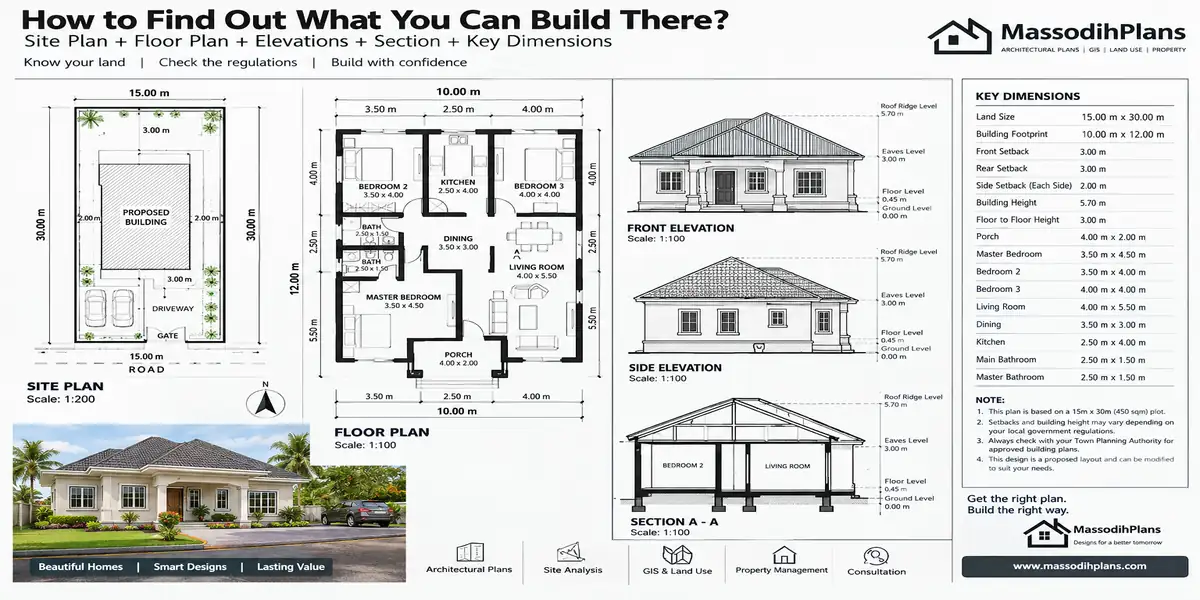
Before You Spend a Single Naira on That Estate, Read This Cost Breakdown First
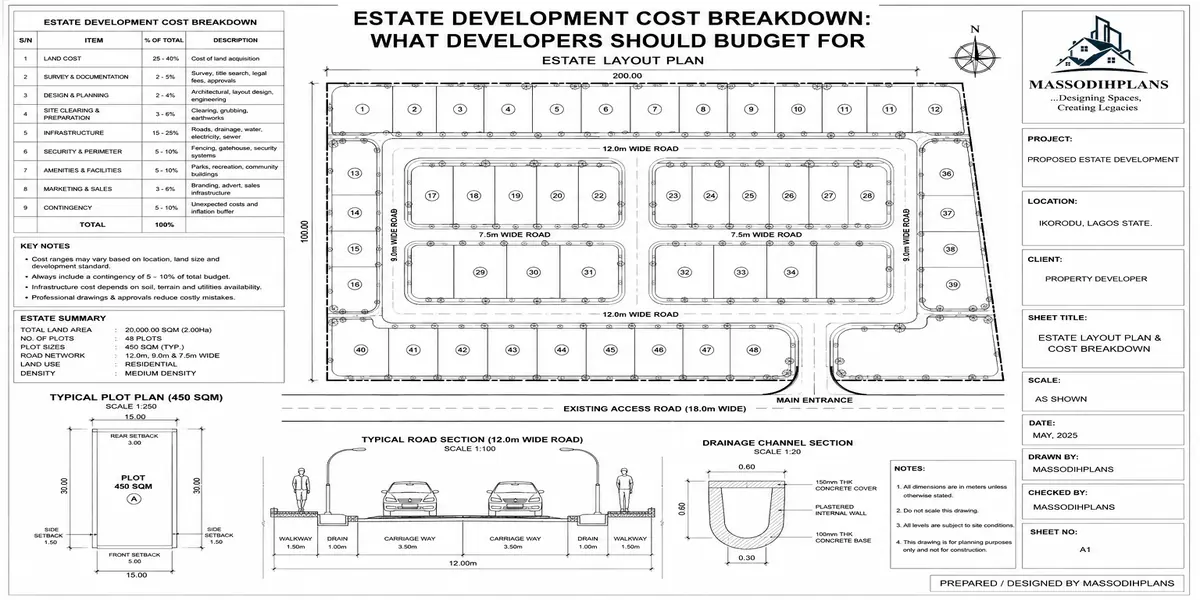
Estate Development Cost Breakdown: What Developers Should Budget For
The Bill That Shocked a Developer
If you are planning to develop an estate in Nigeria, the question is not simply, “How much will the land cost?” Ask instead: “What will it actually cost to take this land from raw property to a planned, approved, serviced and marketable estate?”
That difference can make or break your project.
An estate development budget should go far beyond land purchase. You need to account for surveys and documentation, planning and design, approvals, site clearing and earthworks, roads, drainage, water supply, electricity, street lighting, fencing, security, landscaping, professional fees, marketing, finance costs, taxes and a realistic contingency for increases and site problems. Nigerian development costs can vary dramatically with location, soil conditions, road standards and infrastructure requirements.
In this guide, I want to show you the cost structure the way I would explain it to a developer or client not as a vague “it depends” estimate. You will see what each budget category covers, which expenses are commonly forgotten, how infrastructure can consume your capital, how to separate land cost from development cost, and how to build a contingency that protects your profit.
I will also show you how to think about cost per plot, infrastructure cost, development phases and the relationship between your total investment and expected sales revenue.
By the end, you should be able to look at an estate proposal and ask the right financial and planning questions before committing your money.
If you are serious about getting the layout, don’t stop at the numbers: planning guides on MassodihPlans will help you connect budget to the estate layout, plot arrangement, road hierarchy, drainage and infrastructure decisions that determine whether your development works on paper and on the ground.
Why Most Nigerian Estate Developers Get the Budget Wrong
Many people assume that estate development is simply: buy land, peg plots, sell. My experience suggests otherwise.
The reality on the ground is that the visible costs, land purchase and surveying, typically represent only 30 to 40 percent of the total development investment. The remaining 60 to 70 percent is the infrastructure, professional services, approvals, and contingencies that most first-time developers never plan for.
I have encountered this situation multiple times. A developer comes to us at MassodihPlans to ask for layout design, and when we walk them through the full cost picture, they are genuinely surprised. Not because we have inflated anything. Because they simply did not know what was coming.
Let me break it all down for you, honestly and practically.
The Full Estate Development Cost Breakdown
I have organized this into clear categories. Every serious developer needs to account for all of them.
Category 1: Land Acquisition Costs
This is the starting point. But land cost itself has layers.
Purchase price of bare land
This varies enormously by location, proximity to infrastructure, access road quality, and state. Land in Lekki, Lagos costs completely different from land in Uyo, Calabar, or Kano. There is no universal number here. What I can tell you is: never base your budget on what a neighbour paid two years ago. Land prices in growing Nigerian cities change fast.
Due diligence and legal search fees
Before you pay for any land, you need a lawyer to search the title at the relevant Lands Registry. This protects you from buying land under dispute, government acquisition, or fraudulent transfer. Legal fees for this process typically range from N50,000 to N300,000 depending on the complexity of the title search and the law firm involved.
Governor’s Consent or title perfection fees
When you buy land in Nigeria, you are usually buying from someone who has a Certificate of Occupancy. For the title to transfer to you legally, you need Governor’s Consent. This involves statutory fees, legal fees, and stamp duty. In many states, this can cost between 5 and 10 percent of the land value. Ignore this and your title remains imperfect, which means you cannot legally sell plots with clean titles.
Community or family settlement fees
In many parts of Nigeria, especially Rivers State, Akwa Ibom, Cross River, Enugu, and Anambra, community leaders expect a settlement when land is being developed commercially. This is not a government fee. But ignoring it can bring your development to a complete stop regardless of your Certificate of Occupancy. From what I have seen in practice, savvy developers budget for this from the beginning and handle it respectfully.
Land clearing and topographic survey
After purchase, the land needs clearing and a full topographic survey before layout design can begin. Clearing costs depend on vegetation density. Topographic survey by a registered surveyor typically costs between N150,000 and N800,000 depending on land size and terrain complexity.
Category 2: Professional Services
This is where most first-time developers underbudget most severely.
Town Planning and Layout Design
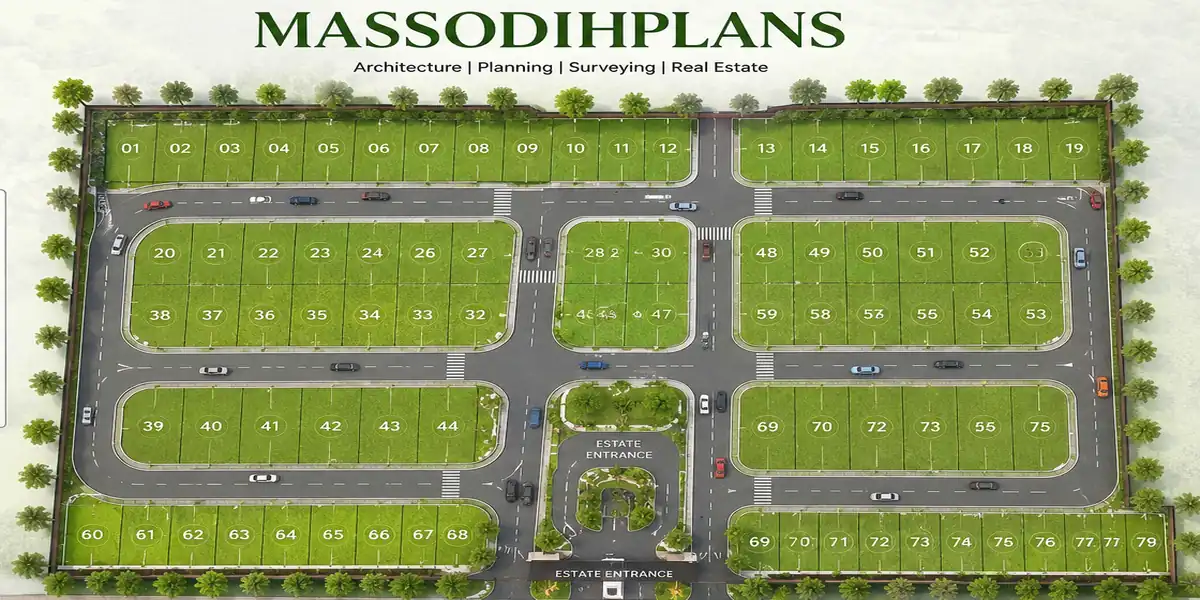
A properly prepared estate layout by a registered NITP town planner is not optional. It is the document that unlocks planning approval, enables legal plot title transfer, and protects your entire investment. Cost varies by estate size and state, but for a medium-sized estate of 50 to 200 plots, professional layout design fees typically range from N300,000 to N2,000,000 or more.
This is one of those costs where cutting corners produces the worst possible outcome. I have seen layouts that were clearly prepared by untrained hands, plots arranged without proper road hierarchy, no drainage provision, no setbacks defined. The planning authority rejected them. The developer had to start over. The cost of doing it wrong was higher than the cost of doing it right.
For estate layout design services, you can explore what MassodihPlans offers on our Services page.
Architectural Design Services
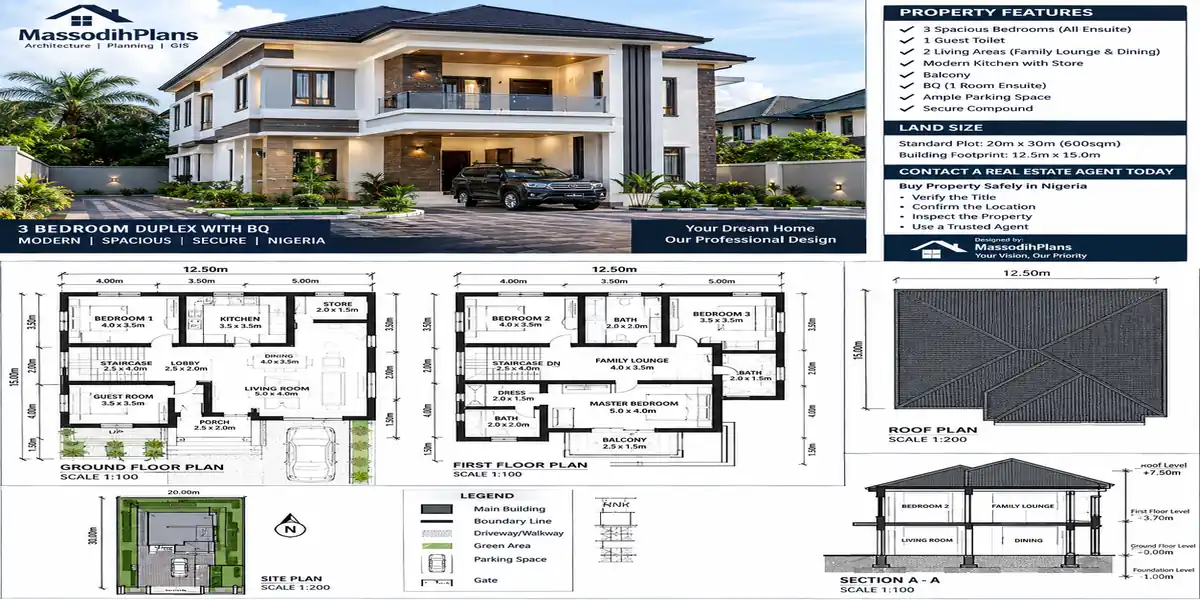
If your estate development includes any prototype residential buildings, show homes, commercial units, or community facilities, you need ARCON-registered architectural designs. Architectural design fees depend on the building type, number of floors, and level of detail required. Estate developers who want to show buyers what the finished homes will look like need this budget line.
Browse design standards in the MassodihPlans Plans Library to understand what quality architectural drawings look like.
Structural Engineering
Any estate road bridges, drainage structures, culverts, or community building structures require a structural engineer’s design and certification. Structural engineering fees for estate infrastructure typically run from N200,000 to N1,500,000 depending on scope.
Quantity Surveying
A Bill of Quantities (BOQ) prepared by a registered quantity surveyor is your cost control document. It itemizes every material and labor component of your infrastructure and gives you a reliable basis for contractor tendering. Without a BOQ, contractors give you speculative prices and the actual cost almost always exceeds initial quotations. QS fees are typically between 1.5 and 3 percent of the estimated construction value.
Environmental Impact Assessment
For estate developments above a certain scale, an EIAR is required before planning approval. This is more common for large developments but increasingly required in states that are strengthening their environmental regulations. EIAR preparation fees typically range from N500,000 to N2,000,000 depending on the scope and the consulting firm.
Category 3: Planning Approval Fees
Every Nigerian state has statutory fees for planning approval. These are not negotiable and are paid to the government, not to professionals.
Development permit application fees Paid to the state planning authority (LASPPPA in Lagos, FCDA in Abuja, respective State Ministry of Physical Planning in other states) for review and approval of your estate layout. Fees vary by state and estate size but typically run from N100,000 to N1,000,000 for medium-sized estates.
Approval conditions compliance costs Most planning approvals come with conditions. You may be asked to submit a drainage study, traffic impact assessment, or environmental management plan. These studies cost money to prepare, from N150,000 to N500,000 per study depending on complexity.
Approval inspection fees Some state planning authorities charge site inspection fees during the approval process. Budget N50,000 to N200,000 for this.
Survey regularization and cadastral fees Your survey plan must be certified and registered at the state survey department. Fees vary by state but are typically N100,000 to N500,000 for estate-scale surveys.
One thing our lecturers constantly emphasized at the University of Uyo was that the planning approval process is not a one-payment event. It is a multi-stage process with fees at each stage. Budget for the whole process, not just the submission fee.
Category 4: Site Preparation and Earthworks
Before any road or drainage construction begins, the site must be prepared. This is often the first major construction cost and frequently the most underestimated.
Land clearing and vegetation removal Bush clearing, tree felling, and debris removal. Costs range from N200,000 to N2,000,000 per hectare depending on vegetation density and site access.
Topsoil stripping and disposal The fertile topsoil layer is stripped from road and drainage alignments before construction. This material must be stockpiled for later use in landscaping or disposed of responsibly.
Cut and fill earthworks For sites with significant slope variation, material is cut from high areas and filled into low areas to create level building platforms and properly graded road alignments. This can be the single most expensive site preparation cost on hilly or irregular terrain. On a project I worked on in the hilly sections of Akwa Ibom State, earthworks costs alone exceeded the total professional services budget because the site topography was underestimated in the initial budget.
Drainage channel excavation Before any surface drainage can be constructed, the natural drainage corridors must be excavated to proper depths and profiles. This is separate from construction of the drain structures themselves.
Erosion control during construction Exposed soil during estate construction is highly vulnerable to erosion, especially during the Nigerian rainy season. Silt fences, sediment traps, and temporary drainage controls are necessary costs during the construction period.
Category 5: Road Construction
Roads are typically the largest single infrastructure cost in an estate development. They are also the item buyers notice and judge immediately.
Road formation and subbase This involves grading the road to proper level, compacting the subgrade, and applying laterite or quarry base material. For a 9-metre wide residential street, formation costs in most Nigerian states currently range from N8,000,000 to N18,000,000 per kilometre depending on material availability and labor rates.
Road surface treatment options
| Road Type | Approximate Cost Per km | Durability |
|---|---|---|
| Compacted laterite/gravel | N5M to N10M | Low, needs annual maintenance |
| Bitumen surface treatment (single/double) | N15M to N30M | Moderate, 5 to 8 years |
| Asphalt concrete overlay | N30M to N60M | Good, 10 to 15 years |
| Concrete pavement | N40M to N80M | Excellent, 20+ years |
Many developers in Nigeria start with laterite roads to reduce initial cost and plan to upgrade later. From my experience, this is practical for Phase 1 budget management, but the upgrade cost and timeline must be clearly communicated to buyers from the beginning. Buyers who bought expecting asphalt and got laterite become very unhappy very quickly.
Road drainage and kerbing Kerb stones, drainage channels alongside roads, and cross-culverts under road junctions. For a properly drained estate road, budget N3,000,000 to N8,000,000 per kilometre for drains and culverts, separate from the road surface itself.
Road furniture and signage Speed bumps, road markings, street signs, estate entrance signage. Budget N500,000 to N2,000,000 for a typical 50 to 100 plot estate.
Category 6: Drainage Infrastructure
I want to spend significant space on this because drainage is the cost that Nigerian developers most consistently underestimate, and the one that, when done badly, destroys entire estates.
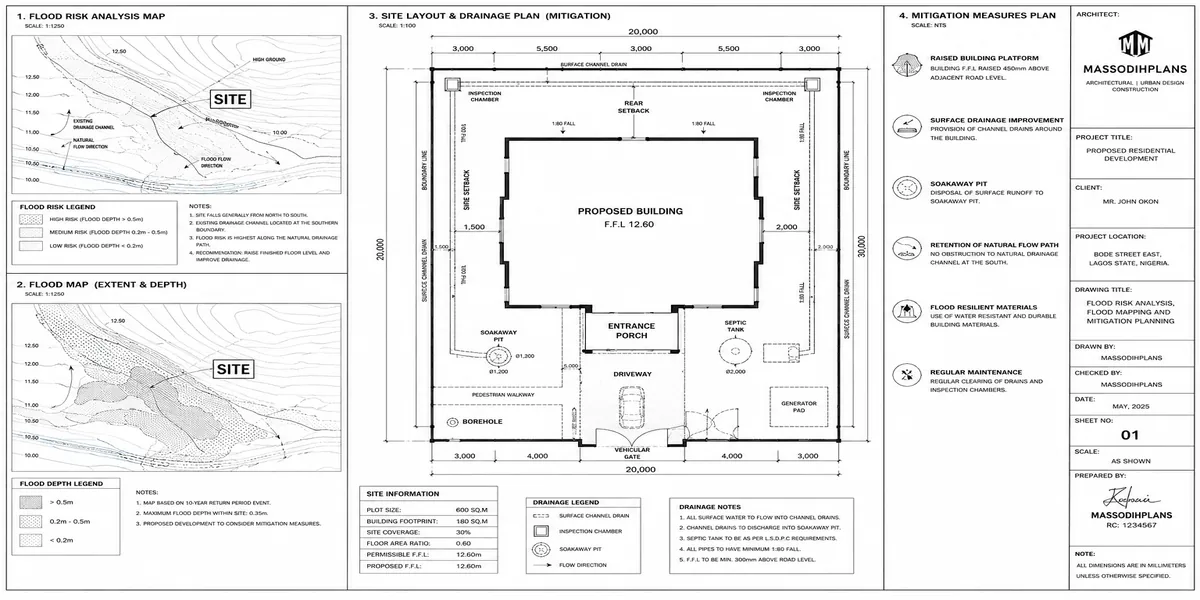
Open channel drains Concrete-lined open channels along road corridors and natural drainage routes. Cost for U-shaped concrete drains ranges from N15,000 to N35,000 per linear metre depending on size, depth, and concrete specification. A 100-plot estate may need 2,000 to 4,000 metres of drains. Do the multiplication. Drainage is not cheap.
Box culverts and pipe culverts Where drainage channels cross under roads, culverts are needed. Concrete box culverts cost N80,000 to N300,000 each depending on span and depth. A medium estate may need 15 to 30 culverts.
Detention or retention ponds For estates in flood-prone zones or with large impervious areas, a detention pond collects peak runoff and releases it slowly. Detention pond construction including excavation, lining, and inlet/outlet structures costs N1,000,000 to N5,000,000 depending on capacity.
Drainage maintenance infrastructure Manholes, inspection chambers, and access points must be included in the drainage design to allow future maintenance. Budget for these from the start.
This is not just theory. I have seen it happen. A developer in Uyo State completed a beautiful 80-plot estate, sold every plot, and within three years, the entire southern section flooded every rainy season because the drainage design did not account for the natural overland flow path crossing the estate from neighboring land. Retroactively fixing drainage in a developed estate is enormously expensive and creates serious conflict with plot owners.
Category 7: Utilities Infrastructure
Electricity extension and distribution Getting EEDC, IKEDC, or your state electricity distribution company to extend power to your estate typically involves paying for transformer installation, distribution poles, and cable costs. Budget N2,000,000 to N10,000,000 for a standard estate transformer and distribution network depending on distance from existing grid infrastructure and the estate size.
Borehole and water distribution Most Nigerian estates cannot rely on state water boards. A borehole plus overhead tank plus gravity distribution to plots is the practical solution. A borehole with pump, overhead tank, and distribution pipework for 50 to 100 plots costs approximately N2,500,000 to N6,000,000 depending on borehole depth, tank capacity, and pipe network size.
Street lighting Solar street lights or grid-connected street lights along estate roads. Budget N150,000 to N350,000 per unit installed, with spacing of every 30 to 50 metres along roads. A 100-plot estate may need 40 to 80 street lights.
Telecommunications ducts A responsible developer installs conduit ducts for fibre and cable TV during road construction rather than allowing telecoms companies to cut through finished roads later. Cost is relatively minor during construction, N50,000 to N200,000 for conduit installation, but the saving in future road damage is significant.
Sewage and waste management Most Nigerian estates use individual soakaway systems at plot level. But an estate-wide sewage management plan, including proper soakaway spacing from water supply infrastructure, is still required. For higher-end developments, a central sewage treatment plant may be appropriate. Community waste collection points must also be designed and constructed.
Category 8: Community Infrastructure
Many developers ignore this completely and then wonder why their estate feels incomplete to buyers.
Perimeter fencing A perimeter wall or fence defines your estate, provides security, and establishes the development’s identity. Sandcrete block perimeter wall costs approximately N25,000 to N45,000 per linear metre including foundation and coping. For a 3-hectare estate with a 700-metre perimeter, this is N17,500,000 to N31,500,000. It is a significant cost that must be budgeted.
Estate entrance gate and gatehouse A proper entrance gate, boom barrier, and security gatehouse. Budget N1,500,000 to N5,000,000 depending on specification and size.
Green spaces and landscaping Parks, planted medians, tree planting along roads. Budget N500,000 to N3,000,000 depending on the scale and quality of landscaping. I strongly believe this is one of the best investments in an estate development. Green spaces raise plot values and improve buyer perception significantly more than their cost.
Community building or multipurpose hall Some estates include a small community centre or multi-purpose hall. This is particularly attractive to buyers in formal estate developments. Budget N5,000,000 to N15,000,000 for a simple but functional structure.
Plot demarcation and corner posts Every plot must be physically demarcated with survey beacons or concrete corner posts after construction, so buyers can identify their exact plot on the ground. Budget N50,000 to N150,000 per plot for this, which for a 100-plot estate is N5,000,000 to N15,000,000.
Category 9: Marketing and Sales Infrastructure
Many developers treat this as an afterthought. It is not.
Estate branding and signage Billboards, estate name signs, plot numbering signs. Budget N300,000 to N2,000,000 depending on scale and quality.
Sales office or show unit A small sales kiosk or show flat dramatically improves buyer confidence. Budget N500,000 to N5,000,000 depending on specification.
Professional photography and aerial photography Quality estate photography including drone imagery for marketing. Budget N100,000 to N500,000.
Legal documentation for plot sales Engaging a solicitor to prepare standard plot sale agreements, deed of assignment templates, and allocation letters. Budget N200,000 to N800,000 for proper legal documentation setup.
Category 10: Contingency and Overhead
This is the category most first-time developers ignore completely, and then regret most bitterly.
Construction contingency A standard construction contingency in Nigerian estate development is 10 to 15 percent of the total construction budget. This covers unexpected soil conditions, price escalation during construction (very common in the current Nigerian economic environment), design modifications, and unforeseen site challenges.
Over the years, I have noticed that developers who skip the contingency budget are the ones who run out of money halfway through road construction and abandon the project. Plot owners have been stranded in half-finished estates across Nigeria because of this single budgeting failure.
Project management overhead Someone has to manage this project full time. If it is you, that is your time and opportunity cost. If it is a hired project manager, budget for their fee, typically 3 to 5 percent of total project cost.
Bank charges and financing costs If any part of your estate development is funded through a loan or credit facility, the interest and charges are a real cost that must be built into your financial model.
Inflation allowance In the current Nigerian economic environment, construction material costs can increase 20 to 40 percent within a single year. If your project will span more than 12 months, build an inflation allowance into your material and labor budgets.
The Real Cost Picture: A Sample Budget Summary
Let me pull this together for a hypothetical 50-plot medium-density residential estate on 1.5 hectares in a Nigerian state capital:
| Cost Category | Estimated Range (Naira) |
|---|---|
| Land acquisition (including title) | N15M to N50M |
| Professional services (layout, architecture, engineering, QS) | N1.5M to N4M |
| Planning approvals and government fees | N500K to N1.5M |
| Site preparation and earthworks | N2M to N6M |
| Road construction (1.5km of roads) | N15M to N35M |
| Drainage infrastructure | N8M to N20M |
| Utilities (electricity, water, lighting) | N6M to N15M |
| Community infrastructure (fencing, gate, landscaping) | N8M to N25M |
| Plot demarcation | N2.5M to N7.5M |
| Marketing and sales infrastructure | N1M to N3M |
| Contingency (12% of construction) | N5M to N15M |
| Total Estimated Development Cost | N64.5M to N182M |
These figures are indicative. They will shift significantly based on location, soil conditions, developer specification choices, and prevailing market prices at the time of construction.
What this table shows very clearly is that the cost to properly develop a 50-plot estate in Nigeria is substantial. A developer who budgets only for land and surveying will not get to the finish line.
The Nigerian Reality Layer: What No One Warns You About
From what I have seen in practice, there are estate development costs in Nigeria that rarely appear in formal budget templates but are very real:
Community relations and appeasement Already mentioned under land acquisition. But this can recur during construction if community members feel excluded from the development benefits. Factor this in.
Security during construction Construction sites in Nigeria are theft targets. Materials disappear overnight. A security arrangement, whether a watchman, security company, or community watch, is a real recurring cost during the construction period.
Infrastructure bribery and facilitation fees I am going to say this plainly: getting utility connections in Nigeria sometimes involves informal facilitation payments to government officials or utility company staff. I am not recommending this practice. But any developer who pretends this cost does not exist is preparing a budget disconnected from reality.
Exchange rate exposure If any of your construction materials are imported or priced in dollar terms (electrical materials, specialty fittings, imported floor tiles), your budget is exposed to naira depreciation. This has destroyed the financial models of many estate developers in recent years.
Project timeline extension costs Every month a project runs longer than planned is a month of security cost, management cost, and, if financed, interest cost. Build realistic timelines. Then add 30 percent.
The Investment Layer: When Does an Estate Development Make Financial Sense?
Based on my experience, a well-planned Nigerian estate development can generate returns of 50 to 200 percent on investment over 3 to 5 years. But only if the full cost picture is understood from the beginning.
The developers who lose money are not usually those who bought bad land or built bad roads. They are those who sold plots at prices calculated only against land cost, without accounting for the full infrastructure cost. By the time they finish developing, the infrastructure cost has eroded all profit and sometimes more.
If I were advising a developer today, I would recommend this sequence:
- Calculate the total development cost including all categories above
- Add your desired profit margin (typically 30 to 50 percent above total cost for a well-located estate)
- Divide by the number of saleable plots
- That is your minimum plot price. If that price is achievable in your target market, proceed. If not, reconsider the land cost or the development scale
This is simple. But from projects I have worked on, most developers skip this calculation entirely.
Development Phases: Spreading Cost to Manage Cash Flow
For large estate developments, phasing is one of the most important cost management strategies available to a developer.
Phase 1: Develop the primary access road, main drainage spine, estate entrance, and the first block of plots. Use Phase 1 plot sales revenue to fund Phase 2.
Phase 2: Extend roads and drainage into the second section, install utilities, complete perimeter fencing.
Phase 3: Final plots, community facilities, landscaping, and estate completion works.
During studio exercises at university, our planning instructors emphasized phasing not just as a construction strategy but as a financial survival mechanism. A developer who tries to complete everything before selling anything will run out of money on large estates. A phased approach protects cash flow and allows development quality to be sustained throughout.
Mistakes to Avoid in Estate Development Budgeting
I have seen these mistakes repeatedly. They are costly and largely avoidable:
Using competitor’s old plot prices as your baseline: Construction costs change. Your budget must be based on current prices, not what someone paid two years ago.
Ignoring drainage in the budget: Drainage is expensive. Budget fully for it from the start or you will either skip it (and flood your buyers) or run out of money.
Underestimating earthworks: Until you do a topographic survey, you do not know how much cut and fill your site needs. Survey first. Budget later.
No contingency budget: This single omission has stalled more estate developments in Nigeria than any other factor.
Selling plots before approval: This exposes you to enormous legal liability and, more practically, means you cannot provide buyers with proper titles.
Budgeting for roads but not for road maintenance: Even finished roads need maintenance. Build a maintenance fund into your estate management framework from day one.
Forgetting about professional fees: These are not optional extras. They are the foundation of a legal, approvable development.
Expert Note: The Real Purpose of a Cost Breakdown
A cost breakdown is not just a financial document. It is a planning tool.
When you truly understand what every component of estate development costs, you make better land purchase decisions. You negotiate from knowledge rather than hope. And you set realistic timelines. You communicate honestly with buyers about what they are getting and when.
My experience in planning and design has shown me that developers who understand their full cost picture make the best estate developers. Not because they are richer, but because they plan better.
And that is exactly what town planning is about at its core: helping people make better decisions about the use of land, before the consequences of bad decisions become permanent.
Frequently Asked Questions
How much does it cost to develop a 100-plot estate in Nigeria?
A full 100-plot residential estate in a Nigerian state capital, including land, professional services, roads, drainage, utilities, fencing, and contingency, typically costs between N120,000,000 and N350,000,000 or more depending on location, specification, and soil conditions.
What is the most expensive part of estate development?
In most Nigerian estates, roads and drainage together account for 40 to 55 percent of the total infrastructure budget. This surprises many developers who expect land cost to dominate.
Can I develop an estate in phases to reduce upfront cost?
Yes, and for large developments this is the recommended approach. Phase your development based on plot revenue from earlier phases funding later infrastructure. MassodihPlans can help you structure a sensible phasing plan as part of our layout design services.
Do I need to budget for planning approval even if my land already has a title?
Yes. A land title (Certificate of Occupancy) does not substitute for estate layout planning approval. These are different authorizations from different government agencies. Both are legally required before you can sell plots.
How do I get an accurate cost estimate for my estate development?
Engage a registered quantity surveyor to prepare a Bill of Quantities based on your estate layout drawings. This is the only reliable basis for accurate cost estimation. General estimates like this article provides are starting-point guides, not project-specific figures.
What happens if I run out of budget halfway through an estate development?
Buyers who have paid for plots but cannot access infrastructure will typically pursue legal action. You will also have difficulty attracting new buyers. Prevention is far easier than resolution: budget correctly from the beginning, maintain a contingency fund, and phase development carefully.
Can MassodihPlans help me prepare an estate layout within my budget?
Yes. We design layout plans that match your development objectives and budget realities. Contact us through the Services page.
Conclusion: Budget Fully or Do Not Start
The worst thing that can happen to a Nigerian estate development is not a failed soil test or a planning authority rejection. It is running out of money in the middle, with buyers holding allocation letters and plots that are still bush.
That is a legal problem. A reputational problem. And for many developers, a personal financial disaster.
The full estate development cost breakdown exists so that you can make informed decisions before you commit to a development. Before you buy the land. And before you promise plots to buyers. Before you sign any contractor agreement.
If you are at the beginning of your estate development journey, start by understanding every cost category in this article. Then get a professional layout prepared, a Bill of Quantities from a quantity surveyor, and a realistic cash flow plan.
At MassodihPlans, we help developers get the planning and design foundation right so that everything built on top of it is solid.
Visit our Services page to discuss your project. Explore our Plans Library for design inspiration. Learn the planning fundamentals through Plan School.
Build something worth building. Plan the money first. Then build the estate.
Recommended articles:
- Estate Layout Design Services for Property Developers in Nigeria
- Building Plan Approval Process in Nigeria
- House Plans for Nigerian Developers
- Infrastructure Planning for Nigerian Estates
- Consequences of Unplanned Urban Development in Nigeria
- Land Purchasing Guide for Nigerian Developers
- Nigerian Estate Master Plan for Small Plots: Modern Residential Layout Strategies That Maximize Space
- What Happens When a City Develops Without a Master Plan
- The Proposed FutureGrid Nation Blueprint for Smarter Land Development
- The MegaRegion FlowPlan for Balanced Urban Expansion
- Layout Plan Cost in Nigeria and Abroad: What Every Landowner Must Budget Before Building
- Environmental Management Plan Cost Guide for Developers in Nigeria and Beyond
- Site Development Plan Cost: What Every Property Owner Must Know Before Building
- Why District Planning Is Important for Urban Development
- Commercial Development Planning Costs: What Every Investor Must Know Before Spending a Kobo
- Housing Estate Layout Plan: Why Every Estate Needs One in Nigeria and Beyond
- Master Plan Preparation Process Explained Step by Step
- Cost of Master Plan Preparation for Communities and Institutions
- How to Evaluate Land in Lagos Before Choosing a House Plan to Build Safely (15 Best Ways)
- How to Choose the Right Residential Location in Abuja Before You Build (20 Best Areas Ranked for Buildability)
- How to Choose the Right Residential Location in Lagos Before You Build
- 10 Best House Plans for Small Plots in Nigeria: What Buyers Should Consider
- How to Choose the Right House Plan Based on Your Plot Size in Nigeria Today
- How GIS Can Help You Choose the Right Land for Your Dream House in Nigeria
- How to Identify Flood Risk Before Building a House in Nigeria Today, Safely
Authority: Nigerian Institution of Quantity Surveyors (NIQS)
Author
Massodih Okon is a Nigerian built-environment professional with academic and professional experience in urban and regional planning, geography, architectural design, Landscape Design, GIS and land development.
He holds a Master’s degree in Urban and Regional Planning from the University of Uyo and a first degree in Geography and Regional Planning.
Through MassodihPlans, he publishes practical guides on Nigerian house plans, building design, physical planning, site planning, development approval and residential construction. Read the full author profile →