You Have a Plot in Nigeria. Here Is Who Should Draw Your House Plan and Why It Matters More Than You Think
House Plan Design Services in Nigeria
The Problem Nobody Warns You About Before You Start Building
You saved money for years. You acquired a plot. Maybe it is a 50 by 100 plot in Uyo, a 30 by 60 corner piece in Surulere, or a half plot somewhere in Enugu where land finally became affordable enough to act. You are ready to build. And the first person you find is someone who says “I can draw your plan for 30,000 naira.”
I want to talk to you very honestly about what happens next, because I have seen this story more times than I can count.
The drawing comes out looking decent. You take it to the planning authority for approval and they reject it. The consultant you trusted did not include the correct setback dimensions for your local government. The structural notes are missing. The site plan does not show your drainage channel or your borehole. You are back to square one, but now you have lost time, money, and your confidence.
Or worse, you build from those drawings anyway, because getting approval feels like something you can sort out later. The building goes up. It looks fine from the outside. But the bedrooms are arranged in a way that collects heat by 2pm. There is no provision for a generator space. Your neighbour sinks a borehole and your foundation begins to show hairline cracks six months later because nobody did a proper site analysis.
These are not rare stories. They happen regularly across Nigeria, from Lagos to Kano to Port Harcourt.
Professional house plan design services exist precisely to prevent them. And on this page, I want to explain what those services actually cover, what you should expect when you engage a professional, and how to make sure you are getting work that will serve you for the next twenty, thirty, or fifty years.
What Professional House Plan Design Services in Nigeria Actually Include
Many people think a house plan is just a drawing of where the rooms will go. It is not. A complete set of architectural drawings prepared by a qualified professional for a Nigerian residential project typically includes all of the following:
Floor Plans
These show the arrangement of rooms on each level of the building. A good floor plan does not just distribute rooms. It shows the internal circulation route (how you move from one room to another), the position of doors and windows, the wall thicknesses, and the relationship between private areas like bedrooms and social areas like the living room and kitchen.
For a Nigerian home, floor plan design also needs to account for domestic realities that most imported templates ignore. Where does the generator sit? Where do you put the freezer, which is often a major feature of a Nigerian kitchen? Is there a domestic staff room? Is there a store for building materials you will accumulate before the next phase of construction? These details matter.
Elevations
Elevations are drawings that show the exterior faces of a building. Front elevation, rear elevation, side elevations. They tell you what the building will look like from outside and give the contractor information about the height of windows, the type of external finishes, the roof design, and the overall aesthetic character of the building.
Sections
A section is a drawing that shows what the building would look like if you cut through it and looked inside the wall. Sections reveal ceiling heights, staircase design (for duplexes), floor levels, and how the roof structure sits over the building. Many local contractors skip sections from what they call “building plans.” That is a problem, because sections contain information that prevents a host of construction errors.
Site Plan
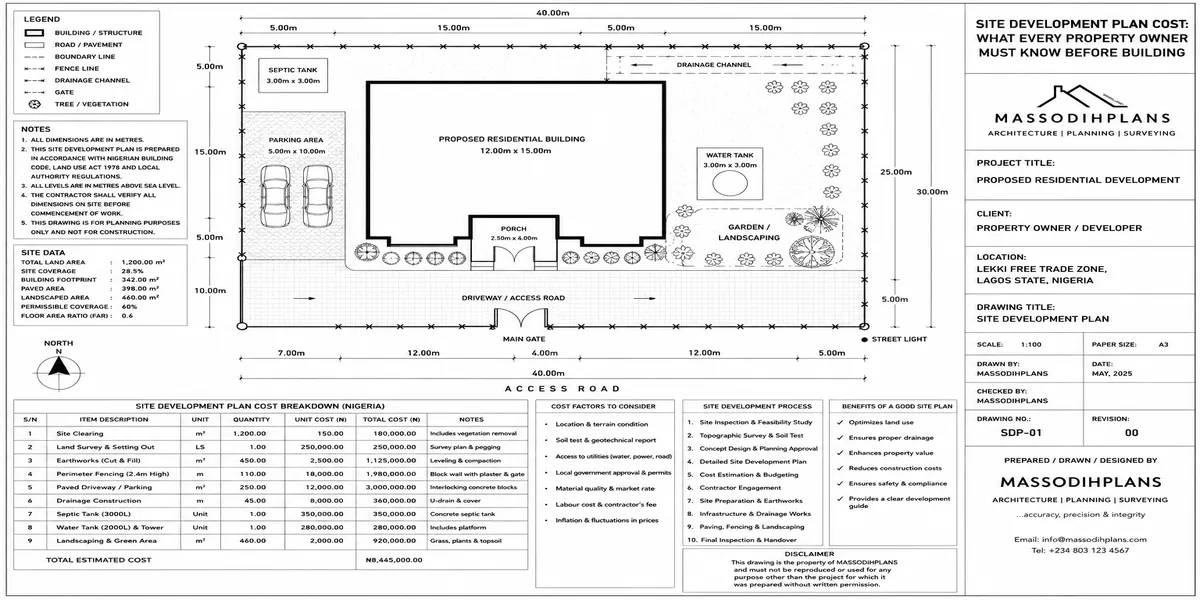
The site plan shows your building plotted within the actual boundaries of your land. It shows setbacks from all four sides, the position of the gate and driveway, external fencing, the borehole location, the soak pit or septic tank position, the drainage flow direction, and any overhead power lines or access easements that affect the plot. Without a site plan, approval is almost impossible to obtain from any serious planning authority in Nigeria.
Roof Plan
This shows how the roof is arranged, where ridges, valleys, and eaves fall, and how rainwater is directed off the building. In Nigeria, where heavy tropical rainfall can cause serious damage to poorly designed roofs, getting the roof plan right is not optional.
Schedule of Finishes and Notes
A professional set of drawings includes a schedule that specifies the type of materials to be used, from wall tiles to roof sheeting to external rendering. This is important not just for the contractor but for budgeting and for planning authority approval in some states.
What Happens When These Are Missing
Listen carefully here, I want to be direct. Many drawings you will find advertised online, in WhatsApp groups, or from neighbourhood “civil engineers” are not complete sets. They are partial drawings that look like enough to start building but are missing critical information that only reveals its absence at the worst possible moment.
A builder who lacks section drawings may get your staircase wrong and discover the error after the first floor slab has been cast. A contractor who has no detailed site plan may violate your setback by two metres and trigger a stop-work notice from the local planning authority. A roof designed without proper plan documentation may channel rainwater directly against an external wall and cause long-term dampness.
Getting complete, professionally prepared drawings is not a luxury. On a project where you are committing millions of naira, paying for proper documentation is the most cost-effective decision you can make.
Nigerian Climate and Why Your House Plan Must Reflect It
Nigeria sits in the tropical zone. Depending on where your plot is, you are dealing with either a hot and humid coastal climate like Lagos, Port Harcourt, or Calabar, or a hotter and drier savanna climate like Kano, Kaduna, or Abuja. Some cities like Enugu and Jos sit somewhere in between.
Your house plan needs to be designed for where you are actually building. This affects every single decision in the design.
Ventilation
Is not just about putting windows in. A properly designed Nigerian home uses cross-ventilation, which means windows are positioned on opposite walls so that wind can move through the space and carry heat out. A room with windows on one wall only will be a heat trap in the dry season. Professional house plan designers know how to position rooms, doors, and openings to take advantage of prevailing wind direction.
Roof design
In Nigeria must account for torrential tropical rainfall. Overhanging eaves that extend 600mm to 900mm beyond the external wall protect walls from driving rain and reduce the solar heat load on the building by shading the upper portion of the wall. Flat or slightly pitched roofs on poorly designed homes in southern Nigeria are one of the most common sources of long-term building problems.
Window sizing and positioning
Must balance ventilation with solar shading. Large west-facing windows on a Lagos home will make the afternoons unbearable regardless of how many fans you run. A professional designer will adjust the orientation of rooms and the sizing of openings to manage this.
Floor levels
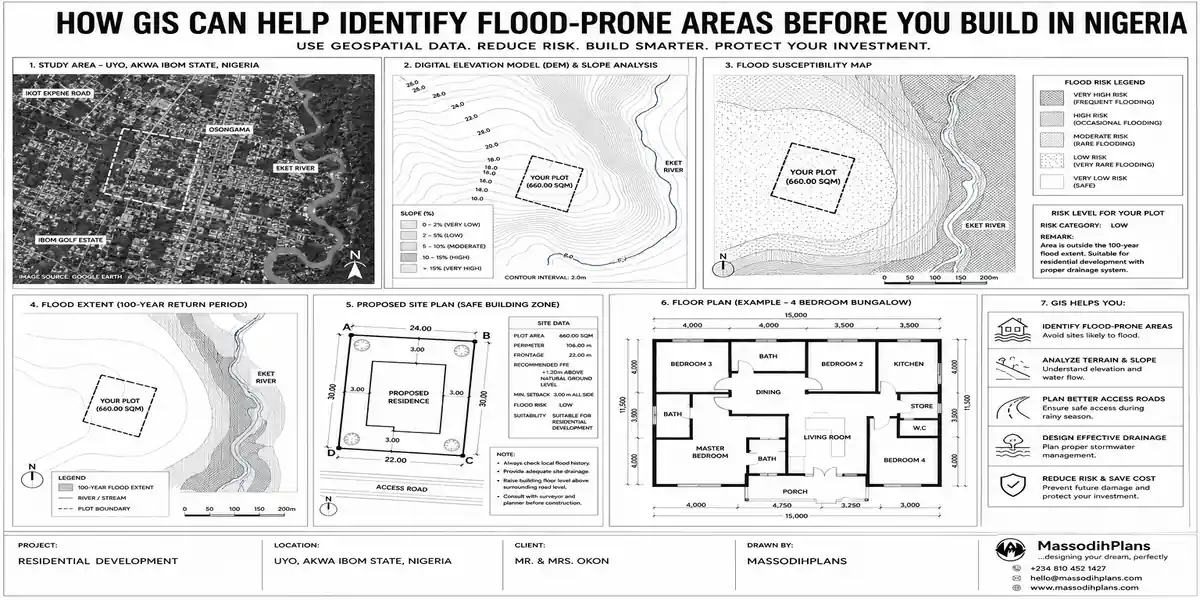
Must account for local flooding patterns. In many parts of Port Harcourt, Benin City, Onitsha, and Lagos, building at ground level without adequate fill and proper drainage planning leads to flooding. I always advise clients in flood-prone areas to raise the finished floor level by a minimum of 600mm above the surrounding ground level and to incorporate proper external drainage channels in the site plan.
The Site Analysis Step That Most Nigerian Builders Skip
Before any professional house plan designer puts pencil to paper or opens their CAD software, there is a step that should happen first, and most builders in Nigeria completely skip it: the site analysis.
Site analysis involves visiting the actual land and studying it. What is the shape of the plot? What is the topography? Which direction does it face? Where is the sun at different times of day? Where do neighbours’ buildings sit in relation to it? Is there a seasonal water table issue? Is the soil stable or does it have organic content that requires a more robust foundation design?
I have seen so many cases where a perfectly reasonable plan was built on a plot where the actual site conditions demanded a different approach entirely. The client spent money on a plan, spent more money on a builder, and then spent even more money on a structural engineer who had to redesign the foundation after the original footings showed signs of differential settlement.
A professional site analysis takes one or two days. It costs a fraction of what corrective work will cost if problems emerge after construction. It is part of what you should expect from a serious professional house plan design service in Nigeria.
Understanding Building Setbacks in Nigeria
Setbacks are the minimum distances that your building must maintain from your plot boundary. They vary by state and by local planning authority, and they are the single most common source of conflict between homeowners and planning authorities across Nigeria.
In a typical residential area in Uyo, for example, the minimum front setback from the road is 3 metres. Side setbacks are often 1.5 metres on each side. The rear setback may be 3 metres as well. But in some local governments, these figures are different. And in a layout scheme, the developer’s estate regulations may impose their own setback requirements on top of the government minimum.
A professional house plan design service will establish the applicable setbacks for your specific plot before the design begins. This prevents the painful situation where a beautiful and well-thought-out plan has to be redesigned from scratch because it was drawn without accounting for local planning regulations.
The relationship between setbacks and usable building footprint is something I explain in detail in our Plan School section, particularly for clients who are working with small or narrow plots where every metre of the building footprint counts.
Small Plot Design: Where Professional Service Earns Its Fee Most Visibly
If your plot is on the small side, which in Nigerian urban contexts often means a plot of 450 square metres or less, professional house plan design service stops being optional. It becomes the only way to get a functional, liveable home out of limited land.
Small plot design requires skill that goes well beyond knowing how to draw. It requires spatial thinking. And it requires understanding how rooms can serve multiple purposes. It requires designing circulation routes that do not eat into usable floor area. Also it requires making bedrooms feel generous even when they are compact. It requires using courtyard spaces, double-height volumes, and roof terraces to compensate for limited ground coverage.
A 40 by 60 plot in Lekki or Abuja GRA can produce a beautiful, well-ventilated, three-bedroom home with a domestic staff room, a generator house, a borehole position, and a small outdoor sitting area if the design is done properly. The same plot, handled without skill, produces a building that is dark, difficult to move through, and uncomfortable to live in.
You can explore specific examples of how small Nigerian plots can be developed in our Plans Library, where I show complete design packages for common Nigerian plot sizes.
Parking, Generator Space, and Borehole Planning
These three elements are not optional extras in Nigeria. They are essential functional components of any residential building in any urban area across the country.
Parking. Even if you do not own a car right now, designing a home without a defined parking provision is a decision you will regret. In any urban estate in Nigeria, a house without parking provisions is less desirable for rental and loses resale value. The standard single parking bay is 2.4 metres wide and 5 metres long. A proper driveway that allows a saloon car to turn and exit forward requires additional space that must be accounted for in the site plan.
Generator space. Power supply in Nigeria remains unreliable across all regions and all income brackets. A proper generator space is not just a concrete pad under the staircase. It is a dedicated, ventilated enclosure positioned away from habitable rooms, with a pathway for fuel delivery, and with cable routing to a changeover switch inside the building. Most basic house plans completely ignore this. A professional service includes it by default.
Borehole planning. If you are building in any peri-urban or semi-urban part of Nigeria, you will likely need a borehole. The borehole position must be a minimum of 15 metres from any soak pit or septic tank to prevent contamination. It needs to be accessible to a drilling rig, which means the access path from your gate to the borehole location must be clear of permanent obstructions. Your site plan should show this provision even if you are not drilling at construction stage.
The Approval Process and Why Your Drawings Must Be Right the First Time
Planning approval in Nigeria varies significantly by state, local government, and urban context. In Lagos, the Lagos State Physical Planning Permit Authority has its own submission requirements. And in Abuja, the Federal Capital Development Authority operates its own planning approval system. In Rivers State, the Ministry of Urban Development and Physical Planning has its own process. In Akwa Ibom, the Ministry of Lands and Physical Planning administers the process at state level, while local government development control offices operate at the grassroots level.
What almost all of these authorities have in common is this: they require a complete set of professionally drawn architectural plans as part of the permit application. A site plan showing the plot boundaries and setbacks. Elevations. Floor plans. A drainage layout. Sometimes a structural drawing. In some cases, an environmental assessment.
Submitting incomplete or non-compliant drawings wastes your time and the authority’s time. It delays your project by weeks or months. And if you build without approval or before approval is granted, you risk a demolition notice that is legally enforceable.
The practical guidance on building approval, documentation requirements, and how to navigate the approval process across different Nigerian states is something I cover in depth in our Services category. If you need personal guidance for your specific state, this is something you can discuss with us directly.
Material Considerations and Cost Planning
One of the most valuable things a professional house plan designer does is produce drawings that allow you to prepare an accurate Bill of Quantities before you start spending money.
In Nigeria, where material prices are unstable and can shift significantly within a single month, knowing exactly how much cement, sand, gravel, steel, roofing sheets, and blocks your building requires gives you critical budgeting information. You can decide to buy and stockpile materials when prices are favourable. And you can get multiple quotations from suppliers. You can phase the project intelligently.
Without proper drawings, your contractor will be working from estimates and guesses. Material waste will be higher. Cost overruns will be common. And the final figure will be significantly above what you expected.
For typical Nigerian residential construction, a well-documented plan with a proper schedule of quantities can reduce material waste by 15 to 25 percent compared to building from rough or incomplete drawings. On a project costing 15 million naira, that is a saving of between 2 and 4 million naira. The professional fee for producing those drawings is a fraction of that figure.
You can get a sense of current building costs across Nigerian cities by reading our construction cost guides for Kano, Port Harcourt, Abuja, and Lagos.
What Builders Usually Get Wrong (and How Your Plan Prevents It)
I want to be honest about what happens on site when drawings are poor or absent.
Contractors adjust on the fly. When a detail is not clearly shown in the drawing, the average Nigerian contractor will make a decision based on what is easiest to build, not what is most correct for the design. This produces buildings where the staircase lands in the wrong place, where windows are narrower than designed because the mason decided the openings were “wide enough,” and where rooms end up smaller than planned because the wall thickness was increased without calculation.
Roofing errors are extremely common. A roof that is not clearly detailed in plan and section will almost always be built with errors in how the trusses are spaced, how the eaves are formed, or how valleys and ridges are waterproofed. Roofing errors in Nigeria’s climate are not cosmetic. They lead to water ingress, ceiling damage, and in severe cases, structural failure.
Drainage is ignored until water enters the building. Most contractors have no formal training in drainage. If your plan does not show the drainage layout, they will not provide one. The result is a compound where rainwater has nowhere to go except against the external walls and through the front gate.
Security considerations are forgotten. Perimeter wall height, gate positioning, visibility sightlines from the living room to the entrance, the position of security lights and CCTV mounting points, the design of a gatehouse or security kiosk. These are things that a professional designer includes in a complete site plan and that most local “plan drawers” never consider.
Duplex Design Specific Considerations
If you are building a duplex, the complexity of the design increases significantly and so does the importance of getting professional help.
A duplex requires a coordinated design across two floors. The walls on the ground floor must align with the walls on the first floor to allow proper load transfer down to the foundation. This is called structural alignment and it is something that a professional architectural and structural engineer will resolve during the design stage. Building a first-floor layout that does not align with the ground floor produces a building that requires expensive transfer beams and is structurally inefficient.
The staircase is one of the most technically demanding elements of a duplex design. It must fit within the available plan area, meet minimum headroom requirements (2.1 metres at the tightest point), have a comfortable rise and run ratio (risers of 175mm and goings of 250mm are standard), and connect the floors in a way that makes sense for how the family will actually move through the building.
Balconies, roof terraces, and first floor overhangs all require structural detailing that must be resolved in the drawing before construction begins. I cover duplex design considerations in more detail in our article on duplex design for Nigerian plots.
Investment, Resale, and Rental Value
A properly designed and documented building in Nigeria holds significantly better resale and rental value than a building constructed from inadequate drawings.
Here is why. Sophisticated buyers or tenants often ask about a building’s documentation before making any commitment. They expect to inspect the approved plan and approval certificate. Buildings without approval, or buildings that violate approved plans, create legal risks that knowledgeable buyers factor heavily into their offer price.
Good design also increases functionality and comfort. In the rental market, this advantage attracts better tenants, reduces vacancy rates, and allows property owners to charge premium rents compared to poorly designed properties within the same neighbourhood.
In estate development, developers rely on high-quality and complete architectural documentation to attract institutional investors, secure construction loans from banks, and obtain project insurance when selling multiple units.
Professional house plan design services are not just about the drawings themselves. They are about the entire downstream value chain that depends on those drawings being correct.
How to Choose a Professional House Plan Designer in Nigeria
There are several things to look for when engaging a professional for house plan design services in Nigeria.
First, ask about qualifications. In Nigeria, architectural practice is regulated by the Architects Registration Council of Nigeria (ARCON). A registered architect will have a valid ARCON practice number. For buildings that require structural engineering input, you should also confirm that a qualified civil or structural engineer is involved in the structural drawings.
Second, ask to see previous work. A credible designer will have completed projects they can show you, either as physical drawings, photographs of built buildings, or digital files. Look at the completeness of the drawing set, not just the aesthetics of the elevations.
Third, discuss what is included. Is the fee for architectural drawings only, or does it include site analysis, structural drawings, and approval documentation? What is the revision policy if your brief changes during design?
Fourth, ask about timelines. A complete set of professional drawings for a typical three-bedroom bungalow should take between two and four weeks from brief to final drawings. A duplex may take four to six weeks. Anyone promising a complete professional set in 48 hours is either working from a template they are barely adapting to your plot, or they are not producing professional-quality work.
What the MassodihPlans Professional Service Offers
At MassodihPlans, I offer professional house plan design services that are grounded in the realities of building in Nigeria. Not generic drawings produced from software templates. Not plans borrowed from foreign housing typologies that ignore Nigerian plot regulations, climate, and lifestyle.
Every project starts with a proper understanding of your plot, your budget, your family size, and your long-term plans for the building. From that brief, I produce a design that fits your land, satisfies your local planning authority’s requirements, and gives your contractor clear, complete information to build from.
The services available through MassodihPlans include:
Residential Architectural Design for bungalows, duplexes, and multi-unit developments across all Nigerian plot sizes, including narrow and small plots where space optimization is critical.
Site Planning and Compound Design that addresses parking, drainage, borehole positioning, generator housing, perimeter fencing, and gate design as part of a complete site development package.
Building Approval Documentation prepared to the submission requirements of relevant state and local planning authorities, including site plans, floor plans, elevations, sections, and drainage layouts.
Planning Consultancy for clients who need professional guidance on zoning regulations, land use change applications, development control compliance, and estate planning.
Construction Supervision Support for clients who want periodic professional oversight during the building process to confirm that construction is proceeding in accordance with the approved drawings.
You can read more about each of these service areas and enquire about your specific project through our Services page. For clients who prefer to start by building their own understanding of how house design works before engaging professional help, our Plan School section covers architectural drawing, space planning, setback calculation, and building design principles in a way that is practical and accessible without needing a formal architectural background.</p>
A Practical Note on Budget and Fees
Professional house plan design fees in Nigeria vary based on the complexity of the project, the location, and the scope of the service required. A basic bungalow architectural drawing set may cost between 80,000 and 250,000 naira depending on the designer and the level of detail required. A full-service package for a duplex, including architectural, structural, and approval drawings, may range from 300,000 to 800,000 naira or more in major cities.</p>
These figures may seem significant. But put them in the context of the total cost of building. A three-bedroom bungalow in most Nigerian cities currently costs between 8 and 18 million naira to build, depending on specification and location. Professional design fees represent between 1 and 4 percent of that total project cost. For the protection and value that well-produced drawings provide, that is among the best investments in the entire project.
Trying to save money at the drawing stage and spending it at the correction stage is a pattern I see constantly. Please do not repeat it.
Quick Summary: What to Take Away from This Page
If you are building in Nigeria and you need a house plan, here is the core of what I want you to remember:</p>
A proper house plan is not a drawing of rooms. It is a complete documentation package that guides every decision on site from foundation to roof.
Your drawing must reflect your actual plot, your local planning authority’s setback requirements, your Nigerian climate zone, and the practical realities of building and living in Nigeria.</p>
Getting professional help is not expensive relative to the cost of the project and the cost of mistakes. It is the most financially rational decision you can make.
At MassodihPlans, I am here to help you build something that works, not just something that looks good on paper.
FAQs: Professional House Plan Design Services in Nigeria
What is included in a professional house plan design service in Nigeria?
A complete professional house plan design service includes floor plans for each level, elevations showing all four faces of the building, sections, a site plan showing the building on your actual plot with setbacks and external features, a roof plan, and a schedule of materials and finishes. Structural drawings are typically produced by a structural engineer coordinating with the architect.
How much does a house plan cost in Nigeria?
Fees vary by project complexity and location. A basic three-bedroom bungalow design set typically costs between 80,000 and 250,000 naira. A duplex with structural and approval drawings may cost between 300,000 and 800,000 naira. These figures represent a small percentage of the total construction cost and provide protection against much more expensive mistakes.
Do I need building approval before I start construction in Nigeria?
Yes. Building without a valid planning permit from your local planning autho
rity exposes you to stop-work orders, fines, and in serious cases, demolition notices. The approval process requires a professionally drawn and complete set of architectural drawings submitted in the format required by your specific state or local government.</p>
Can a house plan be designed for a small plot in Nigeria?
Yes, and it is actually where professional design adds the most visible value. Small Nigerian plots of 450 square metres or less require careful spatial planning, smart room arrangement, and detailed site analysis to produce a building that is functional, comfortable, and compliant with setback requirements. Generic or template plans often fail on small plots.
How long does it take to get professional house plan drawings in Nigeria?
A typical three-bedroom bungalow drawing set takes two to four weeks from the time a complete brief is received. A duplex may take four to six weeks. Projects requiring approval documentation may add additional time depending on the local authority’s review timeline.
What is the difference between an architectural drawing and a structural drawing?
An architectural drawing covers the spatial arrangement, aesthetic character, and functional design of the building. A structural drawing covers the structural engineering elements including foundation design, column and beam sizing, slab reinforcement, and load calculations. Both are required for a building permit in most Nigerian states.
Can MassodihPlans help me get my building plan approved in my state?
Yes. Through our professional services, I can produce approval-ready documentation for most Nigerian states and provide guidance on submission requirements. You can enquire about your specific state through our contact page.
Reference: Architects Registration Council of Nigeria
Ready to Get Your House Plan Done Right?
If you have a plot in Nigeria and you want drawings that are accurate, complete, and ready for both your contractor and your planning authority, I am here to help.
Whether you are building a bungalow on a small plot, a duplex in an urban estate, or a mixed-use structure, the process starts with a conversation about your land and your goals.
Reach me directly through the Contact page and tell me where your plot is, the size of it, and what you want to build. I will give you an honest assessment of what is involved and what it will take to get your building right the first time.
While you are here, take time to explore:
The Plans Library for layout ideas and design concepts suited to Nigerian plot sizes.
The Plan School to build your understanding of architectural drawing, setbacks, and building design before you commit to a brief.
The Services page for a detailed overview of what professional design, planning, and approval support covers.
Building in Nigeria is not easy. But building from a good plan makes every other part of the process more manageable. Start there.
Related Posts you need to complete this article
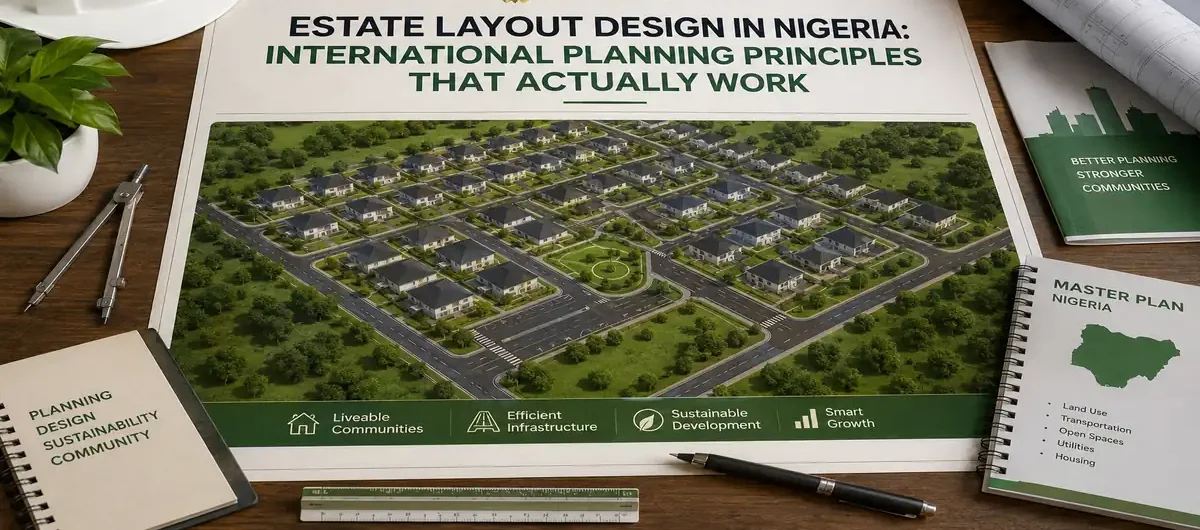
- Small Residential Estate Layout Design in Nigeria: Smart Master Plan Ideas for Limited Land
- Smart Duplex Design for Narrow Plots in Lekki, Nigeria: Complete Practical Guide
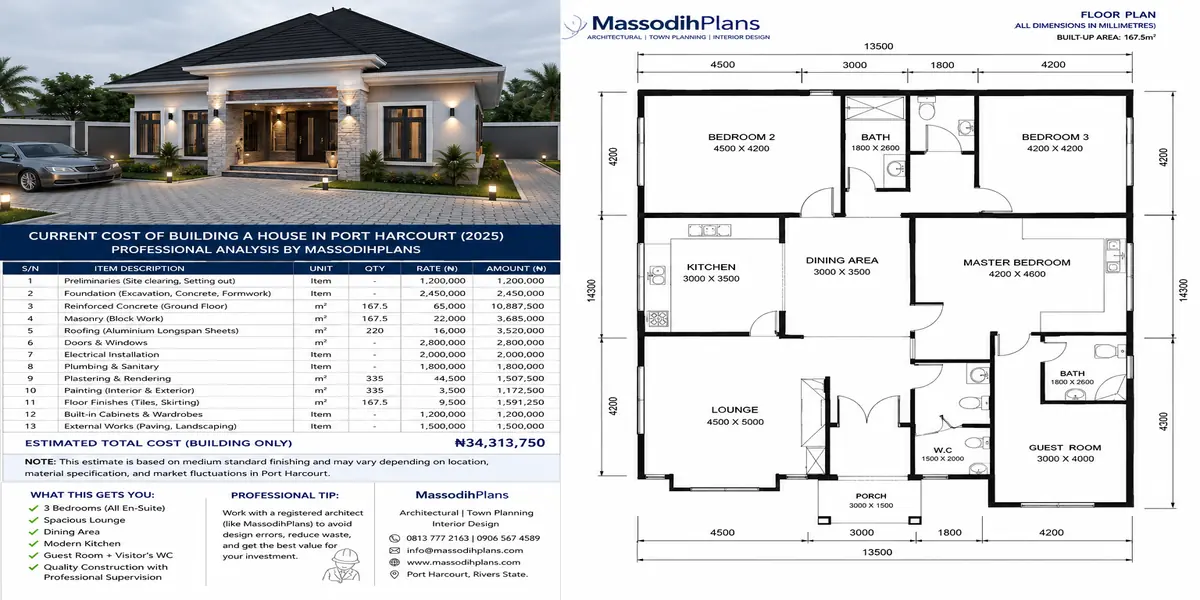
- Current Cost of Building a House in Port Harcourt (Professional Analysis)
- Best 4 Bedroom House Plan for Small Plots in Abuja
- Cost of Roofing a Bungalow and Duplex in Abuja Small Plot Now
- Affordable Bungalow Plan for 40×80 Plot in Port Harcourt
- 2 Bedroom Flat Plan for Narrow Plots in Nigeria: Complete Layout, Dimensions, and Building Guide
- 4 Bedroom Duplex Plan for 100×150 Plot in Nigeria
- 7 Cheapest Areas to Buy Affordable Land in Uyo Before Prices Increase
- Best Places to Buy Land in Uyo for Fast Development and High Property Value
- Building Materials Price Guide in Nigeria (Full Cost Guide)
- Commercial Development Planning Costs: What Every Investor Must Know Before Spending a Kobo
- Cost of Roofing a Bungalow and Duplex in Abuja Small Plot Now
- Current Cost of Building a House in Port Harcourt (Professional Analysis)
Others
- Environmental Management Plan Cost Guide for Developers in Nigeria and Beyond
- Best Roofing Sheets for Nigeria Compared with International Brands
- Cost of Building a House in Nigeria: A Complete Guide for Nigerians Living Abroad
- Cost of Roofing a 4 Bedroom Duplex in Abakaliki (Complete Guide)
- How to Choose Roofing Materials for Nigeria’s Climate: Advice for Overseas Homeowners
- Cheap Nigerian House Plans That Still Look Modern
- Best 2 Bedroom House Plans for Small Plots
- Modern Duplex House Plan for 50×100 Plot in Lagos
- Modern Nigerian House Plan for a 30×60 Plot in Ibadan: The Complete Practical Guide
- Modern Small House Designs That Feel Surprisingly Spacious
- Site Development Plan Cost: What Every Property Owner Must Know Before Building
- Smart House Design Ideas for 50×100 Plots in Nigeria
- Smart Ways to Reduce Building Costs in Nigeria Without Reducing Quality
- What Is a Master Plan and Why Does Every Growing Community Need One?