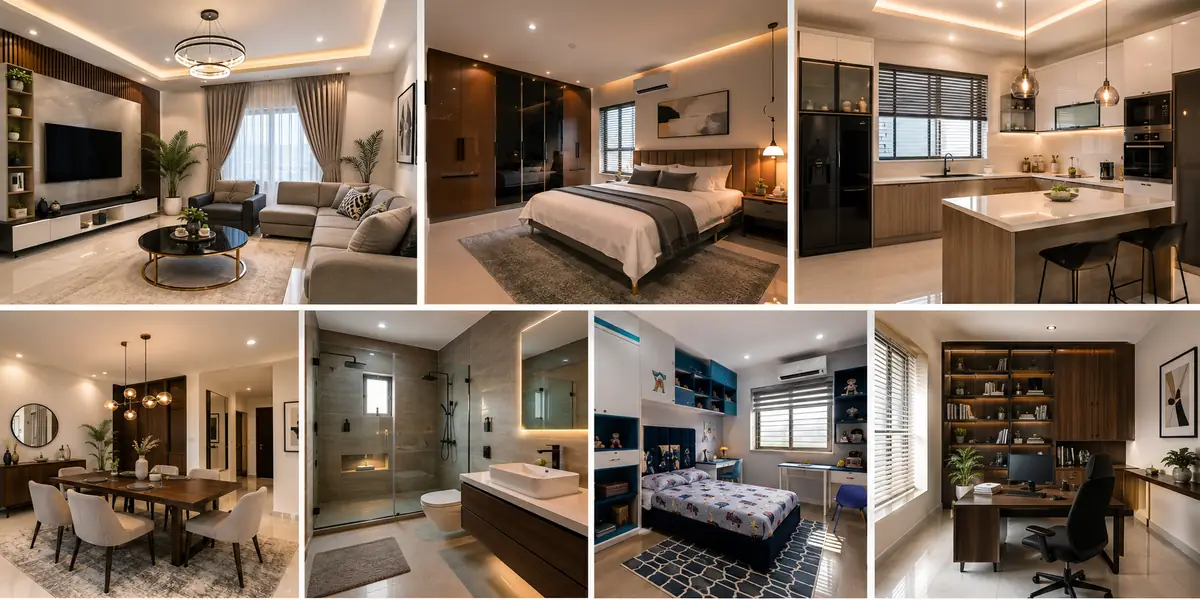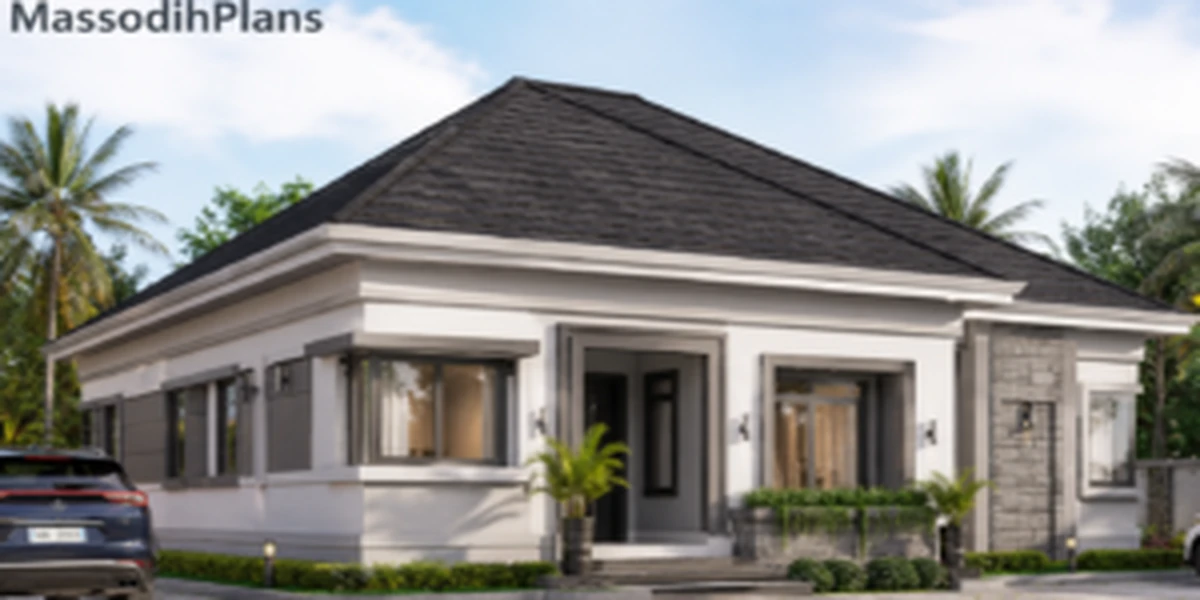
Modern compact 3-bedroom bungalow design on a 50x100ft Nigerian plot showing layout, setbacks, and carport
Introduction: Your Plot Is Not Too Small: You Just Need the Right Design
Let me tell you something I have seen happen too many times in my years as a town planner and architectural design consultant.
Someone buys a 50ft by 100ft plot or even smaller saves money for years, brings their family together, and then goes to a draftsman or an architect. The man draws something that looks nice on paper. Then reality hits: the building does not fit the plot properly. The rooms feel like prison cells. There is no parking space. The windows face a wall. The rooms are dark. The neighbour’s fence is practically inside your living room.
I have seen people actually cry in my office over this.
And what is the problem? It is not the plot size. It is that most people go into small-plot building without a proper understanding of how design on a small plot is different from design on a big plot.
This guide is for you if your plot is small. I want you to read this and leave here knowing exactly what works, what does not work, what it will cost, and how to make your small house feel like a home and not a box.
I will show you real plans. Real dimensions. And real Nigerian examples. Real costs.
Let us start from the beginning.
First, What Is a “Small Plot” in Nigeria?
When Nigerians talk about a small plot, they usually mean one of the following:
- A plot of 50ft x 100ft (about 15m x 30m) this is the most common “standard” plot in most Nigerian towns
- A half plot, which is 50ft x 50ft (about 15m x 15m)
- An irregular plot narrow, corner, or L-shaped, usually less than 450 square metres total
In cities like Lagos, Abuja, Port Harcourt, and Uyo, many people are building on 50x100ft plots and even smaller. Some plots in Surulere, Lagos are as narrow as 20ft wide. In Uyo, I have seen clients come with plots that are 40ft x 80ft in places like Aka Road and Shelter Afrique.
So when I say “small plot” in this article, I mean any plot under 500 square metres where every inch of design decision matters.
Why Small House Design Is a Skill on Its Own
Here is what most people do not understand.
Designing a house on a big 100ft x 100ft plot is almost easy. You have room to make mistakes. You can add a balcony here, extend a corridor there, and the house still works.
But on a small plot, design is like a surgery. Every room has to earn its place. Every wall you place affects the next room. Get the toilet position wrong and the smell will affect the bedroom forever. Get the staircase position wrong on a two-storey and you lose the best light in the house.
This is why I always tell people: small plot design is not about cramming rooms into a small space. It is about designing intelligently so that a 3-bedroom house on a 50x100ft plot can feel bigger than a poorly designed 4-bedroom on a 100x100ft plot.
And I have seen it happen, more than once.
The 5 Main Small House Plan Types That Work Well in Nigeria
Let me walk you through the five designs I have seen work consistently on small Nigerian plots. I will give you each one with its dimensions, room layout, what plot it fits, its cost estimate, and honest building advice.
Design 1: The Compact 3-Bedroom Bungalow on a 50x100ft Plot
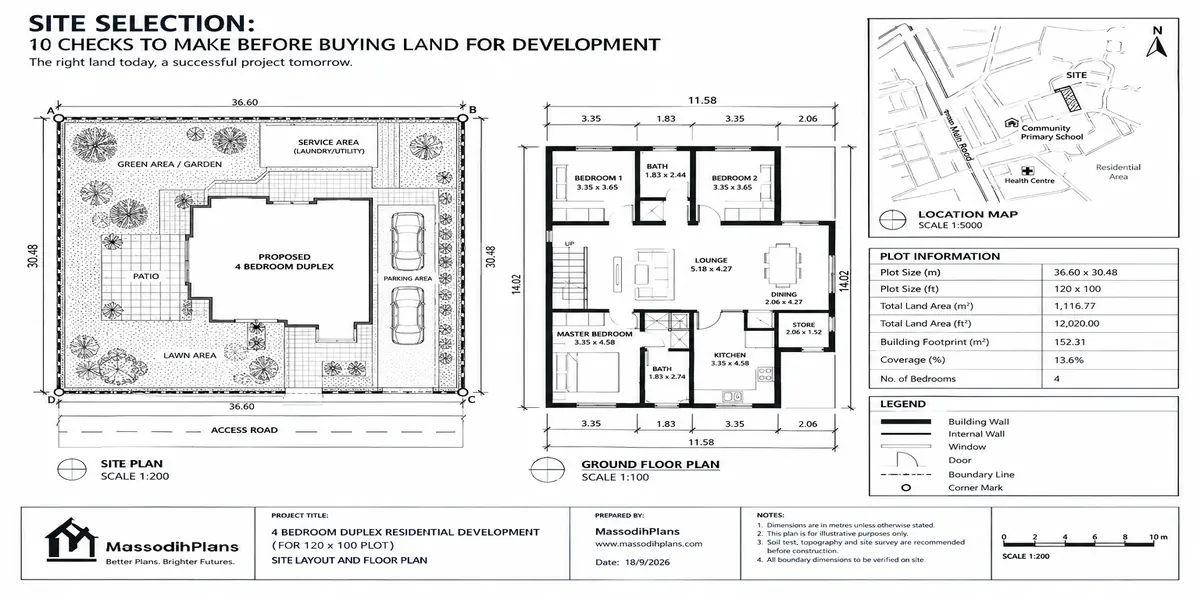
Plot Size: 50ft x 100ft (15.24m x 30.48m)
Building Footprint: Approximately 12m x 14m = 168 square metres
Setbacks (as per most Nigerian planning authorities):
- Front setback: 3 metres minimum (some states require 6m)
- Side setbacks: 1.5m each side
- Rear setback: 2m minimum
After setbacks on a 15m wide plot, you have about 12m of width to work with.
Room Layout:
- Living room: 4.5m x 5m
- Dining area: Open to living room, 3m x 3m
- Kitchen: 3m x 3.5m (separate, with back door access)
- Master bedroom: 4m x 4.5m with en-suite toilet and bath
- Bedroom 2: 3.5m x 4m
- Bedroom 3: 3m x 3.5m (can double as a study or boys’ quarters)
- Family toilet: 1.5m x 2m
- Corridor: 1.2m wide, running down the middle
- Front porch: 2m deep
Ventilation Strategy:
This is where I want you to pay close attention. In Nigeria, our climate is hot and humid for most of the year. If you do not design your small house for proper air circulation, your family will be sweating in their own rooms whether or not they have air conditioning.
For this design, I always recommend:
- Windows on opposite walls in every bedroom so cross-ventilation happens naturally
- High louvres or clerestory windows near the ceiling to let hot air escape
- Kitchen positioned at the back with its own window facing the rear yard
- Master bedroom on the side with the most shade (usually east or south depending on your plot orientation)
Roof Type:
A hip roof works well on this footprint. It sheds rainwater from all four sides, which matters in places like Uyo, Calabar, and Lagos where rain can be very heavy. Pitch it at about 30 to 35 degrees. Use aluminum long-span roofing sheets or stone-coated steel tiles depending on your budget.
Avoid flat roofs on small houses in Nigeria unless you are doing a contemporary design and have a very experienced roofer. Flat roofs in our climate need proper waterproofing and drainage that most contractors in Nigeria do not handle correctly.
Parking:
On a 50x100ft plot, after setbacks, you can fit one covered carport at the front corner of the building. Keep it simple: a concrete slab with a canopy roof supported by two columns. Do not try to put a full garage — you will eat too much into your living space.
Orientation:
If your plot faces north or south, try to put the living room facing north. In Nigeria, south-facing rooms get heavy afternoon sun which is uncomfortable. If your plot faces east or west (which is common in many Nigerian layouts), your architect will need to manage sun through proper shading devices like extended eaves, pergolas, or planted trees.
Cost Estimate (2024-2025 Nigeria):
Material costs vary by state but here is a realistic range:
- Foundation to lintel level (with blocks and concrete): N8,000,000 to N12,000,000
- Roofing (hip roof with aluminum sheets): N2,500,000 to N4,000,000
- Finishing (tiles, paint, doors, windows, plumbing, electrical): N7,000,000 to N12,000,000
- Total rough estimate: N17,500,000 to N28,000,000
This is for using quality materials with a professional contractor. It does not include land cost or building approval fees.
Suitability:
This design is very suitable for a young family with 2 or 3 children. It is also good for a couple looking to build their first house. It works in urban and peri-urban plots in cities like Uyo, Owerri, Enugu, and Calabar.
Building Advice:
Please do not try to add a second floor to this footprint unless the foundation and columns are specifically designed for it. I have seen people start building a bungalow and then midway decide to add a second floor. The result is a structurally unsafe building. If you think you may want to expand upward in future, tell your structural engineer from day one so the foundation and columns are sized for it.
Design 2: The Narrow Plot 2-Storey Semi-Detached on a 40x80ft Plot
Plot Size: 40ft x 80ft (12.19m x 24.38m)
This is one of the most challenging plots to design for. But I want to show you it can be done elegantly.
Building Footprint: 9m x 13m per floor = 117 square metres per floor, about 234 square metres total across two floors
Setbacks:
- On a 40ft (12.19m) plot, after the minimum 1.5m setback on each side, you have only 9.19m width to work with
- Front setback: 3m
- Rear setback: 2m
Ground Floor Layout:
- Porch: 1.5m deep
- Living room: 4.5m x 5m
- Kitchen: 3m x 3m (at the back, open to a small service yard)
- Guest toilet: 1m x 1.8m
- Store: 1.5m x 2m
- Staircase: 1m x 3m (along the side wall, against the party wall)
First Floor Layout:
- Master bedroom: 4m x 4.5m with en-suite bathroom
- Bedroom 2: 3.5m x 4m with a window balcony facing front
- Bedroom 3: 3m x 3.5m
- Common bathroom: 1.5m x 2m
- Small landing: 2m x 2m at top of stairs
Ventilation on a Narrow Plot:
This is where most designs fail on narrow plots. The sides of the building are often close to the neighbour’s fence. So the side windows sometimes face a wall and get no breeze.
My solution in practice:
- Make the front and rear facades do most of the ventilation work
- Add large louvred windows on the front elevation of each bedroom
- Create a small open service court at the rear so the kitchen and back rooms get air
- Use a ridge vent in the roof space so hot air escapes from the top
Parking:
I will be honest with you. On a 40ft wide plot, parking is difficult. The maximum you can do is one car parked at the side within the setback zone, or a covered front bay if your local planning authority allows it. In many states, you cannot park within the front setback. Check with your town planning office.
Roof Type:
A gable roof works better on a narrow plot than a hip roof because a gable roof follows the long direction of the building. This way, the roof overhang can be generous at the front and back, giving shade and protection from rain.
Cost Estimate:
- Foundation and ground floor structure: N12,000,000 to N18,000,000
- First floor and roof: N10,000,000 to N16,000,000
- Finishing: N10,000,000 to N16,000,000
- Total estimate: N32,000,000 to N50,000,000
Advantages:
The biggest advantage of going two storeys on a narrow plot is that you get more rooms without sacrificing yard space. Your children have a proper bedroom each. You still have space behind the house for a garden, service area, or future boys’ quarters.
Building Advice:
Do not compromise on the staircase width. I see too many narrow plot buildings where the staircase is 80cm wide. That is too narrow. Minimum 1m, preferably 1.1m. You will spend the rest of your life carrying things up and down that staircase. Give it proper width.
Design 3: The Smart 2-Bedroom Flat on a Half Plot (50x50ft)
Plot Size: 50ft x 50ft (about 15.24m x 15.24m)
Many people in cities like Lagos, Abuja, and Uyo own half plots and feel limited. But a half plot can give you a beautiful, functional 2-bedroom flat that is perfect for a small family or as an investment property you rent out.
Building Footprint: 11m x 12m = 132 square metres
Layout:
- Living room: 4m x 5m
- Dining area: 3m x 3m (open to living)
- Kitchen: 2.5m x 3.5m
- Master bedroom: 4m x 4.5m with en-suite
- Bedroom 2: 3.5m x 4m
- Common toilet: 1.5m x 2m
- Porch: 1.5m deep
- Side passage: 1.5m wide for access to rear
Drainage Consideration:
On a small plot, where does your rainwater go? This is one of the most ignored questions in small plot design and it causes serious problems later. Your site must have a clear drainage path from the roof gutters to a soak pit or a drain channel that connects to a street drain. Do not leave drainage to chance. On a half plot, I always recommend:
- Gutters on all roof edges
- A soak pit at the rear corner of the plot (minimum 2m deep, 1.5m diameter)
- A paved path around the building so surface water flows away from the walls
- No blocking of natural drainage with solid fences at the base
Land Use Consideration:
Before you build, confirm that your land use zoning allows residential development. Some half plots near commercial areas are zoned mixed-use or commercial, which may affect your building approvals and your neighbour’s activities. This matters more than most people think.
Cost Estimate:
- Foundation to roof level: N11,000,000 to N16,000,000
- Finishing: N7,000,000 to N11,000,000
- Total: N18,000,000 to N27,000,000
Suitability:
This design is ideal as a starter home for a young couple, a rental investment property, or a home for a single professional who wants comfort without excess.
Design 4: The Open-Plan Bungalow on a 60x120ft Plot
A 60x120ft (18.29m x 36.58m) plot gives you a little more breathing room but still needs a careful approach to maximise space and avoid waste.
Building Footprint: 14m x 16m = 224 square metres
This is a larger footprint that allows you to go open-plan in the living areas, which is one of the most powerful ways to make a small house feel much bigger.
Room Layout:
- Open-plan living, dining, and kitchen: 6m x 9m total (this single combined space feels very large compared to three separate small rooms)
- Master bedroom: 4.5m x 5m with en-suite, walk-in wardrobe nook
- Bedroom 2: 4m x 4.5m
- Bedroom 3: 3.5m x 4m
- Bedroom 4 or study: 3m x 3.5m
- Family bathroom: 2m x 2.5m
- Back porch/service area: 2m deep
- Front porch: 2.5m deep
- Garage or carport: 3m x 6m (side position)
Why Open Plan Works for Small Plots:
When you remove the walls between the living room, dining, and kitchen, the visual space almost doubles. Light from the kitchen window now reaches the living room. The person cooking can still talk to the family. The house feels modern and spacious.
I designed an open-plan bungalow for a client in Uyo in 2022 on a 60x100ft plot. When visitors came, they kept asking “how many rooms do you have?” because the house felt so much bigger than it was. The secret was the open plan plus large windows and a light-coloured interior.
Ventilation and Nigerian Climate:
For an open-plan design in Nigeria, cross-ventilation is critical because the whole central area needs air movement. I recommend:
- At least two large casement or sliding windows on opposite sides of the open-plan area
- A ceiling fan rated for the square footage of the space (a 60-inch fan for a 54 sq metre open plan is ideal)
- The kitchen portion should still have a dedicated exhaust window or mechanical extractor to prevent cooking smells from filling the whole house
Material Considerations:
For small houses in Nigeria, the materials you choose affect both the cost and the feel of the space:
- Walls: Sandcrete hollow blocks remain the most common. For a small house, ensure your block-laying is perfectly plumb and straight. Crooked walls make small rooms feel even smaller.
- Flooring: Large-format tiles (60x60cm or 80x80cm) make small rooms look bigger. Avoid small mosaic tiles in living areas of small houses.
- Ceiling: A flat POP (Plaster of Paris) ceiling with recessed lighting removes the cluttered look of a louver-and-rafter ceiling and adds a clean, spacious feel.
- Doors: 900mm (90cm) wide doors are better for small houses than the common 800mm doors. They feel less tight when you open them.
- Windows: Aluminium casement windows are more space-efficient than louvers on small house designs because you can get larger glass area in the same frame size, letting in more light.
Roof Type:
A combination of hip and gable (hipped gable) works beautifully on a rectangular footprint like this. It sheds water efficiently, gives good headroom, and allows a ceiling height of about 3m which makes the rooms feel generous.
Cost Estimate:
- Foundation to roof: N18,000,000 to N28,000,000
- Finishing (good quality): N14,000,000 to N20,000,000
- Total: N32,000,000 to N48,000,000
Design 5: The Storey Building on a 50x100ft Plot With BQ and Parking
This is the most ambitious design for a standard 50x100ft plot and it is also one of the most popular requests I get from clients who want maximum value from their land.
Plot Size: 50ft x 100ft
Total Building Area: Ground floor (150 sq m) + First floor (150 sq m) = 300 sq m
Ground Floor Layout:
- Lobby/entrance: 2m x 3m
- Living room: 5m x 6m
- Dining: 3.5m x 4m
- Kitchen: 3.5m x 4m
- Guest room: 3.5m x 4m with toilet
- Maids’ room (BQ): 2.5m x 3m with toilet (rear of building)
- Store: 2m x 2m
- Staircase: 1.2m x 3.5m
First Floor Layout:
- Master bedroom: 5m x 5.5m with en-suite bathroom, wardrobe
- Bedroom 2: 4m x 4.5m with wardrobe
- Bedroom 3: 3.5m x 4m
- Family bathroom: 2m x 3m
- Open balcony: 1.5m deep, running along the front
Setbacks and Plot Fit:
Here is the honest reality on a 50x100ft plot:
- After your 3m front setback and 2m rear setback, you have 25.48m depth to work with
- After 1.5m side setbacks on both sides, you have 12.24m width
- Your 12m x 14m building footprint fits with about 1.2m margin on one side and about 11m of rear yard remaining
- That rear yard is where your BQ, septic tank, soak pit, and a small garden or service yard go
Parking:
On this design, I put a carport at the right side of the building on the ground floor, within the side setback zone, with a canopy extending from the building. It fits one car comfortably and a motorcycle beside it. If you want two cars, you will need to sacrifice either the BQ or the rear yard depth.
Drainage on This Footprint:
With a larger building footprint, your roof area is larger and so is your rainwater runoff volume. Ensure:
- Gutters all around with downpipes at each corner
- A french drain or channel around the perimeter of the building
- Your septic tank is minimum 3m away from any foundation and minimum 15m from any borehole
- Do not build over your soak pit it needs maintenance access
Ventilation:
On a two-storey building on a tight plot, the first floor usually gets better natural ventilation than the ground floor because it is higher and less blocked by neighbours’ fences and walls. So your bedrooms on the first floor will naturally be cooler.
For the ground floor living areas, ensure windows are not blocked by the BQ or rear extension. Keep at least 1.5m clearance between any extension wall and the main building’s rear window.
Roofing:
For a storey building on this footprint, I recommend aluminum long-span roofing sheets in a hip roof configuration. Avoid stone-coated tiles on a two-storey building that does not have a properly engineered roof structure — the added weight needs to be accounted for in the structural design.
Cost Estimate:
- Foundation to first floor slab: N18,000,000 to N28,000,000
- First floor walls and roof: N16,000,000 to N24,000,000
- Finishing (both floors): N18,000,000 to N28,000,000
- Total: N52,000,000 to N80,000,000
These figures are realistic for 2024-2025 Nigerian construction costs. They will vary significantly by state and by the quality of finishing you choose.
The Mistakes That Make Small Houses Feel Even Smaller (And How to Avoid Them)
Let me tell you the biggest mistakes I see on small plot buildings in Nigeria.
Mistake 1: Too many walls
In Nigeria, many people want every room to be fully enclosed. But in a small house, all those walls eat into the usable space and block light and air. Use open plan layouts where possible, especially in living areas.
Mistake 2: Dark interiors
Light is the cheapest way to make a space feel bigger. But many small Nigerian houses have small windows, dark paint colours, and no ceiling lighting plan. Result: the house feels like a cave. Use white or very light wall colours. And use at least two windows per room. Use recessed or hanging ceiling lights.
Mistake 3: Wrong ceiling height
A ceiling at 2.4m feels oppressive in a small room. Go to 3m or at least 2.8m in the living areas. The extra height costs very little extra in construction but transforms how the space feels.
Mistake 4: Ignoring the outdoor connection
Even a small plot has outdoor space. A front porch where you can sit in the evening, or a small rear court where a child can play, makes the whole house feel less boxed in. Design your small house to connect to its outdoor spaces, not to shut them out.
Mistake 5: No storage design
In a small house, if you do not plan storage from the beginning, your rooms will be full of things and feel even smaller. Plan for built-in wardrobes in every bedroom, a kitchen pantry, and a store room. These do not have to be large. Even a 0.9m deep wardrobe changes how a room feels and functions.
Building Approval: What You Need to Know Before You Start
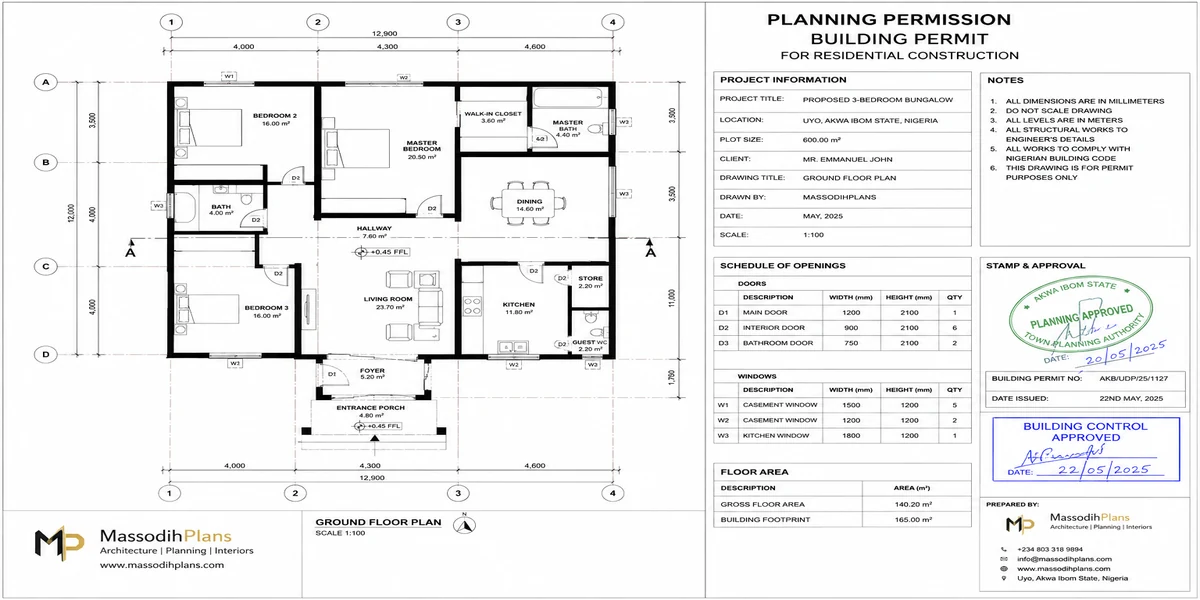
Please do not build without approval. I know many people do it in Nigeria but the risk is real. If the local planning authority identifies an unapproved building, they can seal it, demolish extensions, or fine you. More importantly, an unapproved building cannot be legally sold or transferred easily.
For small plots in most Nigerian states, you will need:
- A survey plan of the plot
- An architectural drawing (approved by a registered architect)
- A structural drawing (approved by a structural engineer)
- Soil test result for the foundation
- Environmental impact assessment (not always required for small residential)
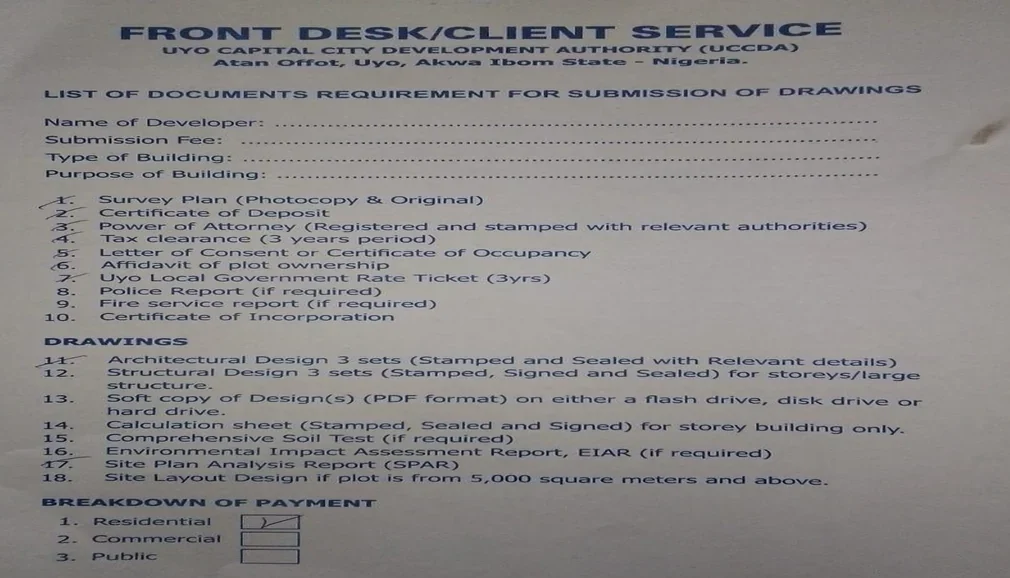
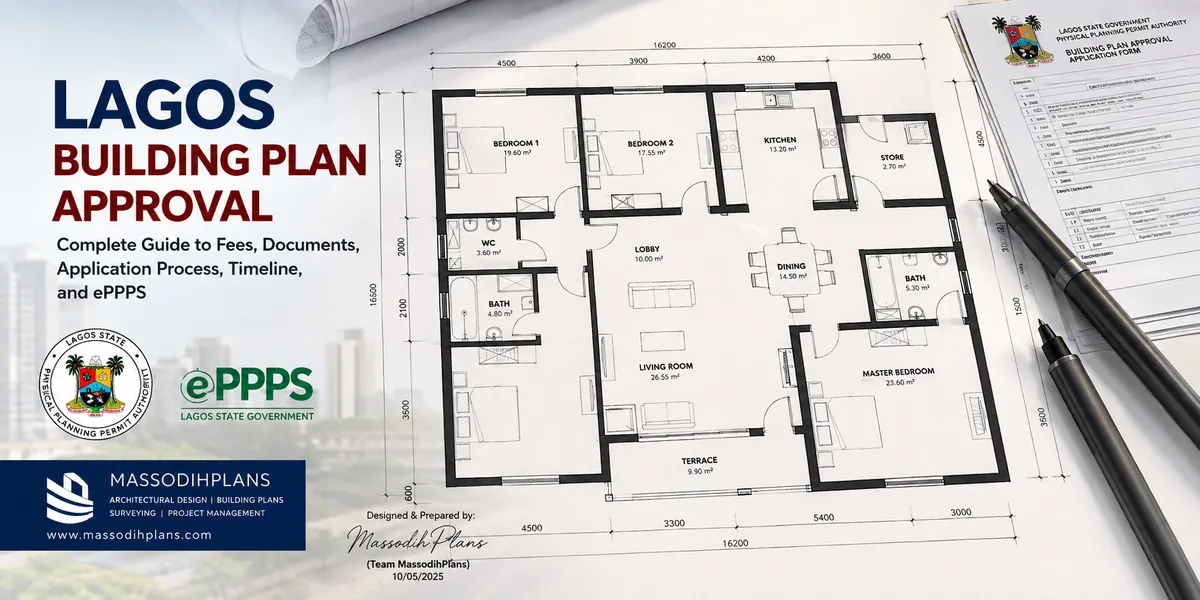
Submit these to your state or local government planning authority. The approval timeline varies from 2 weeks to several months depending on the state.
In Akwa Ibom, Uyo specifically, the Akwa Ibom State Ministry of Physical Planning and Urban Development handles approvals. I have walked clients through this process and it is manageable if your documents are complete.
A Real Story: The Uyo Client With a 45x90ft Plot
Let me tell you about a real client I worked with. His name I will not mention, but he gave me permission to share this story.
He came to me in 2023 with a plot of about 45ft x 90ft in a part of Uyo. He wanted a 3-bedroom storey building, a car park, and a small BQ. The first plan his previous draftsman drew had the building occupying almost the entire plot with barely 60cm setbacks on both sides.
I told him: “This will never get planning approval. And even if it did, the house will be miserable to live in.”
We redesigned from scratch. And we pushed the building to one side, gave a proper 1.5m setback on both sides, created a 3m front setback, and tucked the BQ at the rear with its own small yard. We added a hip roof with wide overhangs to shade the walls and reduce heat. We opened up the ground floor living area into an open plan.
When he moved in six months later, he sent me a voice note saying: “My brother, I don’t know how you did it but this place feels huge inside.”
That is what good small plot design does.
FAQs: Small House Designs in Nigeria
Q: What is the smallest plot size I can build a 3-bedroom house on in Nigeria?
You can technically build a 3-bedroom bungalow on a 40ft x 80ft plot, but you will need to be very efficient with your layout. The rooms will be on the smaller side. A 50ft x 100ft plot is much more comfortable for a 3-bedroom design in Nigeria.
Q: Can I build a storey building on a half plot (50x50ft)?
Yes, you can. But your ground floor footprint will be small (about 9m x 10m after setbacks) and the rooms will be compact. It is more practical to do a 2-bedroom arrangement on a half plot unless you are willing to have very small rooms.
Q: How can I make my small house feel more spacious?
Use open-plan layouts in living areas. Use light paint colours. Install large windows. Keep ceiling height at 3m or above. Plan built-in storage. Remove unnecessary corridors. Use large-format floor tiles.
Q: Does a small house cost less to build in Nigeria?
Yes, in absolute terms, a smaller house costs less. But the cost per square metre of a well-designed small house can sometimes be higher because you are packing more quality into less space. Do not try to cut quality just because the house is small.
Q: What roof type is best for a small house in Nigeria?
A hip roof is generally best because it sheds water on all four sides and provides shade from multiple directions. A gable roof is good for narrow plots. Avoid flat roofs unless you have an experienced waterproofing contractor.
Q: What is the minimum setback required for a small residential plot?
Setbacks vary by state and local area. A typical minimum is 3m front, 1.5m each side, and 2m rear. Always confirm with your local planning authority before finalising your design.
Q: Can I add a BQ to a small plot design?
Yes, but it must be included in the original design plan and within approved setbacks. A small BQ at the rear of a 50x100ft plot is feasible. A BQ on a half plot (50x50ft) is very tight and may not be practical.
Q: How much does a small house cost to build in Nigeria in 2025?
A simple 2 or 3-bedroom bungalow on a standard plot can cost between N18 million and N35 million depending on the state, materials, and finishing quality. A storey building can cost N45 million to N80 million. These are rough estimates and fluctuate with material prices.
Q: What type of foundation is best for a small house?
Strip foundations (mass concrete or reinforced) are standard for bungalows. For storey buildings, you need a structural engineer to design the foundation based on your soil test result. Do not skip the soil test.
Q: Is it worth buying a small plot in a good location versus a large plot in a remote location?
In my professional opinion, yes. A small plot in a good location will serve your family better in terms of daily life and will appreciate faster in value. A large plot far from infrastructure gives you space but costs you time, money, and quality of life every day.
Explore more on MassodihPlans:
- Find downloadable plans that fit tight Nigerian plots
- See how 4 bedrooms can fit a standard plot
- Detailed breakdown of construction costs by state
- Storey building options for your plot
- The full guide to planning permits
- Costs, types, and what works for our climate
- When you are building in a planned estate
- What to check before you buy
- Open Plan House Designs for Nigerian Families
- Work directly with our team
- Nigerian Building Approval Checklist for Overseas Property Owners
- Survey Plan vs Deed of Assignment in Nigeria: The Complete Difference Explained
- Survey Plan Symbols and Numbers Explained in Nigeria: A Complete Guide for Land Buyers
- Lost Survey Beacon in Nigeria: What to Do, Replacement Cost, and Legal Process
- Town Planning Services: Plans, Permits and Land Development
- How to Draw a Floor Plan Step by Step: A Complete Beginner’s Guide
- Building a House in Nigeria While Living Abroad: Complete Approval and Documentation Guide
- How Much Money Do You Need to Build a House in Nigeria from the UK, USA or Canada?
- Cost of Building a House in Uyo: Honest Budget Guide for Property Owners
- Best Places to Buy Land in Uyo for Fast Development and High Property Value
Reference
For understanding Nigerian building regulations and standards: NIA The professional body that regulates architectural practice in Nigeria. Useful if you want to verify a registered architect.
Are You Trying to Build on a Small Plot and You Are Not Sure Where to Start?
I want to help you before you make an expensive mistake.
At MassodihPlans, we work with Nigerian homeowners every day who are dealing with exactly what you are facing: a plot that feels too small, a design that does not work, a contractor who has started building and things are already going wrong.
Here is what we can do for you:
If you need a ready-made plan that already fits a 50x100ft or similar plot, go to our Plans Library and browse what we have. Each plan comes with full room dimensions, site plan, and a cost guide.
Browse Plans That Fit Your Plot
If you need a custom design for your specific plot and requirements, reach out to our design team directly. We have worked on plots across Uyo, Lagos, Abuja, Port Harcourt, and other Nigerian cities.
If you are still in the planning stage and just want to understand your options better, read more on our Plan School section where we break down every aspect of building in Nigeria in plain language.
Your plot is not too small. It just needs the right design.
Written by the MassodihPlans team, built environment professionals with experience across Nigerian residential and urban projects.