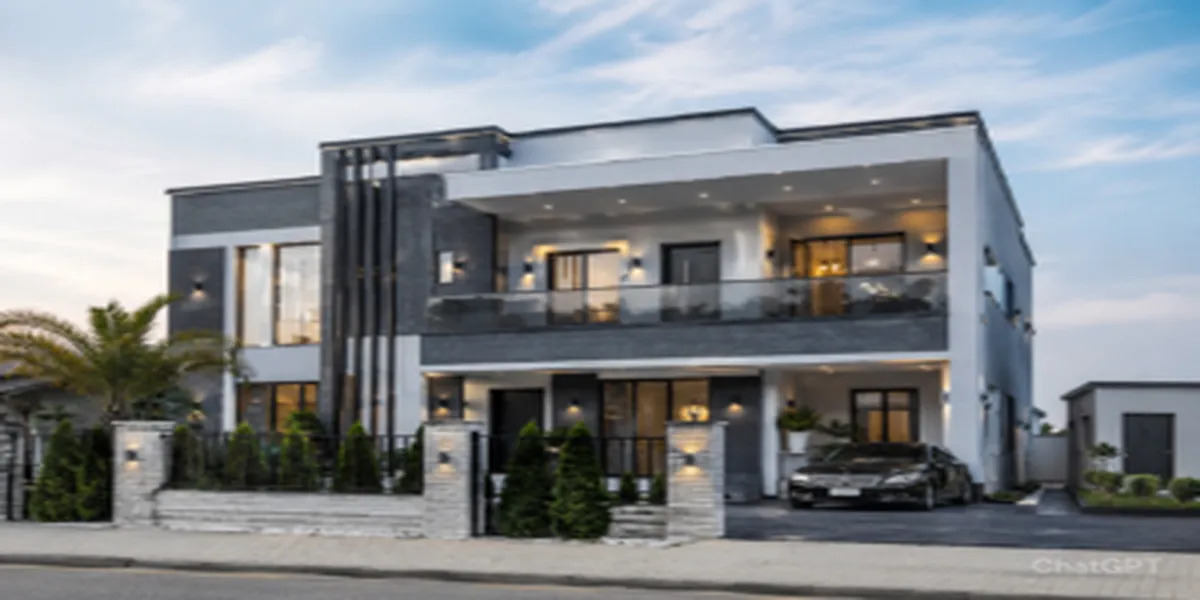
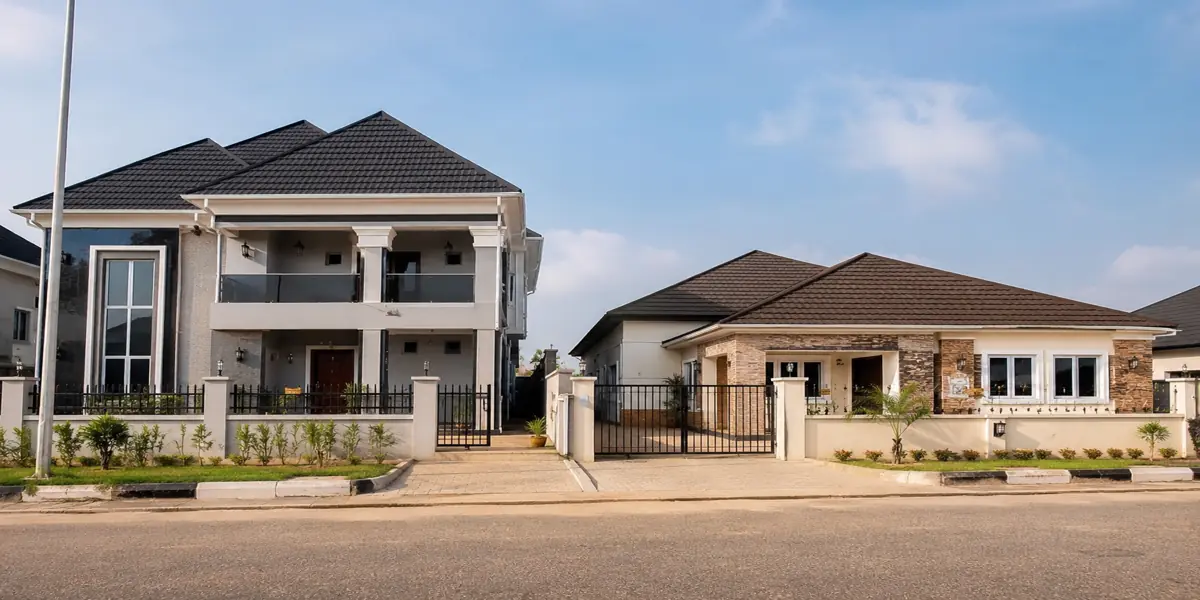
Updated last on August 12, 2026: This Is What a Nigerian Duplex Should Actually Look Like
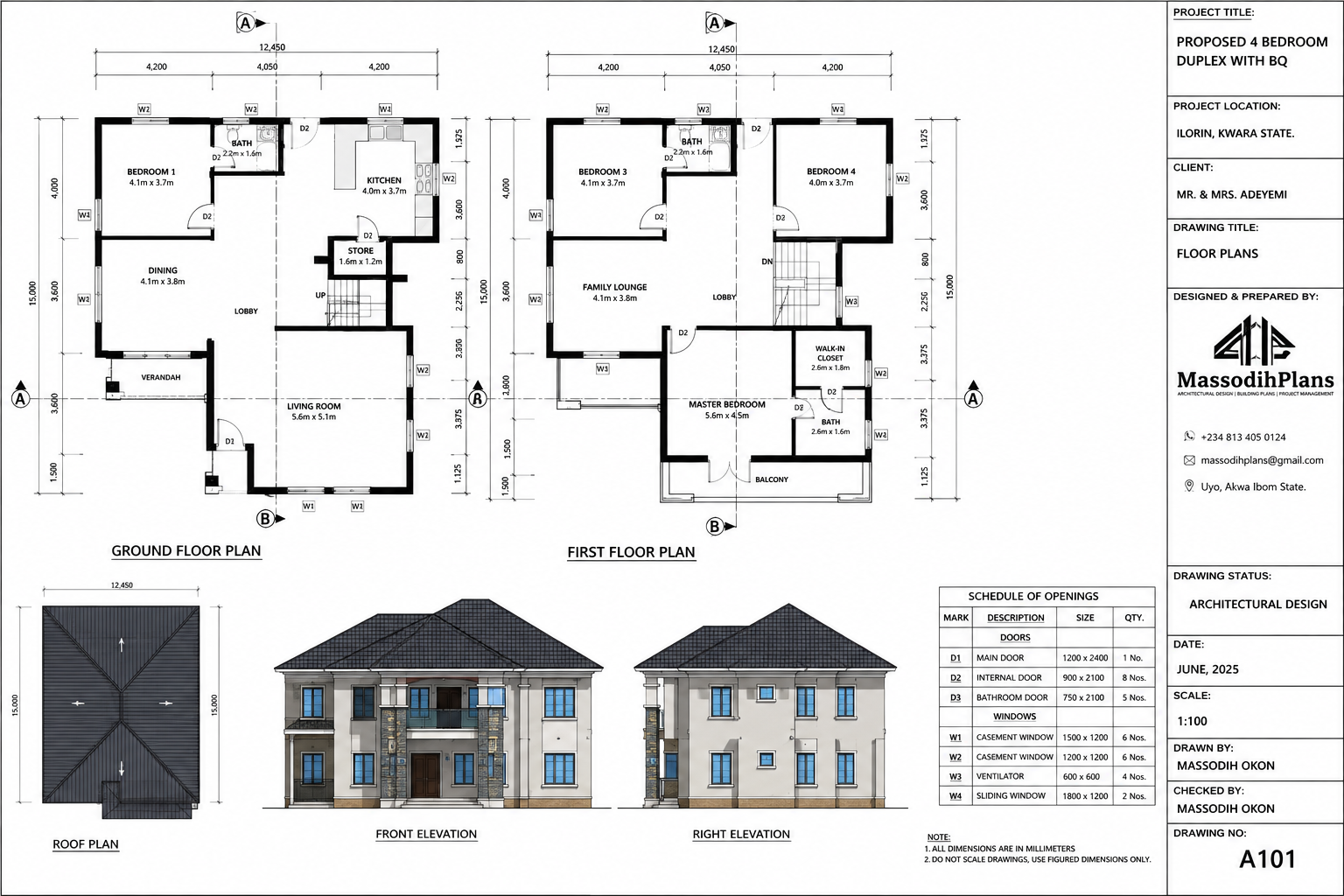
Duplex plans design
Let me answer this straight, no long story before it: a Nigerian duplex plan with modern roofing today means steep-pitch aluminum longspan or stone-coated tiles arranged in bold gable, hip, or butterfly combinations, sitting on a duplex layout that balances family living upstairs with entertainment space downstairs. That’s the short version. Now let’s go deeper, because I’ve supervised enough of these builds across Akwa Ibom and Rivers States to know the short version alone gets you a plan that looks good on paper and leaks in your second rainy season.
Most articles you’ll find online show you pretty renders and stop there. I’m not doing that with you. In this guide, I’m walking you through what modern roofing actually does to your duplex design how roof pitch angle affects your ceiling height and attic ventilation, why some “trending” roof styles quietly fight against Nigeria’s rainfall patterns, and which roofing material choices actually hold their color and strength past year five, not just in the showroom. I’ll also show you how roofing decisions ripple into your foundation cost, your gutter and drainage planning, and your final building approval process things that catch first-time builders off guard.
If you’re planning to build, renovate an old roofline, or you’re simply comparing plans before committing your budget, stay with me through this one. I’ve structured it so each section answers the next question you’d naturally ask, in the order you’d actually ask it starting with roof types, moving into duplex layout pairing, then cost, then approval. By the end, you won’t just have “a nice-looking plan.” You’ll understand exactly why it works, and you’ll know which of my other plan breakdowns to check next for your specific state and budget.
What “Modern Roofing” Actually Means on a Nigerian Duplex
Before we go any further, let me clear up what modern roofing means in a Nigerian residential context, because it gets used loosely.
Modern roofing on a Nigerian duplex is not just about colour. It is not about using expensive materials without a design logic behind them. Modern roofing means:
- The roof form was designed as part of the architecture, not bolted on at the end
- The pitch and overhang respond to the Nigerian climate specifically
- The shape works with the floor plan below it, not against it
- The material choice balances thermal performance, durability, and visual quality
- The drainage detail was thought through before the roof went up
That last point about drainage is where many Nigerian duplexes fail. A visually attractive flat or butterfly roof that pools water in Warri or Rivers State becomes a maintenance nightmare within two rainy seasons. A steep hip roof in Abuja’s dry northern climate absorbs unnecessary heat through an oversized surface area.
Good modern roofing is a design decision. Let me show you the options and what each one does on a Nigerian duplex.
The Four Modern Roofing Styles That Work on Nigerian Duplexes
1. The Contemporary Hip Roof with Extended Overhang
This is the most practical choice for most Nigerian regions, and when it is done right, it looks genuinely modern rather than dated.
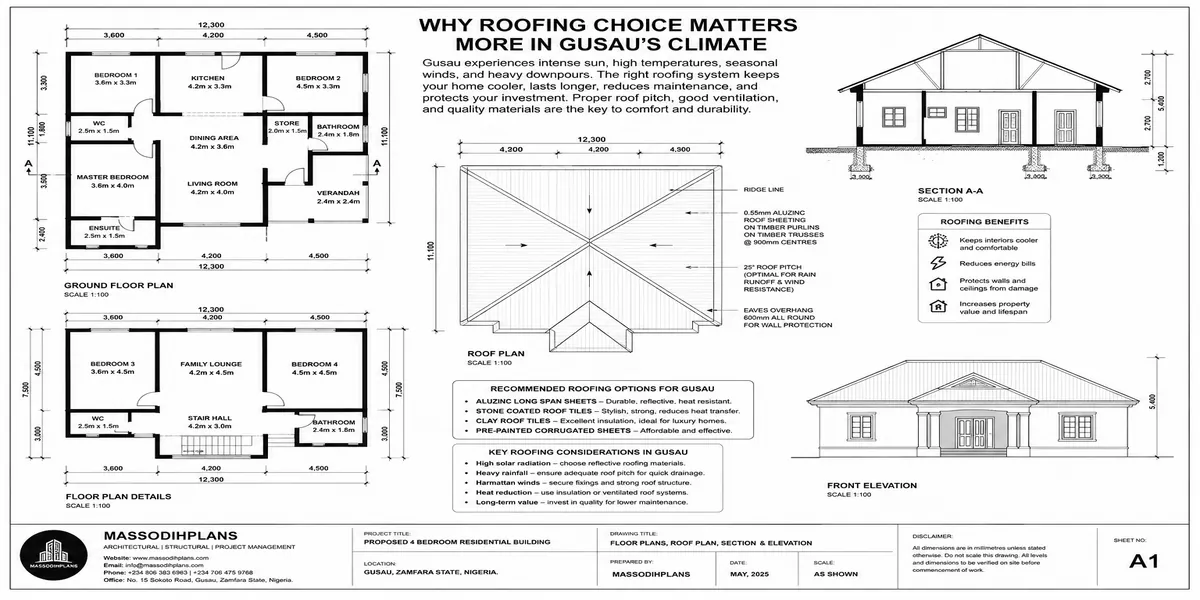
The difference between a hip roof that looks tired and one that looks premium is the overhang. A 600mm to 900mm overhang on all four sides does several things at once. It creates shade on the upper floor windows, which reduces heat gain dramatically. And it keeps rainwater well away from the wall surface, which protects the render and reduces maintenance. It gives the building a horizontal visual weight that reads as deliberate design rather than an afterthought.
Best suited for: Lagos, Port Harcourt, Calabar, Uyo, Warri, Enugu, Onitsha, and all high-rainfall southern states.
Pitch recommendation: 25 to 35 degrees in high-rain zones. Do not go below 20 degrees on a full hip roof in the south; it will pond water.
Material choice: Aluminium long-span in charcoal, dark bronze, or anthracite. Avoid raw silver-grey. It fades and ages poorly in the sun.
What to avoid: A hip roof with no overhang, or with very shallow overhangs of 200mm or less. It looks unfinished and performs poorly.
2. The Flat Roof with Parapet (Modern Box Aesthetic)
If you have ever driven through Lekki Phase 1, Jabi in Abuja, or GRA Port Harcourt and noticed certain duplexes that look genuinely contemporary, that clean flat-top silhouette almost always comes from a flat roof behind a parapet.
Done correctly, this roofing form creates a building that looks like something out of a serious architectural magazine. It reads as urban, modern, and considered. The building sits on the street with confidence rather than apologizing for itself with a generic pitched roof.
The engineering reality is that a true flat roof in Nigeria is not actually flat. It has a minimum slope of 1:50 (about 1 to 2 degrees) built into the structure to direct water toward drainage outlets. Those drainage outlets must be properly designed, sized correctly for your local rainfall intensity, and kept clear of debris. A blocked flat roof drain in Lagos during rainy season is not a problem you want to discover from the inside of your master bedroom.
Best suited for: Abuja, Kaduna, Kano, and drier northern states. Also works in Lagos and Port Harcourt when the drainage detail is properly engineered.
Waterproofing requirements: Bituminous membrane or torch-on felt over a concrete slab. Do not use ordinary cement screed and paint as your waterproofing. It will fail.
Parapet height: 600mm to 900mm above finished roof level. High enough to hide any roof equipment and create the clean roofline, but not so high it catches wind loading.
What to avoid: Flat roofs on buildings where the owner cannot commit to annual maintenance inspections. If you will not be available to check the drainage outlets twice yearly, choose a pitched option.
3. The Mono-Pitch (Skillion) Roof
This is the boldest modern roofing choice for a Nigerian duplex and the one that most immediately signals architectural intention to anyone passing the plot.
A mono-pitch roof slopes in one direction only. On a two-storey duplex, the roof plane rises from the lower front elevation to a higher rear edge, or vice versa depending on the orientation strategy. The result is a building with a strong diagonal line that creates genuine visual drama. The upper floor under the high side of the roof often benefits from a high ceiling that makes the main bedroom feel unexpectedly generous.
I have seen this done beautifully on a 50×100 plot in Ikeja, Lagos, where the architect used the roof slope to create a clerestory window strip at the top of the rear elevation. The natural light that came into the upper floor bedroom corridor was remarkable, and the roof form gave the whole building a distinctive silhouette that stood out in a street of identical hip-roofed neighbours.
Best suited for: All regions, but the drainage detail must be resolved at the low edge. The entire roof’s rainwater discharges along a single linear gutter, so that gutter must be properly sized.
Pitch recommendation: 10 to 20 degrees. This range keeps the building proportions clean without creating excessive height on the high edge.
Material choice: Aluminium standing seam in anthracite or zinc grey. The standing seam detail looks premium and performs well longitudinally.
What to avoid: Running the low edge toward your neighbour’s property without a drainage agreement. All that roof water has to go somewhere.
4. The Combination Roof (Hip with Flat Insert)
This is the most common modern compromise in Nigerian duplex design today, and when it is handled well, it looks genuinely premium.
The concept is straightforward: the main roof volume is a traditional hip or hipped gable form, but one section, typically above a balcony or a projecting wing, is resolved as a flat terrace or covered flat roof element. The contrast between the pitched main roof and the flat secondary element creates visual interest without the full engineering commitment of an all-flat roof.
On a duplex, this approach allows you to create a functional roof terrace above a ground-floor wing. That terrace becomes a usable outdoor space at upper floor level, which is enormously valuable on a small plot where the compound is otherwise the only outdoor area.
Best suited for: Lagos, Abuja, Enugu, and any city where the aspiration is a modern mixed aesthetic without abandoning the structural simplicity of a pitched main roof.
Key design requirement: The flat insert must be physically separated from the main pitched roof drainage pattern. Water from the pitched section must not dump onto the flat terrace. Each drainage zone must be independent.
Plot Suitability: What Size Plot Do You Actually Need?
Let me give you the honest version of this because I find that many online guides recommend duplex plots as if size does not matter. It does.
Minimum Plot for a Comfortable Duplex
60ft x 100ft (18.3m x 30.5m) is the ideal minimum for a full four-bedroom Nigerian duplex with two-car parking, proper setbacks, a functional compound, a generator enclosure, and room for a borehole.
50ft x 100ft (15.2m x 30.5m) is achievable with careful planning but requires design discipline. You will need to use vertical space efficiently, keep the ground floor parking tight, and make sure the staircase position does not eat into living space. The guide on the modern duplex house plan for a 50×100 plot in Lagos walks through exactly how this works in practice.
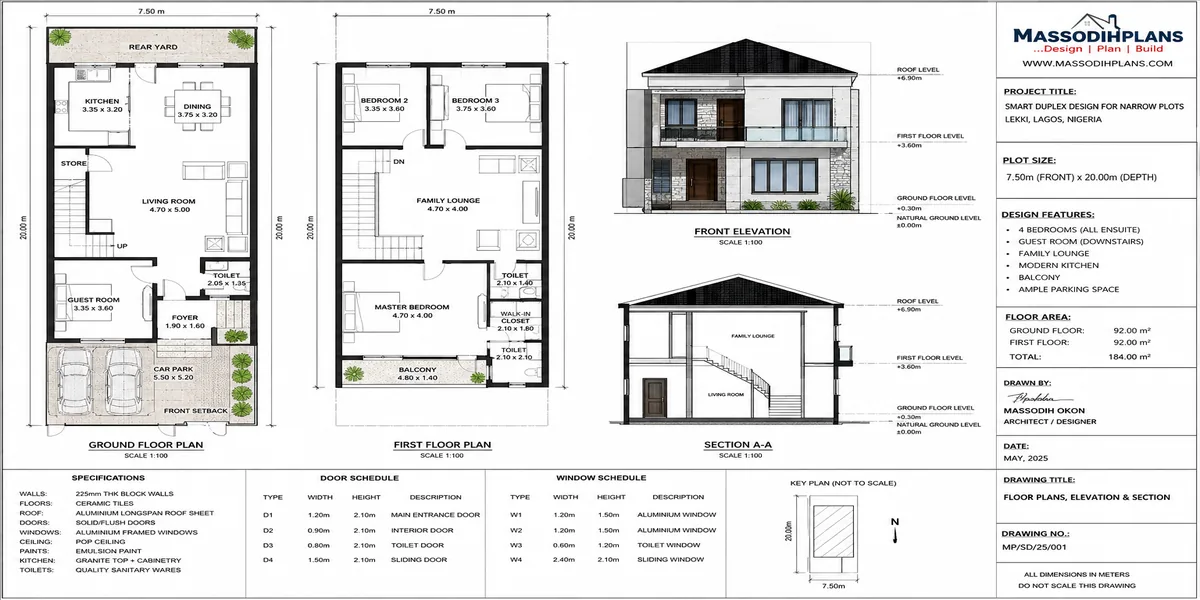
40ft x 80ft (12.2m x 24.4m) is the tight minimum and is only appropriate for a duplex when the design specifically responds to the narrow plot constraints. On these sizes, I recommend reading about smart duplex design for narrow plots in Lekki before commissioning any drawing.
| Plot Size | Duplex Viability | Parking | Compound Feel |
|---|---|---|---|
| 40 x 80 ft | Tight but buildable | 1 car (tight) | Minimal |
| 50 x 100 ft | Good with planning | 2 cars | Functional |
| 60 x 100 ft | Comfortable | 2 cars + visitor | Generous |
| 60 x 120 ft | Ideal | 3+ cars | Very comfortable |
Nigerian Duplex Floor Plan: Full Layout Breakdown
Let me show you a realistic floor plan layout for a typical Nigerian duplex on a 50×100 plot. These dimensions are not hypothetical. They are the result of working through real setback calculations and site conditions.
Setback Assumptions (Standard Nigerian Urban)
- Front setback: 3 metres
- Rear setback: 3 metres
- Side setbacks: 1.5 metres each
After setbacks on a 50×100 plot, the buildable footprint is approximately: Width: 15.2m minus 3m = ~12.2m buildable width Depth: 30.5m minus 6m = ~24.5m buildable depth
That gives a ground floor footprint of approximately 300 square feet usable area (after circulation), and with two floors, a total living area of around 4,500 to 5,000 square feet depending on the staircase and balcony arrangements.
Ground Floor Layout
| Space | Recommended Size | Notes |
|---|---|---|
| Covered entrance porch | 3.0m x 2.0m | Protects door from rain and sun |
| Reception/Lobby | 2.5m x 3.0m | Entry transition, not a room |
| Living Room | 5.5m x 4.5m | Opens toward compound |
| Dining Area | 3.5m x 3.5m | Adjacent to kitchen |
| Kitchen | 4.0m x 3.5m | Rear position for service access |
| Store/Pantry | 2.0m x 1.5m | Off kitchen |
| Guest Bedroom | 4.0m x 4.0m | Ensuite, ground floor privacy |
| Guest Bathroom | 2.2m x 1.8m | Attached to guest room |
| Visitor WC | 1.5m x 1.2m | Near living room entrance |
| Staircase | 1.2m x 4.5m | Side wall position, 14 to 16 risers |
| Passage | 1.2m minimum width | Connects front zone to rear |
| Rear Service Yard | 3.0m x 2.5m | Laundry, water, back exit |
Upper Floor Layout
| Space | Recommended Size | Notes |
|---|---|---|
| Landing/Upper Lobby | 2.5m x 2.5m | Connects all upper rooms |
| Master Bedroom | 5.5m x 5.0m | Southeast or east facing ideally |
| Master Bathroom | 3.5m x 2.5m | Ensuite, proper ventilation essential |
| Master Wardrobe | 2.5m x 1.8m | Walk-in preferred |
| Bedroom 2 | 4.5m x 4.0m | Ensuite recommended |
| Bedroom 3 | 4.0m x 3.5m | Can share bathroom with bedroom 2 |
| Children/Study Room | 3.5m x 3.0m | Doubles as home office |
| Family Lounge | 4.0m x 3.5m | Central upper floor gathering space |
| Balcony | 3.5m x 1.8m | Front facing, off master or family lounge |
| Shared Upper Bathroom | 2.5m x 2.0m | For bedrooms 3 and 4 |
Roofing and the Floor Plan: How They Must Talk to Each Other
Here is the piece of design knowledge that most Nigerian builders never hear until something has already gone wrong on site.
The roof structure and the floor plan below it are not independent decisions. The roof beam layout, the ridge direction, the hip return positions, the point where a flat roof transitions to a pitched section, all of these come directly from the plan geometry below. If you change your floor plan layout significantly after the roofing drawing is done, the roof drawing becomes wrong. I have seen this cause costly site errors where a hip return sat directly over a bedroom window, eliminating the window’s daylight.
The practical rule is this: Finalize your floor plan before your architect starts the roof drawings. Do not accept a situation where someone says “we will sort the roof later.” There is no “later” in construction. Everything must be resolved on paper before it is built in reality.
If you are currently at the drawing stage and want to understand how the design process works from plan to roof, the Plan School category has practical guides on this.
Ventilation in a Nigerian Duplex: The Part That Saves Your Electricity Bill
Nigeria’s climate is the single biggest reason you should care about ventilation design. In Lagos, Port Harcourt, or Uyo, the ambient temperature is above 28 degrees Celsius for most of the year. A duplex that is not ventilated properly becomes an oven, and a family that lives in an oven runs their air conditioner constantly.
Running an air conditioner constantly in Nigeria in 2026, with the current electricity tariff situation, is an extremely expensive way to live. Good ventilation design reduces your cooling load, reduces your power bill, and makes your home genuinely comfortable even during power outages.
Cross-Ventilation Strategy for a Nigerian Duplex
Cross-ventilation works when air enters a space from one side and exits through an opening on the opposite or adjacent side. The key is that both openings must be present and correctly positioned.
Ground floor: Your living room must have windows on at least two sides. On a narrow plot, the front living room window and the rear kitchen window, connected through the open-plan dining and kitchen zone, create a natural airflow path. Do not put a solid wall between your living room and dining area if your plot is narrow. The opening is your ventilation path.
Upper floor: The master bedroom must be positioned so that it is not between two other enclosed rooms. A corner bedroom position, with windows on two external walls, is always warmer than a single-aspect bedroom. On a 50×100 plot, the master bedroom on the upper floor should ideally occupy a front corner of the building with windows both on the front facade and on one side wall.
The roof ventilation factor: A metal roof in full Nigerian sun can reach 70 to 80 degrees Celsius at the surface. That heat radiates down into the room below. A 200mm ventilated roof cavity between the outer metal sheet and the ceiling board below reduces the heat that enters your rooms by a very significant margin. Always specify a ventilated roof space in your duplex design. It is not optional.
Roofing Materials: What to Actually Specify in Nigeria Today
Long-Span Aluminium Roofing Sheet
The most common choice and still the best value-for-money option when correctly specified. The mistake most Nigerian builders make is buying the thinnest, cheapest gauge (0.35mm) to save money on the line item, then spending that saving and more on repairs within five years.
Specify 0.45mm or 0.55mm aluminium. The price difference per sheet is modest. The durability difference over a 20-year building life is enormous.
Colour choice matters thermally. A dark charcoal roof absorbs more heat than a light grey or off-white. In the south where rain cools the roof naturally, dark colours look premium and are manageable. In the north where the dry season is long and intense, specify lighter colours. The building materials price guide on MassodihPlans covers building material prices in Nigeria and will give you current market benchmarks to work with.
Concrete Roof Tiles
More expensive to install but genuinely more beautiful and significantly better thermally than metal sheet. The mass of the tile absorbs heat during the day and releases it slowly. The room below a concrete tile roof is noticeably cooler than the same room under aluminium.
The downside in Nigeria is the structural requirement. Concrete tiles are heavier than metal, so your roof structure must be designed to carry the load. Do not substitute concrete tiles for aluminium on a roof structure that was designed for metal without consulting your engineer.
Stone-Coated Steel Tiles
The middle-ground option between long-span aluminium and concrete tiles. These are steel sheets coated with coloured stone granules that give a tile-like appearance. They look significantly more upscale than plain long-span aluminium, are lighter than concrete tiles, and perform reasonably well thermally.
For a duplex where the owner wants a modern aesthetic without the structural cost of concrete tiles, stone-coated steel is a strong choice. Budget approximately 40 to 60 percent more than equivalent-area long-span aluminium.
Realistic Cost Estimate: What a Modern Duplex with Quality Roofing Costs in Nigeria
Let me be transparent with you. Any cost estimate in Nigeria today should be treated as a benchmark, not a contract. Material prices change, labour rates vary by city, and the naira exchange rate affects imported materials significantly. What I can give you is a realistic framework.
These figures are estimates for a mid-range 4-bedroom duplex on a 50×100 plot with modern finish and quality roofing in 2026:
| Cost Component | Estimated Range |
|---|---|
| Structural work (foundation, columns, beams, slabs) | N8M to N15M |
| Blockwork (all floors) | N4M to N7M |
| Roofing (structure plus covering) | N3M to N7M |
| Windows and doors | N4M to N8M |
| Plumbing (all floors) | N2.5M to N5M |
| Electrical (all floors) | N2M to N4.5M |
| Tiles and floor finish | N3M to N6M |
| Plastering and paint | N2.5M to N5M |
| Staircase (concrete or steel) | N1.5M to N3.5M |
| Balcony railings and external works | N1M to N2.5M |
| Fence, gate, and compound | N2M to N5M |
| Contingency (10 to 15 percent) | N3M to N6M |
| Total Estimated Range | N36M to N79M |
The roofing component alone (N3M to N7M) reflects the difference between standard long-span aluminium and stone-coated steel or concrete tile. For a complete breakdown of what building a duplex costs in Lagos specifically, the guide on cost of building a 4-bedroom duplex in Lagos gives city-specific analysis.
For Port Harcourt construction costs, the current cost of building a house in Port Harcourt is a valuable companion read.
The Nigerian Reality Layer: What Most Guides Leave Out
Generator Space
Your duplex will need a generator. Not “might.” Will. Plan a concrete-slab generator pad in a position that is:
- Not directly beneath any bedroom window (noise)
- Not immediately beside the kitchen entrance (exhaust fumes)
- Accessible from the street or compound gate for fuel delivery
- Protected from direct rainfall with a louvred enclosure
A standard 10KVA generator pad is approximately 1.5m x 1.0m. Bigger generators need more clearance. Decide your generator capacity before the compound slab is poured, not after.
Borehole Position
Where your borehole sits affects your plumbing cost significantly. A borehole placed at the rear of the compound close to the building reduces the pipe run to your storage tanks and increases water pressure. A borehole placed at the front near the gate creates a longer pipe run and may need a booster pump. Decide the borehole position during site planning, before any concrete is poured.
Flooding Awareness
If your duplex is in Lagos Island, Lekki, any part of Rivers State, Bayelsa, Delta, or other flood-prone zones, your finished floor level must be raised above the natural ground level. The standard minimum is 600mm. In high-risk flood areas, go to 900mm or 1200mm above natural ground. Yes, this adds to your foundation cost. No, it is not optional. A flooded ground floor is not a design problem. It is a planning failure.
Compound Security
A compound that feels secure without feeling like a prison is a design challenge. The fence height, gate type, and building setback all work together. On a standard Nigerian plot, a 1.8-metre perimeter fence with a sliding or swing gate gives adequate privacy without making the building look hidden. Position your duplex so that the living room window does not face directly at the gate. You want natural surveillance of the gate from inside the house without your living room being on display to every passerby.
Material Price Volatility
When your contractor gives you a bill of quantities, ask for the material quantities separately from the labour. This matters because if materials go up in price between when you priced the job and when you buy, you know exactly what is a price increase and what is a markup. Nigerian construction material prices have been volatile. Working from a detailed bill of quantities protects you.
What Builders Get Wrong on Nigerian Duplex Construction
I want to share some things that I have observed repeatedly, because these are the mistakes that cost Nigerian homebuilders real money and real frustration.
Neglecting the staircase width. The legal minimum staircase width in residential construction is 900mm clear width. Many contractors build 800mm or even narrower because it saves space and materials. That staircase will feel uncomfortable for the life of the building, and if you ever need to carry furniture or move a sick family member, you will feel this mistake.
Ignoring the roofing drainage before the slab. Rain outlet positions must be decided at slab stage because the outlets often need to pass through the slab or the parapet wall. Deciding the outlets after the slab is poured means cutting, patching, and weakened concrete.
Buying cheap ceiling board. The ceiling board is what you see every day. It is what absorbs moisture when your roof leaks, and it is what burns if there is an electrical fire above it. Do not save money on ceiling board. Use 9mm Placo or equivalent.
Skipping the roof tie beam. The ring beam at the top of your upper floor walls is what holds the roof structure in position. Some Nigerian contractors reduce or skip this element to save concrete and rebar. Do not allow it. The ring beam is structural.
Not supervising the mortar mix. The standard mortar mix for blockwork is 1:6 (one part cement to six parts sharp sand). Many site workers extend this to 1:8 or 1:10 to save cement. The wall looks fine for years and then shows cracks. Supervise the mix yourself or employ a trusted site foreman who will.
Small Plot Optimization: Getting the Most from Limited Land
On a 50×100 or smaller plot, every design decision must earn its place. Here is how I approach small plot duplex optimization:
Vertical is your friend. A duplex is already using vertical space. Push this further by using high ceilings on the ground floor (minimum 3.0m floor-to-ceiling) to create a sense of space that compensates for the limited plan area.
Remove unnecessary rooms. A separate guest toilet plus a guest bathroom plus a downstairs study is three separate rooms that could be two functional spaces with better design. Every room that is not fully justified is a room that eats your circulation space.
Treat the balcony as outdoor living. A 3.5m by 2.0m balcony off the family lounge on the upper floor adds meaningful outdoor space to the building without expanding the footprint. In the tropical Nigerian climate, a shaded balcony is genuinely usable for six to eight months of the year.
Plan for expansion. If your budget only allows you to build the ground floor now and complete the upper floor in two years, design the ground floor slab and columns to carry the full two-storey load from day one. This is a structural decision that must be made at foundation stage. Revisiting it later means demolition or expensive retrofitting.
If you are comparing whether a duplex or a bungalow better suits your plot and budget, the detailed comparison at bungalow vs duplex: which is better to build in Nigeria today will help you think it through properly.
Family Lifestyle Suitability
A duplex is an excellent fit for a growing Nigerian family when it is designed with daily life in mind, not just aesthetics.
Children’s movement: The upper floor is the natural place for children’s bedrooms on a Nigerian duplex. It keeps their movement away from the more formal ground floor, creates a natural boundary between adult and children’s zones, and allows parents on the upper floor to be near the children at night. Position the children’s rooms adjacent to the family lounge, not at the far end of a long corridor.
Guest privacy: In Nigerian family culture, having a guest bedroom on the ground floor is near universal. It allows guests to arrive, use the living room, access their room, and use a bathroom without ever going to the upper floor where the family sleeps. This is not just courtesy; it is privacy for both parties.
Elderly accessibility: If there is any possibility that elderly parents will live in the building, either now or in future, I strongly recommend including a full ground floor bedroom and bathroom suite that is completely functional as a permanent room, not just a guest room. Steps and staircases become genuinely difficult as people age. The ground floor suite preserves dignity and independence.
Work from home: The children’s study room or the upper floor bedroom 4 doubles naturally as a home office. Position it with a window facing a quiet side of the compound rather than the street, and ensure the electrical specification includes dedicated circuit points and adequate natural light.
Investment Value: What a Well-Designed Duplex Returns
A properly designed and constructed Nigerian duplex in an urban location is one of the most durable assets a family can build. Here is the realistic investment picture:
Rental income: The ground floor of a duplex designed with a separate entrance can be rented as a self-contained unit while the owner occupies the upper floor. In Lagos, Abuja, or Port Harcourt, a well-finished ground floor duplex unit rents for N1.5M to N4M per annum depending on location and finish. This rental income is real money that can fund your construction loan repayment or supplement your income.
Resale value: A duplex with modern roofing, quality finish, and a functional compound commands a price premium on resale over an identically located duplex with generic finish. The difference is not marginal. In Rumuola, Port Harcourt, I have seen duplexes with contemporary roofing and exterior treatment sell for 30 to 40 percent more than comparable-sized neighbours with dated designs.
Estate suitability: If you are building in an estate with a developer or as part of a cluster development, a consistent modern roofing aesthetic across units improves the estate’s perceived quality and attracts higher-income tenants and buyers. The guide on small residential estate layout design in Nigeria explores this further.
Drainage Considerations: The Non-Negotiable Detail
Your compound must drain. This sounds obvious but most Nigerian duplex builders discover drainage problems after the compound is paved, not before.
The compound ground surface should slope away from the building at a minimum 1:50 gradient toward a drainage channel or soak away. If your plot is in a low-lying area, you may need to raise the entire compound level to ensure proper gradient without flooding.
The roof drainage must also connect to a system. A roof on a 200 square metre building during a Lagos rainstorm discharges an enormous volume of water. That water must go somewhere: into an underground soak away, into a surface drain that connects to the street drain, or into a collection tank for reuse. Standing water at the base of your duplex wall will cause foundation damage over time. Do not treat drainage as a finishing detail. It is structural.
Parking Considerations
A four-bedroom duplex implies a family with at least two cars. That means two parking spaces are a minimum, not a luxury.
On a 50×100 plot, two-car parking in a side-by-side arrangement at the front of the compound consumes approximately 5.5 metres of compound width for the cars plus a minimum 6-metre turning radius in front of them. This is achievable on a 15-metre-wide plot after setbacks but leaves the compound tight.
On a 50×100 plot, consider tandem parking (one car behind the other) if the compound width is tight. The inconvenience of the second car occasionally being blocked is significantly less than the alternative of designing away living space to accommodate wider parking.
If parking is a real constraint, the smart house design ideas for 50×100 plots covers parking layout strategies specifically.
Building Advice You Will Not Find Easily Elsewhere
Visit your intended contractor’s previous jobs. Not the photos on their phone. The actual buildings, finished or ongoing. Look at the blockwork. And look at the mortar joints. Look at the window reveals. These are the details that tell you whether a contractor takes care of the work or just delivers something that looks acceptable from a distance.
Get an independent structural engineer. Not the one your contractor recommends. Your own. Pay them separately. The fee is small compared to what a structural failure costs. They review the structural drawings, approve the reinforcement schedule, and check the concrete mix design before it is poured.
Pay your architect before construction starts. The mistake many Nigerian homebuilders make is stopping the architect’s fees the moment drawings are produced. The most valuable thing your architect does is not the drawings. It is the site supervision and the corrections they catch before they become expensive problems.
Do not let the contractor buy all the materials without you. You buy, or you nominate a trusted person to buy directly from the supplier, and the contractor collects from you. The markup on materials when contractors buy is real and substantial.
Modern Design Concepts: What Makes a Nigerian Duplex Look Premium
Beyond the roofing form, several design choices elevate a duplex from ordinary to genuinely impressive:
The entrance canopy. A well-designed entrance canopy that projects 2 to 3 metres over the front door, supported by slim steel columns, creates an arrival experience that signals quality immediately. This is not expensive. A well-built steel canopy with a flat roof covering costs a fraction of the gate or perimeter fence.
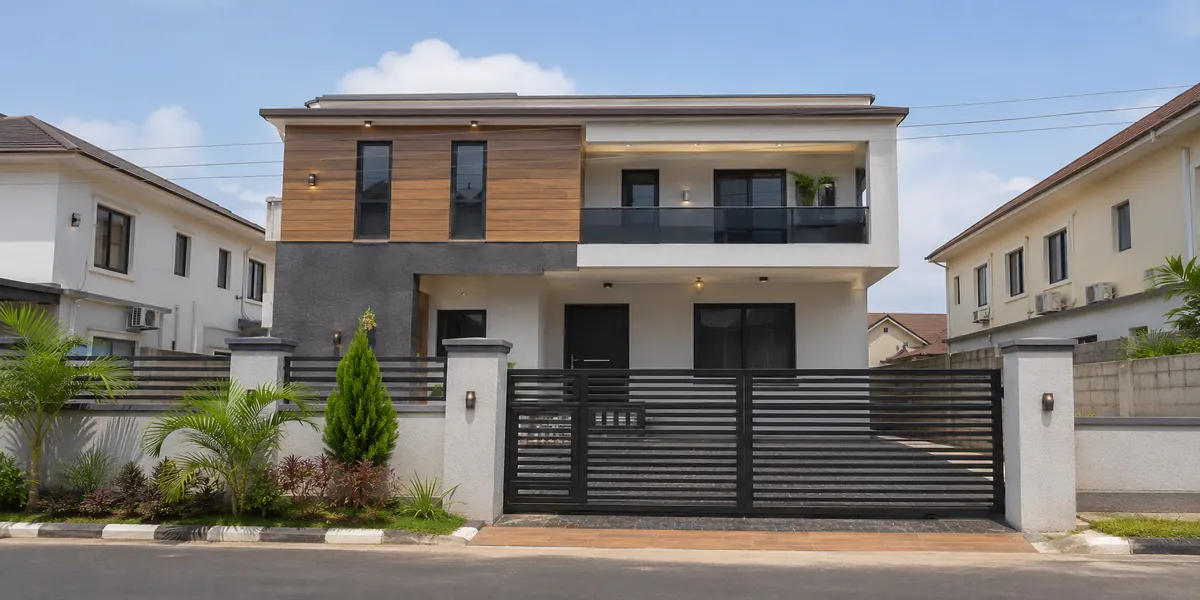
The balcony railing. Replace standard iron-railing balcony barriers with either powder-coated flat steel plate railings with horizontal slots, or reinforced glass balustrades. Both look contemporary. And both cost more than tube-steel railings. Both are worth it.
The facade treatment. Breaking the facade into two or three materials or textures, a section in textured render, a section in cladding tile, a section in fair-faced blockwork, creates visual depth that reads as intentional architecture rather than a single rendered box.
External lighting. In-ground uplighters at the base of the facade columns, wall-mounted linear LED strips under the entrance canopy, and pendant lighting on the balcony ceiling transform how the duplex reads at night. Well-lit Nigerian duplexes look significantly more premium than identical daytime designs that go dark after 6pm.
Orientation: Direction Matters More Than You Think
The orientation of your duplex on its plot directly affects comfort, energy cost, and air quality throughout the year.
The living room should face south or southeast. This provides morning and midday sun for natural lighting while avoiding the intense afternoon western sun, which heats living spaces most aggressively from around 2pm to 6pm.
The master bedroom should face east. Morning light in the master bedroom is pleasant and natural. Western afternoon sun baking the master bedroom wall is the reason so many Nigerian bedrooms are uncomfortable in the evenings.
The kitchen should face northwest or north. Keep the intense afternoon sun away from your kitchen. A kitchen with a western wall in a tropical climate is a very uncomfortable workspace.
The staircase can face west. It is a transitional space. It does not matter if it gets afternoon sun because nobody sits in a staircase.
Not all plots allow perfect orientation. On a narrow north-south facing plot, you have less flexibility than on an east-west oriented one. But understanding the ideal helps you make the best available choice rather than the default choice.
Common Mistakes to Avoid on a Nigerian Duplex
Building the upper floor before the ground floor is weathertight. Complete the roof before any upper floor finishes. Rain inside an incomplete building causes damage that costs more to repair than the time saved.
Choosing roofing colour last. Roofing colour affects heat load, material lead time, and exterior aesthetics. Decide it during design, not on site.
Ignoring the parapet capping. On a flat roof or parapeted hip roof, the coping stones or metal capping on the parapet wall is what keeps water from entering the wall core. Badly installed parapet capping causes chronic leaks that look like mysterious rising damp from inside.
Buying tiles before the floor level is confirmed. Your tile choice should be confirmed after the structural slab level and screed depth are known. Many Nigerian builders buy tiles in advance and then discover the finished floor level is higher than expected, creating a step at the front door.
Not specifying the staircase material early. A concrete staircase and a steel staircase require completely different structural provisions at slab stage. Decide before the slab is poured.
Frequently Asked Questions
What is the best modern roofing type for a Nigerian duplex?
For most of southern Nigeria, a contemporary hip roof with 600mm to 900mm overhangs using 0.55mm aluminium or stone-coated steel in a dark neutral colour is the most practical choice. It performs well in heavy rain, looks modern when done correctly, and is achievable on standard construction budgets. For drier northern regions or where a very contemporary aesthetic is the priority, a properly engineered flat roof with correct waterproofing is worth considering.
How many bedrooms should a duplex on a 50×100 plot have?
Four bedrooms total (one on the ground floor, three on the upper floor, with a study) is the most functional arrangement for a family duplex on a 50×100 plot. Five bedrooms are achievable but require reducing room sizes below what feels generous. Three bedrooms on a 50×100 plot gives each room more space and allows for a larger family lounge and study area.
What does it cost to build a duplex with modern roofing in Nigeria in 2026?
A mid-finish four-bedroom duplex with quality roofing, excluding land cost, currently ranges from approximately N36 million to N79 million depending on city, material specification, and finishing level. Lagos, Abuja, and Port Harcourt are at the higher end of this range. Uyo, Enugu, and secondary cities tend to be 15 to 25 percent lower.
Is a flat roof practical in Nigeria’s rainy climate?
Yes, when properly engineered. The key requirements are a minimum 1:50 drainage slope, correctly sized and positioned roof outlets, bituminous or torch-on waterproofing membrane (not cement paint), and an annual maintenance commitment to clear the drainage outlets. A flat roof that is properly detailed in Lagos will outlast a badly detailed pitched roof.
What is the minimum plot size for a Nigerian duplex?
The practical minimum for a comfortable family duplex with parking and correct setbacks is 50 by 100 feet. Smaller plots (40 by 80 feet) are possible with specific narrow-plot design strategies, which I cover in detail in the Lekki narrow plot guide linked below.
Should the living room be on the ground floor or upper floor of a Nigerian duplex?
Ground floor for the formal living and dining. Upper floor for the family lounge. This is the arrangement that matches how Nigerian families actually live: formal reception happens downstairs, daily family life happens upstairs. This arrangement also gives your ground floor a functional dual purpose if you later want to rent the ground floor unit.
How do I prevent my duplex roof from leaking in heavy Nigerian rain?
Use the correct gauge material (minimum 0.45mm aluminium), ensure all ridge and hip joints have factory-sealed overlapping flashings, install aluminium ridge caps (not just mortar), ensure gutter downpipes are properly connected to drainage outlets, and never cut corners on the roofing labour. Roof leaks in Nigeria almost always trace back to a poor joint, not material failure.
Category Links (3 required):
External Reference: Nigerian Institute of Architects
Ready to Build Your Nigerian Duplex?
You have read through the full guide. Now the next step is yours.
If you are still at the ideas stage, start by browsing the Plans Library where you will find architect-developed Nigerian house plans covering duplex designs, bungalows, and compact layouts for small plots.
And if you want to understand the drawing and design process before you commit to anything, the Plan School breaks down everything from reading a floor plan to understanding setback regulations.
If you are ready to commission a design or get professional input on your specific plot, the Services page covers customized house design, site planning analysis, architectural consultation, and more.
This is the kind of project where getting the design right at the beginning protects every naira you will spend during construction. Take it seriously at the planning stage and you will not spend the rest of the building process fixing things that should never have been wrong.
Conclusion
A Nigerian duplex with modern roofing is not a trend you’re chasing. It’s a decision that determines whether your family stays comfortable through Harmattan dust and rainy-season downpours, whether your roof survives 20 years or fails in five, and whether the house holds its resale value when it’s time to pass it on.
Here’s the truth most articles won’t tell you: the roof is your most underrated structural element. It’s a thermal system that decides how hot your bedrooms get by 2pm. And it’s a drainage system that decides whether your foundation floods. It’s a visual statement that decides what your neighbours think before they’ve even stepped inside. Treat it with the same seriousness you’d give your columns and beams, because structurally, it deserves that respect.
Everything else follows from that mindset. Let your rooms flow logically into each other. Ventilate for the climate you actually live in, not the climate in a foreign design magazine. Plan for your generator house, your borehole, and your flood risk before the first block goes down. Then supervise the build yourself, actively, not from a distance.
Get this right, and you won’t just have a duplex you’ll have a home your family loves, your visitors remember, and your grandchildren inherit with pride. That’s what real architecture does. It outlives the people who commissioned it.
Author
Massodih Okon is a Nigerian built-environment professional with academic and professional experience in urban and regional planning, geography, architectural design, Landscape Design, GIS and land development.
He holds a Master’s degree in Urban and Regional Planning from the University of Uyo and a first degree in Geography and Regional Planning.
Through MassodihPlans, he publishes practical guides on Nigerian house plans, building design, physical planning, site planning, development approval and residential construction. Read the full author profile →
Related Guides
- How Much Is a Building Permit in Lagos State? Complete Current Fee and Approval Cost Guide for Developers
- Building Plan Approval Cost in Lagos: Complete Guide to Official Fees, Assessments, and Extra Charges
- Terraced Duplex Cost in Lagos: Complete Buying, Building, Construction, and Budget Guide for Homeowners
- Detached House Building Cost in Lagos: Complete Landed Property and Construction Budget Planning Guide
- 5 Bedroom Duplex Cost in Lagos: Complete Construction Budget for Materials, Labour, Finishing, and Design
- 4 Bedroom House Construction Cost in Lagos: Standard, Mid-Range, and Luxury Building Budget Explained
- 3 Bedroom House Construction Cost in Lagos: Complete Budget Breakdown From Foundation to Final Finishes
- 2 Bedroom House Construction Cost in Lagos: Complete Budget, Materials, Labour, and Finishing Cost Guide
- How Much Does It Cost to Build a House in Lagos? Complete Construction Budget and Cost Breakdown Guide
- Nigeria House Plan Approval Costs: Complete Guide to Getting Building Approval Faster Without Costly Delays
- Lagos Building Plan Approval: Complete Guide to Fees, Documents, Application Process, Timeline, and ePPPS
- Cost of Building a House in Lagos: Complete Budget Guide to Materials, Labour, Design, and Approval Costs
- Architecture & Architectural Design: Complete Guide to Modern Houses, Building Design and Modern Architecture
- Sustainable Landscaping: Complete Guide to Xeriscaping, Landscape Lighting and Water-Efficient Gardens
- Landscaping Services: Complete Guide to Landscape Design, Hardscaping, Garden Planning and Outdoor Improvements
- Landscape Architect: What They Do, What They Design and When You Need One
- Urban Planning & Urban Design: Complete Guide to Modern Cities, Development and Renewal