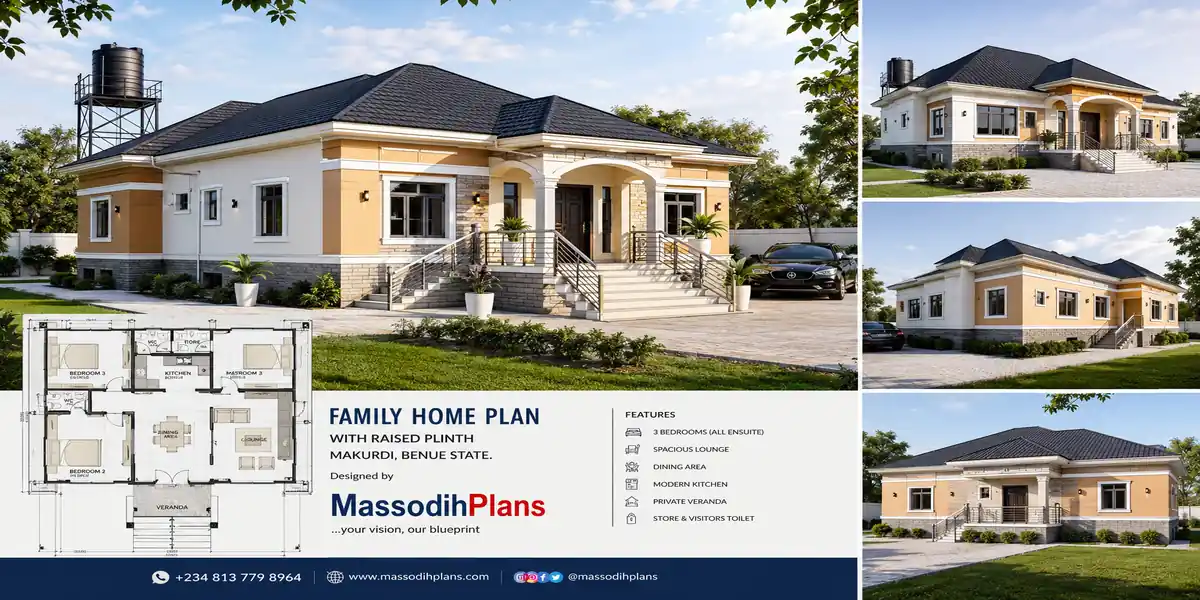
Why Nigerians Are Finally Getting Affordable Architectural Drawings Without Being Cheated
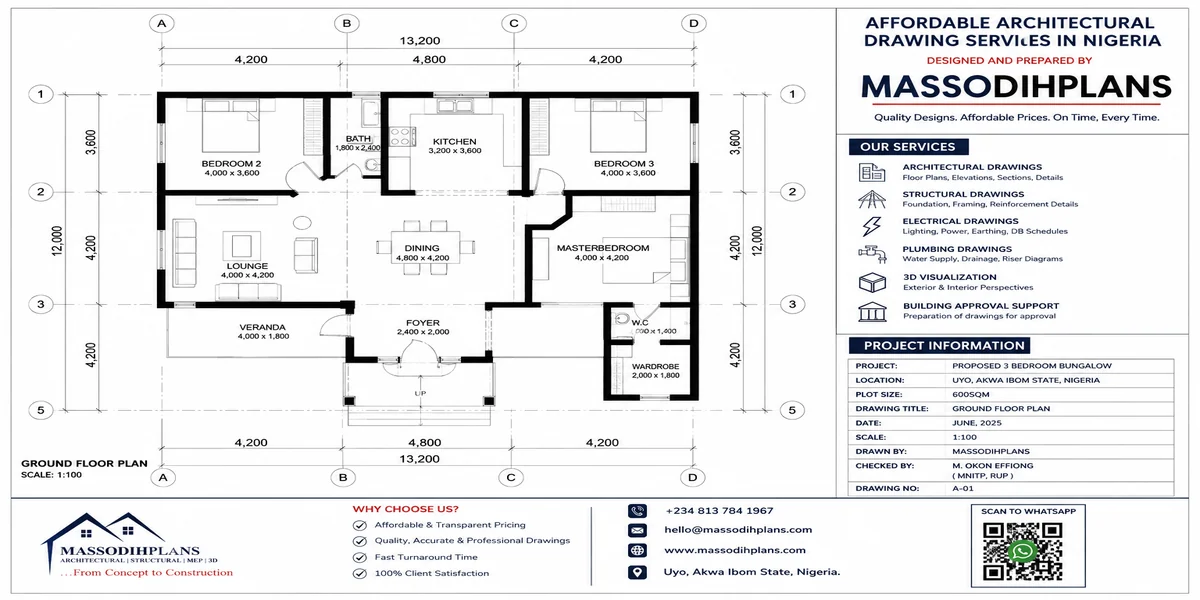
affordable architectural drawing services nigeria
If you are searching for affordable architectural drawing services in Nigeria, the real question is not, “Who can draw my house plan cheaply?” It is: “Who can turn my ideas, plot, budget and building requirements into clear, practical drawings that I can actually use for construction and, where required, submit for professional approval?” That difference can save you from expensive redesigns, wasted materials and approval problems.
Affordable does not have to mean incomplete. A useful architectural drawing package should communicate how the building is arranged, how it looks, how it is constructed and how it fits the site. Depending on the project, this can include a site plan, floor plans, roof plan, elevations, sections, schedules, construction details and coordinated drawings for structural, electrical and plumbing work. Nigerian approval requirements can also vary by location, so you should know exactly what your package includes before paying. For example, the Federal Housing Authority specifies signed architectural drawings and requirements for scales, orientation, ventilation, lighting and open spaces.
In this guide, I will show you what affordable architectural drawing services in Nigeria should realistically cost, what you should receive for your money, the difference between basic drafting, architectural design and approval-ready documentation, and when you need a registered professional.
We will also look at the questions you should ask before hiring a designer, common “cheap plan” traps, what information you should provide, how revisions work, and how to compare quotations without choosing the wrong service simply because it has the lowest price.
Whether you are building a bungalow, duplex, apartment, or shop.
By the end, you should be able to judge a quotation intelligently, identify missing drawings before construction begins, and choose a service that gives you value not just a beautiful floor plan.
What Exactly Are Architectural Drawing Services?
Before we talk price, let us make sure you understand what architectural drawing services actually cover. Many Nigerians confuse a “building plan” with a proper architectural drawing set, and that confusion often leads to underpaying for incomplete work or overpaying for something that does not meet regulatory standards.
Professional architectural drawing services in Nigeria include a full set of documents that cover:
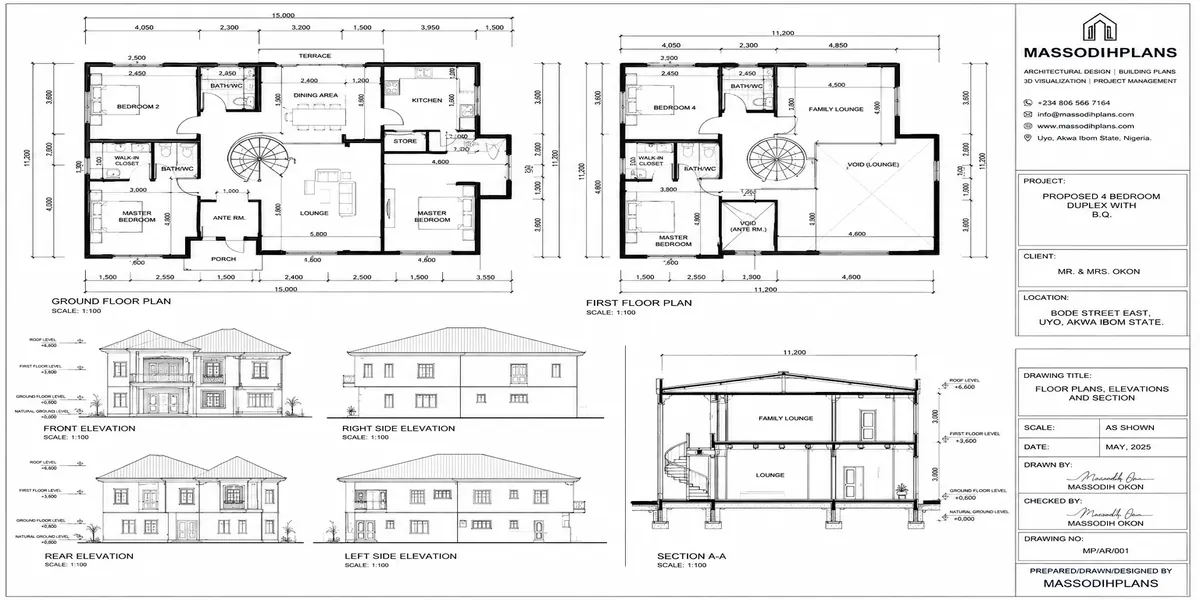
Architectural drawings: Floor plans, elevations, sections, site plans, and roof plans
Structural drawings: Foundation layout, beam sizes, column positions, and lintel specifications
Mechanical, Electrical, and Plumbing (MEP) drawings: Water supply layout, drainage routing, electrical distribution, and conduit positions
Bill of Quantities (BOQ): A detailed cost estimate document showing quantities and materials for each stage of construction
3D renders or perspectives: Visual representations of what the finished building will look like
For most residential builds in Nigeria, the minimum set you need before approaching your State Urban Development Board or Town Planning authority includes the architectural and structural drawings, a site plan, and a drainage layout. Skipping any of these is not a shortcut. It is a liability.
Expert Note: I always tell clients that architectural drawings are not an expense. They are the cheapest form of insurance you will ever buy. A set of accurate drawings catches conflicts between structure and plumbing before they become expensive demolition jobs on site.
How Much Do Architectural Drawing Services Cost in Nigeria?
This is the question most people come here with, and I will give you honest numbers rather than evasive ranges.
Architectural fees in Nigeria are typically calculated as a percentage of the estimated construction cost, or as a flat fee per square metre of the built-up area, depending on the practitioner.
The Nigerian Institute of Architects (NIA) recommends a professional fee schedule, though market rates vary widely.
Realistic Cost Ranges by Building Type
| Building Type | Estimated Construction Cost | Typical Drawing Fee Range |
|---|---|---|
| 2-bedroom bungalow (60 sqm) | N8M to N14M | N150,000 to N450,000 |
| 3-bedroom bungalow (90 sqm) | N14M to N22M | N250,000 to N650,000 |
| 4-bedroom duplex (200 sqm) | N28M to N55M | N500,000 to N1.4M |
| Commercial building (small) | N40M and above | N800,000 and above |
| Town Planning layout or estate | Varies | N500,000 to N5M+ |
These figures cover architectural drawings only. If you add structural and MEP drawings, expect an additional 30 to 50 percent on top of architectural fees.
How City Location Affects Your Architectural Drawing Cost
Lagos and Abuja practitioners charge significantly more than counterparts in Enugu, Uyo, Owerri, or Kaduna. This is not always a reflection of quality. It often reflects overheads, office rent, and market expectation. A 3-bedroom plan in Victoria Island may cost you N800,000 from a certified firm that would charge N350,000 in Calabar.
Online architectural drawing services like MassodihPlans close this gap by delivering premium quality at standardised, transparent prices regardless of your location in Nigeria or internationally.
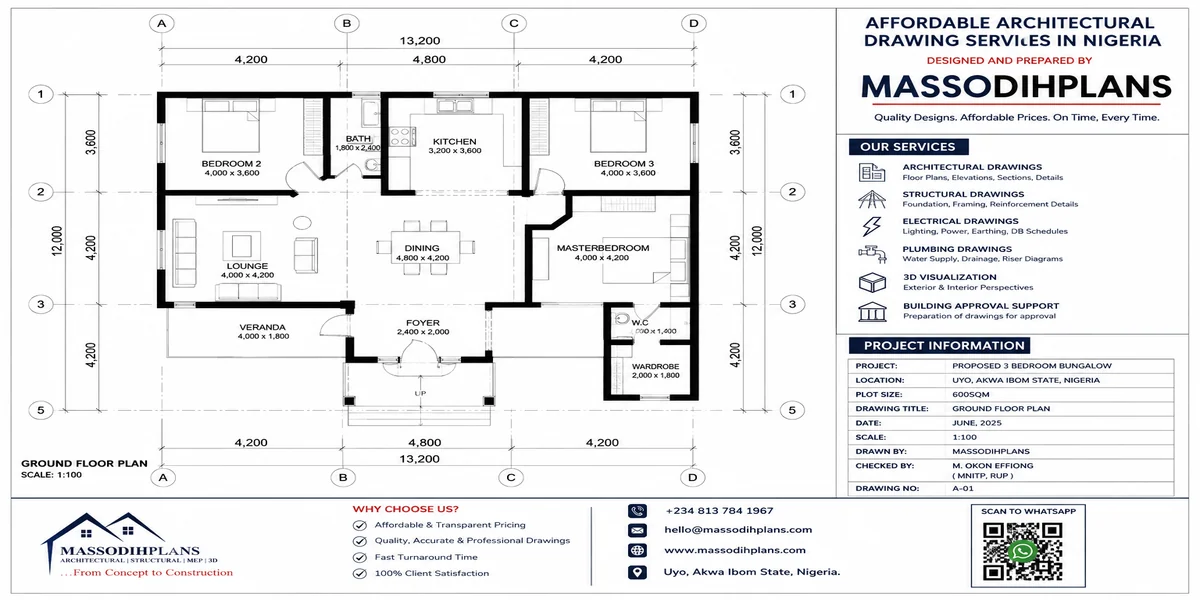
affordable architectural drawing services nigeria
What Makes Architectural Drawing Services Truly Affordable in Nigeria?
Affordability is not the same as cheapness. I want to be very direct about this distinction because it matters to your building’s safety and your long-term investment.
An affordable architectural service gives you:
- Full professional drawings that meet state planning authority requirements
- Site-specific design adapted to your actual plot dimensions and setbacks
- A licensed or experienced architect or draughtsman behind the design
- Clear documentation you can hand to any contractor or quantity surveyor
- Revisions built into the process so the design actually fits your needs
A cheap but dangerous drawing service gives you:
- A copied plan that was never measured against your land
- Missing structural details that leave builders guessing
- No drainage or MEP coordination
- Drawings that fail approval at the Town Planning office
- No professional standing if problems arise later
MassodihPlans offers affordable architectural drawing services that do not compromise on any of the five quality points above. You get a site-responsive design, full drawing sets, and transparent pricing from the start. View our house plans and drawing packages
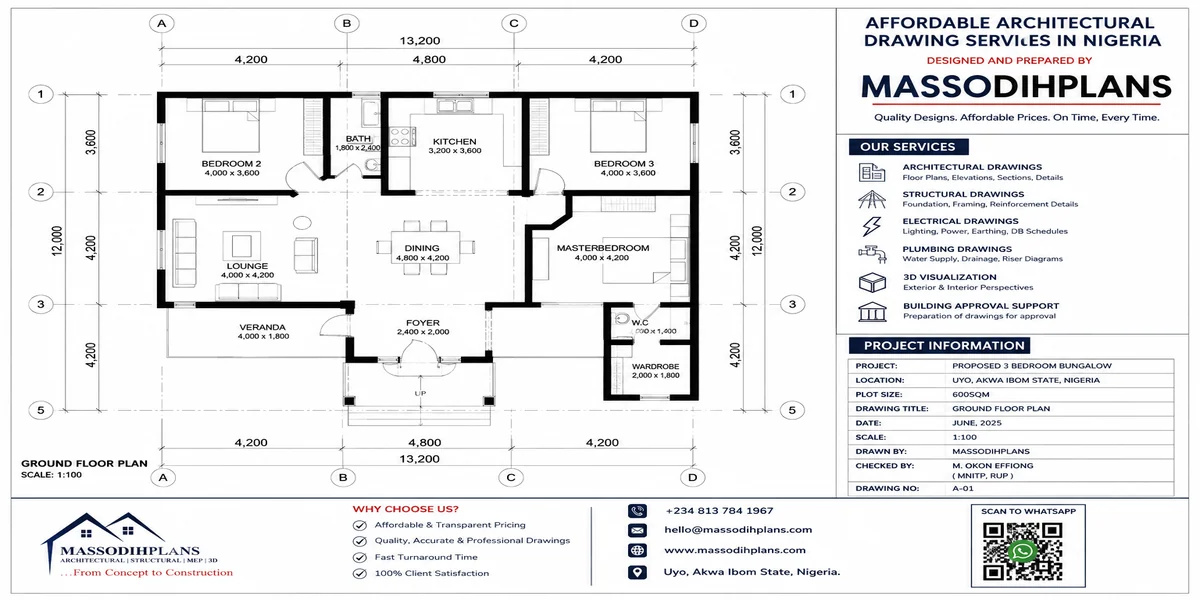
affordable architectural drawing services nigeria
The Complete Drawing Services Available for Nigerian Clients
Understanding the full menu of what is available helps you order exactly what your project needs rather than paying for what you do not need or missing something critical.
Residential Architectural Drawings
This is the most common need for Nigerian clients. Residential drawings cover:
- Floor plan layout showing all rooms, corridors, doors, windows, and built-in features
- Four elevations showing the front, rear, left, and right faces of the building
- At least two cross-sections showing internal heights, floor-to-ceiling dimensions, and structural relationships
- Roof plan showing rafter direction, ridges, valleys, and drainage fall
- Site plan showing plot boundaries, setbacks, building footprint, parking, drainage, and access. See examples of residential floor plans for Nigerian plots
Structural Drawings
Structural drawings translate the architectural design into engineering information that controls how the building stands up. This includes:
- Foundation plan with footing dimensions and reinforcement specifications
- Ground floor and suspended floor slab layout (where applicable)
- Beam and column schedule
- Lintel details over openings
- Roof structural details
Without structural drawings, your contractor is guessing how much iron to put in your foundation. That guess could either waste your money or compromise your building’s life span.
MEP (Mechanical, Electrical, Plumbing) Drawings
MEP drawings are the most commonly skipped documents in Nigerian residential construction, and this single omission causes more post-construction headaches than almost anything else.
Plumbing layouts determine where pipes run inside your slab and walls. If your electrician later chases through a load-bearing beam to route conduit, the structural consequences can be serious. MEP drawings prevent these conflicts before they happen on site. Explore combined architectural and MEP drawing packages
Town Planning Drawings and Layouts
Beyond individual houses, Nigeria’s growing urban centres have a serious need for proper town planning designs. This includes:
- Estate layout drawings
- Subdivision plans
- Land use zoning drawings
- Infrastructure planning for roads, drainage, and utilities within a development
MassodihPlans specialises in both individual residential designs and town planning layout drawings for developers and landowners across Nigeria. Learn more about our town planning design services
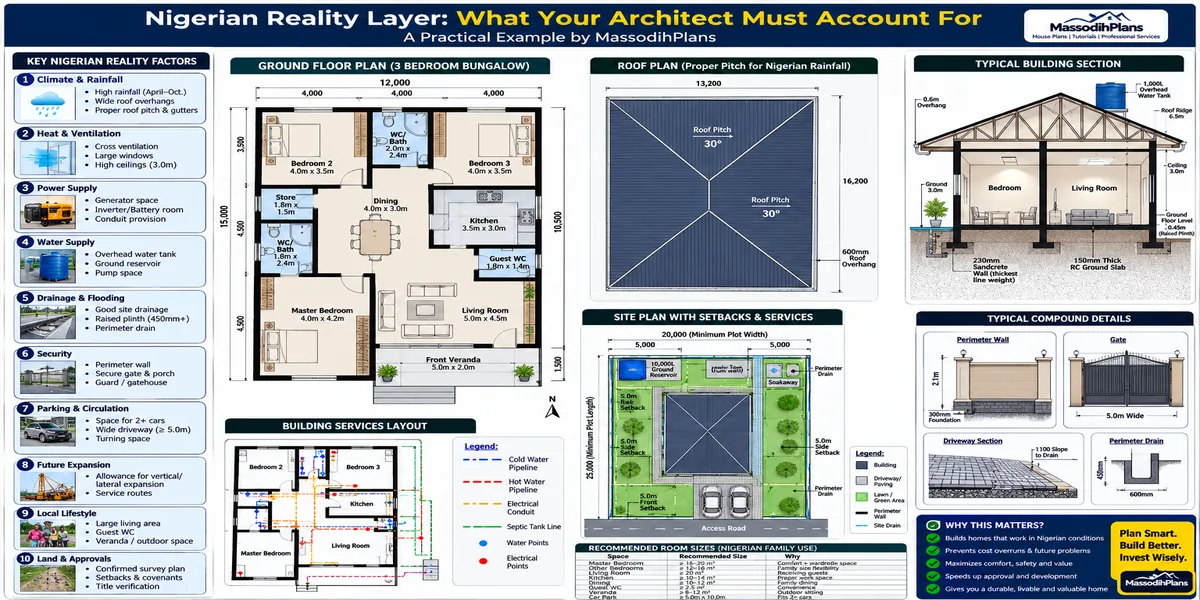
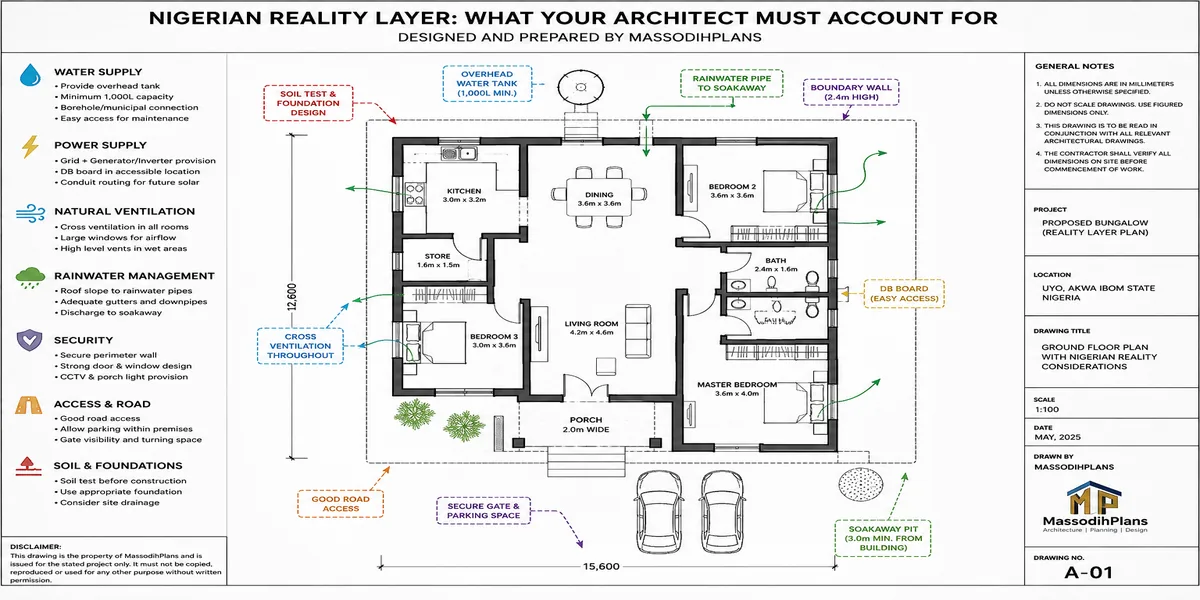
Nigerian Reality Layer: What Your Architect Must Account For
Any architectural drawing service operating in Nigeria must understand the specific environmental, infrastructural, and cultural realities of building here. A design copied from a European or American template and handed to a Nigerian client is not just useless. It is irresponsible.
Here is what a properly Nigeria-specific design must address:
Heat Management and Ventilation
Nigeria’s climate demands cross-ventilation in every habitable room. Rooms that rely only on air conditioning will become liabilities the moment NEPA takes light, which happens every day in most parts of the country. Good architectural drawings position window openings on opposite walls to encourage natural airflow.
In southern Nigeria, where humidity is high, roof overhangs should be generous to protect walls from tropical rain while still allowing breezes through high-level louvres. In the north, internal courtyards and thick walls provide thermal mass that keeps interior temperatures manageable without mechanical cooling.
Power Supply and Generator Space
Every Nigerian residential design must include a designated generator space. This is not optional. The generator enclosure should be positioned for exhaust ventilation, noise separation from bedrooms, and ease of refuelling without walking through the main house.
Your drawings should show the generator room or external slab, the automatic changeover switch location, and the sub-distribution panel if the generator feeds a separate circuit.
Borehole and Water Storage Planning
Municipal water supply is unreliable across most of Nigeria. A responsible architectural drawing includes:
- A designated borehole position at safe distance from the septic tank (minimum 15 metres in most states)
- Overhead water storage tank position on the building or a separate tower
- Plumbing routing from borehole pump to header tank and then to distribution points. Read our guide on planning your borehole and water system on a Nigerian plot
Flooding and Drainage
Parts of Lagos, Port Harcourt, Warri, and Benin experience serious seasonal flooding. Your site plan must show finished floor level raised above the predicted flood line, with proper grading of the compound to drain water away from the building and toward the street or a soak-away pit.
In areas with clay soil, surface drainage channels within the compound become essential design elements, not afterthoughts.
Compound Security and Gate House
Nigerian homes almost universally require perimeter walls, security fencing, and in many cases a gatehouse or guard station. Your architectural drawing set should show the gate position, perimeter wall height, guard post dimensions, and lighting points along the fence line.
This is particularly important when your drawings are submitted for planning approval. Many state authorities check that the site plan includes fencing and access control as part of the approval assessment.
Septic Tank and Soakaway Positioning
Septic tanks and soakaway pits must be shown on your site plan with accurate dimensions and setback distances from the house foundation, the borehole, and the plot boundary. Getting this wrong creates health hazards and can lead to planning rejection or demolition orders.
nigerian reality layer
Small Plot Optimization: Making Every Square Metre Work
Nigeria’s urban land market has driven plot sizes down dramatically over the past two decades. What was once a standard 1,200 sqm plot in many cities is now being subdivided into 300 sqm, 200 sqm, and even 100 sqm parcels. Building well on small plots is now a core architectural skill. Explore our collection of house plans designed for small Nigerian plots
How Space Is Maximised on Tight Plots
Compact design is not about cramming rooms into a space. It is about eliminating wasted circulation. A well-designed 90 sqm bungalow can feel more spacious than a poorly arranged 130 sqm one because every square metre is doing useful work.
Key strategies include:
- Central corridor elimination: Instead of a long central passage, use an entry lobby that opens directly into the living area, with bedrooms accessed from a short branch corridor
- Combined living and dining: On small plots, a single open-plan living-dining space reads as larger and supports natural light better than two separate rooms
- Kitchen positioning: Place the kitchen at the rear of the building to keep service traffic separate from social and sleeping zones
- Multi-purpose spaces: A study can double as a guest room. A covered rear porch can function as an outdoor kitchen space
Narrow Plot Strategies
Plots narrower than 10 metres require specific design thinking. Standard room widths may need adjustment, and the building’s long axis should run parallel to the long plot dimension to keep setback compliance manageable.
On narrow plots, single-loaded corridor layouts (where rooms open to one side only) become useful, and split-level designs can add floor area without increasing the building’s footprint when the land allows.
Human Lifestyle Layer: Designing for How Nigerians Actually Live
The best architectural drawing reflects how the people who will live in the building actually use their home. Generic designs that ignore cultural patterns of use create buildings that technically work but never feel right.
Family Lifestyle Suitability
Nigerian family structures tend toward multi-generational living or frequent extended family visits. This means your design often needs:
- A guest bedroom separate from the family sleeping wing, ideally with its own toilet and access that does not pass through private areas
- A parlour large enough to host visitors, with direct access from the main entrance
- A kitchen that can accommodate more than one cook during family gatherings
Children’s Movement and Safety
Children in Nigerian homes need safe play space within the compound. Your site plan should allocate paved or grassed play area that is visible from the kitchen window and away from the gate. Staircases in duplex designs must have proper balustrade specifications in the drawings.
Elderly Accessibility
With parents and grandparents often living with younger family members, at least one bedroom on the ground floor with an en suite bathroom and level access to the main living area is a design choice that becomes invaluable over time.
Work-From-Home Considerations
The rise of remote and hybrid work in Nigeria means many clients now need a dedicated workspace within their home. A study or home office does not need to be large, but it must be separate enough for focus and professional video calls, ideally away from the children’s wing and with its own small storage provision. Browse our duplex plans with home office provisions
Construction Experience Layer: What Builders Often Get Wrong
Getting good architectural drawings is only half the battle. The other half is making sure those drawings are actually used and respected during construction. I have seen too many projects where the architect’s careful design was quietly ignored on site.
What Builders Usually Get Wrong
- Shifting wall positions: Contractors sometimes move non-structural partition walls to “simplify” formwork. This changes room sizes and can affect ventilation paths.
- Ignoring setbacks: Some builders push foundations closer to plot boundaries than the drawings specify to gain extra internal space. This creates legal exposure when neighbours or the planning authority measure.
- Substituting beam sizes: Structural drawings specify beam and column sizes for good reason. Reducing iron content or column dimensions to save material cost is a structural risk, not a saving.
- Skipping drainage slopes: Plumbers who are not working from MEP drawings often lay pipes at insufficient gradient, leading to blockages within years of occupation.
Practical Site Supervision Tips
If you cannot afford a full-time site supervisor, visit the site at these critical stages and compare what you see against your drawings:
- After foundation excavation but before concrete is poured
- After substructure blockwork is complete and before the ground floor slab
- After ring beam formwork is set and before concrete is poured
- When roofing timber is being fixed and before sheeting begins
- When plumbing and electrical rough-in work is complete and before wall plastering
At each of these stages, the drawings should match what is being built. If they do not, you need to know why before the work is covered up.
Investment Layer: The Long-Term Value of Getting Your Drawings Right
Architectural drawings are not just a regulatory requirement. They are an investment in the value and usability of your property for decades.
Resale Potential
A properly documented property with full drawing sets, approved planning permit, and completion certificate is significantly easier to sell and commands a higher price. Buyers in today’s market, particularly diaspora investors and corporate tenants, expect documentation. Properties without it face price discounts or prolonged sales processes.
Rental Profitability
In Nigeria’s rental market, the difference between a well-designed and a poorly arranged building can mean the difference between premium rental income and chronic vacancies. Proper bedroom sizing, natural ventilation, good storage, and a visually appealing exterior all come from good architectural drawings executed well.
Estate Development Suitability
If you are developing for sale within an estate or housing scheme, your buyer’s due diligence will include reviewing the original architectural drawings. Having a professional, complete drawing set protects your development’s credibility and reduces buyer objections. Learn about architectural drawing services for estate developers
How to Get Affordable Architectural Drawing Services Without Getting Cheated
Here is a practical checklist for commissioning architectural drawings in Nigeria without falling into the traps that have burned other clients.
Step-by-Step Process
Measure your plot accurately before you contact any architect. You need plot dimensions, orientation (which direction north faces), and the addresses of adjoining properties.
Define your brief clearly: How many bedrooms? Any specific room requirements? Ground floor or multi-storey? Generator room? Any special provisions like a shop, a home office, or a flat for extended family?
Ask for a written fee proposal that specifies exactly what drawings will be delivered and in what format. Vague verbal agreements invite disputes.
Confirm professional credentials: For full approval drawings, you need either a registered architect (registered with ARCON) or an approved building practitioner. Ask to see their professional registration number.
Clarify the revision policy: How many rounds of design revision are included before additional fees apply?
Confirm the deliverable format: You need CAD or PDF drawings, not hand-sketched copies.
Do not pay 100% upfront: A reasonable payment structure is 50 percent on commission, 30 percent at design stage, and 20 percent on final drawing delivery.
Common Budget Mistakes to Avoid
- Do not budget only for the architectural drawings and forget structural and MEP drawings. The full set costs more but saves far more on site.
- Do not negotiate the architectural fee down so far that the architect loses motivation to do thorough work. Fair fees produce thorough designs.
- Do not use a drawing set designed for a different plot without professional modification. No two Nigerian plots have exactly the same constraints.
nigerian architectual plans reality layer
Why MassodihPlans for Your Architectural Drawing Needs
MassodihPlans was created specifically to bridge the gap between the quality of architectural design Nigerians deserve and the prices many have been forced to accept out of necessity.
Our drawing services include:
- Residential floor plans for plots from 100 sqm to 1,500 sqm
- Full architectural drawing sets including plans, elevations, sections, roof plans, and site plans
- Structural drawing coordination
- Town planning layouts for estate developers and landowners
- 3D visualisation for presentation and marketing
All designs are Nigeria-specific, climate-responsive, and delivered in formats compatible with Nigerian planning authority submission requirements.
You should not have to choose between a building that looks right on paper and one that actually works for your life and your budget. MassodihPlans makes both possible. Get started with your architectural drawing project today
Cost-Saving Strategies That Do Not Compromise Quality
There are legitimate ways to reduce your architectural drawing costs without sacrificing what matters.
Use a pre-designed plan as a starting point: Purchasing a standard plan from a plan library like MassodihPlans and commissioning site-specific modifications is significantly cheaper than a fully custom design from scratch. Browse our ready-made house plans
Build in phases: A phased design approach allows you to complete the structural shell and move in while interior finishing and extensions are deferred to a later phase. A good architect can design for this from the start.
Combine architectural and structural commissions: Commissioning all drawing types from one firm or platform reduces coordination costs and eliminates the finger-pointing that happens when separate professionals disagree on details.
Avoid unnecessary design complexity: Every irregular angle, curved wall, or non-standard roof geometry adds to drawing time and construction cost. A clean rectangular plan with a standard hip or gable roof is not boring. It is economically intelligent.
Frequently Asked Questions
How much does an architectural drawing cost in Nigeria?
For a standard 3-bedroom bungalow, you should budget between N250,000 and N650,000 for architectural drawings depending on location and the experience of the practitioner. Online services tend to offer more transparent and competitive pricing than local walk-in offices in expensive cities.
Can I build without architectural drawings in Nigeria?
Legally, you cannot. Most state governments in Nigeria require submission of architectural drawings for planning approval before construction begins. Building without approval exposes you to fines, stop-work orders, and demolition.
How long does it take to get architectural drawings done in Nigeria?
A standard residential drawing set takes between 2 and 4 weeks depending on the complexity of the design and the speed of client feedback during the revision process. Rushing this stage almost always produces inferior results.
What is the difference between a building plan and an architectural drawing?
People use the terms interchangeably, but professionally, a building plan refers to the floor plan view only. An architectural drawing set includes floor plans, elevations, sections, roof plan, and site plan. You need the full set, not just the floor plan.
Do I need a registered architect for my house drawing in Nigeria?
For submission to most State Planning Authorities and the FCT, yes. Drawings submitted by unlicensed practitioners are often rejected or require subsequent certification by a registered professional, which adds cost and time.
Does MassodihPlans provide approved drawings for planning submission?
Yes. MassodihPlans provides drawings to professional standards suitable for planning authority submission. We also offer consultation on meeting specific state planning requirements.
Can I modify a ready-made plan from MassodihPlans to fit my own plot?
Absolutely. Our standard plans are designed as flexible starting points, and we offer modification services to adjust layouts, dimensions, and site orientation to match your specific plot conditions.
What is the cheapest way to get good architectural drawings in Nigeria?
Starting from a quality pre-designed plan and commissioning a site-specific adaptation is the most cost-effective approach for most Nigerian residential clients. This is exactly the service model we have built at MassodihPlans.
Reference: Nigerian Institute of Architects (NIA) official website
Ready to Get Your Architectural Drawings Done the Right Way?
You have invested too much in your plot and your building dream to hand it to a quack draughtsman or an architect who will hand you a copied plan that was never designed for your land.
MassodihPlans gives you access to premium, Nigeria-specific architectural drawing services at prices that respect real Nigerian budgets. Whether you are starting from a ready-made plan, need a full custom design, or are planning a town layout for your development, we have a service designed for your project.
Here is what to do next:
- Browse our house plans collection and find a starting point that matches your vision
- View our drawing packages to understand what is included at each level
- Contact us directly to discuss your plot, your brief, and your budget
Your building journey deserves a solid foundation. Start with the right drawings.
By MassodihPlans | Nigeria’s Premium House Plans and Architectural Drawing Platform
About Author
Massodih Okon is a Nigerian built-environment professional with academic and professional experience in urban and regional planning, geography, architectural design, Landscape Design, GIS and land development.
He holds a Master’s degree in Urban and Regional Planning from the University of Uyo and a first degree in Geography and Regional Planning.
Through MassodihPlans, he publishes practical guides on Nigerian house plans, building design, physical planning, site planning, development approval and residential construction. Read the full author profile →
Related guides
- 4 Bedroom House Construction Cost in Lagos: Standard, Mid-Range, and Luxury Building Budget Explained
- 3 Bedroom House Construction Cost in Lagos: Complete Budget Breakdown From Foundation to Final Finishes
- 2 Bedroom House Construction Cost in Lagos: Complete Budget, Materials, Labour, and Finishing Cost Guide
- How Much Does It Cost to Build a House in Lagos? Complete Construction Budget and Cost Breakdown Guide
- Nigeria House Plan Approval Costs: Complete Guide to Getting Building Approval Faster Without Costly Delays
- Lagos Building Plan Approval: Complete Guide to Fees, Documents, Application Process, Timeline, and ePPPS
- Cost of Building a House in Lagos: Complete Budget Guide to Materials, Labour, Design, and Approval Costs
- Architecture & Architectural Design: Complete Guide to Modern Houses, Building Design and Modern Architecture
- Sustainable Landscaping: Complete Guide to Xeriscaping, Landscape Lighting and Water-Efficient Gardens
- Landscaping Services: Complete Guide to Landscape Design, Hardscaping, Garden Planning and Outdoor Improvements
- Landscape Architect: What They Do, What They Design and When You Need One
- Landscaping: Complete Guide to Design Ideas, Gardens, Yards and Outdoor Spaces
- Landscaping & Landscape Design: Complete Guide to Landscape Architecture
- Urban Planning & Urban Design: Complete Guide to Modern Cities, Development and Renewal
- Real Estate Development & Site Planning: Guide to Planning, Construction, Infrastructure and Stormwater Management
- Urban Planning & Urban Design: Complete Guide to City Planning, Zoning and Land Development
- Building Setback Requirements: Complete Guide to Front, Side and Rear Setbacks
- Building Permit Documents: Complete Checklist of Requirements for Building Approval