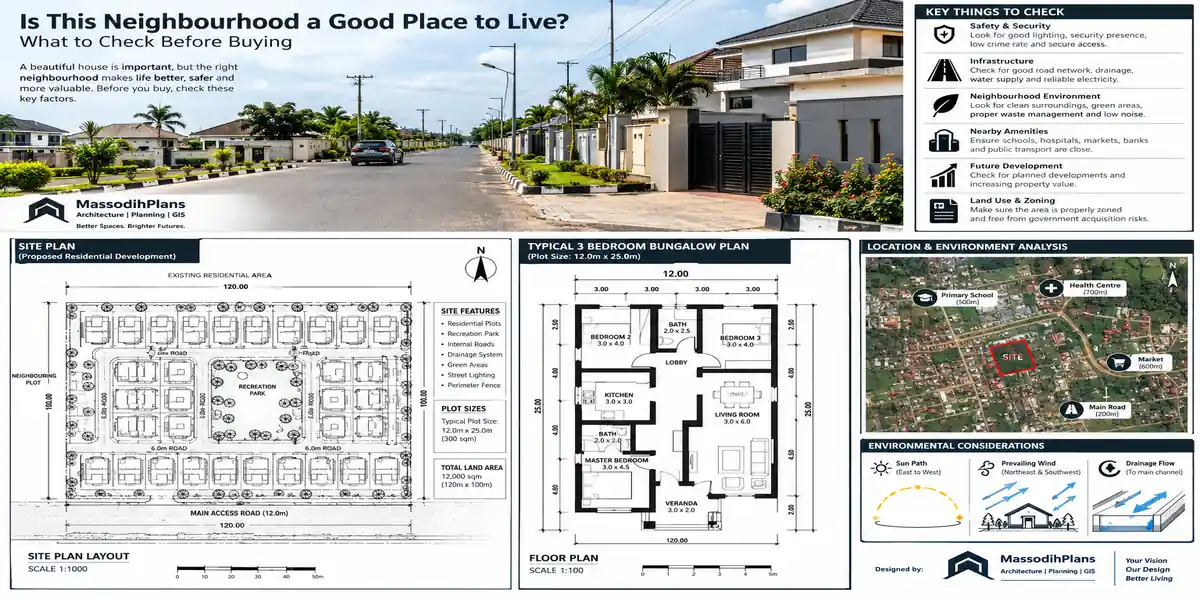
Is This Neighbourhood a Good Place to Live? What to Check Before Buying
A client called me two years ago, excited. He had just paid for a plot in an “up and coming” area, and he wanted me to start drawing his house plan the following week. I asked him one question before I touched AutoCAD: “Have you been to that plot when it’s raining?” Silence. He hadn’t. Three weeks later, after a downtown pour, he sent me a video of that same plot under almost a foot of water.
That phone call is the reason this article exists. Not because I read somewhere that flooding matters, but because I have sat with a grown man staring at video footage of his own future compound turned into a small lake, wondering whether to still build there or cut his losses and start over.
So this isn’t a checklist copied from a real estate blog. This is the actual conversation I have with clients, students, and friends before anyone commits money to a plot or a house plan. If you’re asking “is this neighbourhood good?” you’re asking the right question, just maybe not asking it in enough directions yet.
Security: What to Actually Check, Not What People Tell You
Everyone will tell you an area is “peaceful.” Peaceful compared to what, since when, and according to who?
Here’s what actually tells you something:
Fence height and gate style on existing houses. If every compound around has 8-feet fences with barbed wire or electric wire on top, that’s not decoration that’s the residents telling you, with concrete and wire, what they’ve experienced.
Street lighting after dark. Drive through at 9pm, not 9am. An area that looks calm at noon and goes pitch black with no light at night is a different place after sundown, and that’s when most break-ins happen.
Police presence and response distance, not just “is there a station in the area” but how far, and whether residents can tell you a police response actually came quickly the last time something happened.
Vigilante or community security arrangement. Ask directly: is there a community security levy, and what does it fund? Areas with an organized, funded local security group behind the official police almost always report fewer incidents than areas relying on police alone.
Talk to at least three different households, not one. One neighbour will tell you it’s fine because nothing has happened to them personally. Three different households give you a pattern.
Schools: Beyond “Is There a School Nearby”
For anyone building a family home, this question isn’t really “is there a school” it’s “will my child’s actual daily life be good here.”
Walking distance vs. driving distance. A school that’s “5 minutes away” by car might be a 40-minute walk with no safe pedestrian path, which matters if you ever want your child walking or if fuel and driver costs become a factor.
School quality tiers around you, not just proximity. Some neighbourhoods have schools nearby that aren’t ones you’d actually enroll your child in check the reputation, not just the location pin.
Traffic pattern at school drop-off and pick-up times. An area that’s calm all day can become gridlocked for 45 minutes twice daily right around your own street, which affects your commute whether or not you have kids in that school.
Roads: The Difference Between “There’s a Road” and “The Road Works”
A tarred road on Google Maps tells you almost nothing about what that road is actually like to use.
Check the road in both dry and wet season if you can. A road that’s perfectly smooth in January can be a chain of potholes and standing water in August. If you can’t check both seasons yourself, ask a resident directly what the road is like during the rains.
Width and passing space. Can two cars pass each other comfortably, or does every meeting require someone reversing? This becomes a daily frustration that photos never show you.
Who maintains it. Government roads sometimes get forgotten for years. Private estate roads are maintained (or not) by the estate association. Knowing which one you’re dealing with tells you who to actually hold responsible when it deteriorates.
Access road width relative to what you plan to build. If you’re planning a duplex that will eventually need delivery trucks, moving vans, or even a fire service vehicle to reach it in an emergency, check that the access road can actually take that width this is a real safety consideration, not just a comfort one.
Transport: What Your Actual Daily Commute Will Look Like
This is separate from roads, because a road can be perfectly fine and transport to it can still be terrible.
What actually moves through this area private cars only, commercial buses, tricycles (keke), okada? Some areas have almost no public transport, which is fine if you drive but a real problem if household members rely on public transport, including domestic staff or extended family who visit regularly.
Time to your actual workplace at actual rush hour, tested at the real time you’d be traveling, not a random midday drive that gives you a falsely fast number.
Fuel/transport cost reality if the area is far from major routes. A cheap plot two hours from your workplace can cost more in fuel and time over five years than a pricier plot closer in.
Flooding: The One Most People Only Check Once
I don’t need to convince you flooding matters Nigeria’s own hydrological agency projected over 14,000 communities at high flood risk in 2026 alone, across most states in the country, with major cities including Lagos, Abuja, and Port Harcourt specifically flagged for severe urban flooding risk. That’s not a rare event you can gamble against. That’s an annual pattern.
What people get wrong is checking this once, on a dry day, and calling it done.
Visit during or right after heavy rain, not just on a clear day. If you genuinely cannot, ask several different residents not one what happens to that specific street when it rains hard, and how long the water takes to clear.
Check the land’s position relative to its surroundings. Land that sits lower than the surrounding plots or the road will collect water from everywhere around it, no matter how well you build.
Ask about drainage channels nearby are they open, are they maintained, are they blocked with refuse? A blocked drain a hundred metres away can flood your compound even if your own plot is well-planned.
Understand that rapid, unplanned development is actively making this worse, not better, in many Nigerian cities wetlands and natural water-absorbing land are being built over faster than drainage infrastructure is being expanded, which is part of why flood patterns keep worsening in areas that weren’t traditionally flood-prone.
Never rely on a dry-season site visit alone to judge flood risk. If you can’t visit during the rains yourself, pay someone local even a site caretaker to send you a video of that exact plot during the next heavy downpour before you commit money to a design.
Noise: The Layer Nobody Mentions Until They’re Already Living There
Noise is deeply personal, but here’s what to actually check rather than guess:
Proximity to places of worship. Beautiful communities, genuinely, but a mosque or church directly beside your fence changes your mornings and evenings in a way you should know about before you build, not after.
Nearby markets, mechanic workshops, or generator-heavy commercial strips. These bring life and convenience but also noise that runs for most of the day.
Main road proximity and traffic volume, especially if the road carries heavy trucks or commercial buses that run early morning and late night.
Existing power supply reliability, because unreliable power means generator noise both yours and your neighbours’ becomes part of your daily soundscape whether you like it or not.
Amenities: What Actually Gets Used Weekly, Not What Looks Good on a Map
Skip the generic “hospitals and malls nearby” checklist and ask about what you’ll actually use:
Distance to a hospital you’d trust in an emergency, not just the nearest clinic. A clinic five minutes away is not the same as a hospital capable of handling a real emergency thirty minutes away.
Market or grocery access for daily needs, and whether prices there run noticeably higher because of the area’s reputation (a common, quiet cost of living in “prestigious” neighbourhoods).
Fuel stations, especially during fuel scarcity periods, since some areas have reliable stations and others force a long drive during shortages.
Recreational space somewhere to walk, somewhere for children to play outside, isn’t a luxury add-on; it measurably affects daily quality of life over years, not just moving-in day.
Future Development: Reading Where an Area Is Actually Headed
This is where most people either get lucky or get badly burned, because it requires looking forward, not just at what exists today.
Check the area’s zoning classification and any published master plan with the state or local planning authority this tells you what’s officially allowed to be built around you, not just what’s there now.
Look for early signs of infrastructure investment new road construction, drainage expansion, power infrastructure upgrades. These usually predict property value growth years before it becomes obvious.
Look for early signs of the opposite unregulated informal settlement growth, encroachment onto drainage channels or road reserves, signs that planning enforcement isn’t active in the area. These predict declining livability even in areas that look fine today.
Ask about any pending government projects road widening, drainage works, or even government acquisition that could affect the specific plot, not just the general area. Some plots sit inside government-acquired land that residents have simply been occupying without formal regularization, which is a serious future risk.
Property Values: Reading the Real Signal, Not the Asking Price
Asking price tells you what a seller wants. It doesn’t tell you what’s actually happening in an area.
Compare recent actual sale prices, not listing prices, if you can get them from more than one source agents, community land committees, or even direct neighbours who’ve sold recently.
Check how long properties typically stay on the market in that area. Fast turnover suggests real demand; properties sitting unsold for years suggest the market has quietly cooled, whatever the listing price still says.
Understand what’s actually driving value in that specific area is it genuine infrastructure and demand growth, or speculative buying that could reverse once the hype settles? These look identical on a price chart in year one and very different by year five.
The Layers Almost Nobody Else Puts in This Kind of Article
Everything above is the standard list. Here’s what I add, because I’ve watched these bite people who checked everything else and still got caught.
Land Tenure and Title Type
This is, arguably, more important than every point above combined, and it’s almost never mentioned in “is this neighbourhood good” content. An area can have great roads, great schools, low flood risk, and still be sitting on land with unresolved title disputes, family land without proper documentation, or land under government acquisition that hasn’t been released. Confirm the actual title type Certificate of Occupancy, Excision, Gazette, or raw family land and verify it at the land registry yourself, or through a lawyer, not just by trusting what the seller or agent tells you.
Soil and Ground Condition
Two plots on the same street can have completely different soil behaviour — one firm, one sandy or waterlogged underneath. This directly affects your foundation type and cost, and it’s a separate question from surface flooding. A soil test on your specific plot, not a general assumption about the “area,” is the only way to actually know.
Power Supply Reliability, Specifically
Not “is there electricity” how many hours a day, realistically, across different seasons, and how many households nearby run generators as their actual primary power source rather than a backup. This affects both your daily comfort and your long-term running costs, especially if you’re planning any electrical-heavy setup like a borehole pump or air conditioning.
The Landlord-to-Resident Ratio and Community Culture
An area dominated by long-term resident-owners tends to have stronger informal security, cleaner shared spaces, and a genuine community structure. An area dominated by short-term tenants and absentee landlords tends to have weaker community accountability, even where the physical infrastructure looks similar. Ask around, or simply notice how many houses look actively lived-in and maintained versus locked up and neglected.
Waste Management Reality
Does refuse actually get collected on a schedule, or does the area rely on informal dumping that eventually finds its way into drains directly feeding back into the flooding problem above? This is rarely mentioned anywhere, and it quietly affects both livability and flood risk simultaneously.
Emergency Access
If something goes seriously wrong a fire, a medical emergency can an ambulance or fire service vehicle actually reach your specific plot, given the road width, gate position, and any barriers along the route? This is a genuine safety question, not paranoia, and it directly affects the site layout decisions your architect needs to make.
The Part That Actually Matters Most: Turning What You Found Into a House Plan Decision
Here’s the honest truth nobody tells you: a neighbourhood assessment is useless if it just becomes a list of worries in your head. Everything you find above should directly change what you build, not just whether you build there. This is the part I actually get asked about most, and it’s the part missing from literally every “good neighbourhood” article I’ve ever read.
If the area has real flood risk
Don’t default to a standard ground-floor bungalow with a low plinth. Raise your floor level above the surrounding ground, avoid basements entirely, position your septic system carefully relative to the water table, and design your compound to include some permeable, unpaved ground rather than covering everything in concrete or interlocking stone, which only pushes water somewhere else.
If security is a genuine concern
Your house plan needs a controlled single point of entry, a gatehouse or porter’s position with sightlines to the gate, minimal blind spots along the perimeter fence, and window placement on ground-floor rooms that doesn’t create easy access points. This is a layout decision made at the drawing stage, not something you bolt on with more wire after the house is built.
If the road is noisy or the plot faces a busy street
Orient bedrooms toward the quieter side of the plot, use the noisier street-facing side for less sensitive spaces like a garage, store, or sitting room, and consider a solid boundary wall rather than an open fence to buffer sound.
If power supply is unreliable
Plan your electrical wiring and conduiting from day one to accommodate an inverter or solar system later, even if you can’t afford it immediately. Retrofitting this into finished walls is far more disruptive and expensive than building it in from the start.
If the plot is small or land is expensive because the area is developed and in demand
Build up, not out. A well-planned two-storey design gets you the room count you need on a smaller footprint, protecting more of your compound for parking, a small garden, or future expansion.
If the area is genuinely early-stage and still developing
Design with future flexibility in mind. A layout that allows a room to be added later, or a floor to be added on top when your foundation is designed to carry it, protects your investment as the area (and your family’s needs) grow.
If land tenure is uncertain or you’re on family land without full documentation
This affects how much permanent, heavy investment makes sense right now. In genuinely uncertain-title situations, a simpler, less capital-intensive design until the title is fully resolved is often the wiser move than committing to your dream house on land whose ownership isn’t yet airtight.
This is the actual answer to “I don’t know what house plan to build.” You don’t choose a house plan from a catalogue of pretty designs first. You read your specific plot and neighbourhood honestly, on every layer above, and then you choose or ask your architect to adapt a plan that responds to what you actually found. A gorgeous plan built blind to its site is a liability. A modest plan built in genuine response to its site is a home that actually works for years.
Bring your neighbourhood findings to your architect before the first drawing, not after. Tell them plainly: this area floods, this area is quiet at night but busy by day, this plot faces a noisy road, power here is unreliable. A good architect designs around these facts. A plan bought off a template online has no idea any of this exists.
How to Actually Go and Check All This (Not Just Read About It)
- Visit at three different times: morning rush, midday quiet, and evening/night.
- Visit at least once during or right after heavy rain, or get someone local to send you footage.
- Talk to at least three separate households who already live there, not one agent and not one neighbour.
- Check the land title at the relevant land registry directly, not just from documents the seller hands you.
- Ask your local planning authority about the area’s zoning and any pending development or acquisition affecting the specific plot.
- Get a soil test done on your actual plot before finalizing foundation design, regardless of what “everyone says” about the area’s soil.
Frequently Asked Questions
What is the single most important thing to check before building in a new area?
Land title and tenure. An area can pass every livability check and still be a serious risk if the title itself isn’t clean this is the one issue that can cost you the entire investment, not just comfort or convenience.
How do I check flood risk if I can’t visit during the rainy season myself?
Ask multiple long-term residents directly, check the plot’s ground level relative to its surroundings, and if possible, arrange for someone local to send you video during the next heavy rain before you commit.
Should I still build in an area with known flood risk if the land is otherwise perfect?
It’s possible, but it changes your foundation type, floor level, and site drainage design significantly, and those changes cost more. Go in with that cost expectation from the start rather than discovering it mid-construction.
Does a “good neighbourhood” today guarantee good property value later?
No. Future development direction infrastructure investment versus unregulated growth matters more for long-term value than current conditions alone, which is why the future-development check matters as much as the present-day checklist.
How does all this actually change my house plan?
Directly flood risk changes your floor level and foundation, security concerns change your layout and entry points, noise changes your room orientation, unreliable power changes your electrical planning, and land tenure uncertainty changes how much permanent investment makes sense right now. Your house plan should be a direct response to what your neighbourhood assessment actually found, not a design chosen independently of it.
Final Word
I’ve sat with too many clients after the fact after the flood, after the break-in, after the drawn-out title dispute wishing they’d asked these questions before, not after. None of this is complicated. It just takes actually going there, at the right times, and asking the right people the right questions. Do that, and the house plan question answers itself, because by then you’ll know exactly what your specific plot needs you to build.
If you already know your plot and its realities, browse our Plans Library for designs that can be adapted to your specific site conditions, or visit Plan School to understand how site factors actually shape a good floor plan. If you want direct guidance walking through your own plot’s assessment before you commit to a design, our Services page outlines how we work with clients from site visit through to approved drawings. You can also explore more site-selection and building guides on our Homepage.
Read these related posts to complete this lesson
- I Don’t Know Which Location to Buy In: How to Choose the Best Location
- I Don’t Know What Type of Property I Should Buy: Here’s How to Actually Decide
- Can’t Find a Property Within Your Budget? Here’s the Part Nobody’s Telling You
- I Don’t Know Where to Find the Right Property in Nigeria | Buyer Guide
- I Need a Real Estate Agent to Help Me Buy a Property in Nigeria Safely
- Property for Sale in Nigeria: The Buyer’s Guide Nobody Publishes Today
- How Do I Get Natural Ventilation? Best Ways to Improve Airflow at Home
- Where Should My House Face? Best Direction for Sun, Wind and Comfort
- I Can’t Understand or Visualize My Floor Plan — Let’s Fix That Right Now
- My Floor Plan Has Poor Circulation: How to Fix It and Improve Flow
- I Don’t Know How to Arrange My Rooms: Here’s How to Actually Figure It Out
- My Rooms Are Too Small: How Big Should Each Room Be in a House?
- I Don’t Know How Big Each Room Should Be: Standard Room Size Guide
- How Much Building Can I Put on My Plot? Building Coverage and Setbacks
- My House Plan Doesn’t Fit My Land: What to Do Before You Build
- I Need a House Plan That Fits My Plot with Exact Dimensions and Layout
- I Don’t Know What House Plan to Build? Here’s How to Decide
Author
Massodih Okon is a Nigerian built-environment professional with academic and professional experience in urban and regional planning, geography, architectural design, Landscape Design, GIS and land development.
He holds a Master’s degree in Urban and Regional Planning from the University of Uyo and a first degree in Geography and Regional Planning.
Through MassodihPlans, he publishes practical guides on Nigerian house plans, building design, physical planning, site planning, development approval and residential construction. Read the full author profile →