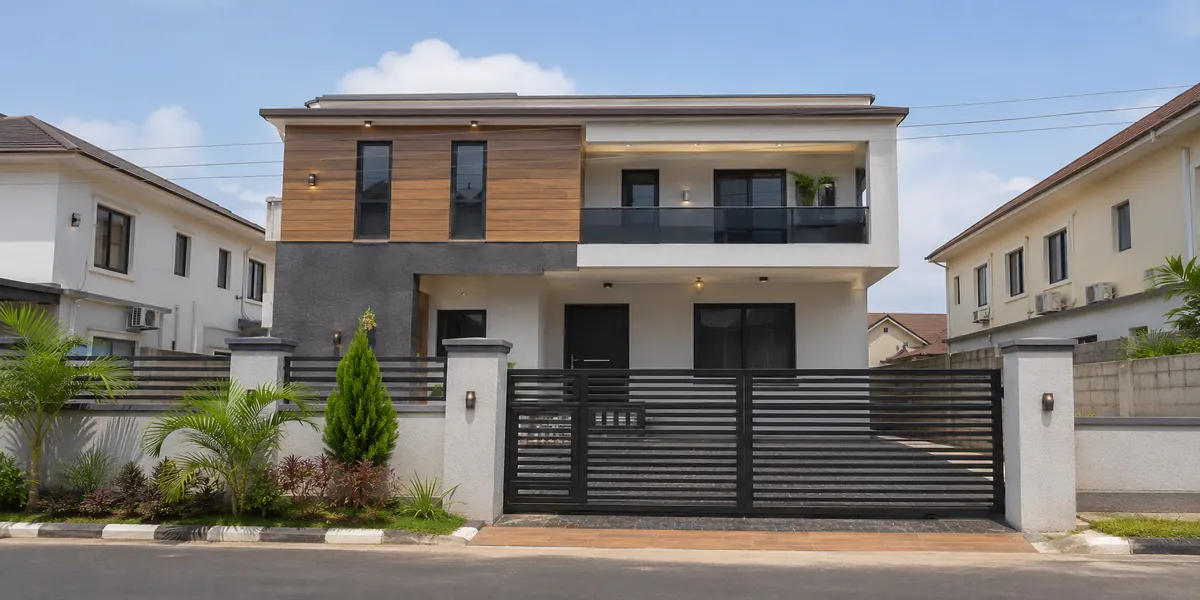
Best Nigerian Duplex Designs for 40×80 Plots
You Have a 40×80 Plot. Here Are the Duplex Designs That Actually Work in Nigeria
A 40×80 plot is not a small plot. But it is not a generous one either.
At 3,200 square feet of land, roughly 297 square metres, this plot size is what most middle-income Nigerians are working with in fast-growing towns like Uyo, Owerri, Ilorin, Enugu, and even parts of Abuja’s satellite towns. People buy it, fence it, and then wonder: “Is this land big enough for a duplex?”
The answer is yes. But only if you plan it correctly.
I have reviewed dozens of duplex designs that were squeezed onto 40×80 plots across Nigeria, and what I keep finding is the same pattern: people build without thinking about setbacks, they ignore ventilation, they forget about parking, and they end up with a beautiful-looking house that is actually uncomfortable to live in.
This article is for you if you have a 40×80 plot and you are serious about building a duplex that works not just one that looks good in a photo.
Let me show you the best layout options, what each one costs, how to position your building, and what you must never do on a plot this size.
Understanding Your 40×80 Plot Before You Design Anything
Before you pick a floor plan, you need to understand what a 40×80 plot actually gives you after regulation setbacks.
In most Nigerian states, building regulations require:
- Front setback: 3 metres to 6 metres (depending on the local authority and road classification)
- Rear setback: 3 metres minimum
- Side setbacks: 1.5 metres on each side
Let me show you what that means in real numbers.
If your plot is 40 feet wide by 80 feet deep (about 12.2 metres by 24.4 metres), after applying a conservative 3-metre front setback, 3-metre rear setback, and 1.5 metres on each side, your buildable footprint becomes approximately:
- Width available: 12.2m minus 3m = 9.2 metres
- Depth available: 24.4m minus 6m = 18.4 metres
That gives you a buildable area of roughly 169 square metres per floor.
That is actually quite comfortable for a well-designed duplex. The challenge is not the space, it is how you use it.
Expert Note: Many people in Nigeria confuse a 40×80 plot measured in feet with one measured in metres. Always confirm with your surveyor whether your Certificate of Occupancy measurements are in feet or metres. A 40×80 plot in metres is almost four times larger than a 40×80 plot in feet. This guide primarily addresses the smaller variant, 40 feet by 80 feet, which is the more common residential allocation.
The 3 Best Duplex Designs for a 40×80 Plot
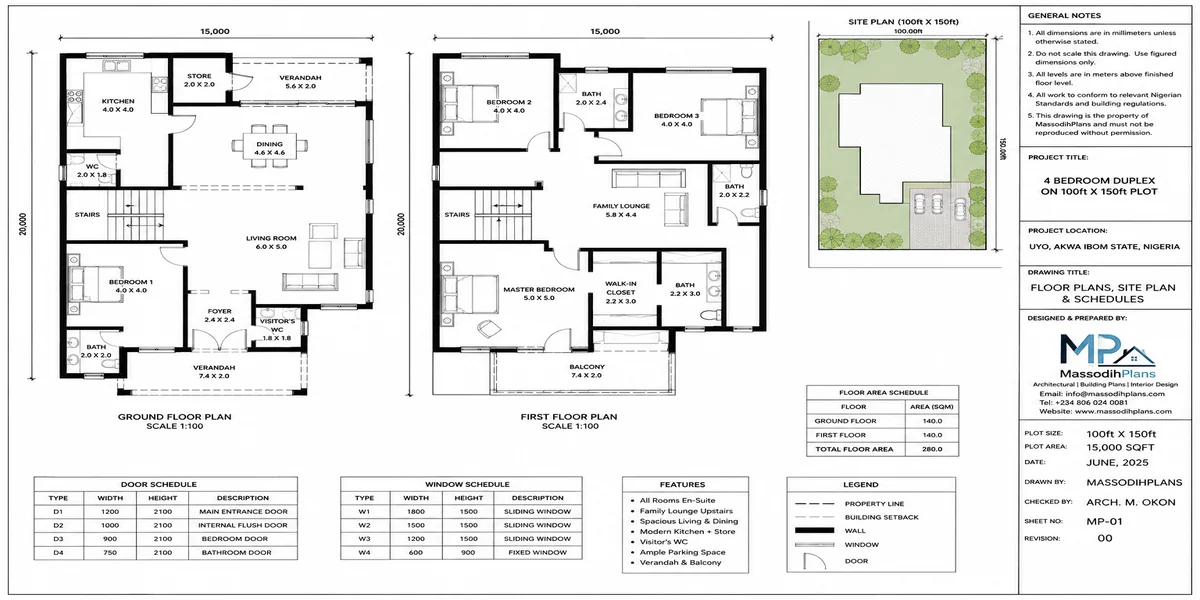
Design Option 1: The Compact 3+3 Duplex (Three Bedrooms Per Floor)
This is the most popular and practical choice for a 40×80 plot.
What “3+3” means: Three bedrooms on the ground floor for the owner’s family, three bedrooms on the first floor for a tenant or extended family. Both units have their own sitting room, dining area, kitchen, toilets, and bathroom.
Ground Floor Layout:
- Entrance porch
- Sitting room (living area): 4.5m x 5m
- Dining area: 3m x 3.5m (open to kitchen)
- Kitchen: 3m x 3.5m with back door exit
- Master bedroom with en-suite: 3.5m x 4m
- Bedroom 2: 3m x 3.5m
- Bedroom 3: 3m x 3.5m (can serve as study or children’s room)
- Common toilet and bathroom
- Staircase positioned toward the back or side to preserve living space
First Floor Layout:
- Separate landing/lobby for tenant privacy
- Sitting room: 4m x 5m
- Kitchen: 2.8m x 3m
- Master bedroom with en-suite: 3.5m x 3.8m
- Bedroom 2: 3m x 3.5m
- Bedroom 3: 3m x 3.2m
- Common bathroom
- Balcony at front: 1.5m x 4m
Total built-up area: Approximately 280 to 320 square metres (both floors combined, excluding roof overhang)
Who this suits: This design works best for a family of four to five who wants rental income from the top floor. In cities like Uyo, Port Harcourt, and Enugu, a well-finished 3-bedroom top-floor apartment on a fenced compound earns between ₦400,000 and ₦900,000 per year depending on the estate and finishing quality.
Design Option 2: The 4+3 Duplex (Larger Ground Floor, Compact First Floor)
This design gives the owner more space downstairs while keeping the top unit comfortable enough for rental.
Ground Floor Layout:
- Entrance foyer with formal sitting area
- Family lounge (informal sitting area at the back): 3m x 4m
- Dining: 3.5m x 3.5m
- Kitchen: 3.5m x 4m with pantry or store
- Master bedroom with en-suite and wardrobe: 4m x 4.5m
- Bedroom 2: 3.5m x 3.5m
- Bedroom 3: 3m x 3.5m
- Bedroom 4: 3m x 3m (guest room or home office)
- Common bathroom and toilet
- Maid’s room or boys’ quarters (BQ) access from kitchen, though this usually requires extending to a detached structure given the setback constraints
First Floor Layout:
- 3-bedroom apartment as in Option 1 but slightly more compact
- Emphasis on privacy and natural light through cross-ventilation windows
Who this suits: Families who plan to live long-term on the ground floor and want the flexibility of the 4th room as a home office, prayer room, or mother-in-law suite. This design is also popular with civil servants in Abuja satellite towns who need the extra room for a study.
Note on the 40×80 constraint: Four bedrooms on a ground floor that is only 9.2 metres wide is tight. You will likely need to sacrifice a formal dining area or reduce corridor widths. A good architect will find the balance — but do not attempt this without professional drawings.
Design Option 3: The Semi-Detached Twin Duplex (Two Mirror-Image Units Side by Side)
This is for the investor who wants to build two complete duplex units on one 40×80 plot and sell or rent both.
Here is the honest truth: a full side-by-side semi-detached duplex on a 40×80 plot in feet is extremely tight. Each unit would be roughly 4 metres wide after accounting for the shared wall and setbacks, which is below comfortable residential standards.
My recommendation: Use this option only if your 40×80 plot is measured in metres. If it is in feet, go with Option 1 or Option 2. Trying to force two duplex units into a plot this size in feet will give you narrow rooms, poor ventilation, and a building that nobody will want to buy or rent at full value.
That said, if your plot is 40×80 in metres (approximately 131 feet by 262 feet), a twin duplex design becomes very viable and can generate strong rental income in urban Nigerian markets.
See our duplex designs for narrow plots for more on managing tight width constraints.
Room-by-Room Analysis: What Every Space Needs
The Sitting Room
On a 40×80 plot, your sitting room should not be less than 4 metres by 5 metres. Anything smaller starts to feel like a box once you add a sofa set, a centre table, and a TV console.
Position the sitting room to face east or north where possible. In Nigerian cities, east-facing sitting rooms catch the morning breeze and avoid the brutal afternoon sun that cooks west-facing rooms.
The Kitchen
Nigerian cooking is not gentle. Egusi soup, ofe onugbu, okoho soup, these produce real smoke and heat. Your kitchen needs:
- A window above the sink that opens outward
- A back door that leads to the rear yard (not just a window)
- At least one louvre window on a different wall from the cooking window, this creates cross-ventilation that pulls smoke out rather than letting it circulate
Avoid fully enclosed kitchens on a 40×80 plot. I have seen houses where the kitchen has only one small window, and the ceiling turns brown in two years from grease and smoke. Not just unsightly, it is a health issue.
The Master Bedroom
3.5 metres by 4 metres is the minimum for a master bedroom that can comfortably fit a standard bed, two side tables, a wardrobe, and a dressing table. Anything below 3.2m wide feels cramped once furniture is in.
Your master bedroom en-suite should have:
- A water closet (WC)
- A shower or bathtub
- A hand basin
- A window that opens not just a louvre slit at ceiling level
Secondary Bedrooms
3 metres by 3.5 metres is acceptable for a secondary bedroom for two children. If you plan to rent out rooms, 3m x 3.5m will feel tight to most tenants, especially if there is only a shared bathroom.
The Staircase
This is where many builders make expensive mistakes on 40×80 plots.
Your staircase should:
- Be at least 1 metre wide (1.2 metres is more comfortable)
- Have a consistent rise height of 17cm to 19cm
- Not be positioned in the middle of the building where it eats the best circulation space
- Be positioned at the back of the ground floor if the owner wants maximum front living space, or to the side if you want each floor to have full-depth rooms
A staircase that is too steep (rise above 22cm) will be difficult for elderly people and young children. I have seen contractors in Uyo build staircases so steep that an elderly grandparent cannot climb them safely. This is avoidable with simple planning.
Ventilation Strategy for Nigerian Climate
Nigeria sits between the equator and the Tropic of Cancer. Most Nigerian cities experience:
- High humidity for six to eight months of the year
- Temperatures between 25°C and 38°C for most of the year
- Harmattan dust from November to February in the north and parts of the south
On a 40×80 plot, your ventilation strategy must work even when electricity fails because NEPA will fail.
Key ventilation principles for your duplex:
- Prevailing wind direction matters. In most southern Nigerian cities (Lagos, Port Harcourt, Uyo, Calabar), the prevailing wind comes from the southwest. Orient your main windows and openings to face southwest for maximum natural airflow.
- Cross-ventilation is not optional. Every room must have at least two openings on different walls. A room with one window and one door does not have cross-ventilation it has stagnant air. On a 40×80 plot, you achieve this by avoiding flush rear walls. Leave a slight offset or step in your floor plan so interior rooms can get a window on a side wall.
- High-level openings help. Louvre windows positioned near the ceiling (not the floor) allow hot air to escape upward. Hot air rises. If you give it a way out near the top of the room, your room stays cooler by about 3°C to 5°C compared to rooms with only mid-height windows.
- Use a hip roof, not a flat slab. A pitched roof creates an air gap between the ceiling and the roof covering. This trapped air acts as insulation. A flat concrete slab roof transmits heat directly into the top-floor rooms, making them unbearably hot without air conditioning.
See more on roof types in our guide to roofing options for Nigerian houses.
Roofing Options for a 40×80 Duplex
The most common roof types for duplexes on 40×80 plots in Nigeria are:
Hip Roof (Recommended) A hip roof slopes on all four sides. It handles wind from any direction, sheds rainwater efficiently, and provides good overhead insulation. It looks clean and modern on a duplex. The main cost is the additional complexity of the rafter system, but this is manageable.
Gable Roof A gable roof has two sloping sides and two vertical (gable) ends. It is cheaper to build than a hip roof and allows good attic ventilation through gable vents. The risk in Nigeria: exposed gable ends are vulnerable to strong winds during storms, particularly in coastal cities.
Flat Roof with Parapet Some modern Nigerian duplexes use a flat concrete roof slab, often with a parapet (raised wall) at the perimeter for aesthetics. This is popular in Abuja for a contemporary look. The problem: flat roofs absorb and retain heat, making top-floor rooms hot. If you go this route, install a suspended ceiling with air gap and good insulation.
My recommendation for a 40×80 duplex: Hip roof with aluminium long-span sheets or stone-coated steel tiles. It manages heat, survives storms, and does not require the constant maintenance that asbestos or ordinary corrugated iron sheets do. Stone-coated steel tiles also add to the resale value of the property.
Parking on a 40×80 Plot
After setbacks, your 9.2-metre-wide buildable area leaves roughly 2.5 to 3 metres on one side of the building if your main structure is 6 to 7 metres wide.
Realistic parking options:
- One car in front of the building (between the gate and the front entrance) minimum 2.4m wide by 5m deep
- A carport to one side of the building if you leave 3+ metres on that side
- Double car parking requires at least 5 metres of clear width in your front setback area
If you plan to have two units (owner + tenant), plan for at least two parking spaces from the beginning. A 40×80 plot can accommodate this, but only if you design for it. Many people discover after construction that two cars cannot both park inside the compound because no one planned for it.
See our compound arrangement guide for Nigerian homes for more on this.
Cost Estimate for a 40×80 Duplex in Nigeria (2024 to 2025)
Material prices in Nigeria have shifted dramatically since 2022. What cost ₦30 million to build in 2021 now costs ₦80 million to ₦120 million or more depending on your state and finishing level.
Here is a realistic cost framework for a 3+3 duplex on a 40×80 plot with mid-range finishing:
| Item | Estimated Cost Range |
|---|---|
| Foundation (strip or raft) | ₦3.5m to ₦7m |
| Block work and lintel | ₦5m to ₦9m |
| Roofing (hip roof, aluminium long-span) | ₦4m to ₦8m |
| Electrical installation (wiring + fittings) | ₦2.5m to ₦5m |
| Plumbing (pipes + fittings + WC + sinks) | ₦2m to ₦4m |
| Plastering and screeding | ₦3m to ₦5m |
| Tiles (floor and wall) | ₦3m to ₦8m |
| Doors and windows (aluminium or casement) | ₦3m to ₦6m |
| Painting and finishes | ₦2m to ₦4m |
| Gate, fence, and compound paving | ₦2.5m to ₦5m |
| Septic tank and soakaway | ₦400k to ₦900k |
| Borehole and overhead tank | ₦600k to ₦1.5m |
| Contingency (materials price fluctuation) | 10 to 15% of total |
| Estimated Total (mid-range) | ₦37m to ₦70m+ |
These are honest estimates. Anyone who tells you a well-built Nigerian duplex costs ₦15 million in 2025 is either talking about a very small structure, very poor-quality materials, or has not priced materials recently.
Important: Labour costs vary significantly by state. Labour in Lagos and Abuja is typically 30% to 50% higher than in Uyo or Kogi. Factor this into your budget planning.
For a city-specific breakdown, read our construction cost guide or our Port Harcourt building cost guide.
Nigerian Reality Layer: What Most Architects Do Not Discuss
Generator Room
You will use a generator. This is not pessimism, it is Nigerian reality.
Plan a dedicated generator room or covered space at the rear of the compound, not beside your bedroom window. The generator should be:
- At least 5 metres from any sleeping room window
- In a ventilated enclosure to reduce noise transmission into the building
- Positioned close to where your main electrical panel is located
If you do not plan for this from the beginning, your generator ends up parked in the walkway, running under the staircase, or positioned where it pushes fumes into your kitchen. I have seen all three.
Borehole Placement
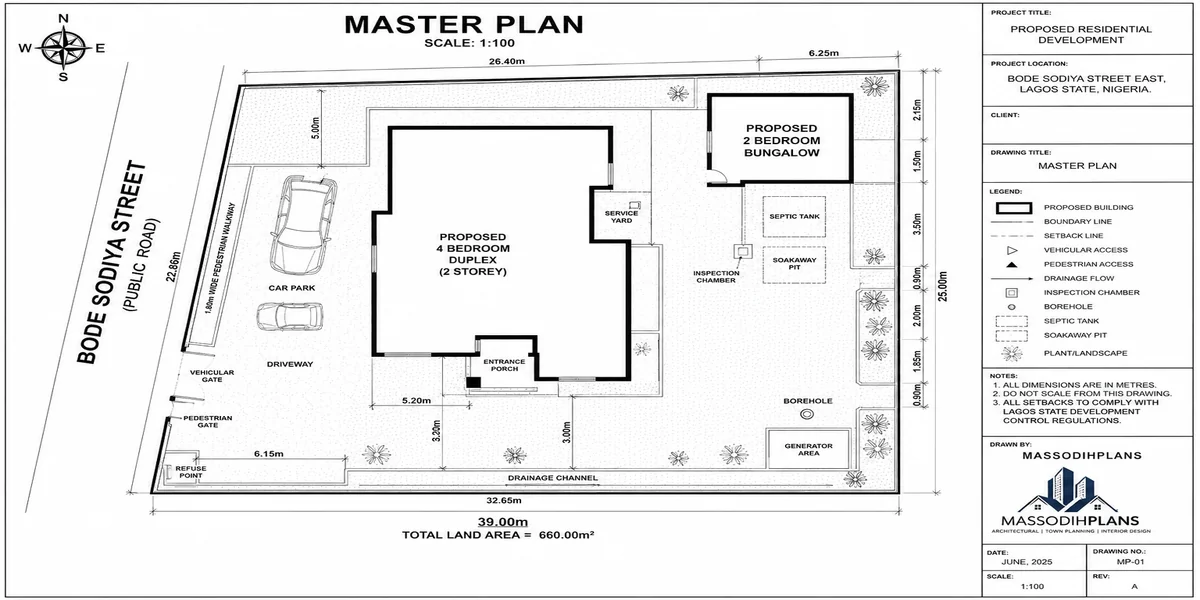
Your borehole should not be within 15 metres of your septic tank or soakaway pit. On a 40×80 plot, this means you need to plan the positions of both the borehole and the septic tank before construction begins — not after.
The typical arrangement:
- Borehole at the front corner of the compound (away from the septic tank)
- Septic tank at the rear of the compound, offset from the borehole
If you place your septic tank first without planning for the borehole, you may find that there is no viable location for the borehole that meets the 15-metre separation rule. In that case, you will be buying water in jerricans indefinitely.
Drainage
Flooding is a real threat in many Nigerian cities. Uyo, Port Harcourt, Lagos, Warri these cities flood seasonally. On a 40×80 plot, drainage design is not optional.
- Your floor level should be at least 600mm above the adjacent road level
- The compound should slope gently toward the gate (front), so rainwater exits through the drainage channel at the street not backward toward the building
- Soakaways must be sized for your plot size and soil type. Sandy soils absorb faster; clay soils may require larger soakaway chambers or French drains
If the land you purchased is in a flood-prone area, investigate before you build, not after. Read our site analysis guide before building in Nigeria for a detailed checklist.
Security Features
Compound security on a 40×80 plot should include:
- A perimeter fence of at least 2 metres in height (2.4 metres in higher-risk areas)
- Electric fence top or razor wire if the area requires it
- Gate with intercom or visibility for the owner before opening
- Security light at the gate and at all corners of the building
- The front door should not face the gate directly a slight visual offset at the entrance protects interior privacy when the gate is open
A gatehouse (security post) is feasible on a 40×80 plot if your setback allows it, but only as a small single-room structure near the gate. Do not build a full boys’ quarters in the gate area it eats into parking and compound movement space.
Small Plot Optimization: How to Make Every Metre Count
On a 40×80 plot, you cannot afford wasted space. Here is how good design maximizes the available area:
Open-plan ground floor living area. Instead of a separate formal sitting room, dining room, and family lounge, consider an open-plan arrangement that combines the sitting and dining areas under one flowing space. This makes the ground floor feel larger and improves air circulation.
Built-in wardrobes. Free-standing wardrobes eat room space. Designing built-in wardrobe recesses into the bedroom walls recovers 40 to 60cm of floor space per bedroom which makes a real difference in rooms that are already 3 to 3.5 metres wide.
Under-stair storage. The space beneath your staircase should not be wasted. On a 40×80 duplex, this area can become a store, a WC, or a utility room. A 1-metre wide staircase with a moderate rise gives you roughly 4 to 6 square metres of under-stair space.
Mezzanine landing as functional space. Rather than a bare landing at the top of the stairs, design a landing that doubles as a reading corner, home office nook, or small study area. You can fit a desk and shelving in 2 square metres without affecting the upstairs circulation.
Common Building Mistakes to Avoid on a 40×80 Plot
These are the mistakes I see most often on site visits and building consultations:
1. Building right to the setback boundary without confirming the actual setback. Setback requirements vary between states, LGAs, and street types. A building on a federal road has different setback requirements than one on a residential estate road. Confirm with your state’s Urban Development Board or Ministry of Physical Planning before laying foundation.
2. Making the staircase an afterthought. I have reviewed plans where the staircase was squeezed into a corner after all the rooms were arranged, resulting in a staircase that is 750mm wide with a 23cm rise. This is dangerous and will be flagged during building inspection.
3. No cross-ventilation in bathrooms. A bathroom with a WC and no window (only an exhaust fan) is a Code-minimum bathroom. In a country with unreliable electricity, an exhaust fan that does not work is just decoration. Give every bathroom at least one openable louvre window.
4. Ignoring the septic tank and soakaway layout until the last phase. By the time you lay foundation and begin block work, the positions of underground structures should already be established. Moving a septic tank after block work has started costs time and money.
5. Positioning the master bedroom at the front of the building. A master bedroom that faces the street has security and noise problems. In a Nigerian context, you want your master bedroom at the rear or side, away from street noise and curious passersby.
6. Not accounting for future solar panels. The roof area of a 40×80 duplex is limited. If you think you may install solar panels in the future (and electricity costs in Nigeria make this a near-certainty), plan your roof orientation and structural load capacity for this from the beginning.
See our house plan mistakes guide for Nigeria for a more detailed breakdown.
Investment Value of a 40×80 Duplex in Nigerian Real Estate
A duplex on a 40×80 plot in a decent Nigerian city neighbourhood is among the most practical real estate investments available to the average Nigerian professional. Here is why:
Rental income. In most tier-2 cities (Uyo, Enugu, Owerri, Ilorin), a well-finished 3-bedroom first-floor apartment rents for ₦400,000 to ₦900,000 per year. In Port Harcourt and Lagos, this figure can go significantly higher. Over 10 years, the ground-floor owner essentially lives for free while the tenant pays down a significant portion of the construction cost.
Resale value. A completed duplex in a fenced compound on a C of O land in any growing Nigerian city appreciates between 12% and 25% annually when you factor in land value appreciation. Duplexes also attract more serious buyers than bungalows because of the rental income potential.
Estate suitability. Developers building housing estates across Nigeria increasingly favour the duplex typology because it allows two revenue-generating units per plot. If you ever want to sell your developed plot to an estate developer, a duplex design is a more attractive proposition than a bungalow.
Long-term practicality. As your family grows, a duplex on a 40×80 plot gives you options. You can occupy both floors as your family expands, revert one floor to rental when children move out, or convert the first floor into a short-let property in a tourist or commercial city.
Read more on this in our duplex investment guide for Nigerian homeowners.
Orientation, Plot Positioning, and Sun Path
Where you face your building matters more than most people realize.
In Nigeria, the sun moves roughly east to west, with a southward tilt during the harmattan months (November to February) and a northward tilt during the rainy season. The most uncomfortable orientation for a house is west-facing, because the afternoon sun beats directly into west-facing rooms from about 1pm to 6pm the hottest part of the day.
Best orientation for a 40×80 duplex in Nigeria:
- Main living areas (sitting room, dining) facing south or southeast
- Bedrooms facing east or north
- Kitchen and utility areas tolerating west or northwest
On a 40×80 plot, your orientation options depend on which direction your plot faces the road. Most plots face the road on their 40-foot (12.2-metre) side, meaning your building’s front face is determined by the street layout.
If your plot faces north (road is to the north), you are in luck your living room will face north (avoiding the direct afternoon sun) and your building’s rear will face south (getting the most sunlight in the compound, which is useful for drying).
If your plot faces west (road is to the west), consider designing a veranda or deep overhang at the front to shade the sitting room from the afternoon sun.
Balcony Design on a 40×80 Duplex
Balconies serve real functions in Nigerian houses not just aesthetics.
A first-floor balcony of 1.5 metres depth by 3 to 4 metres length gives the upstairs tenant:
- A shaded outdoor sitting area
- Drying space for small items
- Natural ventilation for the adjacent living room
Balconies on 40×80 plots work best at the front of the building. Rear balconies are possible but often end up over a tight service yard.
Design your balcony with:
- A solid parapet wall of at least 1.1 metres height (safety requirement)
- A roof overhang above if the balcony faces west or southwest (rain protection)
- A drain point to prevent balcony flooding that overflows into the ground floor
Material Recommendations for a 40×80 Duplex
Material selection is where most Nigerian self-builders make costly decisions either overspending on imported finishes that add no structural value, or cutting corners on structural materials that cause long-term problems.
Foundation: Use a strip foundation for firm soils or a raft (mat) foundation for soft or waterlogged soils. Do not use a simple pad foundation for a duplex the load distribution does not work safely.
Blocks: Use 9-inch (225mm) sandcrete blocks for ground-floor and first-floor walls. In coastal or high-humidity areas (Lagos, Calabar, Bonny), consider using granite-mix blocks rather than pure sand blocks to reduce moisture absorption.
Roofing: Aluminium long-span roofing sheets remain the best value for money at scale. Stone-coated steel tiles cost more (₦1,200 to ₦2,500 per sheet as of 2024) but are more resistant to hail, wind, and rust. Avoid regular corrugated iron sheets for a duplex they rust, they are noisy in rain, and they reduce the perceived value of your property.
Ceiling: POP (Plaster of Paris) ceiling on a steel grid is the standard choice for a mid-range Nigerian duplex. PVC ceiling panels are cheaper but have a plastic look and can sag over time in humid areas. For a top-floor apartment, a suspended ceiling with a 200mm air gap helps significantly with heat reduction.
Floor tiles: Italian-grade vitrified ceramic floor tiles (600mm x 600mm) in neutral tones work well for a rental duplex because they are durable, easy to clean, and appealing to most tenants. Avoid pure marble or polished porcelain in a rental unit they scratch easily and replacement is expensive.
Read our guide to selecting building materials in Nigeria for more on this.
What Builders Often Get Wrong on This Plot Size
After reviewing construction projects across Akwa Ibom, Rivers, Anambra, and Abuja, these are the site-level mistakes I find most:
Insufficient concrete mix for ring beams. Some contractors water down their concrete to stretch materials. A ring beam poured with a 1:2:4 mix (one part cement, two parts sand, four parts gravel) is fine. Anything weaker in a duplex is a structural risk, particularly in termite-prone zones.
Skipping anti-termite treatment. Termites are serious in many Nigerian states. The foundation base and all wooden elements should receive anti-termite treatment (chemical application to the soil and timber). Skipping this to save ₦50,000 today can cost you ₦3 million in structural repairs in five years.
Rushing the drying time on plastering. Plaster needs to cure fully before painting. Contractors under pressure will paint over wet plaster, which leads to bubbling, flaking paint, and eventual wall dampness. Give plaster a minimum of three weeks before painting.
Under-sizing the overhead tank. For a duplex occupied by two households, you need a minimum of 5,000 litres of overhead storage. I see too many duplexes with a single 1,000-litre tank shared between both floors. The result is constant water shortage.
FAQs
Q: Can I build a 5-bedroom duplex on a 40×80 plot in Nigeria?
Yes, but it requires careful planning. A 5-bedroom duplex on a 40×80 plot typically means 3 bedrooms on the ground floor and 2 upstairs (or the reverse). You will likely need to reduce room sizes slightly or use an open-plan living area to accommodate the additional room. I would recommend consulting with an architect before committing to this, because squeezing in a 5th bedroom often compromises cross-ventilation or creates awkward corridor arrangements.
Q: What is the difference between a 40×80 plot in feet and in metres?
A 40×80 plot in feet equals approximately 12.2m x 24.4m, giving a total land area of about 297 square metres. A 40×80 plot in metres equals 40m x 80m — that is 3,200 square metres, which is a large plot capable of holding multiple buildings. Confirm which unit applies to your C of O before planning.
Q: Is a 40×80 plot enough for a duplex and a boys’ quarters (BQ) in Nigeria?
It depends on your building footprint. If your main duplex structure uses 8 to 9 metres of width, the remaining side and rear space is typically enough for a small single-room BQ at the rear. However, the BQ should not compromise the required setbacks. In many states, ancillary structures like BQs are permitted within the rear setback zone at reduced setback requirements, but check your state’s building regulations to confirm.
Q: How long does it take to build a duplex on a 40×80 plot in Nigeria?
With continuous funding and active supervision, a standard 3+3 duplex takes 12 to 18 months from laying the foundation to completion. Many Nigerian self-builders take 3 to 5 years because funding comes in installments. The building itself does not get worse from waiting but material prices rising while construction pauses can significantly affect your final budget.
Q: Do I need an architect for a 40×80 duplex or can I use a contractor with a sample plan?
You need an architect or at minimum, a registered building designer. Using a contractor’s “sample plan” without a proper drawing means your building may not comply with local building regulations, which can result in a stop-work order. It also means your design may not suit your specific plot’s orientation, soil conditions, or lifestyle. Architectural fees are not an extravagance; they are insurance.
Q: How much does it cost to build a duplex on a 40×80 plot in 2025?
Based on current material prices, a mid-range finished 3+3 duplex in most southern Nigerian states will cost between ₦60 million and ₦90 million. High-spec finishing (imported tiles, German locks, stone-coated roof) can push this to ₦100 million or above. Budget honestly and include a 15% contingency for material price fluctuations.
Conclusion: Start with the Right Plan, Not Just a Beautiful One
A 40×80 plot is a real opportunity. I want you to be clear about that.
But the opportunity only becomes a good building if the design work is done properly before a single block is laid. The mistakes I described in this article wrong setbacks, poor ventilation, no cross-breeze, under-sized water tanks, bad staircase design every one of them was avoidable. They happened because someone chose speed over planning.
If you are working with a 40×80 plot, here is my practical advice:
- Confirm your plot dimensions and whether they are in feet or metres.
- Find out your state’s exact setback requirements before committing to a floor plan.
- Engage a registered architect or licensed building designer who has worked in your state.
- Budget for the full building — including borehole, fence, gate, septic tank, and generator provision.
- Plan your compound layout (parking, drainage, borehole, generator, BQ) before construction starts, not after.
If you want to look at actual plans for this plot size, visit our Plans Library and filter by plot size. We have reviewed and adapted designs specifically for Nigerian plots and Nigerian climates.
If you are not sure where to start, read our beginner’s guide to building in Nigeria before you talk to any contractor.
And if you want professional input on your specific plot and situation, our design consultation service is available for homeowners at any stage of the building process.
Build deliberately. Build once.
Ready to Build Your Duplex?
If this guide helped you think more clearly about your 40×80 plot, here are your next steps:
- Browse plans: Explore our Plans Library for duplex floor plans optimized for Nigerian plots.
- Learn more: Visit Plan School for free guides on every stage of building in Nigeria.
- Get professional help: Need a consultation on your specific plot? Check our Services page.
Share this article with anyone planning to build it could save them from expensive mistakes.
REFERENCE: Nigeria Building Code — Federal Ministry of Works
Related Articles
- Smart Duplex Design for Narrow Plots in Lekki, Nigeria: Complete Practical Guide
- Cost of Building a 4 Bedroom Duplex in Lagos (Complete Guide)
- Bungalow vs Duplex: Which is Better to build in Nigeria Today?
- Architectural Engineering and Architectural Design Courses for House Building Plans
- How to Draw a 3 Bedroom Floor Plan in a Small Plot Step by Step
- 4 Bedroom Duplex Plan for 100×150 Plot in Nigeria
- The MegaRegion FlowPlan for Balanced Urban Expansion
- Layout Plan Cost in Nigeria and Abroad: What Every Landowner Must Budget Before Building
- Survey Plan Cost in Nigeria: Fees, Process and Hidden Expenses
- GIS Applications in Urban Planning: Real-World Examples That Work
- Building Regulations Every Nigerian Property Developer Must Know
- How to Read a Survey Plan in Nigeria Without Hiring an Expert
- National Building Code of Nigeria Explained for Beginners
- Step-by-Step Tutorial for Drawing a Bungalow Plan
- Luxury 5 Bedroom Duplex Plan With Penthouse in Nigeria
- What Makes a Good Estate Layout Plan? A Practical Guide for Nigeria and Beyond
- Commercial Development Planning Costs: What Every Investor Must Know Before Spending a Kobo