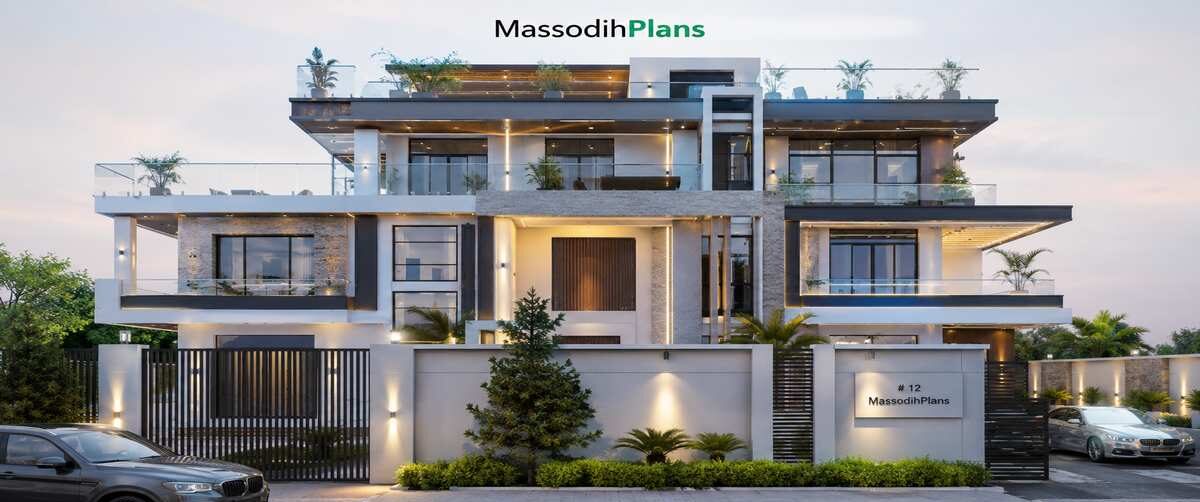
Luxury 5 Bedroom Duplex Plan With Penthouse in Nigeria
The 5-Bedroom Duplex With Penthouse Nigerians Are Building Right Now (Full Plan Inside)
If you are looking for a luxury 5 bedroom duplex plan with penthouse in Nigeria, here is what you need to know straight away: this design works best on a plot of 650 square metres and above, delivers three well-arranged floors, gives you five bedrooms on the first and second floors, and crowns the building with a spectacular penthouse on top. You can build it in Lagos, Abuja, Port Harcourt, Uyo, or any Nigerian city where land is available. This is not theory. I have worked on designs like this across South-South Nigeria, and I want to give you the real picture.
Now let me tell you something. When most people say they want a duplex with a penthouse, they picture it. They imagine the height, the rooftop view, the prestige, the large master bedroom suite on the penthouse level, the terrace overlooking the street. They see it clearly in their mind. But the moment they sit down with an architect or contractor, things start getting complicated. Drawings, approvals, cost projections, structural columns, drainage layouts, all of it lands on the table at once.
That is exactly why I am writing this. Not to rank on Google. Not to fill a page with words. But to break this down the same way I would explain it to a client sitting across from me in my office in Uyo. Simple. Honest. Practical.
If you want to explore more plans before you decide, start from our Plans Library where we have collected designs for different budgets and plot sizes across Nigeria.
What Plot Size Do You Need For This Plan?
This is always the first question I get, and it is the right one to start with. In my experience, the biggest mistake Nigerian homebuilders make is designing a building first and then trying to squeeze it into whatever land they already have. It almost never ends well.
For a luxury 5 bedroom duplex with penthouse, here is what I recommend:
- Minimum plot: 20m x 32.5m (650 sqm)
- Comfortable plot: 22m x 36m (792 sqm)
- Ideal plot: 25m x 40m (1000 sqm)
- Setback from road frontage: 6 metres minimum
- Side setbacks: 2 to 3 metres on each side
- Rear setback: 3 to 4 metres.
At the University of Uyo, we were taught that setback requirements exist not just for aesthetics but for emergency access, drainage, and future road widening. During my internship, I discovered that many buildings in Uyo and Port Harcourt were built right to the property boundary and later faced demolition notices from the urban development authority. Please do not make that mistake.
Our Plan School section has detailed articles explaining Nigerian setback regulations and how to calculate your net buildable area properly. I strongly recommend reading through that before you finalise your design.
Floor-by-Floor Arrangement of the Luxury 5-Bedroom Duplex With Penthouse
Let me walk you through this building level by level. Think of it like taking a tour of the property.
Ground Floor
This is where your day starts and ends in terms of movement. The ground floor should do one thing very well: welcome people while protecting your family’s privacy.
- Spacious reception and sitting room (minimum 6m x 7m)
- Formal dining room separated from the living area
- One guest bedroom with en-suite bathroom (this is for elderly parents or important visitors)
- Kitchen with service corridor or utility area
- Store room, pantry, or domestic staff quarters
- A toilet for visitors near the main entrance
- Double-leaf front door with a porch or portico
- Covered parking for at least two cars within the compound
In my experience, Nigerian families underestimate how important a well-positioned guest bedroom on the ground floor is. When grandparents visit, when a sick relative needs to stay over, or when guests arrive late at night, having that downstairs room saves everyone from uncomfortable situations. I have worked with clients who later regretted removing this room to make the kitchen bigger.
First Floor
This is the main sleeping floor. All the family bedrooms sit here, and this is where you spend the quietest part of your day.
- Master bedroom with walk-in wardrobe and large en-suite bathroom (minimum 6m x 5m)
- Two additional bedrooms with shared or individual bathrooms
- Family lounge or TV area (a small sitting space just for the family, not for visitors)
- Landing area at the top of the staircase with natural light source
- Balcony off the master bedroom
One thing our lecturers constantly emphasised at university was bedroom orientation. Your master bedroom should face east or northeast if possible, so morning light enters naturally. In the Nigerian heat, a bedroom that catches morning breeze and avoids afternoon sun from the west is a far more comfortable room.
Second Floor
This floor carries two more bedrooms and begins the transition into the penthouse level.
- One bedroom with en-suite (can serve as teenage children’s room or home office)
- One flexible bedroom that can be a study, prayer room, or guest room
- A corridor landing that connects to the penthouse staircase
- A small sitting alcove or reading corner with a view
- Wide balcony or terrace overlooking the front compound
Penthouse Level
Now this is where it gets exciting. And I want to be very honest with you here: a penthouse in a Nigerian context is different from what you see in American movies. Our version is practical, elevated, and still very luxurious.
- Penthouse master suite with a large bedroom, lounge, and private bathroom
- Open rooftop terrace with perimeter railing (minimum 1.2m high for safety)
- Wet bar or entertainment corner
- Storage room for roof maintenance equipment
- Access to roof drainage inspection and water tank area
- Wide views of the neighbourhood from all sides
From what I have seen in practice, the penthouse level adds roughly 15 to 25 percent to your total construction cost but increases your property value by 30 to 40 percent compared to a regular two-storey building. If you plan to sell or rent in the future, this investment pays itself back quickly.
Room Dimensions at a Glance
Approximate dimensions for a comfortable build on 650 sqm:
| Room | Recommended Size | Floor |
| Reception and Sitting Room | 6.5m x 7.0m | Ground |
| Formal Dining Room | 4.5m x 5.0m | Ground |
| Guest Bedroom (Ground) | 4.0m x 4.5m + en-suite | Ground |
| Kitchen | 3.5m x 4.5m | Ground |
| Master Bedroom | 6.0m x 5.5m + walk-in | First Floor |
| Bedroom 2 | 4.0m x 4.5m | First Floor |
| Bedroom 3 | 4.0m x 4.5m | First Floor |
| Family Lounge | 4.0m x 4.0m | First Floor |
| Bedroom 4 | 4.0m x 4.5m | Second Floor |
| Bedroom 5 / Study | 3.8m x 4.2m | Second Floor |
| Penthouse Suite | 6.0m x 5.5m | Penthouse |
| Rooftop Terrace | 10.0m x 8.0m (approx) | Penthouse |
Note: All dimensions are internal clear dimensions. Wall thicknesses add approximately 0.3m per wall on each side.
Ventilation, Natural Lighting, and Nigerian Climate
This is one of the sections I feel most strongly about, because in Nigeria, bad ventilation literally makes life miserable. I have entered houses in Uyo and Port Harcourt that cost over two hundred million naira to build but feel like an oven inside because the architect placed windows in the wrong position or made them too small.
Here is what good ventilation looks like for this design:
- Cross-ventilation: windows and openings on opposite walls in every major room
- Louvred aluminium windows on the ground floor for permanent airflow even when closed
- Casement windows on upper floors to catch higher-level breezes
- High-level ventilation openings in the kitchen to remove cooking heat and moisture
- The penthouse rooftop terrace itself acts as a natural wind catcher for the floor below
- Ceiling heights of minimum 3.0m on the ground floor and 2.7m on upper floors
During my undergraduate studies in Town Planning at the University of Uyo, one of the things I clearly remember from our Environmental Planning modules was solar orientation. Nigeria sits between 4 and 14 degrees north of the equator. That means our sun moves from east to west with strong midday overhead radiation. Your design must account for this.
Expert Note on Orientation
- Ideal orientation: main facade facing south or southeast
- Master bedroom: avoid west-facing windows to reduce afternoon heat
- Kitchen: never face west, cooking plus afternoon sun is a punishment
- Penthouse terrace: design a pergola or roof overhang to reduce direct sun
- Balconies with 1.2m projection provide excellent shade for rooms below
Roofing Style and Drainage Planning
For a duplex with a penthouse, roofing is not a simple decision. The roof of the main building and the flat roof of the penthouse terrace need different solutions.
Main Building Roof
- Hip roof or combination of hip and gable recommended
- Galvanised long-span aluminium roofing sheets, minimum gauge 0.55mm
- Roof pitch between 25 and 35 degrees for proper rainwater runoff in Nigerian climate
- Fascia boards and gutters properly fitted and connected to downpipes
- Avoid flat concrete roofs on the main section as they trap heat and leak with time
Penthouse Terrace Roof
- Reinforced concrete slab with waterproof screed and floor tiles
- Gradient screed sloping minimum 1:50 toward drainage outlets
- Perimeter overflow scuppers to handle heavy rainfall
- Under-slab insulation layer to reduce heat transfer into the penthouse room below
From a planning perspective, I strongly recommend that your builder installs roof drainage pipes inside the walls, not exposed on the external face. I have seen beautiful buildings in Asokoro and GRA Port Harcourt that are ruined by black PVC pipes running down the outside of white walls. Plan your drainage internally from the beginning.
Realistic Cost Estimate for Building This Plan in Nigeria Now
I want to be very clear here: I will not give you a single fixed figure. Material prices in Nigeria change weekly. What cost 1,500 naira per block in January can cost 2,200 naira by June. The global cement price fluctuation, fuel subsidy removal effects, and exchange rate changes all affect construction costs directly.
What I will give you is a structured breakdown so you can do your own current estimate:
| Cost Item | Budget Range (NGN millions) | Notes |
| Foundation and substructure | 8M – 15M | Depends on soil bearing capacity and depth |
| Ground floor slab and columns | 6M – 10M | Structural engineer required |
| Block work (all floors) | 12M – 20M | 9-inch blocks for external walls recommended |
| Roofing (main + penthouse slab) | 8M – 14M | Include insulation and waterproofing |
| Plastering and screeding | 5M – 8M | Internal and external |
| Electrical installation | 6M – 12M | Include provisions for solar and inverter |
| Plumbing and drainage | 5M – 10M | Include borehole connection |
| Tiling (floor and wall) | 8M – 15M | Penthouse terrace tiles are more expensive |
| Doors, windows, and ironmongery | 7M – 14M | Security doors for all external openings |
| Painting and finishes | 4M – 8M | Two coats minimum on all surfaces |
| Generator room, borehole, septic | 3M – 6M | Essential utilities |
| Gatehouse, fence, compound work | 5M – 10M | Include drainage channels in compound |
| TOTAL (estimated range) | 77M – 142M | Excludes land cost and approval fees |
This is not just theory. I have seen it happen. Projects that started with a budget of 50 million naira ended up requiring over 130 million because the owner did not include approval costs, soil testing fees, structural engineering consultancy, and supervision fees. Please add 10 to 15 percent of your construction budget for professional fees and unforeseen costs.
Cost-Saving Tips From the Field
- Buy your roofing sheets in the dry season when prices are slightly lower
- Use precast concrete lintels instead of cast-in-place to reduce formwork cost
- Stage your block purchases to avoid stock decay from rain exposure
- Install conduits before slabs are cast. Retrofitting costs three times more
- Use locally sourced granite from verified quarries to reduce haulage cost
- Hire a registered architect and structural engineer upfront. This saves you from expensive corrections later
You can get help with procurement planning and site supervision through our professional services. We work with clients across South-South Nigeria.
Parking, Security, and Compound Arrangement
A luxury building deserves a well-thought-out compound. I have reviewed plans for very expensive homes where the compound arrangement was an afterthought, and the result was chaos. No proper turning radius for cars, no clear service entrance, no thought given to visitor parking. Let me help you avoid that.
Parking Considerations
- Minimum of two covered parking spaces within the compound
- Clear 6m driveway width from gate to parking for comfortable turning
- Guest parking of at least two additional open spaces inside the gate
- If your gate opens outward onto the street, you need approval and a proper setback
- Electric sliding gate is now standard for this class of property in Nigerian GRA and estate settings
Security Planning
- Perimeter fence minimum 2.4m high with decorative precast or plastered finish
- Gatehouse positioned at the main entrance with direct view of the gate and driveway
- CCTV provision points at gate, main entrance, and compound corners
- Security lighting on compound fence at minimum every 6m
- The penthouse rooftop actually gives excellent perimeter visibility, useful for surveillance cameras
Generator Room and Borehole
This is something I have encountered many times on Nigerian construction sites: the generator and borehole are planned at the last minute, and they end up in terrible positions. Your generator room should be close to your main distribution board but far from bedroom windows. The borehole should be a minimum of 30 metres from your septic tank to prevent contamination.
- Generator room: at least 3m x 3m with ventilation louvers and oil-resistant floor finish
- Borehole position: north or south end of compound, never downhill of septic tank
- Septic tank: rear of compound, minimum 3m from property boundary
- Overhead water tank: minimum 5,000 litres for a household of this size
Staircase Planning for a Three-Storey-Plus-Penthouse Building
I need to talk about this because I have seen this mistake repeatedly: staircases that are too narrow, too steep, or placed in a position that breaks the circulation of the entire building.
- Minimum stair width: 1.2m (this allows two people to pass comfortably)
- Recommended stair width for this class of building: 1.5m
- Each riser: maximum 175mm high, tread minimum 280mm deep (comfortable for elderly and children)
- A landing at mid-flight is required for any staircase exceeding 16 risers
- The staircase from second floor to penthouse can be a spiral staircase to save space but must still be minimum 1.0m clear diameter
- Provide a handrail on both sides of the staircase for safety
- Install an under-stair storage cupboard. In Nigerian homes, this space is wasted constantly
During a design review on a project in Calabar, I noticed the architect had placed the staircase in a position that blocked the dining room from the kitchen. Every time food was being served, someone had to walk around the staircase. It sounds small but it destroys daily comfort. Position your staircase centrally or at the side of the building, never cutting through a functional space.
Nigerian Reality: What This Plan Faces on the Ground
This is the section most architecture blogs skip. But I think it is the most important one, because building in Nigeria is different from building anywhere else in the world. The challenges are real, and you need to plan for them.
Power Supply Reality
- Plan for a solar-inverter hybrid system from the beginning. Do not retrofit it later
- The penthouse is an ideal location for solar panels due to unobstructed sun access
- Your electrical load design must include a transfer switch between PHCN supply and generator
- Provide a dedicated electrical room or panel board position for your inverter batteries
Flooding and Drainage
Over the years, I have noticed that flooding is one of the biggest threats to completed buildings in Nigerian cities. Uyo, Benin, Port Harcourt, and parts of Lagos experience heavy flooding during the rainy season. Your compound drainage must be designed by a professional.
- Install a perimeter drain inside your compound fence before any construction starts
- The compound floor level should be a minimum of 300mm above the external road level
- All downpipes must connect to a soak pit or discharge point, never open across the compound
- Include a drainage inspection chamber inside the compound for maintenance access
Heat Management
- Use hollow sandcrete blocks instead of solid blocks for external walls for thermal mass reduction
- Paint external walls with light-coloured paint to reduce heat absorption
- Install ceiling insulation boards under your roof to reduce heat transfer into living spaces
- Aluminium reflective foil under roofing sheets reduces roof heat significantly
Investment and Rental Value of This Plan
Let me speak to you as someone who also understands the Nigerian real estate market from a planning and design perspective.
| Investment Analysis Summary |
| Location: Lagos Lekki Phase 1 / Abuja Maitama / PH GRA / Uyo Ring Road Axis |
| Estimated resale value after completion: 350M to 650M NGN depending on location and finish |
| Rental income potential: 8M to 20M NGN per annum (whole property let) |
| Penthouse level alone: rentable separately as executive short-let at 150,000 to 500,000 NGN per night |
| ROI period: 8 to 15 years for rental use |
| Estate suitability: Excellent. Most estate developers in Nigeria accept this typology |
From what I have seen in practice, properties with a penthouse level command a significant premium in the Nigerian luxury residential market. On our MassodihPlans homepage, we explain more about how our design approach is focused on long-term value, not just the immediate build cost.
One lesson I learned early is that you should design for your exit strategy, not just your current lifestyle. What happens to this building in 20 years? Will your children want to live in it? Will they be able to sell it? A luxury five-bedroom duplex with a penthouse remains desirable in every Nigerian urban market regardless of economic cycles, because good housing never goes out of demand.
Common Mistakes to Avoid When Building This Plan
- Starting construction without an approved building plan. In Nigerian cities, you face demolition, fines, and delays if you build without approval from your local planning authority.
- Mixing structural and non-structural walls without proper engineering guidance. This has caused partial building collapses in Nigeria.
- Buying substandard roofing sheets because they are cheaper. A roof failure in the first rainy season costs more to fix than the savings you made.
- Using the penthouse terrace as an afterthought. Plan its waterproofing and drainage from the foundation stage.
- Ignoring your setbacks to maximise floor area. Authorities will eventually enforce compliance.
- Hiring only one contractor for the entire build without professional supervision. Mistakes go unnoticed and uncorrected.
- Skipping soil investigation. A luxury building on weak laterite soil without a proper foundation will develop cracks within five years.
- Installing tiles before all overhead wet works are finished. Water from upper-floor plumbing ruins new tiles below.
Future Expansion and Flexibility
One thing I appreciate about this plan is that it allows for future modification without major structural interference.
- The penthouse suite can be converted into a home cinema or library in future
- The guest bedroom on the ground floor can become a dedicated home office
- The rooftop terrace can accommodate a small gym, garden, or swimming pool plunge area
- Solar panel installation can be done after completion without major modifications
- The family lounge on the first floor can be converted into a sixth bedroom if needed
My academic training exposed me to the concept of design flexibility in residential architecture. The buildings that survive across generations are not the most rigid ones. They are the ones that allow occupants to adapt the space as their lives change. This design does that very well.
Reference: Nigerian Building Code
The National Building Code of Nigeria (2006, Federal Ministry of Housing) provides the regulatory framework for structural requirements, setbacks, fire safety, and floor-to-ceiling heights referenced in this article. Every residential building in Nigeria, regardless of budget, must comply with this code. Source: Federal Republic of Nigeria, National Building Code (2006). Federal Ministry of Works and Housing.
Frequently Asked Questions
What is the minimum plot size for a 5-bedroom duplex with penthouse in Nigeria?
The minimum comfortable plot size is 650 square metres (20m x 32.5m). Anything smaller will compromise your setbacks, parking, and compound drainage. For the penthouse to look proportional, you need the height that comes with at least 15m of road frontage.
How many floors does a 5-bedroom duplex with penthouse have?
This design has four levels: ground floor, first floor, second floor, and penthouse. Structurally it is a three-storey building with a penthouse crowning the roof. This is different from a two-storey duplex. You need a structural engineer to certify all floor slabs.
Can this plan fit on a 500 sqm plot in Lagos?
It is possible but it will be very tight. You will lose some parking space and your side setbacks will be at the minimum allowed. I would recommend discussing this with a registered architect who can reduce the footprint while keeping all five bedrooms. We can help you through our services page.
What type of roof is best for a duplex with penthouse in Nigeria?
A hip roof over the main building section combined with a flat reinforced concrete slab for the penthouse terrace works best. The hip roof drains rainwater in all four directions and requires no parapet wall that can crack. The flat slab needs proper waterproofing screed and functional drainage outlets.
How long does it take to build this plan in Nigeria?
From mobilisation to completion with continuous funding, expect 18 to 30 months depending on your location and site conditions. Projects that run on inconsistent funding take 3 to 6 years. Please plan your financing before you break ground.
What is the estimated cost of building a 5-bedroom duplex with penthouse in Nigeria?
Based on current market rates, expect between 77 million and 142 million naira for the building alone, depending on your choice of finishes and location. This does not include land cost, professional fees, or building approval costs. Always get a professional Bill of Quantities from a Quantity Surveyor before committing to a budget.
Does a penthouse add value to a Nigerian residential property?
Yes, absolutely. In my experience, a penthouse adds 30 to 40 percent to the resale value of a residential property compared to an equivalent building without one. In the Nigerian luxury property market, penthouses are increasingly sought after for short-term letting and as executive residential properties.
Final Thoughts: Is This the Right Plan For You?
Here is what I want you to take away from everything we have discussed today.
A luxury 5 bedroom duplex with penthouse in Nigeria is not just a beautiful building. It is a statement. It is a decision you make about how your family will live, how your guests will feel when they walk through your door, and what your property will be worth in the years to come.
But more than that, it is a serious construction project that requires serious planning. You need the right plot size. And you need proper professional guidance from a registered architect, a structural engineer, and a town planner. You need a building approval before your first block is laid. And you need someone on site who understands what your drawings mean and will not cut corners when your back is turned.
This conclusion is based on both academic training and real-world observation. In over fifteen years of professional work in planning and design across South-South Nigeria, the projects that succeeded were the ones where the owner invested in proper preparation before construction started. The ones that failed were always the ones that rushed to site without a proper plan.
Your Next Steps
| Next Steps |
| 1. Confirm your plot dimensions and check for deed of survey / certificate of occupancy |
| 2. Engage a registered architect to produce your working drawings |
| 3. Submit for building plan approval at your state urban development authority |
| 4. Commission a soil investigation report before foundation design |
| 5. Prepare your Bill of Quantities with a certified Quantity Surveyor |
| 6. Mobilise with at least 30 percent of your total construction budget liquid |
If you have questions about this plan or you want us to design something specifically for your plot size, location, or budget, I am here to help. That is exactly what MassodihPlans exists for.
Browse our Plans Library for more Nigerian house plan designs ranging from bungalows to luxury duplexes. Visit Plan School if you want to understand the building process better before you commit. And if you are ready to start, our Services page tells you exactly how we can work together.
You can also visit the MassodihPlans homepage to see what we are about. We are not just another house plan website. We are a team of professionals who have worked on real Nigerian projects, made real mistakes, learned real lessons, and are now sharing all of that with you for free.
Explore More on MassodihPlans
If this article was useful to you, here are more resources on our platform that will help you continue your building journey:
- 4 Bedroom Duplex Plan in Nigeria – Compare this with a smaller but equally well-designed duplex option
- Duplex House Plan for Lagos – Lagos-specific layout advice for duplex construction on tight plots
- Cost of Building a Duplex in Nigeria – Detailed breakdown of construction costs across Nigerian states
- Housing Estate Layout Plan in Nigeria – If you are building on an estate or planning a site development
- Building Approval Process in Nigeria – Everything you need to know before submitting your building plan
- Site Development Plan in Nigeria – Understanding what a site plan contains and why you need one
- 5 Bedroom Bungalow Plan in Nigeria – Prefer single-storey? This is our most popular bungalow layout
- Duplex Plan for Port Harcourt – GRA and estate plot design guidance for Port Harcourt builders
- Real Estate Investment in Uyo – Where to build for maximum long-term value in Akwa Ibom State
- Building Materials Price in Nigeria – Current prices for cement, blocks, roofing, and tiles in Nigeria