How to Build Cities That People Actually Want to Live In
How to Build Cities That People Actually Want to Live In: The 2050 Urban Growth Blueprint. Let me be honest with you the way I would be with a younger colleague who just walked into my office confused.
Most of the cities we are building in the world including Nigeria right now, they are not built for people. They are built for vehicles. For politicians. For land speculators. And for developers who want to squeeze as many units as possible into a piece of land without thinking once about the person who will wake up there every morning, cook, raise children, breathe.
I have sat on planning desks in Uyo. And I have reviewed physical development plans. I have watched developers present housing schemes where the corridors are 900mm wide, the kitchens face the western sun directly, and the compound has space for one car but the client has three. Nobody asked: will the person who lives here be comfortable?
That is the conversation I want to have today.
This is not a 2050 blueprint in the way governments write them full of tables and targets that nobody reads. This is a 2050 blueprint for real Nigerians. For the man in Rumuola, Port Harcourt who just bought a 50 by 100 plot and wants to know what fits there. And for the couple in Barnawa, Kaduna who want a bungalow that does not become an oven in April. For the young planner in school who is wondering what good urban design actually looks like when it touches ground.
Let me take you through it, plot by plot, room by room, roof by roof.
The Real Problem: We Are Building for Land, Not for Life
Before I show you plans and dimensions, I want you to understand something I see every day in practice.
Nigerian families are buying smaller and smaller plots. In Uyo today, a standard residential plot in most government layouts is 18 by 36 metres which is 648 square metres. In older layouts like Ibom Layout and State Housing Estate, you still find 30 by 60 metre plots, which is 1,800 square metres. But in most newer developments around Shelter Afrique, Ewet Housing, and the expanding fringes people are buying 50 by 100 feet plots, which is roughly 15 by 30 metres only 450 square metres.
In Lagos, Abuja, and Port Harcourt, things are even tighter. People buy 300 square metre plots in places like Ajah, Sangotedo, and Lugbe. In some old urban cores like Surulere and Alimosho, people inherit land that is 200 square metres or even less.
And then they come to an architect or a draughtsman and say: I want a 4-bedroom duplex.
The result of that conversation, when it goes wrong, is a building that covers 95 percent of the plot, has no setback, no breathing room, no parking, no garden, bad airflow, and neighbors so close you can hear them argue at midnight.
When it goes right and it can go right you get something beautiful even on a small plot. That is what I want to show you.
The Minimum You Must Know Before You Touch a Plot
Setbacks: What Is Non-Negotiable
Every state in Nigeria has planning regulations that specify minimum setbacks the distance your building must keep from the boundary of your plot. You cannot ignore this. If you do, the planning authority can demolish your building or refuse to give you a certificate of occupancy.
Here are the typical setbacks in most Nigerian state layouts (though they vary always check your state Urban and Regional Planning Law):
- Front setback from the road: 3 metres minimum (some places require 4.5 metres)
- Side setback from neighbor’s fence: 1.5 metres on each side (some require 3 metres for bungalows)
- Rear setback: 3 metres minimum
Now let us do the math on a 15m by 30m plot (approximately 50 by 100 feet):
- Remove 3m front setback = 27m remaining depth
- Remove 3m rear setback = 24m buildable depth
- Remove 1.5m on each side = 12m buildable width
So your actual buildable footprint on a 15 by 30 metre plot is roughly 12 by 24 metres = 288 square metres.
That is your canvas. And honestly? That is enough for a decent 3-bedroom bungalow or a modest 4-bedroom duplex if you plan smartly.
House Plans That Actually Work for Nigerian Plots
Let me take you through four real design scenarios that I have either designed, reviewed, or advised on. These are not textbook designs. These are solutions I have worked out for real families on real plots in Nigerian cities.
Design Scenario 1: The 450sqm Plot Bungalow (15m x 30m)
Best for: First-time homeowners, young families, rental investment
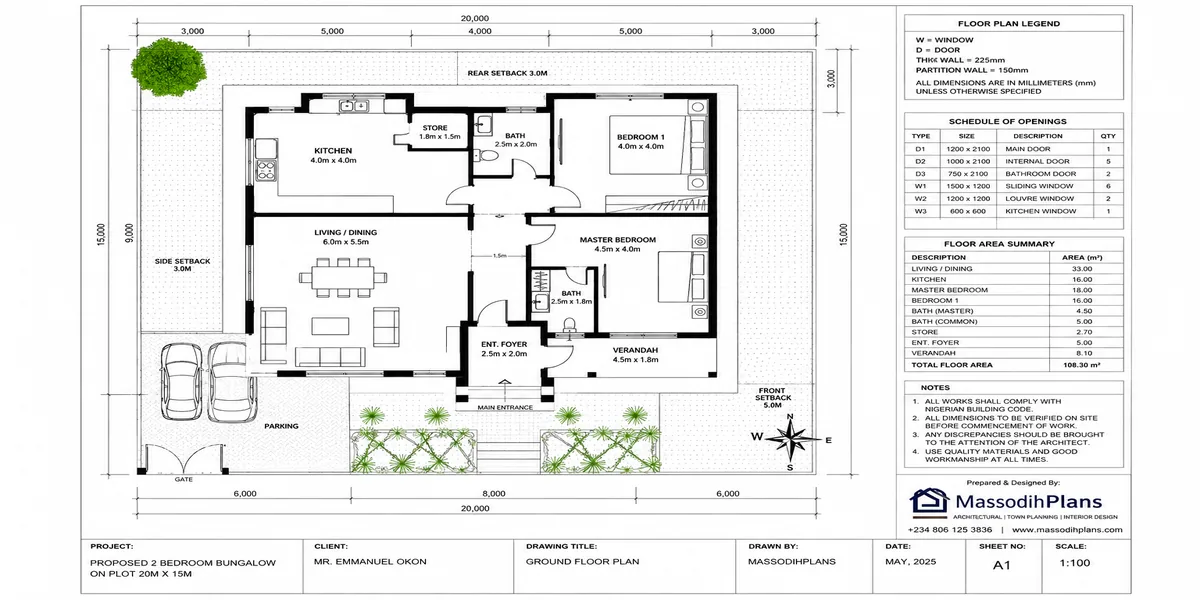
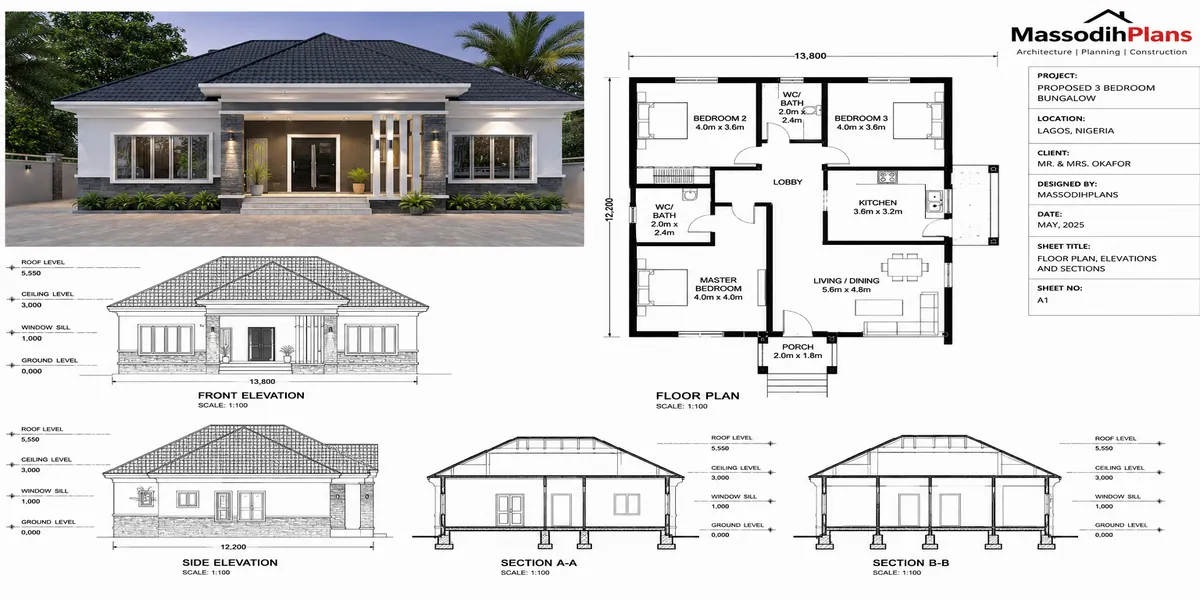
Plot Size: 15m x 30m (450 sqm) Building Footprint: 11.5m x 14.5m = approximately 167 sqm Type: 3-bedroom bungalow
Room Arrangement:
| Room | Dimensions | Size |
|---|---|---|
| Living Room | 5.5m x 4.5m | 24.75 sqm |
| Dining Area | 3.5m x 3m | 10.5 sqm |
| Kitchen | 3.5m x 3.5m | 12.25 sqm |
| Master Bedroom | 4m x 4.5m | 18 sqm |
| Master Ensuite | 2m x 2.5m | 5 sqm |
| Bedroom 2 | 3.5m x 3.5m | 12.25 sqm |
| Bedroom 3 | 3.5m x 3.5m | 12.25 sqm |
| Common Bathroom | 2m x 2.5m | 5 sqm |
| Corridor/Circulation | — | approx. 15 sqm |
| Porch/Veranda | 3m x 2m | 6 sqm |
| Store/Utility | 2m x 2m | 4 sqm |
Setbacks Used:
- Front: 3m (room for parking + small garden)
- Rear: 3.5m (service yard, clothes drying, generator housing)
- Left side: 1.5m
- Right side: 2m (wider to allow natural light to reach bedrooms on that side)
Parking: 1 covered carport (3m x 5.5m) integrated into front setback area or attached to one side of the building.
Ventilation Strategy: This is where most Nigerian house designs fail completely. In a bungalow on a 15m by 30m plot, you must do three things:
First, orient your building so that the long axis runs east-west. This means your living room and most rooms face north or south. In Nigerian climate especially in the south where we have humid tropical conditions — north-facing rooms get even, diffuse light and less direct heat. South-facing rooms get morning and evening sun rather than the brutal afternoon western sun.
Second, every room must have cross-ventilation. This means each room should have a window on at least two different walls, or one window and one door opening into an open corridor or courtyard. When wind enters from one window and exits from another, your room cools down naturally even in March heat.
Third, raise your windows higher than you think you should. Windows placed at 900mm from finished floor level are good. But if you raise them to 1200mm from floor level, you create a stack effect — hot air rises and escapes at the top, and cool breeze enters from lower windows. This simple change can reduce your room temperature by 2 to 3 degrees Celsius. In Owerri in March, that is the difference between sleeping and suffering.
Roof Type
Hip roof with 30-degree pitch using aluminum roofing sheets. For this plot and building shape, a hip roof reduces wind uplift (important in coastal states like Akwa Ibom and Rivers), sheds rainwater evenly on all sides, and protects all walls from rain.
Do not use flat roofs in southern Nigeria. They are maintenance nightmares and they trap heat like an oven. I have seen so many flat-roofed buildings in Lagos and Warri that are basically uninhabitable on the top floor because the owner wanted a modern look and forgot they live in a tropical rainforest.
Nigerian Climate Considerations for This Design:
- Use 250mm hollow sandcrete blocks (not solid) they are lighter and provide slight thermal mass
- Render and paint external walls with light colors (white, cream, pale yellow) dark walls absorb heat
- Add roof insulation board (aluminum foil-backed board is affordable and very effective)
- Install louver windows in bathrooms and kitchen for permanent ventilation even when main windows are closed
- Provide mosquito mesh on all windows non-negotiable in the south
Cost Estimate (2024-2025 Nigerian market, Mid-level finish):
| Item | Estimate Range (NGN) |
|---|---|
| Foundation and substructure | 2,500,000 — 3,500,000 |
| Walling (blocks, mortar, labor) | 3,500,000 — 5,000,000 |
| Roofing (structure + sheets) | 2,500,000 — 4,000,000 |
| Doors and Windows | 1,500,000 — 2,500,000 |
| Electrical installation | 1,200,000 — 2,000,000 |
| Plumbing and drainage | 1,500,000 — 2,500,000 |
| Plastering and tiling | 2,000,000 — 3,500,000 |
| Painting | 800,000 — 1,200,000 |
| External works (fence, gate, drainage) | 1,500,000 — 2,500,000 |
| TOTAL ESTIMATE | 17,000,000 — 26,700,000 |
This assumes you are doing a mid-level finish good quality tiles (not Italian marble), aluminum windows, simple PVC ceiling, and normal painting. If you want premium finish Italian tiles, hardwood doors, granite countertops add 30 to 50 percent.
Suitability: This design is most suitable for a nuclear family of 4 to 6 people. It is also excellent as a rental property because 3-bedroom bungalows in good Nigerian neighborhoods rent from N300,000 to N600,000 per year depending on state.
Advantages of This Layout:
- All bedrooms have direct window ventilation
- Kitchen is at the rear away from main living zone which is correct because kitchen odors and cooking heat should not circulate into the living room
- Corridor-free bedroom zone (you access all bedrooms from one short hallway rather than a long corridor that wastes space)
- Natural light reaches every room including the bathrooms
- The 3.5m rear yard allows you to build a generator house, keep a water storage tank, and still have space for a small kitchen garden which I always recommend to any client who asks me
Design Scenario 2: The 300sqm Small Urban Plot (12m x 25m)
Best for: Lagos, Abuja, Port Harcourt urban and peri-urban locations
Plot Size: 12m x 25m (300 sqm) Building Footprint: 9m x 13m = 117 sqm (Ground Floor) Type: Compact 3-bedroom duplex (lower: living + kitchen; upper: 3 bedrooms)
When someone comes to me with a 12 by 25 metre plot in a place like Lekki Phase 2 or Lugbe Extension and says they want a duplex, my first question is: who will live here? Because a duplex on a 300 sqm plot is doable but only if you accept certain trade-offs honestly.
The trade-off is this: you will not have a garden. Your parking will be in the setback. Your building will feel compact but it can still feel good inside if the interior planning is right.
Ground Floor Layout:
- Entrance porch (2m x 1.5m)
- Living room (5m x 4m = 20 sqm)
- Dining (3m x 3m = 9 sqm)
- Kitchen (3m x 3.5m = 10.5 sqm)
- Guest toilet (1.5m x 1.5m)
- Staircase and circulation (approx. 10 sqm)
First Floor Layout:
- Master bedroom + ensuite (4m x 4m + 2m x 2.5m)
- Bedroom 2 (3m x 3.5m = 10.5 sqm)
- Bedroom 3 (3m x 3.5m = 10.5 sqm)
- Common bathroom (2m x 2.5m)
- Landing/circulation (approx. 6 sqm)
Orientation: Position the staircase on the western side of the building. This creates a thermal buffer between the western afternoon sun and the main living spaces. Western walls absorb the most heat in Nigerian climate putting your staircase there means the rooms that matter most are shielded.
Setbacks on This Plot:
- Front: 3m (tight just enough for 1 car parking space of 2.5m + 0.5m planting strip)
- Rear: 2.5m (service zone barely enough for a small utility area)
- Sides: 1.5m each
Ventilation: On a narrow 9m-wide building, cross-ventilation is harder to achieve. My solution for this scenario is always a small internal light-well a 1.5m x 1.5m open shaft at the center of the building that pulls fresh air from the ground and distributes it into upper-floor bathrooms and corridors. It also brings natural daylight into the heart of the building.
Drainage: On small urban plots, surface water management is critical. Your rear setback of 2.5m must have a proper surface drain channel connected to the public drainage system or a soak-away. Never allow runoff from your roof to pool at your foundation — it will destroy your foundation within 10 years.
Roof Type: Mono-pitch (shed roof) or low-pitched hip roof. On a narrow urban duplex, a mono-pitch roof can be both functional and modern-looking. Pitch it at 20 to 25 degrees sloping to the rear — this directs rainwater away from the street and toward your rear drainage.
Cost Estimate (300sqm plot duplex, mid-level, 2025): N25,000,000 to N42,000,000 depending on finishes and foundation conditions.
Design Scenario 3: The 648sqm Standard Plot (18m x 36m)
Best for: Families wanting comfort, government layout plots, Uyo-style residential areas
This is the sweet spot. The 18 by 36 metre plot is common in many Nigerian government residential layouts in Uyo, Benin City, Enugu, Jos. If you have this size, count yourself lucky.
What Fits Here Comfortably:
- A 4-bedroom bungalow with parking for 2 cars
- A 4-bedroom duplex with compound and a small staff quarters
- A modest 3-flat apartment building (for investment)
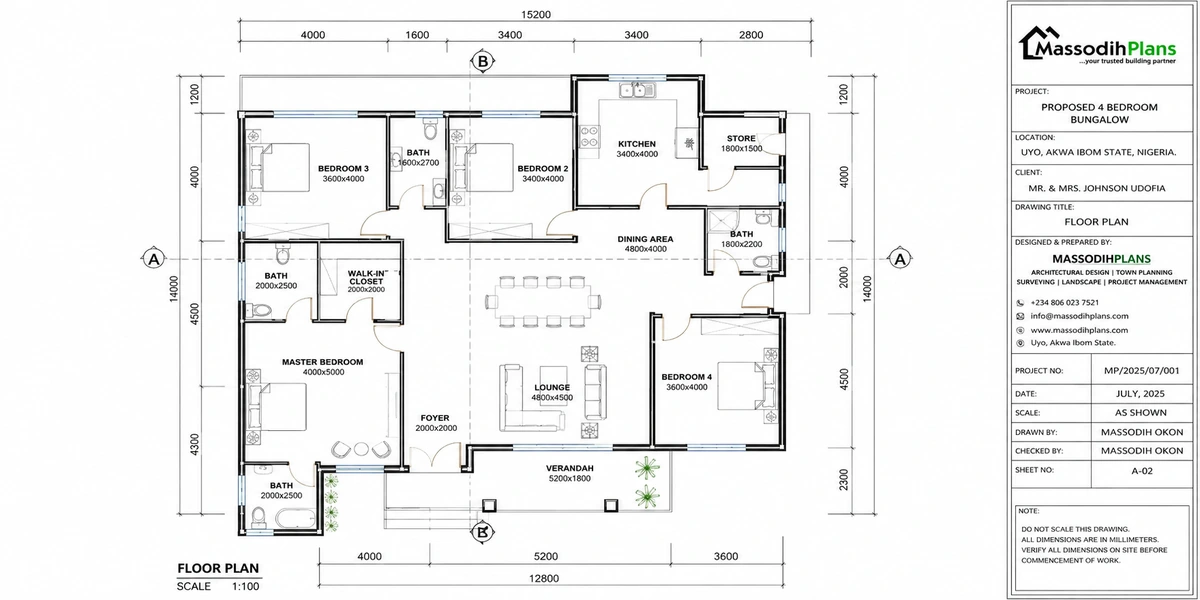
I will focus on the 4-bedroom bungalow because that is what most families coming to me actually want.
Building Footprint: 13.5m x 19m = 256.5 sqm
Room Arrangement:
| Room | Dimensions |
|---|---|
| Living Room | 6m x 5m |
| Dining | 4m x 4m |
| Kitchen | 4m x 4m (with pantry) |
| Master Bedroom + Ensuite + Wardrobe | 5m x 5m (room) + 2.5m x 3m (ensuite) |
| Bedroom 2 + Ensuite | 4m x 4.5m + 2m x 2.5m |
| Bedroom 3 | 4m x 4m |
| Bedroom 4 | 3.5m x 3.5m |
| Common Bathroom | 2m x 3m |
| Boys Quarters/Domestic Staff Room | 3m x 3m + small bathroom |
| Covered Porch (front) | 4m x 2m |
| Store | 2.5m x 2m |
| Utility/Laundry Room | 2m x 2m |
Parking: 2-car covered carport (6m x 6m) attached to the left side of the building. This leaves the full width of the front setback for a small garden and clear access.
Compound: With the 256.5 sqm footprint on a 648 sqm plot, you still have roughly 390 sqm of open land — enough for a proper garden, a borehole/tank area, generator housing, and a small garden shed.
Ventilation Strategy: This size plot allows you to design a central courtyard or a U-shaped building plan. I prefer the U-shape for most Nigerian bungalows because it creates a sheltered outdoor zone at the rear that catches prevailing wind and distributes it across all rooms opening into that rear yard.
Setbacks:
- Front: 4.5m (room for 2-car parking + 2m garden strip)
- Rear: 5m (proper service yard, BQ, drainage channel)
- Sides: 3m each
Drainage on This Plot: With a compound this size, you must provide a perimeter drain around the building. Install 450mm x 450mm concrete surface drains connecting to either a soak-away or the street drainage. Do not let your compound water pool it attracts mosquitoes and erodes your foundation.
Material Considerations: I always tell my clients: buy materials once, buy them right. For a building on this scale:
- Foundation: Strip foundation in concrete minimum grade C20 (1:2:4 mix) or raft foundation if you are in a waterlogged area like many parts of Uyo, Warri, or Port Harcourt
- Block type: 9-inch hollow sandcrete blocks for external walls, 6-inch for internal walls
- Roofing: Long-span aluminum sheets on timber or steel purlins. Avoid clay tiles for most of southern Nigeria they are heavy, add structural cost, and some are poor quality locally
- Floor: Reinforced concrete slab on ground (minimum 100mm thick with mesh reinforcement)
- External finish: Sand-cement render with good quality masonry paint (Sandtex or equivalent) not emulsion paint on external walls
Cost Estimate (4-bedroom bungalow, 648sqm plot, mid-level, 2025): N35,000,000 to N58,000,000
Design Scenario 4: The 50sqm Micro-Plot Urban Infill (10m x 5m — old core city)
Best for: Old Lagos Island, Onitsha, Kano old city, Aba urban core
Yes, people build on plots this small. I have reviewed such projects. A 10 by 5 metre plot in the dense urban core of Onitsha or Lagos Island is a real situation. You cannot fit much but you can still fit something dignified if you plan vertically.
On a 10m x 5m footprint with setbacks reduced to 1m front and 0.6m sides (as allowed in some dense urban areas by local zoning), your buildable floor plate per floor is roughly 8.4m x 3.8m = about 32 sqm per floor.
With a 3-storey building, you get 96 sqm of total floor space. That is:
- Ground floor: Living, kitchen, toilet
- First floor: 2 bedrooms + bathroom
- Second floor: 1 bedroom + multipurpose room
Not a family mansion but a dignified urban home. The key principle for this design is: go vertical, build tight, and spend your budget on quality finishes and good ventilation rather than more space.
What 2050 City Planning Actually Needs to Look Like
I have been talking about individual plots. But let me zoom out because the plot is not separate from the city. How your city is planned determines whether your individual house works or fails.
Here is what I want to see in Nigerian cities by 2050 and what good planners, governors, and citizens can start pushing for today:
Mixed-Use Zoning That Respects How Nigerians Actually Live
The European model of strict zoning offices here, housing there, shops somewhere else does not work in the Nigerian context. Nigerians are entrepreneurs. The woman who sews clothes in her front room is not a nuisance. She is a productive citizen. The man who runs a provisions shop from his compound is not violating urban order he is serving his street.
Good 2050 Nigerian zoning should be mixed-use residential: allow small-scale commercial activities at the ground floor of residential buildings, especially along collector roads. This is already happening informally in every Nigerian city. The planning system needs to formally recognize and manage it rather than pretend it does not exist.
Streets Designed for People, Not Just Cars
In most Nigerian residential layouts, there are no sidewalks. You walk on the road. This is dangerous, uncomfortable, and signals clearly what the planning priority was the car, not the human.
By 2050, every new residential layout in Nigeria should have: a minimum 1.5m paved pedestrian footpath on both sides of every collector road, shade trees every 10 metres along those paths, and covered market structures within 500m walking distance of every housing cluster.
This is not expensive. It is a planning decision.
Drainage Infrastructure Built Ahead of Housing
I have seen this too many times. A government lays out a new estate, sells plots, people build their houses — and then three years later, every July, half the estate is under water because the main drainage canal was never built.
Good urban growth by 2050 means infrastructure first, then housing. Put in your primary drainage channels before you sell the first plot. This is how Uyo’s older estates were designed the drainage channels came before the buildings. We need to return to that discipline.
Setback Enforcement That Is Real
Currently in many Nigerian cities, setback violations are widespread because enforcement is weak or because planning approvals are given without site inspections.
By 2050, using GIS mapping and drone surveillance (both already available and affordable), state planning authorities can do real-time monitoring of building setbacks without sending an inspector to every site. This technology exists. The will to use it is what we need.
Green Space at the Neighborhood Level
Every residential layout in Nigeria should have a dedicated green space a park, a children’s playground, a community garden within 400m of every house. This is not a luxury. Green space reduces urban heat island effect, improves mental health, provides space for children to play safely, and creates community identity.
The current practice of allocating one small “open space” to an entire estate of 500 plots and then later using that space to build a market or a police station must stop.
Building Advice: What to Do Before You Break Ground
Whether you are building in Uyo, Kano, Lagos, or Enugu, these are the things I tell every client before they start:
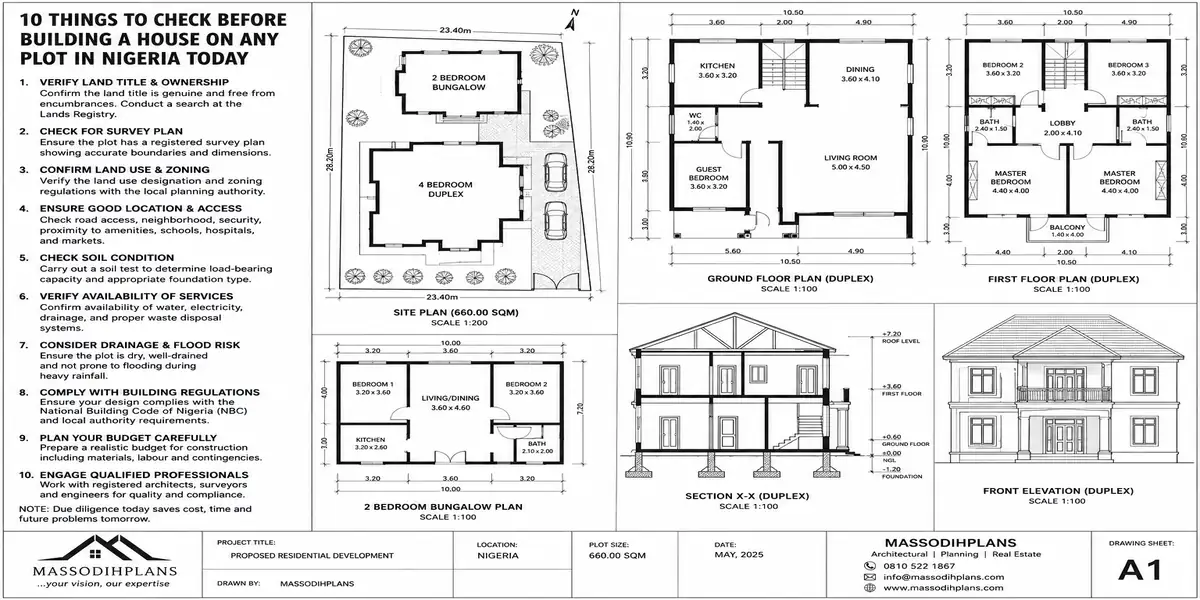
1. Get Your Survey Plan and Title Document Right First
I know people who started building and found out later their plot boundary was disputed. Do not build before you have a proper survey plan from a registered surveyor, and a genuine right of occupancy or certificate of occupancy from the state. This is not optional.
2. Do a Soil Test
In many parts of southern Nigeria, especially in riverine areas and former floodplains, the soil condition is poor. Building without a geotechnical report on a waterlogged or expansive clay site means your foundation can fail within 5 years. A basic soil test costs between N80,000 and N250,000 it is the cheapest insurance you will ever buy.
3. Involve a Registered Architect and Town Planner From the Start
I say this not to advertise my profession but because I have cleaned up too many disasters caused by buildings designed without professional input. A registered architect knows the building code. A town planner knows the setbacks and zoning rules. These professionals exist to protect you not to take your money.
4. Get Planning Approval Before You Start
In Nigeria, many people build first and try to get approval later. This is a trap. State planning authorities have the legal power to demolish unapproved structures. And even if they do not demolish yours, a building without planning approval cannot be properly valued, sold, mortgaged, or insured.
5. Supervise the Work Yourself or Through a Professional
Do not release money and disappear. Visit the site. Ask questions. If you cannot visit daily, hire a site supervisor or ask your architect to provide supervision services. A supervised building is a better building full stop.
Roofing Decisions for Nigerian Climate
This deserves its own section because I see so many wrong roofing decisions on Nigerian buildings.
The Best Roof for Southern Nigeria (Lagos, Rivers, Akwa Ibom, Delta, Cross River): Long-span aluminum roofing sheets (0.55mm gauge minimum) on a timber or light steel frame, with aluminum foil-backed insulation board installed immediately below the sheets. Hip roof shape, minimum 25-degree pitch.
Why aluminum? It reflects heat, is lightweight, resists the high humidity and salt air of coastal areas, and lasts 20 to 30 years with proper installation.
Why hip shape? Because the coastal south experiences strong winds especially during storm season. A hip roof is aerodynamically superior. It has no gable ends exposed to wind pressure, so it stays on the building when others are flying off.
The Best Roof for Northern Nigeria (Kano, Kaduna, Sokoto, Maiduguri): In the semi-arid north, heat gain through the roof is your primary problem, not wind or rain. Here I recommend clay tile roofing (if budget allows) or aluminum sheets with heavy insulation and a ceiling board that creates an air gap. The air gap between the roof sheet and the ceiling is your best natural air conditioner.
Flat roofs in the north are more acceptable than in the south because rainfall is lower and the risk of ponding is less — but they must be properly waterproofed and must slope at a minimum 1:50 gradient toward drainage outlets.
Universal Rule: Never Use Less Than 0.55mm Gauge Aluminum Sheets
The 0.40mm sheets you see being sold cheaply in most markets are a false economy. They dent under hail, corrode faster, and flex under heat causing fastener holes to widen and the roof to leak within 3 to 5 years. Pay the extra money for 0.55mm or 0.7mm.
Land Use and Plot Efficiency: The Numbers That Matter
When I look at a design, I calculate the plot coverage ratio (PCR) and the floor area ratio (FAR). These tell me if a design is sensible or greedy.
Plot Coverage Ratio (PCR): Building footprint divided by plot area.
- Good practice for residential: 25 to 40 percent
- Maximum allowed in most Nigerian layouts: 50 percent
- What many developers actually build: 70 to 90 percent (which is wrong and often illegal)
Floor Area Ratio (FAR): Total floor area of building divided by plot area.
- For a 2-storey house on a 300sqm plot with 120sqm footprint: FAR = 240/300 = 0.8 (acceptable)
- For a 4-storey block of flats on the same plot: FAR could reach 2.0 or above (requires special permission)
When your developer or contractor shows you a plan that covers 80 percent of your plot, ask them the PCR. If it is above 50 percent, ask why. Understand that you are giving up parking, drainage, ventilation, and your neighbors’ right to light and air.
The 2050 House: What It Should Look Like in Practice
Let me paint a picture. Not utopia practical reality.
The 2050 Nigerian house that I want to see built on a standard plot of 648 sqm should:
Have three bedrooms minimum with each bedroom having a private window that opens to the outside (not into a corridor). Have a kitchen at the rear of the building with a mechanical exhaust fan and a window facing the prevailing wind direction. And have a 2-car parking space in the front setback that is paved not just packed earth that turns to mud every rainy season. Have a perimeter fence that is 1.8m high for security but has a pedestrian gate that is visible from the living room. Also have a rainwater harvesting tank connected to roof gutters this is free water for gardening and washing. Have a solar panel or solar inverter space provision on the roof even if you do not install it immediately. Also have natural cross-ventilation in every room so that an average of 8 months per year, you do not need a fan to sleep comfortably. Have a compound that is at least 30 percent unpaved permeable surface for stormwater infiltration, for growing a tree, for being a human being and not just a tenant of a concrete box.
This is not expensive to achieve. It is a planning decision made at the beginning at the design stage before the first block is laid.
Summary: The Blueprint in Plain Language
If you are building a house in Nigeria right now, here are the ten things that will determine whether you build a home people want to live in or a structure people want to escape:
- Respect your setbacks, they protect you and your neighbors and they are the law.
- Orient your building east-west so you minimize western sun exposure.
- Design for cross-ventilation in every room not just the master bedroom.
- Do not cover more than 40-50 percent of your plot, your compound needs to breathe.
- Use a hip roof with proper pitch, it lasts longer and handles Nigerian weather better.
- Install roof insulation board, it will change the temperature inside your house more than any air conditioner.
- Build your drainage before you finish your fence, water has no respect for who built last.
- Do your soil test before your foundation, do not guess on the most important part of your house.
- Get your planning approval, a building without approval is a building at risk.
- Build for the people who will sleep there not for the person driving past.
This is what good urban growth looks like. Not smart cities built with sensors and algorithms. Human cities built with common sense and care.
FAQs
What is the minimum plot size for a 3-bedroom bungalow in Nigeria?
You can build a functional 3-bedroom bungalow on a plot as small as 12m x 20m (240 sqm), but the standard recommended minimum is 15m x 30m (450 sqm). This gives you enough room for proper setbacks, parking, ventilation, and a small compound. Anything smaller than 240 sqm will require vertical construction a duplex or apartment to give you the same number of rooms.
What are the standard setback requirements for residential buildings in Nigeria?
Setbacks vary by state, but the common standards in most Nigerian state layouts are: 3 to 4.5 metres front setback from road or plot boundary, 1.5 to 3 metres on each side, and 3 metres at the rear. Always confirm with your state Urban and Regional Planning Authority because regulations differ between states and even between urban and rural zones within the same state.
How much does it cost to build a 3-bedroom bungalow in Nigeria in 2025?
A 3-bedroom bungalow with mid-level finishes on a 450 sqm plot in most Nigerian states currently costs between N17 million and N27 million depending on location, soil conditions, and material prices at the time of construction. Lagos and Abuja will be at the higher end. States like Kebbi, Zamfara, or Yobe will be at the lower end. These figures are estimates and can shift significantly with inflation and material cost changes.
Which roof type is best for a Nigerian house?
For southern Nigeria the humid coastal belt from Lagos to Calabar a hip roof with aluminum sheets at minimum 25-degree pitch is the best all-round choice. For northern Nigeria, a combination of aluminum sheets with heavy ceiling insulation and adequate roof ventilation works best. Avoid flat roofs in the south entirely. They are maintenance problems waiting to happen.
What is plot coverage ratio and why does it matter?
Plot coverage ratio (PCR) is the percentage of your plot area that is covered by your building’s footprint. A PCR of 40 percent means 40 percent of your land is building and 60 percent is open. Good residential design keeps PCR between 25 and 50 percent. When you go above 50 percent, you begin losing space for parking, drainage, ventilation, and compound activities and in some states, you are violating planning regulations.
Can I build a duplex on a 300 sqm plot?
Yes, a compact duplex is feasible on a 300 sqm (approximately 12m x 25m) plot. You will have a limited compound, parking for one car in the front setback, and no rear garden to speak of but you can have 3 bedrooms on the upper floor and full living facilities on the ground floor. The key is to spend your design budget on interior quality and ventilation rather than trying to squeeze in a fourth bedroom.
What is the best building orientation for Nigerian climate?
Orient the long axis of your building east-west. This means your main facade faces north or south. North and south-facing walls receive more even, diffuse light and less direct solar heat gain than east and west walls. West-facing walls receive the harshest afternoon sun try to put your staircase, bathroom, or service rooms on the western side to act as a thermal buffer for your living spaces.
Do I need planning approval for a house in Nigeria?
Yes, absolutely. Every new residential building in Nigeria requires a planning permit (often called building plan approval) from the state Urban and Regional Planning Authority or equivalent body. Building without approval exposes you to demolition orders, inability to get a Certificate of Occupancy, and complications when you want to sell or mortgage the property. The process and costs vary by state but it is always worth doing.
Related post
- Modern Small House Designs That Feel Surprisingly Spacious
- How a State Master Plan Works: A Complete Guide to Modern Infrastructure Development
- The MegaRegion FlowPlan for Balanced Urban Expansion
- The Proposed FutureGrid Nation Blueprint for Smarter Land Development
- Cost of Roofing a House in Uyo: Current Prices Explained
- House Plan Design Services in Nigeria: What They Cover, Who Needs Them, and How to Choose Right
- Best Nigerian Duplex Designs for 40×80 Plots
- Best Places to Buy Land in Uyo for Fast Development and High Property Value
- Full Cost Breakdown for Building a Duplex on a Small Plot in Kano Nigeria
- Industrial Estate Layout Design in Nigeria: Smart Master Plan for Small Industrial Plots
- Nigerian Urban and Regional Planning Act (Cap N138)
- Best Roofing Sheets for Nigeria Compared with International Brands
- Cost of Building a House in Nigeria: A Complete Guide for Nigerians Living Abroad
- Cost of Roofing a 4 Bedroom Duplex in Abakaliki (Complete Guide)
- How to Choose Roofing Materials for Nigeria’s Climate: Advice for Overseas Homeowners
- Cheap Nigerian House Plans That Still Look Modern
- Best 2 Bedroom House Plans for Small Plots
- Land Use Act and Building Development in Nigeria: What Every Landowner Should Know
- Step-by-Step Guide to Preparing an Estate Layout Plan in Nigeria
Others
- Small Residential Estate Layout Design in Nigeria: Smart Master Plan Ideas for Limited Land
- Smart Duplex Design for Narrow Plots in Lekki, Nigeria: Complete Practical Guide
- Current Cost of Building a House in Port Harcourt (Professional Analysis)
- Best 4 Bedroom House Plan for Small Plots in Abuja
- Cost of Roofing a Bungalow and Duplex in Abuja Small Plot Now
- Affordable Bungalow Plan for 40×80 Plot in Port Harcourt
- 2 Bedroom Flat Plan for Narrow Plots in Nigeria: Complete Layout, Dimensions, and Building Guide
- 4 Bedroom Duplex Plan for 100×150 Plot in Nigeria
- 7 Cheapest Areas to Buy Affordable Land in Uyo Before Prices Increase
- Best Places to Buy Land in Uyo for Fast Development and High Property Value
- Building Materials Price Guide in Nigeria (Full Cost Guide)
- Commercial Development Planning Costs: What Every Investor Must Know Before Spending a Kobo
- Cost of Roofing a Bungalow and Duplex in Abuja Small Plot Now
- Current Cost of Building a House in Port Harcourt (Professional Analysis)
- Environmental Management Plan Cost Guide for Developers in Nigeria and Beyond
- Why District Planning Is Important for Urban Development
Your Plot Is Not the Problem. The Plan Is.
If you have been reading this article and thinking about your own plot, the size, the family that will live there, the money you have saved, I want you to know one thing: every problem you are worried about has a solution.
A small plot does not mean a small life. A tight budget does not mean a bad building. What it means is that you need a plan designed by someone who actually understands Nigerian plots, Nigerian weather, Nigerian families, and Nigerian building costs.
That is exactly what we do at MassodihPlans.
You can browse our ready-made house plans right now and find something that fits your plot and your budget. Every plan in our library comes with floor plan layouts, site plans, dimensions, and a basic cost guide. You do not need to commission a new design from scratch unless you want to.
If you do want a custom design something built around your specific plot, your family size, your taste, and your city our professional design and planning services are available. Tell us your plot size, your state, your budget, and what you want. We will give you a plan that is honest, buildable, and designed for real Nigerian life.
No sales pressure. No hidden fees. Just good plans made for people.
See Our House Plans Library | Talk to Us About Your Project
Massodih is a practicing architect and urban planner based in Uyo, Akwa Ibom State, with academic training in Geography and Urban and Regional Planning from the University of Uyo. He runs MassodihPlans.com, a Nigerian built environment resource for homeowners, students, and professionals.