Finally, a 4 Bedroom Duplex That Actually Fits Your 100×150 Plot Without Compromise
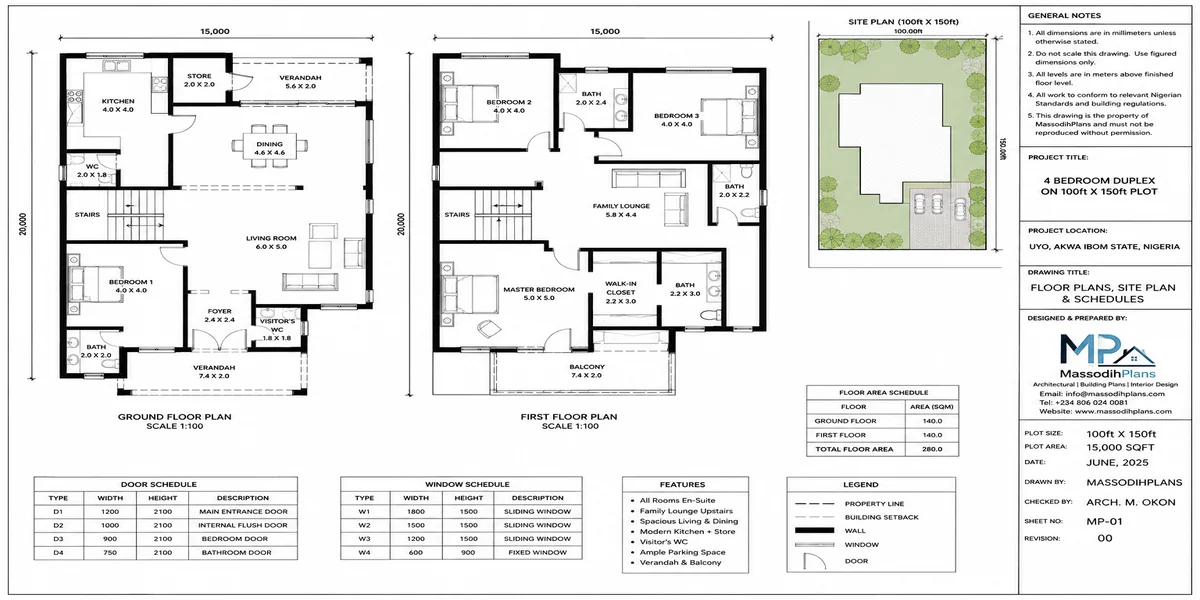
4 Bedroom Duplex Plan for 100×150 Plot in Nigeria
Introduction
Yes, a 100 × 150 ft plot gives you about 15,000 sq ft (1,393.5 m²), which is more than enough space for a 4-bedroom duplex in Nigeria, with room for parking, landscaping, outdoor living and setbacks. But the real question is not, “Can I build a 4-bedroom duplex on 100 × 150?” It is: “How should I use this plot so the house is comfortable, practical, attractive, affordable to build and easy to approve?”
That is what this guide will help you answer.
I will walk you through a practical 4-bedroom duplex plan designed around a 100 × 150 ft Nigerian plot—not just a pretty floor plan. You will see how the site can be organized, where the building can sit, how much space to reserve for setbacks and circulation, how to plan parking and landscaping, and how the rooms can connect for family life.
We will also examine the ground- and first-floor arrangement, bedroom sizes, living and dining spaces, kitchen and service areas, stair placement, balconies, bathrooms, natural lighting and ventilation, security, drainage, water storage, septic systems and outdoor spaces. I will explain the design decisions behind the plan so you can adapt the idea to your own site rather than copy a drawing blindly.
You will learn what can change the project cost: floor area, foundation conditions, finishes, roofing, windows, doors, mechanical and electrical services, external works, location and current material prices. I will also cover estimated construction costs, professional drawings, approvals, structural considerations and common mistakes to avoid before you start.
By the end, you should understand not only what a 4-bedroom duplex can look like on a 100 × 150 plot, but how to make the land work harder for your family and investment.
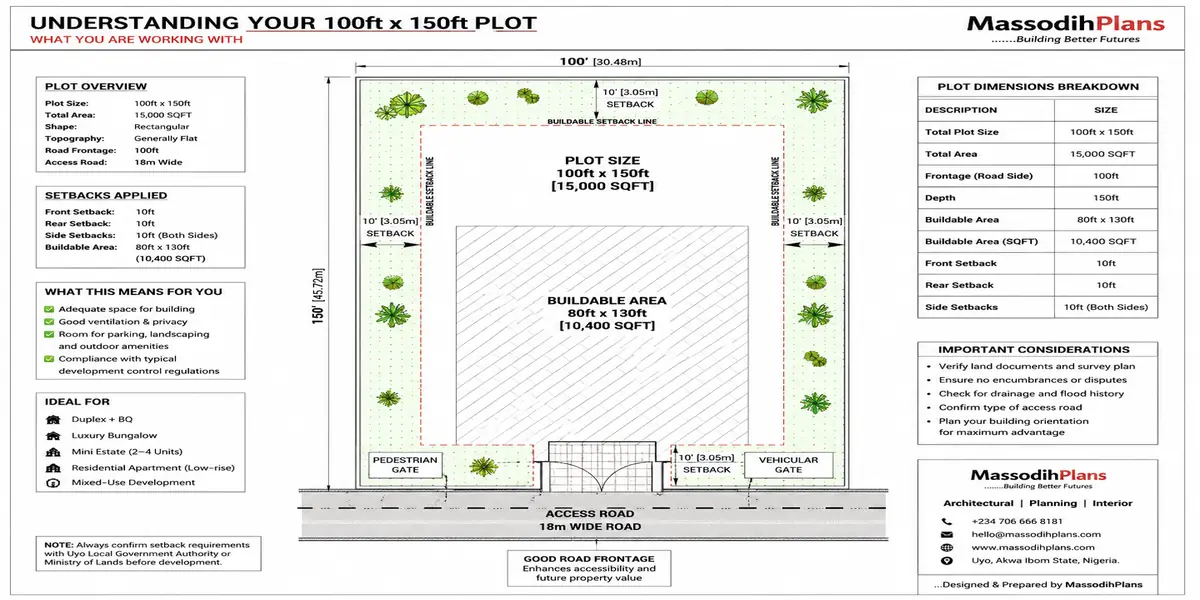
Understanding Your 100×150 Plot: What You Are Working With
Before we look at the plan itself, let us understand the land.
A 50×100 plot gives you a total land area of 5,000 square feet, which is approximately 465 square metres. That sounds generous until you factor in the setbacks required by Nigerian town planning regulations.
Typical Nigerian Setback Requirements
Most state planning authorities in Nigeria require:
- Front setback: 3 metres to 6 metres from the road or plot boundary
- Rear setback: 3 metres minimum
- Side setbacks: 1.5 metres on each side (sometimes 2 metres in newer estates)
After applying a conservative setback of 5 metres front, 3 metres rear, and 1.5 metres on each side, your buildable footprint on a 50×100 plot becomes approximately:
- Width available: 50ft minus 3ft on each side = roughly 44ft (about 13.4 metres)
- Depth available: 100ft minus front and rear setbacks = roughly 75ft (about 22.9 metres)
That gives you a buildable ground floor area of approximately 307 square metres. Spread across two floors, your duplex can have a total floor area of around 560 to 600 square metres. That is more than enough for a comfortable, functional 4 bedroom duplex.
Understanding Your 100×150 Plot: What You Are Working With
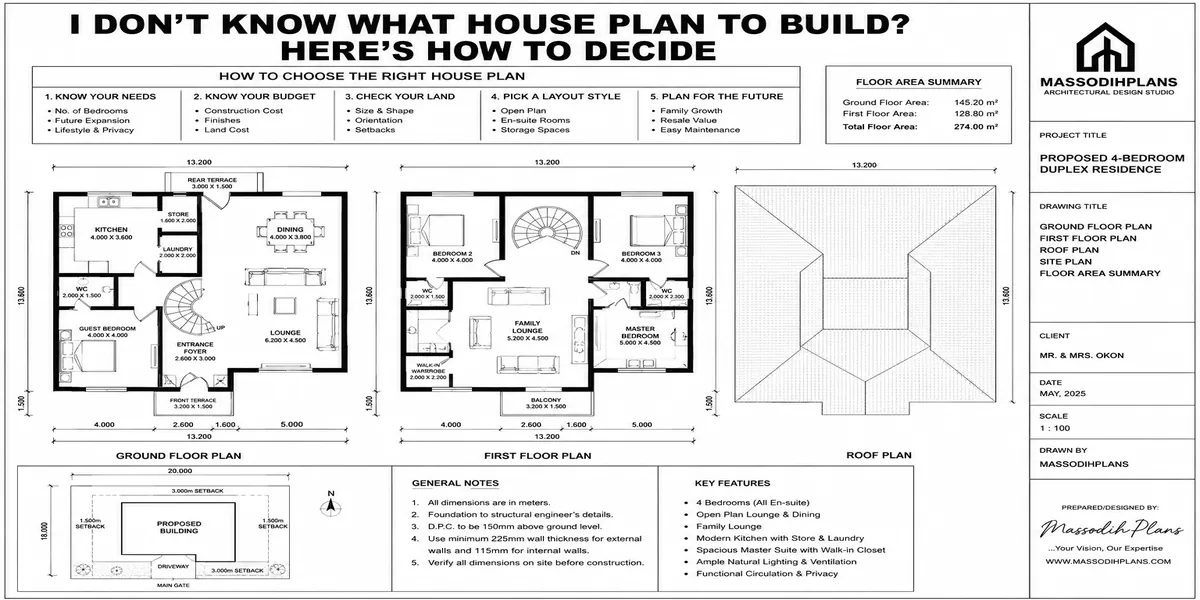
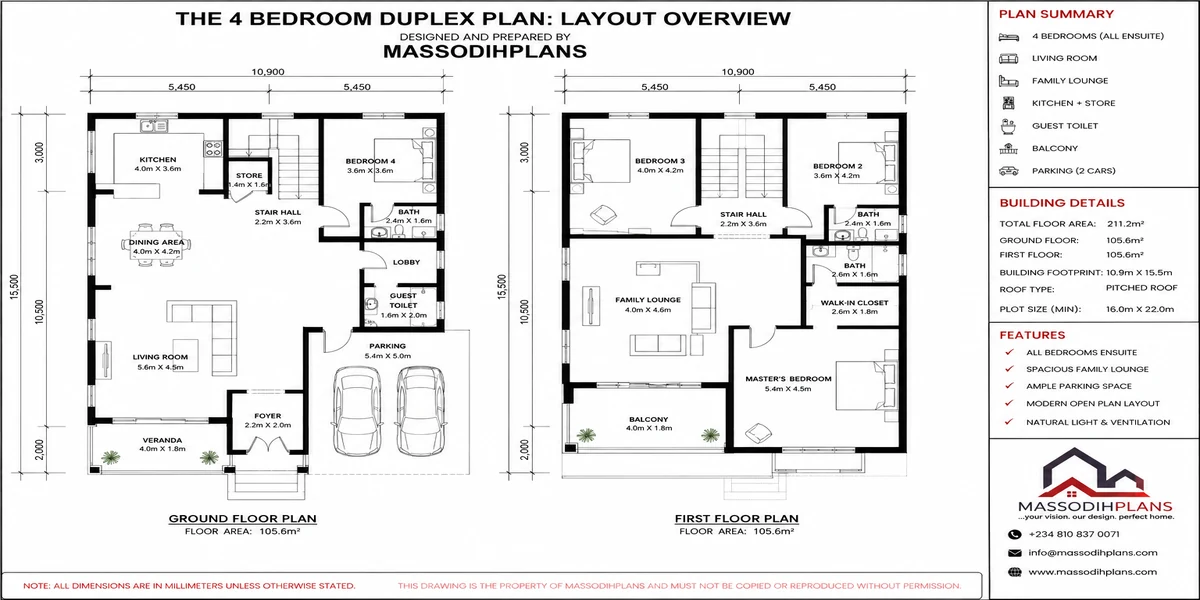
The 4 Bedroom Duplex Plan: Layout Overview
This plan divides the duplex into two well-balanced floors, each serving a distinct lifestyle purpose.
Ground Floor Layout
The ground floor is designed for living, receiving, and utility. It contains:
- A spacious living room (approximately 5.5m x 5m)
- A formal dining area open to the living room
- A well-sized kitchen with a dedicated store/pantry
- One guest bedroom with an en-suite toilet and bath
- A visitor’s toilet (separate from the guest bedroom)
- A covered parking space for one vehicle under the building or to the side
- A utility/laundry area at the rear
- A rear service entrance
The ground floor is intentionally kept public-facing. Guests and visitors never need to go upstairs. The kitchen connects to both the dining area and the rear utility zone, which is practical for daily cooking and domestic work.
First Floor Layout
The first floor is private and reserved for the family. It contains:
- A master bedroom with a walk-in wardrobe and en-suite bathroom (approximately 5m x 4.5m)
- Two standard bedrooms (approximately 4m x 3.5m each), each with built-in wardrobe space
- One additional bedroom that can serve as a study, children’s room, or home office (approximately 3.5m x 3m)
- A shared family bathroom
- An open landing area at the top of the staircase
- A small balcony accessible from the master bedroom or the landing
The layout on the first floor prioritises privacy without sacrificing movement. Each bedroom has a window on at least two walls where possible, and the corridor between rooms is wide enough to feel comfortable but compact enough not to waste space.
The 4 Bedroom Duplex Plan: Layout Overview
Dimensions at a Glance
| Space | Approximate Size |
|---|---|
| Plot size | 50ft x 100ft (465 sqm) |
| Total building footprint | Approx. 12m x 15m |
| Ground floor area | Approx. 180 sqm |
| First floor area | Approx. 180 sqm |
| Total floor area | Approx. 360 sqm |
| Living room | 5.5m x 5m |
| Master bedroom | 5m x 4.5m |
| Standard bedrooms (x2) | 4m x 3.5m each |
| Fourth bedroom/study | 3.5m x 3m |
| Guest bedroom (ground floor) | 4m x 3.5m |
| Kitchen | 4m x 3m |
| Parking space (side) | 5.5m x 3m |
These dimensions leave adequate setback on all sides and allow a small compound area at the front and rear.
Room Arrangement: Why This Layout Works
A lot of Nigerian house plans fail not because of the size but because of poor room arrangement. Rooms that do not relate to each other logically create frustration during daily living.
In this plan, I made intentional decisions:
The kitchen is at the rear of the ground floor. This means cooking smells, noise, and domestic activity stay away from the living and receiving area. It also allows a direct connection to the rear service yard for waste disposal and washing.
The guest bedroom is on the ground floor. Elderly parents, guests, and anyone who struggles with stairs can sleep comfortably without going upstairs. This is a critical consideration many Nigerian families overlook until a parent visits.
The master bedroom is positioned at the front of the first floor. This gives the homeowner a view of the compound entrance and access to the balcony, which is both a ventilation and a lifestyle feature.
The children’s bedrooms are at the rear of the first floor. Children playing or moving around in their rooms does not disturb the master bedroom. Their windows face the rear compound, which is safer.
The staircase is centrally located. It serves both floors without eating into any room’s usable space. The landing at the top creates a natural transition from public movement to private bedrooms.
For a related discussion on how staircase positioning affects small plot duplexes, see our guide on Smart Duplex Design for Narrow Plots in Lekki, Nigeria: Complete Practical Guide.
Ventilation Strategy for This Plan
In Nigeria, ventilation is not a luxury. It is a survival issue. Many parts of the country experience intense heat from March through October, and a poorly ventilated house becomes unbearable without constant generator-powered air conditioning. That is expensive, and it is avoidable with good design.
Cross-Ventilation Design
This plan is designed for cross-ventilation on both floors. Every room has openings on at least two walls. The prevailing wind in most southern Nigerian states comes from the south-southwest, and the plan is oriented to take advantage of this.
Key ventilation features include:
- Large louvre or casement windows at high and low points in each room
- Open landing design at the staircase top, which acts as a natural air shaft
- Kitchen ventilation through a rear window and a ceiling vent above the cooking area
- Balcony on the first floor that draws wind through the master bedroom
Heat Management
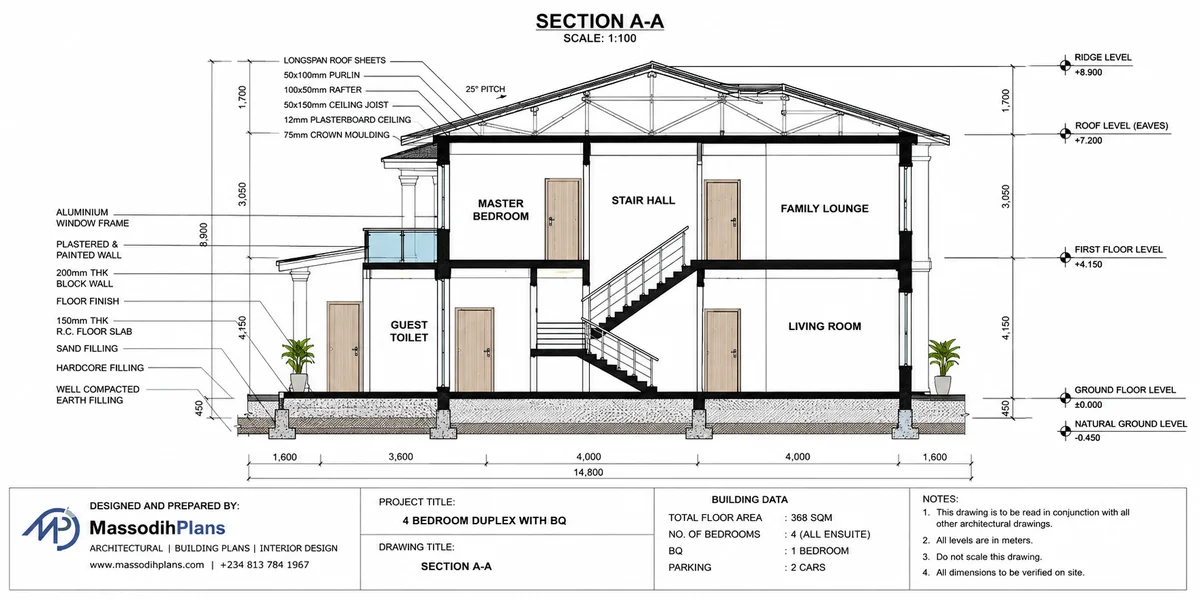
The roof is designed with a generous overhang of at least 600mm on all sides. This shades the walls and windows from direct afternoon sun, significantly reducing heat gain inside the building.
Ceiling height on both floors is set at 3 metres minimum. In Nigeria’s climate, higher ceilings allow hot air to rise and remain above occupant level, making rooms feel cooler without air conditioning.
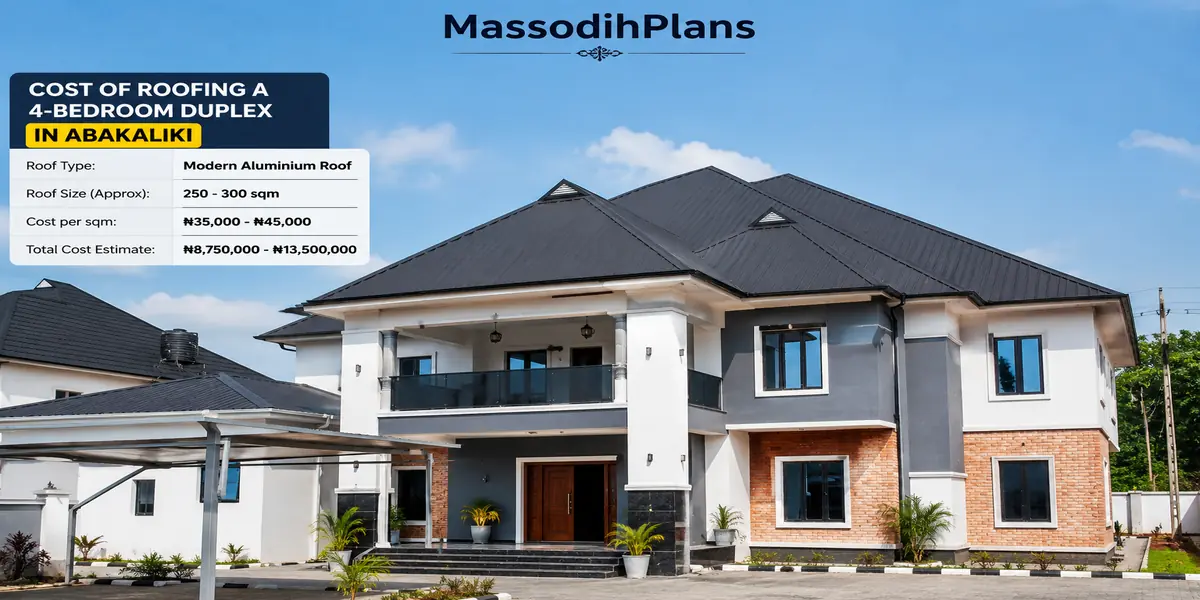
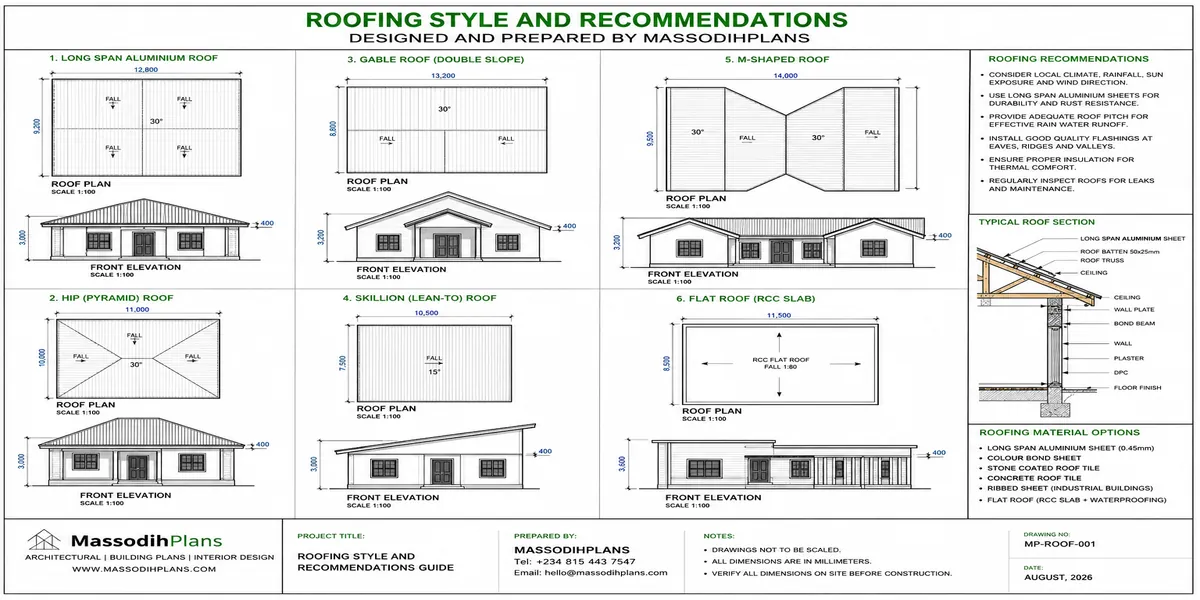
Roofing Style and Recommendations
The recommended roofing style for this plan is a hip roof with moderate pitch.
Why a Hip Roof
A hip roof suits this building for several reasons:
- It provides overhang on all four sides, shading walls equally
- It is more wind-resistant than a gable roof, which is important in coastal and storm-prone regions of Nigeria
- It looks architecturally clean and modern when combined with a flat-roof feature over the balcony section
- It handles Nigerian rainfall more efficiently, directing water away from all walls
Roofing Materials
For this plan, I recommend long-span aluminium roofing sheets (either Step Tile or Milano profile) over a standard timber or steel purlin frame. The advantages:
- Long-span sheets reduce the number of joints and therefore the risk of leaks
- Aluminium is corrosion-resistant, which matters in coastal states like Lagos, Delta, Rivers, and Akwa Ibom
- Step Tile or Milano profiles give the roof a modern tiled appearance without the weight or cost of clay tiles
If your budget allows, consider a lightweight stone-coated steel roofing system. It is more expensive but lasts longer and performs better in high-humidity areas.
For a full comparison of Nigerian roofing materials and their costs, read our article on Best Roofing Materials for Nigerian Houses: Cost, Durability, and Climate Performance.
Roofing Style and Recommendations
Parking Considerations
Parking on a 50×100 plot requires deliberate planning. You cannot afford to lose the entire side of your compound to vehicles.
This plan accommodates parking in two ways:
Option A: Side parking. A 5.5m x 3m open parking bay is carved out on the right side of the compound, leaving just enough room for a car to enter, park, and exit without reversing to the street. A low fence and gate separate this bay from the street.
Option B: Basement-level carport under the building. If the plot terrain allows for a slight grade change, the ground floor can be raised 600mm to 900mm, and a single parking space can be tucked under part of the building. This is more expensive but frees up the entire compound for landscaping or a children’s play area.
For urban plots in Lagos and Abuja where security is a concern, Option B is significantly safer since the car is within the building’s footprint.
Avoid the temptation to park two cars on a 50-foot-wide plot without professional layout advice. Poor parking planning is one of the most common mistakes that leaves Nigerian homeowners with a compound that feels like a car park.
Plot Size Suitability and Orientation
Is 100×150 Enough for This Plan?
Yes, a 50×100 plot is suitable for this 4 bedroom duplex plan. The building sits comfortably within the plot after setbacks, with room for:
- A modest front compound (gate, driveway, small garden)
- A functional rear service yard (generator enclosure, washing area, possibly a small borehole pump house)
- Side access for parking or a pedestrian pathway
Ideal Plot Orientation
The ideal orientation places the longer axis of the plot running north to south. This means:
- The front of the house (living room, main entrance) faces south or east
- The bedrooms on the first floor receive morning sun from the east and are shaded from intense afternoon western sun
- Cross-ventilation works with the prevailing southern winds
If your plot faces west (common in many Nigerian estate layouts), compensate with deep overhangs on the west-facing walls and minimise window openings on that side.
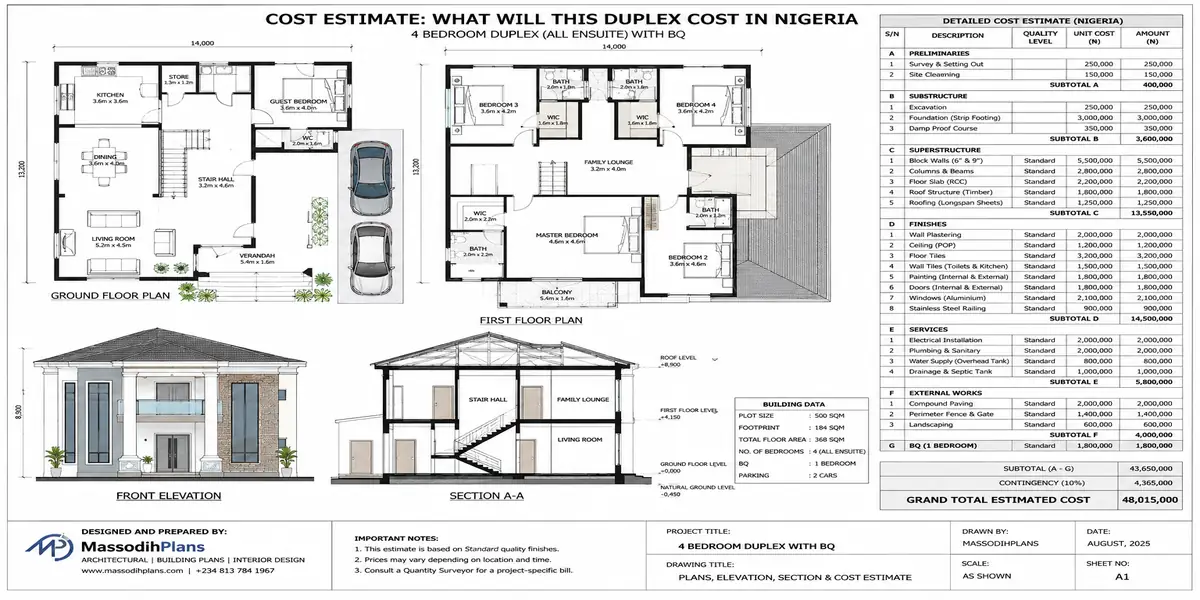
Cost Estimate: What Will This Duplex Cost in Nigeria?
This is the question every serious builder asks. I will give you honest figures, not minimum-possible numbers designed to attract you and shock you later.
Cost estimates vary by state, materials selected, finishing level, and the year you are building. These figures reflect mid-range finishing in a southern Nigerian state as of current market conditions. Always get updated quotes from local suppliers before finalising your budget.
Approximate Cost Breakdown
| Item | Estimated Cost (NGN) |
|---|---|
| Foundation and substructure | 3,500,000 to 5,500,000 |
| Blockwork (ground + first floor) | 4,000,000 to 6,500,000 |
| Roofing (hip, long-span) | 2,500,000 to 4,000,000 |
| Plumbing (supply and waste) | 1,500,000 to 2,500,000 |
| Electrical (wiring, fittings) | 1,500,000 to 2,500,000 |
| Plastering and screeding | 2,000,000 to 3,000,000 |
| Tiling (floor and wall) | 2,500,000 to 4,500,000 |
| Doors and windows | 2,500,000 to 4,000,000 |
| Painting (interior and exterior) | 1,000,000 to 1,800,000 |
| Staircase (concrete or steel) | 800,000 to 1,500,000 |
| Compound fence and gate | 1,500,000 to 2,500,000 |
| Miscellaneous and contingency (10%) | 2,000,000 to 3,500,000 |
| Total Estimate | 25,800,000 to 41,800,000 |
These figures assume mid-range tiles, standard aluminium windows, decent internal doors, and no imported fittings. A high-end finishing will push the upper figure significantly higher. A very basic finishing can bring the lower figure down, but not by as much as most people hope.
For a deeper look at current construction costs across different Nigerian states, see our article on How Much Does It Cost to Build a Duplex in Nigeria
Cost Estimate: What Will This Duplex Cost in Nigeria?
Nigerian Reality Layer: What Your Architect May Not Tell You
Unstable Material Prices
Building material prices in Nigeria can shift dramatically within a single construction period. Cement, iron rods, and blocks are the most volatile. I advise clients to purchase key structural materials (cement, rods, blocks) at the start of construction and store them securely on site, even before the foundation begins. Buying in bulk also attracts better pricing from suppliers.
Power Supply and Generator Space
Plan for a dedicated generator enclosure from day one. The enclosure should be:
- At least 2m x 1.5m (for a medium-sized generator)
- Located at the rear of the compound, away from bedroom windows
- Constructed with ventilation louvres and a lockable steel door
- Connected to the main electrical distribution board via an automatic changeover switch
This is not optional in Nigeria. It is a structural necessity.
Flooding and Drainage
On a 50×100 plot, drainage planning is critical. Before you lay a single block, your builder should:
- Establish the natural drainage direction of the plot
- Design the compound level so water flows away from the building and toward the street or rear drain
- Install French drains or surface channels along the fence lines
Many Nigerian homes suffer avoidable flooding because the compound was not properly graded during construction. The cost of fixing it after the fact is significantly higher than doing it right the first time.
Borehole Planning
If you plan to install a borehole (and in most Nigerian cities, you should), locate it at the front or side of the compound, at least 15 metres from any septic tank or soak away. Mark this position before the fence is built. Repositioning a borehole after construction is both difficult and expensive.
Gatehouse Positioning
If your family’s lifestyle or security situation requires a gatehouse, design it into the fence structure at the front right or front left corner of the compound. A well-integrated gatehouse does not eat into your parking or compound circulation space. An afterthought gatehouse almost always creates problems.
For more on planning a secure Nigerian compound, read our guide on Smart Duplex Design for Narrow Plots in Lekki, Nigeria: Complete Practical Guide
Small Plot Optimisation: Making Every Square Metre Work
A 50×100 plot is not a small plot by Nigerian residential standards. But the duplex sitting on it needs to be designed intelligently so no square metre feels wasted.
Circulation Efficiency
The internal corridors in this plan are kept to their functional minimum. The ground floor has no long corridor. Rooms open directly off the living area or the kitchen zone. On the first floor, the landing is shared by all four bedrooms, eliminating the need for a long wasteful passage.
Multifunctional Spaces
The fourth bedroom is intentionally sized and positioned to serve multiple roles over the life of the building. Today it might be a child’s room. In five years it might become a home office with a dedicated desk area. In fifteen years, when the children leave, it becomes a hobby room, a prayer room, or a guest space. Good architecture plans for the whole life of a building, not just its first use.
Compact Luxury Concepts
Luxury in a Nigerian home is not about square footage alone. It is about finish quality, ceiling height, natural light, and the feeling of space.
This plan achieves compact luxury through:
- 3-metre ceilings on both floors
- Large windows that flood rooms with daylight
- An open-plan living and dining area that feels expansive without being large
- A master bedroom suite that feels hotel-quality because of the walk-in wardrobe and en-suite design, not because of its size
Human Lifestyle Layer: Who Is This Plan For?
Family with Young Children
This plan is excellent for a family with two to three children. The children’s bedrooms are together on the first floor, separated from the master by the landing and bathroom zone. Parents can hear what is happening in the children’s rooms without the noise directly disturbing their sleep.
Family with Elderly Parents
The ground floor guest bedroom is the most important feature for this demographic. An elderly parent can live comfortably on the ground floor without ever needing to climb stairs. The visitor’s toilet is nearby, and the kitchen is accessible. This arrangement maintains family togetherness without the safety risk of elderly persons navigating stairs daily.
Work-From-Home Professionals
The fourth bedroom on the first floor works well as a dedicated home office. It is away from the ground floor noise of the living area and kitchen. A professional working from home has privacy and quiet without being isolated from the family.
Future Family Growth
If you currently have two children and plan for more, this plan accommodates that growth. The fourth bedroom starts as a baby’s room and grows with your family. If your family eventually fills all four bedrooms, the ground floor guest bedroom still handles visiting family without disruption.
Construction Experience Layer: What Builders Get Wrong
After watching dozens of Nigerian housing projects succeed and fail, I have identified the most common construction mistakes on duplex projects of this size.
Poor Foundation Sizing
Many Nigerian builders use the same foundation depth regardless of soil conditions. On expansive clay soils (common in parts of Lagos, Abuja, and Southeast Nigeria), shallow strip foundations will cause cracking within years. Always insist on a soil test before the foundation is designed.
Ignoring Column Positions
Some contractors try to shift column positions during construction because of “site convenience.” Never allow this. Column positions are structurally coordinated with beam spans and floor loading. Moving a column by even 300mm can compromise the structural integrity of the entire floor above.
Rushing the Block Curing Period
Fresh concrete blocks need a minimum of 28 days to cure properly before being used in construction. Many site workers use blocks that are one week old because the schedule is under pressure. The result is excessive wall cracking and water seepage within a few years.
Material Substitution Without Notification
Contractors sometimes substitute specified materials with cheaper alternatives without telling the client. This happens most often with reinforcement steel, pipe diameters, and ceiling board thickness. Specify materials in your contract documents and carry out random site inspections, especially during foundation, concrete casting, and electrical rough-in stages.
For a full guide on supervising your Nigerian building project effectively, read our article on How to Supervise Your Building Project in Nigeria Without Being an Architect.
Investment Layer: What This Duplex Is Worth
Rental Profitability
A 4 bedroom duplex in a decent Nigerian urban neighbourhood is one of the most reliably profitable rental properties in the country. In cities like Lagos, Port Harcourt, or Abuja, a well-finished 4 bedroom duplex on a serviced estate fetches between 2.5 million and 6 million naira per year in rent, depending on location and finishing.
Even in secondary cities like Uyo, Owerri, Benin City, and Ibadan, the same property type generates between 800,000 and 2 million naira annually.
If you are building this duplex as an investment rather than a primary residence, the return on a 30 to 40 million naira construction investment in a good location can be remarkable over a 10-year horizon.
Resale Potential
Duplexes consistently outperform bungalows on the secondary property market in Nigeria. Buyers prefer duplexes because they signal status, provide more usable floor area per plot, and are associated with better-quality neighbourhoods and estates. A well-finished duplex on a titled 50×100 plot in a good Nigerian city location is one of the most liquid real estate assets available to the private buyer.
Estate Suitability
This plan is well-suited for estate developments and gated community environments. The building footprint fits cleanly within the typical 50×100 plot allocation used by most Nigerian real estate developers. If you are a developer building multiple units, this plan’s efficiency and design quality support premium pricing in the estate market.
For a detailed look at how to position a duplex for maximum investment return in Nigeria, see our article on Duplex vs Bungalow Investment: Which Makes More Money in Nigeria.
Security Considerations
Perimeter Fence
The compound fence should be a minimum of 2.2 metres high. For added security in urban areas, top the fence with sharp wire or electric fence installation. Design the fence with no low sections near the gate that can be used for climbing.
Entrance Door
The main entrance door to the duplex should be a reinforced security door with a multi-point locking system. Aesthetically it can look like a standard panel door. Structurally it should resist forced entry.
Window Burglarproofing
All ground floor windows and the first floor balcony door must have burglarproof bars. Use powder-coated flat bar or flat twisted bar designs that look modern and do not give the house a prison appearance. Avoid the old round bar style, which is dated and less resistant.
External Lighting
Install motion-sensitive floodlights at the entrance gate, at the rear compound corners, and above the parking bay. Well-lit compounds are significantly less attractive to intruders.
4 bedroom duplex section plan design
Common Mistakes to Avoid on 50×100 Duplex Projects
- Buying a plan without checking if it actually fits your specific plot dimensions and shape
- Starting construction without approved drawings from your state urban planning authority
- Using the same contractor for both the structural work and the finishing work without separate supervision
- Over-specifying the kitchen and master bathroom at the expense of the structure’s quality
- Building the fence last, which leaves your materials and site workers exposed to theft throughout the project
- Failing to factor in the cost of site preparation, borehole, septic tank, and perimeter drainage when budgeting
- Choosing a staircase design that looks impressive in a picture but consumes too much floor space on both levels
Future Expansion Possibilities
One of the advantages of a thoughtful duplex plan on a 50×100 plot is that there is often room for future additions.
Boys’ Quarters
If your rear setback and town planning regulations allow it, a single-room boys’ quarters (BQ) can be added at the rear of the compound. This serves as staff accommodation or additional family quarters without touching the main building.
Rooftop Addition
With proper structural planning from day one, this duplex can carry a rooftop terrace or a single additional room on the roof level in the future. The columns and beams must be sized for this from the foundation stage. Tell your structural engineer your long-term plans before the foundation is cast.
Drainage and Land Use Considerations
Urban flooding has destroyed the interiors of thousands of Nigerian homes. The solution is not just gutters along the road. It starts on your plot.
Grade your compound to fall away from the building in all directions. Install a perimeter surface drain inside the fence line. Connect all roof downpipes to this drain system rather than allowing roof water to splash against the foundation or pool against the walls.
If your plot is in a flood-prone area (as many Nigerian urban plots are), raise your finished floor level to at least 600mm above the highest flood level observed on the street. This single decision has saved many Nigerian homes from major flood damage.
Material Recommendations Summary
| Element | Recommended Material | Reason |
|---|---|---|
| Block type | 9 inch sandcrete blocks (for walls) | Thermal mass, insulation, cost |
| Foundation | Concrete strip or pad (after soil test) | Depends on soil type |
| Roofing | Long-span aluminium or stone-coated steel | Durability, weight, leakproofing |
| Floor tiles | Vitrified porcelain (600x600mm) | Durability, easy maintenance |
| External paint | Sandtex masonry paint | Waterproof, weatherproof |
| Windows | Aluminium casement with louvres | Ventilation, security, durability |
| Plumbing pipes | PPR or CPVC | Corrosion resistance, longevity |
| Electrical wiring | 2.5mm and 4mm PVC-insulated copper | Safety, capacity |
Related Post:
- 7 Cheapest Areas to Buy Affordable Land in Uyo Before Prices Increase
- Best Places to Buy Land in Uyo for Fast Development and High Property Value
- The StateVision GrowthPlan for Modern Infrastructure Development
- The MegaRegion FlowPlan for Balanced Urban Expansion
- The Proposed FutureGrid Nation Blueprint for Smarter Land Development
- How to Draw a 3 Bedroom Floor Plan in a Small Plot Step by Step
- Best Small Plot House Designs for Modern Urban Living
- Building Approval in Nigeria: Costs, Requirements, Process and How to Get Your House Plan Approved Fast
- 7 Small Plot Design Mistakes Nigerians Make (And How to Fix Them)
- Bungalow vs Duplex: Which is Better to build in Nigeria Today?
- 4 Bedroom House Construction Cost in Lagos: Standard, Mid-Range, and Luxury Building Budget Explained
- 3 Bedroom House Construction Cost in Lagos: Complete Budget Breakdown From Foundation to Final Finishes
Others
- 2 Bedroom House Construction Cost in Lagos: Complete Budget, Materials, Labour, and Finishing Cost Guide
- How Much Does It Cost to Build a House in Lagos? Complete Construction Budget and Cost Breakdown Guide
- Nigeria House Plan Approval Costs: Complete Guide to Getting Building Approval Faster Without Costly Delays
- Lagos Building Plan Approval: Complete Guide to Fees, Documents, Application Process, Timeline, and ePPPS
- Cost of Building a House in Lagos: Complete Budget Guide to Materials, Labour, Design, and Approval Costs
- Architecture & Architectural Design: Complete Guide to Modern Houses, Building Design and Modern Architecture
- Sustainable Landscaping: Complete Guide to Xeriscaping, Landscape Lighting and Water-Efficient Gardens
- Landscaping Services: Complete Guide to Landscape Design, Hardscaping, Garden Planning and Outdoor Improvements
- Landscape Architect: What They Do, What They Design and When You Need One
- Landscaping: Complete Guide to Design Ideas, Gardens, Yards and Outdoor Spaces
- Landscaping & Landscape Design: Complete Guide to Landscape Architecture
- Urban Planning & Urban Design: Complete Guide to Modern Cities, Development and Renewal
- Real Estate Development & Site Planning: Guide to Planning, Construction, Infrastructure and Stormwater Management
- Urban Planning & Urban Design: Complete Guide to City Planning, Zoning and Land Development
- Building Regulations by Country: Permits, Zoning, Codes and Property Development Rules
- Building Regulations and Codes: Complete Guide to Requirements Worldwide
- House Construction Approval Process: Planning, Permits, Inspections and Final Approval
FAQs
1. Is a 100×150 plot enough for a 4 bedroom duplex in Nigeria?
Yes. A 50×100 plot is one of the most common residential plot sizes in Nigeria, and it comfortably accommodates a 4 bedroom duplex with proper setbacks, parking, a front compound, and a rear service yard. The key is working with a plan that is specifically designed for this plot size rather than adapting a larger plan to fit.
2. How many floors does this 4 bedroom duplex have?
This plan has two floors. The ground floor contains the living areas, kitchen, one guest bedroom, and parking. The first floor contains the master bedroom and three additional bedrooms.
3. How much does it cost to build a 4 bedroom duplex in Nigeria?
Based on current market conditions and mid-range finishing, a 4 bedroom duplex of this type costs between 25 million and 42 million naira to build, depending on location, soil conditions, material quality, and labour rates. This figure does not include the cost of the land.
4. Can I build this duplex on a corner plot?
Yes, and a corner plot often gives you more flexibility for parking access and compound arrangement. Corner plots may have different setback requirements on the side facing the secondary road, so confirm this with your local town planning authority.
5. What is the best roofing type for a duplex in Nigeria?
A hip roof with long-span aluminium roofing sheets is the most practical and widely recommended option for Nigerian residential duplexes. It provides shade on all four sides, handles heavy rainfall efficiently, and looks modern. Stone-coated steel roofing is a premium alternative with better aesthetics and longer lifespan.
6. Do I need an architect to build this plan in Nigeria?
Yes. Nigerian law requires that residential buildings of this complexity be designed and supervised by a registered architect and a structural engineer. Beyond legality, professional supervision significantly reduces costly mistakes and protects your investment.
7. Can I convert this duplex into two separate flats later?
A duplex designed as a single-family home can be adapted for separate occupancy, but this requires a deliberate structural and plumbing layout from the beginning. If your long-term plan is a two-flat arrangement, tell your architect at the design stage so independent entrance, plumbing stacks, and electricity supply can be properly planned.
8. How long does it take to build this duplex?
With a well-organised contractor, adequate funding, and uninterrupted material supply, a 4 bedroom duplex of this scale typically takes between 14 and 24 months to reach completion, from foundation to handover. Poor funding flow, rainy season interruptions, and material shortages are the most common causes of delay.
Conclusion
Building a 4 bedroom duplex on a 50×100 plot in Nigeria is one of the most achievable and rewarding housing decisions you can make. When the plan is right, the design is intelligent, and the construction is properly supervised, this project delivers a family home that is comfortable, beautiful, practically designed for Nigerian daily life, and financially sound as a long-term investment.
The plan I have described here is not theoretical. It is a practical, tested layout built around the real dimensions of a 50×100 plot, Nigerian setback requirements, our climate, our security challenges, our power situation, and the way Nigerian families actually live.
What I want you to take away from this article is not just the plan itself but the thinking behind it. Every room has a reason. And every dimension respects both your lifestyle and your land. Every building advice point in this guide comes from watching Nigerian homes succeed and fail, and learning from both.
If you are ready to take the next step, browse the MassodihPlans library for downloadable versions of this plan and related designs. If you need a customised version for your specific plot shape, dimensions, or family requirements, reach out to our team for a consultation.
And if this article helped you understand your project better, share it with someone who is also planning to build. Good housing knowledge shared freely is how we help more Nigerian families build better homes.
Call to Action
Ready to Build Your 4 Bedroom Duplex?
Browse the complete MassodihPlans library and download this plan with full architectural drawings, structural guidelines, and a detailed specification sheet. Whether you are building in Lagos, Abuja, Port Harcourt, Enugu, Uyo, or anywhere across Nigeria, this plan is ready for your site.
Browse House Plans Library | Request a Custom Plan | Contact Our Team
Not sure which plan is right for your plot? Read our free guide: How to Choose the Right House Plan for Your Nigerian Plot.
MassodihPlans is a Nigerian-focused house plans and architecture education platform helping families build better homes on every budget and every plot size.
Author
Massodih Okon is a Nigerian built-environment professional with academic and professional experience in urban and regional planning, geography, architectural design, Landscape Design, GIS and land development.
He holds a Master’s degree in Urban and Regional Planning from the University of Uyo and a first degree in Geography and Regional Planning.
Through MassodihPlans, he publishes practical guides on Nigerian house plans, building design, physical planning, site planning, development approval and residential construction. Read the full author profile →