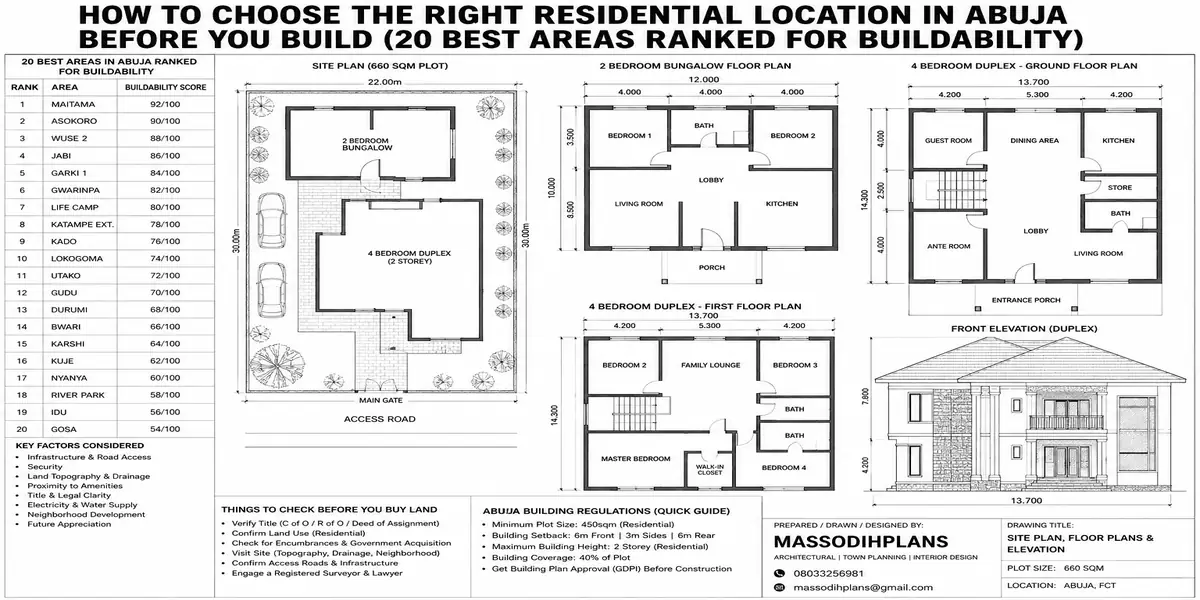
How to Choose the Right Residential Location in Abuja Before You Build
Choosing where to build a house in Abuja is not simply about finding a beautiful neighbourhood or buying the cheapest plot you can afford. The right residential location can determine your building cost, daily commute, drainage problems, access to utilities, security, future property value, and even how easy it will be to obtain development approval.
If you are asking, “Where is the best place to build in Abuja?”, I want you to look at the question differently. Maitama may be prestigious, Gwarinpa may offer space, Jahi may feel like a growth corridor, and Lugbe may look attractive on a tighter budget but the “best” location depends on what you are building, who will use it, how much you can spend, and what the land can actually support.
In this guide, I will take you beyond the usual list of “best areas to live in Abuja.” We will rank 20 locations specifically from a buildability perspective, considering road access, drainage and flood exposure, topography, infrastructure, land-use compatibility, neighbourhood character, security, proximity to essential services, development pressure, plot suitability, and long-term investment potential. Abuja’s planning system matters too: the FCT’s planning authorities prepare and monitor land-use plans and development standards, while Development Control oversees building development in line with the Abuja Master Plan.
Most importantly, I will show you what to inspect before paying for land including the questions to ask, warning signs that should make you walk away, and how to match an area with your house type and budget.
So, before you fall in love with a plot because of its location, let’s determine whether it is actually a smart place to build. That difference can save millions and years of regret.
Why “Best Place to Live” and “Best Place to Build” Are Different Questions
A neighbourhood can be a wonderful place to rent and a genuinely difficult place to build, and vice versa. Three reasons this happens constantly in Abuja:
Title type varies enormously by district. Land with a proper Certificate of Occupancy (C of O) from the FCT Administration is fundamentally different, legally and practically, from land held under an Excision, a Right of Occupancy pending regularization, or informally acquired “family land” on the city’s fringes. You can live happily as a tenant on any of these. You cannot safely build on all of them without serious title risk.
Terrain in Abuja is not uniform. Unlike Lagos, where the main site-selection concern is waterlogging and soft coastal soil, Abuja’s challenge is often the opposite rocky, undulating terrain in districts like Katampe and parts of Guzape that dramatically increases excavation and foundation cost, alongside genuinely flat, easy-to-build areas elsewhere in the same general vicinity.
Formal districts follow the Abuja Master Plan; many satellite areas don’t, or only partially do. Districts developed directly under the FCDA master plan have surveyed layouts, defined setbacks, and planned infrastructure corridors. Many satellite towns and informal extensions grew organically, which means plot boundaries, road reservations, and drainage paths are far less predictable — and far more likely to create approval headaches later.
Before you fall in love with a plot’s price or its neighbourhood reputation, ask two questions no rental guide will prompt you to ask: what title does this land actually carry, and has this specific district been formally planned under the FCDA master plan or developed informally? Those two answers matter more to a builder than almost anything else on this list.
The Six Factors That Actually Determine Buildability
1. Title Type and Documentation
In descending order of security for a builder: Certificate of Occupancy (C of O) issued directly by FCT Administration, Right of Occupancy with clear regularization status, Excision-based title with documented consent, and informal/customary land without federal documentation. Building on the last category carries real risk of demolition, since the FCT Administration has continued periodic enforcement against unapproved structures on undocumented land across the territory.
2. Terrain and Soil Condition
Abuja’s landscape includes rocky outcrops, undulating hills, and flat plains, sometimes within the same district. A soil test and topographical survey before purchase not after tells you whether you’re buying a straightforward strip-foundation plot or one that will need expensive rock breaking or a raft/pile foundation.
3. FCDA Master Plan Compliance
Districts developed as part of the original Abuja master plan (Phases 1–4 broadly cover Maitama, Asokoro, Wuse, Garki, and similar core areas) have the most predictable setbacks, road networks, and drainage infrastructure. Later phases and satellite towns vary in how completely they follow master-plan principles some are well-planned extensions, others are informal growth that planning authorities are still working to regularize.
4. Infrastructure Readiness
Road access, drainage, water supply, and power availability at the time you buy not projected for “when the government finishes the road” should drive your decision. Land priced attractively because infrastructure is “coming soon” is a real opportunity in growth corridors, but it’s a different risk profile from land in an already-serviced district, and you should price that risk in.
5. Distance from District/Area Council Planning Authority
Districts under direct FCDA/AMMC administration typically process building approvals differently from areas under Area Council authority (AMAC, Bwari, Gwagwalada, Kuje, and others). Knowing which authority governs your plot before you buy tells you what approval process and timeline to actually expect.
6. Plot Cost Relative to Construction Cost
A cheap plot in a district with difficult terrain or poor infrastructure can end up costing more overall than a pricier plot on flat, serviced land once you add the excavation, foundation, road, and utility connection costs the cheap plot requires. Always evaluate land price and likely construction cost together, not land price alone.
Never rely on a land seller’s verbal assurance about title or master-plan status. Verify directly with the FCT Administration’s land registry (or a registered surveyor/lawyer acting on your behalf) before any payment changes hands. Abuja has an active history of multiple sales on the same plot and disputed Excision boundaries, and this single verification step is the most important money you’ll spend before construction even begins.
20 Residential Locations in Abuja, Ranked for Buildability
Tier 1: Prime Districts Highest Title Security, Established Infrastructure, Premium Land Cost
1. Maitama Core FCDA master plan district, C of O land the norm, generally flat and favourable terrain, fully serviced. Land cost is the highest in the FCT; buildability is excellent, but this tier is about capital, not construction difficulty.
2. Asokoro Similarly core to the original master plan, mostly flat with some elevated sections offering good drainage, strong title security, mature infrastructure. Some plots near the hills need a proper topographical survey before foundation design.
3. Guzape Hilly and elevated in sections, which affects foundation cost but also gives some plots genuinely striking views and natural drainage advantages. Title is generally strong, though verify boundaries carefully in the more recently developed sections.
4. Wuse II Fully serviced, flat, established master-plan district, though residential plots here are increasingly scarce and command commercial-adjacent pricing.
Tier 2: Established Family Districts Strong Infrastructure, Moderate-to-High Land Cost
5. Gwarinpa One of Africa’s largest planned housing estates, laid out on genuinely flat, easy-to-build terrain with a formal grid layout. Title is generally secure though plot sizes and specific sub-scheme documentation vary confirm which phase/scheme a plot sits in before purchase.
6. Life Camp Master-plan-adjacent, largely flat, well-connected by road, strong infrastructure. A reliable choice for straightforward construction with minimal terrain surprises.
7. Jabi Mostly flat with good road access; some low-lying sections near the lake require drainage checks before foundation design, since proximity to Jabi Lake affects water table depth in places.
8. Katampe (Main) Flat-to-gently-sloped in most sections, formally planned, strong infrastructure trajectory. A dependable buildability choice within the diplomatic-adjacent zone.
9. Katampe Extension More undulating and hilly than Katampe Main in places, which raises foundation and access-road cost on some plots but also offers elevation and view advantages. Verify individual plot topography rather than assuming the district’s terrain is uniform.
10. Mabushi Flat, centrally located, well-serviced, generally straightforward for construction with minimal terrain complications.
Tier 3: Growth Corridors Developing Infrastructure, Mixed Title Status, Moderate Land Cost
11. Jahi Flat and generally favourable terrain between Katampe and Gwarinpa, with infrastructure actively improving. Confirm current road and drainage completion status for the specific street, since this is a district still catching up to its master-plan vision in parts.
12. Dawaki Largely flat and increasingly serviced, popular for its land cost relative to proximity, but title documentation is more mixed here than in Tier 1–2 districts verification is essential before purchase.
13. Karsana Flat terrain, expanding infrastructure, generally more affordable land cost, but as a newer growth area, confirm current access road and drainage status against the district’s master plan rather than assuming full completion.
14. Lokogoma Gently rolling terrain in sections, established residential character, reasonably serviced with continuing infrastructure investment. A solid mid-tier buildability choice.
15. Apo Mixed flat and gently sloped terrain, meaningful existing infrastructure and a fair number of formally planned estates within the district, though verify specific plot documentation given the mix of formal and less-formal development in different pockets.
16. Gudu Flat terrain, reasonably central, moderate infrastructure; a workable option with generally manageable construction conditions.
Tier 4: Affordable and Emerging Areas Lower Land Cost, Higher Diligence Required
17. Kubwa Flat-to-gently-sloped, large and well-established as a satellite town with substantial existing housing stock, but title type varies significantly by specific scheme some areas hold strong FCDA-recognized documentation, others require more careful verification.
18. Lugbe Mostly flat, close to the airport corridor, considerable existing development with infrastructure that has improved significantly but remains uneven street to street check road and drainage completion for your specific plot rather than the district generally.
19. Karu Mixed terrain and mixed title status, functioning as both an FCT and Nasarawa State border area in parts this specific detail matters enormously and must be confirmed, since building regulations and the approving authority can differ depending on which side of the boundary a plot falls.
20. Bwari More varied, hillier terrain in sections given its location further from the city core, with infrastructure and title documentation earlier in their development trajectory than the districts above. Land cost is correspondingly lower genuinely worth considering for long-term growth potential, but budget extra diligence time and a proper topographical survey before committing.
Tier 3 and Tier 4 districts are where the real investment opportunity in Abuja tends to sit but they’re also where the due diligence gap between “looks like a good deal” and “is actually a good deal” is widest. Never skip a professional title search and site survey on these plots just because the price feels right.
Quick Comparison: Buildability at a Glance
| District | Terrain | Title Security | Infrastructure | Land Cost |
|---|---|---|---|---|
| Maitama, Asokoro | Mostly flat | Very high | Mature | Very high |
| Guzape | Hilly | High | Mature | High |
| Gwarinpa, Life Camp, Mabushi | Flat | High | Strong | Moderate-high |
| Katampe/Ext, Jabi | Flat-hilly mix | High | Strong, improving | Moderate-high |
| Jahi, Lokogoma, Apo, Gudu | Mostly flat | Moderate-high | Developing | Moderate |
| Dawaki, Karsana | Flat | Mixed — verify | Developing | Moderate-low |
| Kubwa, Lugbe | Flat-gentle | Mixed — verify | Improving, uneven | Low-moderate |
| Karu, Bwari | Mixed | Mixed — verify carefully | Early-stage | Low |
Red Flags to Watch For Before You Buy Land in Abuja
Multiple “agents” offering the same plot a strong signal of disputed or multiply-sold land
No C of O, and the seller can’t explain the actual title status clearly vague answers about “processing” are a warning, not a minor detail
A plot boundary that doesn’t match the survey plan on the ground always physically verify beacon positions with a licensed surveyor, not just the paperwork
Land significantly cheaper than everything else in the immediate area with no clear explanation price gaps this large usually reflect a real problem, not luck
Pressure to pay quickly “before another buyer takes it” legitimate transactions allow time for proper title verification; urgency pressure is a classic red flag across Nigerian land markets, not just Abuja
A Practical Due Diligence Sequence Before You Buy
Identify the governing authority FCDA/AMMC directly, or the relevant Area Council for the specific plot
Conduct a title search at the FCT land registry to confirm the seller’s documented ownership and title type
Engage a licensed surveyor to verify plot boundaries against the survey plan physically, on site
Commission a soil test and topographical assessment before finalizing price, since terrain directly affects your construction budget
Confirm current infrastructure status (road, drainage, water, power) rather than relying on projected or promised completion
Check zoning and any estate-specific covenants that will govern what you’re allowed to build
Engage a lawyer for conveyancing before any funds are released, independent of the seller’s or agent’s recommended lawyer
Frequently Asked Questions
What is the most important factor when choosing land in Abuja to build on, not just live on?
Title security. A beautiful, well-located plot with unclear or disputed title is a far bigger risk to a builder than a less glamorous plot with a clean, verified Certificate of Occupancy.
Is cheaper land in emerging Abuja districts a good idea for building?
It can be a genuinely strong opportunity, but it requires more diligence, not less verify title and terrain carefully, since the lower price often reflects earlier-stage infrastructure and less mature documentation rather than a straightforward bargain.
Does hilly terrain in districts like Katampe Extension or Guzape make building impossible?
No, but it changes your foundation design and cost. A proper topographical survey and soil test before purchase let your structural engineer plan for the terrain rather than discovering it mid-construction.
Should I use the same lawyer or surveyor recommended by the land seller?
No. Engage your own independent lawyer and surveyor for title search and boundary verification a professional recommended by the seller has an inherent conflict of interest in a transaction meant to protect you.
How does building authority differ between FCDA/AMMC districts and Area Council areas like Karu or Bwari?
Districts under direct FCDA/AMMC administration typically have more established, centralized approval processes, while Area Council-governed areas (AMAC, Bwari, Gwagwalada, Kuje, Kwali) follow their own local processes confirm which authority governs your specific plot, since this affects your approval timeline and requirements.
Conclusion
Choosing where to live in Abuja and choosing where to build in Abuja are genuinely different exercises, and conflating them is how good people end up with land they can’t easily build on, or a construction budget blown open by terrain and infrastructure surprises nobody flagged before the purchase. Title security, terrain, master-plan compliance, and real infrastructure status checked before you pay, not after are what actually separate a good building plot from a good-looking one.
If you’re at the land-selection stage, our Services page outlines how we support clients with site assessment and design before a purchase is finalized. Browse our Plans Library for house designs suited to a range of plot conditions and sizes, or visit Plan School to understand the building approval process once your land is secured. You can also explore more site-selection and building guides on our Homepage.
Related Guides
- Semi-Detached House Plans: Modern Duplex and Bungalow Designs With Shared Walls, Dimensions, Costs and Layout Ideas
- Courtyard House Plans: Beautiful 2–6 Bedroom Designs With Private Outdoor Spaces, Floor Plans and Dimensions
- Contemporary House Plans: Modern 2–6 Bedroom Designs With Open Layouts, Large Windows, Dimensions and Costs
- House Finishing Cost in Nigeria: Complete Breakdown of Tiles, Painting, Ceiling, Doors, Plumbing and Electrical Work
- Foundation Cost Calculator: Estimate House Foundation Cost From Soil Type, Dimensions, Materials and Labour
- Block Quantity Calculator: How to Calculate the Number of Blocks Needed for Any House From Your Floor Plan
- Cement Quantity Calculator for Building: Calculate Bags Needed for Foundation, Blockwork, Slab, Plastering and Screeding
- Self-Contained House Plans: 15 Efficient Designs With Room Dimensions, Floor Plans, Building Costs and Ideas
- 1 Bedroom House Plan: Affordable Self-Contained Floor Plans With Dimensions, Materials, Cost and Space-Saving Ideas
- 6 Bedroom House Plans: Modern Nigerian Floor Plans With Dimensions, Ensuite Rooms, Parking and Cost Estimates
- How to Choose the Right Residential Location in Lagos Before You Build
- 10 Best House Plans for Small Plots in Nigeria: What Buyers Should Consider
- How to Choose the Right House Plan Based on Your Plot Size in Nigeria Today
- How GIS Can Help You Choose the Right Land for Your Dream House in Nigeria
- How to Identify Flood Risk Before Building a House in Nigeria Today, Safely
- How to Analyse a Building Site Before Choosing a House Plan in Nigeria
- How to Check a Plot of Land Before Buying It in Nigeria: Complete Guide
- How to Choose the Right Land for Building a House in Nigeria Safely Today
- How Much Does It Cost to Build a House in Nigeria? Full Guide to Materials, Labour, Foundation, Roofing and Finishing
- Roofing Quantity Calculator: Calculate Roofing Sheets, Timber, Nails, Ridge Caps and Accessories From Your House Plan
- Best 4 Bedroom House Plan for Small Plots in Abuja
- Cost of Roofing a Bungalow and Duplex in Abuja Small Plot Now
Author
Massodih Okon is a Nigerian built-environment professional with academic and professional experience in urban and regional planning, geography, architectural design, Landscape Design, GIS and land development.
He holds a Master’s degree in Urban and Regional Planning from the University of Uyo and a first degree in Geography and Regional Planning.
Through MassodihPlans, he publishes practical guides on Nigerian house plans, building design, physical planning, site planning, development approval and residential construction. Read the full author profile →