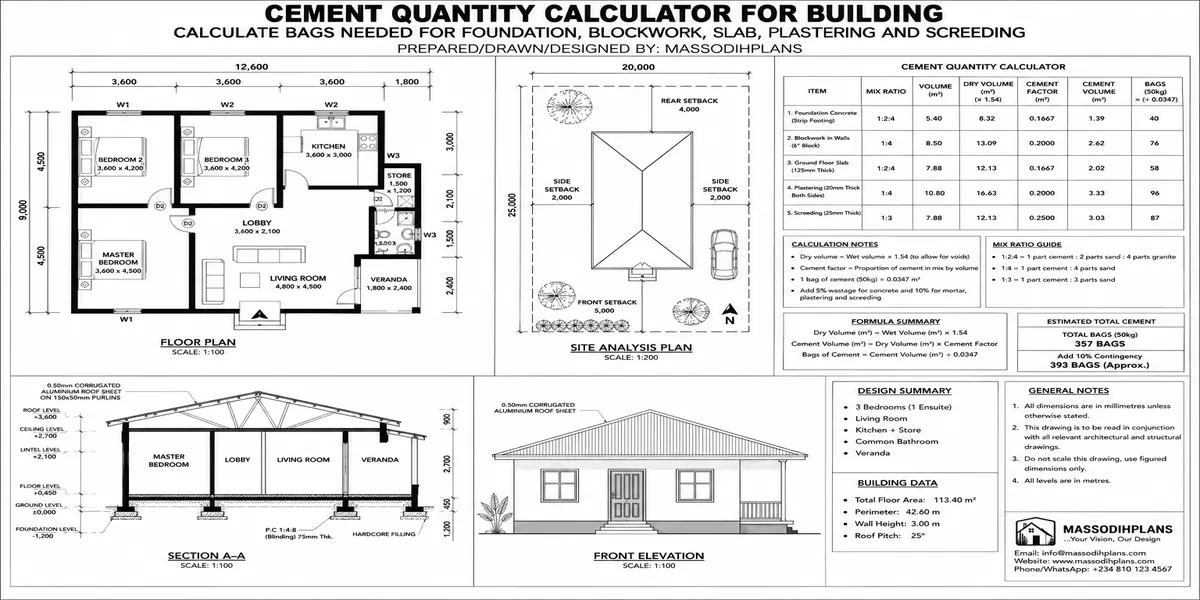
Cement Quantity Calculator for Building: Calculate Bags Needed for Foundation, Blockwork, Slab, Plastering and Screeding
Introduction
Are you are asking, “How many bags of cement do I need to build my house?”, the honest answer is: it depends on what you are building, the dimensions, thickness, mix ratio, foundation type, and the amount of wastage on site. That is why a cement quantity calculator should do more than give you one random number.
In this guide, I’ll show you how to calculate cement requirements for the stages of construction foundation concrete, footing and blinding, blockwork mortar, floor slabs, columns and beams, wall plastering, and floor screeding. You’ll see the formulas, examples, conversion steps, mix-ratio logic, and the way to turn your measured quantities into 50 kg bags before you buy.
More importantly, I’ll help you avoid two mistakes that quietly increase building costs: underestimating cement and buying far more than your project needs. An estimate should account for dimensions and thickness, the selected mix, dry-volume conversion, material characteristics, workmanship, and a sensible wastage allowance. Published calculators commonly use these principles, while professional tools also separate concrete, mortar, plaster and screed calculations because each application behaves differently.
If you are building in Nigeria, this guide also puts the calculation into a local context, including common 50 kg cement bags and examples relevant to Nigerian residential construction. But remember: a calculator is an estimating tool, not a substitute for structural drawings, an engineer’s specification, or a bill of quantities.
By the end, you’ll know not only how many bags you need, but why that number makes sense and how to check it before spending your money. I’ll also show you where cement consumption can change dramatically, so you can budget with confidence instead of guessing.
The Two Numbers Every Cement Calculation Starts From
Before the formulas, two constants apply to every calculation below.
1. One bag of cement weighs 50kg and has a volume of approximately 0.0347 m³ (roughly 1.226 cubic feet). This is your conversion factor from “volume of cement needed” to “number of bags to buy.”
2. Dry volume factor: multiply wet (mixed) concrete or mortar volume by 1.54 before splitting it into cement, sand, and aggregate proportions. When cement, sand, and water are dry and separate, they take up more space than they do once mixed and compacted the particles fill each other’s gaps. This factor accounts for that difference and for normal bulking, and it is the step most rough estimates skip entirely, which is the single biggest reason DIY cement estimates run short.
Always calculate your dry volume first, then split it by mix ratio, then convert to bags in that exact order. Reversing the order (splitting by ratio first, then trying to apply the 1.54 factor) is the most common cause of calculation errors I see on site.
1. Foundation Concrete: How Many Bags of Cement You Need
Foundation concrete in Nigeria is typically mixed at 1:3:6 (lean/mass concrete for strip foundations on stable soil) or 1:2:4 (for foundations bearing higher structural load, or where soil conditions demand extra strength).
Formula
Step 1: Foundation volume (m³) = Length × Width × Depth of the concrete strip/base
Step 2: Dry volume = Wet volume × 1.54
Step 3: Cement volume = Dry volume × (1 ÷ Sum of ratio parts)
Step 4: Cement quantity (bags) = Cement volume ÷ 0.0347
Worked Example
A strip foundation for a standard 4 bedroom duplex: 45 metres of total foundation run, 0.6m wide, 0.6m deep, mixed at 1:3:6 (ratio sum = 10).
- Wet volume = 45 × 0.6 × 0.6 = 16.2 m³
- Dry volume = 16.2 × 1.54 = 24.95 m³
- Cement volume = 24.95 × (1 ÷ 10) = 2.495 m³
- Cement bags = 2.495 ÷ 0.0347 = ≈ 72 bags
For the same volume at a stronger 1:2:4 mix (ratio sum = 7): Cement volume = 24.95 × (1 ÷ 7) = 3.56 m³ → ≈ 103 bags.
Quick Reference: Cement Bags per m³ of Foundation Concrete
| Mix Ratio | Common Use | Bags per m³ (wet volume) |
|---|---|---|
| 1:4:8 | Blinding/mass fill, non-structural | ~3.3 bags |
| 1:3:6 | Standard strip foundation, stable soil | ~4.4 bags |
| 1:2:4 | Higher-load foundations, columns tied to footing | ~6.3 bags |
| 1:1.5:3 | Structural columns/beams above foundation | ~8.1 bags |
2. Blockwork: How Many Bags of Cement for Mortar
This is the stage almost every online cement calculator gets vague about, because it depends on block size, joint thickness, and whether you’re using hollow or solid blocks details that matter a lot in Nigerian construction specifically.
Formula
Step 1: Wall area (m²) = Wall length × Wall height (subtract door/window openings)
Step 2: Number of blocks = Wall area ÷ Face area of one block (0.45m × 0.225m for standard 6"/9" blocks = 0.101 m² per block face)
Step 3: Mortar volume = Number of blocks × Mortar volume per block joint (approx. 0.0025 m³ per block for standard 10mm joints on a 6" block; approx. 0.0035 m³ for a 9" block)
Step 4: Dry mortar volume = Mortar volume × 1.33 (mortar uses a lower bulking factor than concrete since it has no coarse aggregate)
Step 5: Cement volume = Dry mortar volume × (1 ÷ Sum of ratio parts) — standard blockwork mortar is 1:6
Step 6: Cement bags = Cement volume ÷ 0.0347
Worked Example
A 9-inch block wall, 30 linear metres, 3m high, minus 12 m² of door/window openings, mortar mix 1:6.
- Wall area = (30 × 3) − 12 = 78 m²
- Number of blocks = 78 ÷ 0.101 = 772 blocks
- Mortar volume = 772 × 0.0035 = 2.70 m³
- Dry mortar volume = 2.70 × 1.33 = 3.59 m³
- Cement volume = 3.59 × (1 ÷ 7) = 0.513 m³
- Cement bags = 0.513 ÷ 0.0347 = ≈ 15 bags
Note: this covers mortar joints only it does not include the blocks themselves or plastering, which is calculated separately below.
Quick Reference: Cement Bags for Blockwork Mortar (1:6 mix, per 100 blocks laid)
| Block Type | Approx. Bags per 100 Blocks |
|---|---|
| 6-inch hollow block | ~1.9 bags |
| 9-inch hollow block | ~2.7 bags |
| Solid/dense block (either size) | ~3.2–3.8 bags |
Hollow sandcrete blocks use meaningfully less cement in both the blocks themselves and their mortar joints than solid blocks, while still meeting structural requirements for most residential walls when properly reinforced factor this into both your cement budget and your block-purchase decision, not just one or the other.
3. Slab (Suspended Floor / Roof Slab): How Many Bags of Cement
Slab concrete is structural and typically mixed at 1:2:4, sometimes 1:1.5:3 for higher-load slabs (larger spans, heavier finishes, additional storeys above).
Formula
Step 1: Slab volume (m³) = Length × Width × Thickness
Step 2: Dry volume = Wet volume × 1.54
Step 3: Cement volume = Dry volume × (1 ÷ Sum of ratio parts)
Step 4: Cement bags = Cement volume ÷ 0.0347
Worked Example
A first-floor slab: 12m × 10m, 150mm (0.15m) thick, mixed at 1:2:4.
- Wet volume = 12 × 10 × 0.15 = 18 m³
- Dry volume = 18 × 1.54 = 27.72 m³
- Cement volume = 27.72 × (1 ÷ 7) = 3.96 m³
- Cement bags = 3.96 ÷ 0.0347 = ≈ 114 bags
Quick Reference: Cement Bags per m³ of Slab Concrete
| Mix Ratio | Typical Use | Bags per m³ |
|---|---|---|
| 1:2:4 | Standard residential floor/roof slab | ~6.3 bags |
| 1:1.5:3 | Heavier-load slabs, longer spans | ~8.1 bags |
Always calculate slab volume using the actual poured thickness from your structural drawing, not a rounded estimate. A slab poured even 20mm thicker than specified across a large floor area adds up to several extra cubic metres and several extra bags of cement that a rough guess won’t catch.
4. Plastering: How Many Bags of Cement per Square Metre
Plastering is usually mixed at 1:4 or 1:6, applied at a standard thickness of 12mm for internal walls and 15mm for external walls (external walls need the extra thickness for weather resistance).
Formula
Step 1: Plaster area (m²) = Wall length × Wall height (both faces if plastering both sides) − openings
Step 2: Wet volume = Plaster area × Thickness (in metres)
Step 3: Dry volume = Wet volume × 1.33
Step 4: Cement volume = Dry volume × (1 ÷ Sum of ratio parts)
Step 5: Cement bags = Cement volume ÷ 0.0347
Worked Example
Internal plastering for a room: 40 m² of wall area, 12mm thick, mix 1:4.
- Wet volume = 40 × 0.012 = 0.48 m³
- Dry volume = 0.48 × 1.33 = 0.638 m³
- Cement volume = 0.638 × (1 ÷ 5) = 0.128 m³
- Cement bags = 0.128 ÷ 0.0347 = ≈ 3.7 bags
Quick Reference: Cement Bags per m² of Plastering
| Thickness | Mix Ratio | Bags per m² |
|---|---|---|
| 12mm (internal) | 1:4 | ~0.092 bags |
| 12mm (internal) | 1:6 | ~0.066 bags |
| 15mm (external) | 1:4 | ~0.115 bags |
| 15mm (external) | 1:6 | ~0.082 bags |
For a full house, multiply your total internal and external wall area (both faces where applicable) by the figure matching your chosen mix and thickness.
5. Screeding: How Many Bags of Cement for Floor Screed
Screeding the cement-sand layer applied over a slab to create a smooth, level floor finish before tiling is typically mixed at 1:3 or 1:4, applied at 25–50mm thickness depending on the floor’s condition and finish requirements.
Formula
Step 1: Floor area (m²) = Length × Width of the area to be screeded
Step 2: Wet volume = Floor area × Thickness (in metres)
Step 3: Dry volume = Wet volume × 1.33
Step 4: Cement volume = Dry volume × (1 ÷ Sum of ratio parts)
Step 5: Cement bags = Cement volume ÷ 0.0347
Worked Example
Floor screeding: 80 m² of floor area, 40mm thick, mix 1:3.
- Wet volume = 80 × 0.04 = 3.2 m³
- Dry volume = 3.2 × 1.33 = 4.256 m³
- Cement volume = 4.256 × (1 ÷ 4) = 1.064 m³
- Cement bags = 1.064 ÷ 0.0347 = ≈ 31 bags
Quick Reference: Cement Bags per m² of Screeding
| Thickness | Mix Ratio | Bags per m² |
|---|---|---|
| 25mm | 1:3 | ~0.24 bags |
| 40mm | 1:3 | ~0.38 bags |
| 50mm | 1:4 | ~0.36 bags |
Full Worked Example: A 4 Bedroom Duplex, Stage by Stage
Pulling all five calculations together for a single project gives you a realistic sense of how cement demand actually distributes across a build something no single-stage calculator online currently shows in one place.
| Stage | Basis | Estimated Bags |
|---|---|---|
| Foundation (1:3:6, 16.2 m³ wet volume) | 45m run, 0.6m × 0.6m | ~72 bags |
| Blockwork mortar (9″ block, 1:6, ~2,400 blocks) | 240 m² of walling | ~65 bags |
| Slab (1:2:4, 18 m³ wet volume) | 12m × 10m, 150mm thick | ~114 bags |
| Plastering (12mm internal + 15mm external, ~480 m²) | Both wall faces | ~52 bags |
| Screeding (40mm, 1:3, 280 m² floor area) | All rooms and passages | ~106 bags |
| Estimated Total | ~409 bags |
This lands squarely within the 350–500 bag range experienced Nigerian builders quote for a standard duplex which is exactly the sanity check this stage-by-stage method gives you: if your contractor’s material list comes in far outside this range for a comparably sized project, it’s worth asking for the breakdown before you approve the purchase.
Always add a wastage allowance of 5–10% on top of your calculated total. Spillage, over-mixing, damaged bags, and minor design changes are normal on any real site calculating the exact theoretical minimum and ordering precisely to it is how projects run short mid-pour.
Common Cement Estimation Mistakes
Skipping the dry volume factor (1.54 for concrete, 1.33 for mortar/plaster/screed) and calculating straight from wet volume this alone can understate your cement need by 30% or more
Using a generic “bags per house” figure instead of calculating per stage house sizes and designs vary too much for a single number to be reliable
Forgetting to subtract door and window openings from wall area before calculating blockwork and plastering quantities
Applying the same dry volume factor to both concrete and mortar they’re different because concrete contains coarse aggregate and mortar doesn’t
Not accounting for block size 6-inch and 9-inch blocks consume meaningfully different mortar volumes per wall area, and using a generic figure regardless of block size skews the estimate
Frequently Asked Questions
How many bags of cement are in one cubic metre of concrete?
It depends on the mix ratio. A standard 1:2:4 mix uses approximately 6.3 bags per m³, while a 1:3:6 mix uses approximately 4.4 bags per m³ richer (lower-ratio) mixes always require more cement per cubic metre.
How do I calculate cement for blockwork without knowing the exact block count?
Calculate your net wall area (length × height, minus openings), divide by 0.101 m² to estimate block count for standard 6″/9″ blocks, then apply the mortar-per-block figures in the blockwork section above.
Is the dry volume factor of 1.54 always correct?
1.54 is the standard, widely used factor for concrete mixes and is accurate for most site conditions. Some quantity surveyors use figures between 1.5 and 1.57 depending on aggregate type and moisture content 1.54 is a reliable default for planning purposes.
How much cement do I need for a whole house, not just one stage?
Add up the bags calculated for each individual stage foundation, blockwork, slab, plastering, and screeding rather than relying on a single blended “bags per square metre of house” figure, since that approach hides the real variation between stages shown in this guide.
Should I buy all my cement at once or in stages?
Buy per stage where possible. Cement has a shelf life of roughly 3 months if stored correctly (dry, off the ground, away from moisture), so buying your full project total upfront risks strength loss in bags used late in the build.
Conclusion
Cement is the largest single material cost on most Nigerian building projects approval, which makes it the material most worth calculating precisely rather than estimating roughly. Work stage by stage foundation, blockwork, slab, plastering, screeding using the actual formulas above rather than a single rule-of-thumb figure, and you’ll land close enough to your real requirement to budget with confidence and negotiate supplier orders from a position of knowledge, not guesswork.
If you’re at the planning or costing stage of a project, browse our Plans Library for house plans with documented floor areas that make these calculations straightforward, or visit Plan School to understand how quantity surveyors build a full Bill of Quantities from figures like these. For hands-on support estimating and supervising your specific project, our Services page outlines how we can help. You can also explore more building cost guides on our Homepage.
- Self-Contained House Plans: 15 Efficient Designs With Room Dimensions, Floor Plans, Building Costs and Ideas
- 1 Bedroom House Plan: Affordable Self-Contained Floor Plans With Dimensions, Materials, Cost and Space-Saving Ideas
- 6 Bedroom House Plans: Modern Nigerian Floor Plans With Dimensions, Ensuite Rooms, Parking and Cost Estimates
- 60×100 Plot House Plans: Luxury 4–8 Bedroom Designs, Site Layouts, Dimensions, Setbacks and Cost Estimates
- 40×80 Plot House Plans: Spacious 4–6 Bedroom Designs With Floor Plans, Parking, Setbacks and Cost Guide
- 40×60 Plot House Plans: Best 3–6 Bedroom Layouts, Floor Plans, Dimensions and Estimated Building Cost
- 30×60 Plot House Plans: 15 Smart 2–6 Bedroom Designs, Dimensions, Setbacks and Building Costs
- Modern House Design: Architecture, Building Plans, Architectural Design and Ideas for Beautiful Homes
- Urban Design & Modern Architecture: Principles, Building Design and the Role of Architects
- How to Fast-Track Building Approval in Lagos Without Breaking the Rules: Legal Ways to Avoid Costly Delays
Author
Massodih Okon is a Nigerian built-environment professional with academic and professional experience in urban and regional planning, geography, architectural design, Landscape Design, GIS and land development.
He holds a Master’s degree in Urban and Regional Planning from the University of Uyo and a first degree in Geography and Regional Planning.
Through MassodihPlans, he publishes practical guides on Nigerian house plans, building design, physical planning, site planning, development approval and residential construction. Read the full author profile →