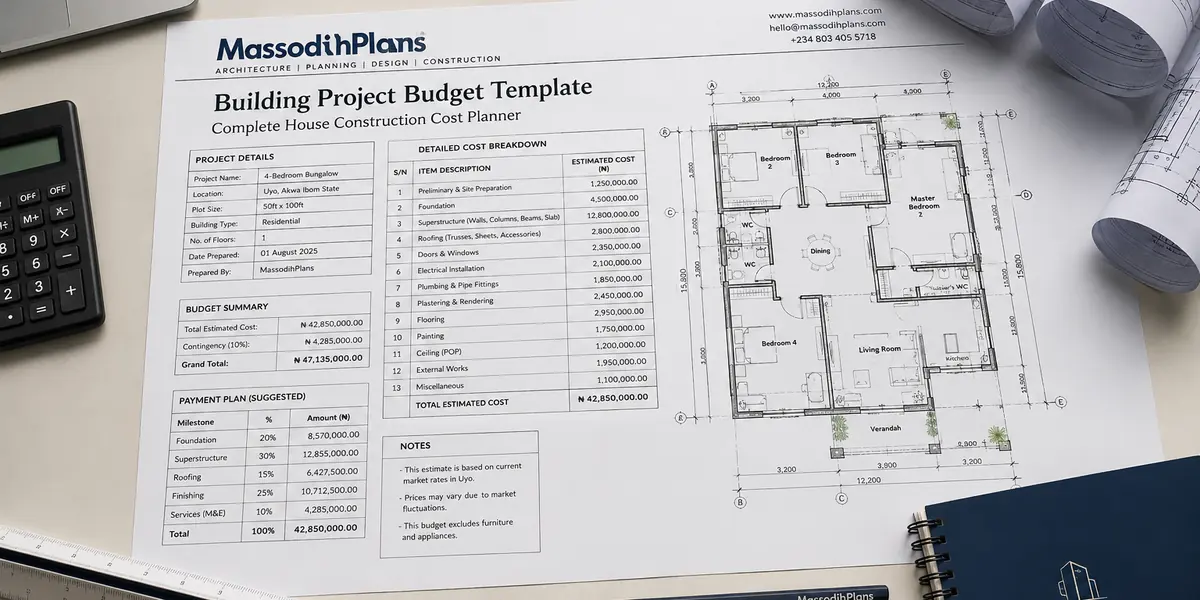
Building Project Budget Template: Complete House Construction Cost Planner
A building project budget template is a practical tool for estimating, organizing and tracking the full cost of constructing a house from preliminary expenses and foundation work to roofing, finishes, services and external works. It helps you break the project into specific cost categories, set realistic spending limits, record actual expenses and identify where your money is going before construction costs begin to get out of control.
One of the biggest mistakes homeowners make is treating the construction budget as a single figure. For example, saying “I have ₦30 million to build” does not tell you how that money will be distributed or whether it is sufficient for the proposed house. A workable budget needs to show what is expected to be spent on design, approvals, site preparation, foundation, structural work, roofing, doors and windows, electrical installation, plumbing, plastering, flooring, painting, ceilings and other necessary components.
There are also project expenses that are easy to overlook. Transportation, drainage, fencing, external works, professional fees, labour variations, material wastage and unexpected site conditions can gradually increase the amount required to complete the building.
That is why I developed this Building Project Budget Template: Complete House Construction Cost Planner. It provides a structured way to plan your expected expenditure, record what you actually spend and compare both figures as construction progresses.
You can adapt the template for a bungalow, duplex or other residential project and transfer the tables into Excel, Google Sheets or a notebook for regular updates.
Important: This template is a planning and expense-tracking tool, not a guaranteed construction price. Actual building costs vary according to location, floor area, design, specifications, site conditions, labour, material prices, professional fees and prevailing market conditions.
Why Every Homeowner Needs a Building Budget
A building budget helps you understand how much money you have available, what the money will be spent on, which construction stages are most expensive, how much has already been spent, how much remains, whether the project is exceeding its budget, where unnecessary costs are occurring, and how design changes affect your finances.
Most importantly, a budget helps you make decisions before your money runs out not after, when the only options left are unpleasant ones.
Field Note: The projects I’ve seen stall indefinitely almost never stalled because the client ran out of money outright. They stalled because nobody had a clear picture of how much was left and what it still needed to cover so spending continued past the point it should have slowed down.
The Four Numbers Every Homeowner Should Know
Before construction begins, identify these four numbers.
1. Available Budget: How much money can you realistically dedicate to the project?
₦________________________
2. Estimated Construction Cost: How much is the current project expected to cost?
₦________________________
3. Contingency: How much have you reserved for unexpected expenses?
₦________________________
4. Maximum Comfortable Budget; What is the maximum amount you are prepared to spend without putting yourself under unacceptable financial pressure?
₦________________________
I ask every client this fourth question directly, because it is rarely the same figure as their “estimated construction cost” and the gap between the two tells me a lot about how much flexibility we actually have.
Building Project Budget Summary
Start your budget with a simple summary.
| Category | Estimated Budget | Actual Cost | Difference |
|---|---|---|---|
| Land | ₦ | ₦ | ₦ |
| Survey | ₦ | ₦ | ₦ |
| Design/Professional Fees | ₦ | ₦ | ₦ |
| Planning/Approval | ₦ | ₦ | ₦ |
| Site Preparation | ₦ | ₦ | ₦ |
| Foundation | ₦ | ₦ | ₦ |
| Structure | ₦ | ₦ | ₦ |
| Walls | ₦ | ₦ | ₦ |
| Roofing | ₦ | ₦ | ₦ |
| Doors & Windows | ₦ | ₦ | ₦ |
| Electrical | ₦ | ₦ | ₦ |
| Plumbing | ₦ | ₦ | ₦ |
| Plastering/Rendering | ₦ | ₦ | ₦ |
| Flooring/Tiling | ₦ | ₦ | ₦ |
| Ceiling | ₦ | ₦ | ₦ |
| Painting | ₦ | ₦ | ₦ |
| Kitchen | ₦ | ₦ | ₦ |
| Bathrooms | ₦ | ₦ | ₦ |
| External Works | ₦ | ₦ | ₦ |
| Landscaping | ₦ | ₦ | ₦ |
| Security | ₦ | ₦ | ₦ |
| Water System | ₦ | ₦ | ₦ |
| Power/Backup System | ₦ | ₦ | ₦ |
| Miscellaneous | ₦ | ₦ | ₦ |
| Contingency | ₦ | ₦ | ₦ |
| TOTAL | ₦ | ₦ | ₦ |
1. Land Acquisition Budget
If you have not yet purchased the land, include all land-related expenses.
| Expense | Estimated | Actual | Difference |
|---|---|---|---|
| Land purchase | ₦ | ₦ | ₦ |
| Legal fees | ₦ | ₦ | ₦ |
| Survey | ₦ | ₦ | ₦ |
| Documentation | ₦ | ₦ | ₦ |
| Registration | ₦ | ₦ | ₦ |
| Agent fees | ₦ | ₦ | ₦ |
| Other | ₦ | ₦ | ₦ |
| TOTAL | ₦ | ₦ | ₦ |
Land cost is often treated separately from construction cost. If you already own the land, record its value separately rather than pretending the land has no financial value it is still part of your total property investment, even if it didn’t come out of the “construction” envelope.
2. Survey and Site Investigation Budget
| Item | Estimated | Actual |
|---|---|---|
| Land survey | ₦ | ₦ |
| Topographical survey | ₦ | ₦ |
| Site investigation | ₦ | ₦ |
| Soil investigation where required | ₦ | ₦ |
| Site analysis | ₦ | ₦ |
| Other | ₦ | ₦ |
| TOTAL | ₦ | ₦ |
The exact investigations required depend on the site and project this is where a proper site analysis checklist pays for itself before you’ve spent a naira on materials.
3. Professional Fees
| Professional/Service | Estimated | Actual |
|---|---|---|
| Architect | ₦ | ₦ |
| Town planner | ₦ | ₦ |
| Surveyor | ₦ | ₦ |
| Structural engineer | ₦ | ₦ |
| Quantity surveyor | ₦ | ₦ |
| Electrical professional | ₦ | ₦ |
| Plumbing professional | ₦ | ₦ |
| Landscape professional | ₦ | ₦ |
| Other specialist | ₦ | ₦ |
| TOTAL | ₦ | ₦ |
Do not automatically remove professional fees from your budget to reduce costs. In my experience, proper professional input is one of the cheapest forms of insurance available on a construction project it prevents the expensive mistakes, not just the cosmetic ones.
4. Planning and Approval Costs
| Item | Estimated | Actual |
|---|---|---|
| Planning application | ₦ | ₦ |
| Approval fees | ₦ | ₦ |
| Documentation | ₦ | ₦ |
| Inspection-related costs | ₦ | ₦ |
| Other applicable fees | ₦ | ₦ |
| TOTAL | ₦ | ₦ |
Requirements and fees vary by location always confirm current figures with the relevant planning authority rather than assuming they match what a friend paid in a different town.
5. Site Preparation Budget
Possible expenses include:
☐ Clearing ☐ Excavation ☐ Filling ☐ Compaction ☐ Site access ☐ Temporary drainage ☐ Temporary fencing ☐ Site security ☐ Temporary water ☐ Temporary electricity
| Item | Estimated | Actual |
|---|---|---|
| Clearing | ₦ | ₦ |
| Excavation | ₦ | ₦ |
| Filling | ₦ | ₦ |
| Compaction | ₦ | ₦ |
| Site access | ₦ | ₦ |
| Temporary facilities | ₦ | ₦ |
| Other | ₦ | ₦ |
| TOTAL | ₦ | ₦ |
6. Foundation Budget
| Material/Work | Estimated | Actual |
|---|---|---|
| Cement | ₦ | ₦ |
| Sand | ₦ | ₦ |
| Aggregate | ₦ | ₦ |
| Blocks | ₦ | ₦ |
| Reinforcement | ₦ | ₦ |
| Binding wire | ₦ | ₦ |
| Hardcore | ₦ | ₦ |
| Formwork | ₦ | ₦ |
| Labour | ₦ | ₦ |
| Equipment | ₦ | ₦ |
| Transportation | ₦ | ₦ |
| Other | ₦ | ₦ |
| TOTAL | ₦ | ₦ |
Foundation cost can vary substantially depending on the building and ground conditions this is the category where borrowing a neighbour’s figures does the most damage to your budget’s accuracy.
7. Structural Work Budget
| Item | Estimated | Actual |
|---|---|---|
| Reinforcement | ₦ | ₦ |
| Cement | ₦ | ₦ |
| Sand | ₦ | ₦ |
| Aggregate | ₦ | ₦ |
| Formwork | ₦ | ₦ |
| Labour | ₦ | ₦ |
| Equipment | ₦ | ₦ |
| Transportation | ₦ | ₦ |
| Other | ₦ | ₦ |
| TOTAL | ₦ | ₦ |
Structural specifications should come from the appropriate design, never estimated by eye.
8. Blockwork and Wall Construction Budget
| Item | Estimated | Actual |
|---|---|---|
| Blocks | ₦ | ₦ |
| Cement | ₦ | ₦ |
| Sand | ₦ | ₦ |
| Lintels | ₦ | ₦ |
| Reinforcement where required | ₦ | ₦ |
| Labour | ₦ | ₦ |
| Scaffolding | ₦ | ₦ |
| Transportation | ₦ | ₦ |
| Other | ₦ | ₦ |
| TOTAL | ₦ | ₦ |
9. Roofing Budget
Roofing can become a major component of the construction budget clients are frequently surprised by how quickly this category adds up once fascia, gutters and accessories are all accounted for.
| Item | Estimated | Actual |
|---|---|---|
| Roofing sheets | ₦ | ₦ |
| Roof structure | ₦ | ₦ |
| Timber/steel components | ₦ | ₦ |
| Nails/screws | ₦ | ₦ |
| Ridge caps | ₦ | ₦ |
| Flashings | ₦ | ₦ |
| Fascia | ₦ | ₦ |
| Gutters | ₦ | ₦ |
| Downpipes | ₦ | ₦ |
| Insulation | ₦ | ₦ |
| Labour | ₦ | ₦ |
| Transportation | ₦ | ₦ |
| Other | ₦ | ₦ |
| TOTAL | ₦ | ₦ |
10. Doors and Windows Budget
| Item | Quantity | Estimated | Actual |
|---|---|---|---|
| External doors | ₦ | ₦ | |
| Internal doors | ₦ | ₦ | |
| Security doors | ₦ | ₦ | |
| Door frames | ₦ | ₦ | |
| Door hardware | ₦ | ₦ | |
| Windows | ₦ | ₦ | |
| Glass | ₦ | ₦ | |
| Window hardware | ₦ | ₦ | |
| Security features | ₦ | ₦ | |
| Labour | ₦ | ₦ | |
| TOTAL | ₦ | ₦ |
11. Electrical Budget
| Item | Estimated | Actual |
|---|---|---|
| Cables | ₦ | ₦ |
| Conduits | ₦ | ₦ |
| Distribution board | ₦ | ₦ |
| Circuit breakers | ₦ | ₦ |
| Switches | ₦ | ₦ |
| Sockets | ₦ | ₦ |
| Light fittings | ₦ | ₦ |
| Earthing | ₦ | ₦ |
| Data/network | ₦ | ₦ |
| TV infrastructure | ₦ | ₦ |
| Labour | ₦ | ₦ |
| Testing | ₦ | ₦ |
| Other | ₦ | ₦ |
| TOTAL | ₦ | ₦ |
Electrical specifications should be determined by the appropriate professional this is never the category to trust to guesswork.
12. Plumbing Budget
| Item | Estimated | Actual |
|---|---|---|
| Water pipes | ₦ | ₦ |
| Waste pipes | ₦ | ₦ |
| Drainage pipes | ₦ | ₦ |
| Pipe fittings | ₦ | ₦ |
| Valves | ₦ | ₦ |
| Taps | ₦ | ₦ |
| Water tank | ₦ | ₦ |
| Pump | ₦ | ₦ |
| Water heater | ₦ | ₦ |
| Labour | ₦ | ₦ |
| Testing | ₦ | ₦ |
| Other | ₦ | ₦ |
| TOTAL | ₦ | ₦ |
13. Plastering and Rendering Budget
| Item | Estimated | Actual |
|---|---|---|
| Cement | ₦ | ₦ |
| Sand | ₦ | ₦ |
| Additives where required | ₦ | ₦ |
| Labour | ₦ | ₦ |
| Scaffolding | ₦ | ₦ |
| Transportation | ₦ | ₦ |
| Other | ₦ | ₦ |
| TOTAL | ₦ | ₦ |
14. Flooring and Tiling Budget
| Item | Estimated | Actual |
|---|---|---|
| Floor tiles | ₦ | ₦ |
| Wall tiles | ₦ | ₦ |
| Tile adhesive | ₦ | ₦ |
| Grout | ₦ | ₦ |
| Tile accessories | ₦ | ₦ |
| Screeding | ₦ | ₦ |
| Labour | ₦ | ₦ |
| Transportation | ₦ | ₦ |
| Other | ₦ | ₦ |
| TOTAL | ₦ | ₦ |
Remember to consider wastage when estimating tile quantities I always advise clients to order a bit beyond the raw square-metre figure to account for cuts, breakage, and future repairs.
15. Ceiling Budget
| Item | Estimated | Actual |
|---|---|---|
| Ceiling boards/panels | ₦ | ₦ |
| Framing | ₦ | ₦ |
| Screws | ₦ | ₦ |
| Cornices | ₦ | ₦ |
| Jointing materials | ₦ | ₦ |
| Labour | ₦ | ₦ |
| Lighting integration | ₦ | ₦ |
| Other | ₦ | ₦ |
| TOTAL | ₦ | ₦ |
16. Painting Budget
| Item | Estimated | Actual |
|---|---|---|
| Primer | ₦ | ₦ |
| Paint | ₦ | ₦ |
| Undercoat | ₦ | ₦ |
| Filler | ₦ | ₦ |
| Sandpaper | ₦ | ₦ |
| Brushes | ₦ | ₦ |
| Rollers | ₦ | ₦ |
| Labour | ₦ | ₦ |
| External coating | ₦ | ₦ |
| Other | ₦ | ₦ |
| TOTAL | ₦ | ₦ |
17. Kitchen Budget
Kitchen costs can vary enormously depending on your specification I have seen kitchens for identical floor areas differ by a factor of three, purely on cabinetry and appliance choices.
| Item | Estimated | Actual |
|---|---|---|
| Cabinets | ₦ | ₦ |
| Countertop | ₦ | ₦ |
| Sink | ₦ | ₦ |
| Tap | ₦ | ₦ |
| Tiles/splashback | ₦ | ₦ |
| Cooker/hob | ₦ | ₦ |
| Oven | ₦ | ₦ |
| Extractor | ₦ | ₦ |
| Refrigerator | ₦ | ₦ |
| Hardware | ₦ | ₦ |
| Labour | ₦ | ₦ |
| Other | ₦ | ₦ |
| TOTAL | ₦ | ₦ |
18. Bathroom Budget
| Item | Estimated | Actual |
|---|---|---|
| WC | ₦ | ₦ |
| Wash basin | ₦ | ₦ |
| Basin tap | ₦ | ₦ |
| Shower | ₦ | ₦ |
| Bathtub | ₦ | ₦ |
| Bathroom tiles | ₦ | ₦ |
| Grout | ₦ | ₦ |
| Mirror | ₦ | ₦ |
| Accessories | ₦ | ₦ |
| Labour | ₦ | ₦ |
| Other | ₦ | ₦ |
| TOTAL | ₦ | ₦ |
19. External Works Budget
Homeowners often underestimate external works this is consistently the category clients most regret leaving out of their original budget.
| Item | Estimated | Actual |
|---|---|---|
| Fence | ₦ | ₦ |
| Gate | ₦ | ₦ |
| Driveway | ₦ | ₦ |
| Walkways | ₦ | ₦ |
| Drainage | ₦ | ₦ |
| Paving | ₦ | ₦ |
| External lighting | ₦ | ₦ |
| Landscaping | ₦ | ₦ |
| Outdoor structures | ₦ | ₦ |
| Other | ₦ | ₦ |
| TOTAL | ₦ | ₦ |
20. Water Infrastructure Budget
| Item | Estimated | Actual |
|---|---|---|
| Water tank | ₦ | ₦ |
| Tank stand | ₦ | ₦ |
| Pump | ₦ | ₦ |
| Borehole where applicable | ₦ | ₦ |
| Pipes | ₦ | ₦ |
| Filtration | ₦ | ₦ |
| Plumbing | ₦ | ₦ |
| Other | ₦ | ₦ |
| TOTAL | ₦ | ₦ |
21. Power and Backup Budget
| Item | Estimated | Actual |
|---|---|---|
| Generator | ₦ | ₦ |
| Inverter | ₦ | ₦ |
| Batteries | ₦ | ₦ |
| Solar panels | ₦ | ₦ |
| Changeover | ₦ | ₦ |
| Electrical installation | ₦ | ₦ |
| Other | ₦ | ₦ |
| TOTAL | ₦ | ₦ |
22. Security Budget
| Item | Estimated | Actual |
|---|---|---|
| Security doors | ₦ | ₦ |
| Fence | ₦ | ₦ |
| Gate | ₦ | ₦ |
| Security lighting | ₦ | ₦ |
| CCTV | ₦ | ₦ |
| Alarm system | ₦ | ₦ |
| Access control | ₦ | ₦ |
| Other | ₦ | ₦ |
| TOTAL | ₦ | ₦ |
23. Landscaping Budget
| Item | Estimated | Actual |
|---|---|---|
| Topsoil | ₦ | ₦ |
| Grass | ₦ | ₦ |
| Trees | ₦ | ₦ |
| Shrubs | ₦ | ₦ |
| Flowers | ₦ | ₦ |
| Paving | ₦ | ₦ |
| Planters | ₦ | ₦ |
| Irrigation | ₦ | ₦ |
| Outdoor lighting | ₦ | ₦ |
| Labour | ₦ | ₦ |
| TOTAL | ₦ | ₦ |
24. Labour Budget
Do not treat labour as an afterthought. Your labour budget may include:
☐ Mason ☐ Carpenter ☐ Steel fixer ☐ Plumber ☐ Electrician ☐ Tiler ☐ Painter ☐ Roofer ☐ Ceiling installer ☐ Aluminium/glazing installer ☐ Landscaper ☐ Other workers
| Labour Category | Estimated | Actual |
|---|---|---|
| Masonry | ₦ | ₦ |
| Carpentry | ₦ | ₦ |
| Reinforcement | ₦ | ₦ |
| Roofing | ₦ | ₦ |
| Plumbing | ₦ | ₦ |
| Electrical | ₦ | ₦ |
| Tiling | ₦ | ₦ |
| Painting | ₦ | ₦ |
| Ceiling | ₦ | ₦ |
| Landscaping | ₦ | ₦ |
| Other | ₦ | ₦ |
| TOTAL | ₦ | ₦ |
25. Transportation Budget
Transportation can become a significant hidden cost one I make a point of raising early, because clients rarely price it in until the first sand delivery invoice arrives.
Track: ☐ Sand delivery ☐ Cement delivery ☐ Block delivery ☐ Steel delivery ☐ Timber delivery ☐ Roofing delivery ☐ Tile delivery ☐ Door/window delivery ☐ Equipment transportation ☐ Waste removal
| Transportation | Estimated | Actual |
|---|---|---|
| Materials | ₦ | ₦ |
| Equipment | ₦ | ₦ |
| Waste removal | ₦ | ₦ |
| Other | ₦ | ₦ |
| TOTAL | ₦ | ₦ |
26. Miscellaneous Expenses
Create a separate category for smaller expenses that can easily disappear from your records.
Examples: ☐ Printing ☐ Photocopying ☐ Site communication ☐ Temporary utilities ☐ Minor tools ☐ Repairs ☐ Cleaning ☐ Site security ☐ Small replacement materials ☐ Other
| Item | Estimated | Actual |
|---|---|---|
| ₦ | ₦ | |
| ₦ | ₦ | |
| ₦ | ₦ | |
| ₦ | ₦ | |
| TOTAL | ₦ | ₦ |
27. Contingency Budget
Never assume that your initial estimate will be exactly equal to your final cost. Unexpected issues can arise from site conditions, material price changes, design changes, labour changes, transportation, weather, repairs, additional work, and unforeseen technical problems.
Create a contingency allowance appropriate to your project’s circumstances.
Contingency: ₦________________________
Do not treat contingency as free money. It is there to protect the project from reasonable unexpected costs the moment it becomes a source of “extra” spending on things you’d already decided against, it stops doing its job.
28. Building Project Payment Tracker
Use this to record every major payment.
| Date | Paid To | Description | Amount | Payment Method | Receipt |
|---|---|---|---|---|---|
| ₦ | |||||
| ₦ | |||||
| ₦ | |||||
| ₦ | |||||
| ₦ | |||||
| ₦ |
29. Contractor Payment Tracker
If you are paying a contractor in stages:
| Stage | Agreed Amount | Paid | Balance |
|---|---|---|---|
| Mobilisation | ₦ | ₦ | ₦ |
| Foundation | ₦ | ₦ | ₦ |
| Walls | ₦ | ₦ | ₦ |
| Roofing | ₦ | ₦ | ₦ |
| Finishes | ₦ | ₦ | ₦ |
| External works | ₦ | ₦ | ₦ |
| Final payment | ₦ | ₦ | ₦ |
| TOTAL | ₦ | ₦ | ₦ |
Payments should correspond to the agreed contract arrangements and actual progress not to whatever the contractor says they urgently need this week.
30. Building Materials Cost Tracker
| Date | Material | Quantity | Unit Price | Total | Supplier |
|---|---|---|---|---|---|
| ₦ | ₦ | ||||
| ₦ | ₦ | ||||
| ₦ | ₦ | ||||
| ₦ | ₦ | ||||
| ₦ | ₦ |
31. Variation Cost Tracker
A variation is a change from the original scope, design or specification. Record every significant change.
| Date | Variation | Reason | Additional Cost | Approved? |
|---|---|---|---|---|
| ₦ | ☐ | |||
| ₦ | ☐ | |||
| ₦ | ☐ | |||
| ₦ | ☐ |
Before approving a significant variation, understand its effect on cost, time, design, and other construction elements a change that seems small in isolation can ripple into three other decisions you hadn’t considered.
32. Budget vs Actual Tracker
This is one of the most important tables in the entire budget.
| Category | Budget | Actual | Difference |
|---|---|---|---|
| Foundation | ₦ | ₦ | ₦ |
| Structure | ₦ | ₦ | ₦ |
| Walls | ₦ | ₦ | ₦ |
| Roofing | ₦ | ₦ | ₦ |
| Electrical | ₦ | ₦ | ₦ |
| Plumbing | ₦ | ₦ | ₦ |
| Finishes | ₦ | ₦ | ₦ |
| External works | ₦ | ₦ | ₦ |
| Other | ₦ | ₦ | ₦ |
| TOTAL | ₦ | ₦ | ₦ |
What does the difference mean?
If actual cost budget, you are overspending. If actual cost budget, you are currently below the original estimate. But remember that a low actual cost early in construction does not necessarily mean the project is under budget overall later stages may still have significant costs waiting.
33. Monthly Construction Budget Tracker
| Month | Planned Spending | Actual Spending | Difference |
|---|---|---|---|
| January | ₦ | ₦ | ₦ |
| February | ₦ | ₦ | ₦ |
| March | ₦ | ₦ | ₦ |
| April | ₦ | ₦ | ₦ |
| May | ₦ | ₦ | ₦ |
| June | ₦ | ₦ | ₦ |
| July | ₦ | ₦ | ₦ |
| August | ₦ | ₦ | ₦ |
| September | ₦ | ₦ | ₦ |
| October | ₦ | ₦ | ₦ |
| November | ₦ | ₦ | ₦ |
| December | ₦ | ₦ | ₦ |
34. Construction Progress vs Money Spent
Money spent should be compared with actual project progress. For example:
Estimated project cost: ₦________________
Amount spent: ₦________________
Percentage spent: __________%
Estimated physical progress: __________%
If you have spent a very large percentage of the budget but the project appears far from completion, investigate why. This does not mean physical progress and expenditure must always match perfectly different construction stages have different costs, and roofing or finishes can consume a disproportionate share relative to how “far along” the building looks.
35. Remaining Budget Calculator
Remaining Budget = Total Available Budget − Total Money Spent
Example: if your available project budget is ₦50,000,000 and you have spent ₦32,000,000, then your remaining budget is ₦18,000,000.
But do not assume the remaining amount is completely available for new spending. You still need to account for outstanding contractor payments, unpaid material orders, professional fees, variations, external works, and contingency. I have seen clients treat a “remaining balance” figure as spare cash, only to discover it was already fully committed.
36. Final Project Cost Formula
A useful simplified formula is:
Final Project Cost = Construction Costs + Professional Costs + Approvals + External Works + Other Costs + Variations
Your own project may require additional categories depending on its specifics.
37. Building Budget Checklist
Before starting construction:
☐ Land cost identified ☐ Survey cost identified ☐ Professional fees identified ☐ Approval costs identified ☐ Site preparation estimated ☐ Foundation estimated ☐ Structure estimated ☐ Wall construction estimated ☐ Roofing estimated ☐ Doors estimated ☐ Windows estimated ☐ Electrical estimated ☐ Plumbing estimated ☐ Finishes estimated ☐ Kitchen estimated ☐ Bathrooms estimated ☐ External works estimated ☐ Landscaping estimated ☐ Water system estimated ☐ Power system estimated ☐ Security estimated ☐ Labour estimated ☐ Transportation estimated ☐ Miscellaneous estimated ☐ Contingency included ☐ Payment schedule prepared ☐ Contractor quotation reviewed ☐ Budget compared with available funds
38. Questions to Ask Before Approving Your Budget
Can I actually afford this design? ☐ Yes ☐ No
Does the budget include professional fees? ☐ Yes ☐ No
Does it include external works? ☐ Yes ☐ No
Does it include drainage? ☐ Yes ☐ No
Does it include water infrastructure? ☐ Yes ☐ No
Does it include electricity and backup power? ☐ Yes ☐ No
Does it include kitchen and bathroom fittings? ☐ Yes ☐ No
Does it include labour? ☐ Yes ☐ No
Does it include transportation? ☐ Yes ☐ No
Does it include contingency? ☐ Yes ☐ No
Can I still afford the project if costs increase? ☐ Yes ☐ No
How to Control Your Building Budget
1. Finalise the Design Before Construction changing the design repeatedly can create additional costs.
2. Prepare Detailed Quantities where appropriate, use professional quantity measurement and costing rather than guessing.
3. Compare Suppliers prices can differ between suppliers and locations.
4. Buy According to the Construction Programme avoid unnecessarily purchasing materials too early.
5. Track Every Significant Expense small expenses can become significant when accumulated.
6. Control Variations every design change should be considered carefully.
7. Avoid Unnecessary Luxury not every expensive material adds meaningful value to the building.
8. Prioritise Quality Where It Matters do not compromise critical structural, electrical, plumbing or safety requirements simply to save money.
9. Protect Materials damage and theft are also construction costs.
10. Review Your Budget Regularly a budget should be a living document, not something you write once and never revisit.
Common Building Budget Mistakes
Mistake 1: Budgeting Only for Blocks, Cement and Roofing a house contains many more components than the structural shell.
Mistake 2: Ignoring Professional Fees professional services are part of the project cost.
Mistake 3: Forgetting External Works fencing, drainage, paving and landscaping can consume significant money.
Mistake 4: Starting With an Unrealistic Budget a design should be evaluated against financial reality, not the other way around.
Mistake 5: No Contingency unexpected costs happen, without exception, on every project I have ever supervised.
Mistake 6: Changing Materials Midway changing specifications can create additional expenses.
Mistake 7: Not Recording Payments unrecorded payments make it difficult to know where your money went.
Mistake 8: Choosing a Contractor Solely by Price a very low quotation may not represent the lowest overall project cost.
Mistake 9: Spending Too Much on Finishes Too Early do not allow decorative choices to consume money needed for essential construction.
Mistake 10: Confusing Construction Cost With Total Property Cost the cost of building the house is only one part of the overall property investment.
Simple One-Page Building Budget
If you want a quick version, use this:
| Category | Budget | Actual |
|---|---|---|
| Land | ₦ | ₦ |
| Survey | ₦ | ₦ |
| Design/Professionals | ₦ | ₦ |
| Approvals | ₦ | ₦ |
| Site Preparation | ₦ | ₦ |
| Foundation | ₦ | ₦ |
| Structure | ₦ | ₦ |
| Walls | ₦ | ₦ |
| Roofing | ₦ | ₦ |
| Doors/Windows | ₦ | ₦ |
| Electrical | ₦ | ₦ |
| Plumbing | ₦ | ₦ |
| Finishes | ₦ | ₦ |
| Kitchen/Bathrooms | ₦ | ₦ |
| External Works | ₦ | ₦ |
| Water | ₦ | ₦ |
| Power | ₦ | ₦ |
| Security | ₦ | ₦ |
| Landscaping | ₦ | ₦ |
| Miscellaneous | ₦ | ₦ |
| Contingency | ₦ | ₦ |
| TOTAL | ₦ | ₦ |
Personal Building Budget Summary
Project Name: _______________________________
Location: ____________________________________
Plot Size: ____________________________________
Building Type: _______________________________
Estimated Floor Area: _________________________
Number of Floors: ____________________________
Number of Bedrooms: __________________________
Estimated Construction Budget: ₦______________
Available Funds: ₦____________________________
Contingency: ₦________________________________
Expected Start Date: _________________________
Expected Completion: _________________________
Final Budget Review
Before construction begins, ask:
☐ Has the design been reviewed? ☐ Has the site been properly assessed? ☐ Has the construction scope been defined? ☐ Have major quantities been estimated? ☐ Have major material prices been researched? ☐ Have labour costs been considered? ☐ Have professional fees been included? ☐ Have approval costs been included? ☐ Have external works been included? ☐ Has contingency been included? ☐ Has the budget been compared with available funds? ☐ Is the contractor’s quotation clear? ☐ Are payment terms clear? ☐ Are variations controlled? ☐ Will you maintain proper financial records?
If several answers are No, your budget probably needs more work before construction begins.
Frequently Asked Questions
What is a building project budget?
A building project budget is a financial plan showing how much money is expected to be spent on the different components of a construction project. It should include more than just construction materials.
What should a house construction budget include?
It can include land-related costs, surveys, professional fees, approvals, site preparation, foundation, structural work, walls, roofing, doors, windows, electrical, plumbing, finishes, kitchen, bathrooms, external works, landscaping, water, power, labour, transportation, miscellaneous expenses and contingency.
How much contingency should I include in my building budget?
There is no single percentage that is appropriate for every project. The appropriate allowance depends on the project’s complexity, design stage, site conditions, market conditions and how well the costs have been established. A quantity surveyor or other appropriate professional can help determine a suitable allowance.
Should labour be included in the building budget?
Yes. Labour can represent a substantial portion of construction costs and should not be forgotten.
Should I include furniture in my construction budget?
It depends on what you want your budget to represent. You can create a separate furniture and household equipment budget rather than mixing it with the core construction budget.
Should landscaping be included?
Yes, if landscaping is part of your intended project. A house can be structurally complete while significant external work remains unfinished.
How can I know whether my construction budget is realistic?
The best approach is to develop the design and specifications sufficiently, obtain appropriate quantity/cost information and compare the estimated cost with current local market conditions. Do not rely on a random figure from someone who built a different house see our building cost calculator guide for the underlying method.
My Final View
A building budget is not simply a list of prices. It is a financial control system for your construction project.
The purpose is not to predict every naira perfectly from the beginning. The purpose is to understand where your money is going, identify potential problems early and make better decisions before costs become difficult to control.
Remember these five rules: plan your design, estimate your costs, track your spending, control your changes, protect your contingency.
A homeowner who understands the budget is in a much stronger position to make informed construction decisions. Before you spend your first major amount on construction, know what you are building, understand what it is expected to cost, and establish how you will monitor the money throughout the project.
Build with a plan. Build with a budget. Build with control.
Need Help Planning Your Building Project?
MassodihPlans provides practical built-environment information and services covering house planning, architectural design, site analysis, town planning, GIS/mapping and landscape design.
If you are preparing to build, proper planning and budgeting can help you make better decisions before construction begins.
Browse our Plans Library for house designs you can budget against confidently, learn the fundamentals in Plan School, check Services for cost planning and quantity support, or return to the Homepage for more practical guides.
MassodihPlans: Plan Better. Build Smarter.
Complete this lesson by reading the following:
- Homeowner’s Construction Checklist: 150+ Things to Check Before and During Building
- Building Materials Checklist: 100+ Materials You May Need When Building a House
- House Planning Checklist: 50+ Essential Things to Check Before Building a House (Complete Guide)
- What Principles Guide the Design of an Air Force Base Master Plan?
- Town Planning Services: Plans, Permits and Land Development
- Building Regulations Every Nigerian Property Developer Must Know
- National Building Code of Nigeria Explained for Beginners
- Building Approval in Nigeria: Costs, Requirements, Process and How to Get Your House Plan Approved Fast