You Have a Small Plot in Nigeria. Here Is the 3 Bedroom Bungalow Plan That Actually Works
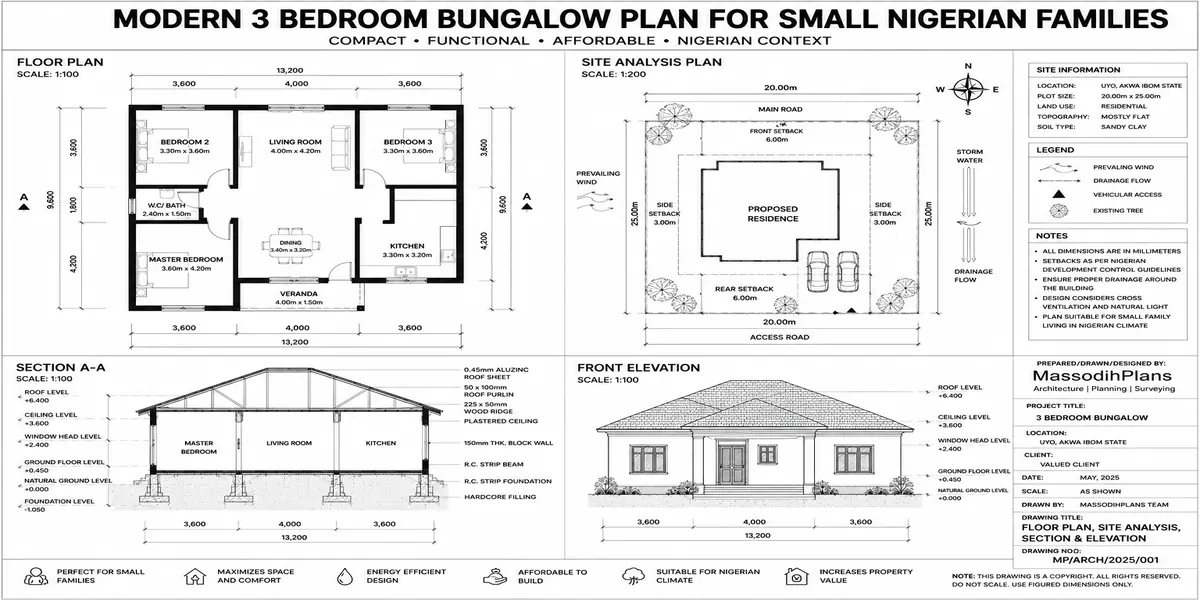
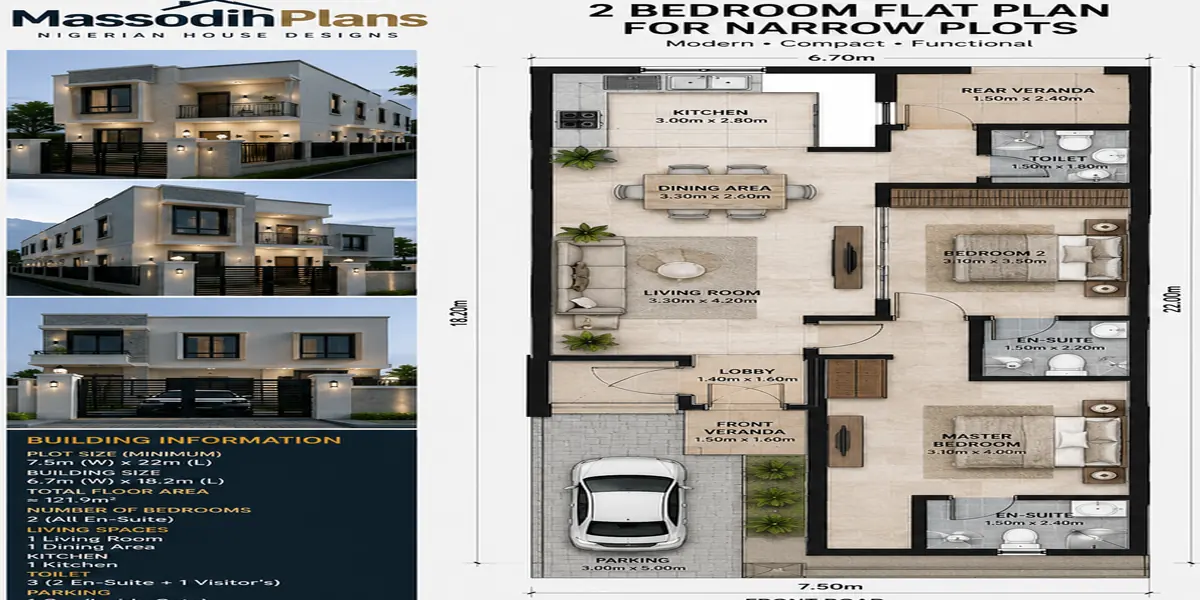
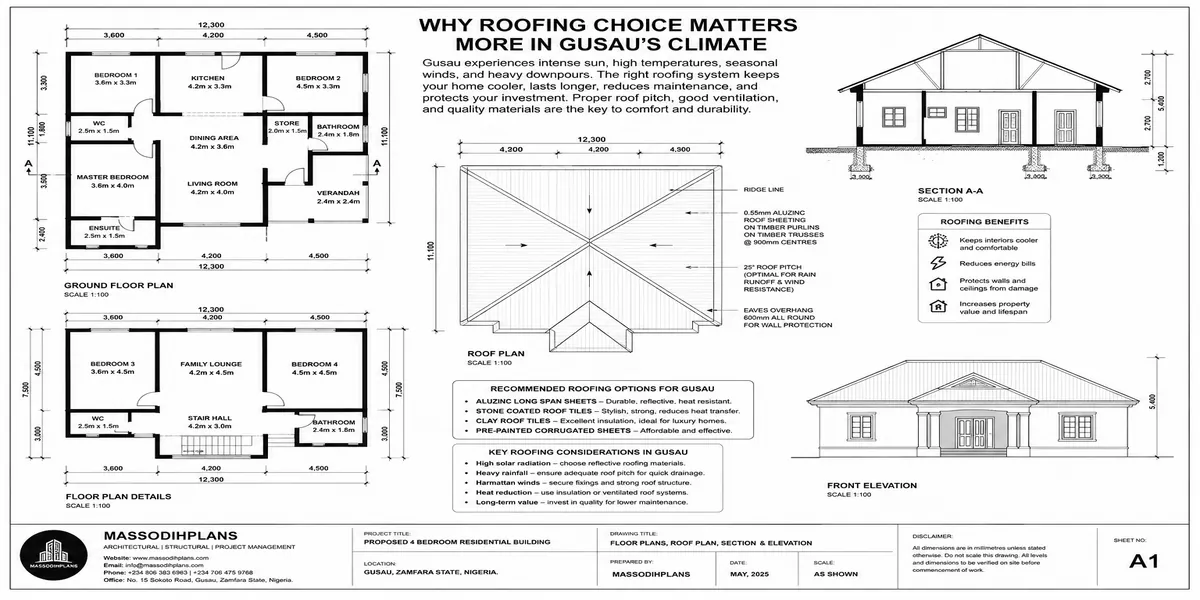
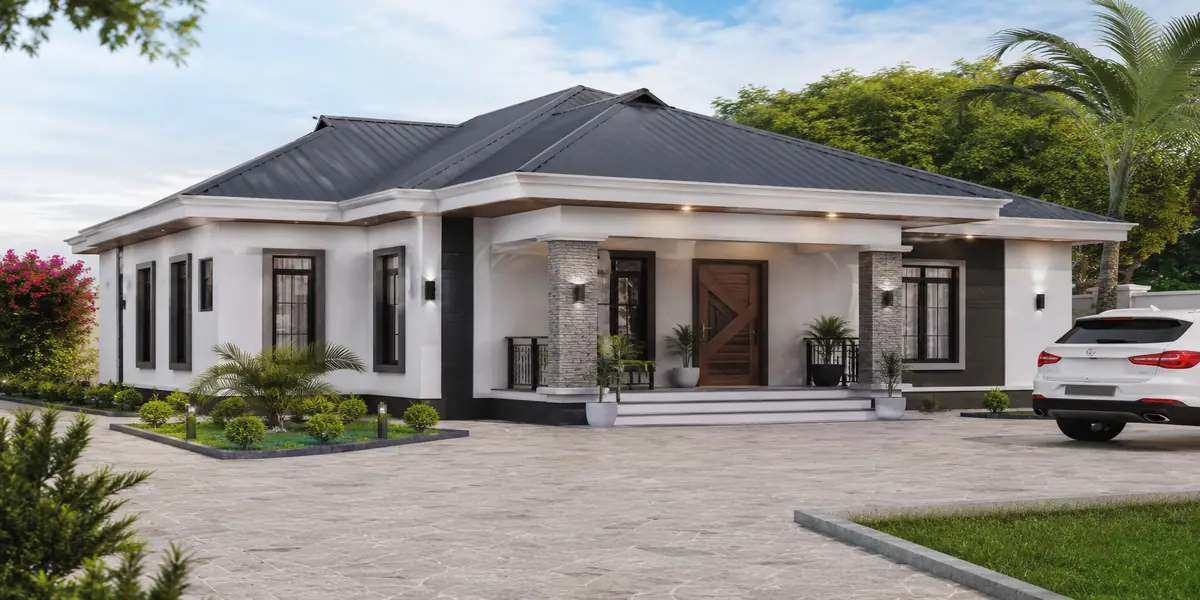
Modern 3 bedroom bungalow plan layout for small Nigerian plot showing room arrangement
Introduction
If you are looking for a modern 3 bedroom bungalow plan for a small Nigerian family, the goal is not simply to squeeze three bedrooms onto a piece of land. The real goal is to create a home that feels spacious, private, naturally ventilated, easy to maintain, affordable to build, and practical for everyday Nigerian living.
That is exactly what this modern 3 bedroom bungalow plan is designed to achieve. Instead of giving you another attractive floor plan that looks good on a screen but becomes difficult to build on site, I will walk you through the thinking behind the design: room sizes, circulation, setbacks, parking, natural lighting, cross ventilation, kitchen placement, bedroom privacy, outdoor space, drainage, orientation, roof design, and how the building can respond to the realities of a Nigerian climate.
You will also see how the floor plan relates to the site, why every major dimension matters, and which design decisions can save space without making the house feel cramped. Whether you are planning to build in Uyo, Lagos, Abuja, Port Harcourt, or another Nigerian city, this guide will help you understand what to look for before approving or buying a house plan. A good plan must fit the land, the family, the budget, and the environment at the same time.
Stay with me because the most important part is not the drawing itself. It is learning how to judge whether a 3 bedroom bungalow plan will actually work before construction begins. By the end, you should be able to compare layouts intelligently, identify expensive design mistakes, understand what to ask your architect or designer, and make better decisions about your own home before spending your money.
What Plot Size Is This Plan Suitable For?
The 3 bedroom bungalow plan we are discussing here is designed to fit comfortably on a 50 by 100 feet plot (approximately 15 by 30 metres), which is one of the most common residential plot sizes in Nigerian towns and cities.
It can also fit on:
- 60 by 120 feet (the popular full plot in many states)
- 40 by 80 feet (a half plot in many southern Nigerian towns)
- Irregular plots from 450 to 650 square metres
If your plot is smaller than 40 by 80 feet, the plan can still work but you will need to make some adjustments, which I will explain later in this article.
From my experience: The biggest mistake people make is buying a plot first and then looking for a plan later without checking if the dimensions can carry their dream house. Always do it the other way around. Know your plan. Know your required setbacks. Then go for your plot.
The Full Layout of This 3 Bedroom Bungalow Plan
Let me take you through this plan room by room, the way I would explain it to a client sitting across from me in my office.
Overall Footprint
The building footprint sits at approximately 12 metres by 15 metres (that is about 180 square metres of built area) for a standard version.
This leaves room for:
- Front setback of 3 to 4.5 metres
- Side setbacks of 1.5 metres on each side
- Rear setback of 3 metres
- Carport or driveway space
Room Arrangement
Here is how the rooms are arranged:
1. Living Room Located at the front of the house, facing the main entrance. Size is approximately 4.5 metres by 5 metres. This is the first thing guests see when they walk in. It connects directly to the dining area so the open-plan feel makes the whole ground floor look bigger than it actually is.
2. Dining Area Flowing from the living room, this space is about 3 metres by 3.5 metres. It sits between the living room and the kitchen so serving food feels natural.
3. Kitchen The kitchen is at the rear of the house, approximately 3 metres by 3 metres. It opens to the back veranda or backyard, which is very important in Nigeria because you need cross ventilation and an easy path to your external kitchen or generator area.
4. Master Bedroom This is the largest bedroom, approximately 4 metres by 4 metres, with an en-suite bathroom and wardrobe provision. It is positioned at the rear of the house for privacy from guests who enter the living room.
5. Bedroom 2 Approximately 3.5 metres by 3.5 metres with a small wardrobe niche. Positioned in the middle section of the house.
6. Bedroom 3 Approximately 3.5 metres by 3 metres. This can serve as a children’s room, home office, or guest room.
7. Common Bathroom and Toilet Strategically placed in the corridor between the bedrooms so it is accessible from all bedrooms without walking through the living room.
8. Entry Porch or Veranda A covered porch of about 2 metres by 4 metres at the front. This is not decoration. In Nigeria, your porch is where you sit in the evenings, where children play, where guests wait, and where your security is visible from the road.
9. Rear Veranda Small but important. About 1.5 metres wide across the back of the kitchen. This gives the house breathing room at the back and a place for your domestic work.
Setbacks You Must Respect
Before your builder starts, you must know that town planning authorities in every Nigerian state require setbacks. These are the minimum distances your building must maintain from the plot boundary.
Typical setbacks for a residential bungalow in most Nigerian states:
| Position | Minimum Setback |
|---|---|
| Front (road-facing) | 3.0 – 4.5 metres |
| Side (both sides) | 1.5 metres minimum |
| Rear | 3.0 metres minimum |
If your plot is 50 by 100 feet, that is roughly 15 by 30 metres. After applying setbacks on all sides, your buildable area becomes approximately 10 by 23 metres. This is enough to comfortably fit this bungalow plan.
Ventilation Strategy for the Nigerian Climate
Ventilation is not a luxury in Nigeria. It is survival.
I say this from experience. I have been on project sites in Uyo in the middle of March when the heat was unbearable inside houses that were perfectly built but poorly ventilated. The owners spent a fortune on the structure and then had to run air conditioners 24 hours a day just to survive. That is not planning. That is punishment.
Here is how a good 3 bedroom bungalow handles ventilation:
Cross Ventilation The key is ensuring that windows on opposite sides of the room are aligned so that prevailing winds can blow straight through. In southern Nigeria, the dominant wind direction is south-west. Your windows should face and receive this wind.
High-Level Louvres Above your windows and doors, install high-level louvres or jalousies that stay partially open at all times. Hot air rises and these vents allow it to escape. Simple. Effective.
Kitchen Position Always position the kitchen at the downwind end of the house. This prevents cooking smells and heat from blowing into the bedrooms and living area.
Ceiling Height In this plan, ceiling height is 2.7 metres minimum, and ideally 3 metres. Higher ceilings allow hot air to stratify above your head, making the room feel cooler.
Window-to-Floor Ratio Each room should have window openings that total at least 10% of the floor area. For a 3.5 by 3.5 metre bedroom (12.25 square metres), that means at least 1.2 square metres of window opening.
Orientation: Which Way Should Your House Face?
In my early career, I noticed that most people just face their house toward the road and do not think further. That is a mistake.
The ideal orientation for a Nigerian bungalow is:
Main entrance facing north or northeast: This reduces direct afternoon sun beating into your living room.
Bedrooms on the south or southwest side: These rooms receive gentler morning light and catch the cool south-west breeze.
Kitchen at the east or northeast rear: Gets morning sun which helps dry out moisture early, and the prevailing breeze keeps fumes away from the rest of the house.
If your plot forces the entrance to face west (common on many layouts), use a deep veranda, an overhanging eave of at least 1.2 metres, and louvred screens to reduce direct sun glare into the house.
Roofing Style
The roof of a Nigerian house is doing very heavy work. It is managing rain, heat, and structural load all at once.
For this 3 bedroom bungalow plan, I recommend:
Hip Roof (Recommended)
A hip roof slopes on all four sides. This design:
- Sheds rainwater evenly in all directions
- Handles strong winds better than gable roofs
- Looks modern and clean
- Reduces the amount of wall exposed to direct sun
Pitch recommendation: 30 to 35 degrees for most Nigerian climates. In high-rainfall areas like the Niger Delta and Cross River, go to 35 to 40 degrees for faster water runoff.
Roofing Materials
Long-span aluminium roofing sheets (0.55mm gauge): The most practical choice for most Nigerians. Durable, widely available, relatively affordable.
Gerard stone-coated tiles: More premium, excellent heat insulation, looks beautiful. More expensive.
Concrete flat roof with screeding: Only use this if you plan to add a second floor later. On its own as a bungalow, it traps heat badly in Nigeria without proper thermal insulation.
My honest advice to any client: Whatever roofing material you choose, install a proper ceiling with insulation board or PVC panels beneath it. The space between the roof and your ceiling acts as a thermal buffer. Without it, your bedroom becomes an oven.
Parking, Generator, and Borehole Planning
This is where most Nigerian house plans fall short. They show you a nice house but forget that you need space for:
1. Car Parking A standard parking space is 2.5 metres wide by 5 metres long. If you have two cars, you need 5.5 metres of width minimum (two bays plus a small buffer). On a 15-metre-wide plot, this is doable if your setback allows it.
2. Generator House (Genhouse) Position the gen house at the side or rear of the building. Keep it:
- At least 3 metres from windows (exhaust fumes)
- Accessible for fuel delivery
- With proper ventilation gaps (do not enclose it completely)
- On a raised concrete slab to protect from flooding
3. Borehole Position
- Minimum 15 metres from your septic tank
- Not under a tree (roots damage the casing over time)
- Near the side of the house for easy access and piping
4. Water Tank (Overhead) Position your overhead water tank on a strong concrete or steel frame either at the rear corner or side of the building. The weight of a 5,000-litre tank full of water is approximately 5 tonnes. Do not place it above any room without a proper structural calculation.
Cost Estimate for This 3 Bedroom Bungalow
Let me give you honest numbers. Not the inflated ones you will get from some contractors, and not the unrealistically low ones that will come back to bite you later.
Important note: Building costs in Nigeria vary significantly by state, by season, and by material availability. These figures are based on mid-level finishes in states like Akwa Ibom, Rivers, Lagos, and Abuja as of recent construction seasons. Always get at least three quotations from verified contractors before you start.
| Stage | Estimated Cost Range |
|---|---|
| Foundation and DPC | ₦1.5M – ₦2.5M |
| Block work (walls) | ₦2M – ₦3.5M |
| Roofing (structure + sheets) | ₦1.8M – ₦3M |
| Plumbing (internal) | ₦600K – ₦1.2M |
| Electrical installation | ₦700K – ₦1.5M |
| Plastering and screeding | ₦900K – ₦1.5M |
| Doors and windows | ₦1.2M – ₦2.5M |
| Tiles and finishing | ₦1.5M – ₦3M |
| Painting | ₦500K – ₦900K |
| Total estimate | ₦10.7M – ₦19.1M |
This is for the main structure only. It does not include:
- Land
- Drainage and compound work
- Borehole and overhead tank
- Generator house
- Perimeter fence
- Professional fees (architect, structural engineer, town planner
From my experience working with clients across the Niger Delta and Southeast: The single biggest cause of abandoned buildings in Nigeria is starting construction without a realistic total budget. People calculate the house cost and forget that the fence, drainage, borehole, and compound finishing can add another 30 to 40 percent to the total project cost. Budget for everything before you pour the first block.
Nigerian Reality Layer: What Most Plans Ignore
This section is for you. I have never seen a foreign house plan website include this, and very few Nigerian ones do either.
Flooding and Drainage
Before you lay your foundation, understand the drainage pattern of your land. I have witnessed firsthand how a beautifully finished house becomes flooded every rainy season simply because no one checked the elevation or provided proper drainage channels.
For this bungalow plan:
- Raise your floor level at least 600mm (60cm) above the external ground level
- Provide a concrete apron drain around the building perimeter
- Ensure your compound slopes away from the building, not toward it
- Do not block your drainage path with blocks, gravel, or flower beds
Power Supply
There is no point designing a house as if PHCN (or your distribution company) will supply 24-hour electricity. Design for the reality:
- Provide a gen house space in the layout
- Design your electrical system with automatic changeover provisions
- Install conduit for solar inverter wiring even if you are not installing solar immediately
- Position your inverter battery bank in a ventilated corner, not inside a bedroom
Security and Compound Planning
- Position your main entrance gate where your house porch or veranda has a clear line of sight
- Consider a small gatehouse or security post at the entrance
- Ensure the compound wall is at least 1.8 metres high with proper coping
- Exterior lights (solar-powered or on a separate circuit) at the gate and corners are not optional in most Nigerian neighbourhoods
Material Price Volatility
In my experience, material prices in Nigeria can change significantly within weeks. During my time on various projects, I have seen cement prices double in less than three months and iron rod prices spike during major construction booms.
How to protect yourself:
- Buy materials in stages and lock in quotes with verified suppliers
- Never give a contractor a lump sum upfront. Pay in stages tied to completed work
- Keep a 15% contingency fund above your total budget estimate
Small Plot Optimization: Making Every Square Metre Count
On a small plot, waste is expensive. Here is how this plan maximises space:
Open Plan Living and Dining By combining the living and dining into one flowing space, you eliminate the corridor that would have separated them. You lose about 8 square metres of wasted passage area and gain a living space that feels twice as large.
Built-In Wardrobes Instead of buying separate wardrobes that eat into floor space, build your wardrobe into the wall cavity or into purpose-designed alcoves. A built-in wardrobe adds almost no footprint to the room but gives you the same storage.
Multi-Use Bedroom 3 Design bedroom 3 with a fold-down desk niche so it doubles as a home office when needed. As more Nigerians work remotely or run small businesses from home, this flexibility is not a luxury, it is practical planning.
Compact Bathroom Layout A bathroom does not need to be large to be functional. A well-designed 2 by 2.5 metre bathroom with a wall-hung sink, a space-saving shower tray, and wall-mounted toiletries storage works perfectly.
Family Lifestyle Suitability
Let me tell you who this plan is ideal for:
Young couples with up to 3 children: All three bedrooms are functional, private, and properly sized.
Multigenerational families: The master bedroom is well separated from the other two rooms, giving parents privacy. Elderly parents or a nanny can use bedroom 3 near the common bathroom.
Work-from-home professionals: Bedroom 3 can be converted to a home office with minimal modification.
Couples planning for future growth: The rear of the compound has expansion space for a boys quarter, an additional room, or a kitchen extension.
Common Mistakes to Avoid on This Building Type
Over the years, I have noticed the same errors come up again and again on bungalow projects in Nigeria. Here are the most important ones:
Building the house too close to the fence Many people try to maximise their footprint and encroach on setbacks. This creates drainage problems, blocks neighbours, violates planning law, and makes future maintenance of the outer walls nearly impossible.
Low ceilings to save cost Reducing ceiling height from 3 metres to 2.4 metres saves very little money but permanently makes your house uncomfortable in the Nigerian heat. This is not a saving. It is a compromise you will regret every summer.
Ignoring the ceiling and roof insulation I have seen people spend ₦500,000 on beautiful tiles and ignore ceiling insulation. The result is a house that looks good but feels like a furnace. Always insulate.
Oversized gate and underdone drainage Nigerians spend huge money on impressive gates and almost nothing on compound drainage. A flooded compound is worse than a simple gate. Balance your priorities.
Poor supervision I cannot overstate this. Even with a good plan, a bad site supervisor will introduce variations that ruin the design, waste materials, and weaken the structure. If you cannot supervise personally, hire a professional to do it for you. The cost is worth it.
Investment and Resale Value
This 3 bedroom bungalow plan has strong investment appeal for several reasons:
Rental demand: A properly finished 3 bedroom bungalow in most Nigerian cities commands ₦600,000 to ₦2,500,000 per annum depending on location and finish.
Resale value: Bungalows on titled land in developing areas of cities like Port Harcourt, Uyo, Asaba, and Lagos Island fringes have shown consistent appreciation.
Estate adaptability: This plan works in estate layouts because it fits a standard plot, does not require unusually large infrastructure, and has a roof design that matches most estate architectural control standards.
Rental flexibility: The plan can be reconfigured to create a mini-flat from bedroom 3 with a separate entrance if you ever need extra rental income.
Frequently Asked Questions
Can I build this 3 bedroom bungalow plan on a half plot?
Yes, you can. A half plot in most Nigerian cities is 50 by 50 feet or about 15 by 15 metres. After setbacks, your buildable area will be reduced, but with a compact layout design, a comfortable 3 bedroom bungalow is achievable. You may need to reduce some room sizes or eliminate the rear veranda. I recommend working with an architect to adjust the plan to your specific plot dimensions rather than forcing a standard plan onto a smaller space.
How many blocks will a 3 bedroom bungalow use?
A standard 3 bedroom bungalow with this footprint will use approximately 2,800 to 3,500 blocks of 9-inch sandcrete blocks for the walls alone, depending on wall height, window sizes, and the number of courses. Your block-making or supply cost should be based on this range.
What is the total building cost for a 3 bedroom bungalow in Nigeria in 2024 and 2025?
Based on current mid-level market rates, you should budget between ₦10 million and ₦20 million for the main structure, depending on your state, finish quality, and whether you are in a high-cost urban area like Lagos or Abuja. Always add 15 to 20 percent contingency above your estimate.
Do I need a building permit to build a bungalow in Nigeria?
Yes. Every state in Nigeria requires you to obtain a building permit (also called a building approval or development permit) before construction begins. The process involves submitting architectural drawings, structural drawings, and other documents to your local planning authority. Building without a permit can result in a stop-work order, demolition, or problems when you try to sell the property later.
Is a 3 bedroom bungalow better than a duplex for a small plot?
For a small plot with limited budget, a bungalow is generally the better choice. It has lower construction cost, simpler structural requirements, and is easier to maintain. A duplex on a very small plot can feel cramped and may fail to meet setback requirements, especially if you also need parking. However, if you have clear plans for a second floor in the future, building a bungalow with roof beam provisions to support a future second floor is a very smart long-term strategy. See our article on how to design a bungalow with future duplex expansion for more on this.
Further Reading
If this article helped you, here are other pages that will take your planning even further:
- Browse the Plans Library for downloadable Nigerian house plans
- How to get your building approved in Nigeria without stress
- Small plot estate master planning guide
- What setbacks mean and how they affect your design
- Modern duplex plan for 60 by 120 feet Nigerian plot
- How to design a bungalow for a 40 by 80 feet Nigerian plot
- Complete guide to roofing your Nigerian house
- Our professional architectural and town planning services
Authority Reference: NIA Nigeria – Nigerian Institute of Architects
Conclusion
A small plot in Nigeria is not a limitation. It is a challenge that proper planning can solve completely.
This 3 bedroom bungalow plan works because it was designed with Nigerian reality in mind. The heat, the flooding risk, the need for parking and a gen house, the setback requirements, the ventilation demands. All of it is considered.
Do not let anyone rush you into building without a proper plan. I have seen too many good people lose good money on badly planned houses. Take your time, get your documents in order, work with professionals, and build something you will be proud of for decades.
If you need a plan designed specifically for your plot dimensions, location, and family size, my team at MassodihPlans is here to help you. We design, we plan, and we guide you through every stage of the process.
Browse our Plans Library if you want to see more designs, or visit Plan School if you want to understand more before you start building.
Your house will stand long after you are gone. Build it right. Written by Massodih
About Author
Massodih Okon is a Nigerian built-environment professional with academic and professional experience in urban and regional planning, geography, architectural design, Landscape Design, GIS and land development.
He holds a Master’s degree in Urban and Regional Planning from the University of Uyo and a first degree in Geography and Regional Planning.
Through MassodihPlans, he publishes practical guides on Nigerian house plans, building design, physical planning, site planning, development approval and residential construction. Read the full author profile →