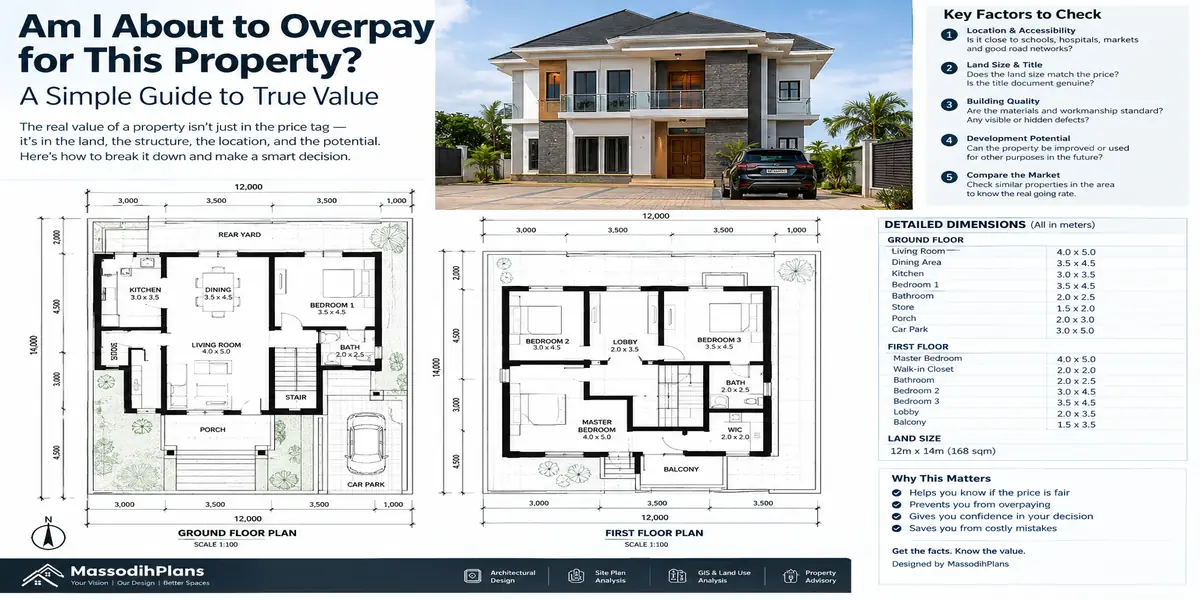
Am I About to Overpay for This Property? A Simple Guide to True Value
Someone sent me a screenshot last month. A plot in an “emerging” part of Lagos, agent asking ₦45 million, and the message under it just said: “Is this too much?”
That’s really the whole question, isn’t it. Not “what’s the market rate” people can Google that. The actual question sitting underneath is: am I about to hand over money I’ll regret handing over, for a piece of land or a house I don’t fully understand yet? And most of what’s written on this topic, especially the stuff dominating Google right now, answers a completely different question. It tells you to “check comps” and “hire a realtor” and “look at days on market” which is fine advice if you’re buying a listed house through an MLS system in America. It is almost useless if you’re standing on a plot in Ibeju-Lekki with an agent who has three other “serious buyers” supposedly waiting behind you.
So let’s actually answer your question. Not the American version of it. Yours.
The First Thing to Understand: Price and Value Are Not the Same Question
Before anything else, separate these two things in your head, because most overpaying happens when people mix them up:
Price is what the seller or agent is asking. Value is what the property is actually worth, given its location, title status, size, and condition. Overpaying isn’t paying a high number it’s paying a number that’s higher than the value, whatever that number happens to be. A ₦20 million plot can be a terrible overpay, and a ₦90 million plot can be genuinely fair. The number alone tells you nothing.
This sounds obvious written down, but I watch people forget it constantly, because an asking price feels like information. It isn’t. It’s a starting offer from someone with an incentive to get you to treat it as if it were the truth.
The very first thing to do with any asking price is mentally relabel it. Don’t think “the price is ₦45 million.” Think “the seller wants ₦45 million, and my job is to find out what it’s actually worth.” That one mental shift changes how you handle everything that follows.
Why Comparables Work Differently Here Than What You’ve Read Online
Every article you’ll find tells you to check “comparable sales” what similar properties nearby have sold for. Good advice, badly suited to how our market actually works.
In the US, sold prices are public record. Here, almost nobody discloses what they actually paid. The number quoted to you by a neighbour, an agent, or even the seller themselves is very often not the real transaction price sometimes inflated to make their own purchase look smart, sometimes deflated to dodge tax conversations. So “just check comps” is advice built for a transparent market, dropped into a market that isn’t one.
What actually works instead:
Talk to more than one agent in the same specific area, not the same agent twice. Different agents quote differently, and the spread between their numbers tells you more than any single number does.
Ask a registered surveyor or estate valuer who works that specific axis what similar plots have genuinely gone for not agents, a professional valuer, because their reputation depends on being roughly right, not on closing your deal.
Check the Land Use Charge or ground rent records where accessible these are sometimes based on more grounded valuations than open-market asking prices, and can serve as a sanity check.
Walk the actual street, not just the plot. What’s currently under construction two plots down tells you more about real demand than any figure quoted to you.
None of this gives you a clean number the way an MLS printout does. It gives you a range, and a sense of whether the asking price sits inside that range or well outside it. That range is your real answer key.
The Question Nobody Else Is Asking: Is the Title Even Worth What’s Being Charged?
Here is the layer that’s completely missing from every “how to know if you’re overpaying” article I found while researching this, because none of them were written for a market where land title itself carries a price tag independent of location.
A property with a clean Certificate of Occupancy (C of O), verified at the land registry, and free of any governor’s consent complications is worth genuinely more than an identical plot sitting on a shaky title a receipt from a family, an “excision in progress,” or a title that “will be regularized after purchase.” Agents routinely quote both types of land at similar prices, because the buyer often doesn’t ask the right question until it’s too late.
So before you even get to “is this a fair price,” ask a sharper question: fair price for what, exactly?
- A registered, verified C of O plot
- A governor’s consent property with clean chain of title
- A family-receipt or “omo-onile” allocation with no government backing
- Land under an active excision process, not yet complete
These are not the same product. If two plots on the same street are priced the same, but one has a verified title and the other doesn’t, the one without proper title is the one that’s overpriced every single time, no matter what number is on it because you are also inheriting risk, legal cost, and possibly a future fight over the same land.
Never let anyone rush you past a title search at the land registry, especially with the classic line that “another buyer is waiting.” A verified title search typically takes days, not months, and any seller who treats that short delay as a dealbreaker is telling you something important about how comfortable they are with scrutiny.
The Pressure Tactics That Make People Overpay Without Realizing It
Nobody sits down and decides “I will overpay today.” It happens gradually, usually because of a specific pattern of pressure, and I’ve watched the same patterns repeat across different clients and different cities.
The manufactured urgency. “There’s another buyer coming to see it this afternoon.” Sometimes true. Very often not. Either way, urgency is designed to move you from evaluating to deciding, and those are different mental states. A property that’s genuinely worth the asking price will still be worth it tomorrow, after your title search comes back.
The anchor-and-discount trick. Quote high, then “for you” bring it down by a few million, framed as a special favour. The discounted number feels like a win because it’s lower than the first number you heard but the first number was never the real ceiling, it was a psychological anchor. Compare the final number to independent value, not to the opening quote.
The emotional attachment lock-in. This one is subtler. You’ve now told your spouse, visited three times, pictured your furniture in the space and the seller or agent can sense that emotional sunk cost building. The moment you notice yourself justifying a price because “I’ve already come this far,” stop and separate the decision from the momentum.
The “everyone is buying here” narrative. Genuine growth areas exist, but “prices are going up fast, buy now before it’s too late” is also the exact script used to sell overpriced land in areas where growth is speculative at best. Ask for something concrete behind the claim an approved government project, a specific road contract, actual infrastructure underway not just the phrase itself.
A Practical Way to Actually Check: The Three-Number Method
Here’s something I walk clients through directly, because it turns a vague feeling into an actual comparison.
Number one: the asking price. Simple what’s being requested.
Number two: the land-plus-construction replacement value. If it’s a built property, estimate what it would cost to buy equivalent land in that specific location today, plus what it would genuinely cost to construct an equivalent building at current material and labour rates. This tells you what the property is worth as a physical asset, stripped of any “location premium” story.
Number three: the professional valuation. A registered estate valuer or surveyor, engaged independently by you (not recommended by the seller or their agent), gives you a third, professionally-arrived-at figure.
When these three numbers cluster reasonably close together, the asking price is probably fair. When the asking price sits noticeably above both the replacement value and the professional valuation, that gap is your overpay and now it’s a number, not a gut feeling you can talk yourself out of.
The professional valuation fee feels like an unnecessary cost when you’re trying to close a deal quickly. It is the cheapest insurance you will buy in this entire transaction. A valuation that costs a few hundred thousand naira, on a property purchase worth tens of millions, is not an expense it’s the one document standing between you and a mistake with an extra zero on it.
Questions to Ask That Most Buyers Never Think to Ask
- Why is the seller actually selling? A relocation or straightforward upgrade is different from a distress sale hidden behind a normal-sounding reason.
- How long has this specific property genuinely been on the market, and has the price moved during that time, and in which direction?
- Is the boundary on the survey plan the same boundary physically pointed out to you on the ground? Discrepancies here are more common, and more consequential, than people expect.
- Does the property sit within, or partially within, a drainage easement, road reserve, or any government acquisition/setback zone? This affects both legal usability and true value, and it’s rarely volunteered upfront.
- Are there any outstanding land use charges, tenement rates, or service charges (for estate properties) attached to the property that will become your responsibility?
- If it’s an estate property, what do the estate’s actual covenants and service charge structure look like — not just what the marketing brochure says?
When Paying “Above Market” Actually Makes Sense
I want to be fair here, because not every premium is an overpay. Sometimes a higher price is genuinely justified:
- The location has real, verifiable infrastructure development underway not rumoured, actually underway
- The title is unusually clean and fully verified, where most comparable plots nearby carry title complications
- The specific plot has a genuinely rare feature for its area corner position, unusually wide frontage, direct road access where most plots nearby don’t have it
- You have a documented, independent valuation that supports the higher number
The difference between a smart premium and an overpay isn’t the size of the number it’s whether you can point to a specific, verifiable reason for it, or whether the reason is just “the agent said this area is hot right now.”
What To Do If You Suspect You’re Already Being Overcharged
If you’re mid-negotiation and the numbers above are pointing toward overpay, you have more room to move than most buyers realize:
Bring your independent valuation to the table directly. Not as an accusation, just as information: “My valuer’s figure came in at X, here’s the report.” This changes the conversation from opinion versus opinion to document versus asking price.
Walk away, genuinely, at least once. Not as a manipulation tactic as an actual willingness to lose the deal if the numbers don’t work. Sellers and agents read forced bluffs easily; they read genuine indifference very differently.
Ask what happens to the price if you handle your own registration and legal work, rather than folding it into a bundled figure. Bundled pricing hides where the actual premium is sitting.
Get everything discussed verbally put in writing before any money changes hands. A verbal “we can sort out the title issue later” is worth nothing once payment is made.
The Uncomfortable Truth About “Overpaying” in a Rising Market
Sometimes the honest answer is: yes, you are overpaying compared to true current value, and you might still choose to proceed anyway because the location is genuinely positioned to appreciate, or because the alternative (renting indefinitely, or waiting years for a “better deal” that may not come) costs you more than the overpay itself. That’s a legitimate decision. What isn’t legitimate is making that trade-off without knowing you’re making it. The entire point of everything above isn’t to talk you out of buying it’s to make sure that if you do pay above strict market value, it’s a decision you made with open eyes, not one that was made for you by pressure and an unverified number.
Frequently Asked Questions
How do I know the real value of land before an agent tells me a price?
Get an independent estate valuer or surveyor working that specific area to assess it before you’re quoted a price, or immediately after not one recommended by the seller or agent.
Is it normal for agents to quote different prices for the same property?
Yes, and the spread between quotes from different agents is useful information in itself a wide spread often signals the asking price isn’t well anchored to actual value.
Does a Certificate of Occupancy always mean a fair price?
No a C of O confirms title strength, not price fairness. You can still overpay for land with a clean title. Title status and price fairness are two separate checks, both necessary.
Should I trust an agent’s claim that another buyer is interested?
Treat it as unverified information, not fact. If it’s true, a short delay for your own title search and valuation won’t lose you a genuinely serious deal; if it’s pressure tactics, the delay will usually expose that.
Is a professional valuation worth the cost for a smaller property purchase?
Yes. The valuation fee is small relative to the risk of overpaying on a major purchase, regardless of the property’s size it’s proportionally cheap insurance either way.
One Last Thing
If there’s a single habit I’d want you to walk away with, it’s this: treat every number you’re given as a claim, not a fact, until you’ve checked it against something independent a valuer, a registry, a second agent, an actual site walk. That single habit is worth more than any checklist, because it’s the thing that keeps working even in situations this article never specifically covered.
If you’re working through land or house documentation right now and want a second pair of eyes on it, our Services page covers how we support clients through exactly this kind of verification. For anyone still deciding what to build once the land question is settled, our Plans Library and Plan School are there when you get to that stage. And you can always find more of these straight-talking guides on our Homepage.
Related Posts
- How Do I Know the True Value of a Property? Before You Buy or Sell It
- Is This Property Actually Worth the Asking Price? What to Check First!
- Is This Neighbourhood a Good Place to Live? What to Check Before Buying
- I Don’t Know Which Location to Buy In: How to Choose the Best Location
- I Don’t Know What Type of Property I Should Buy: Here’s How to Actually Decide
- Can’t Find a Property Within Your Budget? Here’s the Part Nobody’s Telling You
- I Don’t Know Where to Find the Right Property in Nigeria | Buyer Guide
- I Need a Real Estate Agent to Help Me Buy a Property in Nigeria Safely
- Property for Sale in Nigeria: The Buyer’s Guide Nobody Publishes Today
- How Do I Get Natural Ventilation? Best Ways to Improve Airflow at Home
- Where Should My House Face? Best Direction for Sun, Wind and Comfort
- I Can’t Understand or Visualize My Floor Plan — Let’s Fix That Right Now
- My Floor Plan Has Poor Circulation: How to Fix It and Improve Flow
- I Don’t Know How to Arrange My Rooms: Here’s How to Actually Figure It Out
- My Rooms Are Too Small: How Big Should Each Room Be in a House?
- I Don’t Know How Big Each Room Should Be: Standard Room Size Guide
- How Much Building Can I Put on My Plot? Building Coverage and Setbacks
- My House Plan Doesn’t Fit My Land: What to Do Before You Build
- I Need a House Plan That Fits My Plot with Exact Dimensions and Layout
- I Don’t Know What House Plan to Build? Here’s How to Decide
Author
Massodih Okon is a Nigerian built-environment professional with academic and professional experience in urban and regional planning, geography, architectural design, Landscape Design, GIS and land development.
He holds a Master’s degree in Urban and Regional Planning from the University of Uyo and a first degree in Geography and Regional Planning.
Through MassodihPlans, he publishes practical guides on Nigerian house plans, building design, physical planning, site planning, development approval and residential construction. Read the full author profile →