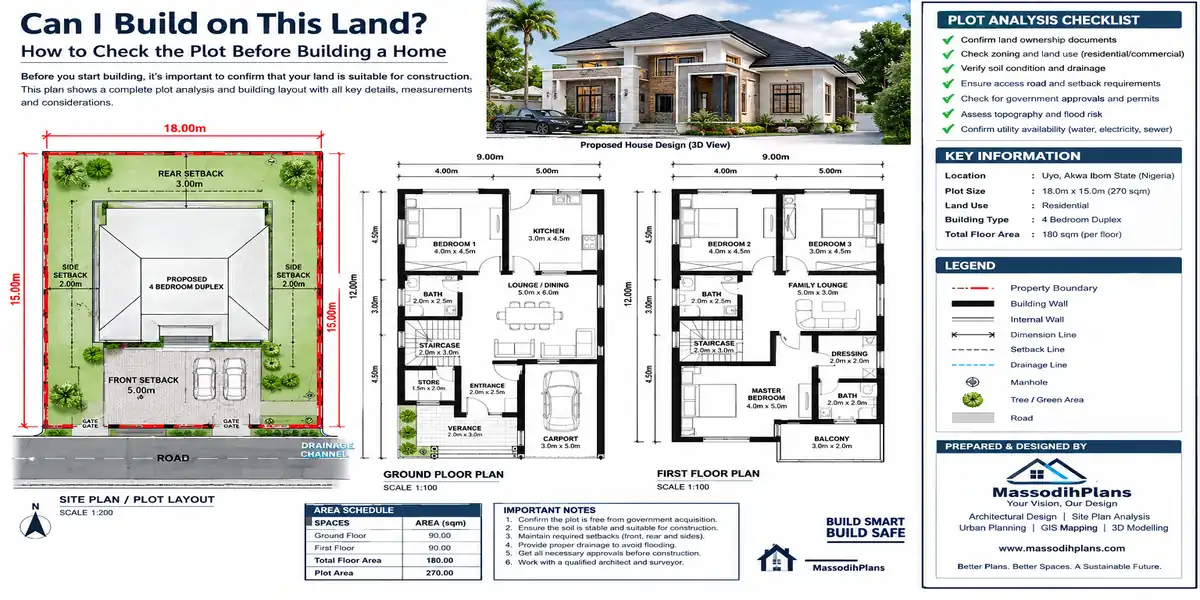
Can I Build on This Land? How to Check the Plot Before Building a Home
Let me tell you about a man I once sat with in my office, holding a receipt for a plot in a fast-developing part of Akwa Ibom. Not a deed. Not a survey plan. A receipt handwritten, with a thumbprint at the bottom. He’d paid ₦4.2 million for it two years earlier. He wanted me to draw his building plan so he could start construction that dry season.
I had to tell him something he did not want to hear: nobody could confirm, from what he had in his hand, that the land was even his to build on. Not because I was being difficult. Because a receipt tells you that money changed hands. It does not tell you who actually owned the land, whether it sits inside a government acquisition, whether it’s zoned for the house he wanted to build, or whether three other people also have “receipts” for the same plot from the same seller.
That story is the reason this article exists. “Can I build on this land?” sounds like one question. It is actually five or six different questions wearing one trench coat, and almost every article answering it online is written for a country with a county zoning office you can call and a clean parcel database you can search in ten minutes. Nigeria doesn’t work that way, and pretending otherwise is how people end up like the man in my office money gone, plan drawn, and a building that never gets approval, or worse, gets demolished.
So let’s actually go through this properly.
The One Question That’s Really Six Questions
When someone asks “can I build on this land,” they’re usually asking some combination of:
- Do I (or the seller) actually have a legitimate legal claim to this land?
- Is this land zoned or designated for residential use, or something else?
- Is the land physically suitable soil, drainage, flood risk?
- Does it have legal access a real road, not a footpath through someone else’s compound?
- Is it free of government acquisition, litigation, or competing family claims?
- What specifically am I allowed to build here house type, height, density?
You cannot answer “can I build on this land” with a yes or no until you’ve worked through all six. A plot can pass on title and fail on zoning. It can pass on zoning and fail on government acquisition. I’ve seen land pass everything except access, and that single missing item quietly held up construction for eleven months while the buyer tried to negotiate a right of way with a neighbour who knew exactly how much leverage he had.
Don’t ask “can I build on this land” as one question to one person. Ask it as six separate questions to the specific offices and professionals who can each answer their part a lawyer for title, the state planning authority for zoning, a surveyor for boundaries and acquisition status, a geotechnical engineer for soil. One person telling you “it’s fine” rarely means all six have actually been checked.
Question 1: Does Anyone Actually Have a Legal Right to Build Here?
This is where Nigeria’s land law creates a genuinely different starting point from almost every other country’s zoning article you’ll find online.
Under the Land Use Act of 1978, all land in each state is vested in the Governor, held in trust for the people. What you or a seller “own” is technically a right of occupancy granted by the state, not outright freehold ownership in the Western sense. This single fact is the root of most Nigerian land disputes, and it’s why the documents that prove your right to build matter so much more here than in countries where a deed alone settles the question.
The documents that actually establish this right, roughly in order of strength:
Certificate of Occupancy (C of O) issued by the state government, the strongest evidence of a right of occupancy over a specific parcel
Governor’s Consent on a Deed of Assignment required when land changes hands, and its absence is one of the most common defects in Nigerian land transactions
Excision and Gazette where formerly family or communal land has been officially released from government acquisition and gazetted for private allocation
Registered Survey Plan confirms the parcel’s exact boundaries and coordinates as lodged with the state Surveyor-General
Deed of Assignment / Deed of Sublease the transaction document, only as strong as the title behind it
Family/Customary receipts or agreements the weakest form, common in peri-urban and rural areas, and the source of the vast majority of “can I build here” disputes I’ve handled
If what you’re holding stops at a receipt or a family agreement with no excision or gazette behind it, you don’t yet have an answer to “can I build on this land” you have a starting point for finding out.
Governor’s Consent is not a formality you can skip and fix later. Building on land where the assignment lacks Governor’s Consent, or where the title hasn’t been perfected, is one of the most common reasons construction gets stopped mid-project by state enforcement, sometimes after tens of millions of naira have already gone into the building.
Question 2: Is This Land Zoned for Residential Use?
This is the part every American zoning article covers well, and where Nigerian buyers often assume “there’s no equivalent here” there is, it’s just less centralized and less digitized than a US county zoning portal.
Every Nigerian state has a physical/urban and regional planning authority (LASPPPA and LASURA in Lagos, RIVSPPPA in Rivers State, and equivalent boards in other states including Akwa Ibom) that maintains master plans and layout designations classifying land as residential, commercial, industrial, agricultural, institutional, or reserved for public infrastructure. Your plot’s designation under that master plan not what the current land looks like, and not what the seller tells you is what actually determines whether residential development is permitted there.
Here’s the part that surprises people: land can look completely residential fenced, with neighbouring houses already built — and still sit in a zone designated for something else on the state’s master plan, especially in areas where development has outpaced formal planning enforcement. I have reviewed plots surrounded by existing houses that were, on paper, still zoned agricultural or reserved for a road expansion nobody had implemented yet.
How to actually check this:
- Request a zoning/planning information confirmation from your state’s urban and regional planning authority, using the plot’s survey coordinates or registered plan number
- Cross-check against any published or accessible state master plan/layout plan for that local government area
- Where the authority operates a GIS portal (an increasing number of states now do), search the parcel directly
Ask the planning authority for permitted use in writing, referencing your specific survey plan number, not a verbal “yes it’s residential” over the counter. Verbal confirmations have no evidential weight if a dispute or enforcement action comes up later.
Question 3: Can I Build a House on Agricultural Land?
This deserves its own answer because it comes up constantly, especially with peri-urban and semi-rural plots that look cheap and available.
The honest answer: usually not directly, and not automatically. Land designated agricultural under a state’s master plan generally cannot be used for residential construction until it goes through a change of use process a formal application to the relevant planning or lands authority to convert the designation from agricultural to residential, often alongside a regularization process if any informal development has already started.
This isn’t just paperwork bureaucracy. Agricultural zoning frequently correlates with land that hasn’t been serviced with the drainage, road, and utility infrastructure residential development assumes. Land that’s cheap because it’s “agricultural” is very often cheap for reasons that also make it harder or more expensive to actually build on poor access roads, no drainage infrastructure, and a change-of-use process that can take months and isn’t guaranteed to be approved.
If you already own agricultural-zoned land and want to build:
- Confirm the exact current zoning designation in writing from the state planning authority
- Apply formally for change of use / conversion, providing your survey plan and title documents
- Expect this to take considerably longer than a straightforward building plan approval plan your timeline around it, not around when you’d like to start construction
- Do not begin construction while the application is pending building ahead of approval is one of the fastest routes to a demolition notice
Question 4: Is This Land Under Government Acquisition?
This is the layer almost no international article on “can I build on this land” covers, because it’s a distinctly Nigerian problem, and it’s one of the biggest reasons land that looks perfectly fine turns out to be unbuildable.
Many parcels across Nigerian states including large tracts in Lagos, Rivers, and Akwa Ibom remain under government acquisition: land formally taken over by the state for public purposes (roads, institutions, reserves, future development) that has never been officially released back for private allocation, even if informal settlement or sale has continued on the ground for years. Land under acquisition can be sold to you by an “owner,” fenced, surveyed, and look completely normal and still be legally unbuildable until it’s excised and gazetted for private use, or until the acquisition is formally revoked.
This is precisely why excision and gazette documents matter so much in the title hierarchy above. A plot without evidence of excision, sitting within a known acquisition area, is one of the highest-risk “can I build here” situations in Nigerian land transactions and it’s exactly the kind of risk a receipt or informal family sale will never disclose to you.
How to check acquisition status:
- Conduct a search at the state Ministry of Lands / Land Registry against the specific parcel, not just the general area
- Ask specifically and in writing whether the plot falls within any government acquisition, and if so, whether it has been excised and gazetted
- Be suspicious of land priced noticeably below the surrounding market rate in an area you know is developing fast acquisition status is one of the most common hidden reasons
A “government acquisition” search is not the same as a title search, and sellers will rarely volunteer this information. Insist on it as a separate, explicit search at the Ministry of Lands before you commit funds — this single check has saved several of my clients from buying land they could never legally build on.
Question 5: Family and Community Land Disputes (The “Omo-Onile” Problem)
If you’ve spent any time around Nigerian land transactions, you already know this word, and if you haven’t, you need to before you buy anything. Omo-onile literally “children of the soil” refers to descendants of original landowning families who, in many areas, continue to claim informal fees, levies, or outright ownership over land long after it has been sold or allocated to others.
This creates a specific and very real version of “can I build on this land”: you may hold a perfectly valid C of O or registered deed, and still face physical obstruction, extortion demands, or violence at the point of construction from parties claiming an unresolved family interest in the land. This is not a hypothetical it’s one of the most common on-the-ground construction disruptions across parts of Lagos, Ogun, and similar rapidly urbanizing areas, and it increasingly shows up in other developing states too.
Practical steps that actually reduce this risk:
- Before purchase, ask directly whether the land has a documented history of family/community disputes, and get this in writing where possible from the seller or their lawyer
- Engage a lawyer to conduct a proper title search that traces the root of title back through any family or communal origin, not just the most recent sale
- Where the area is known for this issue, budget for and formally document any community engagement or “recognition” process common in that specific locality, distinct from and in addition to your formal title
- Never rely on the seller’s verbal assurance that “the community has been settled” ask for documentation of exactly what was settled and with whom
Question 6: Is the Land Physically Suitable to Build On?
Title and zoning can be perfect, and the ground itself can still say no.
Soil condition: Waterlogged, sandy, or poorly compacted soil common in low-lying and coastal areas across Lagos, Rivers, and Akwa Ibom demands more expensive foundation types (raft or pile foundations instead of standard strip foundations) and, in extreme cases, can make standard residential construction prohibitively expensive relative to the land’s value. A soil test before you finalize design isn’t optional caution it directly determines your foundation cost.
Flood risk and drainage pattern: Land sitting in a natural floodplain or drainage channel, even if not formally designated as such, will flood regardless of what your title documents say. Check the plot’s actual topography and its relationship to nearby water bodies and drainage channels, not just its paperwork.
Setback from water bodies and high-tension lines: Most states enforce mandatory setback distances from rivers, creeks, and high-tension power lines, which can significantly reduce your plot’s actual buildable area even where the land is otherwise approved for residential use.
Erosion-prone terrain: Sloped or gully-adjacent land, common in parts of South-South Nigeria, needs specific engineering assessment before you assume standard construction methods will work.
Commission your soil test and topographic survey before you finalize your building design, not after. I’ve had to redesign entire foundation systems at real added cost because a client designed first and tested soil second.
Question 7: Does the Land Have Legal Access?
A plot with perfect title, correct zoning, and good soil is still not straightforwardly buildable if the only way to reach it is across someone else’s land without a documented right of way. This gets overlooked constantly because during a site visit, walking to the plot feels normal nobody stops you. The legal question is different: is there a registered, enforceable right of access, or are you relying on a neighbour’s ongoing goodwill?
Confirm road frontage and access as part of your survey plan review, and where access depends on a right of way across another parcel, get that documented and registered, not assumed.
What Can I Actually Build on My Land?
Once you’ve cleared title, zoning, acquisition status, soil, and access, “what can I build” comes down to your specific plot’s permitted parameters, set by your state’s planning authority and, where applicable, your local development control regulations:
- Permitted use residential, and at what density (single-family, multi-family, mixed-use)
- Plot coverage the maximum percentage of your plot area that can be built on
- Setbacks the mandatory distance your building must sit from front, rear, and side boundaries
- Height restrictions maximum number of storeys or building height permitted in that zone
- Density/plot ratio for estates or planned layouts, how many units or how much floor area is permitted per plot
These specifics come from your local planning authority’s development control guidelines for that exact zone, and they’re what your architect designs against not a generic assumption based on what neighbouring buildings look like.
The Practical Verification Checklist
If you take nothing else from this article, take this sequence, in this order:
- Get the registered survey plan and confirm the plot’s exact coordinates and boundaries
- Conduct a title search at the state Land Registry against those specific coordinates not the general area
- Request written zoning/permitted-use confirmation from the state urban/regional planning authority, referencing the survey plan number
- Conduct a separate government acquisition search at the Ministry of Lands
- Investigate family/community land history, especially in areas known for omo-onile activity
- Commission a soil test and topographic survey before finalizing any building design
- Confirm legal, documented access not just physical walkability to the plot
- Only then commission architectural design, since design decisions (foundation type, setbacks, orientation) depend on what steps 1 through 7 actually reveal
Skipping straight to step 8 because a plot “looks fine” is the single most common mistake I see, and it’s the mistake that turns a straightforward build into a stalled one.
If Your Land Fails One of These Checks
Finding a problem doesn’t automatically mean walk away it means you now know what has to be resolved before you build, and roughly what that resolution costs in time and money:
- Wrong zoning → apply for change of use/conversion, budgeting real time for the application to be processed
- Under government acquisition, not excised → this is a genuine deal-breaker in most cases until formal excision and gazette happen, which can take years and isn’t guaranteed factor this into whether you proceed with purchase at all
- Unresolved family/community claims → resolve and formally document this before construction, engaging a lawyer experienced in that specific locality’s land history
- Poor soil → adjust your foundation design and budget accordingly rather than assuming standard costs
- No documented access → negotiate and formally register a right of way before you build, not after
A Note for Diaspora Buyers Specifically
If you’re buying from abroad, every single risk in this article is harder to catch remotely, and easier for a dishonest party to hide from you. Never rely solely on a relative or agent’s verbal confirmation for any of the six questions above. Engage a lawyer and a registered surveyor directly, ask for documented search results (not summaries), and where possible, have an independent professional physically inspect the plot and its immediate surroundings before you transfer funds. Distance is exactly the vulnerability that weak title, undisclosed acquisition status, and unresolved family claims are most often used to exploit.
Frequently Asked Questions
Can I build on this plot?
Only once you’ve confirmed legitimate title, correct residential zoning, clear government acquisition status, resolved family/community claims, suitable soil, and documented legal access. Any one of these failing means the honest answer is “not yet.”
Is this land suitable for residential development?
Suitability has two separate parts: whether it’s zoned for residential use under your state’s planning framework, and whether it’s physically suitable soil, drainage, flood risk. Both need separate confirmation.
Can I build a house on agricultural land?
Generally not without a formal change of use application converting the designation to residential first. Building ahead of that approval risks enforcement action later.
Can I build on this particular property?
This depends on that specific parcel’s title status, acquisition history, and zoning general area reputation or neighbouring buildings tell you very little about your specific plot’s legal status.
Is my land developable?
If you already own it, “developable” means the same six checks apply: title clarity, correct zoning, no unresolved acquisition, no unresolved family claims, adequate soil, and legal access.
Is this land zoned for residential use?
Only your state’s urban/regional planning authority can confirm this definitively, referenced against your specific survey plan not assumption based on what’s built nearby.
What can I build on my land?
And what your zone’s plot coverage, setback, height, and density rules permit confirmed from your local planning authority’s development control guidelines for that specific zone, not a generic assumption.
What type of development is allowed?
Determined by your parcel’s permitted use classification and density allowance under the applicable state master plan and local development control regulations.
The Bottom Line
“Can I build on this land” isn’t a question your gut, your agent, or a fenced perimeter can answer. It’s answered by six specific checks, in a specific order, done through the specific offices that hold that information and in Nigeria, that list includes some things (government acquisition, excision, omo-onile history) that most land-buying guides written for other countries will never even mention. Do the six checks before you fall in love with the plot, not after you’ve already paid for it.
If you’re at the verification stage and want support reviewing title, zoning, and site suitability before you commit, our Services page outlines how we assist clients through exactly this process. Browse our Plans Library once your land is confirmed buildable and you’re ready to move to design, or visit Plan School to understand how building plan approval works once verification is done. You can also explore more land and planning guides on our Homepage.
Related guides to help you
- Planning Permission Explained: Everything You Must Know Before Building on Your Land
- Am I About to Overpay for This Property? A Simple Guide to True Value
- How Do I Know the True Value of a Property? Before You Buy or Sell It
- Is This Property Actually Worth the Asking Price? What to Check First!
- Is This Neighbourhood a Good Place to Live? What to Check Before Buying
- I Don’t Know Which Location to Buy In: How to Choose the Best Location
- I Don’t Know What Type of Property I Should Buy: Here’s How to Actually Decide
- Can’t Find a Property Within Your Budget? Here’s the Part Nobody’s Telling You
- I Don’t Know Where to Find the Right Property in Nigeria | Buyer Guide
- I Need a Real Estate Agent to Help Me Buy a Property in Nigeria Safely
- Property for Sale in Nigeria: The Buyer’s Guide Nobody Publishes Today
- How Do I Get Natural Ventilation? Best Ways to Improve Airflow at Home
- Where Should My House Face? Best Direction for Sun, Wind and Comfort
- I Can’t Understand or Visualize My Floor Plan — Let’s Fix That Right Now
- My Floor Plan Has Poor Circulation: How to Fix It and Improve Flow
- I Don’t Know How to Arrange My Rooms: Here’s How to Actually Figure It Out
- My Rooms Are Too Small: How Big Should Each Room Be in a House?
- I Don’t Know How Big Each Room Should Be: Standard Room Size Guide
- How Much Building Can I Put on My Plot? Building Coverage and Setbacks
- My House Plan Doesn’t Fit My Land: What to Do Before You Build
- I Need a House Plan That Fits My Plot with Exact Dimensions and Layout
- I Don’t Know What House Plan to Build? Here’s How to Decide
Author
Massodih Okon is a Nigerian built-environment professional with academic and professional experience in urban and regional planning, geography, architectural design, Landscape Design, GIS and land development.
He holds a Master’s degree in Urban and Regional Planning from the University of Uyo and a first degree in Geography and Regional Planning.
Through MassodihPlans, he publishes practical guides on Nigerian house plans, building design, physical planning, site planning, development approval and residential construction. Read the full author profile →