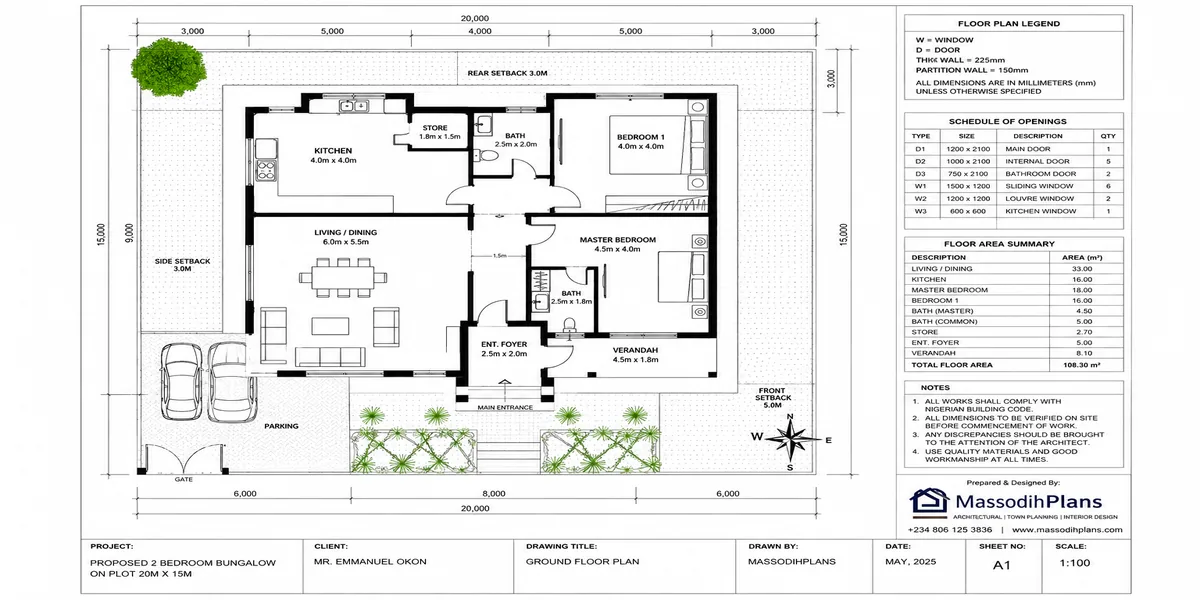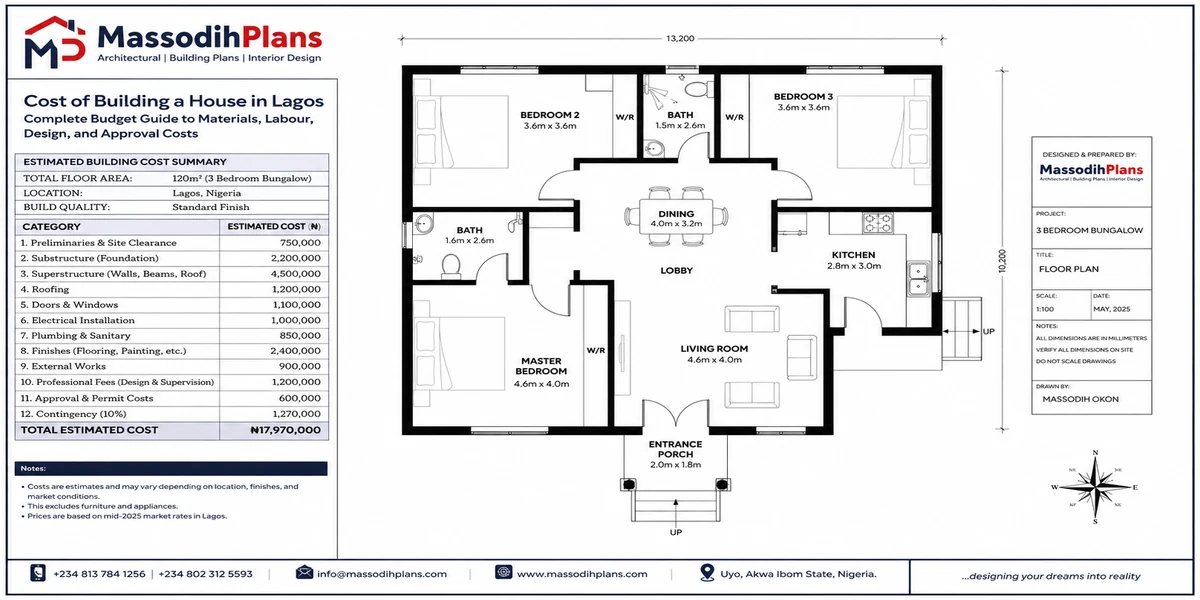
Cost of Building a House in Lagos
How much does it cost to build a house in Lagos? There is no single price that applies to every property. Your final budget depends on the house type, floor area, location, soil condition, foundation design, quality of materials, labour rates, architectural and engineering fees, finishing standard, site conditions, and approvals required before construction begins.
This guide is designed to give you the picture not just a tempting total figure that can leave you stranded halfway through construction. You will see how the cost changes from one stage to another, what you may spend on cement, blocks, reinforcement, sand, granite, roofing, windows, doors, plumbing, electrical work, tiles, painting and other materials, plus the labour behind each stage. We also explain professional design costs, quantity surveying, structural engineering, site investigation, building-plan approval and other expenses that inexperienced builders often leave out of their first budget.
Most importantly, this is not simply a “how much money do I need?” guide. It is a planning guide for deciding what you can build with your available budget, where you can save without compromising safety, and where cutting costs can create expensive problems later. Lagos is important because location, accessibility, traffic, drainage, groundwater and soil conditions can change construction requirements and logistics. Current market prices move, so any estimate should be treated as a planning range rather than a guaranteed contractor quotation.
By the end, you will understand the major cost drivers, how to build a realistic Lagos construction budget, which hidden expenses to reserve for, and how to compare contractor quotations intelligently. If you already own land or are still choosing a house plan, our related guides on house designs, building approval and construction costs will help you take the next step with fewer surprises.
What Actually Determines Your Building Cost in Lagos
Before any numbers, understand the variables driving them, because two people building “the same house” in Lagos can pay wildly different totals.
Location within Lagos matters more than almost anything else. Building in Ikoyi, Lekki Phase 1, or Banana Island carries premium land, labour, and logistics costs; building in Ikorodu, Badagry, or outer Ajah costs meaningfully less across every category, simply because land, transport, and demand differ.
Building size and floor count scale cost roughly proportionally, but not perfectly a storey building costs more per square metre than a bungalow, because it needs more structural steel, more foundation work, and more skilled labour hours.
Reality Check: Two 4-bedroom houses of identical size can differ by ₦20 million or more purely based on finishing standard tiles, sanitary fittings, doors, and paint quality swing cost more than most people expect.
Finishing standard basic, medium, or high-end is genuinely the biggest lever within your control. As of 2026, planning estimates place basic residential construction at roughly ₦150,000–₦250,000 per square metre, medium-standard around ₦300,000–₦500,000, and high-end developments at ₦600,000 and above.
Soil condition and foundation type vary significantly across Lagos’s mix of dry land and reclaimed or waterlogged terrain, directly affecting foundation cost a piled foundation on soft, reclaimed land near the Lekki axis costs dramatically more than a standard strip foundation on firm ground.
Professional involvement level full architectural and structural design versus an informal, unsupervised build affects both upfront design cost and long-term risk, a trade-off we’ll unpack fully later in this guide.
Understanding these five variables lets you interpret every number in this guide against your specific project, rather than treating any single figure as universal. Let’s start turning that into real money beginning with cost per square metre.
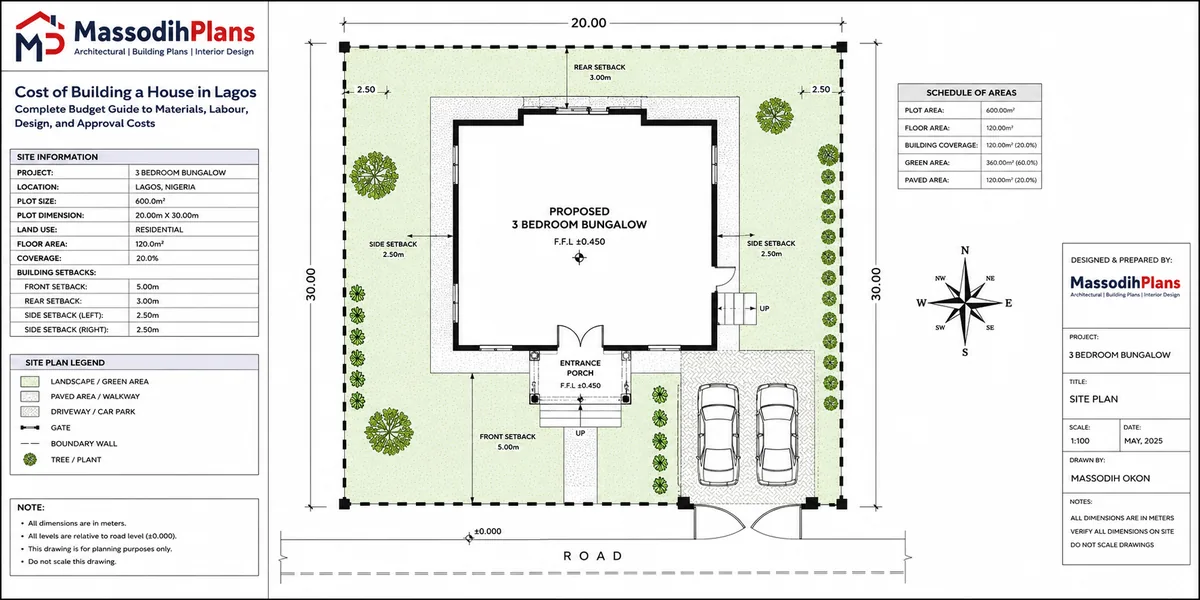
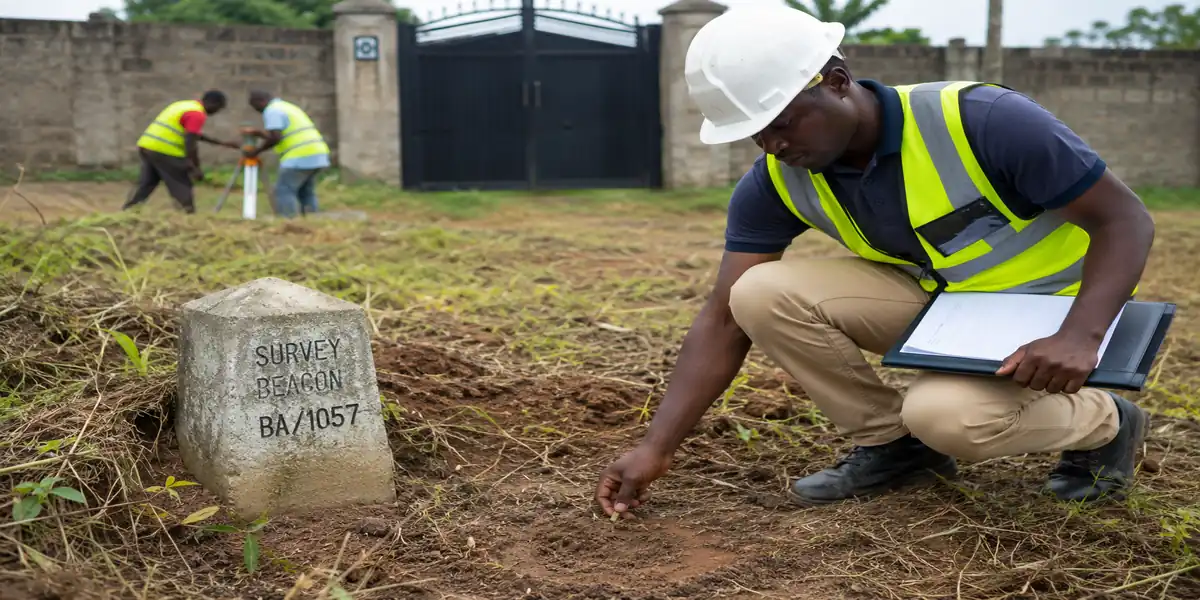
Site Plans Cost of Building a House in Lagos
Cost Per Square Metre in Lagos: The Real 2026 Numbers
This is the number everyone searches for, so let’s be precise about it, and precise about what it does and doesn’t include.
At basic finishing standard block walls, simple tiles, basic sanitary fittings, ordinary doors and windows expect roughly ₦150,000 to ₦250,000 per square metre in 2026. And At medium finishing better tiles, POP ceilings, upgraded fittings, quality doors expect ₦300,000 to ₦500,000 per square metre. At high-end finishing imported fittings, premium tiles, aluminum windows, sophisticated electrical and possibly smart-home wiring costs run ₦600,000 per square metre and beyond, climbing further in premium Lagos zones.
Quick Estimate Formula: Total floor area (sqm) × cost per sqm for your chosen finishing standard = rough construction cost, BEFORE land, design fees, and approval costs. Never mistake this number for your total project budget.
For a typical 150 sqm bungalow at medium standard, that’s roughly ₦45–75 million in pure construction cost. For a 250 sqm duplex, roughly ₦75–125 million at the same standard.
Here’s what most guides fail to mention: this per-square-metre figure covers construction only structure, roofing, walls, and finishing. It does not include land acquisition, architectural and structural design fees, LASPPPA/LASBCA approval costs, boreholes, fencing, external works, or furnishing. Treating the per-sqm figure as your total budget is exactly how projects run out of money at 70% completion a genuinely common failure pattern I’ve seen repeated across sites for years. We’ll build your true total budget, layer by layer, through the rest of this guide, starting with the cost that usually comes before construction even begins: land.
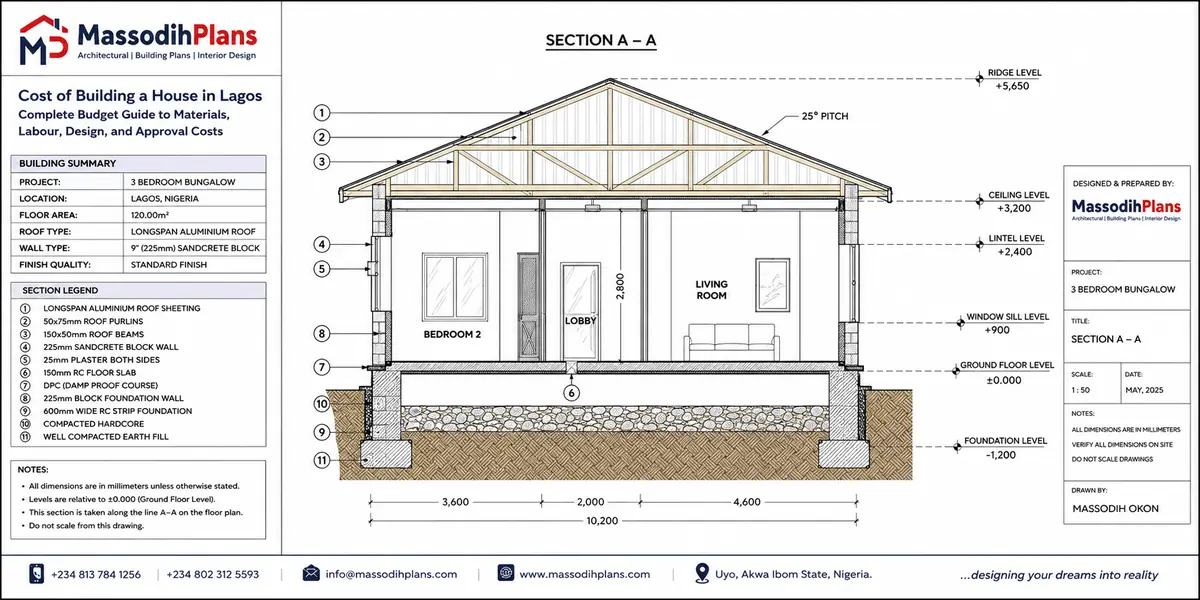
Section plan Designs
Land Cost in Lagos: The Foundation of Your Budget
Land is where your budget genuinely starts, and in Lagos, it varies more dramatically than almost anywhere else in the country.
At the premium end, Banana Island and Ikoyi land trades at several million naira per square metre, pushing a standard plot well past ₦500 million before a single block is laid. Eko Atlantic sits in a similarly premium bracket, driven by land scarcity and reclamation cost. Lekki Phase 1 and Victoria Island remain expensive, though somewhat below Ikoyi levels.
Mid-range areas Lekki (further out), Ajah, and parts of Ikeja GRA offer more accessible land, while Ikorodu, Badagry, and outer Epe remain the most affordable entry points into Lagos land ownership, at the cost of longer commutes and, sometimes, less developed infrastructure.
Non-Negotiable Advice: Land title matters more than land size in Lagos. A smaller plot with clean, registered title (Certificate of Occupancy or Governor’s Consent properly perfected) is a safer investment than a larger plot with disputed or family land documentation always conduct a search at the Land Registry before any payment changes hands.
Governor’s Consent, required when purchasing land already held under someone else’s title, adds its own cost layer — typically calculated as a percentage of the land value, and this is a cost first-time builders frequently forget to budget for entirely, discovering it only once they’re deep into the purchase process. Budget for it from day one, not as a surprise near closing.
Land secured, let’s move to the material that will actually become your walls, floors, and roof and where I want to give you real, current 2026 numbers, not vague ranges.
Material Costs: Real 2026 Prices You Need
Materials typically consume the largest share of any construction budget, so let’s get specific about what things actually cost right now.
Cement is your single biggest line item. As of 2026, a 50kg bag retails between roughly ₦9,500 and ₦13,000 in Lagos depending on brand Dangote, BUA, and Lafarge and purchase volume. Buying by the trailer load (around 600 bags) rather than retail can save ₦200–₦500 per bag, which adds up to a genuinely meaningful amount across a full project.
Local Tip: For Lagos specifically, consider PPC (Portland Pozzolana Cement) over standard OPC for slabs and general work it generates less curing heat, reduces thermal cracking, and resists salt-air intrusion better on the Island axis. It’s also typically slightly cheaper per bag.
Iron rods (reinforcement) fluctuate with steel and energy prices and represent your second-largest material cost, particularly for storey buildings requiring heavier reinforcement get current pricing directly from a supplier before finalizing your structural budget, since this material moves faster than most others.
Sand and granite, sourced locally, vary by proximity to quarries and dredging sites Island projects typically pay a premium for transport compared to mainland sites closer to supply routes.
Blocks, whether purchased or moulded on-site, depend heavily on cement price directly, since cement is their primary input cost.
Material Cost Reality Check
☐ Get written quotes from at least three suppliers before bulk purchase
☐ Buy cement in bulk/trailer loads where storage allows
☐ Confirm current iron rod pricing weekly during active construction it moves fast
☐ Store cement elevated and dry; spoiled cement is pure financial loss
Roofing sheets, doors, windows, tiles, and sanitary fittings then layer on top based on your chosen finishing standard from section two. With materials priced, let’s talk about the people who’ll actually put them together labour.
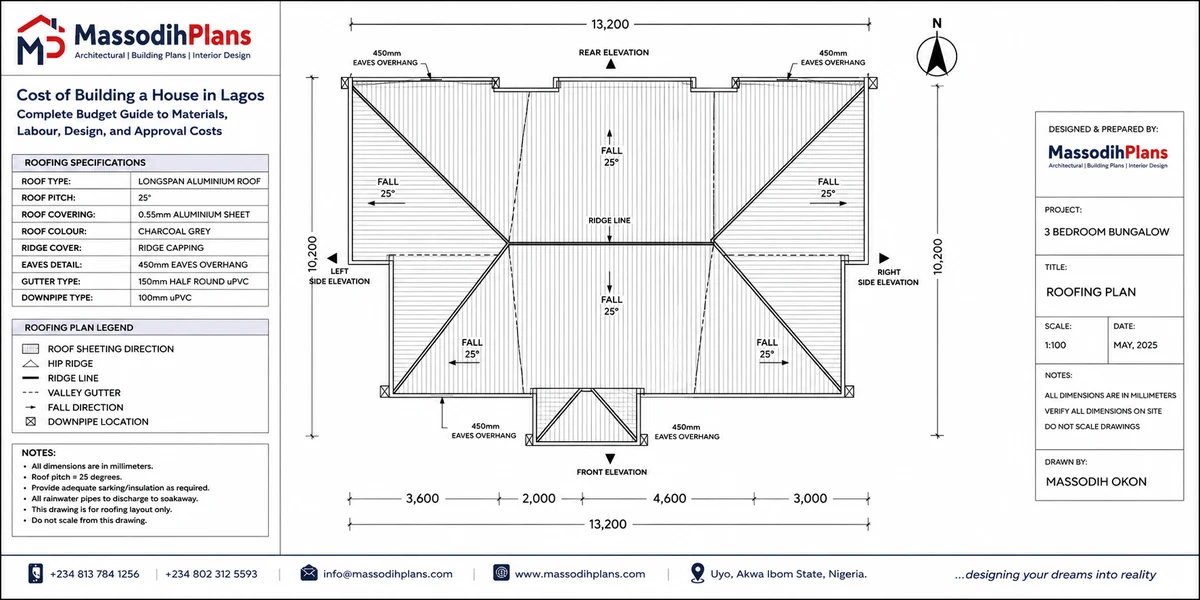
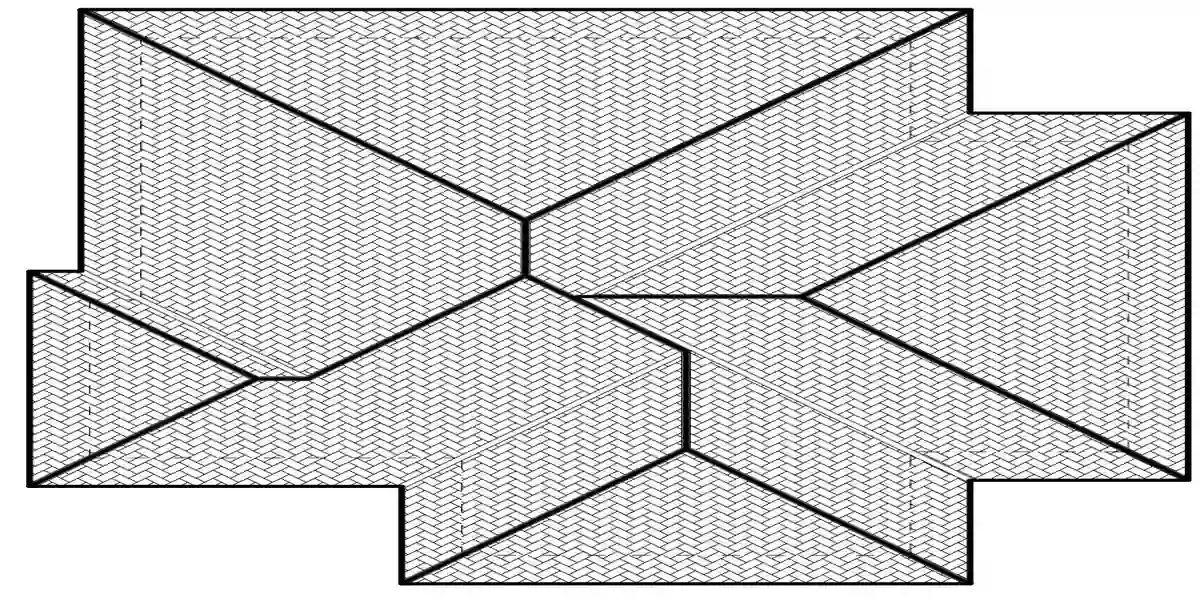
Roofing plan
Labour Costs: What You’re Actually Paying For
Labour in Lagos costs more than almost anywhere else in Nigeria, and understanding why helps you budget honestly rather than being surprised.
Lagos commands premium labour rates due to higher cost of living, stronger demand for construction workers, and genuine competition for skilled tradespeople across the state’s constant building activity. This applies across the board bricklayers, carpenters, iron benders, electricians, plumbers, painters, and tilers all charge more here than in Ibadan, Port Harcourt, or smaller cities.
Structural-phase labour foundation, blockwork, roofing typically represents the largest labour cost bucket, since this phase demands the most person-hours and the most skilled supervision to get right.
Field Insight: Cheap labour is rarely actually cheap. I’ve inspected too many sites where corners cut on bricklaying or iron-bending skill created structural problems that cost far more to correct later than the labour savings were ever worth.
Finishing-phase labour tiling, painting, electrical, plumbing, carpentry costs vary enormously by skill level and finish complexity; intricate tiling patterns, built-in carpentry, and specialized electrical work (smart systems, backup power integration) all command higher rates than standard finishing.
Supervision and site management, whether a dedicated site supervisor, a contractor’s project management fee, or your own time investment, is a real cost too either paid directly, or paid indirectly through inefficiency, material waste, and rework when supervision is skipped entirely.
Payment structure matters practically most Lagos contractors work on staged payments tied to project milestones (foundation, roofing, finishing) rather than a single lump sum, and agreeing this structure clearly upfront, in writing, prevents disputes later.
Materials and labour together typically represent the bulk of construction cost but before either of them can legally begin, you need design, which is where we head next.
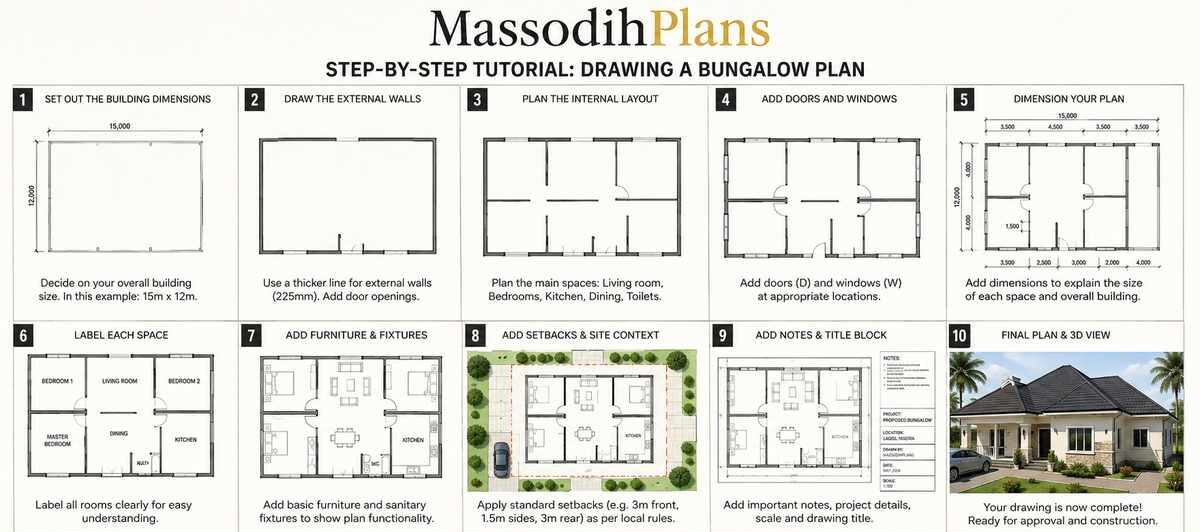
Design and Professional Fees: What You’re Actually Buying
This section rarely gets the attention it deserves in cost guides, and I want to change that, because design isn’t a luxury add-on it’s the foundation every subsequent cost decision depends on.
Architectural drawings in Lagos typically cost between ₦150,000 and ₦800,000 depending on building complexity, size, and the architect’s experience level a simple bungalow sits at the lower end, while a complex multi-storey design with sophisticated spatial planning sits higher.
Structural drawings, prepared by a structural engineer working from the architectural design, typically cost between ₦35,000 and ₦100,000 for straightforward residential projects, scaling upward for taller or structurally complex buildings.
Why This Isn’t Optional
Skipping proper architectural and structural design to save this fee is one of the most expensive false economies in Nigerian construction it’s also a hard requirement for LASPPPA approval, meaning you’ll need these drawings eventually regardless, usually at greater cost and stress once construction is already underway.
Soil testing, required particularly on reclaimed or uncertain terrain common across parts of Lagos, adds a further cost but genuinely protects you from foundation failure on problematic soil skipping this on questionable land is a gamble I’d never recommend to a client.
Quantity surveying a detailed cost estimate reflecting your project’s actual scope and specifications, prepared after design is complete helps you budget with genuine precision rather than rough estimation, and is worth the fee on any project above modest scale.
Construction supervision, whether through your architect, a project manager, or a dedicated site supervisor, protects your design and budget through the actual build the same principle we’ve emphasized throughout our landscaping and architecture guides applies directly here.
Together, professional fees typically represent a modest single-digit percentage of total project cost genuinely small relative to the risk they protect you from. With design secured, you’re now ready for the approval process and this is where I want to give you numbers almost nobody else does.
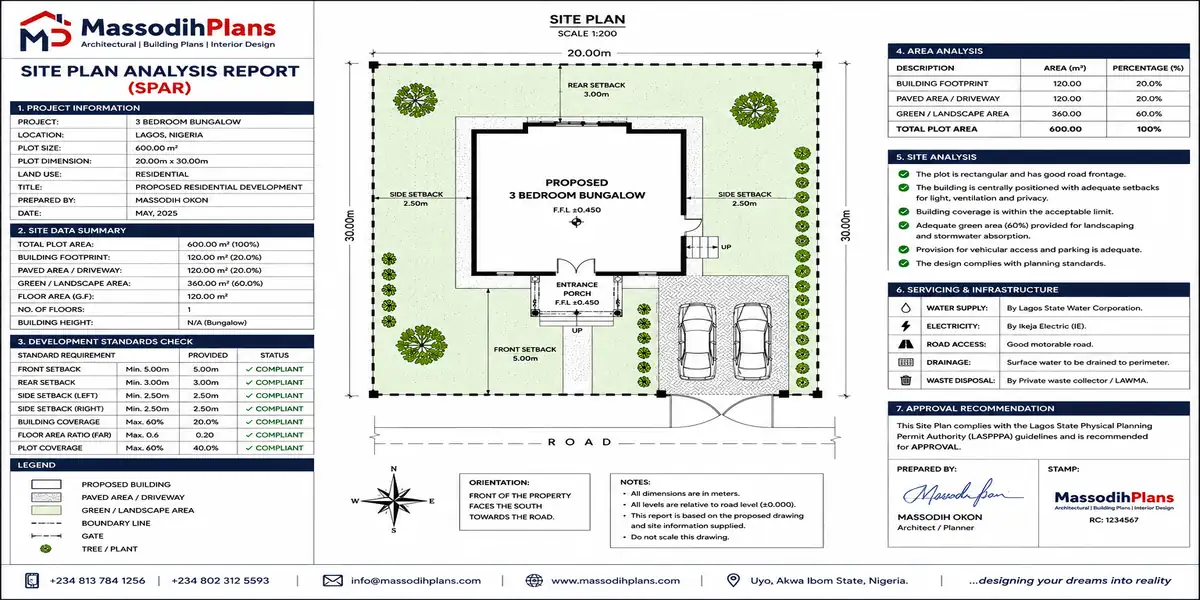
Site Plan Analysis Report Plan
LASPPPA and LASBCA Approval Costs: The Missing Piece
This is genuinely the layer most “cost of building” guides skip almost entirely, and it’s exactly why I want to walk you through it properly because unapproved building in Lagos carries serious risk: fines, enforcement action, and even demolition.
LASPPPA (Lagos State Physical Planning Permit Authority) is the agency that reviews and approves your building plan before construction legally begins. Their fee is calculated using a formula: building volume (length × breadth × height) multiplied by your zone’s rate, plus fencing fees, plus a layout fee (around ₦100,000), plus a registration fee (around ₦50,000), plus an LPO charge (roughly 10% of the building assessment fee).
Zone Matters: LASPPPA rates differ by zone across Lagos Eti-Osa (covering Ikoyi, VI, Lekki) carries different rates than mainland zones. Confirm your specific zone’s current rate directly with LASPPPA or a qualified permit agent before estimating.
LASBCA (Lagos State Building Control Agency) handles inspection and stage certification during construction, charging a fee equal to roughly 20% of your LASPPPA Building Plan Assessment fee a cost easy to forget if you only budget for the initial permit.
Realistically, all-in, a modest residential permit process in Lagos covering LASPPPA fees, LASBCA fees, drawings, and agent assistance if used commonly runs ₦600,000 to ₦2,000,000 total, depending on building size and zone.
Critical Warning: LASPPPA has a specific “as-built penal fee” category for buildings started or completed without approval typically 3 to 5 times the standard permit fee. Never assume “I’ll get approval later.” That assumption is one of the most expensive mistakes in Lagos construction.
With approval costs finally on the table, let’s look at how everything we’ve covered shifts depending on exactly where in Lagos you’re building.
How Costs Shift Across Lagos Zones
Every cost bucket we’ve covered land, materials transport, labour, and approval fees moves together depending on your specific Lagos location, and understanding this helps you choose realistically rather than aspirationally.
Ikoyi, Banana Island, and Victoria Island sit at the top of every cost category simultaneously premium land, premium labour demand, higher LASPPPA zone rates, and often more complex logistics for material delivery to Island sites.
Lekki (Phase 1 through further-out sections) and Ajah offer a wide cost range within themselves Lekki Phase 1 approaches Island-level premiums, while areas further along the Lekki-Epe corridor toward Ajah offer meaningfully more accessible land and construction costs.
Practical Framing: Two clients with identical ₦60 million budgets often end up in very different situations one comfortably completing a full project in Ikorodu, the other struggling to complete even the structural phase in Ikoyi. Match your ambition to your actual budget and zone, honestly, before falling in love with a location.
Ikeja and its GRA sit in a solid mid-range bracket, benefiting from mainland accessibility and established infrastructure without Island-level land premiums.
Ikorodu, Badagry, and outer Epe remain the most affordable entry points across every cost category land, labour, and often LASPPPA zone rates genuinely worth considering if your budget is constrained and commute flexibility exists.
Knowing this landscape before you commit to a location prevents the common, painful scenario of choosing land based on prestige, then discovering your construction budget simply doesn’t stretch to match it. With location cost dynamics clear, let’s cover something equally important: the costs that catch first-time builders completely off guard.
Hidden Costs Nobody Warns You About
I’ve watched too many well-planned budgets collapse not from the big, obvious costs, but from a accumulation of smaller items nobody warned the client about upfront. Let’s fix that here.
Borehole and water supply genuinely essential in most of Lagos given inconsistent public water infrastructure adds a real cost most initial budgets omit entirely, varying by drilling depth and local water table conditions.
Fencing and gate are frequently treated as an afterthought, priced separately (sometimes much later) from the main house budget, despite being a substantial cost on larger plots.
Common Trap: Clients budget meticulously for the house itself, then discover fencing, gate, borehole, and external paving together add another 10–15% on top of the “finished” construction figure they thought was their total.
Alternative power provisions inverter systems, generator housing, or increasingly, solar integration represent a genuinely significant additional cost given Lagos’s power reliability challenges, and one worth budgeting for from the design stage rather than retrofitting later.
Material price volatility during construction is a real risk, not a hypothetical one cement and iron rod prices have moved significantly within single years recently, meaning a budget calculated at project start can be meaningfully outdated by the time you reach finishing stages months later.
Site access and logistics costs particularly on tight urban plots or reclaimed land requiring special equipment access add cost that’s easy to underestimate from a simple per-square-metre calculation.
Professional agent or facilitation fees, if you engage help navigating LASPPPA specifically, add a further cost layer beyond the raw government fees themselves.
Budgeting an honest 15–20% contingency above your calculated construction, design, and approval total is genuinely the single best protection against these accumulated surprises derailing your project. Now let’s bring every layer of this guide together into a realistic sample budget you can actually use.
Putting It All Together: A Realistic Sample Budget
Let’s synthesize everything into something genuinely useful a realistic total budget structure for a medium-standard 4-bedroom duplex (roughly 250 sqm) in a mid-range Lagos zone like Ajah or outer Lekki.
Land: Varies enormously by exact location, but budget realistically for your specific zone based on section three this is genuinely your largest single variable.
Construction (materials + labour combined): At medium finishing, roughly ₦300,000–₦500,000 per sqm × 250 sqm = approximately ₦75–125 million.
Design fees: Architectural and structural drawings combined, roughly ₦200,000–₦900,000 depending on complexity.
Approval costs: LASPPPA and LASBCA combined, realistically ₦600,000–₦2,000,000 depending on zone and building size.
External works (fencing, gate, borehole, paving): Budget a further 10–15% of your construction cost.
Contingency: A genuine 15–20% buffer above your combined total, protecting against material price movement and the hidden costs covered in section nine.
Sample Total Structure
Land (zone-dependent) + Construction (₦75–125M) + Design (₦200K–900K) + Approval (₦600K–2M) + External works (10–15%) + Contingency (15–20%) = Your realistic total project budget
Building in Lagos, done properly, is genuinely achievable at almost any budget level the failures I get called in to assess almost never come from insufficient money in absolute terms. They come from incomplete budgeting: land bought without checking title, construction started without approved drawings, a beautiful finishing budget with no contingency for the cement price that moved mid-project. Every section of this guide exists to close exactly those gaps.
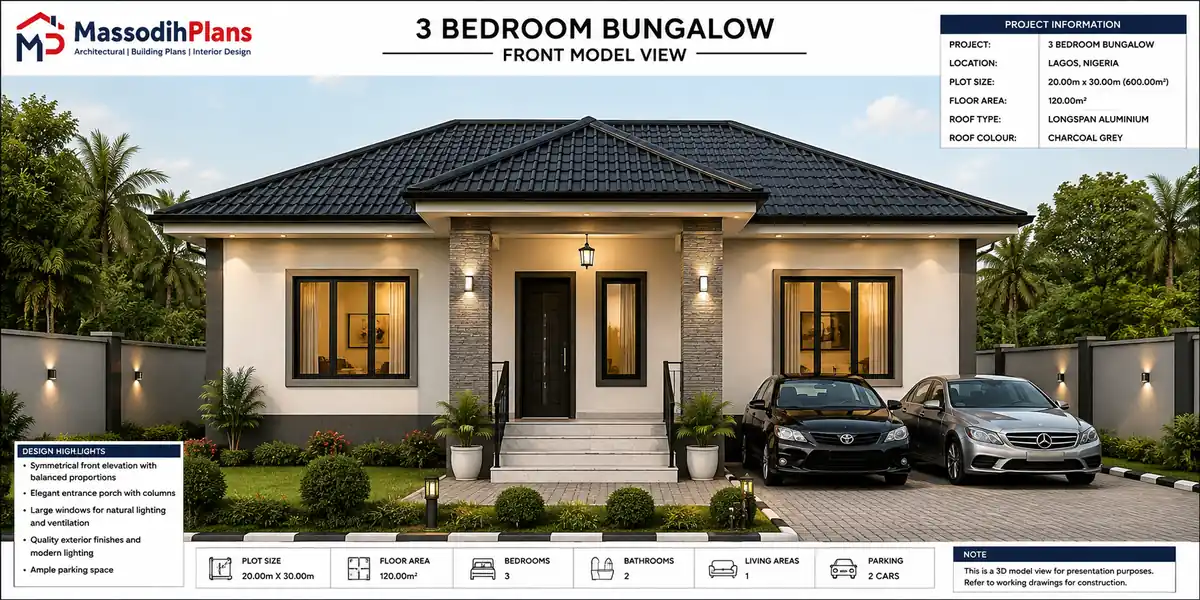
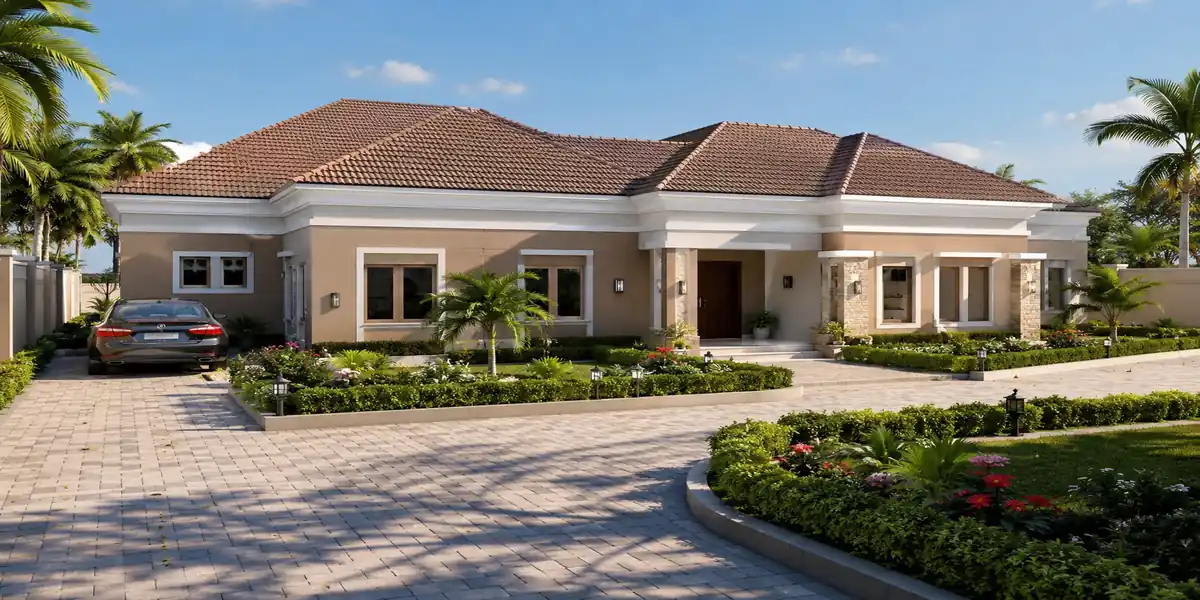
Front Elevation View Plans
If you’re planning a build in Lagos and want a realistic, site-specific budget worked through properly from land to approval, our Services page connects you directly with our team. To understand the design and planning process in more technical depth, explore our Plan School. For house plans already costed with realistic Nigerian construction in mind, browse our Plans Library, and for more guides like this one, return to our Homepage.
Reference: For current LASPPPA fee schedules and building plan approval requirements, the Lagos State e-Planning Permit portal offers official guidance.
Related posts
- Architecture & Architectural Design: Complete Guide to Modern Houses, Building Design and Modern Architecture
- Sustainable Landscaping: Complete Guide to Xeriscaping, Landscape Lighting and Water-Efficient Gardens
- Landscaping Services: Complete Guide to Landscape Design, Hardscaping, Garden Planning and Outdoor Improvements
- Landscape Architect: What They Do, What They Design and When You Need One
- Landscaping: Complete Guide to Design Ideas, Gardens, Yards and Outdoor Spaces
- Urban Planning & Urban Design: Complete Guide to Modern Cities, Development and Renewal
- House Construction Approval Process: Planning, Permits, Inspections and Final Approval
- Land Development Guide: Permits, Planning, Zoning, Costs and Approval Process Explained
- How to Apply for a Building Permit: Requirements, Documents, Costs & Process
- Building Project Budget Template: Complete House Construction Cost Planner
- Building Cost Calculator Nigeria: Estimate Your House Cost in 60 Seconds
- Duplex Construction Cost in Awka, Anambra State: Complete Budget Breakdown
- Cost of Building a 3 Bedroom Bungalow in Umuahia, Abia State (Current Price Guide)
- Cost of Building a 4 Bedroom Duplex in Lagos (Complete Guide)
- Cost of Building a House in Damaturu, Yobe State: Materials, Labour and Finishing
- Cost of Building a Duplex in Yenagoa: Materials and Labour Guide
- Building Design Guide for Safety, Functional, and Cost-Effective Buildings
- Cost of Building a Modern Bungalow in Calabar (Updated Guide)
- Cost of Building a House in Uyo: Honest Budget Guide for Property Owners