Don’t Overspend on Your Home Landscape: Use This Residential Landscape Design Cost Calculator Before You Build
Professionally planned residential landscape featuring decorative paving, native planting, and effective drainage.
Creating a beautiful residential landscape should never begin with guessing the cost. The smartest approach is to use a landscape design cost calculator for residential projects to estimate your budget before construction starts. Whether you are building a new home in Lagos, Abuja, Uyo, Port Harcourt, Enugu, Ibadan, Kano, or anywhere else, understanding the likely cost of landscaping helps you avoid unnecessary expenses, poor planning, drainage problems, and incomplete outdoor spaces.
Many homeowners focus almost entirely on architectural drawings and building construction, only to realize after moving in that they have no proper driveway, poor drainage, muddy surroundings, unattractive front yards, or unusable outdoor spaces. Correcting these problems later usually costs far more than planning them from the beginning.
In my experience, the most successful residential developments treat landscape design as part of the overall site planning process rather than an afterthought. I am going to explains how landscape design costs are calculated, the factors that influence pricing in Nigeria and other countries, and how you can estimate a realistic budget before starting your project.
Why You Need a Landscape Design Cost Calculator
A landscape design cost calculator is not just about knowing how much money you will spend. It is a planning tool that helps homeowners make informed decisions before construction begins.
A good estimate allows you to:
- Set a realistic project budget
- Prioritize essential landscape features
- Prevent unexpected expenses
- Plan construction phases
- Compare contractor quotations fairly
- Allocate funds for long-term maintenance
- Protect the value of your property
One lesson I learned early is that landscape projects become expensive mainly because they were never properly planned. A simple cost estimate prepared before construction often saves homeowners millions of naira over the life of the property.
What Does a Residential Landscape Design Cost Include?
Many people assume landscaping simply means planting flowers and laying grass. Professional landscape architecture is much broader than that.
Depending on your project, the estimated cost may include:
Design Services
- Site inspection
- Site measurements
- Existing condition analysis
- Landscape concept design
- Planting plans
- Hardscape layout
- Drainage planning
- 3D landscape visualization (optional)
Hardscape Features
- Interlocking paving
- Decorative walkways
- Driveways
- Garden edging
- Retaining walls
- Outdoor seating areas
- Pergolas
- Small courtyards
Softscape Features
- Lawn installation
- Shade trees
- Ornamental trees
- Flower beds
- Shrubs
- Ground covers
- Native plants
- Mulching
Drainage and Water Management
Proper drainage often determines whether a landscape succeeds or fails.
Typical drainage costs include:
- Surface drains
- Channel drains
- Catch pits
- Soakaway systems
- Site grading
- Rainwater management
- Erosion control measures
During landscape inspections, I discovered that many attractive gardens fail within two rainy seasons because drainage was ignored during planning.
How a Landscape Design Cost Calculator Works
Professional landscape architects rarely estimate costs using guesswork.
Instead, they evaluate several measurable factors before preparing a cost estimate.
1. Plot Size
The larger the property, the more materials, labour, plants, irrigation, and maintenance are required.
Examples include:
| Plot Size | Typical Landscape Complexity |
|---|---|
| 300 sqm | Small residential landscape |
| 450 sqm | Standard family residence |
| 600 sqm | Medium residential compound |
| 900 sqm | Luxury residential property |
| 1,000+ sqm | Large custom landscape project |
Plot size alone does not determine cost, but it forms the starting point of most estimates.
2. Amount of Hardscape
Hardscape refers to all non-living landscape features.
Examples include:
- Driveways
- Interlocking paving
- Walkways
- Retaining walls
- Concrete edging
- Outdoor patios
- Parking spaces
Projects with extensive paving usually cost significantly more than gardens dominated by planting.
3. Plant Selection
Plant choice affects both installation cost and long-term maintenance.
Factors include:
- Tree size
- Plant maturity
- Imported vs local species
- Native plants
- Ornamental shrubs
- Lawn variety
- Flowering plants
In Nigeria, choosing locally adapted species usually reduces maintenance costs while improving survival during the dry season.
4. Drainage Requirements
Poor drainage remains one of the biggest hidden costs in residential landscaping.
A property with:
- Clay soil
- Poor grading
- Flood-prone surroundings
- High groundwater
- Heavy rainfall
will normally require additional drainage works before landscaping begins.
While preparing site plans, I noticed that homeowners often budget generously for decorative paving but allocate almost nothing for drainage. Unfortunately, decorative paving cannot solve flooding problems.
5. Outdoor Features
Additional outdoor amenities increase the total landscape budget.
Examples include:
- Gazebos
- Pergolas
- Water fountains
- Outdoor kitchens
- Children’s play areas
- Swimming pool landscaping
- Decorative lighting
- Fire pits
- Patio furniture bases
Each feature adds labour, materials, engineering considerations, and future maintenance costs.
6. Labour Costs
Labour rates vary depending on:
- Location
- Project complexity
- Contractor experience
- Construction duration
- Material handling
- Site accessibility
Urban centres generally have higher labour costs than smaller towns, although transportation costs can offset this difference in remote areas.
Nigerian Reality Layer: Why Landscape Costs Vary Across Nigeria
A common mistake is assuming that landscaping costs are the same everywhere in the country.
They are not.
Nigeria’s climate, rainfall patterns, soil conditions, and construction practices vary considerably.
For example:
| Region | Major Landscape Consideration |
| South-South | Heavy rainfall and drainage planning |
| South-East | Erosion control on sloping sites |
| South-West | Urban heat reduction and space optimization |
| North-Central | Seasonal irrigation planning |
| North-East | Drought-resistant planting |
| North-West | Water conservation and shade trees |
This observation comes from practical field experience. A landscape suitable for Uyo may perform very differently in Kano because rainfall, temperature, evaporation rates, and soil conditions are completely different.
Professional landscape design adapts to these local realities instead of applying one standard solution everywhere.
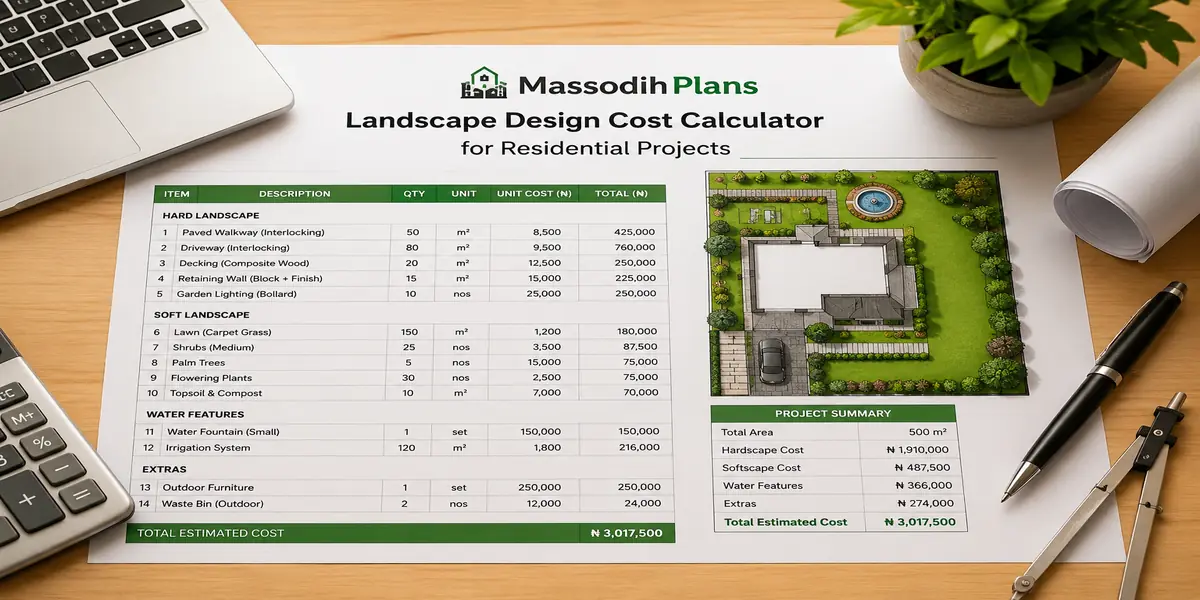
Sample Residential Landscape Cost Calculator
The following table demonstrates how landscape professionals typically estimate project costs. These figures are illustrative only. Actual costs depend on location, design complexity, material quality, contractor rates, and market prices.
| Landscape Component | Estimated Share of Total Budget |
| Landscape design and planning | 8–15% |
| Site preparation | 5–10% |
| Drainage works | 10–20% |
| Interlocking paving and walkways | 20–35% |
| Planting and lawn establishment | 15–30% |
| Outdoor lighting | 5–10% |
| Pergolas, seating, and special features | 10–25% |
| Contingency | 5–10% |
Rather than focusing only on the cheapest quotation, compare what each contractor includes. A lower initial price may exclude drainage, soil improvement, or proper plant establishment, leading to higher costs later.
Practical Site Analysis Before Estimating Landscape Costs
Before any reliable cost estimate is prepared, a professional landscape architect should study the site carefully.
Typical site analysis includes:
Existing Land Conditions
- Ground slope
- Soil type
- Existing vegetation
- Rock outcrops
- Low-lying areas
Drainage Assessment
- Surface water flow
- Flood-prone locations
- Existing drains
- Neighbouring runoff
- Soakaway opportunities
Functional Planning
- Vehicle movement
- Pedestrian circulation
- Parking requirements
- Service access
- Outdoor recreation areas
Environmental Assessment
- Sunlight exposure
- Prevailing winds
- Existing shade
- Heat build-up around buildings
- Opportunities for tree planting
Based on projects I have worked on, spending time on thorough site analysis almost always results in a more accurate budget and a landscape that performs better over time. It also reduces the risk of costly redesigns after construction has already begun.
Note
A landscape design cost calculator should be viewed as a planning guide rather than a fixed quotation. Every residential property is unique, and factors such as topography, drainage needs, material choices, and the homeowner’s design goals can significantly influence the final cost. The most reliable estimates come after a professional site inspection and a well-prepared landscape concept plan.
Residential Landscape Cost Breakdown: Where Your Budget Really Goes
After understanding how a landscape design cost calculator works, the next step is knowing how your budget is likely to be distributed. Many homeowners assume the largest expense is buying plants, but in reality, professional residential landscaping involves much more than greenery.
In my experience, drainage improvements, paving, and site preparation often consume a larger portion of the budget than ornamental planting. Homeowners who understand this from the beginning are less likely to face unexpected costs during construction.
Although every project is different, the following breakdown provides a practical guide for planning residential landscape investments.
Typical Residential Landscape Budget Allocation
The percentages below represent a typical professionally planned residential landscape project.
| Landscape Component | Typical Budget Allocation | Importance |
|---|---|---|
| Site survey and landscape design | 8–15% | Essential for proper planning |
| Site clearing and preparation | 5–10% | Creates a stable foundation |
| Drainage and grading | 10–20% | Prevents flooding and erosion |
| Driveways and paving | 20–35% | Improves accessibility and durability |
| Planting and lawns | 15–30% | Enhances beauty and comfort |
| Lighting | 5–10% | Improves security and ambience |
| Outdoor structures | 10–25% | Adds functionality and value |
| Maintenance contingency | 5–10% | Covers establishment and adjustments |
Every property has unique priorities. For example, a flood-prone site may require more investment in drainage, while a compact urban home may allocate a larger share of the budget to decorative paving and vertical planting.
Hardscape Costs: The Foundation of Every Landscape
Hardscape refers to the permanent built elements of your landscape. These structures provide functionality, improve movement, and define outdoor spaces.
Common hardscape features include:
- Interlocking driveways
- Decorative paving
- Concrete walkways
- Parking areas
- Garden edging
- Retaining walls
- Patio floors
- Courtyards
- Outdoor seating areas
- Boundary landscaping
Hardscape typically represents the largest single cost because it involves excavation, construction materials, skilled labour, and engineering considerations.
Factors That Affect Hardscape Costs
- Area to be paved
- Thickness of pavement
- Soil condition
- Drainage requirements
- Material quality
- Labour rates
- Accessibility of the site
- Foundation preparation
During my internship, I observed that many cracked driveways were not caused by poor paving materials but by inadequate base preparation beneath the paving stones.
One lesson I learned early is that investing in proper foundations usually saves significant repair costs later.
Softscape Costs: Creating a Living Landscape
Softscape consists of the living components of your landscape.
These include:
- Lawns
- Shade trees
- Ornamental trees
- Flower beds
- Shrubs
- Hedges
- Ground covers
- Climbers
- Native vegetation
Softscape costs depend on:
- Plant species
- Plant maturity
- Quantity required
- Soil improvement
- Mulching
- Fertilizer
- Irrigation needs
Choosing mature ornamental trees provides immediate visual impact but usually costs considerably more than planting younger trees.
Choosing Cost-Effective Plants
For many residential projects in Nigeria, low-maintenance plants provide the best long-term value.
Examples include:
- Native shade trees
- Drought-tolerant shrubs
- Ground covers that suppress weeds
- Ornamental grasses
- Indigenous flowering plants
These species generally require:
- Less watering
- Fewer pesticides
- Reduced fertilizer
- Lower maintenance costs
- Better adaptation to local climates
I have encountered this situation multiple times. Homeowners sometimes select attractive imported plants without considering whether they can survive local weather conditions. Within a few months, many of those plants require replacement, increasing the overall cost of the landscape.
Drainage Costs: The Most Important Investment You Cannot See
Many people focus on visible features such as lawns and paving while overlooking drainage infrastructure hidden beneath the surface.
Professional drainage planning may include:
- Surface drains
- Concrete channels
- Catch pits
- French drains
- Soakaway systems
- Site grading
- Swales
- Rain gardens
- Erosion protection
During landscape inspections, I discovered that properties with excellent drainage remain attractive for decades, while poorly drained landscapes often develop standing water, damaged lawns, cracked paving, and foundation problems.
Why Drainage Should Never Be Removed to Reduce Costs
Reducing drainage works to save money often leads to:
- Flooded compounds
- Waterlogged gardens
- Algae growth
- Damaged paving
- Soil erosion
- Mosquito breeding
- Foundation deterioration
This is not just theory. I have seen it happen.
Proper drainage is one of the highest-return investments in any residential landscape.
Outdoor Lighting Costs
Landscape lighting improves both beauty and security.
Common residential lighting includes:
- Entrance lighting
- Path lighting
- Garden lighting
- Driveway lighting
- Security lighting
- Accent lighting
- Tree uplighting
- Solar-powered lighting
The total cost depends on:
- Number of fixtures
- Cable routing
- Electrical installation
- Solar or conventional systems
- Smart lighting controls
Energy-efficient LED and solar lighting often reduce long-term electricity and maintenance costs, making them attractive choices for many homeowners.
Outdoor Living Features and Their Budget Impact
Modern residential landscapes increasingly function as extensions of indoor living spaces.
Popular features include:
- Pergolas
- Gazebos
- Outdoor kitchens
- Barbecue areas
- Patios
- Family seating spaces
- Children’s play areas
- Courtyards
- Swimming pool surroundings
Each additional feature increases:
- Construction costs
- Material requirements
- Design complexity
- Maintenance obligations
Before adding luxury features, consider how often they will actually be used. A simple, well-designed patio may deliver greater everyday value than an elaborate structure that remains unused for most of the year.
State-by-State Landscape Cost Differences in Nigeria
Landscape costs are influenced by local market conditions, labour availability, transportation, and material supply.
The table below highlights general cost trends.
| Location | Typical Cost Trend | Main Reason |
| Lagos | Higher | Labour, land value, logistics |
| Abuja | Higher | Premium residential developments |
| Rivers | Moderate to High | Rainfall and drainage demands |
| Akwa Ibom | Moderate | Material availability varies |
| Enugu | Moderate | Terrain influences site preparation |
| Oyo | Moderate | Competitive labour market |
| Kano | Moderate | Greater emphasis on irrigation |
| Kaduna | Moderate | Seasonal climate considerations |
These trends are illustrative rather than fixed. Material prices, fuel costs, and labour rates fluctuate over time.
Budget-Friendly Landscaping Without Sacrificing Quality
A beautiful landscape does not always require a luxury budget.
The following strategies can significantly reduce costs while maintaining excellent results.
Phase the Project
Instead of constructing everything at once:
- Complete drainage first.
- Install driveways and walkways.
- Prepare planting beds.
- Add trees.
- Install lawns.
- Build outdoor structures later.
This approach spreads costs over time while protecting completed work.
Prioritize Permanent Features
Invest first in elements that are expensive to replace.
Examples include:
- Drainage
- Site grading
- Retaining walls
- Driveways
- Walkways
- Soil improvement
Plants, decorative pots, and outdoor furniture can be added gradually.
Choose Local Materials
Using locally available materials often reduces:
- Transportation expenses
- Delivery delays
- Future replacement costs
Locally sourced stone, interlocking blocks, and native plants frequently provide excellent value while blending naturally with the surrounding environment.
Avoid Overdesigning Small Plots
Small residential compounds benefit from simplicity.
Too many landscape features can:
- Reduce usable space
- Increase maintenance
- Create visual clutter
- Increase construction costs
While preparing site plans, I noticed that well-organized small landscapes often feel larger than overcrowded compounds filled with unnecessary structures.
Landscape Architect’s Practical Layer
One observation from practical field experience stands out repeatedly: homeowners who involve a landscape architect during the early stages of site planning almost always spend less overall than those who wait until construction is nearly complete.
I have seen this mistake repeatedly.
A house is completed, perimeter fencing is finished, and only then does the owner begin thinking about landscaping. Unfortunately, important issues such as drainage routes, driveway widths, tree locations, utility lines, and outdoor circulation have already been fixed, leaving limited design options.
As a result, new paving is broken to install drains, mature trees cannot be planted in suitable locations, retaining walls become necessary where proper grading would have solved the problem, and additional labour is required to correct avoidable mistakes.
The most successful residential projects treat landscape architecture, architectural design, site planning, and drainage planning as parts of one integrated development process rather than separate activities.
Note
A realistic landscape budget should consider not only installation costs but also the cost of maintaining the landscape over the next five to ten years. Choosing durable materials, climate-appropriate plants, and a practical layout often produces better long-term value than selecting the cheapest installation option.
How Professional Landscape Design Increases Property Value
Many homeowners view landscaping as an optional luxury that can be completed after the house is built. In reality, a professionally designed landscape is one of the few property improvements that enhances both everyday living and long-term financial value.
A well-planned landscape creates a positive first impression, improves functionality, reduces maintenance problems, and makes a property more attractive to future buyers or tenants.
In my experience, buyers often make an opinion about a property before entering the building. A neat driveway, healthy lawn, attractive entrance, properly arranged trees, and good drainage immediately communicate that the property has been well maintained.
Ways Landscaping Adds Value
Professional landscape design can:
- Improve curb appeal
- Increase resale value
- Attract higher-quality buyers
- Increase rental demand
- Reduce erosion and flooding risks
- Improve outdoor comfort
- Lower surrounding temperatures through strategic tree planting
- Enhance privacy
- Improve environmental quality
- Extend usable outdoor living space
Unlike decorative improvements that may go out of style, good landscape planning continues delivering value for many years.
Return on Investment: Looking Beyond Initial Cost
Many homeowners ask whether landscaping is worth the investment.
The better question is:
What does poor landscaping cost over the life of the property?
Poor planning often results in:
- Replacing dead plants
- Reconstructing damaged driveways
- Correcting drainage failures
- Repairing foundation damage caused by standing water
- Removing trees planted too close to buildings
- Rebuilding collapsed retaining walls
- Increased maintenance expenses
A professionally designed landscape minimizes these risks while protecting the property’s long-term value.
One lesson I learned early is that the cheapest landscape is rarely the most economical one.
Construction Reality Layer: Mistakes That Become Expensive Later
Landscaping should begin during site planning—not after construction has finished.
Unfortunately, many residential projects treat landscaping as the final decoration instead of an essential design component.
Based on projects I have worked on, these are some of the most common problems encountered after construction.
1. No Space Reserved for Drainage
Driveways are completed before drainage channels are considered.
The result:
- Flooded compounds
- Water entering garages
- Waterlogged gardens
2. Trees Planted Too Close to Buildings
Large trees require sufficient room for both roots and canopy development.
Poor placement may eventually lead to:
- Foundation damage
- Cracked pavements
- Roof interference
- Blocked drainage channels
3. Oversized Driveways
Many compounds dedicate excessive space to vehicles while leaving little room for greenery.
This increases:
- Heat reflection
- Surface runoff
- Visual harshness
A balanced design creates space for both movement and vegetation.
4. Ignoring Outdoor Circulation
Walkways should follow natural movement patterns.
Poor circulation creates:
- Worn grass
- Unsafe pedestrian movement
- Unnecessary paving modifications
5. Landscaping Without a Master Plan
Buying plants gradually without an overall design often produces:
- Visual inconsistency
- Poor spacing
- High maintenance
- Wasted money
This is not just theory. I have seen it happen on numerous residential developments.
Maintenance Layer: Designing Landscapes That Stay Beautiful
An attractive landscape should remain practical long after installation.
The best landscapes are not necessarily those with the most expensive materials—they are the ones that remain healthy and functional with reasonable maintenance.
Design for Easy Maintenance
Consider the following principles:
- Choose native and climate-adapted plants.
- Group plants with similar watering needs.
- Reduce unnecessary lawn areas.
- Install adequate drainage.
- Use mulch to retain soil moisture.
- Leave enough space for future plant growth.
- Select durable paving materials.
- Minimize features requiring constant repairs.
During landscape inspections, I discovered that low-maintenance landscapes often remain more attractive because homeowners can realistically care for them throughout the year.
Practical Maintenance Guide
Regular maintenance protects your investment.
| Maintenance Activity | Suggested Frequency |
|---|---|
| Water newly planted trees | As required during establishment |
| Mow lawns | Every 1–3 weeks depending on season |
| Weed flower beds | Monthly |
| Apply mulch | Once or twice yearly |
| Inspect drainage channels | Before and during rainy seasons |
| Trim shrubs | Every few months |
| Fertilize lawns | As recommended for the grass species |
| Check outdoor lighting | Quarterly |
| Inspect paving for settlement | Annually |
Preventive maintenance usually costs far less than major repairs.
Design Tips for Residential Landscapes
Whether your plot is small or large, these practical tips can improve both appearance and functionality.
Design Tip 1
Plan the landscape before construction begins whenever possible.
Design Tip 2
Invest in drainage before decorative features.
Design Tip 3
Select plants suitable for your local climate and soil.
Design Tip 4
Create clear pedestrian and vehicle circulation.
Design Tip 5
Use shade trees to reduce heat around buildings.
Design Tip 6
Leave adequate maintenance access around structures.
Design Tip 7
Balance hardscape with greenery to avoid excessive heat buildup.
Design Tip 8
Prepare a realistic maintenance budget before installation.
Common Mistakes Homeowners Should Avoid
Avoid these costly errors:
- Landscaping without a professional plan
- Ignoring site drainage
- Planting large trees too close to buildings
- Choosing plants based only on appearance
- Using poor-quality paving materials
- Eliminating maintenance from the budget
- Overcrowding small compounds
- Blocking future utility access
- Ignoring soil conditions
- Hiring contractors based solely on the lowest quotation
Practical Checklist Before Starting Your Landscape Project
Use this checklist before approving your landscape design.
- Site has been professionally analysed.
- Drainage has been properly planned.
- Vehicle and pedestrian circulation are functional.
- Plant species suit the local climate.
- Outdoor spaces have defined purposes.
- Landscape budget includes maintenance.
- Hardscape and softscape are balanced.
- Lighting has been considered.
- Trees are positioned for future growth.
- Landscape design complements the architectural design.
- Future expansion has been considered.
Frequently Asked Questions
Is a landscape design cost calculator completely accurate?
No. It provides an informed estimate. A professional site inspection is necessary to prepare a detailed quotation because every property has unique conditions.
When should landscaping be planned?
Ideally during architectural design and site planning, before construction begins.
What is usually the most expensive part of residential landscaping?
For many projects, hardscape elements such as driveways, decorative paving, retaining walls, and drainage systems represent the largest share of the budget.
Can I complete landscaping in phases?
Yes. Many homeowners install drainage and paving first, followed by planting and outdoor features as funds become available.
Which plants generally require less maintenance in Nigeria?
Native and climate-adapted species usually require less watering, fertilizer, and pest control than many imported ornamental plants.
Does landscaping really increase property value?
Yes. Professionally planned landscapes improve curb appeal, functionality, buyer confidence, and overall marketability, making them a worthwhile long-term investment.
Quick Summary
Before starting any residential landscaping project, remember these key points:
- Prepare a realistic budget using a landscape design cost calculator.
- Begin with professional site analysis.
- Prioritize drainage and grading.
- Balance hardscape with greenery.
- Choose plants suited to local conditions.
- Design outdoor spaces for everyday use.
- Consider future maintenance from the beginning.
- Integrate landscaping with architectural and site planning.
- Focus on long-term value rather than the lowest initial cost.
For more information see:
- MassodihPlans Landscape Design Services – Professional residential landscape planning and design.
- MassodihPlans House Plans – Modern house designs that integrate seamlessly with landscape architecture.
- MassodihPlans Site Plans – Site planning services for efficient land development.
- MassodihPlans Survey Plan Services – Accurate land survey solutions before landscape design.
- MassodihPlans Town Planning Services – Professional planning advice for residential and commercial developments.
- MassodihPlans Building Approval Guide – Learn how landscape planning supports smoother development approvals.
- MassodihPlans Plans Library – Browse ready-made residential plans.
- MassodihPlans Plan School – Educational resources on planning, design, and property development.
- MassodihPlans Homepage – Explore all planning and design services.
- Cost of Building a House in Uyo: Honest Budget Guide for Property Owners
- Estate Layout Planning Standards in Nigeria: Roads, Drainage, Open Spaces and Plot Sizes
- How to Invest in Nigerian Real Estate from Abroad: Complete Guide for Diaspora Investors
- Building Regulations Every Nigerian Property Developer Must Know
- GIS Applications in Urban Planning: Real-World Examples That Work
- Cost of Building a 4 Bedroom Duplex in Lagos (Complete Guide)
- Best Roofing Sheets for Nigerian Weather: Complete Guide
External Authority
For additional guidance on sustainable landscape planning and green infrastructure, see International Federation of Landscape Architects (IFLA).
Conclusion
A beautiful landscape is not created by chance—it is the result of careful planning, sound budgeting, and thoughtful design. Using a landscape design cost calculator for residential projects gives homeowners a practical starting point for estimating costs, setting priorities, and avoiding expensive mistakes.
Throughout my experience in site planning and residential development, one principle has remained consistent: the most successful landscapes are planned alongside the house—not after construction has been completed. This integrated approach allows drainage, outdoor circulation, planting, hardscape, and future maintenance to work together, creating an environment that is both attractive and functional.
Whether you are developing a compact urban plot or a spacious residential property, invest in proper site analysis, climate-appropriate planting, durable materials, and efficient drainage. These decisions not only improve daily living but also protect your property’s long-term value.
If you are planning a new residential development or upgrading an existing outdoor space, consider working with MassodihPlans Landscape Design Services to develop a landscape that reflects your budget, complements your architecture, and performs well for years to come.
You may also find it helpful to explore our guides on house plans, site planning, survey plans, town planning, and building approval to ensure every aspect of your project is professionally coordinated.
If this guide has helped you, share it with other homeowners, builders, or property developers, and return to MassodihPlans for trusted advice on planning, design, and sustainable property development.