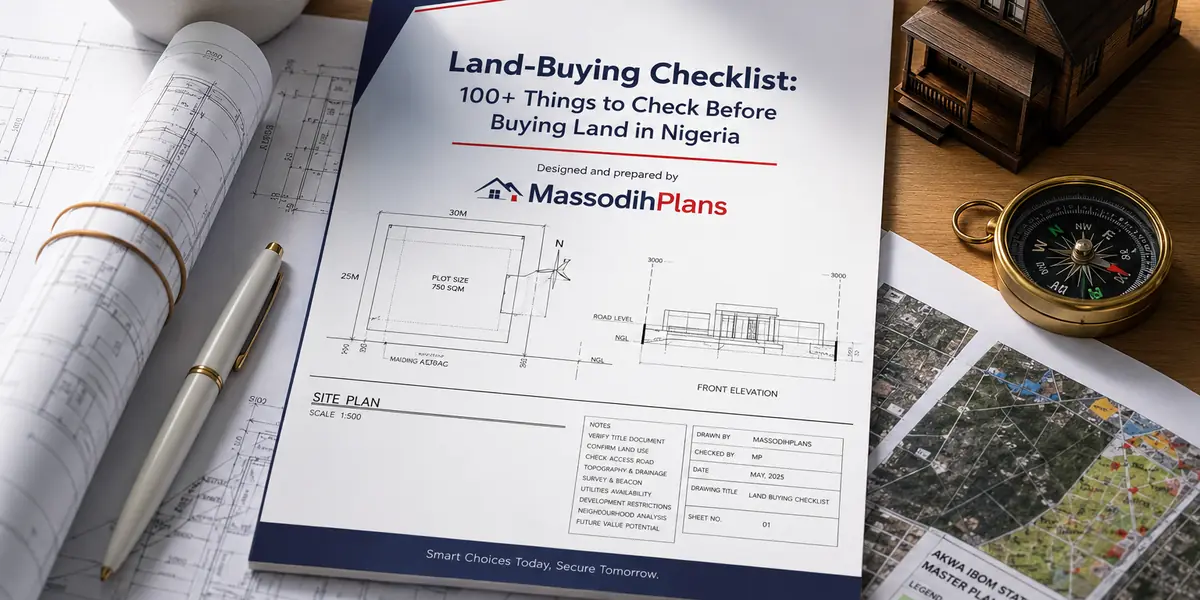
Land-Buying Checklist: 100+ Things to Check Before Buying Land in Nigeria
Land-Buying Checklist: What to Check Before Buying Land in Nigeria
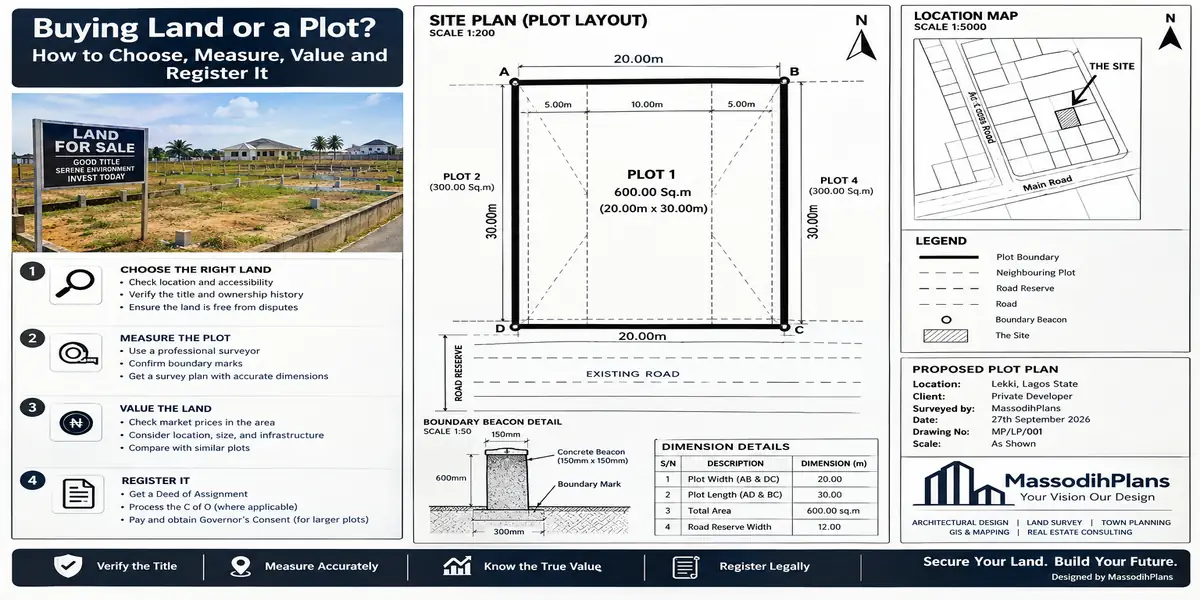
Before buying land in Nigeria, verify who legally owns the property, whether the seller has the right to sell it, whether the title and documents are genuine, whether the boundaries and survey match the actual site, whether the land is free from disputes or acquisition, what the planning authority permits on it, and whether the physical condition and location of the land suit your intended development. Do not treat a convincing seller, attractive price, good neighbourhood or seemingly complete document as proof that a property is safe to buy.
This is where many land purchases go wrong. The problem is often not visible when you first stand on the plot. You may see a clear piece of land, a developing neighbourhood and a seller who appears trustworthy, yet important questions about ownership, title, survey information, planning restrictions, access, drainage, encumbrances or future development may remain unanswered.
Over the years of working around the built environment in Akwa Ibom, Abia, Lagos, Kano, Kaduna, Oyo, Rivers State and other parts of the South-South, I have seen how a decision that takes only minutes to make can create problems that last for years. In some cases, the buyer only discovers the real difficulty when they are ready to design, obtain approval or commence construction.
That is why buying land should not begin with “How much is the plot?” It should begin with “What exactly am I buying, who has the right to sell it, and what can I legally and practically do with it?”
A proper land investigation goes beyond looking at documents. You need to examine the seller and ownership history, title documents, survey and beacon information, site boundaries, accessibility, surrounding development, planning regulations, land-use restrictions, possible acquisition, physical characteristics, drainage, environmental conditions, neighbourhood growth and the property’s suitability for the development you have in mind.
This 100+ point Land-Buying Checklist brings those considerations together in one practical framework. It is designed to help you systematically examine a prospective property before committing your money, while highlighting issues that are easy to overlook when you are focused mainly on location, price and appearance.
Use the checklist during your initial investigation, when inspecting the site, when reviewing documents and before completing the transaction. Where an issue falls outside your expertise, involve the appropriate professional rather than assuming that everything is satisfactory because the seller has provided an explanation.
Important: This checklist is intended for practical property-planning and due-diligence guidance and does not constitute legal advice. Land ownership, title verification, searches, planning controls, acquisition status, registration procedures and other requirements can differ between states, local authorities and individual properties in Nigeria. For a significant land purchase, consult appropriately qualified legal, surveying, planning and other relevant professionals and independently verify important information with the responsible authorities before making payment.
The Golden Rule of Buying Land
Do not buy land simply because someone says it belongs to them.
I have seen this golden rule broken more times than any other in this business, almost always by buyers who were otherwise careful, sensible people until the excitement of finding “the perfect plot” got the better of their judgment.
Before you pay, establish as far as reasonably possible:
Who owns it? Where exactly is it? How large is it? What document supports the ownership? Is the seller authorised to sell it? Is the land free from competing claims or encumbrances? Can you legally use it for your intended purpose? Are there planning restrictions? Are the boundaries correct? Is the physical land suitable for your proposed development?
These questions can save you from enormous financial and legal problems.
Field Note: The buyers who come out of a land transaction unscathed aren’t necessarily the ones with the most money for due diligence they’re the ones willing to walk away when something doesn’t add up. That willingness is worth more than any single document.
PHASE 1: Know Why You Are Buying the Land
Before searching for land, define your purpose.
☐ Residential house
☐ Duplex
☐ Bungalow
☐ Apartment
☐ Rental property
☐ Commercial building
☐ Shops
☐ Office
☐ School
☐ Hotel
☐ Farm
☐ Industrial use
☐ Investment
☐ Future development
☐ Other
My intended use: ____________________________________
The intended use matters because land that is suitable for one purpose may not be suitable for another a plot that works well for a bungalow may be entirely wrong for a commercial development with heavier parking and access demands.
PHASE 2: Set Your Total Land-Buying Budget
Do not budget only for the seller’s asking price. Your financial plan may need to account for:
☐ Purchase price
☐ Survey
☐ Legal/professional fees
☐ Documentation
☐ Search/verification costs
☐ Registration costs where applicable
☐ Taxes/levies/charges where applicable
☐ Agency fees where applicable
☐ Site inspection
☐ Transportation
☐ Initial site clearing
☐ Other transaction expenses
Maximum purchase budget: ₦________________________________
Additional transaction budget: ₦________________________________
Total available: ₦________________________________
PHASE 3: Research the Location
Before paying for land, investigate the neighbourhood properly, not just on the drive there.
☐ Have you visited the area?
☐ Have you visited more than once?
☐ Have you visited during the day?
☐ Have you visited at night where appropriate?
☐ Have you observed the road condition?
☐ Have you investigated drainage?
☐ Have you considered flooding?
☐ Have you checked electricity availability?
☐ Have you checked water availability?
☐ Have you considered security?
☐ Have you checked accessibility?
☐ Have you investigated nearby developments?
☐ Have you considered future infrastructure?
☐ Have you considered noise?
☐ Have you checked nearby commercial/industrial activities?
☐ Have you checked for unpleasant odours or environmental problems?
☐ Have you spoken with people familiar with the area?
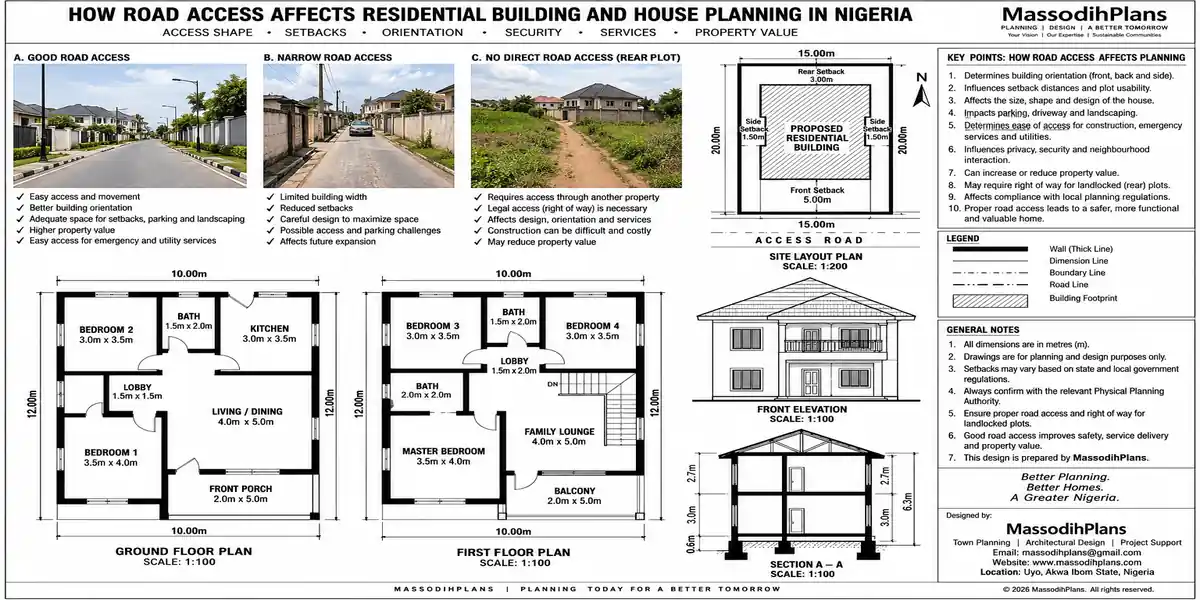
PHASE 4: Check Access to the Land
A cheap piece of land can become difficult to develop if access is poor I have had clients discover, only after purchase, that no construction vehicle could reach their new plot.
☐ Is there a recognised access road?
☐ Is the road physically accessible?
☐ Can construction vehicles reach the site?
☐ Is the access road wide enough for your intended development?
☐ Is the access permanent?
☐ Does access cross another person’s property?
☐ If there is a right-of-way, is it properly documented?
☐ Is the road affected by flooding?
☐ Is the road likely to be widened in the future?
☐ Is the property actually accessible from the road shown by the seller?
PHASE 5: Identify the Seller
Before discussing payment, identify exactly who is selling the land.
☐ Full name confirmed
☐ Contact details confirmed
☐ Identification checked where appropriate
☐ Seller’s relationship to the property established
☐ Seller’s authority to sell confirmed
☐ If an agent is involved, the agent’s authority verified
☐ If there are multiple owners, all required parties identified
☐ If the seller is acting for another person, authority/documentation checked
Never assume that the person standing in front of you automatically has the legal authority to sell the property. This single assumption is behind more failed land transactions than any other mistake I’ve encountered.
PHASE 6: Verify Ownership
This is one of the most important parts of the entire process.
Ask: how did the seller acquire the land? Possible supporting evidence may include relevant title or transaction documents, depending on the circumstances.
☐ Ownership history investigated
☐ Seller’s claim compared with documentation
☐ Previous owner identified where necessary
☐ Transfer history investigated
☐ Possible competing claims investigated
☐ Appropriate official searches conducted
☐ Legal advice obtained where necessary
Do not rely solely on photocopies or verbal explanations.
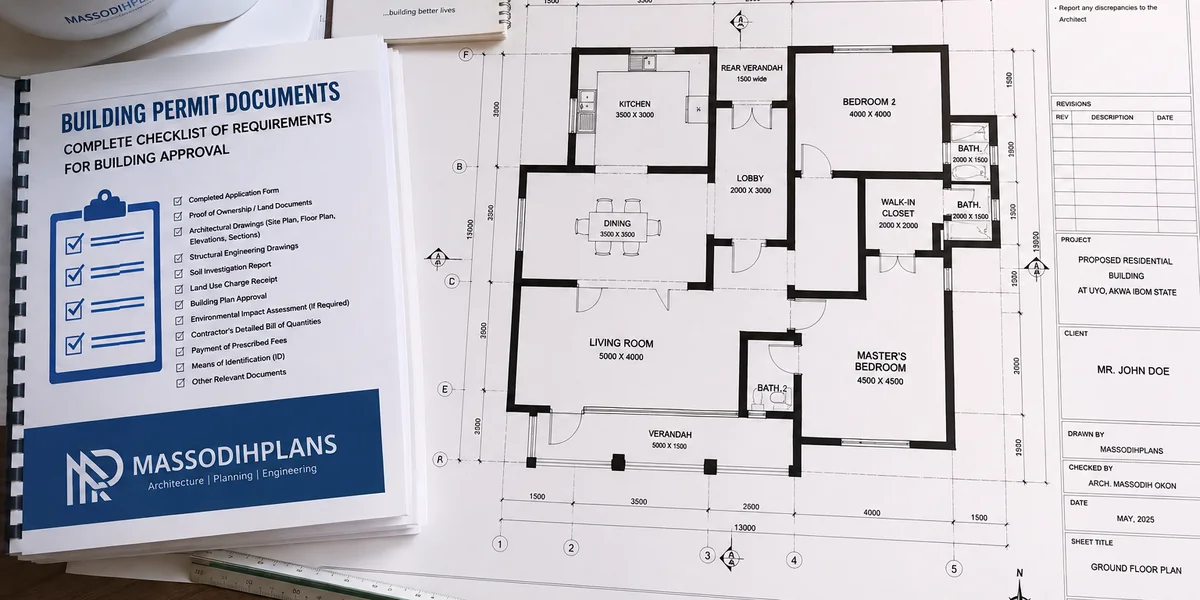
PHASE 7: Land Document Checklist
Depending on the property and location, relevant documentation may include:
☐ Survey plan
☐ Deed of Assignment
☐ Certificate of Occupancy where applicable
☐ Governor’s Consent where applicable
☐ Registered title
☐ Previous title documents
☐ Purchase agreement
☐ Receipts
☐ Allocation documents where applicable
☐ Other relevant land documents
The exact documents required depend on the nature and history of the property. Having a document is not the same as having a valid and transferable interest. The documents should be properly verified I’ve seen genuinely printed, official-looking documents attached to land that the “seller” had no legitimate claim to.
PHASE 8: Verify the Survey
A survey is critical for identifying the location and extent of the land.
☐ Survey plan exists
☐ Surveyor identified
☐ Plot dimensions
☐ Plot area
☐ Coordinates where applicable
☐ Beacon information
☐ Orientation
☐ Access
☐ Adjacent properties
☐ Road position
☐ Boundary information
☐ Survey information corresponds with the physical property
Do not assume that a survey document shown by a seller automatically proves that the exact land being sold is the same land represented on the document always cross-check the paper against the ground.
PHASE 9: Inspect the Physical Boundaries
Visit the land with an appropriate professional where possible.
☐ Locate the boundaries
☐ Identify boundary beacons
☐ Compare physical dimensions
☐ Compare with survey information
☐ Identify neighbouring properties
☐ Identify disputed areas
☐ Check whether fences have crossed boundaries
☐ Check whether structures encroach onto the property
☐ Confirm road frontage
☐ Photograph the site
PHASE 10: Check for Encroachment
Look carefully at neighbouring properties.
☐ Has a neighbour built into the land?
☐ Has a fence crossed the boundary?
☐ Is a road occupying part of the property?
☐ Is a drainage channel crossing the land?
☐ Are utility poles located within the property?
☐ Are there structures on the property?
☐ Are there informal paths across the property?
☐ Are neighbouring buildings too close to the boundary?
Any suspected encroachment should be investigated before purchase.
PHASE 11: Check for Disputes
Ask appropriate people and conduct appropriate searches.
☐ Is there an ongoing dispute?
☐ Has the property previously been litigated?
☐ Are there competing sellers?
☐ Are there family/community disputes?
☐ Are there boundary disputes?
☐ Are there inheritance issues?
☐ Are there claims by previous owners?
☐ Are there court matters relating to the property?
☐ Has the land been sold to anyone else?
If there is a serious unresolved dispute, do not rush into payment. Obtain appropriate legal advice.
PHASE 12: Family Land
Family land can involve additional considerations and, in my experience, some of the most drawn-out land disputes I’ve observed have involved exactly this category.
If the property is said to belong to a family:
☐ Identify the family
☐ Identify the recognised ownership structure
☐ Establish who has authority to sell
☐ Identify required consenting parties
☐ Verify relevant family documentation
☐ Investigate the history of the land
☐ Obtain appropriate legal advice
Do not assume that one family member can automatically sell family property simply because they introduced you to the land.
PHASE 13: Community Land
Where community ownership or customary interests are relevant:
☐ Identify the community interest
☐ Understand the allocation history
☐ Verify the seller’s authority
☐ Check required community documentation
☐ Investigate competing claims
☐ Verify the transaction through appropriate channels
☐ Obtain professional/legal advice where necessary
PHASE 14: Check for Government Acquisition or Reservation
One of the major risks when buying land is discovering that the property is affected by a government acquisition, road reservation, public purpose reservation or other planning restriction. Check with the relevant authority where applicable.
☐ Government acquisition status checked
☐ Road reservation checked
☐ Drainage reservation checked
☐ Public utility reservation checked
☐ Proposed road alignment checked
☐ Planning scheme checked
☐ Land-use designation checked
☐ Other restrictions checked
A beautiful piece of land can become a poor investment if a major portion is reserved for future infrastructure.
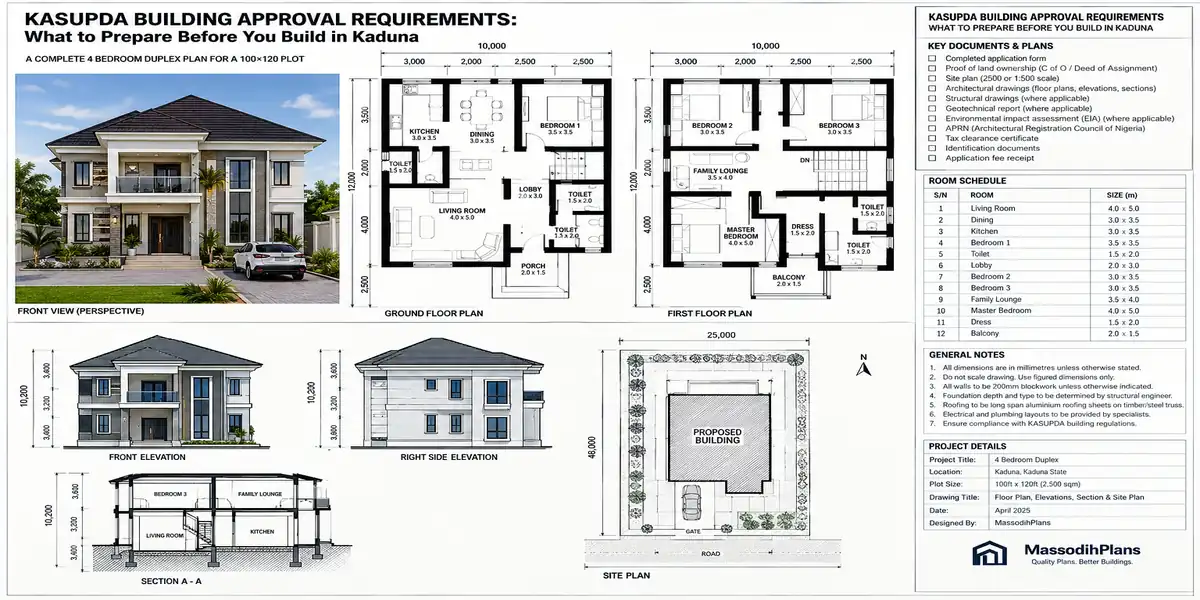
PHASE 15: Check Planning and Development Control
Before purchasing land for construction, find out whether your intended development is compatible with applicable planning regulations.
☐ Permitted land use
☐ Building setbacks
☐ Building height restrictions
☐ Plot coverage requirements
☐ Floor-area requirements where applicable
☐ Parking requirements
☐ Access requirements
☐ Road setbacks
☐ Drainage requirements
☐ Environmental restrictions
☐ Other planning controls
This is particularly important if you intend to build a large residential or commercial development.
PHASE 16: Check the Land Size
Never rely only on the seller saying: “This is a standard plot.” Verify the actual dimensions.
Length: __________________
Width: ___________________
Area: ____________________
Then compare the measurements with the survey documentation. A plot that is advertised as a particular size may not have the dimensions you expect I’ve measured “standard 100×100” plots that came in noticeably short on one side.
PHASE 17: Check the Shape
Land shape affects development.
☐ Rectangular ☐ Square ☐ Irregular ☐ Narrow ☐ Long ☐ Triangular ☐ Corner plot ☐ Other
Ask: can my intended building fit comfortably on this shape? An irregular plot may still be valuable, but the design implications should be understood before purchase.
PHASE 18: Check Topography
Look at the slope of the land.
☐ Flat ☐ Gentle slope ☐ Moderate slope ☐ Steep slope
Consider foundation implications, drainage, access, retaining structures, site preparation, and the cost of earthworks. Do not assume that every piece of land will have the same construction cost simply because the plots have similar sizes our full site analysis checklist goes deeper into reading a site’s terrain.
PHASE 19: Check Flood Risk
Flooding can turn a seemingly cheap property into an expensive problem.
☐ Low-lying areas
☐ Nearby streams
☐ Drainage channels
☐ Evidence of previous flooding
☐ Water marks
☐ Erosion
☐ Poor road drainage
☐ Neighbouring properties elevated significantly above the site
☐ Standing water
☐ Blocked drainage
Ask people who have lived in the area for a long time about flooding history. Where appropriate, obtain professional site assessment.
PHASE 20: Check Soil and Ground Conditions
The ground beneath your property matters.
☐ Weak soil
☐ Expansive soil
☐ Excessive moisture
☐ Filled ground
☐ Erosion
☐ Unstable slopes
☐ Previous excavation
☐ Waste deposits
☐ Other unusual ground conditions
Where the project or site warrants it, obtain appropriate geotechnical/soil investigation. Do not assume that the foundation requirements of a nearby house are automatically suitable for your own project.
PHASE 21: Check Drainage
Ask: where will rainwater go?
☐ Existing drainage
☐ Road drainage
☐ Natural drainage path
☐ Site slope
☐ Neighbouring drainage
☐ Flood channels
☐ Proposed drainage infrastructure
☐ Risk of water flowing onto the property
☐ Risk of water flowing from the property toward neighbours
Poor drainage can create serious problems after construction.
PHASE 22: Check Utilities
Investigate the availability of essential services.
Electricity: ☐ Nearby ☐ Poles nearby ☐ Connection feasibility ☐ Potential infrastructure constraints
Water: ☐ Public water availability ☐ Borehole feasibility where appropriate ☐ Water source ☐ Storage requirements
Telecommunications: ☐ Mobile network ☐ Internet availability
Wastewater: ☐ Sewer availability where applicable ☐ Suitable wastewater solution
PHASE 23: Check the Road
☐ Road width
☐ Road condition
☐ Road ownership/status
☐ Drainage
☐ Accessibility during rainy periods
☐ Traffic
☐ Future road expansion
☐ Distance from major roads
☐ Emergency access
☐ Construction vehicle access
The road can significantly influence the practicality and value of land.
PHASE 24: Check Neighbours
Look around the property.
☐ Residential buildings ☐ Shops ☐ Industrial activities ☐ Schools ☐ Churches/mosques or other facilities ☐ Markets ☐ Workshops ☐ Drainage channels ☐ Farms ☐ Vacant land ☐ Future development potential
Consider how neighbouring development could affect privacy, noise, traffic, security, property value, and future building options.
PHASE 25: Check Environmental Conditions
☐ Open waste dumping
☐ Pollution
☐ Smoke
☐ Bad odours
☐ Excessive noise
☐ Erosion
☐ Flooding
☐ Industrial emissions
☐ Contaminated land concerns
☐ Dangerous infrastructure
☐ Other environmental risks
Do not inspect only the plot. Inspect the surrounding environment.
PHASE 26: Visit the Land at Different Times
If practical, visit in the morning, afternoon, evening, on a weekend, and after rainfall. You may discover traffic, noise, flooding, poor drainage, security issues, neighbourhood activities, or access problems that were not obvious during your first visit a plot that looks tranquil on a Tuesday morning can be a very different place on a Saturday night.
PHASE 27: Check Future Development
Ask: what will this area look like in 5–10 years?
☐ New roads ☐ Road expansion ☐ Commercial development ☐ Housing development ☐ Industrial development ☐ Schools ☐ Markets ☐ Public infrastructure ☐ Drainage projects ☐ Other planned developments
A property’s future environment can affect its value and suitability.
PHASE 28: Be Careful With “Cheap Land”
A low price can be attractive. But ask: why is it cheap?
Possible reasons include poor access, flood risk, difficult terrain, documentation problems, planning restrictions, disputed ownership, remote location, poor infrastructure, unusual plot shape, or development restrictions.
A cheap property is not necessarily a bargain.
PHASE 29: Verify the Selling Price
Compare the asking price with similar nearby properties, recent transactions where reliable information is available, location quality, road access, infrastructure, plot size, documentation, development potential, and physical condition.
Do not automatically assume that the cheapest land is the best investment.
PHASE 30: Do Not Rush Because of Pressure
Be cautious when you hear:
“Another buyer is coming tomorrow.” “Pay now or lose the land.” “This price is only for today.” “Everybody knows this land belongs to us.” “You don’t need a survey.” “The documents will come later.” “Don’t worry about checking with the authorities.”
Pressure should never replace due diligence. In my experience, legitimate sellers rarely mind giving a serious buyer the time to verify things properly the urgency itself is often the clearest warning sign in the whole transaction.
PHASE 31: Land Inspection Checklist
During your physical inspection:
☐ Confirm location ☐ Confirm access ☐ Confirm boundaries ☐ Confirm dimensions ☐ Confirm terrain ☐ Observe drainage ☐ Observe surrounding properties ☐ Observe road conditions ☐ Observe utility infrastructure ☐ Check flooding signs ☐ Check erosion ☐ Check environmental conditions ☐ Take photographs ☐ Record GPS/location information where appropriate ☐ Bring relevant professionals where necessary
PHASE 32: Document Verification Checklist
Before paying:
☐ Seller identified ☐ Ownership investigated ☐ Survey checked ☐ Title documents reviewed ☐ Relevant official search conducted ☐ Encumbrances investigated ☐ Disputes investigated ☐ Planning status checked ☐ Government acquisition/reservation checked ☐ Boundaries verified ☐ Access verified ☐ Seller’s authority confirmed ☐ Legal/professional advice obtained where necessary
PHASE 33: Land Purchase Agreement
Before making a major payment:
☐ Parties identified ☐ Property clearly described ☐ Plot dimensions stated where appropriate ☐ Purchase price stated ☐ Payment terms stated ☐ Transaction conditions stated ☐ Seller’s obligations stated ☐ Buyer’s obligations stated ☐ Documentation requirements stated ☐ Possession arrangements stated ☐ Dispute provisions stated ☐ Signatures completed ☐ Witnesses included where appropriate
Have an appropriate legal professional review significant property transactions.
PHASE 34: Payment Checklist
Before making payment:
☐ Confirm seller identity ☐ Confirm payment amount ☐ Confirm payment purpose ☐ Confirm agreed terms ☐ Confirm documentation ☐ Confirm transaction parties ☐ Keep payment evidence ☐ Obtain receipts ☐ Keep copies of signed agreements ☐ Avoid unexplained cash payments
For substantial transactions, use secure and traceable payment methods appropriate to the circumstances.
PHASE 35: After Purchase
Buying the land is not necessarily the end of the process.
☐ Collect original/relevant documents ☐ Keep copies securely ☐ Complete required registration processes ☐ Update relevant records ☐ Confirm possession ☐ Mark boundaries appropriately ☐ Maintain the property ☐ Monitor encroachment ☐ Keep the survey safely ☐ Keep transaction receipts ☐ Keep legal documents ☐ Begin planning your intended development
Once the land is secured, our building cost calculator guide is a good next step for understanding what your plot can realistically support.
PHASE 36: Land-Buying Red Flags
Stop and investigate further if you encounter:
- Seller refuses verification
- Seller cannot explain ownership history
- Multiple people claim ownership
- The property is involved in a dispute
- Boundaries are unclear
- Survey information does not match the physical site
- Seller refuses professional inspection
- Seller insists you pay immediately
- Documents contain suspicious inconsistencies
- The price is dramatically below comparable properties without a clear explanation
- The land appears to be under government reservation
- Access is unclear
- A road or drainage project may affect the land
- The seller says documentation will be sorted out after payment
- Someone else is occupying or using the property
- Neighbours dispute the seller’s claim.
Any serious red flag should be investigated before you proceed. In my experience, one red flag rarely travels alone where I’ve found one, there’s usually a second waiting to be uncovered.
Questions to Ask the Seller
- Who owns this land?
- How did you acquire it?
- How long have you owned it?
- Do you have the relevant documents?
- Has the land ever been sold before?
- Is anyone else claiming ownership?
- Is there any dispute?
- Is the land under any acquisition or reservation?
- Has anyone occupied the property?
- Are there any outstanding obligations relating to the land?
- What is the exact size?
- Where are the boundaries?
- What is the access route?
- Has the land been surveyed?
- Can the documentation be independently verified?
- Can I inspect the land with my professionals?
- What exactly is included in the sale?
- What happens after payment?
- When will the relevant documents be transferred?
- Who else needs to consent to the transaction?
A seller who genuinely wants to complete a legitimate transaction should generally understand that serious buyers need to conduct due diligence.
Questions to Ask Yourself
Do I know exactly what I am buying? ☐ Yes ☐ No
Do I know who owns it? ☐ Yes ☐ No
Have I verified the ownership? ☐ Yes ☐ No
Have I checked the documents? ☐ Yes ☐ No
Have I checked the survey? ☐ Yes ☐ No
Have I physically inspected the boundaries? ☐ Yes ☐ No
Have I checked planning restrictions? ☐ Yes ☐ No
Have I checked for acquisition/reservation? ☐ Yes ☐ No
Have I checked access? ☐ Yes ☐ No
Have I considered flooding? ☐ Yes ☐ No
Have I considered the soil/ground? ☐ Yes ☐ No
Can I build what I want there? ☐ Yes ☐ No
Have I obtained appropriate professional advice? ☐ Yes ☐ No
If several answers are No, you may not be ready to complete the purchase.
Quick Land-Buying Checklist
☐ Define purpose ☐ Set budget ☐ Research location ☐ Visit site ☐ Identify seller ☐ Verify ownership ☐ Review documents ☐ Conduct appropriate official searches ☐ Verify survey ☐ Confirm dimensions ☐ Confirm boundaries ☐ Check access ☐ Check road ☐ Check drainage ☐ Check flooding ☐ Check terrain ☐ Consider soil ☐ Check utilities ☐ Check planning status ☐ Check government acquisition/reservation ☐ Check encroachment ☐ Check disputes ☐ Check neighbourhood ☐ Compare price ☐ Review agreement ☐ Obtain professional/legal advice ☐ Make traceable payment ☐ Obtain receipts ☐ Complete required registration ☐ Secure documents ☐ Monitor boundaries
Land-Buying Inspection Record
Property Location: ______________________________
Date: _________________________________________
Seller/Agent: __________________________________
Plot Size: _____________________________________
Asking Price: ₦________________________________
Intended Use: __________________________________
Access: Good / Fair / Poor
Drainage: Good / Fair / Poor
Flood Risk: Low / Medium / High
Terrain: Flat / Sloping / Steep
Documentation: Verified / Pending / Concern
Planning Status: Suitable / Pending / Concern
Boundaries: Clear / Unclear
Neighbourhood: Good / Fair / Poor
Major Concerns: ___________________________________
Decision: ☐ Proceed with further due diligence ☐ Negotiate ☐ Obtain professional advice ☐ Do not proceed
Land Due-Diligence File
Create one folder for every property you are considering. Include:
☐ Seller information ☐ Property photographs ☐ Survey ☐ Title documents ☐ Search results ☐ Planning information ☐ Site inspection notes ☐ Professional reports ☐ Correspondence ☐ Purchase agreement ☐ Payment records ☐ Receipts ☐ Registration documents ☐ Other relevant documents
Keeping everything together makes it much easier to track the transaction and, if a dispute ever arises years later, to defend your position.
Frequently Asked Questions
What should I check first before buying land?
Start by identifying the exact property, the seller and your intended use. Then investigate ownership, documentation, boundaries, planning status, access, physical conditions and potential restrictions before making a major payment.
Is a survey enough to prove ownership?
No. A survey primarily helps identify the location, boundaries and dimensions of a parcel. It does not by itself establish every aspect of legal ownership or guarantee that the seller has a valid transferable interest. Ownership and title should be independently verified through appropriate channels.
Should I buy land without a survey?
For a significant land purchase, relying solely on verbal descriptions of the property’s location and dimensions is risky. Obtain and verify appropriate survey information before proceeding.
Can I buy land without checking with the government or relevant authority?
This can expose you to serious risks, particularly where planning restrictions, acquisition, reservations or other public interests may affect the property. The appropriate authority depends on the location and nature of the property.
What if the seller says the land has no problem?
Do your own due diligence. The seller’s assurance should not replace independent verification.
What if the land is very cheap?
Find out why. A low price may be an opportunity, but it can also indicate a problem with access, documentation, ownership, planning, flooding, terrain or other conditions.
Should I involve a lawyer when buying land?
For a significant property purchase, obtaining appropriate legal advice is strongly advisable. A lawyer can help review transaction documents and advise on legal issues relevant to the purchase.
Should I involve a surveyor?
Yes, appropriate surveying expertise can be extremely valuable for confirming the property’s location, boundaries, dimensions and survey information.
Can I buy land and build immediately?
Not necessarily. After acquiring land, you may still need to complete relevant documentation, planning processes, design, approvals and other professional requirements before construction our homeowner’s construction checklist walks through what comes next.
My Final Submission to You
Land buying should never be based solely on “I like the location.”
You may like the location and still have a serious problem. You may like the price and still have a serious problem. You may like the seller and still have a serious problem. You may see beautiful houses around the property and still have a serious problem.
The safest approach is to investigate the land from several perspectives: legal, surveying, planning, physical, environmental, financial, and development potential.
A piece of land is more than a piece of ground. It is a future property investment. And before you commit your money, you should know as much as reasonably possible about what you are buying.
Remember: verify the seller, verify the ownership, verify the documents, verify the survey, verify the boundaries, verify the planning status, verify the physical site, verify the transaction. Then make your decision.
Do not let urgency make you skip due diligence.
Buy land with your eyes open. Plan before you build. Build with confidence.
Need Help With Your Next Building Project?
MassodihPlans provides practical built-environment information and services covering house planning, architectural design, site analysis, town planning, GIS/mapping and landscape design.
If you are buying land with the intention of building, understanding the site before purchasing can help you avoid costly mistakes later.
Browse our Plans Library for house designs to plan around once your land is secure, learn the fundamentals in Plan School, check Services for site analysis and due-diligence support, or return to the Homepage for more practical guides.
MassodihPlans: Plan Better. Build Smarter.
Complete this lesson by reading the following:
- Building Project Budget Template: Complete House Construction Cost Planner
- Homeowner’s Construction Checklist: 150+ Things to Check Before and During Building
- Building Materials Checklist: 100+ Materials You May Need When Building a House
- House Planning Checklist: 50+ Essential Things to Check Before Building a House (Complete Guide)
- 7 Cheapest Areas to Buy Affordable Land in Uyo Before Prices Increase
- Best Places to Buy Land in Uyo for Fast Development and High Property Value
- How to Invest in Nigerian Real Estate from Abroad: Complete Guide for Diaspora Investors
- Best Real Estate Investment Opportunities in Uyo Right Now
- How Do I Get Land Survey and Building Approval in Nigeria From Switzerland? A Step-by-Step Guide for Diaspora Property Owners
- How to Verify Land Ownership Using GIS and Survey Records