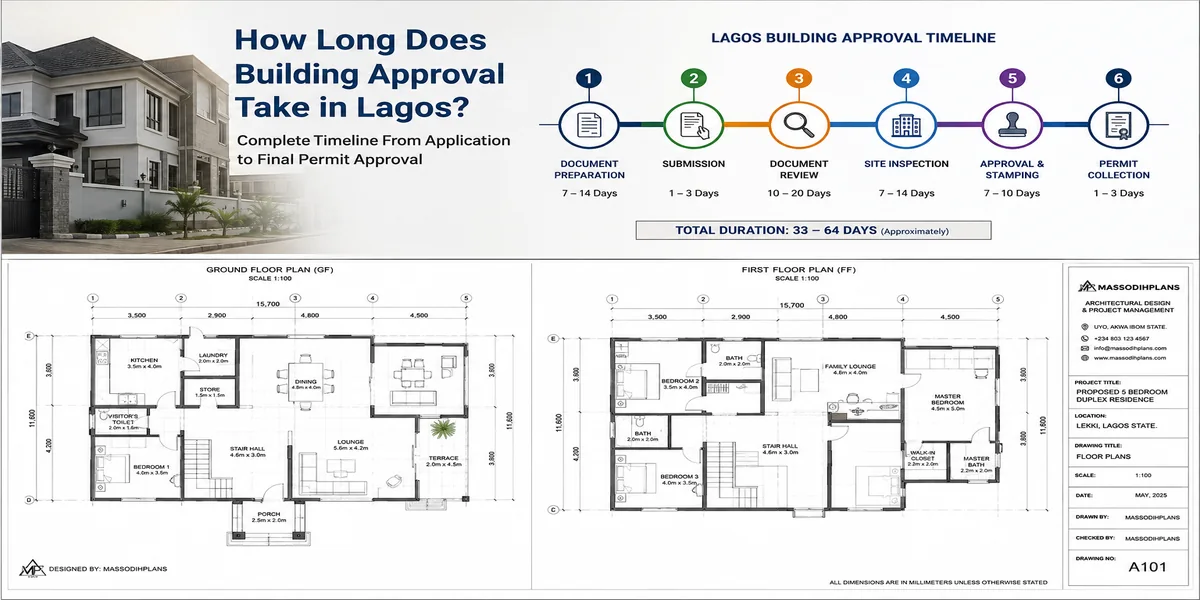
lagos building approval timeline
The Construction-Phase Clock Nobody Explains
Introduction
If you are asking, “How long does building approval take in Lagos?”, the clearest answer is this: a properly prepared application can move through the Lagos e-Planning Permit process in about 28 working days after screening, but your real project timeline can be longer when documents are incomplete, drawings need corrections, inspections or additional clearances are required. Lagos State’s published process breaks the application into specific review stages, so the biggest question is not simply “How many days?” but “What can make my application move or stop?”
That distinction matters because many property owners budget for construction but forget to budget time for approval. You may have your land, architectural design, survey plan and money ready, yet one title problem, zoning issue, setback violation, missing professional endorsement, tax-clearance requirement or drawing amendment can send the application back for correction. For more complex developments, the number of floors and the agencies involved can also affect the route and review level.
In this guide, I’ll walk you through the Lagos building approval timeline from application and screening to technical vetting, fee assessment, concurrent approvals, final endorsement and permit collection. More importantly, I’ll show you what should happen at each stage, where delays commonly occur, how to tell whether your application is actually progressing, and what you can do before submission to reduce avoidable waiting.
I’ll also explain the difference between the official processing timeline and the practical timeline you should use when planning your project, including the documents, drawings, professionals and approvals that can affect your schedule. That knowledge can save weeks, redesign costs, and unnecessary delays. By the end, you’ll have a realistic approval roadmap not just a number and you’ll know exactly what to check before spending money on construction.
The Timeline Question Everyone Asks Wrong
When someone asks me “how long will approval take,” I always ask back: “Approval for what the permit, or permission to actually finish building?” Those are genuinely two different clocks, and conflating them is why so many people get blindsided.
There are actually three separate timelines stacked on top of each other, and every guide I’ve read online only covers the first one.
Timeline one: pre-application preparation. Getting your survey, architectural drawings, structural drawings, and land title documentation ready before you even submit anything. This is the timeline nobody discusses, and it’s often the longest of the three.
Reality Check: If someone tells you “approval takes 3 days,” they’re describing the ePPPS fast-track window for a clean submission not your total journey from “I want to build” to “I can legally start.” Those are very different numbers, and confusing them is exactly how people set unrealistic construction start dates.
Timeline two: ePPPS submission to permit issuance. The part most guides genuinely cover screening, fee assessment, and permit grant through the digital platform.
Timeline three: construction-phase LASBCA notification and stage inspections. The part almost nobody covers properly because holding your permit doesn’t mean you’re free of the clock. You still owe LASBCA formal notice before groundbreaking, and you’ll need inspection and certification at every major construction stage as the building rises.
This guide walks through all three, honestly, with real week-by-week numbers because the actual question you need answered isn’t “how long does the permit take,” it’s “when can I realistically expect to be building, legally, without a stage inspection stalling my site.” Let’s start with the timeline nobody talks about.
Timeline One: Before You Even Submit (The Hidden Clock)
This is genuinely the part I want you to internalize, because I’ve watched more projects delayed here than at any government office.
Land title verification and perfection: 2 to 8+ weeks, sometimes far longer. If your Certificate of Occupancy or Governor’s Consent isn’t already clean and perfected, this single item can consume months a title search at the Land Registry alone takes real time, and if it reveals an issue (competing claims, incomplete perfection, family land complications), resolving it can add months you never planned for.
Pre-Application Timeline Reality
Land title verification/perfection → 2–8+ weeks (longer if issues found)
Survey plan preparation → 1–2 weeks
Soil investigation (where required) → 1–2 weeks
Architectural drawing development → 2–4 weeks
Structural drawing development (after architectural is final) → 1–3 weeks
Document cross-checking and finalization → 3–5 days
Realistic total: 6–16 weeks before you’re even ready to submit
Survey plan preparation, if you don’t already have a registered one, typically takes 1 to 2 weeks with a licensed surveyor, assuming no boundary disputes surface during the process.
Soil investigation, where your site conditions warrant it (and across much of Lagos’s mixed terrain, they genuinely do), adds another 1 to 2 weeks, running in parallel with other preparation where possible.
Architectural drawing development genuinely takes time to do properly 2 to 4 weeks is realistic for a residential project, longer for anything architecturally complex, and this is not a stage to rush, since structural drawings depend entirely on the architectural design being settled first.
Structural drawings, prepared only once architectural design is finalized, typically add another 1 to 3 weeks.
Here’s my honest advice: start this entire pre-application phase the moment you decide to build, running it in parallel wherever the sequence allows land title work while your architect develops early concepts, for instance rather than treating it as a strict, wasteful straight line. Done efficiently, this phase still realistically takes 6 to 16 weeks. Done with a title problem or a slow architect, it can stretch to several months. With your documents genuinely ready, let’s move to the timeline most articles actually cover.
Timeline Two: ePPPS Submission to Permit — The Real Numbers
Since April 1, 2026, every planning permit application in Lagos runs through ePPPS exclusively, and this is genuinely where the state has made its biggest speed improvement but the headline number needs honest context.
The fast-track pathway targets permit issuance within 3 working days of submission but only for applications that pass screening cleanly on the first attempt, with fully consistent, complete documentation. This is genuinely achievable, but it’s the best case, not the average case.
What “Clean Submission” Actually Means: Your survey, architectural, and structural drawings must show identical plot dimensions and boundaries down to the detail. Your professionals must be verifiably ARCON/COREN-registered. Your fee must be ready to pay in full immediately upon assessment. Miss any one of these, and you exit the fast track entirely.
A submission needing correction the more common reality for first-time applicants re-enters the queue after resubmission, meaning each correction cycle can add 1 to 3 weeks depending on how quickly you respond to screening feedback and how backed up the review queue is at that moment.
Fee payment timing matters directly to your clock too once your Building Plan Assessment fee is calculated, payment through the platform should happen immediately; delaying payment simply pauses your own timeline, since the permit isn’t issued until payment clears.
Realistic range for timeline two: a genuinely clean, first-time-correct application can see a permit in as little as 3 to 10 working days. An application needing one or two correction cycles realistically takes 3 to 8 weeks. This is the number most guides quote but as I said at the start, it’s only one-third of your actual story. Let’s move to the part almost nobody explains: what happens after you’re holding that permit in your hand.
Timeline Three: The Construction-Phase Clock Nobody Explains
This is genuinely the heart of what makes this guide different, because holding your LASPPPA permit is not the finish line it’s the starting gun for a second, ongoing timeline that runs alongside your entire construction period.
Mandatory 7-day pre-construction notice. Before you can legally break ground, you must formally notify LASBCA of your intention to commence, and this notice period runs a minimum of 7 days from submission. Groundbreaking before this window closes is treated as unauthorized construction, regardless of your valid permit.
The Construction-Phase Clock, Stage by Stage
LASBCA pre-construction notice → 7 days minimum before groundbreaking
Foundation stage inspection → scheduled after excavation/setting-out, before pouring proceeds
DPC (damp-proof course) level inspection → confirms foundation compliance before blockwork rises further
Lintel-level inspection → verifies structural compliance at wall-plate height
Roofing-stage inspection → confirms structural roof compliance
Final/completion certification → required before the building is considered fully compliant
Stage inspections are not optional checkpoints you can skip and catch up on later
LASBCA’s model requires certification at defined construction milestones foundation, DPC level, lintel level, roofing, and completion and proceeding to the next stage before certification of the current one is exactly the kind of violation that triggers enforcement action, even against a project that started with full, legitimate approval.
Scheduling delay is real and variable
Each inspection requires you to request it, and LASBCA (increasingly supported by accredited CAP agents expanding their coverage capacity) needs to schedule and conduct the site visit. In practice, this can happen within days for a responsive, well-organized site, or stretch to 1 to 3 weeks during high-demand periods if you don’t follow up proactively.
Practical Advice
Request your next stage inspection the moment you know you’ll reach that construction milestone within the coming week don’t wait until the work is already complete and your crew is standing idle waiting for a sign-off. Building this request-ahead habit into your project management is the single best defense against construction-phase timeline surprises.
Across a typical residential build, these construction-phase touchpoints add real, cumulative time not because any single inspection takes long, but because scheduling gaps between stages, multiplied across four or five required inspections over a build lasting many months, genuinely add up. Understanding this is exactly why the next section matters: the calendar factors that make this entire process faster or slower depending on when you start.
Timing Your Application Around Lagos’s Real Calendar
This is genuinely something I’ve never seen another guide mention, and it’s based on real, repeated field experience: when in the year you apply and build measurably affects your timeline.
Rainy season (roughly April through October) slows physical site work and, indirectly, inspection scheduling foundation excavation, concrete pouring, and site access all become genuinely harder to coordinate around heavy, unpredictable rainfall, which can push your own readiness for the next inspection stage even when the government side is moving efficiently.
Seasonal Timeline Awareness
Rainy season (Apr–Oct) → site work and material delivery slow down; foundation and structural stages take genuinely longer
Year-end period (Dec–early Jan) → government office activity slows meaningfully; avoid submitting applications expecting fast processing during this window
Dry season (Nov–March) → generally the most efficient window for both construction progress and government processing rhythm
Budget cycle timing → government fee schedules and zone rates are periodically reviewed; confirm current rates rather than relying on last year’s figures
The December through early January period sees a genuine, predictable slowdown across government offices generally, including planning and building control departments submitting a fresh application or requesting an urgent stage inspection in this window commonly means waiting longer for a response than at almost any other time of year.
Dry season (roughly November through March), by contrast, tends to offer the smoothest combination of efficient site work and more predictable government processing rhythm if you have genuine flexibility in your start date, this is the window I’d steer clients toward.
Factoring seasonal timing into your planning isn’t about gaming the system it’s about honest expectation-setting, so you’re not blindsided by a slower December submission when your neighbor’s clean March application moved noticeably faster. With every layer of the clock understood, let’s put concrete numbers on three realistic scenarios.
Three Real Scenarios: Best Case, Average Case, Realistic Worst Case
Let me give you honest, end-to-end numbers from the day you decide to build to the day you’re legally clear to proceed past your first construction stage.
Best case scenario: 8–11 weeks total. Clean land title already in hand, efficient architect and structural engineer working in parallel where possible, complete first-time ePPPS submission hitting the fast track, and prompt 7-day notice and foundation inspection scheduling. This is genuinely achievable, but it requires every single link in the chain to work cleanly a rare but real outcome for well-prepared clients.
Scenario Comparison
Best case → 8–11 weeks (clean title, first-time approval, prompt inspections)
Average case → 14–22 weeks (minor document corrections, normal scheduling waits)
Realistic worst case → 6+ months (title issues, unregistered professional rejection, seasonal slowdown, repeated correction cycles)
Average case scenario: 14–22 weeks total. This is genuinely where most well-prepared, but not perfectly executed, applicants land a title requiring minor tidying, one or two ePPPS correction cycles, normal (not exceptional) inspection scheduling waits, and construction proceeding through the rainy season at a realistic, weather-affected pace.
Realistic worst case: 6 months or considerably more. This scenario, unfortunately common, stems from the mistakes covered throughout our companion guide on approval delays across Nigeria an unperfected title requiring genuine legal resolution, drawings signed by an unregistered professional triggering outright rejection and a full restart, submission timed right before the December slowdown, and construction-phase stage requests handled reactively rather than proactively.
The gap between best case and worst case here isn’t luck it’s almost entirely down to preparation quality, which is exactly the point of this guide. With scenarios framed, let’s turn this into something you can actually use: a week-by-week planning calendar.
Your Realistic Planning Calendar
Let’s convert everything above into a genuine week-by-week framework you can hold your own project against.
Weeks 1–2: Begin land title verification (or confirm existing title is clean). Engage your architect and begin initial site analysis and concept discussions in parallel.
Weeks 2–6: Land title work continues (if needed). Architectural drawings developed through concept, space planning, and detailed design. Survey plan finalized. Soil investigation conducted if your site warrants it.
Parallel-Track Principle: Wherever genuinely possible, run tasks simultaneously rather than sequentially your surveyor and your architect’s early site visits can happen in the same week; your structural engineer can begin preliminary review once architectural drawings are near-final, rather than waiting for absolute completion. This single habit is what separates an 11-week best case from an 18-week average case on otherwise identical projects.
Weeks 5–8: Structural drawings developed once architectural design is settled. All documents cross-checked for consistency. Professional registrations verified.
Weeks 8–9: ePPPS submission. Fast-track review targets 3 working days for a clean, complete application; budget realistically for a 1 to 3 week correction cycle if screening flags anything.
Weeks 9–10: Fee payment upon assessment. Permit issuance.
Weeks 10–11: LASBCA pre-construction notice submitted (7-day mandatory window begins).
Week 11 onward: Groundbreaking, with foundation-stage inspection requested proactively as excavation nears completion and each subsequent stage inspection (DPC, lintel, roofing, completion) requested the same way as construction progresses, following the request-ahead habit emphasized in section four.
Building your own project against this calendar, adjusted honestly for your specific land title status and professional team’s pace, gives you something almost nobody else offers: a realistic date range you can actually plan a construction start around, rather than a single misleading number borrowed from someone else’s best-case experience.
Frequently Asked Questions
If I already have my drawings ready, how fast can I realistically get approved?
With fully consistent, complete documentation and registered professionals verified, a genuinely clean ePPPS submission can see permit issuance within 3 to 10 working days. This is the fastest realistic outcome, not the guaranteed default.
Does the 3-day ePPPS fast track include the LASBCA construction-phase process?
No. The 3-day figure covers only the LASPPPA planning permit itself. It does not include your mandatory 7-day pre-construction notice period or any subsequent stage inspection scheduling during actual construction.
Can I speed up LASBCA stage inspections by requesting them earlier than needed?
You should request each inspection as soon as you can confidently predict reaching that milestone within the coming days but requesting an inspection for work that isn’t genuinely ready wastes the scheduled visit and can slow your relationship with the assigned inspector going forward. Timing the request accurately matters more than requesting early for its own sake.
What’s the single most common reason people underestimate their total timeline?
Treating “how long does approval take” as a question about the permit alone, then being genuinely surprised when construction-phase notification and stage inspections add real additional weeks and months they never budgeted into their original planning.
Does building during rainy season actually delay government processing, or just physical construction?
Primarily physical construction and your own readiness for the next inspection milestone excavation, concrete work, and material delivery all slow in heavy rain. Government processing itself isn’t officially rainy-season-dependent, but your ability to reach each construction stage on schedule genuinely is.
If my application gets rejected once, does that count against future applications?
A rejected or bounced-back application for correction simply requires resubmission with the flagged issues resolved it’s a normal part of the process, not a permanent mark, though repeated, careless resubmissions can naturally slow your relationship with reviewers who see a pattern of incomplete preparation.
Is there any way to legally skip the 7-day LASBCA pre-construction notice period?
No. This is a mandatory requirement regardless of how quickly you obtained your permit, and beginning construction before it elapses is treated as unauthorized building, exposing you to the penal fees and enforcement risk covered in our Lagos building plan approval guide.
I’ll leave you with the same thing I tell every client sitting across from me: the government’s part of this process has genuinely gotten faster with ePPPS. The part still fully in your hands clean title, complete documentation, registered professionals, and proactive stage-inspection requests through construction is where your actual timeline gets decided. Prepare that part properly, and you’ll likely land closer to the best case than the worst.
If you’re planning a build and want your documentation genuinely structured to move through this entire timeline as fast as it can legitimately go, our Services page connects you directly with our team. For the full breakdown of fees, documents, and the ePPPS process itself, see our Lagos building plan approval guide, and for why approvals stall nationally and how to avoid it, read our Nigeria approval delays guide. To explore house plans already designed with smooth approval in mind, browse our Plans Library, or return to our Homepage for more guides like this one.
Reference
Lagos State e-Planning Permit portal is the authoritative source
Related guides
- Lagos Building Approval Documents: Complete Checklist of Survey, Title, Drawings, Tax Clearance, and More
- How Much Is a Building Permit in Lagos State? Complete Current Fee and Approval Cost Guide for Developers
- Building Plan Approval Cost in Lagos: Complete Guide to Official Fees, Assessments, and Extra Charges
- Terraced Duplex Cost in Lagos: Complete Buying, Building, Construction, and Budget Guide for Homeowners
- Detached House Building Cost in Lagos: Complete Landed Property and Construction Budget Planning Guide
- 5 Bedroom Duplex Cost in Lagos: Complete Construction Budget for Materials, Labour, Finishing, and Design
- 4 Bedroom House Construction Cost in Lagos: Standard, Mid-Range, and Luxury Building Budget Explained
- 3 Bedroom House Construction Cost in Lagos: Complete Budget Breakdown From Foundation to Final Finishes
- 2 Bedroom House Construction Cost in Lagos: Complete Budget, Materials, Labour, and Finishing Cost Guide
- How Much Does It Cost to Build a House in Lagos? Complete Construction Budget and Cost Breakdown Guide
- Lagos Building Plan Approval: Complete Guide to Fees, Documents, Application Process, Timeline, and ePPPS
- Cost of Building a House in Lagos: Complete Budget Guide to Materials, Labour, Design, and Approval Costs
- Architecture & Architectural Design: Complete Guide to Modern Houses, Building Design and Modern Architecture
- Sustainable Landscaping: Complete Guide to Xeriscaping, Landscape Lighting and Water-Efficient Gardens
- Landscaping Services: Complete Guide to Landscape Design, Hardscaping, Garden Planning and Outdoor Improvements
- Landscape Architect: What They Do, What They Design and When You Need One
Author
Massodih Okon is a Nigerian built-environment professional with academic and professional experience in urban and regional planning, geography, architectural design, Landscape Design, GIS and land development.
He holds a Master’s degree in Urban and Regional Planning from the University of Uyo and a first degree in Geography and Regional Planning.
Through MassodihPlans, he publishes practical guides on Nigerian house plans, building design, physical planning, site planning, development approval and residential construction. Read the full author profile →