I Don’t Know Where to Find the Right Property in Nigeria | Buyer Guide
Let’s be honest about something first: you didn’t come here because you don’t know that Nigeria Property Centre or PropertyPro exist. You’ve probably already scrolled through a dozen listings, joined two or three “Land for Sale” WhatsApp groups, maybe even driven out to look at a plot someone’s agent swore was “dry land, no flooding, C of O ready.” And you still feel stuck. That’s not a search problem. That’s a different problem wearing a search problem’s clothes, and I want to spend this whole article showing you what it actually is.
I run a design practice that sits right at the point where “I found land” turns into “now what do I build on it,” so I see this exact confusion from both directions clients who found a property and then discovered it couldn’t fit the house they wanted, and clients who had a house plan they loved and then couldn’t find land that matched it. Almost every “how to find property” article online only talks about the first half. This one is going to talk about both, because they’re actually the same problem.
The Search Terms People Use Aren’t the Real Problem
When people say they don’t know where to find the right property, they’re usually reaching for one of these phrases: find a house, find property, find homes for sale, property search, real estate listings, property listings, MLS listings. Worth pausing on that last one, because it trips up a lot of people, especially diaspora clients.
MLS — Multiple Listing Service, is a shared database American and Canadian real estate agents use to pool their listings so buyers can search one system instead of a hundred separate agent inventories. Nigeria has no equivalent. There is no single, centralized, verified database of available land and property here. What we have instead is a scattered mix of property portals (Nigeria Property Centre, PropertyPro.ng, Private Property Nigeria), individual agents with their own private listings, developer direct-sales pages, land-owning family representatives, community land committees, and an enormous volume of Instagram and WhatsApp posts of wildly varying reliability.
That fragmentation is the first real reason property search here feels exhausting. You’re not failing to use the right search engine. You’re trying to manually reconstruct, in your own head, a database that simply doesn’t exist as one place.
Stop treating property search here like a Zillow or Rightmove search. It isn’t one search it’s several parallel searches across portals, agents, and personal networks that you have to run at the same time and cross-check against each other.
Why “I Don’t Know Where to Search” Is Rarely the Actual Problem
Here’s what I’ve noticed after years of sitting across the table from people at this exact stage: the ones who feel most lost aren’t lost because they lack listing sources. They’re lost because they’re searching without a filter. They open a portal, scroll past forty plots, and every single one feels like it could be “the one” or “not the one” with no real way to tell which.
A filter needs criteria. And criteria for land almost always come from one place people skip: knowing what you actually intend to build on it.
This is the part nobody tells you plainly enough, so I’ll say it directly if you don’t know what house plan you want, you cannot know what property you’re looking for, no matter how good your search is. You’ll keep clicking on listings that “look fine” and rejecting others for reasons you can’t quite articulate, because you’re evaluating land against a house that only exists vaguely in your head.
The Plan-First Method: Decide the House Before You Chase the Land
This is the layer I don’t see covered anywhere else, and it’s the one that actually solves the problem this article is named for. Instead of searching for property first and hoping a design fits later, flip the order.
Step 1: Define Your House Brief in Real Terms
Before you open a single property listing, answer these for yourself:
- How many bedrooms, and does that include a guest room or boys’ quarters?
- Bungalow or storey building? This alone changes your land size needs dramatically.
- Roughly what floor area are you imagining 150 sqm, 250 sqm, 350 sqm?
- What’s your realistic construction budget, separate from your land budget?
- Any non-negotiables a home office, a family lounge upstairs, space for a future extension?
Step 2: Translate That Brief Into Land Requirements
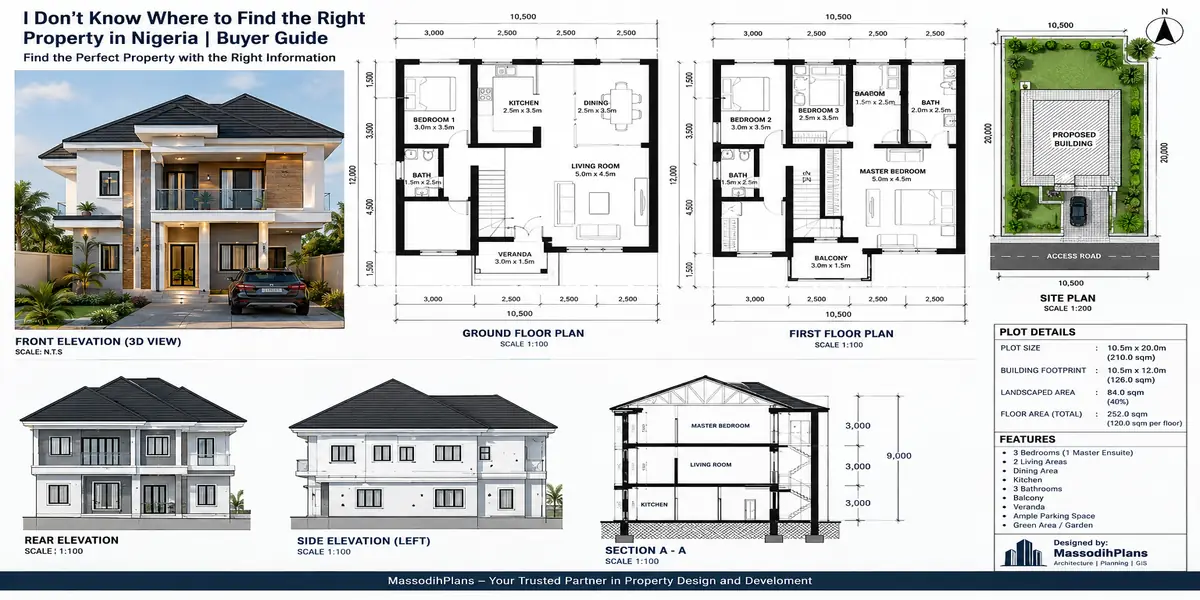
This is the step that turns a vague dream into a search filter. A 4 bedroom duplex with a reasonable compound typically needs a plot of at least 450–600 sqm, with a minimum frontage width wide enough to fit a driveway, gate setback, and building width without the house feeling jammed against the fence. A bungalow with the same bedroom count needs considerably more land, because everything sits on one level. If you want a boys’ quarters, a small garden, or space for a future second building, that’s additional plot depth you need to be searching for specifically, not hoping to find by luck.
Once you know you need, say, a 500 sqm plot with at least 15 metres of frontage in an area zoned for residential use with reasonable soil conditions, your search stops being “scroll and see what feels right” and becomes “does this listing meet my actual criteria yes or no.”
Step 3: Now Search With Real Filters, Not Vibes
With those numbers in hand, go back to the portals, the agents, the WhatsApp groups and this time, ask every single listing the same four questions before you even consider visiting: What’s the plot size and frontage? What’s the title status? What’s the actual asking price per square metre in that specific area, not the general zone? Is there any drainage, flooding, or access road issue visible on a map or satellite view before you make the trip?
You will eliminate most listings in seconds instead of days, because you finally have criteria to eliminate them with.
A cheap plot that’s the wrong shape or size for the house you actually want to build is not a bargain it’s a compromise you’ll be renegotiating with your architect for months, or a design you’ll be unhappy living in for years. Never let land price alone decide the purchase; check it against your actual house brief first.
Where People Actually Find Property in Nigeria (And What Each Source Is Good For)
Property portals (Nigeria Property Centre, PropertyPro.ng, Private Property Nigeria) best for getting a feel for pricing across an area and seeing volume of what’s available, but listings are sometimes stale or duplicated by multiple agents posting the same plot.
Registered estate agents and estate surveyors best for verified, actively available listings and negotiation, but quality varies enormously; always confirm registration with the relevant state or professional body before trusting an agent with a large transaction.
Developer direct-sales (estate developments selling serviced plots directly) often come with clearer title documentation and infrastructure already in place, usually at a premium price for that certainty.
Community and family land sales frequently the cheapest option, but carry the highest documentation and dispute risk, especially around family or communal land where multiple relatives may separately claim the right to sell.
Referrals through people who’ve actually built in the area in my experience, this is consistently the most reliable source, because it comes with someone else’s lived proof that the title, drainage, and access actually held up after purchase.
Local land committees and community associations useful for understanding an area’s real development plans and any pending disputes that won’t show up on a portal listing.
None of these sources is inherently “the right one.” The right one is whichever gets you a property that actually matches the house brief you built in Step 1, with title documentation you can verify.
Verifying a Property Before You Commit: The Layer Almost Everyone Skips
This is where a lot of “how to find property” content stops, right after telling you where to look. But finding a listing that matches your brief is only half the job verifying it is the half that actually protects your money.
Check the Title Documentation Properly
In Nigeria, land is administered under the framework of the Land Use Act, which vests control of land within a state in the governor and requires the governor’s consent before certain rights of occupancy can be validly transferred, assigned, or mortgaged. In practice, this means a Certificate of Occupancy alone doesn’t always tell the whole story for a resale property, you also need to confirm that any prior transfer of that C of O actually received the required consent, or the transaction can be legally invalid even with paperwork in hand.
Get an Independent Survey and Site Visit
Never rely solely on the seller’s or agent’s survey plan. Commission your own registered surveyor to confirm the plot’s actual boundaries, coordinates, and whether it overlaps with any government acquisition, drainage easement, or road reserve this single step catches a large share of the disputes that surface after purchase.
Physically Visit More Than Once, at Different Times
Visit during and after rain if at all possible, to check for flooding. Visit at a different time of day to check road access and neighbourhood activity. A plot that looks perfect on a dry Sunday afternoon photo shoot can tell a very different story after an hour of heavy rain.
Talk to the Immediate Neighbours, Not Just the Seller
Neighbours will tell you about flooding history, disputes, or omonile (self-appointed community land agitators) issues far more honestly than a seller motivated to close the sale.
Engage a Property Lawyer for the Actual Transaction
A lawyer conducting a proper search at the land registry, confirming there’s no pending litigation, and structuring the deed of assignment correctly, is not an optional extra for any serious purchase it’s the difference between a legally sound investment and an expensive piece of paper.
Budget for verification the same way you budget for the land itself. Survey fees, a lawyer’s search and transaction fee, and an independent site inspection typically add a small percentage to your total cost and they’re the cheapest insurance you’ll ever buy against losing the whole investment.
If You’re Searching From Abroad: The Diaspora Layer
If you’re doing this property search from London, Houston, or Toronto rather than standing on the plot yourself, everything above still applies, with a few additions:
Never rely only on the agent’s own “verification.” An agent motivated to close a sale has a conflict of interest in confirming its own listing is clean. Engage an independent surveyor and lawyer with no relationship to the seller or agent.
Insist on a live video walkthrough, not just photos, ideally unannounced or with limited notice, so what you’re seeing is the actual current state of the plot, not a curated shoot.
Understand power of attorney risk. If you’re granting someone power of attorney to transact on your behalf, that document needs to be drafted and limited carefully by your own lawyer broad, poorly worded powers of attorney are a recurring source of diaspora property fraud.
Have a trusted, independent representative physically confirm boundary pillars against the survey plan before you release final payment, not after.
Connecting the Property to the Build: What Most Buyers Only Discover Too Late
Once you’ve found and verified land that matches your house brief, there’s one more check worth doing before you finalize the purchase confirm the plot’s orientation and soil condition actually suit the design you have in mind. A plot with its longer frontage facing east-west, for instance, changes how you’ll need to plan window placement and shading compared to one facing north-south. A waterlogged or sandy plot may need a raft or pile foundation, adding real cost your original construction budget didn’t anticipate. This is a five-minute conversation with an architect or structural engineer before purchase and it’s dramatically cheaper than discovering it after you’ve already paid for the land and started construction.
Common Mistakes That Keep People Stuck in the Search Loop
Searching before defining a house brief, which turns every listing into an unanswerable “does this feel right?” question
Trusting a single source one portal, one agent instead of cross-checking multiple channels against each other
Skipping independent verification because the seller or agent “seems trustworthy”
Chasing the cheapest price without checking whether the plot’s size, shape, and title actually support the house that price is supposedly enabling
Buying land you love before checking it against your actual construction budget, only to discover the foundation type it needs eats a large share of what you’d set aside for the house itself
Frequently Asked Questions
Is there an MLS-style property database in Nigeria?
No single unified system exists. Property search in Nigeria means cross-checking multiple portals, agents, developer listings, and personal networks, since no centralized, verified database currently pools all available listings the way an MLS does in the US or Canada.
How do I know if a property listing price is fair?
Compare it against recent actual sale prices in that specific street or immediate neighbourhood, not the general area prices can vary significantly within the same district depending on drainage, access road quality, and proximity to main roads.
What’s the most reliable way to find property in Nigeria?
A combination: use portals to understand pricing, use registered agents or referrals from people who’ve actually built in the area to find genuine listings, and always independently verify title and boundaries before committing funds.
Should I buy land before or after I have a house plan?
Define your house brief bedroom count, floor area, budget, storey type before searching for land. This turns your property search into a filtered process instead of guesswork, and prevents buying land that can’t actually fit the home you want.
What documents should I insist on before buying land in Nigeria?
At minimum: a Certificate of Occupancy or valid customary right of occupancy, evidence of Governor’s Consent for any prior transfer if the land has changed hands before, a survey plan you’ve independently verified, and a properly drafted deed of assignment reviewed by your own lawyer.
Final Thoughts
You don’t have a search problem. You have a filter problem, and the filter comes from knowing what you’re actually building before you go looking for where to build it. Define your house brief first, translate it into real land requirements, then search and verify with those specific numbers in hand and the listings that used to all blur together will suddenly sort themselves into “possible” and “not even close” within minutes.
If you’re still working out what that house brief should even look like, browse our Plans Library for designs with realistic plot-size requirements already worked out, or visit Plan School to understand how floor area and land size actually relate to each other. If you want direct support matching a property you’re considering against a buildable design, our Services page outlines how we help clients at exactly this stage. You can also explore more land and building guides on our Homepage.
- I Need a Real Estate Agent to Help Me Buy a Property in Nigeria Safely
- Property for Sale in Nigeria: The Buyer’s Guide Nobody Publishes Today
- How Do I Get Natural Ventilation? Best Ways to Improve Airflow at Home
- I Don’t Know What House Plan to Build? Here’s How to Decide
- 15 Things to Check Around a Plot Before Buying Land in Nigeria Safely Today
- How to Analyse a Property Location Before Buying Land in Nigeria Today
- How Road Access Affects Residential Building and House Planning in Nigeria
Author
Massodih Okon is a Nigerian built-environment professional with academic and professional experience in urban and regional planning, geography, architectural design, Landscape Design, GIS and land development.
He holds a Master’s degree in Urban and Regional Planning from the University of Uyo and a first degree in Geography and Regional Planning.
Through MassodihPlans, he publishes practical guides on Nigerian house plans, building design, physical planning, site planning, development approval and residential construction. Read the full author profile →