What Is the Zoning of My Property? How to Check Zoning Before Building
Let’s get straight to it, because I know why you’re here. You either just bought a piece of land, you’re thinking about buying one, or you’re staring at a plot you’ve owned for years wondering what you’re actually allowed to build on it. And somewhere in the last hour, you’ve probably read three different explanations of “zoning” that all sounded like they were written for a law student, not for you.
I’m a Town Planner. This is genuinely my job I sit on planning committees, I read zoning maps for a living, and I’ve had this exact conversation with clients more times than I can count. So let me answer this the way I’d answer a friend who called me about it, not the way a government website answers it.
So, What Is Zoning, Really?
Zoning is your local or state planning authority‘s answer to one question: “What is this specific piece of land legally allowed to be used for?”
That’s it. That’s the whole concept underneath all the jargon. Every plot of land inside a planned area has been assigned a category residential, commercial, industrial, mixed-use, agricultural, and a few others and that category decides what you can legally build and do there. Buy land zoned for residential use, and you generally can’t open a factory on it. Own a plot zoned commercial, and you might not be allowed to just build a private house there either, at least not without extra approval.
Here’s the part almost nobody explains clearly: zoning isn’t about what’s physically possible on your land. It’s about what’s legally permitted. You can absolutely build a shop on residential land in the physical sense nothing stops the concrete and blocks from going up. What stops you is that it’s not permitted, and if you do it anyway, you’re looking at fines, forced demolition, or a permanent headache when you try to sell or get a mortgage on that property later.
Never assume your land’s zoning based on what your neighbours are doing. I’ve seen plots where three houses down someone’s running a full shop on residential land sometimes that’s grandfathered in from before the area was zoned, sometimes it’s just unenforced, and sometimes it’s an accident waiting to catch up with them. Their situation is not your legal green light.
How Do I Find My Property’s Zoning?
This is the question that actually brought you here, so let’s answer it directly.
Step 1: Start with your title documents.
Your deed, Certificate of Occupancy, title deed, or purchase agreement sometimes states the permitted land use directly. It won’t always give you the full zoning designation, but it’s worth checking first because it’s the fastest possible answer if it’s there.
Step 2: Check your local planning authority’s online portal.
Most cities and counties now run a searchable zoning map or GIS (Geographic Information System) tool where you type in your address and it tells you the zoning designation instantly. This is genuinely the fastest reliable method where it’s available.
Step 3: Call or visit the planning department directly.
If there’s no usable online tool, or the online result is unclear, this is your next move. Ask specifically for the zoning designation and, if possible, a copy of the zoning code section for that designation not just the code letters and numbers, but what they actually permit.
Step 4: Request a zoning certificate or letter.
Many planning authorities will issue a formal zoning confirmation letter or certificate for a small fee. This is the version you want in hand if you’re about to spend real money on land, because it’s an official record, not just something you were told over the counter.
Step 5: Bring in a land surveyor or town planning consultant.
If the land has no clear address in the system yet, sits across a boundary between zones, or the zoning history is genuinely murky, this is worth the fee. I’ve walked clients back from land purchases more than once after a proper zoning check turned up something the seller either didn’t know or didn’t mention.
Don’t rely on verbal confirmation from an estate agent, a seller, or even a friendly official at the planning office. Get it in writing. Zoning disputes almost always come down to “who has documentation,” and a remembered conversation loses to a stamped letter every single time.
What Is My Land Zoned For? (Understanding the Designation Itself)
Once you have the zoning designation something like “R-1,” “C-2,” “residential low-density,” or a local equivalent you need to know what that code actually allows, not just what it’s called. This is where a lot of people stop too early, satisfied that they now know their zone name, without checking what it permits.
A zoning designation typically tells you:
- What categories of use are permitted outright (by right), permitted with conditions, or not permitted at all
- The maximum density how many dwelling units or how much floor area per unit of land
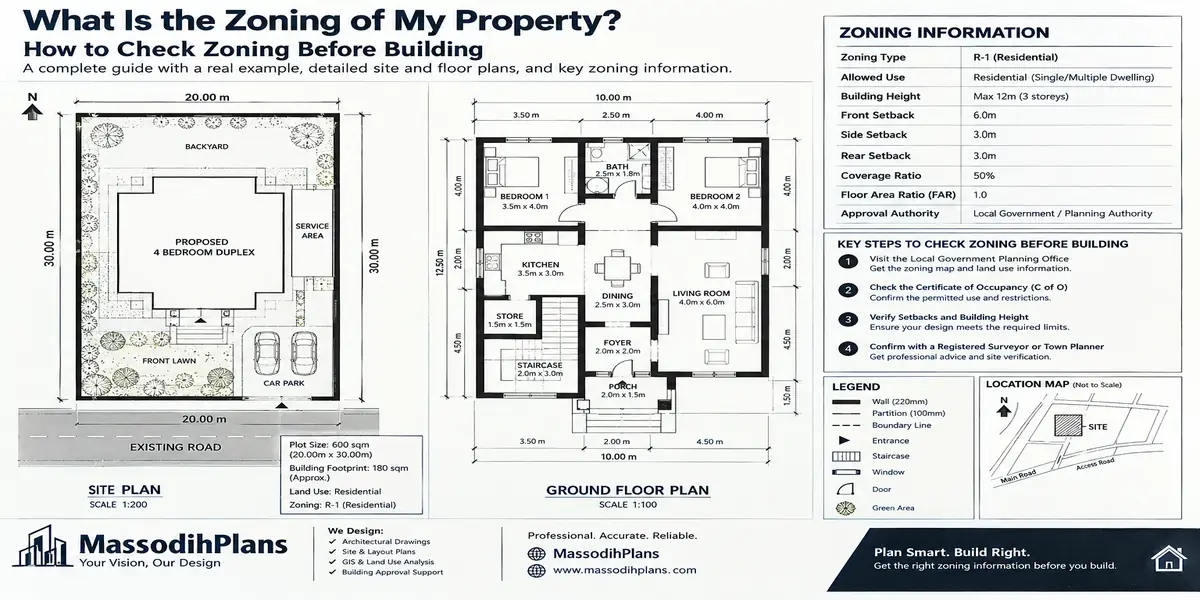
- Minimum setbacks how far a building must sit from each boundary
- Maximum height and number of storeys allowed
- Minimum parking requirements
- Lot coverage limits what percentage of the plot can actually be built on
Two properties can share the exact same zoning label and still have different specific rules if one sits within an overlay district (a special additional layer of rules historic preservation, flood zone, airport noise corridor, and similar) that the base zoning label doesn’t show on its own.
How to Check Zoning: Doing It Properly, Not Just Quickly
There’s a difference between checking zoning fast and checking it properly, and I want to be honest with you about that difference because it matters more than most guides let on.
The fast way gets you the zoning code R-1, C-2, whatever it is. Good enough for basic curiosity.
The proper way gets you three things together: the zoning code, the actual permitted-use list under the current zoning ordinance, and confirmation of whether any overlay districts or pending rezoning proposals affect the property. That third part is the one almost everyone skips, and it’s the one that occasionally blindsides someone six months after they’ve already committed money to a project.
If you’re planning to build, buy, invest, or apply for financing, always confirm zoning through the proper method the planning department directly, or a written zoning certificate never through a quick map search alone. A map tool is a starting point, not a final answer.
Reading a Zoning Map
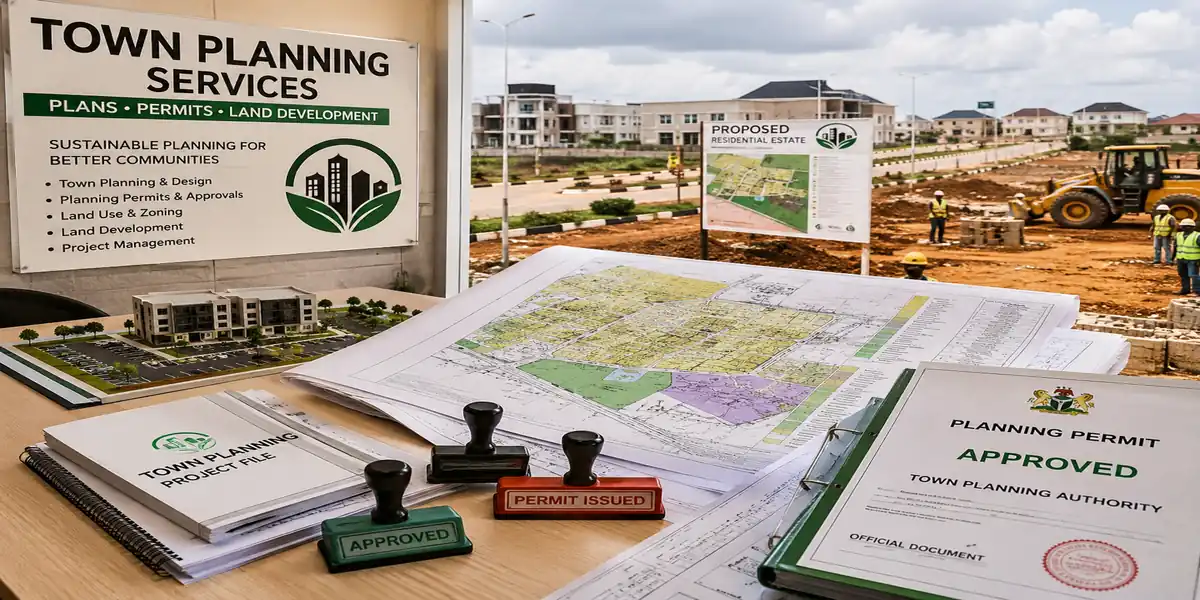
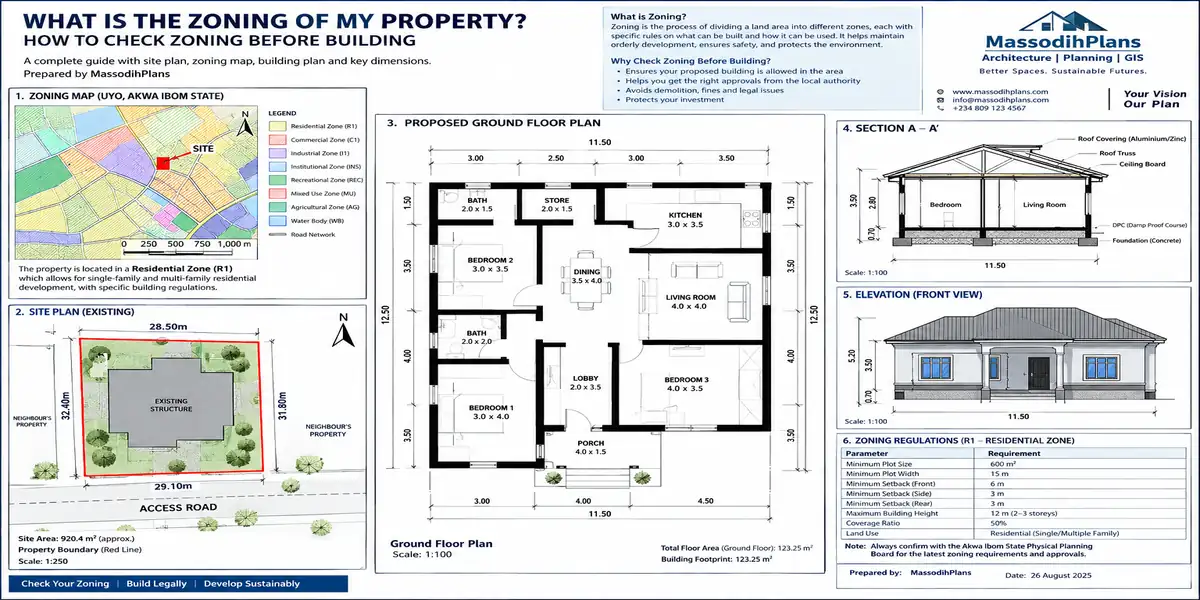
A zoning map is essentially a colour-coded picture of an entire city or district, where each colour or pattern represents a different zoning category. Residential zones are usually shown in yellows or oranges, commercial in reds or blues, industrial in purples or greys, and so on the exact colour scheme varies by jurisdiction, but the logic is always the same: one glance tells you how the whole area is divided.
To actually read one usefully:
- Find your specific plot first, using the address search or by matching your parcel’s shape against the map
- Note the exact code shown for your plot, not just the general colour block some maps show sub-categories within the same colour
- Check the boundary lines carefully if your plot sits near the edge of a zone. Being on the wrong side of a zoning boundary line by a few metres genuinely changes what you’re allowed to do
- Look for any hatching, dashed borders, or symbols layered over the base colour these usually indicate an overlay district with additional rules
Residential Zoning: What It Actually Means
What does residential zoning mean? In plain terms, it means the land is designated primarily for people to live on houses, apartments, or similar dwellings rather than for business or industrial activity.
But “residential” isn’t one single rulebook. It almost always breaks down further:
- Low-density residential typically single-family homes, larger minimum lot sizes, lower height limits
- Medium-density residential duplexes, townhouses, or small multi-family buildings
- High-density residential apartment blocks, taller height allowances, smaller minimum lot sizes per unit
Residential zoning generally restricts or outright prohibits commercial activity on the property meaning that home business, that small shop you were thinking of running from your garage, or that guest house you wanted to convert your compound into may need a separate conditional-use approval, or may not be permitted at all, depending on the specific residential sub-category and jurisdiction.
Commercial Zoning: What It Actually Means
Commercial zoning designates land primarily for business activity retail, offices, restaurants, hotels, and similar uses. Like residential zoning, it usually has sub-categories:
Neighbourhood commercial smaller-scale retail and services meant to serve the immediate surrounding residential area, often with restrictions on size and hours to limit impact on nearby homes
General/central commercial larger-scale retail, offices, and mixed commercial activity, typically in a city’s core commercial districts
Highway/corridor commercial businesses oriented toward vehicle traffic along major roads, often with different parking and signage rules than neighbourhood commercial zones
A common and expensive mistake: buying commercially zoned land assuming you can build a private residence on it “since it’s just for me.” Many commercial zones don’t permit stand-alone residential use at all, or only permit it as part of a mixed-use structure with ground-floor commercial space.
Industrial Zoning: What It Actually Means
Industrial zoning is set aside for manufacturing, warehousing, heavy equipment operations, and similar activity that generally isn’t compatible with residential or commercial neighbours due to noise, traffic, emissions, or safety considerations. It also typically splits into sub-categories:
Light industrial smaller workshops, light manufacturing, warehousing with limited heavy machinery or truck traffic
Heavy industrial larger manufacturing, processing plants, and uses with a bigger physical or environmental footprint
Industrial land is almost always the cheapest per square metre in a given area for exactly this reason its usable purposes are the most restricted, and it’s usually positioned away from residential neighbourhoods on purpose.
Mixed-Use Zoning: What It Actually Means
Mixed-use zoning deliberately allows more than one category of use on the same plot or within the same building most commonly, ground-floor retail or office space with residential units above. It’s become far more common in newer urban planning approaches because it supports walkable neighbourhoods where people can live close to where they shop and work.
Mixed-use zoning usually comes with its own specific ratio rules for example, a requirement that a certain percentage of ground-floor frontage be commercial, or a cap on how much of the building’s total floor area can be residential versus commercial. It’s genuinely one of the more flexible zoning categories, but that flexibility comes with more detailed conditions attached, not fewer.
Zoning Regulations: The Rules Inside Every Zone
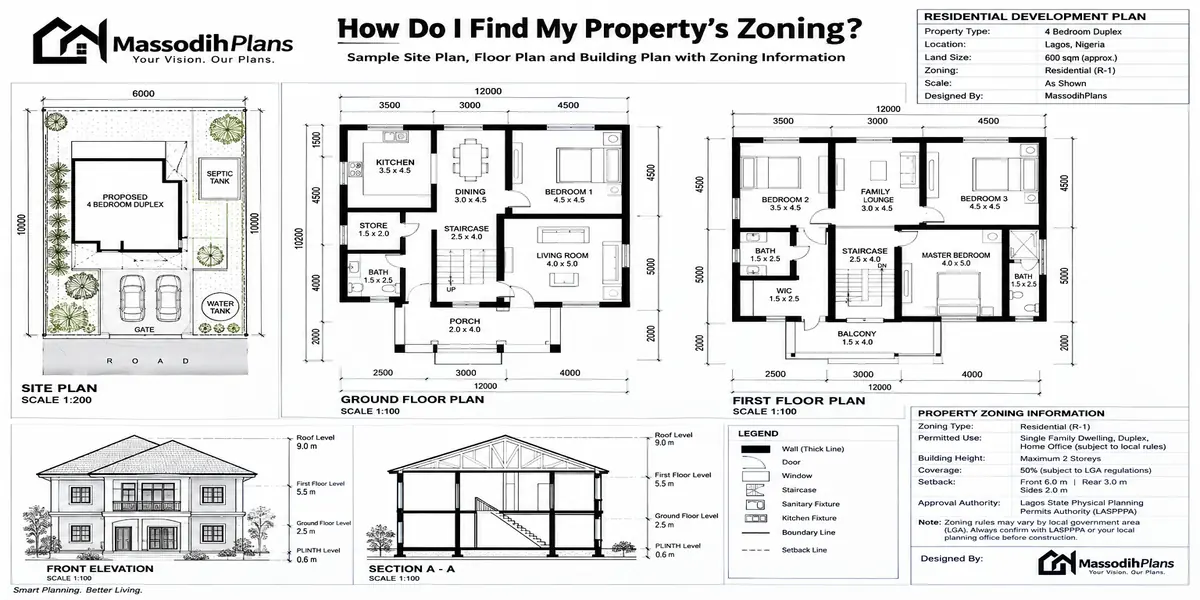
Whatever category your land falls into, the actual zoning regulations attached to it typically cover:
Permitted uses what you can do there without any special approval
Conditional or special-exception uses what you can do there, but only after applying for and receiving additional approval
Setbacks minimum distance from each property boundary a structure must maintain
Height limits maximum building height, sometimes expressed in storeys, sometimes in metres/feet
Density and floor-area ratio how much building floor area is permitted relative to the plot size
Lot coverage the maximum percentage of the plot that can be covered by structures
Parking requirements minimum number of parking spaces per unit or per square metre of commercial space
This is the layer that actually determines whether your specific building idea fits on your specific plot the zoning category tells you the broad category of what’s allowed; the regulations tell you the exact numbers you have to design within.
Zoning Regulations: The Rules Inside Every Zone
Different Zones Give Different Development Rights And Some Uses Need Extra Consent
This is the single most important sentence in this entire article, so I want to slow down on it: your zoning designation gives you certain development rights automatically, “by right,” meaning you don’t need special permission to exercise them. But it also very often lists uses that are only allowed with additional consent sometimes called a conditional use permit, special exception, or discretionary consent, depending on your jurisdiction’s terminology.
Here’s what that actually looks like in practice:
Building a single-family home on land zoned low-density residential is usually a “by right” use no extra consent needed beyond the standard building permit process
Running a home daycare, a small clinic, or a place of worship on the same residential land is very often a conditional use legally possible, but only after a specific application, sometimes with a public notice period, sometimes with a hearing
Building an accessory unit (a granny flat, boys’ quarters converted to a rental unit, or similar) may be permitted outright, permitted with conditions, or not permitted at all, depending on your specific zone
Subdividing a single plot into multiple smaller plots almost always requires separate approval beyond base zoning, regardless of what the base zoning otherwise allows
The mistake I see most often is someone checking the zoning category, seeing it broadly matches their plan, and assuming that’s the end of the checking process. It isn’t. Always ask specifically: “Is my intended use permitted by right, or does it require conditional approval?” Those are two very different answers with two very different timelines and costs attached.
If your plan requires conditional consent, apply for that consent before you commit serious money to design and construction, not after. I’ve seen people spend heavily on architectural drawings for a use that needed conditional approval, only to have the approval delayed or denied money and time that a five-minute upfront question to the planning office would have protected.
The Layer Almost No Article Covers: Zoning Outside the US System
Most zoning content online is written entirely around the American county-GIS-map model, which works great if that’s your jurisdiction and is almost useless if it isn’t. Zoning exists worldwide, but how you actually check it varies enormously by country. Here’s a quick, honest breakdown:
Nigeria
Land use and zoning sit under the Land Use Act, administered through state-level Ministries of Physical Planning and Urban Development, or their equivalent (Lagos State’s LASPPPA, for example). There is often no single national online zoning map you typically confirm zoning through the relevant State Physical Planning Board or Ministry, cross-checked against your Certificate of Occupancy and any approved layout/master plan covering the area. This is exactly why a registered town planner’s involvement matters more in Nigeria than in jurisdictions with a mature self-service online zoning portal.
United States
Zoning is handled at the city or county level, almost always with a searchable GIS zoning map, as covered throughout this guide.
United Kingdom
There’s no direct “zoning” system in the American sense; instead, land use is controlled through Local Plans and planning permission requirements administered by local councils, with permitted development rights covering some smaller changes without full permission.
Canada
Zoning bylaws are set at the municipal level, generally searchable through the city’s planning or zoning bylaw portal, similar in structure to the US system.
Australia
Land-use zoning is set at the state and local council level, typically viewable through a state planning portal or council mapping tool, alongside a planning certificate you can formally request for a property.
South Africa
Zoning falls under municipal town planning schemes, confirmed through the local municipality’s town planning or land use management department.
If you’re reading this from outside the US, the core concepts in this guide (permitted use, conditional use, setbacks, density) still apply only the specific office you contact and the format of the confirmation document change.
What Happens If Your Property’s Use Doesn’t Match Its Zoning?
This comes up more than you’d expect, especially on older properties or land bought without a proper check. A property might be operating in a way that no longer matches its current zoning for a few different reasons:
Legal nonconforming use the use existed before the current zoning was adopted, and is allowed to continue (though often not allowed to expand) under “grandfathering” provisions
Unauthorized use the use never had proper approval and is technically a violation, whether or not it’s ever been enforced against
Zoning has since changed the area was rezoned after the property’s use was established, creating a mismatch that may or may not have formal protection
If you’re buying a property with an existing use that doesn’t obviously match textbook zoning for that area, this is exactly the kind of thing to verify before you close, not after because “the previous owner did it for twenty years” is not the same as “it’s legally protected,” and only a proper records check tells you which one you’re actually dealing with.
Zoning vs. Deed Restrictions and Estate Covenants
One more distinction that trips people up: zoning is a government-imposed rule, but it is not the only rule that might apply to your land. Private deed restrictions, homeowners’ association rules, or estate covenants can impose additional limits sometimes stricter ones that exist entirely separately from municipal zoning. A property can be perfectly compliant with its zoning and still be in violation of a private covenant governing fence height, roofing material, or architectural style. Always check both layers, not just one.
What to Do When Zoning Doesn’t Allow What You Want
If your intended use isn’t permitted under your current zoning, you generally have a few real options:
Apply for a variance a specific, usually minor, exception to a particular requirement (like a setback), typically granted only where strict compliance would create genuine hardship
And apply for a conditional use permit where your intended use is listed as conditionally allowed, rather than fully prohibited
Apply for rezoning a request to have the property’s base zoning designation formally changed, which is a longer, more involved, and less certain process than a variance
Adjust your plan to fit the existing zoning often the fastest and cheapest path, even when it’s not the answer people want to hear
Each of these has a real cost and timeline attached, and none of them are guaranteed to succeed which is exactly why checking zoning before you buy or design is so much cheaper than checking it after.
Frequently Asked Questions
How do I find my property’s zoning?
Start with your title documents, then check your local planning authority’s online zoning map if one exists, or contact the planning department directly and request a written zoning confirmation.
What is my land zoned for?
Your zoning designation (shown as a code or category name) tells you which uses are permitted by right, which are permitted with conditional approval, and which are prohibited entirely check the actual zoning ordinance text, not just the code letters.
What does residential zoning mean?
It means the land is primarily designated for people to live on, generally restricting or prohibiting commercial and industrial activity, with sub-categories controlling density, height, and lot size.
Can zoning change after I buy a property?
Yes. Local authorities can rezone an area at any time through their normal planning process, which is why it’s worth checking not just current zoning but whether any rezoning proposal is pending for your area.
Does zoning override my estate’s private rules?
No zoning and private deed restrictions or estate covenants operate independently. You need to comply with both, and the stricter of the two effectively becomes your real limit.
What’s the difference between a variance and a conditional use permit?
A variance is an exception to a specific rule (like a setback distance) granted for hardship reasons. A conditional use permit allows a use that the zoning already lists as conditionally acceptable, subject to meeting specific requirements.
Finally
If you take one thing away from this: knowing your zoning category is only step one. Knowing exactly what it permits, what it restricts, and what needs extra consent is the part that actually protects your money and your plans. Get it in writing, check it properly rather than quickly, and if your intended use sits anywhere near a grey area, ask the direct question “by right, or conditional?” before you spend a naira, dollar, or pound on design and construction.
If you’re planning a build and want your design checked against your actual zoning and permitted use from the start, our Services page outlines how we work with clients through exactly this process. Browse our Plans Library for designs suited to common residential zoning categories, or visit Plan School to understand approvals and documentation before you commission a plan. You can also explore more planning and land-use guides on our Homepage.
- House Floor Plans: 3, 4 & 5 Bedroom Modern Home Plans With Dimensions and Practical Layouts
- Can I Build on This Land? How to Check the Plot Before Building a Home
- Planning Permission Explained: Everything You Must Know Before Building on Your Land
- Am I About to Overpay for This Property? A Simple Guide to True Value
- How Do I Know the True Value of a Property? Before You Buy or Sell It
- Is This Property Actually Worth the Asking Price? What to Check First!
- Is This Neighbourhood a Good Place to Live? What to Check Before Buying
- I Don’t Know Which Location to Buy In: How to Choose the Best Location
- What Can I Build On My Land? How to Find Out What You Can Build There?
Author
Massodih Okon is a Nigerian built-environment professional with academic and professional experience in urban and regional planning, geography, architectural design, Landscape Design, GIS and land development.
He holds a Master’s degree in Urban and Regional Planning from the University of Uyo and a first degree in Geography and Regional Planning.
Through MassodihPlans, he publishes practical guides on Nigerian house plans, building design, physical planning, site planning, development approval and residential construction. Read the full author profile →