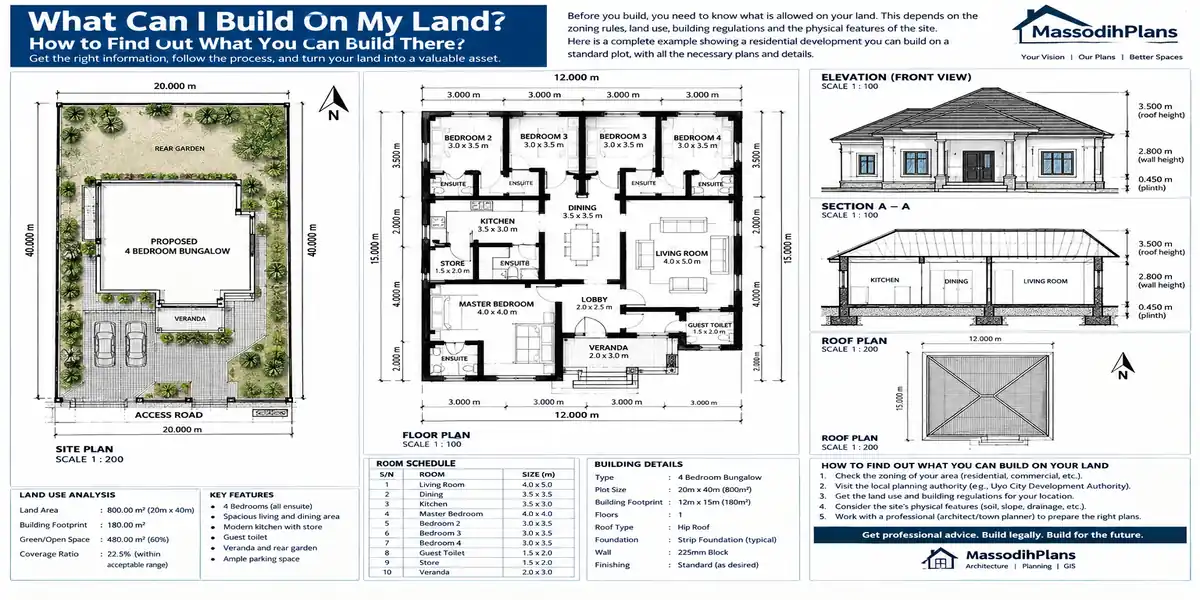
What Can I Build On My Land? How to Find Out What You Can Build There?
Somebody asked me this exact question at a family function last year, standing next to a plate of jollof rice, completely convinced there was a simple yes-or-no answer. “Massodih, I have a plot in Nwaniba road. Can I build a hotel there or not?”
I told him what I’m about to tell you: nobody can answer that question just by looking at your land. Not me, not Google, not the agent who sold you the plot, not your uncle who “knows about these things.” The answer depends entirely on what your land is zoned for and that single piece of information changes everything else about your plan.
So let’s actually solve this properly. Not a list of vague warnings to “check with your local authority” and leave you exactly as confused as before. I’m going to show you how zoning actually works, how to find out your own land’s classification with real steps, and then go through every specific use people ask me about apartments, shops, hotels, schools, churches, warehouses, mixed-use, home offices, and running a business from home so you know exactly where you stand.
First, Understand This: Owning Land Does Not Mean You Can Build Anything On It
This is the part that trips up more people than anything else. In Nigeria, under the Land Use Act of 1978, all land is technically vested in the governor of the state it sits in. You hold a right of occupancy, not outright ownership in the Western sense. That legal reality is exactly why the state through its planning authority gets to decide what categories of development are permitted on any given plot, regardless of what you paid for it or how long you’ve held it.
That decision is called zoning, and every serious plot of land in Nigeria falls under one classification or another, whether the seller told you or not.
The single biggest myth I hear from clients is “the agent said I can build anything I want.” Agents sell land. They are not the people who approve building plans. Only your state’s planning authority Ministry of Physical Planning, LASPPPA in Lagos, the Development Control department in your state can confirm what’s actually permitted.
How Zoning Actually Works (Without the Jargon)
Think of zoning as your city’s way of keeping a noisy printing press from opening next to somebody’s bedroom, and a fuel station from opening next to a nursery school. Every plot gets grouped into a category, and each category comes with rules about what can legally be built there:
- Residential homes, duplexes, apartments, sometimes small-scale home businesses
- Commercial shops, offices, plazas, hotels
- Industrial warehouses, factories, workshops
- Institutional schools, hospitals, churches, government buildings
- Mixed-use a deliberate blend, usually along major roads, where residential and commercial can sit together
- Agricultural farmland, generally restricted from most building development
- Special-purpose government, military, or reserved land, almost never available for private building at all
Residential zoning itself usually splits further into low-density (bungalows and duplexes on generous plots think Lekki Phase 1, Ikoyi, GRA-type areas), medium-density (smaller flats and duplexes, tighter plots), and high-density (multi-storey apartment blocks). This distinction alone answers a huge chunk of the “can I build an apartment here” question, which we’ll get to.
Zoning isn’t uniform across Nigeria it varies by state and even by specific layout within a state. Lagos, Abuja, Rivers, and Akwa Ibom each run their own planning framework, and even within one city, one street can be zoned differently from the next. Never assume your land’s zoning based on what you see nearby.
How To Actually Find Out What Your Land Is Zoned For
This is the part almost nothing online tells you how to actually do. Here’s the real process:
Get your survey plan and title document ready your planning authority needs to identify the exact plot, not just a street address.
Visit the physical planning office covering your local government area for most states this is a Ministry of Lands, Physical Planning, or Urban Development office, or in Lagos specifically, LASPPPA.
Request a zoning confirmation or land use search you’re asking, in writing, “what is this plot’s approved land use classification?” Some offices call this a “zoning letter” or “land use information.”
If you’re not physically in the country or the city, this is exactly the kind of task a registered town planner or architect based locally can do for you physically going to the registry, submitting the request, and reporting back the actual classification, rather than you guessing from a distance.
Cross-check against any estate layout plan, if your land sits inside a private estate because estate developers often set their own use restrictions on top of state zoning, and those can be stricter.
Do this before you buy, not after. A zoning confirmation costs a small fee and a bit of your time. Discovering your zoning after you’ve already built the wrong thing costs a demolition notice.
“Can I Build Apartments?”
This depends entirely on your zoning tier. If your land falls under high-density or medium-density residential zoning, apartment blocks (blocks of flats) are typically permitted, often with rules on the number of units, building height, parking provision per unit, and setback distances. If your land is zoned low-density residential the kind of classification common in areas like Ikoyi, Victoria Island, or Lekki Phase 1 apartment blocks are usually restricted or outright disallowed, because low-density zoning exists specifically to preserve larger plots, more green space, and lower building height in that area.
The practical trap here: plenty of land in medium and high-density zones still has a maximum unit count or height restriction attached. “Zoned for apartments” doesn’t automatically mean “zoned for a six-storey block.” Always confirm the specific density allowance, not just the broad category.
“Can I Build Shops?”
Only if your land carries commercial zoning, or sits within a mixed-use corridor that specifically permits ground-floor commercial activity. Pure residential zoning generally does not permit a standalone retail shop, even a small one, though enforcement intensity varies significantly by state and by how visible the shop is from the main road.
If your land is residential but you want a shop component, the honest paths are: apply for a change of use (covered below), look specifically for land already zoned mixed-use, or scale your ambition down to what’s genuinely permitted as a home-based micro-business, which is a different and more limited thing than an actual shopfront.
“Can I Build a Hotel?”
Hotels need commercial zoning at minimum, and in most states, they also trigger additional layers beyond zoning entirely fire safety certification, a tourism board registration or license depending on your state, and often a higher scrutiny approval process because of the guest-occupancy and public-safety implications. A hotel is one of the uses most likely to get flagged even on land that’s broadly commercial, if the specific plot wasn’t earmarked for hospitality-scale development, parking, and access. This is a case where getting a written zoning confirmation before you design anything isn’t optional it’s the difference between a bankable project and a very expensive lesson.
“Can I Build a School?”
Schools fall under institutional zoning in most planning frameworks, and even where a residential zone technically permits “community facilities,” schools specifically tend to carry extra requirements: minimum plot size, safe road access and drop-off provision, distance from noise-generating or hazardous neighbouring uses, and fire safety compliance appropriate to a building full of children. Some states also restrict school density within a given radius to avoid oversaturation in one neighbourhood. If you’re planning a school, treat the zoning check and the institutional-use approval as two separate conversations with your planning authority, not one.
“Can I Build a Church?”
This is the one I want to be especially direct about, because it’s also the one causing the most heartbreak in Nigeria right now. Churches (and other places of worship) fall under institutional zoning, and building or operating one on land zoned purely residential even quietly, even in a converted living room that grows into a full congregation over time has led to real demolitions in several Nigerian cities in recent years, Lagos in particular. This isn’t a hypothetical risk; it has happened repeatedly to established congregations that assumed years of quiet operation equalled legal approval. If you’re planning a church, get institutional zoning confirmed and a change of use approved before construction, and don’t rely on how long a similar building nearby has been standing as evidence that it’s fine plenty of those buildings are also technically in violation, just not yet enforced against.
“Can I Build a Warehouse?”
Warehouses need industrial zoning, or at minimum a specific commercial-industrial classification depending on your state’s categories. Beyond the zoning question itself, warehouses bring practical land-use issues that matter even where the zoning is correct: heavy truck access requires roads actually built to carry that weight, noise and loading activity need enough distance from residential neighbours to avoid nuisance complaints, and depending on what’s stored, environmental or fire safety review may apply on top of standard building approval. A plot zoned industrial in a location with weak road infrastructure is legally buildable but practically painful to operate that’s a separate due-diligence layer beyond just “is it zoned right,” and it’s one almost nobody checks before buying industrial land.
“Can I Build a Commercial Property?”
“Commercial property” is broad, so the honest answer is: it depends on which commercial use you mean, and commercial zoning itself often has sub-tiers (neighbourhood commercial, like a small plaza or bank branch, versus heavy commercial, like a large shopping centre with major traffic generation). A plot zoned for small-scale neighbourhood commercial use won’t automatically permit a large shopping mall, even though both are technically “commercial.” Get the specific sub-classification, not just the headline category.
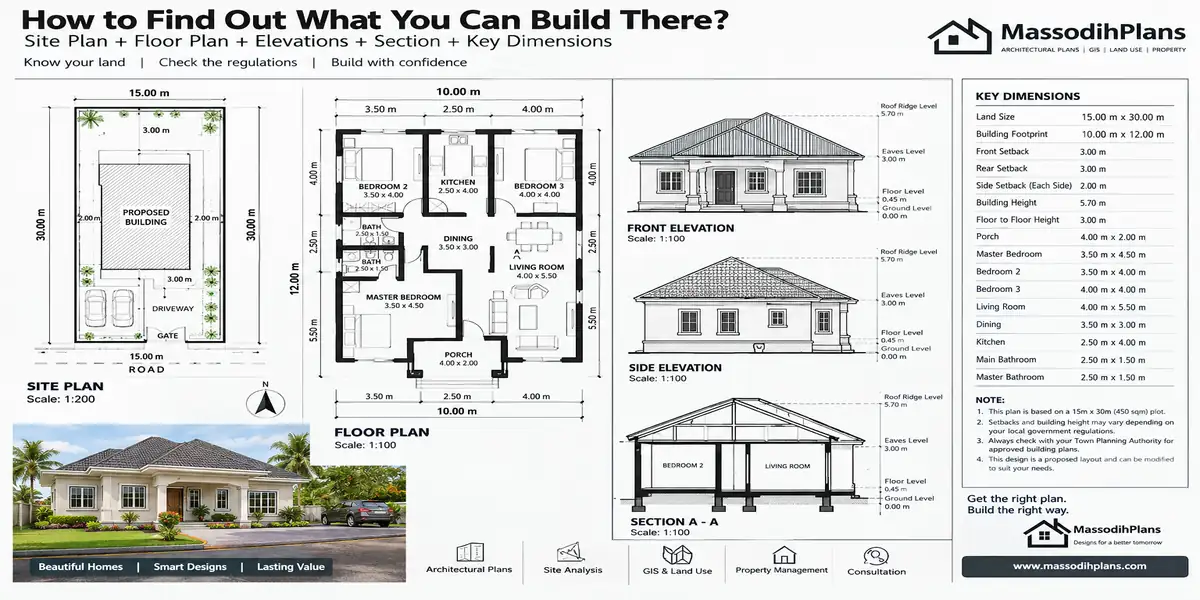
How to Find Out What You Can Build on land
“Can I Build Mixed-Use Development?”
Mixed-use zoning exists specifically to combine residential and commercial (and sometimes light institutional) uses on the same plot or within the same corridor commonly along major roads where ground-floor shops sit beneath residential flats above. If your land is zoned mixed-use, you generally have more flexibility than pure residential or pure commercial zoning allows, but there are still usually rules on what percentage of the building can be commercial versus residential, and on parking provision for the commercial component specifically. Mixed-use is often the most flexible classification available, which is exactly why land already zoned mixed-use tends to carry a price premium over comparable pure-residential land nearby.
“Can I Convert My House To An Office?”
This is technically a change of use, even if it feels like a small internal decision. Converting a full residential building into a commercial office means the use of the land has changed from residential to commercial, and most planning authorities require a formal change of use application and approval before you make that switch not just internal renovation. In practice, enforcement varies: a single small office with no signage and minimal client traffic might go unnoticed for years, while a visibly branded office with regular visitor parking on a residential street is far more likely to draw a planning authority’s attention, a neighbour’s complaint, or both. The safe path is to apply for change of use formally rather than gamble on how visible your operation stays.
“Can I Run A Business From My House?”
This is the question with the most nuance, because “running a business from home” covers everything from a laptop-based consulting practice nobody would ever notice, to a full home salon with a queue of client cars outside your gate every day and those two scenarios are treated very differently in practice, even though both technically happen “at home.”
Most residential zoning frameworks have an informal or formal tolerance for low-impact home occupations work that doesn’t generate significant extra traffic, noise, signage, or non-resident foot traffic. The practical test planning authorities and neighbours actually apply, whether or not it’s written into your specific state’s code, tends to come down to a few things:
- Does the business generate regular client visits and parking on a residential street?
- Is there external signage advertising a business at a residential address?
- Does the activity create noise, smell, or waste beyond normal household levels?
- Are you employing non-household staff who commute to the property daily?
A tutor taking two students a week, a graphic designer working from a home office, or someone selling products online with deliveries handled off-site are generally low-risk and rarely challenged. A full-scale event centre, a busy retail operation with a shopfront cut into your fence, or a workshop running machinery are a different category entirely these are the change-of-use situations covered above, not “working from home” in the sense zoning typically tolerates.
If you’re not sure which side of that line your home business sits on, ask yourself honestly whether a stranger walking past your house would immediately recognize it as a business premises rather than a home. If the answer is yes, it’s worth getting a proper change-of-use conversation started rather than hoping nobody minds.
The Layer Almost No Article Covers: What Happens When You Build The Wrong Use
Getting the zoning wrong isn’t a paperwork inconvenience it has real, escalating consequences, and understanding the full chain helps you take the risk seriously before you spend money, not after:
Building plan rejection your architectural drawings simply won’t be approved for a use the land isn’t zoned for, stopping you before construction even starts, if you go through proper channels
Stop-work orders if you build without approval and it’s discovered mid-construction, work is halted, sometimes with equipment and materials on site sitting idle
Demolition the most severe consequence, and it has happened repeatedly in Nigeria to churches, event centres, and commercial buildings on residential land, regardless of how much money was invested or how long the building had stood
Fines and legal costs separate from demolition risk, and often recurring if the violation continues
Weak resale and financing position a buyer’s bank will not finance a property with a use mismatch against its zoning, and a properly informed buyer will discount their offer heavily to account for that legal exposure, even if you personally never faced enforcement
None of this is theoretical scare-tactic writing this is the actual pattern that plays out, city after city, when people build first and check zoning later.
The “My Neighbour Already Did It” Trap
I want to name this specifically because it’s the single most common justification I hear for skipping the zoning check entirely: “but the house two plots down is already running a shop / already built flats / already has a church.” Here’s the uncomfortable truth that neighbour may simply not have been caught yet, may have a change-of-use approval you don’t know about, or may be sitting on the exact same risk you’re about to take on. Enforcement in Nigeria is inconsistent and often reactive rather than proactive, which means an existing violation nearby tells you nothing reliable about whether your own plan is safe. It’s evidence of what people have gotten away with, not evidence of what’s legally permitted.
If Your Land Is Zoned Wrong For What You Want To Build
You have three honest options, and no fourth shortcut that doesn’t carry real risk:
Apply for a change of use through your state’s planning authority this is a formal process, takes time, isn’t guaranteed to be approved, and often comes with conditions or additional fees, but it’s the legitimate route.
Find land already zoned correctly for your intended use sometimes the more practical and faster answer, especially for commercial, institutional, or industrial projects where the zoning gap is large.
Adjust your plan to match a use the land already permits sometimes the compromise is smaller than people expect; a full shopfront might not be permitted, but a modest, low-visibility home-based version of the same business idea often is.
What doesn’t work long-term is building the unauthorized use quietly and hoping enforcement never catches up as covered above, that’s a risk that compounds rather than disappears with time.
A Straight Checklist Before You Build Anything
- Get a written zoning confirmation from your state’s planning authority for your specific plot
- Check whether your land sits inside a private estate with its own use restrictions, separate from state zoning
- Match your intended use against the specific sub-tier of that zoning (density level, commercial scale, institutional type) not just the broad category
- If your intended use doesn’t match, decide honestly between change-of-use application, different land, or a scaled-down version of your plan
- For hotels, schools, and churches specifically, confirm any additional licensing or safety certification requirements beyond zoning approval
- Get this in writing before you commission architectural drawings designing a beautiful building for a use your land doesn’t permit is money spent solving the wrong problem
Frequently Asked Questions
How do I check what my land is zoned for in Nigeria?
Visit your state’s planning authority (or LASPPPA in Lagos) with your survey plan and title document, and formally request a zoning confirmation or land use information letter for that specific plot.
Can I build a shop on residential land if it’s just a small kiosk?
Even small commercial structures generally require commercial or mixed-use zoning to be fully compliant. A small kiosk may go unenforced longer than a large shop, but it carries the same underlying legal exposure.
Does a Certificate of Occupancy tell me what I can build?
Not by itself. A C of O confirms your right of occupancy over the land, but the zoning classification a separate piece of information from your planning authority determines what use is permitted on it.
Can I convert a residential building into a school or church later, even if I built it as a house?
Only through a formal change of use approval. Simply repurposing the building without that approval carries the same demolition and enforcement risk as building the wrong use from the start.
Is it worth hiring a professional just to check zoning, or can I do it myself?
You can do it yourself if you’re able to visit the planning authority in person with the right documents. If you’re not local especially for diaspora buyers a registered town planner or architect can conduct this check on your behalf and interpret what the classification actually permits, which is often the harder part.
Conclusion
“What can I build on my land?” isn’t really a building question it’s a legal and administrative question that happens to determine everything downstream, including your building question. Get the zoning confirmed in writing before you fall in love with a design, a floor plan, or a business idea for that plot. It’s the cheapest, fastest step in this entire guide, and it’s the one people skip most often usually right before the most expensive mistake on this list happens to them.
If you already know your zoning and want a design that fits it properly, browse our Plans Library for house and building plans matched to common Nigerian zoning categories, or visit Plan School to understand the approval process step by step. If you need direct support confirming your land’s zoning or navigating a change-of-use application, our Services page outlines how we help clients with exactly this. You can also explore more land, planning, and building guides on our Homepage.
- House Floor Plans: 3, 4 & 5 Bedroom Modern Home Plans With Dimensions and Practical Layouts
- Can I Build on This Land? How to Check the Plot Before Building a Home
- Planning Permission Explained: Everything You Must Know Before Building on Your Land
- Am I About to Overpay for This Property? A Simple Guide to True Value
- How Do I Know the True Value of a Property? Before You Buy or Sell It
- Is This Property Actually Worth the Asking Price? What to Check First!
- Is This Neighbourhood a Good Place to Live? What to Check Before Buying
- I Don’t Know Which Location to Buy In: How to Choose the Best Location
Author
Massodih Okon is a Nigerian built-environment professional with academic and professional experience in urban and regional planning, geography, architectural design, Landscape Design, GIS and land development.
He holds a Master’s degree in Urban and Regional Planning from the University of Uyo and a first degree in Geography and Regional Planning.
Through MassodihPlans, he publishes practical guides on Nigerian house plans, building design, physical planning, site planning, development approval and residential construction. Read the full author profile →