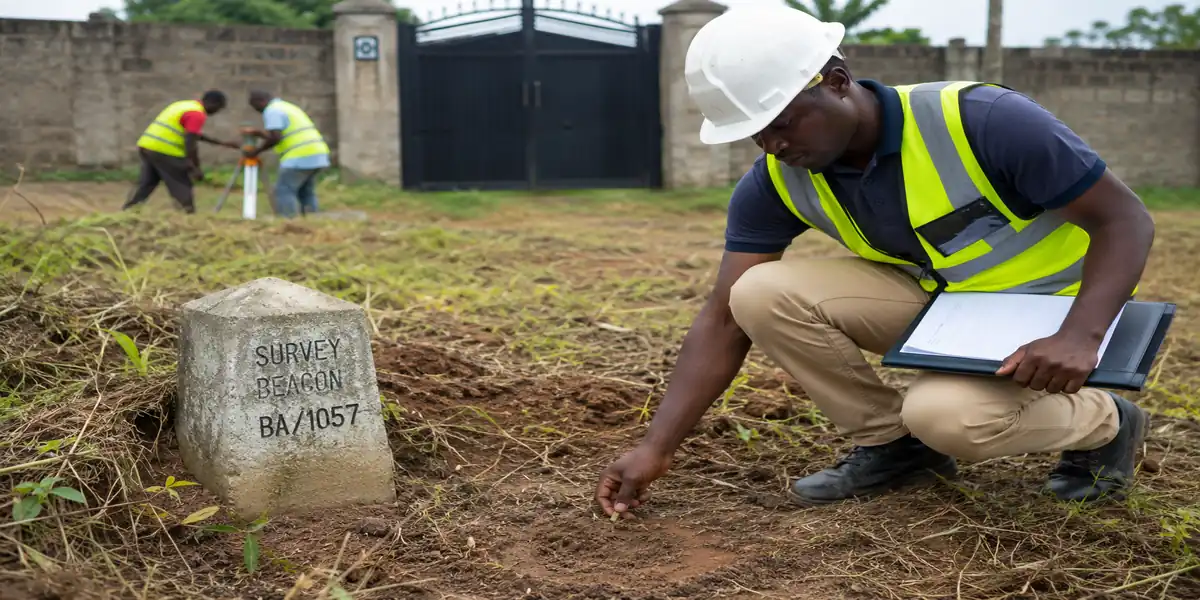
Lost Survey Beacon in Nigeria: What to Do, Replacement Cost, and Legal Process
If a survey beacon on your land has gone missing, the first thing to do is stop assuming where your boundary lines are and engage a licensed surveyor to re-establish the beacon from the original survey plan coordinates not from memory, not from an old fence line, and not from a neighbour’s word. A missing beacon is not a small inconvenience. It is the physical proof of where your land begins and ends, and without it, you are one dispute away from losing part of your plot. I have encountered this situation multiple times across Akwa Ibom and Rivers States, and the buyers who act quickly almost always fare better than those who wait.
This guide will take you through exactly what a lost beacon means, why it happens, what it costs to fix, and the legal steps involved so you can protect your land before a missing marker turns into a boundary war.
What Is a Survey Beacon, and Why Does It Matter?
A survey beacon is a physical marker usually a small concrete pillar or metal peg placed at each corner of a plot to mark its exact boundary position on the ground, matching the coordinates recorded on the registered survey plan. Beacons are the bridge between the paper document and the physical land. Without them, your survey plan is just a drawing with no verified location on the ground.
Key Elements Tied to Every Beacon
- Survey number: the registered plan the beacon belongs to
- Coordinates: the precise GPS position each beacon should occupy
- Bearings and distances: how each beacon relates to the next along the boundary
- Beacon identification marks: numbers or codes engraved on the pillar itself
- Parcel identification: which plot and layout the beacon confirms
Why Beacons Go Missing
In my experience, beacons disappear for a mix of ordinary and deliberate reasons, and it matters which one you’re dealing with because it affects how urgently and how carefully you respond.
Common Causes
- Construction activity: beacons buried, dislodged, or removed during nearby building work
- Erosion and flooding: common in low-lying and riverine parts of Akwa Ibom and Rivers States
- Bush clearing and farming: pillars uprooted during land clearing
- Community or road works: beacons disturbed by government or contractor activity
- Deliberate removal: in some boundary or family disputes, a beacon is removed to create ambiguity in a neighbour’s favour
During field inspections, I discovered that deliberately removed beacons are almost always found on plots already showing early signs of encroachment a fence built slightly over the line, or a structure creeping closer to the boundary than the original plan allows.
What to Do Immediately After Discovering a Lost Beacon
- Do not guess or re-mark the boundary yourself. An informal marker has no legal weight and can worsen a dispute.
- Locate your original survey plan and confirm the survey number and coordinates.
- Engage a licensed surveyor registered with the Surveyors Council of Nigeria (SURCON) to carry out a re-survey.
- Notify neighbouring landowners before the re-survey exercise, especially if the beacon sits on a shared boundary.
- Document the site with photographs and notes before any re-establishment work begins.
- Register the re-established beacon with the Surveyor-General’s office once confirmed.
The Beacon Replacement Process, Step by Step
1. Site Inspection
The surveyor visits the site to assess the current condition of the plot, existing structures, and any remaining beacons that can serve as reference points.
2. Field Measurements
Using GPS or total station equipment, the surveyor takes fresh measurements and compares them against the coordinates recorded on the original registered survey plan.
3. Data Processing
Field data is processed against the original plan to calculate the correct position for the missing beacon, accounting for any acceptable margin of error.
4. Beacon Placement
Once the position is confirmed, a new beacon typically a concrete pillar is cast and installed at the exact coordinate point.
5. Survey Drafting and Submission
The surveyor prepares updated documentation reflecting the re-established beacon and submits it for registration with the Surveyor-General’s office.
How Much Does Beacon Replacement Cost?
Costs vary significantly depending on the state, the number of beacons affected, plot size, terrain, and whether the exercise is straightforward or complicated by a dispute. Factors that increase cost include:
- Multiple missing beacons on the same plot
- Disputed boundaries requiring neighbour negotiation or legal input
- Remote or difficult-to-access terrain
- Urgent turnaround requests
- Re-registration fees at the Surveyor-General’s office
Common hidden expenses include charges for locating and confirming adjoining beacons (since one missing pillar often requires reconfirming the neighbouring ones too), and legal fees if the exercise escalates into a formal boundary dispute. Always request an itemised quote from your surveyor before work begins, and confirm what is and isn’t included.
When a Lost Beacon Becomes a Legal Matter
Not every missing beacon leads to a dispute, but some do particularly where a neighbour has already built close to the boundary, or where family land has multiple claimants. This is not just theory. I have seen it happen: a single missing pillar left unresolved for months hardened into a full boundary dispute once a neighbour’s fence “accidentally” shifted a few feet during the gap.
Legal Process for Disputed Beacon Replacement
- Obtain a certified true copy of the original registered survey plan
- Commission an independent licensed surveyor for a fresh re-survey
- Formally notify the adjoining party in writing of the intended re-establishment
- Where agreement fails, involve a lawyer to mediate or, if necessary, pursue the matter through the relevant land dispute resolution channel
- Register the final, agreed or court-affirmed beacon position with the Surveyor-General’s office
Boundary Disputes Linked to Missing Beacons
| Situation | Risk Level | Recommended Action |
|---|---|---|
| Single beacon missing, no nearby construction | Low | Re-survey and replace promptly |
| Beacon missing near an active building project | Medium | Re-survey urgently, notify neighbour in writing |
| Beacon missing and neighbour has encroached | High | Engage a surveyor and lawyer together |
| Multiple beacons missing across family land | High | Full re-survey with all family stakeholders present |
How This Affects Government Acquisition and Title Verification
A missing beacon can also complicate verification of a plot’s government acquisition status. While working on site plans, I noticed that where beacon positions are uncertain, it becomes harder to confirm whether the affected portion falls inside a gazetted acquisition area, a committed acquisition, or a genuinely free area. Re-establishing the beacon accurately is often a necessary first step before acquisition status can even be properly checked.
Fraud Risk Around Missing Beacons
Missing beacons are sometimes exploited deliberately. Watch for these warning signs:
- A seller who insists a re-survey is “unnecessary” before you buy
- Reluctance to allow an independent surveyor onto the land
- A survey plan whose coordinates don’t match any beacon you can physically locate
- Pressure to complete the purchase before boundary issues are resolved
Protecting Your Investment After Beacon Replacement
Once a beacon is re-established and registered, keep the updated documentation alongside your original survey plan and deed of assignment. Based on projects I have worked on, buyers who maintain a complete, updated document set are far better positioned during resale, building approval, or inheritance transfers than those relying on decades-old paperwork with no record of subsequent beacon work.
Frequently Asked Questions
Can I replace a missing beacon myself without a surveyor?
No. Beacon positions must be re-established using the original registered coordinates by a licensed surveyor. Informal markers carry no legal standing and can create new disputes.
Do I need to inform my neighbour before replacing a beacon?
Yes, especially where the beacon sits on a shared boundary line. Written notice protects you if the matter later becomes contested.
What documents do I need to start the replacement process?
Your original registered survey plan, any prior title documents, and identification confirming your ownership or interest in the land.
Can a missing beacon affect my building approval?
Yes. Planning authorities typically require confirmed boundary positions before approving building plans, so an unresolved missing beacon can delay approval.
Common Mistakes Landowners Make
- Assuming an old fence line reliably marks the true boundary
- Delaying re-survey until a dispute has already started
- Skipping notification to adjoining landowners
- Using an unlicensed surveyor to save cost
- Failing to register the re-established beacon officially
Quick Summary
A lost survey beacon should never be treated casually. Retrieve your original survey plan, engage a licensed surveyor for re-establishment using the correct coordinates, notify adjoining landowners, and register the outcome with the Surveyor-General’s office. Where a dispute is already brewing, bring in legal support early rather than after positions have hardened.
Conclusion: Don’t Let a Missing Marker Cost You Land
A beacon is a small physical object carrying enormous legal weight. Left unresolved, its absence can quietly shift your boundary in a neighbour’s favour or stall a building project at the worst possible time. Act early, use licensed professionals, keep proper documentation, and treat re-establishment as seriously as you would treat the original survey.
For more guidance, visit our Plans Library for verified architectural designs, our Plan School for step-by-step land education, and our Services page for professional survey and planning support. Return to our homepage for more trusted guidance on Nigerian land and building matters.
External reference: LawNigeria — Land Use Act resources
- How to Verify Land Ownership Using GIS and Survey Records
- How to Read a Survey Plan in Nigeria Without Hiring an Expert
- Survey Plan Cost in Nigeria: Fees, Process and Hidden Expenses
- What Is a Survey Plan and Why Do Property Owners in Nigeria Need One?
- Cost of Building a House in Nigeria: A Complete Guide for Nigerians Living Abroad
- How to Read a Survey Plan in Nigeria Without Hiring an Expert
- Survey Plan Cost in Nigeria: Fees, Process and Hidden Expenses
- GIS Applications in Urban Planning: Real-World Examples That Work
- National Building Code of Nigeria Explained for Beginners
- Land Use Act and Building Development in Nigeria: What Every Landowner Should Know
- Building Regulations Every Nigerian Property Developer Must Know