Don’t Lose Your Land: How a Proper Survey Plan Protects Your Property in Nigeria
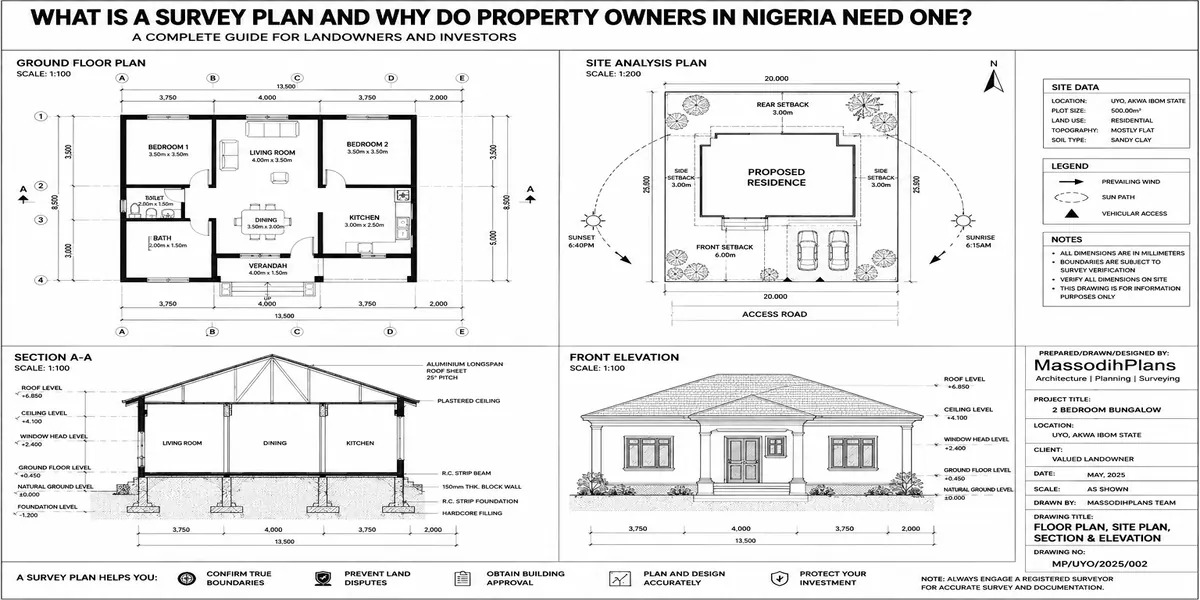
Paper survey plan beside a set of plotted coordinates
Introduction
A survey plan is an official land document prepared from a professional survey that shows the exact position, boundaries, dimensions, coordinates, and other relevant details of a parcel of land. Property owners in Nigeria need one because it helps establish what land they actually own, supports land transactions and documentation, reduces boundary disputes, guides proper building design, and provides reliable information for planning and development decisions.
But here is where many landowners make an expensive mistake: they treat a survey plan as just another paper needed to complete a property transaction. It is much more useful than that. A properly prepared survey plan connects your land to its real location on the ground and creates a technical reference that can help you expose boundary inconsistencies, encroachments, overlaps, access issues, and other problems before they become costly disputes.
This guide goes beyond the usual definition. You will learn what a survey plan contains, how it differs from a site plan and other property documents, who can prepare it, what the surveyor actually does on site, how beacons and coordinates relate to your boundaries, when you need a survey plan, and what can happen when you build or buy land without adequate survey information.
You will also discover how a survey plan can influence architectural design, planning approval, land verification, property development, and future resale. Most importantly, you will learn the questions to ask before accepting a survey plan and the warning signs that deserve professional attention.
Whether you are buying land, developing an existing property, documenting family land, or planning a major investment, understanding the survey plan can protect far more than your paperwork. It can protect the land, money, time, and decisions built upon it.
What Is a Survey Plan? (Survey Plan Fundamentals)
Definition: A survey plan (also called a cadastral plan or site plan) is a technical drawing created by a licensed surveyor showing the exact size, shape, orientation, and boundaries of a parcel of land. It records coordinates, bearing and distance measurements, beacon locations, adjoining parcels, and official parcel identification used for land registration.
Purpose: It provides the legal and technical description required for title documents, registration, building permits, and resolving boundary disputes.
Legal status: In Nigeria, a survey plan prepared and endorsed by a licensed surveyor and approved by the state’s land registry or survey department is an essential element for getting a Certificate of Occupancy (C of O), Deed of Assignment registration, and other statutory processes.
Why Survey Plans Matter: Real Problems They Solve
Prevent buying land without verification: A survey plan confirms what is being sold.
Avoid fraud and multiple sales: It ties the visible land on the ground to legal records.
Resolve boundary disputes: It gives technical proof of boundary lines and beacons.
Secure building approvals: Local authorities usually require a survey plan for planning permission and building permits.
Safeguard against government acquisition problems: It shows recorded boundaries and can be used in compensation or excision matters.
Protect investment value: Correct measurements help avoid future loss of land area or legal costs.
Key Components of a Survey Plan
Survey number / Plan number: The official identification assigned by the surveyor or land registry.
Parcel identification: Adjoining parcel names/numbers, owner names (where applicable), and reference to plan sheets.
Coordinates: Geodetic coordinates (latitude/longitude or local grid) of beacons and corners.
Bearings: Compass directions between points using degrees, minutes, seconds, or decimal degrees.
Distances: Linear measurements between beacons in metres.
Beacon information: Type (concrete, iron pin), position, and reference marks.
Area: Land area in square metres or hectares with calculation method.
Title/reference: Cross-reference to Deed of Assignment, C of O, Gazette notice, or other documents.
Scale, legend, north arrow: Technical drafting conventions.
Surveyor’s stamp and signature: Indicates a licensed professional prepared the plan.
Date and revision history: When the survey was done and any updates.
How Survey Plans Work in Nigeria
State approval: Survey plans are typically submitted to the State Surveyor-General or land registry for verification and endorsement before being used for C of O or registration.
Gazette and excision: In cases where land moves from government (reserved) to freehold status, a Gazette or excision notice can be necessary; survey plans often support excision applications.
Informal areas: Many Nigerian cities have informal layouts where old beacons are missing or plans were never properly registered expect extra fieldwork and documentary tracing.
Common mismatch: I have seen this mistake repeatedly: sellers present a hand-drawn plan or an old plan that doesn’t match physical beacons. Always require recent verification.
State differences: Fees, processing time, and exact procedures vary by state, but the technical content of a plan remains standard.
How Survey Plans Support Ownership Claims
Link to title documents: A survey plan, when endorsed by the survey office, becomes a verified technical description referenced in title instruments.
Proof of possession: During disputes, courts and land registries use survey plans and beacon evidence to determine occupation and adverse possession claims.
Supporting excision/compensation: For government acquisition, survey plans show exact extents used in compensation calculations.
Limitations of Survey Plans
Not a deed: A survey plan alone does not prove ownership; it supports title documents but must be matched to the deed or C of O.
Old or unendorsed plans: They can be outdated or unapproved. I have encountered many cases where plans on file didn’t reflect new subdivisions.
Human error: Surveying errors, mis-placed beacons, or incorrect datum references can cause future disputes.
Physical alteration: Beacons may be removed or destroyed; missing beacons reduce the plan’s usefulness until re-established.
Boundary Issues and Their Solutions
Boundary identification: How to read a plan, locate coordinates, bearings and distances, then match those to beacons on-site.
Missing beacons: Commission a re-establishment survey. Temporary markers are not sufficient if you need legal evidence.
Encroachment problems: If neighbours build into your boundary, the survey plan is the first documentary evidence to demand remediation or negotiate.
Family land conflicts: Use historic plans, local government records, and witness testimony in addition to the survey plan. One lesson I learned early is that oral claims without a plan rarely hold in formal processes.
Boundary disputes: Steps to resolve (1) Verify documents and plan; (2) Hire a licensed surveyor for re-survey; (3) Mediation; (4) Apply to land registry for boundary re-determination or court if necessary.
Survey Numbers, Coordinates, Bearings, Distances: What They Mean
Survey numbers: Unique identifiers for survey records. Always confirm the number on the plan matches registry records.
Coordinates: Give the absolute location of corner points. Check for datum used (WGS84, local grid). If coordinates are forged or mismatched, the plan is worthless in verification.
Bearings: Directional angles between points. Bearings and distances together allow a surveyor to re-locate a boundary on the ground.
Distances: Measured usually in metres; confirm measurements are realistic for the area (some sellers mis-state areas).
Verification Processes: How to Check a Survey Plan in Nigeria
- Ask for the original plan and copies. Never accept only a photocopy without verification.
- Confirm the surveyor’s stamp, license number, and signature.
- Visit the State Surveyor-General’s office or land registry to confirm the plan number and endorsement.
- Cross-check with Title: Compare plan references with the Deed of Assignment or C of O.
- Field verification: Walk the site with a licensed surveyor to re-locate beacons using GPS.
- Check Gazette: For excision or government documents, verify Gazette notices or compensation records.
- Request coordinates and run them on Google Earth or a GIS app to confirm approximate location.
- Consult neighbors: Local knowledge helps confirm boundaries and past transfers.
Surveying Process: Practical Steps and Tools
Site inspection: Walk the property, note existing beacons and visible landmarks.
Field measurements: Use total stations, GNSS/GPS receivers, measuring tapes for short lines.
Equipment used: GNSS receivers, total stations, theodolites, electronic distance meters (EDM), drones for large areas, and GIS software for processing.
Beacon placement: Permanent beacons (concrete or iron rods) should be fixed and recorded with coordinates.
Data processing: Raw field data is processed in surveying software to compute coordinates and generate plans.
Survey drafting: Plans are plotted to scale, showing bearings/distances, beacons, and adjoining parcels.
Submission procedures: Surveyors submit plans to the State Surveyor-General/Registry for endorsement and stamping.
Surveyor’s Practical Layer: Field Observations (from experience)
During field inspections, I discovered that many supposed “beacons” are just painted rocks or temporary rods; insist on permanent markers.
While working on site plans, I noticed that sellers often give an earlier plan that hasn’t been updated after subdivision; always ask for the latest endorsement from the survey office.
In my experience, GPS coordinates provided by sellers sometimes use different datums this causes mismatches. Ask the surveyor which datum was used and request coordinates in WGS84 for easy verification.
I have seen cases where the surveyor’s stamp was forged. Cross-check the license number with the Surveyors Council of Nigeria and the state registry.
One practical tip: photograph each beacon with a GPS timestamp and add the photos to the survey file for future reference.
Common Frauds and How to Avoid Them: Land Fraud Prevention Layer
Fake survey plans: Signs include missing surveyor details, inconsistent scales, or plans that lack registry endorsement.
Multiple sales: Ask for a history of transactions, check the registry for past assignments, and confirm current owner status.
Forged coordinates: Run the coordinates in Google Earth; if the mapped position is in the ocean or on a different property, that’s a red flag.
Fraudulent land transactions: Always insist on seeing the original deed/C of O, not just photocopies.
Warning signs buyers should notice:
- Seller is in a hurry or pushes for cash-only deals.
- Plan paper looks altered or scanned from different documents.
- Beacons missing or placed at odd locations.
- Price too good compared to market.
- No endorsement from state registry.
Practical defenses:
- Hire a licensed surveyor for field verification.
- Pay through traceable means; avoid cash handovers without escrow.
- Confirm the seller’s identity and authority to sell (see Deed of Assignment).
- Conduct title searches and obtain “no encumbrance” letters where possible.
Government Acquisition and Excision Issues
Government acquisition: If government acquires land, compensation is based on approved survey plans and valuations. Keep your plan ready when excision or acquisition is threatened.
Committed acquisition / Global acquisition: When the government earmarks land for future public use, registered plans are used to identify affected parcels.
Excision: Converting government land to private ownership requires survey plans and Gazette notices; ensure your plan matches excision boundaries.
Free areas and gazette: Confirm any Gazette notices that may have altered the legal status of adjacent parcels.
Practical advice: In cases of planned acquisition, having an up-to-date survey plan and documentary proof accelerates compensation negotiations and protects your interests.
Building and Development: How Survey Plans Affect Construction
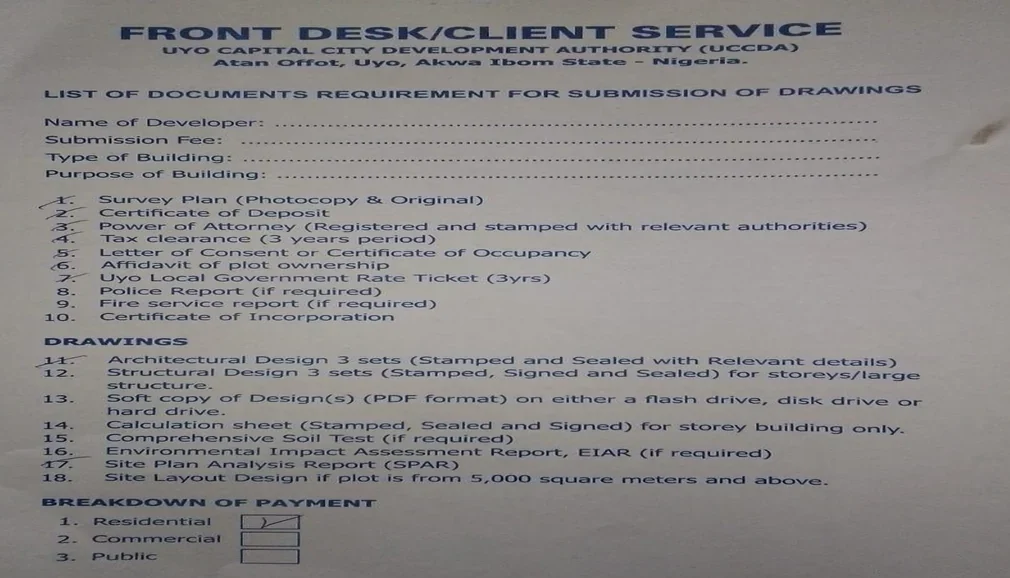
Building approvals: Local planning authorities require a survey plan before issuing approval; the plan informs setbacks and plot coverage calculations.
Setback compliance: A correct survey plan shows setbacks from road reserves and public rights of way; building without compliance invites demolition.
Plot utilization: Accurate area and boundary data help architects and engineers design placements, access, drainage, and service connections.
Construction reality: Survey errors can lead to foundations built on disputed strips, causing forced alterations or demolition later. Based on projects I have worked on, correcting a misplaced foundation is far costlier than getting a proper survey upfront.
GIS, GPS, Drone Surveys: Modern Surveying Technologies
GPS/GNSS surveying: Faster and accurate for coordinates; require correct datum and sufficient satellite lock.
Drone surveys: Useful for large parcels, hard-to-access terrain, and producing high-resolution orthophotos and digital elevation models.
GIS mapping: Helps overlay plans with satellite imagery, cadastral databases, and municipal layers.
Digital surveys: Increasingly accepted by registries when endorsed; ensure digital plan standards match local requirements.
Practical note: While high-tech helps, I have seen drone or GPS data misinterpreted when not processed by a licensed surveyor, always use professionals to interpret digital outputs.
Cost and Practical Considerations
Typical costs: Vary widely, small urban plots may cost less to survey than large rural tracts; expect between NGN X to NGN Y (state dependent). (Note: provide local price checks with surveyors for accurate quotes.)
Factors affecting costs:
- Plot area and complexity.
- Accessibility and need for re-establishing old beacons.
- Number of adjoining parcels.
- Need for topographic details or drone mapping.
State-by-state differences: Processing fees, stamp duties, and registry charges differ by state; include contingency for administrative fees.
Common hidden expenses:
- Re-establishing missing beacons.
- Administrative delays needing correction or resubmission.
- Legal consultation if disputes arise during verification.
Verification Checklist: Practical Steps Before You Buy (Short)
- Demand original survey plan and all supporting documents.
- Confirm surveyor’s license, stamp, and plan number.
- Check state registry endorsement and plan status.
- Walk the site with a licensed surveyor; photograph beacons with GPS timestamps.
- Cross-check coordinates on GIS/Google Earth.
- Confirm seller’s identity and transaction history.
- Insist on secure payment methods and written receipts.
- Obtain copies of Gazette notices if excision involved.
- Ask for a no-encumbrance letter or search report where available.
- Keep copies of all documents and correspondences.
Practical Checklist for Field Verification (Numbered Steps)
- Book a licensed surveyor (confirmed by Surveyors Council of Nigeria).
- Request the original plan and plan number from the seller.
- Run registry and title checks at the state land office.
- Visit the site; locate beacons using GNSS or total station.
- Record beacon photos with coordinates.
- Compare field coordinates to plan coordinates.
- Resolve mismatches immediately — do not proceed with payment.
- Request re-survey if beacons missing or coordinates inconsistent.
- Finalize sale only after registry endorsement and secure payment terms.
Common Mistakes I See Repeatedly
- Buying on “plot on plan” without field verification.
- Accepting photocopies or hand-drawn plans.
- Not checking for government Gazette or excision records.
- Ignoring missing or altered beacons.
- Relying on seller’s word instead of registry checks.
- Skipping a licensed surveyor, a false economy.
Fraud Example Scenarios and How to Respond
Scenario: Seller gives a plan whose coordinates point to a different location. Response: Do not pay, request re-survey, and verify with the registry. Consider police report if fraud is suspected.
Scenario: Multiple people claim the same property. Response: Obtain chain-of-title searches, court records, and commission a thorough land title investigation.
Scenario: Seller claims “no need for plan” because neighbors recognize them. Response: Explain that the plan is required for legal registration and building permits.
Expert Notes (First-hand Observations)
In my experience, buyers who commission a re-survey before purchase avoid over 70% of boundary disputes I’ve seen.
During my internship, I observed that many survey offices still rely on paper records; allow time for manual searches.
While working on site plans, I noticed developers sometimes bypass proper endorsement to save time, a short-term gain that creates long-term legal exposure.
This is not just theory. I have seen it happen: missing beacons caused a five-year court case and substantial loss of property value for one client.
Warning Signs Buyers Must Watch For
- No registry endorsement on plan.
- Seller refuses field verification.
- Plan’s coordinates don’t match visible landmarks.
- Seller requests cash-only payments.
- Beacons are temporary or missing entirely.
- Title history is unclear or has multiple assignments in a short time.
FAQs
Q: Can I trust a survey plan without visiting the site?
A: No. Always visit the site with a licensed surveyor to verify beacons and coordinates.
Q: Does a survey plan equal ownership?
A: No. A survey plan describes the land physically; ownership is shown by title documents like a Deed of Assignment or C of O. Both must match.
Q: How long is a survey plan valid?
A: Technically, until a change occurs (subdivision, re-survey, government acquisition). If beacons are intact and the plan was endorsed, it remains useful. However, re-surveys are common in rapidly changing urban areas.
Q: What if beacons are missing?
A: Commission a re-establishment survey. Don’t proceed with purchase until beacons are properly placed and recorded.
Q: How do I confirm a surveyor is licensed?
A: Check the Surveyors Council of Nigeria and request the surveyor’s license number and registration details.
Q: Can digital surveys replace traditional beacons?
A: Digital data helps, but permanent physical beacons remain critical for legal boundary proof in many practical scenarios.
Investment and Property Security: Protecting Your Land Investment
Due diligence reduces risk: Combine a title search, registry checks, and field verification.
Insurance: Where available, consider title insurance or indemnity insurance in Nigeria to protect against unforeseen defects.
Record keeping: Keep multiple certified copies of the plan, photos of beacons, and all transaction documents.
Long-term value: Properly surveyed and registered land attracts higher value and is easier to sell or mortgage.
Risk reduction: A verified survey plan makes legal defence stronger and speeds up transactions.
How Survey Verification Protects Money: An Example
Example: A buyer paid for a 500 sqm plot using a plan that misstated distances. Later, a re-survey showed the plot was only 350 sqm and part of the land overlapped a road reserve. The buyer faced an expensive legal battle and partial loss of land. If the buyer had commissioned a re-survey and registry check before payment, the loss would have been prevented.
Practical Next Steps Before You Buy
- Hire a licensed surveyor for a pre-purchase re-survey.
- Verify the plan with the state registry.
- Check title documents and the chain of ownership.
- Ensure beacons are permanent and coordinates match the plan.
- Use secure, traceable payment methods with receipts.
- Retain copies of all correspondence and photographic evidence.
Quick Summary (Checklist style)
- Request original survey plan and verify registry endorsement.
- Confirm surveyor’s license and plan number.
- Conduct field verification with GPS and permanent beacons.
- Check title documents, Gazette, and excision records.
- Watch for fraud signs and don’t rush payments.
- Get building approvals only after plan verification.
Common Mistakes to Avoid
- Skipping field checks.
- Relying on verbal assurances.
- Accepting photocopies without registry verification.
- Ignoring government Gazette and excision notices.
Conclusion: Practical Advice and Next Steps
A properly prepared and verified survey plan is essential to protect your land purchase in Nigeria. It prevents fraud, supports title verification, resolves boundary disputes, and ensures your building project meets regulatory requirements. Before you pay, commission a licensed surveyor, verify the plan with the state registry, photograph beacons, check the chain of title, and keep all documents. These steps will safeguard your investment and reduce the chance of costly legal battles.
For more guidance, read related articles on MassodihPlans about title searches, how to spot fake documents, and step-by-step land buying procedures. If you’d like, I can draft a ready-to-use checklist for site visits or a sample email to send licensed surveyors when requesting a quote.
Related Articles
- 7 Cheapest Areas to Buy Affordable Land in Uyo Before Prices Increase
- Best Places to Buy Land in Uyo for Fast Development and High Property Value
- Modern Small House Designs That Feel Surprisingly Spacious
- 25 Narrow PLot House Plans That Maximize Every Inch of Your Plot
- Best Nigerian Duplex Designs for 40×80 Plots
- The Proposed FutureGrid Nation Blueprint for Smarter Land Development
- 7 Small Plot Design Mistakes Nigerians Make (And How to Fix Them)
- Modern Duplex House Plan for 50×100 Plot in Lagos
- Bungalow vs Duplex: Which is Better to build in Nigeria Today?
- How to Practically Draw and Design a Duplex for Small Plots
- What Is a Structure Plan and Why Does It Matter for Nigerian Towns?
- Modern 3 Bedroom Bungalow Plan for Small Nigerian Families
- Why Local Development Plans Matter for Communities
- How Much Does It Cost to Develop an Estate in Nigeria? A Town Planner’s Honest Breakdown
- How to Design an Estate Layout Plan That Works in Nigeria and Abroad
- What Is a Master Plan and Why Does Every Growing Community Need One?
- Labour Cost to Build a House in Nigeria: Complete Mason, Carpenter, Plumber, Electrician and Finishing Cost Guide
Others
- How to Draw a Neighbourhood Plan (SPAR): Step-by-Step Guide to Roads, Plots, Land Use, Setbacks and Layout Design
- How to Draw a House Layout Plan: 10 Step-by-Step Guide From Plot Dimensions to Rooms, Doors, Windows and Setback
- How Do I Get Land Survey and Building Approval in Nigeria From Switzerland? A Step-by-Step Guide for Diaspora Property Owners
- How Do I Get Land Survey and Building Approval in Nigeria From the USA?
- What Is a Beacon Number on a Survey Plan in Nigeria? Meaning, Uses and Importance
- Survey Plan vs Deed of Assignment in Nigeria: The Complete Difference Explained
- Survey Plan Symbols and Numbers Explained in Nigeria: A Complete Guide for Land Buyers
- Lost Survey Beacon in Nigeria: What to Do, Replacement Cost, and Legal Process
- How to Verify Land Ownership Using GIS and Survey Records
- How to Read a Survey Plan in Nigeria Without Hiring an Expert
- Survey Plan Cost in Nigeria: Fees, Process and Hidden Expenses
Massodih Okon is a Nigerian built-environment professional with academic and professional experience in urban and regional planning, geography, architectural design, Landscape Design, GIS and land development.
He holds a Master’s degree in Urban and Regional Planning from the University of Uyo and a first degree in Geography and Regional Planning.
Through MassodihPlans, he publishes practical guides on Nigerian house plans, building design, physical planning, site planning, development approval and residential construction. Read the full author profile →