Property Valuation: How to Calculate Property Value
Introduction to Property Valuation: How to Calculate Property Value, Appraisal, and Pricing
A client called me two years ago, furious, holding a “valuation report” someone had done for his land in less than an hour, without even walking the boundary. The bank had rejected it. He’d paid for it, waited two weeks, and was back to square one before his mortgage deadline. That conversation is the reason this article exists not to give you a definition of property valuation you can already find on Wikipedia, but to actually walk you through how value is calculated, who is allowed to calculate it, and how to avoid losing money to the version of “valuation” that isn’t valuation at all.
I’ll be talking to you the way I’d talk to a client sitting across my desk, or a student in a planning class asking me to explain this properly for the first time. No fluff, no filler. Let’s get into it.
What Property Valuation Actually Is (And What It Isn’t)
Property valuation is the professional process of estimating the economic worth of a property land, building, or both at a specific point in time, using recognized methods and supported by evidence. That last part matters more than most people realize: a valuation isn’t a guess dressed up in Naira signs. It’s a documented, defensible opinion of value, produced by someone qualified and licensed to produce it.
Here’s where the terminology gets genuinely confusing for most people, so let’s clear it up in one place:
Property valuation and property appraisal are, in practice, the same thing. “Valuation” is the term used in Nigeria, the UK, and most of the Commonwealth. “Appraisal” is the American term. If you’re reading a Nigerian valuation report, “appraisal” and “valuation” mean identical processes.
Home appraisal and house appraisal are simply appraisal applied specifically to a residential building, as opposed to land, commercial property, or industrial property.
Real estate valuation and real estate appraisal are broader umbrella terms covering all property types residential, commercial, industrial, and land.
Property value, house value, and home value refer to the actual outcome the naira figure that a valuation process produces.
Property market value specifically means the estimated amount a property should exchange for on the date of valuation, between a willing buyer and a willing seller, in an arm’s-length transaction, with both parties acting knowledgeably and without pressure. This is the standard international definition, and it’s worth memorizing because it’s the benchmark every valuation method is trying to estimate.
Property price and house price are different from value in a way that trips up almost everyone: price is what a property actually sold for, or what a seller is currently asking for it. Value is what a qualified professional estimates it should sell for, based on evidence. A seller can ask any price they like. Value doesn’t move just because someone wrote a bigger number on a signboard.
The next time an agent quotes you a “property value,” ask them directly: is this a valuation, or an asking price? Nine times out of ten, what gets called a “valuation” by agents is actually just a price they think the market will bear not a professionally derived value. The difference matters enormously if you’re using that figure for a mortgage, insurance, or legal purpose.
Land Valuation vs. Building Valuation: Why They’re Calculated Separately
This is a layer almost nobody explains clearly, and it genuinely changes how you should think about your own property.
When a valuer values a developed property, they don’t lump land and building into one number and stop there. They calculate land value and building value separately, then combine them because land and buildings behave completely differently as assets.
Land value is driven almost entirely by location, size, title quality, accessibility, and permitted use. Land doesn’t depreciate. In fact, in most Nigerian urban areas, land appreciates steadily over time as infrastructure develops and demand grows, regardless of what’s built on it.
Building value, on the other hand, depreciates. A building loses value over time due to physical wear, outdated design, and deferred maintenance even a well-built house is worth less in “as new” replacement terms 15 years after construction than it was on completion day, unless it’s been actively maintained or renovated.
This separation is exactly why two houses of identical size and finish, built the same year, can have wildly different valuations if one sits on land with a registered Certificate of Occupancy in a fast-appreciating area and the other sits on land with unregistered “omonile” documentation in a stagnant area. The building might be worth roughly the same. The land underneath it is not.
Who Is Actually Allowed to Value Property in Nigeria (This Is the Part Most Content Skips Entirely)
Here’s something almost every article on this topic including the ones currently ranking leaves out completely, and it’s arguably the single most important thing you need to know before you pay anyone for a valuation.
In Nigeria, property valuation is a regulated professional activity. It’s not something any agent, surveyor, or self-taught “property consultant” can legally perform for official purposes. The Estate Surveyors and Valuers Registration Board of Nigeria was established as a body corporate to serve as the regulatory body for the profession of estate surveying and valuation in Nigeria. Only Estate Surveyors and Valuers registered with ESVARBON, and typically practicing under the Nigerian Institution of Estate Surveyors and Valuers, are legally recognized to produce valuation reports that banks, courts, insurance companies, and government agencies will actually accept.
What this means practically:
A “valuation” done by a real estate agent, a land agent, or an unregistered “surveyor” no matter how confident or professional it looks has no legal standing for mortgage, insurance, litigation, probate, or compulsory acquisition purposes.
If you’re taking out a mortgage, settling an estate, going through a divorce, disputing a compensation figure, or insuring a property, ask directly: is this person a registered Estate Surveyor and Valuer with ESVARBON? Ask to see their registration, the same way you’d confirm a lawyer is called to the bar before trusting their legal opinion.
Cheap, fast “valuations” that skip a physical site inspection are a major red flag. A genuine valuation requires the valuer to physically inspect the property, verify title documents, and gather comparable evidence not just glance at a photo and quote a figure.
Always confirm directly with ESVARBON or NIESV that the person producing your valuation report is currently registered and in good standing, especially where the document will be used for a bank, court, or government process. This single check has saved my clients from rejected reports and wasted money more times than any other piece of advice I give.
The Five Recognized Property Valuation Methods
This is the part everyone actually wants how value is calculated, not just defined. There are five internationally recognized valuation methods, and which one applies depends entirely on the type of property and the reason for the valuation. A competent valuer doesn’t pick a method randomly; the property and purpose dictate it.
1. Comparative Method (Sales Comparison Approach)
This is the most commonly used method for ordinary residential property and land. The valuer identifies recent sales of genuinely comparable properties similar location, size, title, and condition then adjusts for differences to arrive at an estimated value for the subject property.
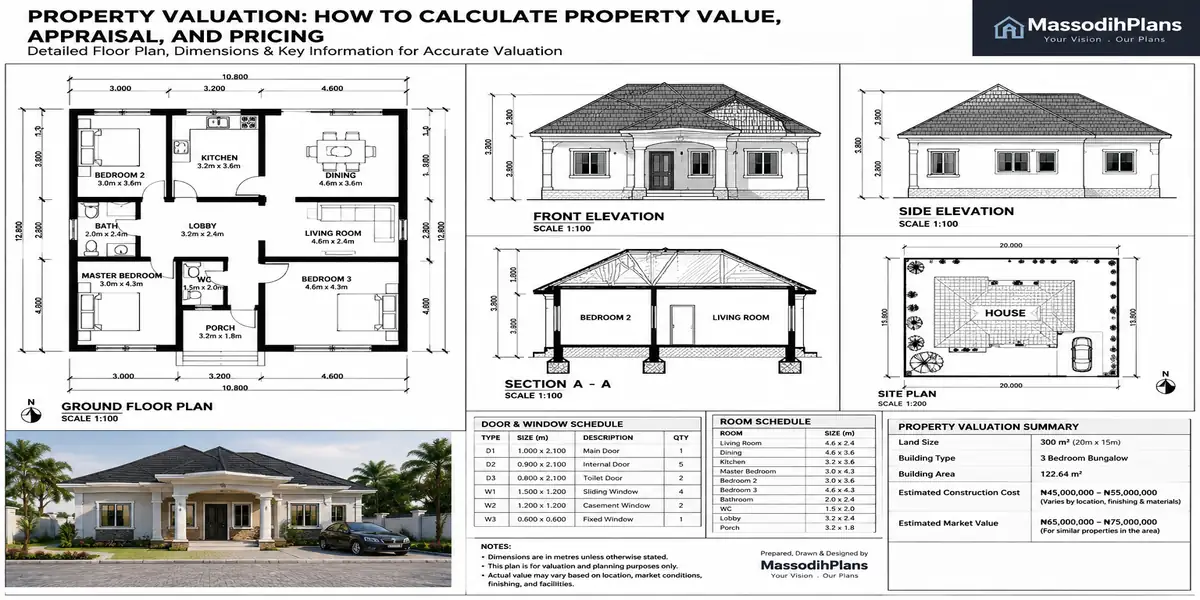
Worked example: Suppose three comparable 3-bedroom bungalows on similar-sized plots in the same neighbourhood recently sold for ₦42 million, ₦45 million, and ₦47 million. Your property is slightly smaller but has a better access road and a registered title, while the comparables had weaker titles. A valuer weighs these differences say, minus ₦2 million for smaller size, plus ₦3 million for stronger title and access and arrives at an estimated value of around ₦46 million. This is professional judgment applied to evidence, not a formula spat out by software.
2. Cost (Replacement) Method
Used when there are few or no comparable sales often for unusual, specialized, or newly constructed properties. The valuer calculates what it would cost to rebuild the structure from scratch at current prices, subtracts depreciation for age and condition, then adds the land value calculated separately.
3. Investment (Income Capitalization) Method
Used for income-generating properties rental blocks, commercial buildings, shopping complexes. The valuer estimates the property’s net annual income and capitalizes it at an appropriate yield (return rate) to arrive at a capital value. A property generating ₦6 million net annual rent, capitalized at a 10% yield, gives an estimated value of ₦60 million.
4. Profits Method
Used for properties where value is tied to the profitability of a specific business operating from it hotels, petrol stations, cinemas. The valuer analyzes the business’s trading potential rather than comparable sales, since these properties rarely have direct comparables.
5. Residual (Development) Method
Used for development sites land with redevelopment or construction potential. The valuer estimates the completed development’s value, then subtracts construction costs, professional fees, financing costs, and developer’s profit to arrive at what the raw land itself is worth today.
If a valuer gives you a value figure without telling you which method they used and why, ask. A proper valuation report always states the method applied and the reasoning behind it this transparency is exactly what separates a defensible professional valuation from a guess with a signature on it.
Can a House Valuation Calculator or Online Tool Actually Replace This?
Short answer: no, and understanding why will save you from a costly mistake.
House valuation calculators, property valuation calculators, house price calculators, property price calculators, and general real estate calculators are all versions of what’s technically called an Automated Valuation Model (AVM). They pull historical sale prices and property characteristics from a database and generate an estimated figure using statistical modelling no human inspection involved.
Here’s what these tools genuinely cannot do, and why it matters:
They can’t verify title. A calculator has no idea whether your property has a clean Certificate of Occupancy, a Governor’s Consent still in process, or a disputed customary title and title quality can swing value by tens of millions of naira on the same physical land.
They can’t inspect condition. Two houses of identical size can differ enormously in value based on structural condition, finishing quality, and maintenance none of which a database captures.
They rely on data availability that Nigeria’s property market genuinely lacks. Unlike the US or UK, Nigeria doesn’t have a comprehensive, publicly accessible register of actual sale prices. Most Nigerian property transactions aren’t recorded in any database an AVM could draw from, which means any “calculator” claiming to value Nigerian property is working from thin, often outdated data.
They have no legal standing whatsoever. No bank, court, or insurance company in Nigeria will accept an online calculator estimate in place of a registered valuer’s report, for any official purpose.
None of this means these tools are useless they can give you a rough, directional sense of value before you commit money to a formal valuation, the same way checking three “similar” listings online gives you a starting point before you negotiate. Just never mistake that rough number for an actual valuation, and never use it as your only basis for a major financial decision.
Factors That Actually Move Property Value Up or Down
Beyond the method used, these are the real-world factors a valuer weighs, and understanding them helps you see why two seemingly similar properties can have very different values.
Title document type — a registered Certificate of Occupancy or perfected title carries significantly more value than land under Governor’s Consent still in process, or unregistered customary/family land, because title risk directly affects marketability and mortgage eligibility
Location and accessibility — proximity to major roads, distance from flood-prone areas, and the general trajectory of the neighbourhood (rising or declining) all weigh heavily
Size and shape of the plot or building — irregular plot shapes and awkward building footprints typically value lower than regular, efficiently usable ones
Infrastructure availability — tarred access road, drainage, power supply reliability, and proximity to water supply all factor into both land and building value
Building condition and age — structural soundness, roof condition, and how well the building has been maintained relative to its age
Comparable market activity — genuine recent sales evidence in the immediate area, which is exactly why the comparative method depends so heavily on a valuer’s local market knowledge, not just national averages
Zoning and permitted use — land zoned for higher-density or mixed-use development is generally worth more than land restricted to low-density residential use only, even at identical size and location
When You Actually Need a Professional Valuation (Not Just a Price Opinion)
This is where I want to be very direct with you, because a lot of people only think about valuation when selling and that’s actually the least legally consequential reason to get one done.
Mortgage financing — banks require a registered valuer’s report before approving a mortgage; this is non-negotiable and cannot be substituted with an agent’s price opinion
Insurance — insuring a property for the wrong value means you’re either overpaying premiums for years or underinsured when disaster strikes and you need to claim
Probate and estate settlement — when a property owner passes away, a valuation is often required to distribute assets fairly among beneficiaries or settle estate tax obligations
Divorce and asset settlement — courts require an independent, defensible valuation to divide marital property fairly, and this is exactly where an unregistered “valuation” gets thrown out
Compulsory acquisition and compensation disputes — when government acquires land for public use, the compensation offered is based on valuation, and property owners have the right to challenge an inadequate figure with their own registered valuer’s counter-report
Litigation and disputes — courts require valuation evidence in land disputes, boundary conflicts, and damages claims
Property tax and rating assessments — some local government rating systems require valuation-based assessment, not just self-declared property price
Selling or buying — the reason most people think of first, but as you can see, far from the only one, and often the one where a wrong figure has the least severe consequences
If you’re on the receiving end of a compulsory acquisition or compensation offer, get your own independent registered valuer’s report before accepting the government’s figure. I have seen property owners accept compensation offers well below actual market value simply because they assumed the government’s figure was final and non-negotiable it usually isn’t, if you have credible counter-evidence.
How Much a Professional Valuation Actually Costs in Nigeria
Valuation fees in Nigeria are typically calculated as a percentage of the property’s estimated value, following ESVARBON’s professional fee scale, though some firms charge flat fees for straightforward residential valuations. For a standard residential property, expect fees roughly in the range of ₦50,000 to ₦300,000+ depending on property value, complexity, and location, with commercial and investment properties commanding higher fees due to the additional analysis involved. Always get a fee quote in writing before commissioning the work, and confirm whether the fee covers a physical site inspection it should, always.
Common Mistakes That Cost People Real Money
Treating an agent’s asking price as a valuation — the two are not the same, and confusing them leads to overpaying as a buyer or underselling as a seller
Accepting a valuation with no physical site inspection — a report produced without the valuer setting foot on the property is not a credible valuation, regardless of how official it looks
Skipping title verification before valuing — value calculated without confirming actual title status can collapse the moment a bank or buyer does their own due diligence
Using outdated comparable sales — property markets shift, and a comparable sale from three years ago in a fast-changing neighbourhood no longer reflects current value
Not challenging a compensation or insurance valuation you believe is too low — you generally have the right to commission an independent counter-valuation; most people simply don’t know this
Confusing “cost of building it” with “value of the property” — what you spent building your house is not automatically what it’s worth; value is set by the market and by depreciation, not by your construction receipts
Frequently Asked Questions
What is the difference between property valuation and property appraisal?
None, in practice. “Valuation” is the term used in Nigeria and most of the Commonwealth, while “appraisal” is the American term for the same professional process.
Can I use an online calculator instead of hiring a valuer?
Only for a rough, informal starting estimate. Online calculators can’t verify title, inspect physical condition, or produce a report accepted by banks, courts, or insurers for any official purpose, you need a registered Estate Surveyor and Valuer.
How is land value different from house value?
Land value is driven by location, title, and permitted use, and typically appreciates over time. Building value depreciates with age and condition. A full property valuation calculates both separately, then combines them.
Who is legally allowed to value property in Nigeria?
Only Estate Surveyors and Valuers registered with the Estate Surveyors and Valuers Registration Board of Nigeria (ESVARBON) are legally recognized to produce valuation reports for official purposes such as mortgages, court cases, insurance, and probate.
Why did my property’s valuation come out lower than I expected?
Usually one of a few reasons: your title document isn’t as strong as you assumed, recent comparable sales in your area are lower than you’re aware of, the building’s condition has depreciated more than expected, or the valuer used a different method than you were anticipating. Ask for the reasoning behind the figure a proper report will explain it.
Do I need a new valuation every time I want to sell my property?
Not strictly for a private sale between you and a buyer, but if either party is financing the purchase through a mortgage, the bank will require its own current valuation regardless of any prior figure you have.
Finally
Property valuation isn’t a number an agent pulls out of a conversation, and it isn’t a figure an app generates from a database that barely covers the Nigerian market. It’s a professional, evidence-based opinion, produced by someone legally registered to produce it, using one of five recognized methods depending on what you’re valuing and why. Know that distinction, ask the right questions before you pay anyone, and you’ll never end up back at square one the way my client did holding a worthless report and a missed deadline.
If you’re planning a property purchase, build, or sale and need this handled properly from the design and documentation side, our Services page outlines how we support clients through that process. Browse our Plans Library if you’re building rather than buying, visit Plan School to understand the planning and approval side of property ownership, and explore more property and building guides on our Homepage. One of the most important sources of evidence in property valuation is information about comparable properties and relevant transactions. Comparable evidence should be analysed and adjusted to account for differences between the subject property and the properties used for comparison. RICS Comparable Evidence in Real Estate Valuation
- Building Approval and Permits: What You Need Before Starting Construction
- Surveying and Property Boundaries: How to Verify Your Plot Before Building
- GIS Property Planning: How GIS Mapping Solves Land and Site Problems
- Land Use: How Is Land Used? Planning, Mapping, Zoning and Development
- Drainage, Flood & Environment: How to Manage Stormwater and Reduce Flood Risk
- How to Fix Traffic Problems With Smarter Urban Transport Infrastructure
Author
Massodih Okon is a Nigerian built-environment professional with academic and professional experience in urban and regional planning, geography, architectural design, Landscape Design, GIS and land development.
He holds a Master’s degree in Urban and Regional Planning from the University of Uyo and a first degree in Geography and Regional Planning.
Through MassodihPlans, he publishes practical guides on Nigerian house plans, building design, physical planning, site planning, development approval and residential construction. Read the full author profile →