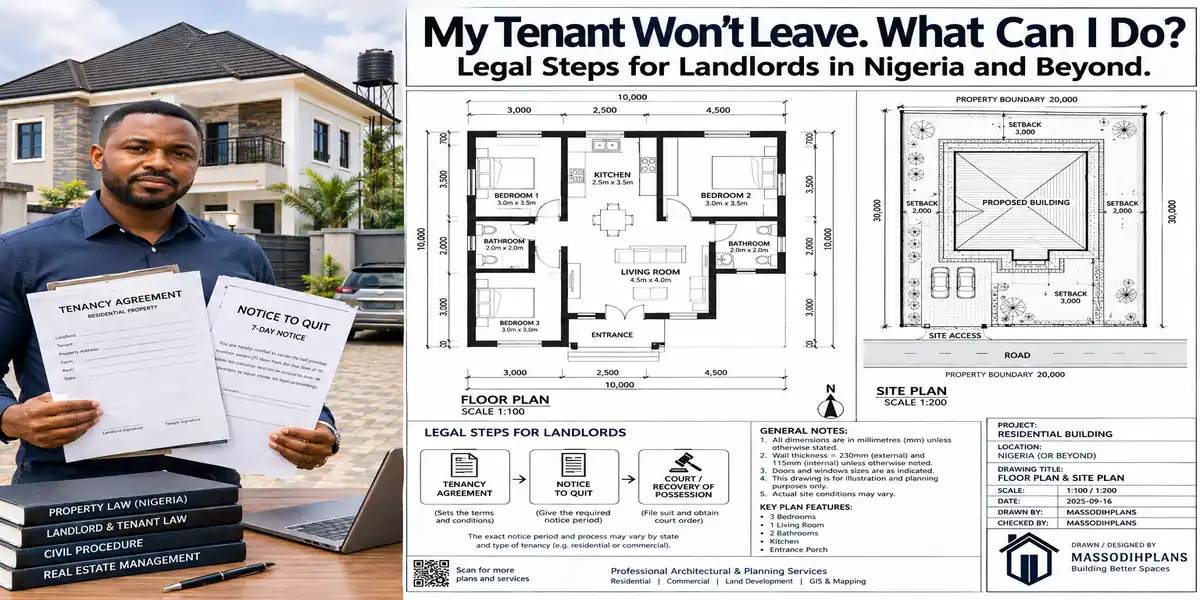
My Tenant Won’t Leave. What Can I Do?
Introduction to My Tenant Won’t Leave. What Can I Do? Legal Steps for Landlords in Nigeria and Beyond
My tenant won’t leave. What can I do?
If your tenant’s tenancy has ended, you have served the required notice, or the tenant has breached the tenancy agreement and still refuses to vacate, do not simply change the locks, remove their belongings or disconnect their electricity and water.
The lawful solution is to determine exactly why the tenant is still occupying the property, confirm that the tenancy has legally ended or can be terminated, serve the correct notices, keep proof of service, and if the tenant still refuses to leave use the appropriate court or tribunal process to recover possession.
In Nigeria, the exact procedure depends on the state or territory where the property is located, the type of tenancy, the tenancy agreement, the reason for recovering possession and the applicable law. There is therefore no single eviction procedure that can safely be applied to every Nigerian property.
The good news is that the process becomes much easier to understand when you follow it in the right order.
This guide explains what to do when a tenant won’t leave, what landlords should avoid, how recovery of possession generally works in Nigeria, what happens when a tenant contests the process, and how similar landlord-tenant situations are handled in other major rental markets around the world.
One important note before we begin: I am a Town Planner and architectural practitioner, not a lawyer. This article is intended as a practical guide to help landlords understand the process. For an actual dispute especially one that is going to court you should consult a qualified lawyer who practices in the jurisdiction where the property is located.
First: Don’t Do the Thing You’re Thinking of Doing
This is the most important point to understand before taking any action.
If you are seriously considering changing the locks while the tenant is away, disconnecting electricity or water to force the tenant out, hiring people to remove the tenant’s belongings, threatening the occupant or physically throwing them out, stop and check the applicable law first.
A landlord’s ownership of a property does not automatically give them permission to use force or bypass the prescribed recovery-of-possession procedure.
In Nigeria, unlawful self-help can expose a landlord to additional civil or criminal consequences, even where the landlord has a legitimate claim to possession.
The same general principle exists in many other countries: a landlord normally needs to follow the applicable legal possession process rather than personally enforcing an eviction.
The safest rule is simple:
Do not touch the property, the tenant’s belongings or essential utilities as a way of forcing the tenant out unless you have confirmed that the specific action is lawful.
Everything that follows is about getting possession back through the appropriate process.
What Exactly Is Your Situation Called?
Understanding your tenant’s situation helps determine what should happen next.
Tenant who overstayed
This is one of the most common situations. The tenancy agreement or lawful tenancy period has ended, but the tenant remains in occupation without a new agreement or the landlord’s continuing consent.
Holdover tenant
A holdover tenant is generally someone who remains in possession after the tenancy has ended. The tenant originally entered the property lawfully, so the situation should not automatically be treated as though the person had broken into the property as a stranger.
Tenant who refuses to vacate
This is the practical description most landlords use. The landlord has told the tenant to leave, but the tenant remains in possession.
Tenant in active breach
This is different from simply overstaying.
The tenant may still technically be within the tenancy period but may have breached the agreement for example through serious rent arrears, unauthorized subletting, serious nuisance or another substantial breach. The appropriate procedure can depend on the nature of that breach and the applicable law. Knowing which situation you actually have matters because the correct notice and procedure may be different.
The Legal Steps: What Should You Do When Your Tenant Won’t Leave?
1. First, Confirm Whether the Tenancy Has Actually Ended
Before asking how to remove a tenant, establish whether the tenant is legally required to leave.
Start by checking:
- The tenancy agreement
- The original start date
- The original end date
- Rent-payment records
- Renewal provisions
- Previous notices
- Any agreement extending the tenancy
- Applicable tenancy legislation
- Whether the tenancy has become periodic or statutory
A fixed-term tenancy can operate differently from a monthly or periodic tenancy. For example, a landlord should not assume that simply because the original agreement contains an end date, the tenant can automatically be removed on that date without considering the applicable law.
If the tenancy has already ended, your next step may be different from a situation where the tenant is still within the tenancy period but has committed a breach.
2. Check the Tenancy Agreement and Applicable Local Law
The tenancy agreement is important, but it is not necessarily the only document governing the relationship.
First ask:
Where exactly is the property located?
Then identify the law, court, tribunal or administrative process that applies. This is particularly important in Nigeria because tenancy and recovery-of-premises procedures can vary between jurisdictions.
For example:
- Lagos State has its own tenancy legislation.
- Rivers State has its own recovery-of-premises framework.
- Akwa Ibom State has its own applicable recovery-of-premises rules.
- Abuja/FCT has its own legal and court framework.
- Other Nigerian states can have different requirements and procedures.
Therefore, do not base an eviction procedure entirely on a WhatsApp message, an old template or something that happened to a landlord in another state.
The same principle applies internationally. A landlord in California should not automatically use a procedure from New York. A landlord in Ontario should not copy a procedure from British Columbia. A landlord in England should not automatically use a Scottish procedure.
The property location matters.
3. Determine What Notice Is Legally Required
If the tenancy has not already ended in a legally effective manner, the landlord may need to serve a formal notice. The required notice can depend on:
- Type of tenancy
- Length of tenancy
- Rent arrears
- Breach of the agreement
- Sale of the property
- Landlord’s intended personal use
- Serious property damage
- Illegal activity
- Terms of the tenancy agreement
- Applicable legislation
There is no universal worldwide rule saying that every tenant must receive exactly 30 days’ notice.
In Nigeria, traditional notice periods can vary according to the type of tenancy and the applicable law. The commonly referenced periods include weekly, monthly, quarterly and yearly arrangements, but landlords should verify the exact requirement applicable to their property.
This is one of the areas where a seemingly small mistake can delay the entire process. A notice that is incorrectly dated, uses the wrong period or does not comply with the applicable law may create problems when the matter reaches court.
4. Serve the Notice Correctly
A notice can be correctly prepared but still create problems if it is not properly served. Keep evidence showing:
- What was served
- Date of service
- Person who served it
- Method of service
- Address where it was served
- Proof of receipt where applicable
Do not rely only on: “I told him to leave.”
A verbal conversation may communicate your wishes, but a formal recovery process can require something much more specific.
Depending on the applicable law, service may involve personal delivery, delivery to an appropriate address, a process server, or another legally recognized method.
The important thing is to know what the law where your property is located requires.
5. Document Everything
Once a dispute begins, documentation becomes extremely important. Create a file containing:
- Tenancy agreement
- Rent receipts
- Bank-payment records
- Notices
- Proof of service
- Emails
- Text messages
- Relevant WhatsApp communications
- Inspection reports
- Photographs
- Property-damage records
- Records of unpaid rent
- Previous correspondence
- Settlement proposals
Try to create a clear timeline:
Tenancy began → tenancy ended or termination ground arose → notice served → notice expired → tenant remained → recovery process commenced.
A good documentary trail can be much more useful than relying on memory months later.
6. What Should You Do When the Tenant Ignores the Notice?
This is where many landlords make a serious mistake. If the tenant remains after a valid notice has expired, do not automatically assume that you can physically remove the tenant yourself.
The next step may involve a court, tribunal or another legally authorized possession procedure.
In Nigeria
Where the applicable statutory conditions are satisfied, the landlord may need to issue the required subsequent notice before commencing recovery proceedings.
In jurisdictions where a further notice of intention to recover possession is required, skipping that stage can create a procedural problem.
The basic sequence
The general concept is: Tenancy ends or is lawfully terminated → required notice → notice expires → tenant remains → recovery proceedings → possession order → lawful enforcement.
The exact procedure, notice periods and court involved must be confirmed for the particular property.
The Nigerian Recovery-of-Premises Process
7. File for Recovery of Premises in Court
If the tenant remains after the required notices have expired, the landlord may need to commence a recovery-of-premises action.
This is the point where the matter moves from: “I have told my tenant to leave.” to: “I am formally asking the appropriate legal authority to recover possession.”
The appropriate court depends on the jurisdiction, the nature of the property, the value of the claim and other applicable rules. This is one of the stages where professional legal advice becomes particularly valuable.
8. What Happens When the Matter Goes to Court
The relevant authority will generally consider whether the landlord has established the legal basis for recovering possession and whether the required procedure was followed. Depending on the jurisdiction and circumstances, the tenant may:
- Contest the notice
- Challenge the reason for termination
- Dispute rent arrears
- Raise procedural objections
- Present evidence
- Claim that the tenancy has not ended
- Seek additional time or relief where the law permits
This is why documentation matters. If your agreement, notices, rent records and proof of service are properly organized, you are in a much better position to present a clear factual record.
9. Obtain and Enforce the Possession Order Lawfully
If the court rules in the landlord’s favour, the landlord may receive an order for possession. That does not necessarily mean the landlord should personally remove the tenant.
Where physical enforcement is required, it should normally be carried out through the legally authorized enforcement mechanism.
The important distinction is: A possession order is not the same thing as permission for a landlord to use force personally.
In some jurisdictions, a bailiff, sheriff or other authorized officer carries out the enforcement.
Can a Landlord Change the Locks or Remove the Tenant’s Belongings?
10. Do Not Assume Ownership Gives You the Right to Lock the Tenant Out
This is one of the most common questions landlords ask.
- Can I change the locks?
- Can I remove the tenant’s property?
- Can I disconnect electricity?
- Can I remove the doors?
- Can I bring the police?
The answer depends on the jurisdiction and circumstances, but landlords should not assume that these actions are automatically lawful simply because they own the property.
In many jurisdictions, physically removing a tenant without following the prescribed process can expose the landlord to additional liability. The safest approach is to obtain advice before taking self-help action.
What About Unpaid Rent and Property Damage?
11. Deal With Rent Arrears and Property Claims Properly
A tenant who refuses to leave may also owe:
- Unpaid rent
- Utility charges
- Repair costs
- Costs associated with property damage
- Other sums permitted by the agreement or applicable law
Keep records of each amount separately.
Do not assume that because a tenant owes money, you can automatically seize belongings, dispose of their property or deduct every expense from a deposit. Different jurisdictions have different rules governing deposits, abandoned property, damages and rent arrears.
When the Tenant Plays Games With the Process
12. What If the Tenant Refuses to Accept the Notice?
A tenant may refuse to physically receive a notice. That does not necessarily end the process. The important issue is whether the notice was served in a manner recognized by the applicable law. This is why landlords should consider using the legally recognized service method and preserve evidence.
What If the Tenant Says They Were Never Served?
This is precisely why proof of service matters. Keep:
- Acknowledgment where applicable
- Witness details
- Process-server records
- Photographs where legally appropriate
- Delivery records
- Copies of the actual notice
Do not assume that sending a document through an informal messaging platform automatically satisfies statutory service requirements.
What If the Tenant Claims They Paid the Rent?
Keep your own payment records from the beginning of the tenancy. Record:
- Date
- Amount
- Payment method
- Account receiving payment
- Rent period covered
- Receipt issued
Do not rely on memory.
What If the Tenant Becomes Confrontational?
Do not respond to threats with threats. If there is a genuine safety issue, contact the appropriate authorities.
Following the formal possession procedure also provides an important layer of protection because the dispute is being handled through the recognized legal process rather than through personal confrontation.
Before Court: Is a Negotiated Exit Worth Trying?
13. Consider a Lawful Negotiated Exit
Not every landlord-tenant dispute needs to become a long courtroom battle. If the tenant is financially stuck rather than deliberately trying to frustrate the landlord, a negotiated move-out arrangement may sometimes resolve the situation more quickly. Some landlords may negotiate:
- A definite move-out date
- Partial forgiveness of arrears
- A reasonable relocation payment
- A written undertaking
- A settlement of outstanding obligations
This can sometimes cost less than months of lost rent and legal expenses. However, any settlement should be properly documented. A practical agreement might specify:
- Exact move-out date
- Condition in which the property will be returned
- Amount to be paid or waived
- Outstanding rent
- Utility obligations
- Key handover
- Consequences of failing to comply
Negotiation should not become an indefinite excuse for delaying the formal process. Set a clear deadline for reaching an agreement.
What Does the Process Cost and How Long Can It Take?
14. Understand the Financial Cost Before You Start
The cost depends heavily on:
- State or jurisdiction
- Lawyer’s fees
- Court fees
- Process-server costs
- Number of hearings
- Whether the tenant contests the case
- Property type
- Complexity of the dispute
Legal fees can range significantly, so obtain a current quotation from a lawyer practicing in the relevant jurisdiction rather than relying on an old figure from another landlord.
What about time?
An uncontested matter may move considerably faster than a heavily contested case. A disputed case can take months or longer depending on the court, registry, evidence, adjournments and issues raised by the parties. There is also another cost that landlords sometimes underestimate:
lost rent.
Every additional month that a non-paying tenant remains in the property can represent lost income on top of legal expenses.
This is why landlords should avoid both extremes: Do not rush into illegal self-help.
But also: Do not delay the lawful process indefinitely.
If You Are a Diaspora or Absentee Landlord
15. Managing a Tenant From Outside Nigeria
If you live outside Nigeria or outside the state where your property is located, the situation can be more difficult.
You need reliable local representation. A relative or caretaker may help with ordinary property management, but a legal dispute can require a lawyer or another person with the appropriate authority to act on your behalf.
Keep:
- Copies of every notice
- Copies of court documents
- Receipts
- Payment records
- Inspection reports
- Written updates
- Photographs
- Communication records
Do not rely entirely on: “Don’t worry, I’ve handled it.”
Ask for documentation. Remote landlords should also allow for communication delays when approving legal steps, paying fees or signing documents.
Nigeria Is Not One Single Tenancy Law
The Nigerian section of this article should not be interpreted as though every state uses exactly the same procedure.
Lagos State Lagos has specific tenancy legislation governing residential tenancy and recovery of possession. Landlords should not attempt to remove a tenant by changing the locks, disconnecting utilities or using force. The proper procedure depends on the applicable tenancy law and the circumstances of the tenancy. For properties in Lagos State, landlords can consult the Lagos State Tenancy Law 2011 for the statutory framework governing tenancy termination and recovery of premises.
Rivers State Rivers State has its own recovery-of-premises framework.
Akwa Ibom State. Akwa Ibom also operates under its applicable recovery-of-premises framework and court procedures.
Abuja/FCT and Other States. The applicable procedure can differ depending on the jurisdiction, property type and circumstances. The practical lesson is: Do not use a Lagos procedure automatically for a property in another state. Before serving a notice, confirm the law applicable to the property.
My Tenant Won’t Leave: What Landlords Can Do in Other Countries
The problem is not unique to Nigeria. Landlords around the world face situations where a tenant remains after a tenancy ends, fails to pay rent or breaches the tenancy agreement.
The exact legal procedure differs considerably. The following international section makes the article useful to readers outside Nigeria while keeping Nigeria as the primary focus.
United States: Eviction Rules Depend on the State
In the United States, eviction law is heavily dependent on state and local rules. A landlord may need to:
- Establish a lawful ground for termination
- Serve the appropriate notice
- Wait for the required period
- File the appropriate eviction case
- Obtain a court judgment or possession order
- Use the legally authorized enforcement process
A landlord should not assume that a procedure used in one American state applies in another. For a U.S. property, check the law of the specific state and locality where the property is located.
Canada: Check the Province or Territory
Canadian residential tenancy rules are generally administered at the provincial or territorial level. For example, Ontario has its own Residential Tenancies Act and Landlord and Tenant Board process.
A landlord may need to:
- Serve the appropriate notice
- Give the required period
- Apply to the relevant tenancy authority
- Attend a hearing where necessary
- Obtain an eviction order
- Have the order enforced through the authorized process
Do not assume that Ontario, British Columbia, Alberta and Quebec follow identical procedures.
United Kingdom: The Rules Depend on the Nation
The United Kingdom is not one single tenancy jurisdiction. England, Scotland, Wales and Northern Ireland have different housing laws and procedures. This distinction is particularly important because private-renting rules in England changed substantially from 1 May 2026.
Therefore, a landlord should identify the specific UK nation in which the property is located before choosing a possession procedure.
Australia: State and Territory Rules Matter
Australia’s rental laws are primarily administered at the state and territory level. A landlord in:
- New South Wales
- Victoria
- Queensland
- Western Australia
- South Australia
- Tasmania
- Australian Capital Territory
- Northern Territory
may encounter different notice and possession procedures.
For example, NSW has a formal termination and possession process and provides for tribunal involvement in appropriate cases. The lesson for landlords is straightforward: Check the law of the state or territory where the property is located.
New Zealand: Notice and Tenancy Tribunal Procedures
New Zealand has specific rules governing fixed-term and periodic tenancies.
The circumstances under which a landlord can end a tenancy and the required notice period depend on the type of tenancy and reason for termination. Where a dispute cannot be resolved between landlord and tenant, the Tenancy Tribunal can become relevant. A landlord should therefore establish whether the tenancy is fixed-term or periodic before deciding what notice to give.
Ireland: Follow the Notice of Termination Rules
Ireland has formal procedures governing the termination of residential tenancies. The required notice period can depend on factors including the length of the tenancy and the reason for termination. Where disputes arise, the Residential Tenancies Board can play an important role. Irish landlords should therefore avoid copying a notice from another country or relying on an informal demand to vacate.
Germany: Residential Tenancy Protections Matter
Germany has statutory rules governing residential lease termination. Written requirements, permissible grounds for termination and tenant protections can all matter. In some circumstances, tenants may have legal grounds to object to termination because of hardship. This means German landlords should be particularly careful about assuming that property ownership automatically means immediate possession can be demanded.
United Arab Emirates: Check the Emirate
Rental law in the UAE can involve emirate-specific rules and authorities. A landlord dealing with a property in Dubai, for example, should check the applicable Dubai rules and procedures rather than assuming that a procedure from another emirate applies. Issues such as:
- Rent arrears
- Sale
- Personal use
- Lease termination
- Notice
- Dispute resolution
can involve specific requirements.
Singapore: Formal Possession Enforcement
Singapore provides another example of why a landlord should not assume that personally removing a tenant is the correct solution.
Where a possession order is not complied with, the legal system provides mechanisms for enforcement, including a Writ of Possession in appropriate circumstances.
The possession process therefore moves from the court order to authorized enforcement rather than simply giving the landlord permission to use force.
South Africa: Follow the Legal Eviction Process
South African landlords must also follow the applicable legal process when seeking to evict occupants. The circumstances surrounding the occupation, notices, court proceedings and enforcement can all matter. A landlord should therefore obtain jurisdiction-specific advice rather than relying on a general internet eviction template.
What Landlords Everywhere Should Avoid
Although the laws differ between countries, landlords should be particularly careful about actions such as:
- Changing locks to force the tenant out
- Removing the tenant’s belongings without legal authority
- Disconnecting utilities to pressure the tenant
- Threatening physical force
- Hiring people to intimidate the tenant
- Entering the property unlawfully
- Ignoring statutory notice requirements
- Using a notice designed for another jurisdiction
- Assuming ownership automatically gives an immediate right to physical possession
The safest approach is to determine what the law allows before acting.
What Happens When the Tenant Goes to Court?
A tenant may challenge the landlord’s claim. Depending on the jurisdiction, the tenant may argue that:
- The tenancy has not ended
- The notice was defective
- The notice was not properly served
- Rent was actually paid
- The landlord breached another obligation
- The reason for termination is not legally sufficient
- The landlord failed to follow the required procedure
This is why landlords should treat the paperwork seriously from the beginning.
A landlord who has the correct documents, dates and proof of service is generally in a much clearer position than one who relies entirely on verbal conversations.
When Should You Involve a Lawyer?
You may want professional legal advice particularly when:
- The tenant disputes the notice
- Rent arrears are substantial
- The tenancy agreement is unclear
- There are multiple occupants
- The property is commercial
- There is a serious property-damage dispute
- The tenant has filed a counterclaim
- The tenant alleges harassment or illegal eviction
- A court case has already started
- You are an absentee or overseas landlord
- You are unsure which notice is required
- You are unsure which court or tribunal has jurisdiction
The cost of obtaining advice before serving the wrong notice can be much lower than the cost of restarting a defective possession case.
How to Make Sure You Never Write This Search Again
Once you finally recover possession, the real objective should be preventing the same problem from happening with the next tenant.
Screen tenants properly
Where legally permissible, verify relevant income, employment, references and guarantor information.
Use a proper written tenancy agreement
Clearly address:
- Rent
- Payment dates
- Duration
- Renewal
- Notice
- Breach
- Maintenance responsibilities
- Property use
- Subletting
- Termination
Keep rent records
Record every payment from the beginning.
Address problems early
Do not allow small breaches to continue for months without documentation.
Know the law before you need it
Find out the relevant notice periods and recovery process for your property before a dispute happens.
My Tenant Won’t Leave: The Practical Landlord Checklist
If you are dealing with this situation right now, use this sequence:
1. Confirm the tenancy status. Has the tenancy actually ended?
2. Identify the legal reason for recovering possession. Do not assume ownership alone answers the question.
3. Check the law applicable to the property. The rules can differ between states, provinces, territories and countries.
4. Review the tenancy agreement. Check the duration, renewal and termination provisions.
5. Determine the correct notice. Do not guess the notice period.
6. Prepare the notice correctly. Make sure the dates and required information are accurate.
7. Serve the notice using the legally recognized method. Keep proof.
8. Allow the required period to expire. Do not attempt premature physical removal.
9. Keep complete records. Maintain the agreement, payment records, notices and correspondence.
10. Consider a documented negotiated exit where appropriate. A lawful settlement can sometimes save time and money.
11. If the tenant remains, commence the appropriate possession process. Use the relevant court, tribunal or authority.
12. Present your evidence clearly. Keep the entire tenancy history organized.
13. Obtain the possession order if the authority rules in your favour. Do not assume the order authorizes personal force.
14. Use the legally authorized enforcement mechanism. Where necessary, allow the relevant bailiff, sheriff or enforcement officer to execute the order.
15. Get professional legal advice when the circumstances are complicated. Especially where there is a contested notice, substantial arrears, a counterclaim or an ongoing court proceeding.
Nigeria vs Other Countries: The Main Lesson
Although the terminology and procedures differ, landlords in many countries face the same fundamental problem:
A tenant remains in possession when the landlord wants the property back.
In Nigeria, the applicable state or territorial recovery-of-premises procedure is important.
In the United States, state and local law determines much of the eviction process.
In Canada, provincial and territorial law plays a major role.
In the United Kingdom, the specific UK nation matters.
In Australia, state and territory law matters.
New Zealand has specific tenancy and Tenancy Tribunal procedures.
Ireland has formal Notice of Termination requirements and dispute-resolution mechanisms.
Germany has statutory residential tenancy protections.
The UAE has jurisdiction-specific rental procedures.
Singapore provides formal court-based possession enforcement.
South Africa also requires landlords to follow the applicable legal eviction process.
The details differ, but the central lesson remains: When a tenant won’t leave, move from informal demands to the legally prescribed possession process.
Frequently Asked Questions
Can I change the locks if my tenant hasn’t paid rent in months?
Do not assume that you can.
Rent arrears may provide a legal basis for terminating a tenancy or recovering possession, but the landlord should still follow the applicable procedure rather than automatically locking the tenant out.
What’s the difference between a holdover tenant and a squatter?
A holdover tenant originally entered the property lawfully under a tenancy but remains after the tenancy has ended. A squatter generally occupies property without the owner’s permission from the beginning. The legal treatment can differ significantly, so landlords should not automatically use the same procedure for both situations.
How fast can I legally get my tenant out?
There is no single worldwide answer.
The timeline depends on:
- Notice requirements
- Court or tribunal availability
- Whether the tenant contests the case
- Evidence
- Jurisdiction
- Enforcement procedures
An uncontested matter can be substantially faster than a contested case.
Do I need a lawyer?
The need for a lawyer depends on the jurisdiction and circumstances.
However, professional advice can be particularly valuable when you are unsure about the correct notice, the tenant disputes your claim, or the matter is moving toward court.
My tenant says they never received the notice. What now?
Check the applicable service requirements and preserve evidence of how, when and where the notice was served.
If service is disputed, obtain advice from a lawyer familiar with the jurisdiction.
Can I bring the police to remove the tenant?
Do not assume that the police can simply remove a tenant because you own the property.
Police involvement and possession enforcement are governed by the applicable law and circumstances.
Where physical possession must be enforced, use the legally authorized process.
Finally
A tenant who won’t leave can make a landlord feel as though the situation is an emergency.
But the frustration of losing rent, dealing with property damage or watching someone remain in your property does not automatically make self-help eviction lawful.
The better approach is systematic:
Confirm the tenancy status. Check the applicable law. Serve the correct notice. Keep proof. Allow the required period. Use the appropriate court or tribunal process. Obtain possession lawfully. Then use the authorized enforcement mechanism where necessary.
That approach may feel slower than changing a lock or removing someone’s belongings, but an unlawful shortcut can create an entirely new legal problem for the landlord.
Whether your property is in Nigeria, the United States, Canada, the United Kingdom, Australia, New Zealand, Ireland, Germany, the UAE, Singapore or South Africa, the same broad principle is worth remembering: Owning the property and having the right to possession are not necessarily the same thing as having the right to physically remove an occupant yourself.
If you are currently dealing with a tenant who refuses to leave, identify the jurisdiction first and obtain advice on the exact procedure applicable to your property.
This article is for general educational purposes and is not a substitute for legal advice. Tenancy, eviction and recovery-of-possession laws can change and can differ significantly by country, state, province, territory and property type. If you are dealing with an actual dispute, consult a qualified property or tenancy lawyer in the jurisdiction where the property is located.
Related MassodihPlans Resources
If you are a landlord, property owner or developer, you can also explore our practical resources on property management, building planning, property development and related built-environment topics.
Visit our Services page for professional support, browse the Plans Library for building-plan resources, or explore Plan School for practical tutorials and guides.
- How Do I Evict a Tenant? 10 Legal Steps for Landlords in Nigeria and Beyond
- How Do I Screen a Tenant? 10-Step Tenant Screening and Verification Guide for Landlords
- How Do I Find Good Tenants? Complete Tenant Screening for Property Owners
- What Do I Do When My Tenant Doesn’t Pay Rent? Landlord Rent Recovery Tips
- How Do I Collect Rent From Tenants? Complete Guide for Property Owners
- How Much Does a Property Manager Charge? Property Management Fees Explained
- How Do I Manage My Property? Complete Property Management Guide for Owners
Author
Massodih Okon is a Nigerian built-environment professional with academic and professional experience in urban and regional planning, geography, architectural design, Landscape Design, GIS and land development.
He holds a Master’s degree in Urban and Regional Planning from the University of Uyo and a first degree in Geography and Regional Planning.
Through MassodihPlans, he publishes practical guides on Nigerian house plans, building design, physical planning, site planning, development approval and residential construction. Read the full author profile →