How Much Does a Property Manager Charge?
Let’s say you’re staring at a management contract right now, and the number at the top says “8% of rent,” but somehow the invoice you got last month was way more than 8% of anything. You’re not imagining it. And you’re not being cheated either, necessarily. You’re just experiencing the single most common source of landlord frustration in this entire industry: the headline percentage is never the real cost.
I want to walk you through this the way I’d explain it to a friend who just texted me “hey, is 10% normal or am I getting robbed?” No fluff, no recycled percentages copied, just the actual mechanics of how these fees work, what they add up to in real money, and how to tell a fair contract from a padded one.
The One Sentence Answer (Then We Get Into the Real Math)
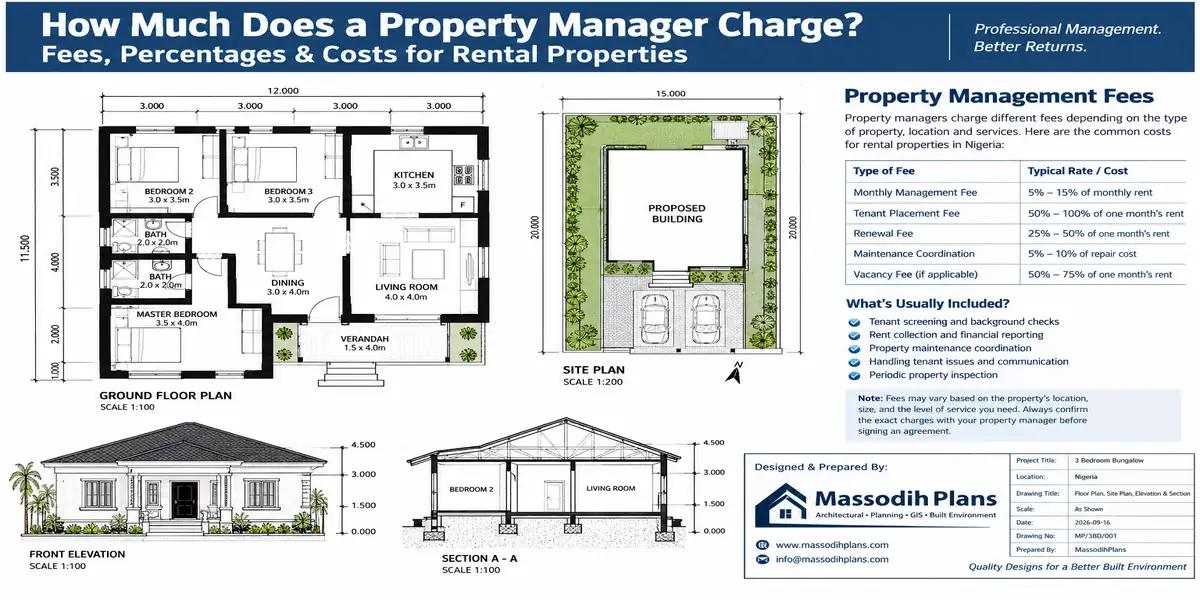
Most residential property managers charge a management fee of 8% to 12% of collected monthly rent, plus a separate leasing/placement fee of 50% to 100% of one month’s rent whenever they place a new tenant. That’s the floor of the conversation, not the whole conversation because a “10% fee” and a “10% fee plus five other charges” can cost you completely different amounts of money by December.
Never compare property managers by their headline percentage alone. Ask each company for their complete, written fee schedule, then calculate what you’d actually pay over a full year on your specific property. The company with the lowest advertised percentage is sometimes the most expensive one once every line item is added up.
Property Management Fees, Decoded Piece by Piece
Here’s the part almost nobody explains clearly: “property management fees” isn’t one fee. It’s a bundle of separate charges, and which ones apply to you depends on your contract, your property type, and honestly, how thorough the company is about disclosing them upfront.
The Monthly Management Fee (The Core Charge)
This is the recurring percentage-of-rent charge, and it’s what most people mean when they ask “how much does property management cost?” The national average residential management fee sits around 8.49% of monthly rent collected, based on a survey spanning hundreds of management branches across dozens of metro areas, with the realistic market range running from roughly 3.75% up to 14% depending on region and property type.
What this fee typically covers: rent collection, tenant communication, coordinating routine maintenance requests, and basic monthly financial reporting. What it typically does NOT cover: finding a new tenant, handling an eviction, or marking up repair invoices those are separate line items, covered below.
Property Manager Fees for Flat-Fee Structures
Not every company charges a percentage. Some especially companies managing larger multifamily buildings charge a flat rate per unit per month instead, commonly somewhere between $75 and $150 per unit. A flat fee is predictable and doesn’t punish you for owning a higher-rent property, but it also doesn’t scale down if your rent is genuinely low, so it can work against you on a smaller or cheaper unit.
The Leasing / Tenant Placement Fee
This is the one that catches new landlords off guard the hardest, because it’s a separate charge from the monthly percentage, and it’s usually the biggest single number on the whole fee schedule. Placement fees typically range from 50% to 100% of one month’s rent, and it’s charged every single time the manager finds you a new tenant which means if you have turnover twice in one year, you pay this twice in that year.
Property Management Percentage vs. Flat Fee: Which Actually Costs You Less?
This is the question everyone should be asking and almost nobody actually calculates. Here’s the honest comparison:
Percentage-based fees align the manager’s incentive with your rent if they raise your rent, their fee goes up too, so they have some motivation to keep the property well-leased at market rate. The downside: on a higher-rent property, that percentage adds up fast in raw dollars.
Flat fees are predictable and can be cheaper on higher-rent properties, but they remove the manager’s incentive to push for rent increases, since their fee stays the same whether your rent is $1,200 or $1,600.
Do this quick gut-check: take the flat fee quoted, divide it by your monthly rent, and see what percentage that actually is. A $150 flat fee on a $1,000/month rental is 15% worse than almost any percentage-based quote you’d get. The same $150 flat fee on a $2,500/month rental is 6% genuinely competitive. The flat fee isn’t inherently better or worse; it’s better or worse for your specific rent level, and you won’t know which until you do that one division.
How Much Does Property Management Actually Cost in the First Year? (Real Numbers)
Here’s where I want to get concrete, because vague percentage ranges don’t help you budget. Let’s run the math on an actual $1,500/month rental with a fairly standard contract.
- Monthly management fee at 10%: $150/month = $1,800/year
- Leasing fee at one-time 75% of a month’s rent (new tenant placed): $1,125
- Lease renewal fee (existing tenant renews instead of leaving): $200
- Maintenance markup at 15% on, say, $1,200 of repairs that year: $180
- Setup/onboarding fee (year one only): $250
Total real cost in year one: roughly $3,555 which works out to about 19.75% of your annual rent income of $18,000, not the 10% you thought you signed up for. In year two, assuming no new tenant placement and the same maintenance level, that drops to roughly $2,180, or about 12.1% of annual rent much closer to what the “10%” headline implied, because the leasing fee only hits when a new tenant actually moves in.
This is the calculation almost every property management article skips, and it’s the single most useful thing you can do before signing anything: build your own year-one and year-two cost projection using your actual rent and your actual expected turnover, not the industry’s generic percentage.
Ask directly whether the quoted percentage is charged on rent due or rent actually collected. Some contracts charge the management fee even during a vacancy or on rent that was never paid, which can quietly turn an “8% fee” into a much higher effective rate during a slow-paying month.
Rental Management Fees You Won’t See Until the Invoice Arrives
Beyond the two headline charges, here’s the full glossary of fees that show up in the fine print of most contracts — and rarely in the sales pitch:
Setup/onboarding fee: $150–$500, one-time, charged when you first sign
Lease renewal fee: $150–$300, charged when an existing tenant renews instead of a new tenant being placed
Maintenance/repair markup: 10–20% added on top of whatever the contractor invoice already costs
Inspection fee: $75–$150 per visit, for routine or move-in/move-out property inspections
Vacancy fee: some contracts charge a reduced monthly fee even while the unit sits empty, to cover marketing and monitoring costs
Eviction coordination fee: often a flat charge on top of actual legal/court costs, since eviction is labor-intensive for the manager
Technology/portal fee: $10–$30/month in some contracts, for tenant and owner portal access
Early termination penalty: charged if you cancel the management contract before its term ends read this clause closely, since it can be the most expensive line item you never think to ask about
None of these are automatically dishonest. A management company genuinely does incur real cost for an inspection, an eviction, or a vacancy period. The problem isn’t that these fees exist it’s that they’re often left out of the sales conversation and only shown up front in a fee schedule you have to specifically request.
Before you sign anything, ask the company this exact question: “Can you send me a complete, itemized fee schedule covering every possible charge, not just the management percentage?” A company that hesitates or gives a vague answer is telling you something important about how they’ll bill you later.
Property Management Commission: A Different Model Worth Knowing
In some markets particularly for vacation rentals, short-term Airbnb-style management, and certain commercial arrangements you’ll see a commission-based structure instead of a flat management percentage. This typically runs higher, often 20% to 40% of gross booking revenue, because short-term rental management genuinely involves far more hands-on work: guest communication around the clock, cleaning and turnover between every stay, dynamic pricing adjustments, and much higher-frequency tenant (guest) placement than a standard year-long lease.
If you’re comparing a long-term rental management quote against a short-term/vacation rental commission quote, you’re not comparing apples to apples the workload, and therefore the fair price, is genuinely different. Don’t be alarmed that a short-term rental commission looks three or four times higher than a long-term management percentage; it’s priced for a different job.
Property Management Fees by Country: A Quick Global Comparison
Because this topic gets searched everywhere, and the “standard” fee genuinely differs by country, here’s a fast comparison so you know what’s normal where you are:
United States: 8–12% of monthly rent (national average near 8.5%), plus a 50–100% of one month’s rent leasing fee
United Kingdom: typically 10–15% of rent for full management service, or 8–12% for “let only” tenant-finding without ongoing management
Canada: generally 8–12% of monthly rent, with tenant placement fees often equal to one month’s rent
Australia: usually 5–12% of rent depending on state and city, generally lower in higher-rent metro markets like Sydney, with a separate letting fee around one to two weeks’ rent
Nigeria: commonly structured as a percentage of annual rent collected (often 5–10%) rather than monthly, reflecting the widespread practice of annual rather than monthly rent payment, plus a separate agency/agreement fee typically charged once at the start of a tenancy
South Africa: typically 8–12% of monthly rent, broadly in line with US and Canadian norms
The takeaway across every country on this list: the percentage number always needs a second question attached to it percentage of what, charged how often, and what else is billed separately. That question matters more than the raw number itself.
Is Property Management Worth the Cost? A Framework, Not a Guess
This is the question underneath every other question in this article, and the honest answer is: it depends on your time, your distance from the property, and your tolerance for 2am maintenance calls not on whether 10% “sounds like a lot.”
Here’s a framework instead of a vague answer. Property management is very likely worth the cost if:
- You live far enough from the property that showing it, handling emergencies, or coordinating repairs in person is genuinely difficult
- You own multiple units and the coordination workload alone would eat a significant chunk of your week
- You have no appetite or experience for the legal side screening, lease compliance, eviction process and a mistake there could cost far more than the management fee
- Your time has a high enough value elsewhere that even a mediocre hourly rate on self-management wouldn’t make sense
Property management is very likely NOT worth the cost if:
- You own one property, live nearby, and don’t mind spending a few hours a month on it
- Your local rental market is calm, with low turnover and reliable tenants
- You’ve used landlord software (rent collection portals, automated reminders, digital lease templates) to handle most of the administrative burden yourself already
- You’ve done the year-one math above and the number genuinely doesn’t leave enough margin on your investment to justify it
Run the numbers both ways before deciding. Calculate your actual projected annual management cost using the year-one/year-two method above, then estimate honestly how many hours a month self-managing would cost you and what your time is actually worth per hour. If the management fee costs less than what your own time is worth for the same work, it’s very likely worth paying. If it doesn’t, self-managing is the financially rational choice, whatever a management company’s sales pitch says.
Questions to Ask Before You Sign Any Management Contract
- Is the monthly fee charged on rent due, or only on rent actually collected?
- What is the exact leasing/placement fee, and does it apply again on every lease renewal or only on a brand-new tenant?
- Is there a maintenance markup, and what percentage, on top of vendor invoices?
- Is there a vacancy fee, and if so, how is it calculated while the unit is empty?
- What is the early termination penalty if I want to end this contract before its term is up?
- Can I get a written, itemized fee schedule covering every possible charge not just the headline percentage?
- Who selects the maintenance vendors, and do I have any say or competing-quote option on larger repairs?
Red Flags in a Property Management Fee Schedule
- A verbal-only fee quote, with no written schedule provided until after you’ve signed
- A management fee charged even during vacancy, with no clear explanation of what that fee is actually covering while the unit sits empty
- An unusually low headline percentage that doesn’t match anything else on this list often a sign the real cost is loaded into maintenance markups or “miscellaneous” charges instead
- No stated cap or transparency on maintenance markup percentage
- A long-term contract with a steep early termination penalty and no clear performance review point before you’re locked in
Frequently Asked Questions
What is a normal property management fee percentage?
For long-term residential rentals, 8% to 12% of monthly collected rent is the standard range, with the national average sitting close to 8.5%. Short-term/vacation rental commissions run significantly higher, often 20% to 40%, because the workload is different.
Do property managers charge fees during a vacancy?
It depends on the contract. Some companies waive the monthly fee entirely while a unit is empty since there’s no rent to take a percentage of; others charge a reduced vacancy fee to cover ongoing marketing and monitoring. Always confirm this specific point before signing.
Is the leasing fee charged every time a new tenant moves in?
Yes, typically. The leasing/placement fee is a separate, one-time charge for each new tenant placement, distinct from the recurring monthly management fee so a property with frequent tenant turnover will see this charge more often than one with long-term, stable tenants.
Is property management tax deductible?
In most jurisdictions, property management fees are a legitimate deductible business expense against your rental income, but confirm the specific treatment with a tax professional in your country, since rules vary.
Should I choose a percentage fee or a flat fee?
Divide any flat fee by your monthly rent to see its effective percentage, then compare that number directly against percentage-based quotes. There’s no universally better model it depends entirely on where your specific rent level lands relative to the flat fee amount.
Conclusion
The real cost of property management was never hiding in the headline percentage it was hiding in the six or seven smaller charges that only show up once you ask for the full schedule, or worse, once the invoice lands. Do the year-one math on your actual property, ask every question on that checklist above before you sign anything, and you’ll know within ten minutes of a sales call whether a company is being straight with you about what they actually charge.
If you’re weighing whether to self-manage or hire help for a property you’re currently building or planning, our Services page covers the ground-up side of getting a rental-ready property built right in the first place. Browse our Plans Library for house and duplex designs suited to rental income properties, or visit Plan School to understand the planning and documentation side of a build meant for tenants. You can also explore more property and building guides on our Homepage.
Author
Massodih Okon is a Nigerian built-environment professional with academic and professional experience in urban and regional planning, geography, architectural design, Landscape Design, GIS and land development.
He holds a Master’s degree in Urban and Regional Planning from the University of Uyo and a first degree in Geography and Regional Planning.
Through MassodihPlans, he publishes practical guides on Nigerian house plans, building design, physical planning, site planning, development approval and residential construction. Read the full author profile →