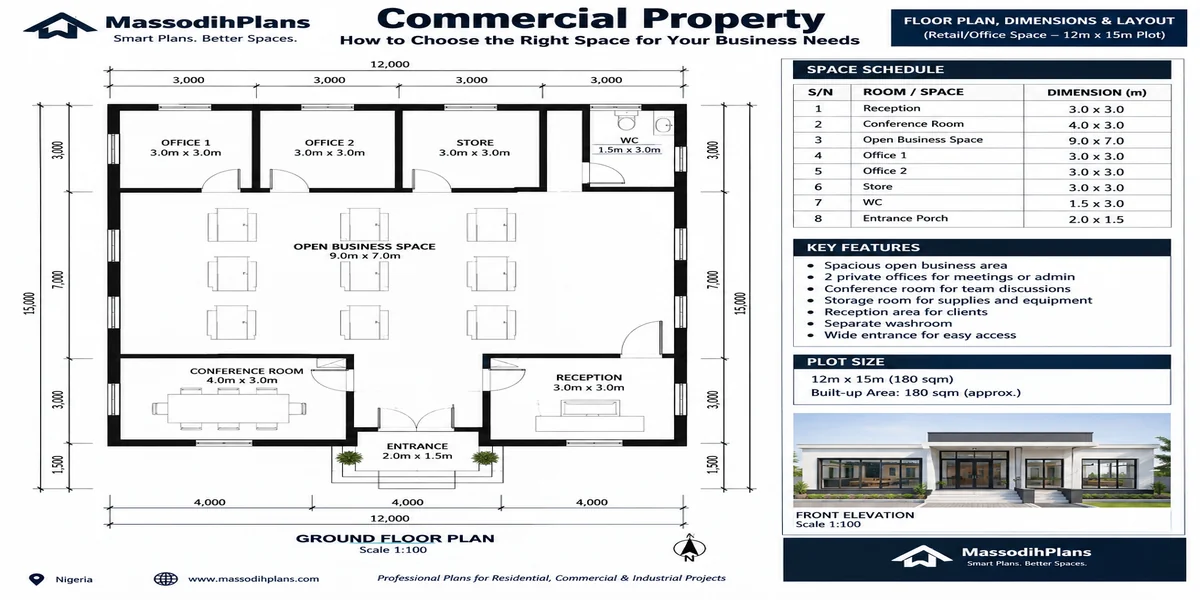
Commercial Property: How to Choose the Right Space for Your Business Needs
A client once called me after signing a five-year lease on a shop he was genuinely excited about great road frontage, decent rent, right side of town. Three months in, he called again, less excited. The building’s electrical supply couldn’t handle his freezers and signage load without tripping constantly, the toilet was shared with two other tenants in a way his customers hated, and the landlord’s “change of use” paperwork for retail had never actually been completed, which came up right when he wanted a bank loan against the lease. Nothing about the location was wrong. Everything about the building was.
That’s the story I want you to hold onto through this whole guide, because it’s the gap almost nobody writing about “choosing commercial property” actually fills. Most of what’s out there and I’ve read a lot of it while researching this is written by real estate brokers, and it’s genuinely good on location, budget, and lease terms. What it almost never covers is the building itself: whether it’s structurally, electrically, and legally built for what you’re about to do inside it. I’m a Town Planner and Architectural Designer, and that’s the layer I add. So consider this the version written by the person who actually designs and approves these buildings, not just the person who sells them.
What Exactly Is “Commercial Property”?
Commercial property is any building or land used primarily for business purposes rather than residential living it generates income or supports an income-generating activity, and it’s classified, taxed, financed, and insured differently from a home. That’s the textbook answer. The practical answer is more useful: the classification itself changes what you’re legally allowed to do in a building, what infrastructure it must have, and what approvals it needs which is exactly where my client’s freezer problem started. His shop had been approved and wired for light retail, not for the electrical load of a small cold-storage operation, and nobody checked that before he signed.
Before you fall in love with any commercial space, ask what land use classification and building approval it currently holds not what the agent says it’s “fine for.” A property zoned or approved for one use can require a formal change of use before you can legally operate a different one, and that process can take months.
Commercial Real Estate as a Category: Know What You’re Actually Shopping For
“Commercial real estate” is really an umbrella term covering several distinct property types, each with its own logic, and most people start their search without realizing they need to pick a type first. Broadly, it splits into: office, retail, industrial (including warehouse), and mixed-use/special purpose (hotels, shopping centers, healthcare facilities). Each category has different tenants, different lease structures, different financing terms from banks, and critically for this guide different building requirements. A property that’s a brilliant retail asset can be a terrible office asset on the exact same street, because the two uses need almost opposite things from a building.
Commercial Property for Sale vs. Commercial Property for Rent: The Real Decision
This is usually framed as a simple “buy or lease” question, but the honest version has more moving parts than most articles admit.
Buying (commercial property for sale)
Makes sense when your business model is stable enough to commit for the long term, when you have the capital or financing to avoid it straining working capital, and when you want to build equity or eventually control the asset for expansion, subletting, or resale. It also makes sense when the kind of building you need a purpose-built warehouse with specific structural loading, for instance is hard to find as a rental in your area.
Renting (commercial property for rent)
Makes sense when you’re testing a market, when your space needs are likely to change significantly in the next few years, when capital is better spent on stock, equipment, or staff than on real estate, or when you want the flexibility to relocate as your customer base shifts.
Here’s the calculation almost nobody shows you: run a simple break-even comparison before deciding. Take your total cost to buy (price, financing cost, renovation, approvals) over your realistic holding period, and compare it against your total rent over the same period (rent, service charge, any fit-out you’d still need to do as a tenant). If buying doesn’t clearly beat renting once you include financing cost and the opportunity cost of tied-up capital, renting is usually the financially disciplined choice even if buying feels more “serious.”
If you’re buying, verify the title and current land use classification thoroughly before you pay anything in Nigeria specifically, confirm there’s a valid Certificate of Occupancy or governor’s consent properly assigned to the seller, and that no encumbrance or dispute sits on the title. A commercial property with an unresolved title issue is one of the most expensive mistakes a business owner can make, because you can lose access to a space you’ve already fitted out and moved customers into.
The Main Types of Commercial Property (and What Each One Actually Demands From a Building)
This is the section that separates a real estate decision from a building decision. Every property type below has its own non-negotiable technical requirements get these wrong, and no amount of “great location” saves you.
Office Space and Office Buildings
Office space is about people spending eight hours a day inside a building, so the things that matter are floor plate efficiency (how much usable space you get per square metre after columns, corridors, and services), natural light and ventilation, lift capacity if it’s a multi-storey office building, and enough power and data infrastructure for modern IT and cooling loads. A cheap office building with an undersized generator or transformer capacity will cost you more in productivity and equipment damage than the rent difference to a properly powered one ever saves you.
Checklist for office space: floor plate depth (deep floor plates waste natural light in the center), parking ratio per staff member, backup power capacity matched to your actual IT and AC load, and fire escape routes that meet code for your expected headcount not just the previous tenant’s headcount.
Retail Property
Retail property lives or dies on visibility, frontage width, and footfall not floor area. A retail unit that’s twice the size but set back from the road, with poor signage visibility, will underperform a smaller unit with a strong street presence almost every time. Beyond location, check the electrical capacity for your specific equipment (refrigeration, lighting displays, POS systems), loading/unloading access for stock deliveries, and whether the toilet and back-of-house facilities are exclusive to you or shared in a way that affects customer experience.
Checklist for retail property: frontage width and visibility from the direction most traffic approaches, dedicated or adequate parking, electrical capacity for your specific equipment load, and a clear, legally documented delivery/loading arrangement.
Industrial Property, Warehouses, and Warehouse Property
Industrial property and warehouse property live on structural and logistical specifics that most business owners never think to check until something breaks or doesn’t fit. Floor loading capacity (how much weight per square metre the floor slab can actually bear) determines whether your racking, machinery, or forklift traffic is even safe to operate. Clear ceiling height determines your racking or equipment options. Dock door height and number determine how fast you can load and unload. Power supply capacity determines whether you can actually run the machinery your business needs, not just light the space.
Checklist for warehouse/industrial property: documented floor loading capacity (ask for the structural specification, don’t assume), clear internal height to the lowest obstruction, number and height of loading docks, three-phase power availability and capacity, and turning radius for the size of trucks you actually use.
Never take a landlord’s verbal word on floor loading capacity or power supply for an industrial or warehouse property. Ask for the structural engineer’s specification or the building’s approved drawings, and if they don’t exist or can’t be produced, treat that as a red flag, not a minor gap.
Shopping Centers and Shopping Malls
A shopping center or shopping mall unit’s value is tied directly to the property’s anchor tenants, foot traffic patterns, and common-area management quality you’re not just renting a unit, you’re renting a share of the whole center’s pulling power. Check the center’s overall occupancy rate (a mall with many empty units is a warning sign, not a bargain opportunity), the service charge structure and what it actually covers, and your unit’s position relative to anchor stores, entrances, and parking.
Business Parks and Industrial Estates
Business parks and industrial estates offer shared infrastructure security, road maintenance, sometimes shared power or effluent treatment under an estate management structure, similar in spirit to the estate covenants I’ve written about for residential layouts. The upside is professionally maintained shared infrastructure you’d struggle to fund alone; the downside is estate rules (operating hours, signage restrictions, use covenants) that can constrain your business more than a standalone property would. Always read the estate’s covenants and management agreement in full before committing, not just the lease terms for your specific unit.
Commercial Building Design: Why the Building Itself Deserves as Much Scrutiny as the Location
This is the part of the conversation that gets skipped almost everywhere, and it’s exactly where my training as an architect (not just a planner) matters most. A commercial building’s design isn’t decoration it directly shapes how your business operates inside it, and it’s often fixable or worsenable depending on what you choose.
Office Building Design
Good office building design balances open-plan collaboration space against enclosed, acoustically separate rooms for calls, meetings, and focused work a building that’s 100% open-plan with no acoustic separation will frustrate staff daily in ways that show up as turnover, not as a line item. Efficient core placement (lifts, stairs, toilets, services) that doesn’t eat into usable floor space, genuine natural light reach into the floor plate, and HVAC zoning that lets different areas be cooled independently are the details that separate a building that’s pleasant to work in from one that’s merely occupied.
Retail Building Design
Retail building design succeeds or fails on sightlines and flow can a customer see the full offering from the entrance, does the layout guide them naturally toward high-margin items, is the checkout positioned so queues don’t block circulation? Storefront glazing, canopy design for weather protection at the entrance, and clear separation between customer-facing and back-of-house areas all directly affect sales, not just aesthetics.
Shopping Mall Design
Shopping mall design at its best creates a “trip generator” anchor tenants and entertainment/food zones positioned to pull footfall past smaller units, wide enough circulation for peak crowding, and clear sightlines from parking to entrances that make the whole complex feel safe and easy to navigate. A mall with confusing internal circulation or poor anchor tenant placement will underperform its location’s raw footfall potential, which is exactly why unit position within the mall matters as much as the mall’s overall address.
If you’re taking a raw or “shell” commercial space and fitting it out yourself, get your fit-out design reviewed against the building’s existing structural, electrical, and fire safety systems before finalizing it a beautiful fit-out design that exceeds the building’s actual electrical or structural capacity will either fail inspection or fail in operation, and either way you’ll pay for it twice.
The Practical Decision Framework: How to Actually Choose
Skip the vibes-based approach of falling for the first attractive listing you tour one of the most common and costly mistakes buyers make is starting with listings before clearly defining their own requirements, which means evaluating properties against a feeling rather than a fixed set of criteria. Here’s the order that actually works:
Define your operational requirements first space needed today and in three years, equipment and structural needs, staff/customer flow, and non-negotiables (loading access, power capacity, parking)
Confirm the legal and planning status current land use classification, building approval status, and (for purchase) title clarity
Verify the building’s technical capacity power supply, structural loading where relevant, fire safety compliance, and condition of major systems (roof, plumbing, HVAC)
Evaluate location against your actual customer or supply chain, not general “good area” reputation footfall for retail, logistics access for industrial, commute patterns for office
Run the buy-vs-rent break-even calculation covered earlier if purchase is even on the table
Get the lease or purchase terms reviewed by a professional before signing, specifically for growth flexibility, service charge structure, and exit clauses
Zoning, Approvals, and Legal Due Diligence
This is the layer where being a Town Planner, not just an architect, actually changes what I check. Every commercial property sits inside a zoning classification set by the relevant planning authority, and that classification determines what you’re legally permitted to operate there, regardless of what the building currently looks like or what the previous tenant did.
In Nigeria, this means confirming: the property’s land use classification with the state planning authority, whether the existing building approval matches your intended use (or whether a change of use application is needed before you legally operate), the validity of the Certificate of Occupancy or governor’s consent if you’re purchasing, and whether the property has any outstanding contravention notices from the planning authority a live contravention can freeze your operations even after you’ve moved in and started trading.
Wherever you’re building, the same principle holds globally, even where the specific document names differ: confirm zoning and use classification match your intended operation, confirm building/occupancy approvals are current and match the actual use, and confirm title or lease is free of disputes and encumbrances before money changes hands, not after.
Commercial Property Investment: A Different Lens From Occupying
If you’re evaluating commercial property as an investor rather than an occupier, the questions change almost completely, and conflating the two lenses is where a lot of first-time commercial investors go wrong.
As an investor, you’re evaluating: rental yield relative to purchase price and comparable assets in the area, tenant quality and lease structure (a long lease with a strong tenant is worth more than a short lease with a shaky one, even at the same headline rent), vacancy risk specific to that property type in that location, and the building’s remaining useful life before major capital expenditure (roof replacement, structural repair, system upgrades) is due. A property with a slightly lower yield but a strong, long-term tenant and low near-term capex risk is very often the better investment than a higher-yield property with an unstable tenant or looming maintenance costs.
For the Nigerian market specifically, rental yields on commercial property have historically run higher than residential in most cities, partly compensating for higher vacancy risk and slower resale liquidity but that yield premium means little if the specific asset needs major structural or electrical rehabilitation the moment you take possession. Always commission an independent building condition survey before purchase, not just a title search.
Commercial Property Management: What Happens After the Ink Dries
Choosing the right property is only half the job how it’s managed afterward determines whether that choice keeps paying off. Good commercial property management covers: proactive maintenance scheduling (rather than reactive repairs after failure), clear service charge accounting that tenants can actually audit, tenant communication and lease compliance monitoring, security and access control appropriate to the property type, and ongoing compliance with fire safety and building regulations as they’re updated over time.
Whether you’re managing your own property or evaluating a managed building you’re about to lease into, ask directly: who handles maintenance requests and what’s the response time, how is the service charge calculated and can you see a breakdown, and what’s the building’s track record on major system failures (power, plumbing, lifts) in the last few years. A well-managed but older building will usually serve you better than a newer building with a poor management track record.
Common Mistakes That Cost People Money on Commercial Property
Choosing on location alone, without verifying the building’s structural, electrical, and legal readiness for the specific use intended
Sizing for today only, without room for the growth that makes the move worthwhile a few years from now
Skipping the change-of-use check, assuming that if a building exists and looks commercial, it’s automatically approved for any commercial use
Ignoring floor loading and power capacity on industrial and warehouse property until equipment doesn’t fit or doesn’t run
Signing a lease without understanding the service charge structure, then being surprised by costs that weren’t in the headline rent
Buying without an independent building condition survey, discovering major capital expenditure needs only after the sale closes
Frequently Asked Questions
How much commercial space do I actually need per employee?
For general office use, a common working range is 7 to 10 square metres per person including circulation and shared facilities, though open-plan, activity-based layouts can run leaner and executive or specialist spaces run higher the honest answer is to size against your actual furniture and workflow, not a generic rule of thumb alone.
Is it better to buy or rent commercial property for a new business?
For most new or early-stage businesses, renting preserves capital and flexibility while the business model is still proving itself; buying tends to make more sense once operations are stable, growth is predictable, and the numbers from a proper break-even comparison favor ownership.
What’s the difference between commercial property for sale and commercial property for rent in terms of risk?
Buying carries market and maintenance risk but builds equity and control; renting carries less capital risk but less control over the space and exposure to rent increases or non-renewal at lease end. Neither is inherently safer it depends on your business’s stability and growth trajectory.
Do I need a change of use approval if a building already looks commercial?
Not automatically. A building’s existing approval is tied to a specific use classification, and operating a materially different use retail in a space approved for offices, for instance often legally requires a formal change of use application before you can operate compliantly.
What should I check first before touring commercial properties?
Define your operational requirements, budget ceiling, and non-negotiables (power capacity, loading access, growth headroom) before you start touring touring first almost always leads to choosing based on how a space feels rather than whether it actually fits.
Finally
The businesses that thrive in their commercial space aren’t the ones that found the prettiest building or the flashiest address they’re the ones that checked the building’s bones (power, structure, zoning, approvals) as carefully as they checked the location. Location gets people through the door once. A building that’s actually built for what you do inside it is what keeps them coming back, and keeps you from discovering three months after signing that the freezer trips the whole shop.
If you’re planning a commercial building, fitting out a leased space, or need design work that actually accounts for your operational load from day one, our Services page outlines how we support clients through design, documentation, and approvals. Browse our Plans Library for building and layout references, or visit Plan School to understand the approval and zoning process before you commit to any property. You can also explore more architecture, planning, and property guides on our Homepage. Also read these:
- Property Valuation: How to Calculate Property Value, Appraisal, and Pricing
- Building Approval and Permits: What You Need Before Starting Construction
- Surveying and Property Boundaries: How to Verify Your Plot Before Building
- GIS Property Planning: How GIS Mapping Solves Land and Site Problems
- Land Use: How Is Land Used? Planning, Mapping, Zoning and Development
- UCCDA Building Approval Requirements in Uyo: Documents, Plans & Fees
Author
Massodih Okon is a Nigerian built-environment professional with academic and professional experience in urban and regional planning, geography, architectural design, Landscape Design, GIS and land development.
He holds a Master’s degree in Urban and Regional Planning from the University of Uyo and a first degree in Geography and Regional Planning.
Through MassodihPlans, he publishes practical guides on Nigerian house plans, building design, physical planning, site planning, development approval and residential construction. Read the full author profile →