Don’t Let Your Building Plan Get Rejected Twice: Here’s How to Get It Right

Going through a building plan rejection letter together before resubmission
Let me answer the question first before anything else: building plans in Nigeria mostly get rejected because of wrong setbacks, poor plot fit, missing survey details, drainage that was not considered, and drawings that do not match what is actually on ground. That is it. Not because government “hates” developers. Not because the process is designed to frustrate you. Most rejections trace back to a small handful of mistakes that repeat themselves, project after project, city after city.
I am writing this one as if you and I are sitting down together, maybe with your site plan spread out on a table between us, because that is exactly how I would explain this to a client or a student in real life. No grammar, no algorithm talk. Just the truth about why your plan keeps bouncing back from the Ministry, and what to actually do about it.
In my experience, nine out of ten rejected plans I have reviewed had a fixable problem, not a fatal one. The frustrating part for most Nigerians is that nobody ever sits them down to explain what went wrong in plain language. That is the gap this article is closing today, especially for those of you working with small or narrow plots where every centimetre matters.
The Real Reasons Building Plans Get Rejected in Nigeria
Forget the long, confusing list you may have seen elsewhere. From what I have seen in practice, rejections almost always come down to these core issues.
1. Setback Violations
Setbacks are the empty spaces your building must keep from the front, back, and side boundaries of your plot. Many Nigerians, especially on small or narrow plots, try to “maximize” the land by pushing the building too close to the fence. The Ministry will reject this every single time, because setbacks are not negotiable suggestions they are fire safety, ventilation, and access requirements.
I have seen this mistake repeatedly: a client buys a 50ft by 100ft plot in a city like Uyo or Port Harcourt, and the contractor draws a building that leaves almost no side space at all, just to get a bigger living room. That plan does not pass, and worse, if it is built anyway, it can be marked down for demolition later.
2. Plot Size and Building Mismatch
This is a small-plot problem that comes up constantly. People bring a design meant for a 100ft by 100ft plot and try to force it onto a 50ft by 80ft plot. The rooms do not fit, the corridors become too tight, and the plan simply cannot satisfy minimum space and setback rules together. The design has to start from the actual plot size, not from a picture someone saw online.
3. Survey Plan and Title Inconsistencies
Sometimes the building plan does not match the registered survey plan different boundary dimensions, wrong orientation, or a parcel number that does not tie back to the title document. The Ministry checks this, and any mismatch sends your file straight back to you.
4. Missing or Wrong Drainage Plan
A huge number of plans get rejected because they show no clear drainage route for rainwater and wastewater. This matters even more in flood-prone areas. If your plan does not show where water goes when it rains, expect a query.
5. Incomplete Documentation
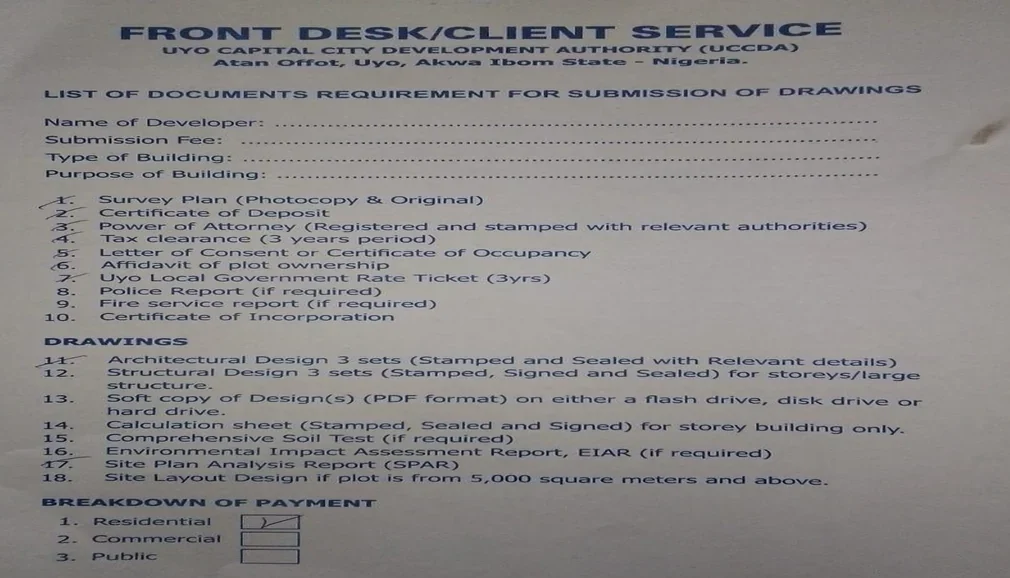
Missing structural drawings, no soil test report where required, incomplete site analysis, or drawings without the proper professional seal and registration number these administrative gaps are some of the most common, and most avoidable, reasons for rejection.
6. Wrong Land Use
Based on projects I have worked on, I have seen people submit a plan for a four-bedroom duplex on land zoned strictly for low-density residential bungalows, or try to build commercial shops on residential-only land. The Ministry will reject this immediately, no matter how beautiful the drawing looks, because land use zoning overrides design preference.
How to Get Your Building Plan Approved Fast
Now to the part you actually came for. Here is the practical sequence I recommend to every client, whether the plot is in Lagos, Uyo, Abuja, or Port Harcourt.
- Start with an accurate, registered survey plan. Do not design on assumptions or an old, unverified plan.
- Confirm the land use zoning for that plot before you finalize any design, not after.
- Design strictly to the plot dimensions, with setbacks built in from the first sketch, not added later as an afterthought.
- Include a clear drainage plan showing where rainwater and wastewater will flow, especially away from neighbouring plots.
- Use a registered architect or town planner to prepare and seal the drawings, since unsealed or unregistered drawings are an automatic rejection in most states.
- Attach all supporting documents at first submission: site analysis, structural drawing, survey plan, and any required soil report, rather than submitting in bits.
- Review the drawing against the specific state’s building code before submission, since requirements differ slightly between states.
If I were advising a client today, I would tell them plainly: pay for it to be done right the first time. The cost of a properly prepared plan is far smaller than the cost of months of delay, repeated rejection fees, and a contractor sitting idle on site waiting for approval.
Making a Small Plot Actually Work: Real Design Solutions
Since small and narrow plots cause so many of these rejections, let us talk specifically about how to design for them properly, instead of fighting the plot size.
How Space Gets Maximized on a Small Plot
- Vertical growth, building up instead of out lets you keep your setbacks intact while still getting enough living space.
- Open-plan living and dining areas reduce the number of internal walls eating into your usable floor area.
- Compact, well-placed staircases (for duplexes) that do not eat into the living room or corridor space.
- Multifunctional rooms, a study that doubles as a guest room, for example instead of dedicating a full room to a function used twice a year.
Narrow Plot Strategies
On narrow plots (anything roughly 50ft wide or less), I generally recommend a long, linear layout rather than a square one, with rooms arranged along a single corridor. This respects your side setbacks naturally while still giving you a workable internal flow.
During studio exercises at university, one thing our lecturers constantly emphasized was that good design does not fight the plot, it works with the plot’s natural shape and orientation. That principle has stayed with me on every small-plot project I have handled since.
Small Plot Optimization Layer
Compact luxury is achievable on small plots, but only when circulation is planned first. I have reviewed plans where the corridor alone was wasting almost 15% of the building footprint because rooms were arranged without thinking about how people actually move through the house. Plan circulation before you plan room sizes, and the rest of the design becomes much easier to fit.
A Realistic Sample Plan for a Small Nigerian Plot
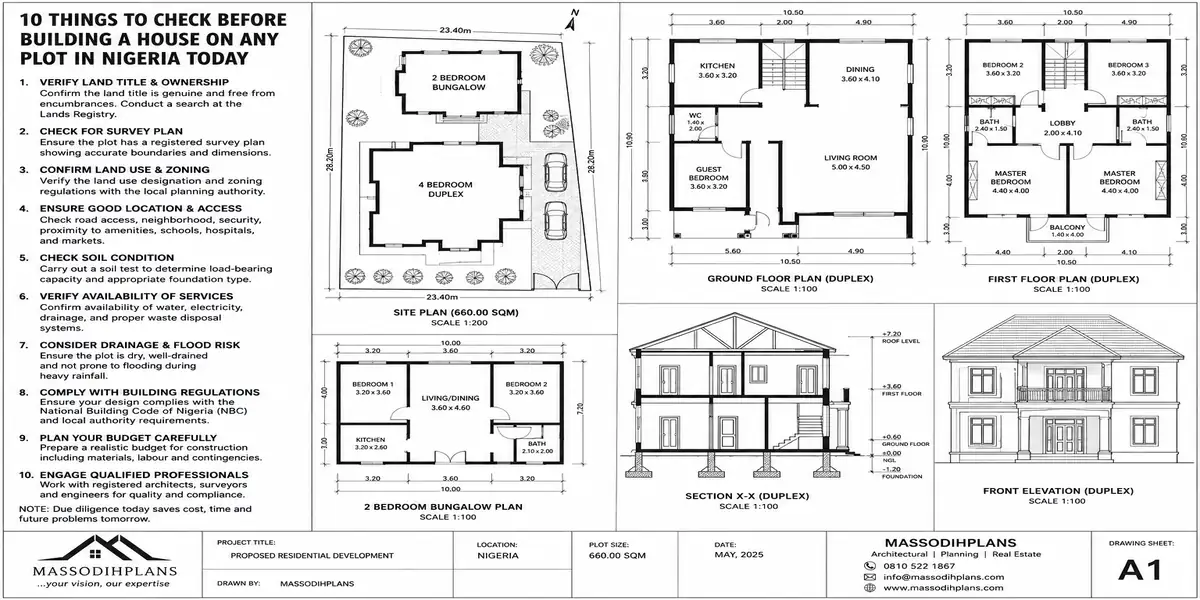
To make this practical rather than theoretical, let us look at a realistic example on a typical small urban plot 50ft by 100ft (about 465 square metres), a size very common across Uyo, Lagos mainland, and Port Harcourt.
| Element | Recommended Dimension / Detail |
| Plot size | 50ft x 100ft (15.2m x 30.5m) |
| Front setback | 4.5m minimum (check local state requirement) |
| Side setbacks | 1.5m minimum each side |
| Back setback | 3m minimum |
| Building footprint | Approximately 9m x 18m, three-bedroom bungalow layout |
| Sitting room | 4.2m x 5m |
| Master bedroom | 3.6m x 4.2m, with attached bathroom |
| Other bedrooms | 3.3m x 3.6m each |
| Kitchen | 2.7m x 3.3m, with direct access to a service area |
| Parking space | One car space minimum, 2.5m x 5m, within the front setback |
Room Arrangement That Actually Works
On this plot size, I place the sitting room and dining area at the front, opening into the corridor that leads to the bedrooms at the back, with the kitchen positioned close to a side or rear door for service access and waste management. The master bedroom typically gets the quietest corner, furthest from the sitting room, for privacy.
Roof Type and Orientation
A simple gable or hip roof works well for this size of building, and is generally more affordable and easier to maintain than complex multi-level roof designs. Orientation matters a lot in Nigeria’s climate wherever possible, I orient the building so the longer walls face north-south rather than directly east-west, which reduces direct afternoon sun heating the main living spaces.
Ventilation
From what I have seen in practice, cross-ventilation is one of the most underrated design decisions on small plots. Placing windows on opposite walls of each room, even small ones, allows air to move through naturally and reduces how much the household depends on fans and air conditioning, which matters a lot given Nigeria’s power supply realities.
Does This Plan Actually Fit Real Family Life?
A building can satisfy every government requirement and still fail the people living inside it, if the human side was not considered.
- Children’s movement: keep bedrooms close enough to the sitting room that parents can hear and supervise young children easily.
- Guest privacy: a visitor’s toilet near the sitting room means guests never need to walk through the family’s private bedroom corridor.
- Elderly accessibility: where possible, place at least one bedroom and toilet on the ground floor, especially for duplex designs, to avoid forcing older family members up and down stairs daily.
- Work-from-home needs: a small study nook or convertible room near the entrance lets someone receive work calls or clients without disturbing the rest of the household.
- Future family growth: leaving even a small, simple expansion option (like an upper floor possibility) protects you from outgrowing the house in five or ten years.
I have worked with clients who only thought about today’s family size when designing, and came back two years later needing an extension that the original setbacks and plot size could no longer comfortably accommodate. Planning a little ahead, even on a small plot, saves that headache.
Human Lifestyle Layer
I once reviewed a plan where the only toilet was tucked directly behind the dining area, with no privacy buffer at all. The family loved the house on paper but struggled with it daily once they moved in. A floor plan is not just lines and measurements it is the shape of someone’s everyday life, and that should always be part of the conversation, not an afterthought.
The Nigerian Realities Every Plan Must Account For
This is the part most architecture content, Nigerian or foreign, simply does not talk about honestly. A building plan that ignores these realities will frustrate the owner long after government has approved it.
Power Supply
Plan generator space into the design from day one. Place it in a well ventilated area that sits slightly away from bedroom windows instead of squeezing it into any available space after construction.
Water and Borehole Planning
Borehole positioning needs to respect distance from soakaway and septic tank locations, a detail I have seen ignored more times than I can count, leading to contamination risk and costly repositioning later.
Flooding and Drainage
During field inspections, I discovered that buildings constructed without raising the floor level above the surrounding road, or without a clear drainage channel, are often the first to flood when heavy rains come. This is especially common in low-lying parts of Port Harcourt, Lagos, and parts of Uyo near waterways.
Heat Management
High ceilings, generous window openings, and roof overhangs that shade the walls from direct sun all reduce indoor heat significantly, an important consideration given how warm most of Nigeria stays through the year.
Compound Security
Position the gatehouse to maintain a clear sightline to the main gate without restricting vehicle turning space. Plan the perimeter fencing together with the main building design instead of adding it later without proper coordination.
Material Price Instability
Over the years, I have noticed that material prices in Nigeria can change significantly between plan approval and the start of construction. I always advise clients to obtain updated cost estimates close to their construction start date instead of relying on figures from several months earlier.
Nigerian Reality Layer
A plan that looks perfect in a foreign architecture magazine often falls apart against Nigerian realities, erratic power, heavy seasonal rainfall, dusty harmattan winds, and the need for security planning most Western designs never consider. Every plan I prepare gets tested against these realities before it gets tested against aesthetics.
What Builders Usually Get Wrong (And How to Supervise Properly)
Even a perfectly approved plan can go wrong on site if it is not supervised properly. This is where a lot of Nigerian homeowners lose money without realizing it.
- Contractors sometimes alter room sizes slightly “to make work easier,” without telling the owner, which can throw off the entire setback compliance.
- Material waste from poor planning of block, cement, and rod quantities, often because nobody did a proper bill of quantities before purchase began.
- Foundation depth gets reduced on soft or waterlogged soil to save cost, a decision that causes serious structural problems years later.
- Drainage channels shown on paper get skipped entirely during construction because nobody insisted on it during supervision.
This is not just theory. I have seen it happen: a foundation poured shallower than specified because the contractor wanted to finish faster, on a site with visibly soft soil. The cracks appeared within two years. A site visit at the foundation stage, even just once, by someone who understands the structural drawing, would have caught that immediately.
Practical Supervision Tips
- Visit the site personally (or send someone qualified) at the foundation stage, the lintel stage, and the roofing stage at minimum.
- Keep a copy of the approved plan on site at all times, and compare actual measurements against it regularly.
- Insist on a proper bill of quantities before bulk material purchase, to reduce waste and theft.
- Ask questions when something on site does not match the drawing, before more work is built on top of it.
Resale, Rental, and Long-Term Investment Value
A well-approved, well-built small-plot home is not just a place to live — it is also a financial asset, and the decisions made at plan stage affect that value for decades.
- A properly approved building plan with no setback violations sells and rents faster, because buyers and tenants increasingly ask for approval documents before committing.
- Estate suitability: homes designed within standard setback and zoning rules integrate more smoothly into estate developments, which often have their own additional design guidelines.
- Urban investment value: well-ventilated, sensibly laid-out small homes in cities like Lagos, Port Harcourt, and Uyo consistently attract stronger rental interest than poorly planned alternatives, because tenants notice comfort even when they cannot articulate why a house “feels right.”
- Long-term practicality: a home that anticipated drainage, power backup space, and water supply from the start avoids costly retrofits that eat into rental profit margins later.
Having seen the consequences of poor planning, I advise every client, even those building strictly for personal use, to design as though they may need to sell or rent the property someday. That mindset alone tends to produce better, more marketable decisions at every stage.
Cost Considerations: What Realistically Affects Your Budget
I am deliberately not throwing out a fixed naira figure here, because material and labour costs shift too often across Nigeria for any number to stay accurate for long. What I can give you is what actually drives the cost up or down.
- Plot size and building footprint, larger footprints mean more foundation, more blocks, more roofing material.
- Roof complexity, a simple gable or hip roof costs noticeably less than multi-level or heavily ornamented roof designs.
- Finishing level, the difference between standard finishing and premium finishing (tiles, fittings, kitchen units) is often the single biggest cost swing in a project.
- Soil condition, soft or waterlogged soil requiring deeper or reinforced foundations adds real cost early in the project.
- Location, material transport cost and labour rates vary across states and even within the same city.
From the projects I have handled, I always recommend that you ask a quantity surveyor to prepare a written cost estimate from your approved drawing instead of relying on the cost of a neighbour’s similar-looking house. Small differences in finishes and soil conditions can significantly increase or reduce the total cost.
Quick Summary: The Fastest Path to Approval
- Start design with an accurate, registered survey plan
- Confirm land use zoning before finalizing the design
- Respect setbacks fully, especially on small or narrow plots
- Include a clear drainage plan from the beginning
- Use a registered, sealed drawing from a qualified architect or town planner
- Submit all required documents together, not piecemeal
- Plan for Nigerian realities: power, water, drainage, security, and heat from day one
Common Mistakes to Avoid
- Designing for a bigger plot size than you actually have, then trying to force it to fit
- Ignoring setbacks to gain a little extra room space
- Submitting a plan without a drainage layout
- Using an unregistered or unsealed drawing to save money upfront
- Skipping site supervision during foundation and structural stages
- Designing only for today’s family size with no thought for future growth
Frequently Asked Questions
How long does building plan approval normally take in Nigeria?
Approval timelines vary by state and depend largely on the quality and completeness of your submission. A properly prepared application with complete documentation moves much faster than an application that requires corrections or additional information. The most important factor you can control is submitting complete and accurate documentation from the beginning.
Can I modify an approved plan after construction has started?
If you want to make significant changes to an approved plan, you usually need to submit an amendment application or apply for a new approval, depending on your state’s regulations. If you build beyond the approved design without obtaining the necessary amendment first, you risk enforcement actions, including demolition orders.
Is it possible to get a good house design on a very small or narrow plot?
Yes, absolutely. Small plots simply require more deliberate planning around circulation, room arrangement, and vertical use of space rather than spreading wide. Many of the most efficient, comfortable homes I have worked on sit on plots people initially assumed were “too small” to build anything decent on.
Do I really need a registered architect, or can a contractor draw the plan?
For the plan to be legally approvable in most Nigerian states, the drawing needs to be prepared and sealed by a registered professional. A contractor-drawn sketch without proper registration is one of the fastest routes to outright rejection.
Finally Word: Let’s Stop This Problem Where It Starts
If there is one thing I want you to walk away with, it is this: building plan rejection in Nigeria is almost always preventable, and almost never about your dream house being “too ambitious.” It is about getting the fundamentals right from the very first sketch the survey, the setbacks, the drainage, the zoning, and the realities of the plot you actually have.
You do not have to learn this the hard way, through months of rejected applications and a contractor waiting idle on site. That is exactly the kind of stress I want this article to help you avoid.
If you are working with a small or narrow plot and want a design that fits properly, respects setbacks, and stands a strong chance of fast approval, MassodihPlans can walk through it with you from the very first sketch.
Keep Exploring on MassodihPlans
If you are still choosing a layout, our duplex plans for narrow plots collection in the Plans Library is a good next stop.
For a deeper breakdown of setbacks and how they are calculated, see our guide on site development plans and setback compliance.
If your land documentation feels uncertain, start with how to read a survey plan in Nigeria before you commission any design.
Curious what building actually costs where you are? Our Nigerian construction cost guides by city break this down realistically.
Estate developers and landlords planning multiple units should look at our estate layout design resources.
Working on something bigger than a residential plot? Our site and master plan preparation content covers that process.
If you want step-by-step beginner guidance, Plan School has structured lessons built specifically for Nigerian homeowners.
For commercial or mixed-use projects, our commercial development planning guide explains how land use rules differ from residential.
Planning a campus, school, or institutional project? Our university and campus master planning insights apply many of the same zoning principles at a larger scale.
When you are ready to move from planning to action, our Services page outlines exactly how we can support your project from design through approval.
And for everything we do at a glance, visit the MassodihPlans homepage anytime.
For official guidance on planning standards referenced across Nigerian states, the Nigerian Institute of Town Planners (NITP) publishes professional standards relevant to development control.