How to Understand Land Use Before Buying Property in Nigeria Safely
Introduction
Buying land in Nigeria is not a matter of finding a plot, agreeing on a price, and collecting a receipt. The question is: what can you legally and practically do with that land after you pay for it?
Land use can determine whether your plot is suitable for a bungalow, duplex, apartment, shop, office, school, clinic, warehouse, or another development. It can also influence building height, density, setbacks, site coverage, parking, access, environmental requirements, and approvals. A valid-looking title does not automatically mean your preferred development will be approved; the permitted use and planning controls for the specific location still need to be checked.
That is why I want you to approach property buying differently. Before you transfer money, think like a developer not just a buyer. Ask what the land is designated for, confirm the title and survey information, check whether the site is affected by acquisition or planning restrictions, and obtain planning information from the authority. These checks can reveal a problem while it is still affordable to walk away, rather than after you have spent millions on a property you cannot develop as intended.
In this guide, I will show you how to read land-use information, connect zoning with the type of building you want, identify red flags, verify documents, understand setbacks and development controls, and make a safer buying decision. I will also explain questions many buyers forget to ask before committing their money.
By the end, you should be able to look at a Nigerian property with a mindset: not “Is this land cheap?” but “Is this land legally, physically, and financially suitable for what I want to build?”
Land Use Is Not the Same Question as Land Title
This distinction is the foundation of everything in this guide, and conflating the two is the single biggest gap in most “how to buy land in Nigeria” advice online.
Title answers: does the seller have the legal right to sell this land to you? This is what a C of O, Deed of Assignment, Governor’s Consent, and Land Registry search establish.
Land use answers a completely different question: what is this specific piece of land legally permitted to be used for, and at what density or building type? This is determined by the state’s master plan, zoning designation, and local planning authority not by the Land Registry, and not by the title document itself.
You can hold a perfectly valid, fraud-free title to land that is zoned agricultural, institutional, green belt, or reserved for future road expansion. The title tells you who can sell it. It does not tell you what you’re allowed to build on it. Buyers who only verify title and skip land use verification are the ones who, months later, find their approved building plan application rejected or worse, discover mid-construction that their land sits inside a road reserve or utility corridor.
Treat title verification and land use verification as two separate investigations, done at two different offices, before you commit funds not one combined “due diligence” step. A land that passes title check can still fail land use check, and it happens more often than most buyers expect.
What “Land Use Classification” Actually Means
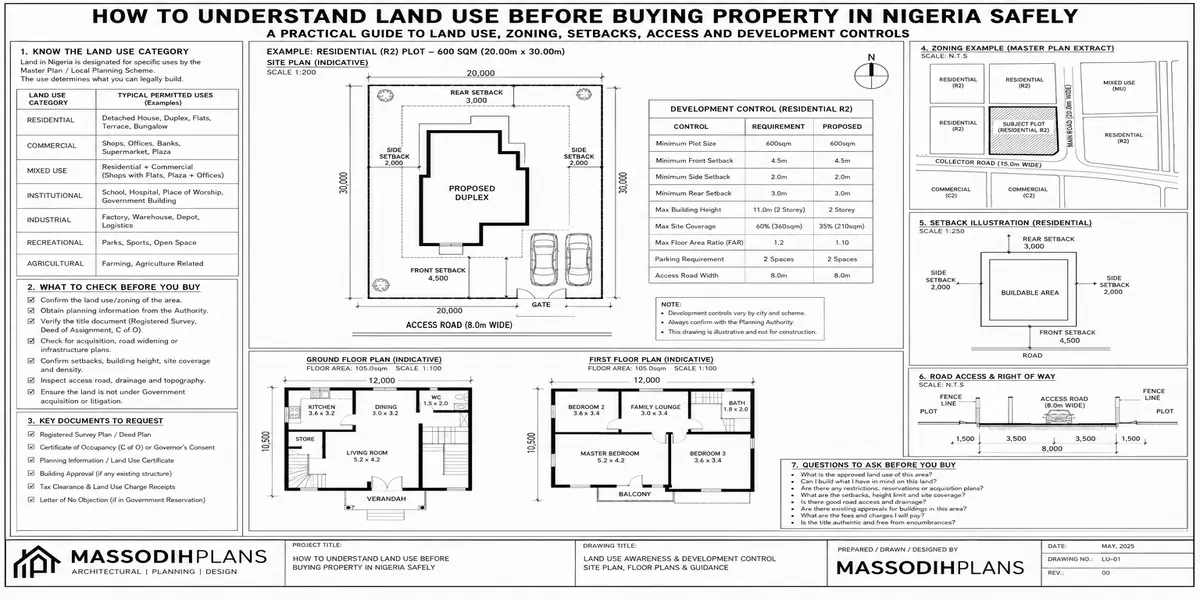
Every parcel of land within an approved layout or master plan in Nigeria carries a designated use, decided by the state’s urban and regional planning framework, long before any individual plot is sold to you. Common classifications include:
Residential further split by density (low, medium, high) which determines how many units or what building type is permitted
Commercial for shops, offices, and business premises
Mixed-use permits a defined combination of residential and commercial activity
Industrial for manufacturing, warehousing, and related uses
Institutional reserved for schools, religious buildings, hospitals, and similar public-facing uses
Agricultural for farming, typically restricted from residential or commercial development without formal conversion
Green belt / open space / setback land deliberately kept undeveloped for drainage, environmental, or planning buffer purposes
Road reserve / right-of-way land set aside for current or future road infrastructure, which cannot legally be built on regardless of any private sale that may have occurred
The classification attached to a plot is not negotiable at the point of sale, and it is not something a seller, however honest, can simply promise you around. It is fixed by planning policy, and changing it requires a formal land use conversion or rezoning application a process that can be lengthy, costly, and is never guaranteed to succeed.
Never accept a seller’s or agent’s verbal assurance about what a plot is “zoned for.” Land use classification must be confirmed directly at the relevant state planning authority or ministry of physical planning, in writing, referencing the specific plot. Verbal assurances have no legal standing when your building plan application is later reviewed.
Where and How to Actually Verify Land Use
This is the practical core of this guide the steps most buyers never take because nobody tells them these offices exist separately from the Land Registry.
1. Identify the Governing Planning Authority
Each state has a designated body responsible for physical planning and development control for example, Lagos State’s planning and building control agencies, or the equivalent ministry of physical planning and urban development in your state. This is a different office from the Land Registry that handles title registration, and land use enquiries must go through this planning authority specifically.
2. Request a Land Use / Zoning Confirmation
With the plot’s survey plan (coordinates, not just an address), request formal confirmation of the land’s approved use classification from the planning authority. This should be a written response referencing the specific parcel, not a general statement about the area.
3. Check Against the Approved Layout or Master Plan
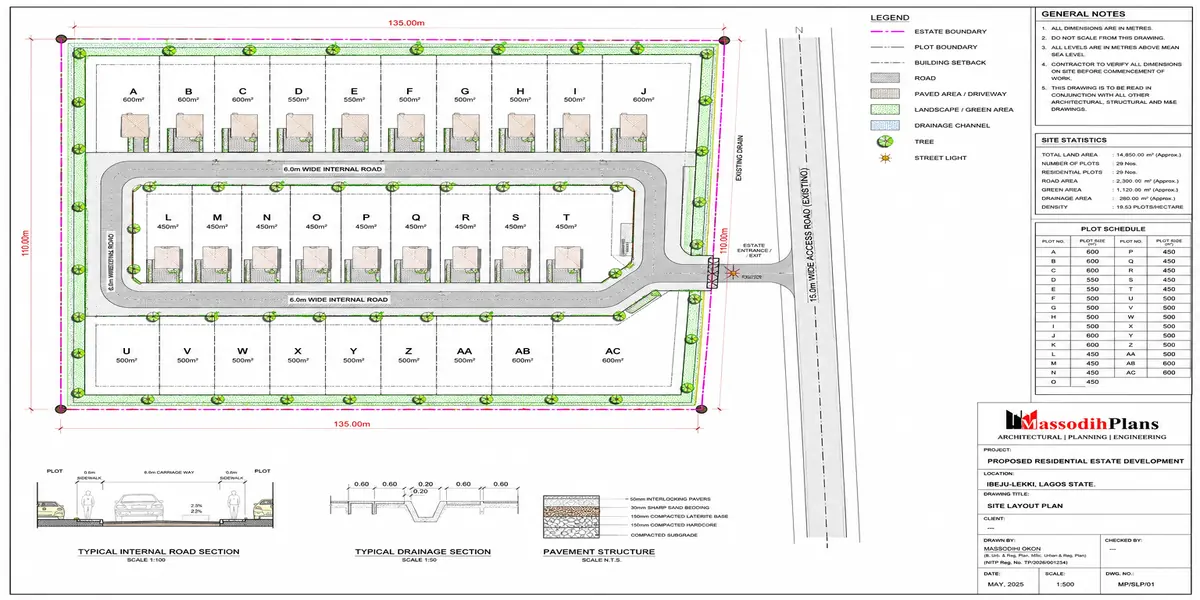
Where the land sits within an approved estate or government layout, request to see (or have your professional request on your behalf) the approved layout plan showing how that specific plot is designated relative to roads, drainage, and neighbouring plots. This reveals setbacks, green belt allocations, and road reserves that an individual title document will never show you.
4. Confirm the Land Is Not Under Government Acquisition or Committed Land
Separately from use classification, confirm whether the land falls under any existing government acquisition (for infrastructure, institutional use, or public purpose) or is “committed” to a government project. Land use classification and acquisition status are related but distinct checks a plot can be zoned residential and still be under acquisition for a road expansion that hasn’t been physically implemented yet.
5. Cross-Check With a Physical Site Visit
Compare what the documentation says against what’s physically on the ground. A drainage channel, an existing road alignment, or visible utility infrastructure crossing the plot are physical clues that the documented land use classification may include restrictions the seller hasn’t disclosed.
6. Engage a Town Planner or Registered Surveyor, Not Just a Lawyer
Lawyers are essential for title verification and contract drafting. But land use and zoning verification is a planning question, and it is most reliably answered by a town planner or licensed surveyor who knows how to read a master plan and make the correct enquiry at the planning authority a step most legal-only due diligence processes skip entirely because it falls outside a lawyer’s core expertise.
Why This Matters More Than Most Buyers Realize
Your Building Plan Can Be Rejected Regardless of Valid Title
Development control authorities assess building plan applications against the land’s approved use classification, not against your title document. A perfectly legitimate C of O does not override a land use mismatch your application for a residential duplex on institutionally zoned land will be rejected regardless of how clean your title paperwork is.
Density Restrictions Affect What You Can Actually Build
Even within residential zoning, low-density classification may restrict you to a single-family bungalow or duplex on a given plot size, while medium or high-density zoning permits multi-unit development. Buyers planning an income property (self-contained units, a small block of flats) specifically need to confirm density classification before purchase, not after design.
Green Belts and Setbacks Are Rarely Visible on a Basic Survey Plan
A standard survey plan shows boundaries and coordinates it does not automatically flag that a strip of your plot falls within a mandatory drainage setback or green belt allocation from the approved layout. This is precisely why cross-checking against the layout plan, not just the individual survey plan, matters.
Road Reserves Can Sit Dormant for Years Before Enforcement
Land use classification as a road reserve or right-of-way doesn’t always mean visible construction activity yet. Buyers sometimes purchase and even build on land earmarked for future road expansion, only to face demolition or compensation-only settlement years later when the infrastructure project is finally executed.
Land Use Conversion Is Possible But Not Guaranteed
If land use verification reveals a mismatch between the classification and your intended use, formal conversion (for example, agricultural to residential) is sometimes possible through the planning authority, but it involves fees, processing time, and no guarantee of approval. This should factor into your decision and negotiation, not be treated as a formality you’ll “sort out later.”
A Practical Land Use Verification Checklist
- Obtain the plot’s survey plan with exact coordinates, not just a street address
- Identify the correct state planning authority (separate from the Land Registry) for that location
- Request written land use/zoning confirmation for the specific parcel
- Request or review the approved layout/master plan for that estate or area, where applicable
- Confirm acquisition/committed-land status separately from use classification
- Physically inspect the site for drainage, road alignment, or utility clues that may indicate undisclosed restrictions
- Engage a town planner or surveyor alongside your lawyer, not instead of one
- If a mismatch exists, get a written, honest assessment of conversion feasibility before proceeding or walk away
Budget time, not just money, for land use verification. A title search can sometimes be rushed. A proper written land use confirmation from a state planning authority often takes longer, and rushing this step to close a sale quickly is exactly how buyers end up owning land they can’t build on.
Frequently Asked Questions
What is the difference between land use and land title in Nigeria?
Title establishes who legally owns or has the right to sell the land. Land use classification, set by the state’s planning authority and master plan, establishes what that land is legally permitted to be used or built for. A valid title does not guarantee a favourable land use classification.
Can I build a residential house on land zoned for another use?
Not legally, without a formal land use conversion approved by the relevant planning authority and approval is never guaranteed. Building without conversion risks demolition or rejection of your building plan application regardless of valid title.
Where do I check the land use classification of a plot in Nigeria?
At the state’s ministry or agency responsible for physical planning and urban development a different office from the Land Registry that handles title. Request a written confirmation referencing the specific plot’s survey coordinates.
Does a Certificate of Occupancy guarantee I can build what I want on the land?
No. A C of O confirms your right to occupy the land under the Land Use Act but does not override the land’s zoning classification. Land in Nigeria is governed by the Land Use Act of 1978, which vests all land within each state under the control of the governor, who holds it in trust for the public. Development approval is assessed against zoning and master plan requirements separately from title.
What happens if I unknowingly buy land in a road reserve or green belt?
You risk demolition, loss of the structure with no compensation guarantee, or a permanently rejected building plan application, even though your title purchase may have been entirely genuine. This is why land use verification must happen before purchase, not after.
Conclusion
Every guide to buying land safely in Nigeria will tell you to check the title. Almost none will tell you that a clean title and a workable land use classification are two separate wins you need to secure independently and that missing the second one can make the first one worthless for your actual purpose. Before you pay for any plot, verify what the land is legally classified for, not just who legally owns it.
If you’re planning a purchase and want that classification checked properly before you commit funds, our Services page outlines how we support land use and site verification alongside design work. Visit Plan School to understand how approved layouts and master plans work, or browse our Plans Library once you’re confident the land use fits your intended build. You can also explore more property and planning guides on our Homepage.
Related posts
- How Land Use Affects the Type of Building You Can Develop in Nigeria Today
- 10 Things to Check Before Building a House on Any Plot in Nigeria Today
- How to Evaluate Land in Lagos Before Choosing a House Plan to Build Safely (15 Best Ways)
- How to Choose the Right Residential Location in Abuja Before You Build (20 Best Areas Ranked for Buildability)
- How to Choose the Right Residential Location in Lagos Before You Build
- 10 Best House Plans for Small Plots in Nigeria: What Buyers Should Consider
- How to Choose the Right House Plan Based on Your Plot Size in Nigeria Today
- How GIS Can Help You Choose the Right Land for Your Dream House in Nigeria
- How to Identify Flood Risk Before Building a House in Nigeria Today, Safely
- How Much Does It Cost to Build a House in Nigeria? Full Guide to Materials, Labour, Foundation, Roofing and Finishing
- Courtyard House Plans: Beautiful 2–6 Bedroom Designs With Private Outdoor Spaces, Floor Plans and Dimensions
- Semi-Detached House Plans: Modern Duplex and Bungalow Designs With Shared Walls, Dimensions, Costs and Layout Ideas
- How to Draw a Neighbourhood Plan (SPAR): Step-by-Step Guide to Roads, Plots, Land Use, Setbacks and Layout Design
Author
Massodih Okon is a Nigerian built-environment professional with academic and professional experience in urban and regional planning, geography, architectural design, Landscape Design, GIS and land development.
He holds a Master’s degree in Urban and Regional Planning from the University of Uyo and a first degree in Geography and Regional Planning.
Through MassodihPlans, he publishes practical guides on Nigerian house plans, building design, physical planning, site planning, development approval and residential construction. Read the full author profile →