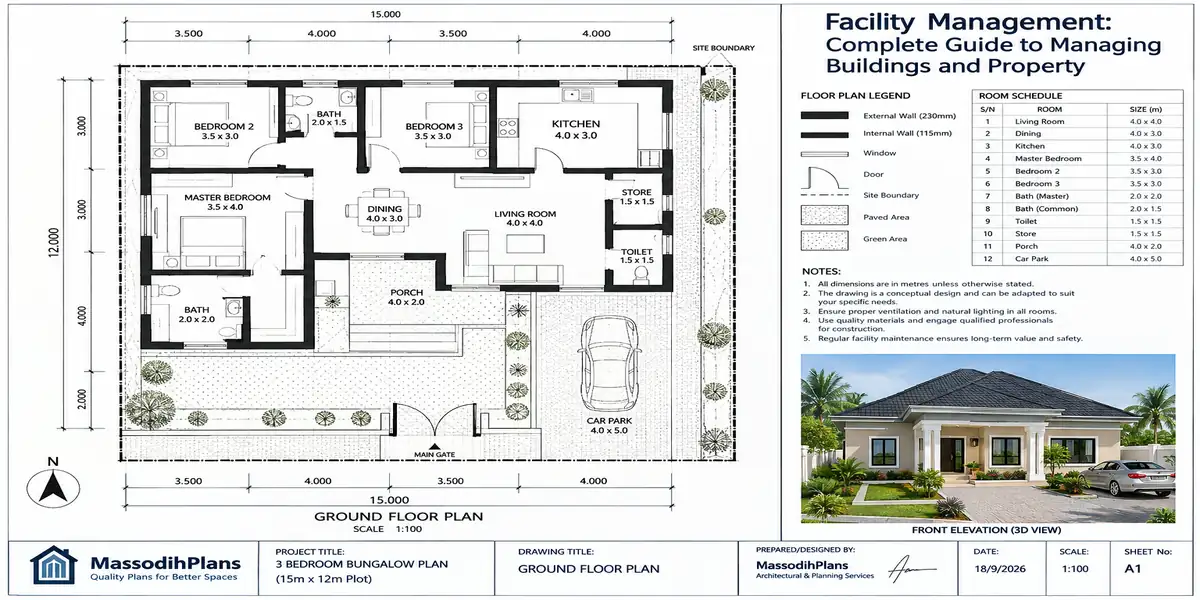
Facility Management: Complete Guide to Managing Buildings and Property
Introduction to Facility Management: Complete Guide to Managing Buildings and Property
A client called me last year, three months after moving into a duplex I’d designed for him, with a simple complaint: “The house is beautiful, but something is always breaking.” Nothing had actually gone wrong with the construction. What had gone wrong was that nobody not him, not his contractor, not me at handover had explained that a finished building doesn’t run itself. It needs to be managed. That gap, between “the house is built” and “the house is being properly looked after,” is exactly what facility management exists to close, and it’s a gap almost nobody explains in plain language before it costs someone money.
This guide exists to close that gap for you, whether you’re a homeowner who just took possession of a new build, a landlord managing rental units, a facility manager trying to sharpen your practice, or a student trying to actually understand this field beyond a textbook definition. I’ll walk through what facility management is, how it’s genuinely different from building and property management (three terms people use interchangeably and shouldn’t), what real checklists and systems look like, what it costs, and because this is where most guides on this topic stop being useful what facility management actually means for someone who just built or bought a home in Nigeria, where generators, boreholes, and septic tanks are facility management realities that no international FM textbook mentions.
What Is Facility Management? A Definition That Actually Makes Sense
Strip away the jargon, and facility management is this: the discipline of keeping a building’s systems, spaces, and services working so the people inside it can do whatever they’re there to do live, work, teach, treat patients, manufacture, sell without the building itself getting in their way.
More formally, facility management is the coordinated management of an organization’s buildings, sites and workplaces, and the support services needed to keep them functional, safe and effective for occupants and operations. That coordination usually spans three broad categories: hard services (the physical systems electrical, plumbing, HVAC, structural upkeep), soft services (cleaning, security, landscaping, waste management), and space/workplace management (how space is allocated, used, and adapted over time).
You’ll see the term written both as “facility management” and “facilities management” these are not different disciplines, just regional and stylistic variation. American usage leans toward “facility management”; British and much of Commonwealth usage, including a good deal of Nigerian professional literature, leans toward “facilities management.” Use either with confidence; a competent professional will understand you mean the same thing.
Once you understand FM as “keeping the building working for the people in it,” the next natural question follows: who actually does that job day to day? That’s the facility manager, and the role deserves its own honest explanation because most descriptions of it online are either too vague or borrowed wholesale from a Western corporate context that doesn’t map cleanly onto Nigerian buildings.
If you remember nothing else from the definitions section, remember this test: facility management is about function and people; property management is about ownership and money. Almost every confusing overlap between the two terms resolves once you apply that test.
What Does a Facility Manager Actually Do?
A facility manager is the person (or team) responsible for the day-to-day operational reality of a building not its ownership, not its lease terms, but whether the lights work, the air conditioning holds temperature, the fire extinguishers are in date, the cleaning happens, and the generator has fuel before it’s needed.
On a typical day, a facility manager might: walk the building checking for visible issues, respond to a tenant or staff complaint about a faulty air conditioning unit, coordinate a contractor visit for elevator servicing, review a maintenance log to see what’s due this week, approve a purchase order for replacement parts, and update a safety inspection record. None of that is glamorous. All of it is what keeps a building from slowly degrading into the kind of place where “something is always breaking.”
For a single residential home which is the reality for most people reading this on a house-plans site you are, by default, your own facility manager unless you hire one. That’s worth sitting with for a moment: the skills and systems below aren’t just for office towers and shopping malls. They apply, at a smaller scale, to the house you just built or bought, and understanding them properly is what separates homeowners who spend calmly on maintenance from homeowners who get blindsided by expensive emergencies.
Having covered what the role involves, it’s worth pausing on a distinction that trips up almost everyone researching this topic because “facility manager,” “building manager,” and “property manager” are frequently used as if they’re the same job when they genuinely are not.
Facility Management vs. Building Management vs. Property Management: The Distinction Nobody Draws Clearly
This is, without exaggeration, the single most searched point of confusion in this entire field, and most articles either avoid it or explain it so abstractly it doesn’t stick. Let me make it concrete.
Property management
Is about ownership and money. A property manager works on behalf of the owner to protect and grow the value of the asset finding tenants, collecting rent, negotiating leases, handling legal compliance, and reporting financial performance back to the owner. If you ask a property manager “is this building profitable,” they should have an immediate answer.
Building management
Sits closer to the physical building itself it’s often used, especially in Nigerian usage, as a broader or more informal term covering the operational running of a building: its systems, its upkeep, its day-to-day functioning. In much everyday conversation, “building management” and “facility management” are used to mean roughly the same thing, though facility management is the more precise, internationally recognized professional term.
Facility management
Is about function and experience. A facility manager works to make sure the building, whoever owns it, actually works for the people inside it safe, comfortable, and operationally sound. If you ask a facility manager “is this building profitable,” that’s not really their question to answer; their question is “is this building working the way it’s supposed to.”
Here’s a simple test that resolves almost every confusing overlap: if the issue involves a lease, rent, a tenant dispute, or the property’s market value that’s property management. If the issue involves whether a system works, whether a space is safe, or whether the day-to-day environment functions that’s facility (or building) management. A single organization often needs both, and the two roles work best when they talk to each other constantly, because facility management insights (recurring maintenance problems, occupant complaints) should directly inform property management decisions (renovation budgets, lease terms, capital planning), and property management decisions (a new tenant, a change of use) directly reshape what facility management has to deliver.
With that distinction settled, we can move from definitions into the actual physical work because “building operations” is the term that describes what facility management looks like once you’re inside the mechanics of a specific building.
If you’re hiring help for a completed building, be specific about which role you actually need. Asking an agency for “a property manager” when what you need is someone to service your generator and inspect your roof will get you the wrong person and the wrong contract and this mismatch is one of the most common and avoidable disappointments I see clients run into after handover.
Building Operations: The Engine Room of Facility Management
Building operations is the term for the actual, ongoing mechanical and procedural work that keeps a building running the engine room beneath the facility management umbrella. It typically covers:
Mechanical, electrical, and plumbing (MEP) systems HVAC, wiring, water supply and drainage, and any building-specific systems like generators, water treatment, or fire suppression
Life safety systems fire alarms, extinguishers, emergency lighting, and evacuation routes, all of which require scheduled inspection, not just installation
Cleaning and janitorial operations scheduled and reactive cleaning across all shared and private spaces
Security operations access control, surveillance, and physical security staffing where applicable
Waste management collection, storage, and disposal, including any specialized waste streams
Energy management monitoring consumption, identifying waste, and managing the balance between grid power, generator power, and (increasingly) solar/inverter systems
Building operations is where facility management stops being a concept and becomes a schedule a set of recurring tasks, each with a frequency, a responsible party, and a record of completion. That schedule is exactly what a proper maintenance program formalizes, and it’s where “building maintenance,” “facility maintenance,” and “property maintenance” three more terms people use interchangeably actually diverge in meaning.
Building Maintenance vs. Facility Maintenance vs. Property Maintenance: Sorting Out the Overlap
These three terms overlap so heavily in everyday use that most people never bother distinguishing them but there is a real, useful distinction, and understanding it changes what you ask for when you hire help.
Building maintenance is the broadest and most literal term the physical upkeep of a structure and its systems, regardless of who owns it or what it’s used for. Fixing a leaking roof, repainting a wall, servicing an HVAC unit all building maintenance.
Facility maintenance is building maintenance viewed through the operational lens of facility management maintenance planned and scheduled as part of a coordinated system, with the goal of keeping the whole facility functional for its occupants, not just fixing individual problems as they appear.
Property maintenance is building maintenance viewed through the ownership lens maintenance carried out specifically to protect the property’s value and meet obligations to tenants, buyers, or regulators. This is the term you’ll most often hear from landlords, letting agents, and property investors.
In practice, the actual physical tasks under all three terms are often identical the difference is who’s asking, and why. A landlord asking about “property maintenance” wants to protect rental income and asset value. A facility manager asking about “facility maintenance” wants operational continuity for occupants. A homeowner asking about “building maintenance” usually just wants their house to keep working. All three, however, benefit from the same underlying tool: a proper checklist, applied consistently rather than remembered sporadically which is exactly where most people, in my experience, fall short.
Don’t get stuck choosing the “correct” term for your situation. Pick whichever one matches how you’ll search for help (a contractor, an agency, a software tool), and focus your actual energy on the checklist and schedule below that’s where the real value lives, not in the terminology.
The Building Maintenance Checklist: What Actually Needs Checking, and How Often
This is the checklist most guides gesture at vaguely and never actually deliver in full. Organize it by system, and treat frequency as a minimum, not a maximum.
Structural and Exterior (every 6–12 months)
- Roof: check for leaks, damaged sheets, blocked gutters, and rusted fasteners
- Walls and render: check for cracks, damp patches, and peeling paint, especially after rainy season
- Foundation and drainage: check for pooling water around the building base, which signals a drainage problem before it becomes a structural one
- Windows and doors: check seals, hinges, and locks for wear
Electrical (every 3–6 months)
- Distribution board: check for loose connections, unusual heat, or tripped breakers that reset without a clear cause
- Wiring: visually inspect exposed wiring for wear, especially in older buildings
- Generator/inverter systems: service according to manufacturer schedule, not just when they fail (covered in more depth below)
Plumbing (every 3–6 months)
- Pipes and joints: check for leaks, especially under sinks and behind toilets
- Water tanks and storage: inspect for sediment buildup and clean on schedule
- Drainage: check that all drains flow freely and gullies aren’t blocked
Fire and Life Safety (every 6 months to annually, depending on system)
- Fire extinguishers: check pressure gauges and service/refill dates
- Smoke detectors: test function and replace batteries
- Emergency lighting and exit routes: confirm they’re clear and functional
HVAC and Ventilation (every 3 months for filters, annually for full servicing)
- Air conditioning units: clean or replace filters, check refrigerant levels, clean condenser coils
- Ventilation: confirm extractor fans in kitchens and bathrooms are working, since these directly affect humidity-related damage in a tropical climate
Grounds and External Areas (monthly to quarterly)
- Landscaping and drainage channels: keep clear of debris that would otherwise redirect water toward the building
- Paving and compound surfaces: check for cracking or settling that could indicate ground movement
Running through this checklist consistently converts maintenance from a reactive, expensive emergency response into a predictable, budgeted routine which is the entire philosophy behind proper building maintenance management, covered in more detail shortly. But before that, it’s worth adapting this same checklist for a different audience: landlords and property owners managing units they don’t personally occupy, where the checklist has to serve a legal and financial purpose as well as a functional one.
The Property Maintenance Checklist for Landlords and Owners
If you’re managing a rental property rather than your own home, your checklist needs an added layer beyond pure function because property maintenance here also has to protect your legal position and your tenants’ rights, not just the building’s physical condition.
Move-in/move-out condition reports: documented, dated, and ideally photographed, to prevent disputes over deposit deductions
Tenant-reported issue log: a system for tenants to report problems, with recorded response times slow response to maintenance requests is one of the most common triggers of tenant disputes and non-renewal
Compliance checks: fire safety, electrical safety, and any locally mandated inspections, kept as dated records you can produce if challenged
Scheduled versus emergency maintenance budget: a separate line for planned upkeep and for genuine emergencies, so one unexpected repair doesn’t derail your entire year’s maintenance plan
Vendor and contractor records: who serviced what, when, and at what cost this becomes essential if you ever sell the property, since a documented maintenance history is a genuine value-add in a sale
Insurance and warranty tracking: dates and coverage for anything still under warranty, so you’re not paying out of pocket for something a manufacturer or contractor still owes you
Notice that this checklist adds documentation and legal protection on top of the same physical maintenance items covered above which is really the core difference between a homeowner’s building maintenance checklist and a landlord’s property maintenance checklist: the second one has to survive a dispute, not just keep the building standing.
Once you have a checklist, the next challenge is turning it into a system that runs continuously rather than a document that gets checked once and forgotten and that system is what building maintenance management actually means in practice.
Building Maintenance Management: Turning a Checklist Into a System
Building maintenance management is the organizational layer that sits above the checklist deciding how maintenance gets planned, tracked, prioritized, and paid for over time. There are three recognized approaches, and understanding all three helps you diagnose which one you’re currently running, often by accident.
Reactive maintenance means fixing things after they break. It requires no planning, and it is, almost without exception, the most expensive approach over time because a failure discovered in an emergency costs more to fix (rush labour, secondary damage, downtime) than the same issue caught early. Most first-time homeowners and small landlords run entirely on reactive maintenance without realizing it, simply because nobody set up anything else.
Preventive maintenance means servicing systems on a fixed schedule regardless of whether they’ve shown a problem yet the checklist above, run on a calendar. This is where the real savings live: a generator serviced every quarter rarely fails catastrophically; one serviced only when it stops working usually fails at the worst possible moment.
Predictive maintenance means using data sensor readings, usage patterns, historical failure records to predict when a system will need attention before it fails, rather than servicing on a fixed calendar regardless of actual condition. This is common in large commercial facilities with sophisticated monitoring, and increasingly accessible even at a smaller scale through connected sensors and software, which is exactly where facility management software enters the picture.
The transition from reactive to preventive maintenance is, in my experience, the single highest-value change a homeowner or small property owner can make not because it’s sophisticated, but because it converts unpredictable emergency spending into predictable, budgeted spending. That shift in mindset is also precisely what separates people who manage buildings casually from people who use facility management services professionally, which is the next layer worth understanding clearly.
Facility Management Services: What You’re Actually Paying For
When people search “facility management services,” they’re usually trying to understand what’s included before they call an agency a reasonable thing to want clarity on before signing anything. Services typically fall into a few groupings:
Hard services: HVAC servicing, electrical maintenance, plumbing repair, generator servicing, structural repairs the physical systems keeping the building functional
Soft services: cleaning, security, landscaping, pest control, waste management the services affecting occupant comfort and appearance rather than core function
Technical/specialized services: fire safety compliance, energy audits, elevator servicing, water treatment services requiring specific certification or expertise
Space and workplace management: for commercial and institutional clients, this covers space planning, occupancy management, and adapting layouts as needs change
Facility management services can be delivered in-house (a dedicated employee or team, common for larger organizations and estates) or outsourced to a facility management company that handles some or all of the above under a contract, often called total facility management (TFM) when a single provider covers everything.
For an individual homeowner, “facility management services” rarely means hiring a full outsourced team it usually means assembling a small, reliable set of contractors (an electrician, a plumber, a generator technician, a cleaner) you can call on a scheduled and emergency basis, effectively building your own miniature version of the same service structure a large facility would use. The principle scales down; it doesn’t disappear.
As buildings and portfolios grow larger, tracking all of this manually becomes genuinely unmanageable which is exactly the gap facility management software exists to close.
Facility Management Software: What It Does and How to Choose One
Facility management software (often called a Computer-Aided Facility Management, or CAFM, system, or more broadly an Integrated Workplace Management System) exists to do digitally what a paper checklist does manually, at a scale paper can’t handle: track assets, schedule maintenance, log work orders, manage vendor contracts, and generate compliance records.
Core functions worth evaluating in any option you consider:
Work order management: logging, assigning, and tracking maintenance requests from creation to completion
Preventive maintenance scheduling: automated reminders based on time or usage, rather than relying on someone remembering
Asset tracking: a record of every major system and piece of equipment, its age, warranty status, and service history
Vendor and contractor management: contact records, contract terms, and performance history in one place
Reporting and compliance: generating the dated records that prove maintenance and safety checks actually happened, which matters both for insurance and for any regulatory inspection
For a single home or a small number of rental units, a full CAFM platform is usually overkill a well-organized spreadsheet or a simple task-reminder app achieves most of the same benefit at a fraction of the complexity. The software becomes genuinely worth adopting once you’re managing multiple buildings, a large commercial facility, or an estate with shared infrastructure, where manual tracking would otherwise consume someone’s entire working week.
Software tracks maintenance and vendors well, but it doesn’t by itself answer a deeper strategic question that both facility managers and property owners eventually have to face: not just “is this working,” but “what is all of this actually worth, and when should it be replaced rather than repaired.” That question belongs to asset management.
Asset Management: The Strategic Layer Above Maintenance
Asset management, within facility management, is the discipline of tracking the condition, value, and remaining useful life of a building’s physical assets HVAC units, generators, roofing, structural elements, elevators and using that information to plan capital spending rather than just reacting to breakdowns.
Every physical asset has a life cycle: acquisition, operation, maintenance, decline, and eventual replacement. Good asset management tracks where each major system sits on that curve, so replacement decisions are planned years in advance around budget cycles, rather than forced suddenly by failure. A generator nearing the end of its realistic service life, tracked properly, becomes a planned line item in next year’s budget. The same generator, untracked, becomes an emergency expense the week it finally fails often at a worse price, because emergency sourcing rarely gets you the best deal.
This distinction planned capital replacement versus emergency crisis spending is, in financial terms, the single biggest value asset management adds over simple maintenance tracking, and it applies whether you’re managing one generator in a family home or forty air handling units across a commercial portfolio.
Zoom out from individual assets to the entire property as a financial holding, and you arrive at property asset management a related but distinctly higher-level discipline worth separating clearly from everything covered so far.
Property Asset Management: Where Facility Management Meets Investment Strategy
Property asset management operates at the portfolio and investment level it’s concerned with maximizing a property’s financial return and long-term value, using facility management and maintenance data as key inputs into that decision-making rather than as the end goal itself.
A property asset manager asks questions like: is this building’s maintenance cost trending in a way that threatens its resale value? Does the current use of the space still make financial sense, or should it be repositioned? Is deferred maintenance quietly eroding the property’s market value in a way the owner hasn’t noticed yet? These are investment and strategy questions, built directly on top of the operational facility management data covered throughout this guide which is exactly why the earlier distinction between facility management (function) and property management (money) matters so much: property asset management is essentially what happens when property management decisions are made rigorously, using real facility data instead of guesswork.
For most individual homeowners, full property asset management is more relevant to how you think about your home as it ages tracking whether deferred maintenance is quietly reducing what your house would sell for than something you’d formally hire out. For landlords and larger property owners, it’s the discipline that ties everything in this guide back to the number that actually matters at the end of the day: what the building is worth.
The Layer Almost No Facility Management Guide Covers: Managing a Nigerian Home After Handover
Everything above applies globally. This section doesn’t, and it’s the reason this guide exists on a Nigerian architecture and building platform rather than a generic international one. Most facility management content is written for offices, hospitals, and commercial towers in countries with stable grid power and municipal water and sewage. Nigerian homeowners are, in effect, running a small independent utility company for their own house and that reality deserves its own honest checklist.
Generator servicing
Oil changes on a running-hours schedule (not just a calendar), air filter checks, and load testing before the rainy season, when generators often sit unused for stretches and fail exactly when you finally need them
Inverter and battery systems
Battery terminals checked for corrosion, charge cycles monitored, and battery replacement planned proactively batteries degrade gradually and are one of the easiest “predictable” replacements to plan for financially in advance
Borehole and water treatment
Pump servicing, water quality testing at reasonable intervals, and filter/softener replacement especially important where groundwater quality varies significantly even within the same neighbourhood
Septic tank and soakaway management
Scheduled desludging before capacity problems appear, since a failed septic system is one of the most disruptive and unpleasant facility failures a Nigerian homeowner can experience
Estate service charge accountability
For homes inside managed estates, understanding exactly what the service charge covers (security, common-area maintenance, drainage) and requesting a breakdown if it’s ever unclear this is property asset management at the estate level, and residents are entitled to transparency on it
Seasonal readiness
A pre-rainy-season check (roof, gutters, drainage) and a pre-dry-season check (generator, water storage) as two fixed calendar events every homeowner should treat as non-negotiable, not optional
This is, functionally, a complete facility management program scaled to a single home hard services (generator, borehole, electrical), a maintenance schedule (seasonal and running-hours based), and even a form of asset management (planning battery and pump replacement before failure). Understanding it this way changes how you budget: not as a series of surprise expenses, but as a manageable annual facility management line item, the same way a commercial building owner budgets for theirs.
If you’re at the design stage rather than already living in your completed home, ask your architect to plan dedicated, accessible space for your generator, water storage, and inverter/battery system from the start. Retrofitting proper ventilation, noise buffering, and access for servicing after the house is finished is far more expensive and far less effective than designing for it upfront.
What Facility Management Services Cost in Nigeria (and How to Think About Hiring Help)
Costs vary enormously by scale, but a few honest benchmarks help set expectations. For a single family home, assembling a reliable set of contractors (electrician, plumber, generator technician) on an as-needed basis typically costs far less annually than most people fear, provided you’re running preventive rather than reactive maintenance the entire point of the checklist and scheduling sections above. For a small estate or a commercial building, a dedicated facility manager or outsourced facility management contract is priced against the building’s size, system complexity, and whether services are bundled (total facility management) or handled separately by trade. Whatever the scale, the same rule applies: a facility management spend that looks like a fixed, predictable annual budget is a sign the system is working; a facility management spend that looks like a series of unpredictable emergencies is a sign it isn’t.
Common Facility and Property Management Mistakes
Running purely reactive maintenance without realizing it, simply because no schedule was ever set up
Confusing facility management with property management when hiring help, and ending up with the wrong skill set for the job
Skipping documentation undated, unrecorded maintenance history that becomes a liability during a sale, a dispute, or an insurance claim
Treating generator, borehole, and inverter systems as install-and-forget, rather than assets with their own maintenance and replacement schedule
No seasonal readiness routine, leading to entirely predictable rainy-season and dry-season failures that a fixed calendar check would have caught
Frequently Asked Questions
What is the difference between facility management and property management?
Facility management is about function keeping a building’s systems and spaces working for the people using it. Property management is about ownership and money leasing, rent collection, tenant relations, and protecting the asset’s financial value. A single organization often needs both, working together.
What does a facility manager do on a daily basis?
Inspecting building systems, responding to occupant issues, coordinating contractors and vendors, reviewing maintenance schedules, and maintaining safety and compliance records the operational work that keeps a building functional day to day.
Do I need facility management for a single family home?
You don’t need a formal service, but you are functionally acting as your own facility manager the moment you take possession of a completed home and applying the checklist and preventive-maintenance principles in this guide, even informally, will save you significant money over time.
Is facility management software necessary for a homeowner?
No, a well-organized spreadsheet or reminder app covers most of what a homeowner needs. Dedicated facility management software becomes worthwhile once you’re managing multiple properties or a large facility where manual tracking is no longer practical.
What is the most important facility maintenance task for Nigerian homeowners specifically?
There isn’t a single most important item, but the seasonal readiness check roof and drainage before rainy season, generator and water storage before dry season catches the largest share of predictable, avoidable failures with the least effort.
Is facility management a good career path in Nigeria?
It’s a growing field as more commercial developments, estates, and institutions professionalize their building operations, and it rewards people with a practical, detail-oriented mindset rather than purely academic qualifications though relevant training and certification strengthen credibility significantly.
Bringing It All Together
Facility management, stripped of jargon, is simply the discipline of making sure a building keeps doing what it was built to do for whoever’s inside it, for as long as it stands. Whether that’s a shopping mall with a dedicated facility management team, a rental property run by a landlord juggling maintenance and tenants, or a family home in Lagos or Uyo where the “facility management team” is really just you and a phone number for your generator technician, the same principles hold: know your systems, schedule your maintenance before things break, document what you do, and treat replacement as something you plan for rather than something that surprises you.
If you’re still at the design and planning stage, the best facility management decision you can make happens before construction even starts designing spaces, access, and system placement that make future maintenance easy rather than something you’re fighting against for the life of the building. Browse our Plans Library for house plans designed with real maintenance access in mind, or visit Plan School to understand how design decisions at the drawing stage affect long-term building operations. If you want direct support planning a new build or reviewing a completed one, our Services page outlines how we work with clients from concept through to handover. You can also explore more building and property guides on our Homepage.
- KASUPDA Building Approval Requirements: What to Prepare Before You Build in Kaduna
- Sustainable Building: How to Create Energy-Efficient and Resilient Homes
- FCDA Building Approval Requirements in Abuja: A Practical Guide for Owners
- How Much Will This Building Plan Cost? Nigeria Building Plan Cost Guide
- Housing Affordability: How to Find Affordable Homes and Low-Cost Housing
Author
Massodih Okon is a Nigerian built-environment professional with academic and professional experience in urban and regional planning, geography, architectural design, Landscape Design, GIS and land development.
He holds a Master’s degree in Urban and Regional Planning from the University of Uyo and a first degree in Geography and Regional Planning.
Through MassodihPlans, he publishes practical guides on Nigerian house plans, building design, physical planning, site planning, development approval and residential construction. Read the full author profile →