How Do I Compare Two Properties?
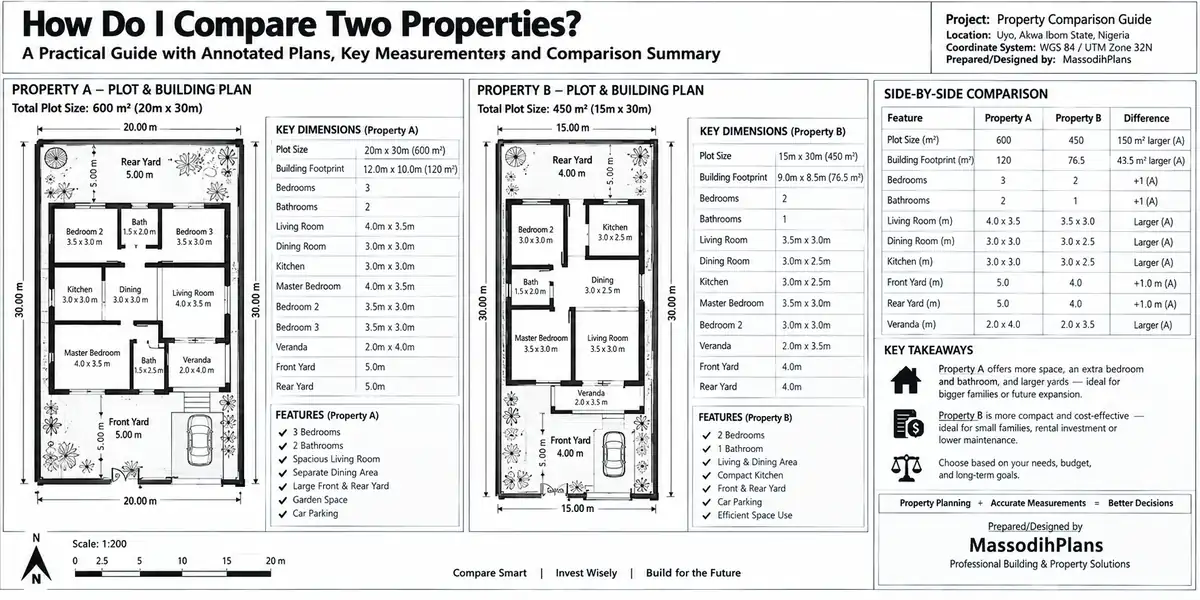
To compare two properties in Nigeria, assess their size, market value, location, title documents, survey plans, accessibility, zoning, building restrictions, drainage, and potential for future development. Calculate the total purchase and development costs, verify ownership and land boundaries, and compare each property against your needs, budget, and long-term goals before deciding.
Let me tell you about a client I’ll call Mr. Effiong. He had two plots shortlisted. Plot A was closer to town, slightly pricier, and smaller. Plot B was cheaper, bigger, and further out. For three weeks, he kept calling me back and forth: “Massodih, which one should I pick?” Every time, his answer changed depending on who he spoke to last. His pastor liked B. And his wife liked A. His agent, unsurprisingly, liked whichever one paid better commission.
Nobody was necessarily wrong. They simply weren’t comparing the same things using the same method. That’s the real problem with comparing two properties: people often focus on the asking price or plot size while overlooking ownership risks, actual market value, development expenses, and planning restrictions that could turn a seemingly good deal into an expensive mistake.
For example, a cheaper plot may require costly land filling, road access improvements, or drainage works. A larger property may also have less usable space because of setbacks, easements, or other building restrictions. Meanwhile, a smaller property in a developed neighbourhood could offer better access to services and stronger resale potential.
So, how do you make the right choice? You need a consistent checklist that allows you to evaluate both properties fairly, verify their legal and physical conditions, and compare their true costs and benefits. Whether you’re considering two plots in Uyo, two duplexes in Lekki, or houses in different Nigerian cities, this guide will help you make an informed decision based on evidence rather than opinions, pressure, or guesswork.
Why “I Just Like It Better” Is Not a Comparison Method
Here’s the honest truth: most people don’t compare properties, they compare feelings. One house “feels” more expensive, one plot “feels” closer, one agent “sounds” more trustworthy. Feelings aren’t useless your gut has information in it but feelings can’t be put in a spreadsheet, and feelings definitely can’t tell you, eight years from now, why you paid 40% more for the smaller plot.
What actually works is breaking a property down into measurable parts, scoring each part, and only then letting your preference decide the tiebreaker. The eight things people genuinely struggle with when comparing two properties are: location, price, land size, building size, condition, access, neighbourhood, and future appreciation. We’re going to walk through each one with real numbers, and by the end, I’ll show you how to combine all eight into a single comparison score something I have not seen done clearly on any property-advice site, Nigerian or international.
Location: Comparing What’s Actually Convenient, Not Just What Sounds Good
Everyone says “location, location, location,” and then nobody explains what that actually means for comparison purposes. Location isn’t a feeling about an area’s reputation it’s a measurable set of distances to the places you’ll actually go: your workplace, your children’s school, the market, the main road, a hospital.
Here’s a simple way to compare location between two properties: list your five most frequent destinations, and note the distance (or drive time) from each property to each destination. Add them up.
| Destination | Property A (km) | Property B (km) |
|---|---|---|
| Workplace | 6 | 14 |
| Children’s school | 3 | 9 |
| Market | 2 | 5 |
| Hospital | 8 | 4 |
| Main road access | 1 | 3 |
| Total weekly distance | 20 km | 35 km |
Property A wins on raw distance here, but notice the hospital line Property B is actually closer to the hospital. That’s the point of breaking location down instead of judging it as one lump feeling: sometimes the “better located” property is only better for most things, not all things, and you get to decide which of those things matters more to your actual life.
Price: The Number Everyone Argues Over But Few Actually Calculate Correctly
Price comparison goes wrong almost every time for one reason: people compare total price instead of price per square metre. A property that costs less in total can easily be more expensive per square metre than one that costs more in total and that’s the number that tells you who’s actually getting the better deal.
The formula:
Price per Square Metre = Total Asking Price ÷ Land Size (in square metres)
Let’s use real numbers. Property A is ₦45,000,000 for a 450 sqm plot. And Property B is ₦38,000,000 for a 330 sqm plot.
Property A: ₦45,000,000 ÷ 450 = ₦100,000 per sqm
Property B: ₦38,000,000 ÷ 330 = ₦115,152 per sqm
Property B looks cheaper on the price tag, but it’s actually more expensive per square metre. That ₦7 million difference in total price is hiding a worse rate, not a better one. This single calculation which takes thirty seconds has saved more than one client from a “bargain” that wasn’t.
Now, small joke break, because I know some of you reading this have already been in this exact gra-gra with an agent.
One agent go tell you “Oga, the price don final-final, no bargain again,” and the next week, another agent don sell the same plot to your neighbour for ₦2 million less. Na the same market, na different mugu dem dey find. Always calculate the rate yourself before you believe anybody’s “final price.”
Land Size vs. Building Size: The Comparison Most People Confuse
This is where I see the most confusion, even among people who should know better. Land size is how much ground you own. Building size is how much of that ground you can actually build on. They are not the same number, and comparing two properties by land size alone without checking building size is how people end up with a “big plot” that can barely fit the house they wanted.
The formula that matters here is plot coverage ratio:
Plot Coverage Ratio (%) = (Building Footprint ÷ Land Size) × 100
Most Nigerian planning authorities cap plot coverage somewhere between 40% and 60% for residential plots, depending on the zoning classification and plot size smaller plots are often allowed a higher coverage percentage than larger ones, precisely because there’s less land to begin with.
Here’s why this matters for comparison. Say Property A is 450 sqm with a maximum allowed coverage of 50%. Property B is 330 sqm with a maximum allowed coverage of 60% (smaller plots in many layouts get a slightly higher coverage allowance).
Maximum Buildable Footprint for A = 450 × 0.50 = 225 sqm
Maximum Buildable Footprint for B = 330 × 0.60 = 198 sqm
Property A still wins on buildable footprint, but the gap (225 vs. 198) is much smaller than the raw land size gap (450 vs. 330) suggested. If your dream design needs a footprint of 200 sqm or less, Property B the smaller, cheaper plot can actually fit it. This is exactly the kind of calculation that matters most to someone planning a small-plot build, which is the entire reason this comparison deserves its own formula instead of a guess.
Before comparing two plots by size, ask each seller or agent for the plot coverage ratio permitted by the local planning authority for that specific plot not a general rule of thumb. This single question changes which plot is actually “bigger” for your purposes.
Condition: Pricing the House You’re Actually Buying, Not the One in the Photo
A property’s condition is where price comparisons quietly fall apart, because a lower asking price on a property needing repairs can cost more than a higher asking price on a property that’s move-in ready. The fix is simple: estimate repair cost and add it to the asking price before you compare.
The formula:
True Comparable Cost = Asking Price + Estimated Repair/Renovation Cost
If Property A is ₦50,000,000 in good condition, and Property B is ₦42,000,000 but needs a new roof, rewiring, and tiling estimated at ₦12,000,000, then:
Property A True Cost = ₦50,000,000
Property B True Cost = ₦42,000,000 + ₦12,000,000 = ₦54,000,000
Property B is actually the more expensive option once condition is priced in, even though its sticker price looked like the bargain.
And since we’re on the topic of “fine” houses:
You know the kind of agent wey go show you one house and swear, “Oga, this house dey mint condition, just small touch-up.” Meanwhile the “small touch-up” na new roof, new septic tank, and prayer for the cracks for the wall. Always carry your own eye or better still, carry a builder’s eye before you believe anybody’s “mint condition.”
Get a builder, engineer, or even an honest artisan to walk the property with you before comparing condition on vibes alone. A fresh coat of paint hides more sins than most buyers realize.
Access: The Cost Nobody Puts in the Comparison, But Everybody Pays Monthly
Access isn’t just “is there a road.” It’s: how much does getting in and out of this property cost you in time, fuel, and wear on your vehicle, every single month, for as long as you live there? This is the one factor almost no property comparison guide actually quantifies so let’s quantify it.
The formula (True Monthly Access Cost):
TMAC = (Daily Round-Trip Distance × Fuel Cost per km × Trips per Month) + Estimated Monthly Road Maintenance Share
Say Property A sits on a tarred road, 2km round trip to the main road daily, at an estimated ₦150 fuel cost per km, 26 working days a month:
TMAC (A) = (2 × 150 × 26) + 0 = ₦7,800/month
Property B sits 6km from the main road on an untarred road that floods in rainy season, same fuel rate, plus an estimated ₦5,000/month shared cost toward community road grading:
TMAC (B) = (6 × 150 × 26) + 5,000 = ₦23,400 + 5,000 = ₦28,400/month
That’s roughly ₦20,600 extra every month for Property B, or about ₦247,200 a year, just in access cost before you even factor in the stress of a flooded road delaying your morning commute. Over ten years, that’s nearly ₦2.5 million in access cost alone, which should absolutely factor into whether Property B’s lower purchase price is really the better deal.
Neighbourhood: What You’re Really Asking When You Ask “Is This Area Good?”
“Good neighbourhood” means different things depending on who’s asking. For comparison purposes, break it into concrete sub-questions instead of one vague impression:
- What is the dominant land use around this property residential, commercial, or mixed, and is that likely to stay that way?
- Is there a functioning drainage system, or does the area flood?
- What is the security situation is there an active resident’s association, estate security, or community watch?
- Are there any noise or environmental concerns nearby a market, a generator-heavy commercial strip, an industrial site?
- Is there a visible trend of new, well-maintained construction, or visible neglect and abandoned buildings?
Score each property 1-5 on each sub-question, and you’ll have a neighbourhood comparison that’s actually based on observable things, not just how the area “felt” when you drove through on a quiet Sunday afternoon.
Future Appreciation: The Factor Everyone Wants to Predict and Nobody Can Guarantee
Nobody can tell you exactly what a property will be worth in ten years anyone who claims certainty here is selling you something. But you can compare two properties’ appreciation potential using observable signals rather than guesswork.
The factors that genuinely drive appreciation, in rough order of impact:
- Confirmed government infrastructure projects nearby (roads, bridges, utility expansion)
- Proximity to an expanding commercial or institutional corridor (new schools, hospitals, government offices)
- Current rate of new, quality construction in the immediate area
- Zoning trend — is the area being upgraded in classification, or is it stable/declining?
- Access improvements already underway (new road construction, bridge completion)
A simple appreciation comparison score:
Appreciation Score = Σ (Factor Present? 1 or 0) for the 5 factors above
Property A: confirmed road project nearby (1), near expanding school corridor (1), high new-construction rate (1), stable zoning (0), access improving (1) = 4/5
Property B: no confirmed infrastructure project (0), no major institutional growth nearby (0), low new-construction rate (0), stable zoning (0), no access improvement (0) = 0/5
This doesn’t guarantee Property A will appreciate faster, but it tells you which property has more visible, trackable reasons to expect appreciation which is the most honest answer anyone can give you on this question.
Bringing It All Together: The Property Comparison Index (PCI)
Here’s the part that, as far as I’ve seen, no property-advice website Nigerian or international actually gives you: a single formula that combines all eight factors into one comparison score, weighted by what matters most to you.
The formula:
PCI = (W₁×L) + (W₂×Pr) + (W₃×LS) + (W₄×BS) + (W₅×C) + (W₆×Ac) + (W₇×N) + (W₈×F)
Where each factor (Location, Price, Land Size, Building Size, Condition, Access, Neighbourhood, Future appreciation) is scored 1-10 for each property, and W₁ through W₈ are the weights you assign to each factor, adding up to 1.0 (or 100%).
You decide the weights based on your priorities. A young family might weight schools and access heavily. An investor might weight future appreciation and price heavily. Here’s a worked example:
| Factor | Weight | Property A Score | Property B Score |
|---|---|---|---|
| Location | 0.20 | 8 | 6 |
| Price (value per sqm) | 0.20 | 7 | 6 |
| Land Size (buildable area) | 0.15 | 8 | 6 |
| Building Size potential | 0.10 | 8 | 6 |
| Condition | 0.15 | 9 | 5 |
| Access | 0.10 | 8 | 4 |
| Neighbourhood | 0.05 | 8 | 7 |
| Future Appreciation | 0.05 | 8 | 3 |
PCI (A) = (0.20×8)+(0.20×7)+(0.15×8)+(0.10×8)+(0.15×9)+(0.10×8)+(0.05×8)+(0.05×8)
= 1.6+1.4+1.2+0.8+1.35+0.8+0.4+0.4 = 7.95
PCI (B) = (0.20×6)+(0.20×6)+(0.15×6)+(0.10×6)+(0.15×5)+(0.10×4)+(0.05×7)+(0.05×3)
= 1.2+1.2+0.9+0.6+0.75+0.4+0.35+0.15 = 5.55
Property A scores 7.95 against Property B’s 5.55 a clear, numbers-backed answer instead of three weeks of back-and-forth phone calls with your pastor, your wife, and your agent all pulling in different directions.
Build this table in a simple spreadsheet before you compare any two properties. Changing the weights to match your actual priorities not mine, not your agent’s is what makes this method honest. The formula doesn’t decide for you; it just makes your own priorities visible to yourself.
Why This Matters Even More on a Small Plot
If you’re comparing two small plots specifically which is the exact situation most of our readers here are in the buildable footprint calculation from the Land Size vs. Building Size section isn’t a nice-to-have, it’s the whole ballgame. A small plot with a generous coverage allowance and good soil can comfortably fit a well-designed 3 or 4 bedroom home, while a slightly larger plot with a tighter coverage limit, bad soil requiring an expensive foundation, or an awkward shape can genuinely build less house for more money.
This is precisely why we built MassodihPlans around small-plot house designs and planning guidance in the first place because the comparison math most people skip is exactly where a small plot either works beautifully or quietly disappoints someone who assumed “small plot” automatically meant “small house.”
Comparing Properties From Abroad: A Layer for Diaspora Buyers
If you’re reading this from the US, UK, Germany, UAE, Iceland, Luxembourg, Switzerland, Qatar, Canada, Australia, or Singapore and a good number of our readers are every formula above still applies, but you need a few extra safeguards because you can’t physically walk both properties yourself:
Get a video walkthrough, not just photos, for both properties photos hide condition issues far more easily than a slow, narrated video walk
Use a trusted, independent professional (not the seller’s own agent) to verify land size, confirm plot coverage rules, and assess condition on your behalf
Confirm title documents independently before any money changes hands survey plan, Certificate of Occupancy or equivalent, and a search at the relevant land registry
Build a Power of Attorney relationship carefully, with someone accountable, if you need a representative to act on your behalf locally
Factor in currency timing exchange rate movement between when you compare prices and when you actually transfer funds can change your real cost meaningfully, especially on larger transactions
The eight-factor comparison and the PCI formula work exactly the same whether you’re standing on the plot yourself or comparing it from 10,000 kilometres away the only thing that changes is who’s gathering the raw numbers for you.
Common Mistakes People Make When Comparing Two Properties
- Comparing total price instead of price per square metre
- Comparing land size instead of buildable footprint
- Ignoring repair/renovation cost when comparing a “cheap” property to a “pricier” one
- Judging neighbourhood by one visit at one time of day
- Treating future appreciation as a guarantee instead of a probability built on visible signals
- Letting one strongly-felt factor (usually price or aesthetics) silently override all the others instead of weighting them deliberately
And since appreciation is the factor everyone gets most excited and most unrealistic about:
Some people go buy land for bush today, and by next week dem don dey ask, “Oga, when the price go double?” My brother, land no be Bitcoin. Appreciation na marathon, no be sprint. If anybody promise you quick-quick doubling for one year, na banana you dey chase, no be property.
Frequently Asked Questions
What is the single most important factor when comparing two properties?
There isn’t one that’s exactly the mistake this guide is built to prevent. The right approach is weighting all eight factors (location, price, land size, building size, condition, access, neighbourhood, future appreciation) according to your own priorities, using the Property Comparison Index method above.
How do I compare two properties with very different prices?
Calculate price per square metre for both, then add estimated repair or renovation cost to get a true comparable cost. The property with the lower sticker price isn’t always the cheaper one once these adjustments are made.
Is a bigger plot always a better deal than a smaller one?
No. What matters is buildable footprint (land size × permitted plot coverage ratio), not raw land size. A smaller plot with a higher coverage allowance can sometimes fit more house than a larger plot with a stricter limit.
How can I compare properties if I’m buying from abroad and can’t visit in person?
Use a video walkthrough instead of photos, hire an independent professional (not the seller’s agent) to verify size, condition, and title, and confirm land documents directly with the relevant registry before any payment.
Can I predict which property will appreciate faster?
Not with certainty, but you can compare observable signals confirmed infrastructure projects, nearby institutional growth, current construction activity, zoning trends, and access improvements to see which property has more visible reasons to expect appreciation.
Finally
Comparing two properties isn’t about picking the one that “feels” right first and justifying it afterward it’s about breaking the decision into the eight parts that actually matter, putting real numbers against each one, and letting your own priorities, not your agent’s commission or your neighbour’s opinion, decide the weights. The Property Comparison Index above won’t remove every bit of uncertainty from a property decision nothing will but it will replace three weeks of back-and-forth phone calls with one spreadsheet you can actually trust.
If you’re comparing plots specifically to figure out what house you can actually build on them, our Plans Library has designs sized for small and mid-size plots so you can match a design to a plot before you commit to it. Visit Plan School to understand plot coverage, setbacks, and the planning rules that decide your real buildable footprint. If you’d like direct support comparing specific properties or plots against your building goals, our Services page outlines how we help. You can also explore more property and planning guides on our Homepage.
- How Do I Produce GIS Maps for My Project? A Practical Mapping Guide
- How Do I Do GIS Analysis for My Dissertation? A Practical GIS Guide
- How Do I Use GIS for My Project? A Practical Guide for Anyone Planning to Build on a Small Plot
- How Do I Determine Service Areas With GIS? Find Coverage Gaps Fast
- How Much of My Land Can I Build On? Plot Coverage Guide Nigeria
- How Do I Check a Property Before I Build? 7 Checks to Avoid Costly Errors
Author
Massodih Okon is a Nigerian built-environment professional with academic and professional experience in urban and regional planning, geography, architectural design, Landscape Design, GIS and land development.
He holds a Master’s degree in Urban and Regional Planning from the University of Uyo and a first degree in Geography and Regional Planning.
Through MassodihPlans, he publishes practical guides on Nigerian house plans, building design, physical planning, site planning, development approval and residential construction. Read the full author profile →