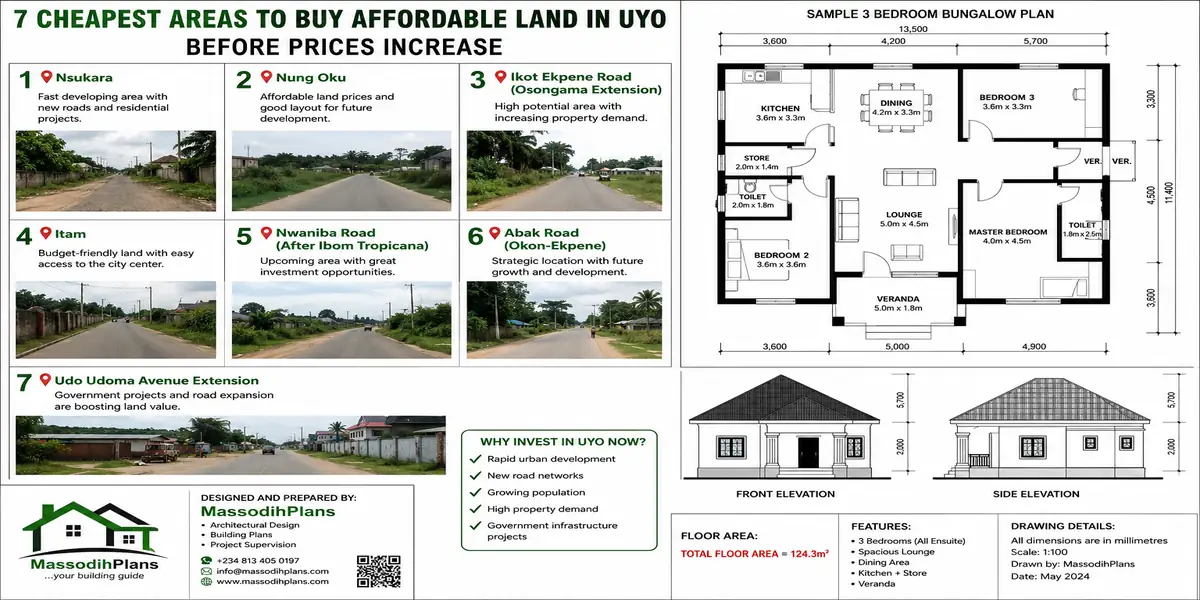
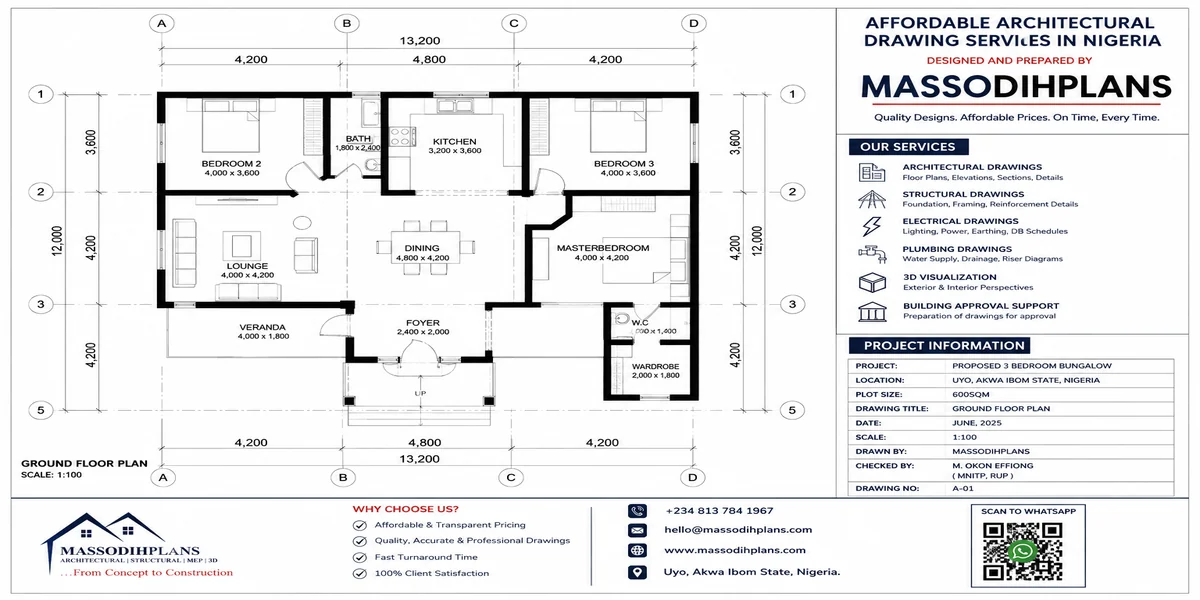
The best Nigerian house plans for Australian property investment are 2- or 3-bedroom bungalows, 3- or 4-bedroom duplexes, and multi-unit apartments, depending on your budget, land size, target tenants and rental-income goals. If you want a practical property that is easier to manage from Australia, a well-designed bungalow may be a sensible starting point. However, if your land is in a location with strong demand for rental accommodation, a multi-unit apartment could offer better income potential. The key is choosing a design that balances construction costs, tenant demand, maintenance and long-term property value.
Perhaps you live in Sydney, Melbourne, Perth or Brisbane and want to invest in Nigerian property without constantly travelling home to supervise construction. You may already own land, or you may still be deciding where to build and how much money to commit. Whatever your situation, choosing the wrong house plan can tie up your savings in a property that costs more to build than it can reasonably earn.
The challenge goes beyond architectural design. You must consider exchange-rate changes, building-material prices, reliable contractors, remote project supervision and the rental market in your chosen Nigerian city. A beautiful duplex is not automatically a better investment than a modest bungalow, and building more rooms does not always guarantee higher returns.
In this guide, we will compare the most suitable house plans for Nigerians investing from Australia, explain which designs may fit different budgets, and explore the features that can improve rental appeal. You will also discover how to avoid costly design and construction mistakes before sending money home. Before choosing your house plan, there is one important investment decision you should make first.
Why “Australian Property Investment” and “Nigerian House Plans” Are the Same Conversation
Here’s the thing people miss: if you’re earning in AUD and building in Nigeria, you’re not just choosing a house design you’re making a cross-border investment decision, and the plan you pick is the single biggest lever you control over whether that investment performs.
A house plan isn’t just a floor layout. It determines:
- Plot size required (which determines land cost, your biggest controllable variable)
- Rental yield potential (a self-contain block earns differently than a single-family duplex)
- Construction complexity (which determines how much can go wrong while you’re not there to watch)
- Resale and appreciation profile (some plans age well in the Nigerian market; others don’t)
So the real question isn’t “which Nigerian house plan is nicest.” It’s “which plan gives me the best return on AUD converted to Naira, built on the smallest sensible plot, with the least risk while I’m supervising from 9,000 kilometres away.” That’s the question this guide actually answers.
Before you fall in love with any plan, work backward from your plot size and target rental income, not forward from a design you saw on Instagram. The plan should fit the investment goal not the other way round.
The Four House Plans That Actually Perform as Investments on Small Nigerian Plots
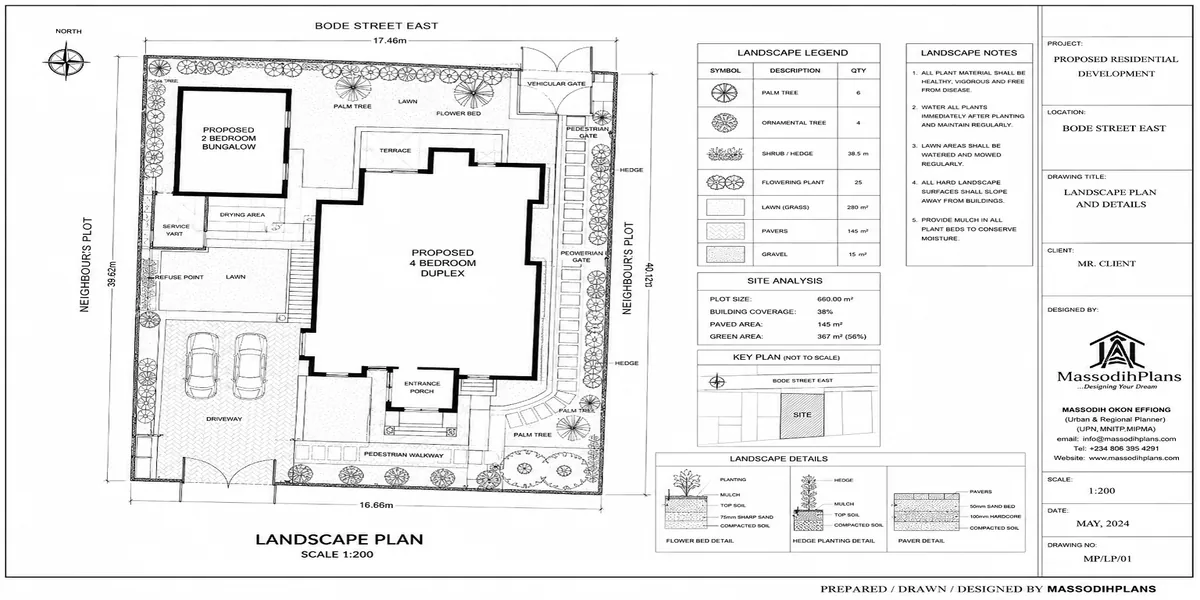
Small plots typically 450 to 650 square metres, common across most Nigerian residential layouts are where the majority of diaspora investors are actually buying. Here’s how the main plan types stack up for that reality.
1. The 3-Bedroom Bungalow
Best for: First-time diaspora investors wanting a straightforward build with predictable rental demand.
A 3-bedroom bungalow on a standard plot is the lowest-risk entry point. It needs no staircase, no complex structural engineering, and it matches what the largest segment of Nigerian tenants actually want and can afford. The trade-off is lower yield per plot compared to multi-unit designs, since you’re only renting (or occupying) one unit per piece of land.
2. The 4-Bedroom Duplex (Owner-Occupier + Future Rental Hybrid)
Best for: Investors who may relocate back to Nigeria eventually, or who want a hybrid live-in/rent-out strategy.
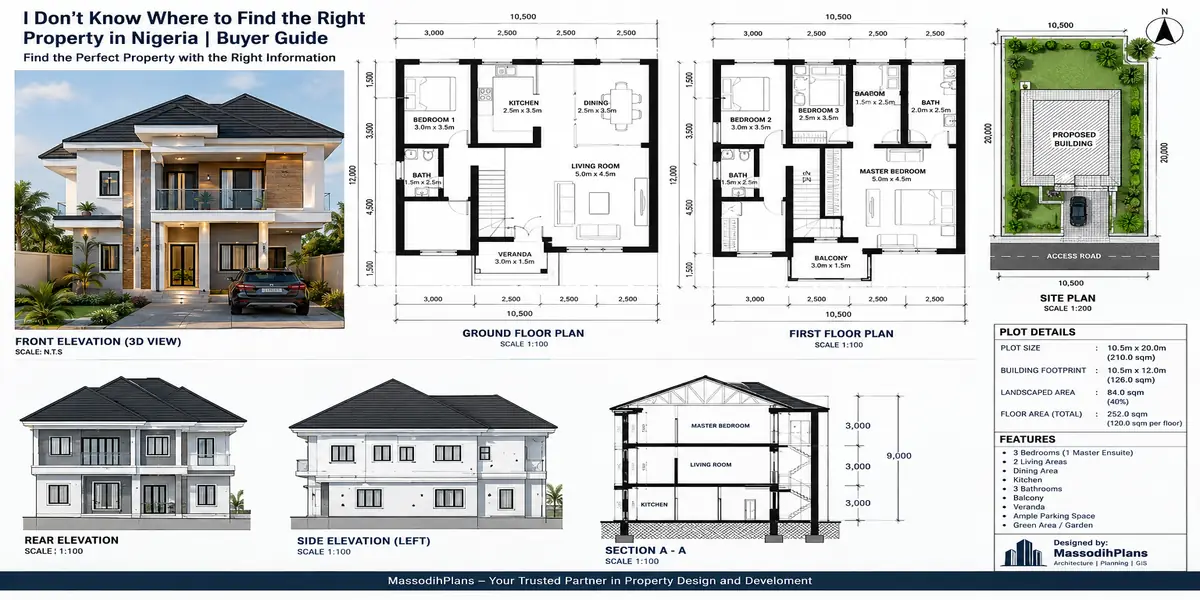
This is the plan most people picture when they say “build my own house,” and it works well on a small plot because the vertical layout uses land efficiently. The ground floor can be rented or used for extended family while the upper floor is reserved for eventual personal use a common and financially sensible hybrid strategy among Australia-based clients I’ve worked with.
3. The Self-Contain / Mini-Flat Block (3–6 Units)
Best for: Investors prioritizing yield over personal use.
This is, plot for plot, usually the strongest pure rental-yield performer on a small urban or peri-urban plot. Instead of one household, you’re collecting rent from three to six separate tenants on the same land footprint. It demands more upfront design precision (shared services, separate meters, fire and ventilation compliance per unit) but the yield math which we’ll run below usually justifies the added complexity.
4. The Twin Duplex (Build One, Sell One)
Best for: Investors wanting to recover a large portion of capital quickly while keeping one unit.
A twin duplex on a slightly larger plot lets you sell one unit to recover construction capital (partially offsetting your AUD-to-Naira exposure) while retaining the second as a rental or personal asset. This is a more advanced strategy and depends heavily on local resale demand in your chosen location.
Now let’s connect this to the number that actually matters to you: the money.
The Real Math: AUD, Naira, and What a Plan Actually Costs You
This is the section most guides skip entirely, and it’s the one that determines whether your investment makes sense at all.
Step 1: Convert Your Build Budget Correctly
Let’s say you’ve budgeted AUD $60,000 for construction (excluding land). At an illustrative exchange rate of 1 AUD = ₦980 (always check the live rate before committing, since this moves regularly):
Naira Budget = AUD Budget × Exchange Rate
Naira Budget = 60,000 × 980 = ₦58,800,000
That figure is your actual construction ceiling and it should be checked against a current Bill of Quantities, not an estimate from a contractor’s WhatsApp message.
Step 2: Calculate Your Net Rental Yield
This is the formula every diaspora investor should run before committing to a plan, and almost nobody does:
Net Rental Yield (%) = (Annual Rental Income − Annual Operating Costs) ÷ Total Investment Cost × 100
Where Total Investment Cost = Land + Construction + Professional Fees + Approval Costs + Contingency (typically 10–15% of construction cost).
Worked example — Self-Contain Block (4 units):
- Land: ₦15,000,000
- Construction: ₦55,000,000
- Professional fees + approvals: ₦4,000,000
- Contingency (12%): ₦6,600,000
- Total Investment Cost: ₦80,600,000
- Rent per unit: ₦600,000/year × 4 units = ₦2,400,000/year
- Annual operating costs (maintenance, agent fees, minor repairs, vacancy allowance): ₦350,000
- Net Annual Income: ₦2,050,000
Net Rental Yield = 2,050,000 ÷ 80,600,000 × 100 = 2.5%
Compare that to the same capital in a single 4-bedroom duplex rented as one unit:
- Total Investment Cost: ₦85,000,000
- Annual rent: ₦1,800,000
- Operating costs: ₦150,000
- Net Annual Income: ₦1,650,000
Net Rental Yield = 1,650,000 ÷ 85,000,000 × 100 = 1.94%
The self-contain block outperforms the single duplex on pure yield, which is a pattern that holds across most of the small-plot comparisons I run for clients more separately rentable units per plot almost always beats one larger unit, up to the point where management complexity starts eating the gain.
Step 3: Calculate Your Break-Even Period
Break-Even Period (years) = Total Investment Cost ÷ Net Annual Rental Income
For the self-contain example above: 80,600,000 ÷ 2,050,000 = 39.3 years on rental income alone. This is a number that surprises most people, and it’s exactly why Nigerian residential rental property is rarely a pure income play the actual investment case rests heavily on capital appreciation, which we address next.
Nigerian residential rental yields, calculated honestly, are usually lower than headline figures you’ll see quoted online. The real investment case for most diaspora buyers is land and property appreciation over a 5–10 year horizon, combined with modest rental income not rental yield alone. Budget with that reality, not an inflated yield projection.
Step 4: Factor In Currency Risk, Not Just Exchange Rate Level
The AUD-NGN rate on the day you transfer money is not the only number that matters the volatility between your decision date and your transfer date matters just as much, especially for a six-figure Naira transfer.
Currency Exposure Formula:
Exposure Risk (₦) = Naira Budget × (Rate Volatility % over your transfer window)
If your transfer window is 3 months and AUD-NGN has moved 8% in a similar past 3-month window, your ₦58,800,000 budget carries roughly ₦4,704,000 of exchange rate exposure money you could gain or lose purely from timing, before a single block is laid. This is why staggering transfers across a build (rather than sending everything at once) and working with a quantity surveyor’s staged payment schedule is standard advice I give every Australia-based client, not just a nice-to-have.
Plot Size and Design Efficiency: Getting More House Per Square Metre
Since small plots are the reality for most diaspora investors (land cost being the single biggest controllable variable), design efficiency matters more here than in a large-plot project.
Design Efficiency Ratio = Usable Built Floor Area ÷ Total Plot Area
A well-designed small-plot plan typically achieves 35–45% efficiency once you account for mandatory setbacks, parking, and compound space. A poorly planned design common when people adapt a plan drawn for a much larger plot can drop this below 25%, meaning you’re paying full land price for space you can’t actually use.
| Plot Size | Typical Setback Loss | Realistic Buildable Footprint | Suggested Plan Type |
|---|---|---|---|
| 450 sqm | ~35% | ~290 sqm | 3-bedroom bungalow |
| 550 sqm | ~32% | ~375 sqm | 4-bedroom duplex |
| 650 sqm | ~30% | ~455 sqm | Self-contain block (4–6 units) or twin duplex |
This is precisely why a plan “bought off the internet” without adaptation to your specific plot so often disappoints — the setback math simply wasn’t run against your actual land before you fell in love with the facade.
Supervising Construction From Australia: The Problem Nobody Prices In
You can get the plan and the math perfect and still lose money if construction isn’t properly supervised and supervision is genuinely harder from Melbourne or Sydney than from Lagos, for one simple reason: the clock.
The Time Zone Problem
Nigeria runs on WAT (UTC+1). Australia’s east coast runs AEST/AEDT (UTC+10/+11), and Western Australia runs AWST (UTC+8). That means when your site supervisor is starting work at 8am in Nigeria, it’s 4pm or 5pm in Sydney and 3pm in Perth a narrow but workable overlap window, usually the Nigerian morning against your Australian afternoon.
Practical fix: Schedule a fixed weekly video call in that overlap window (typically Nigerian 8–10am / Australian eastern 4–6pm), rather than relying on ad-hoc WhatsApp updates, which tend to arrive only when something has already gone wrong.
The Trust Problem
This is the one that actually costs people money. Without physical presence, the biggest risks are material substitution (cheaper materials billed at quoted-quality prices), phantom progress claims, and scope creep.
Hire an independent quantity surveyor or supervising architect someone not employed by your builder to sign off on each construction stage before you release the next payment tranche. This single decision prevents the majority of diaspora construction fraud cases I’ve seen, and it costs a small fraction of what it protects.
A Staged Payment Structure That Actually Works
Instead of a lump sum or vague percentage releases, tie payment strictly to verified physical stages:
| Stage | % of Budget Released | Verification Required |
|---|---|---|
| Foundation complete | 20% | Independent inspection + photos/video |
| Superstructure (block work + roofing) | 35% | Independent inspection + photos/video |
| Finishing (first fix: plumbing/electrical) | 25% | Independent inspection + photos/video |
| Final finishing and handover | 20% | Independent inspection + final walkthrough |
Never release the next tranche purely on a contractor’s say-so. This structure, combined with the weekly call rhythm above, is the closest thing to being there in person that distance allows.
Legal and Paperwork Considerations Specific to Building From Abroad
A few things worth sorting out before money moves, not after:
Power of Attorney (PoA): If you can’t be physically present to sign approval documents or land transaction papers, a properly drafted and notarized PoA lets a trusted representative act on your behalf get this reviewed by a Nigerian-qualified lawyer, not a generic template.
Certificate of Occupancy (C of O) verification: Confirm the land’s title status independently before transferring any significant sum this is the single most common point of diaspora investment fraud in Nigeria.
Building plan approval: Your plan must be formally approved by the relevant state planning authority before construction starts, regardless of where you, the owner, are living.
Remittance documentation: Keep clear records of each transfer for your own financial planning and in case of any future currency-related tax questions in Australia this is a conversation worth having with an Australian tax adviser, since this guide covers the Nigerian building side, not Australian tax law.
Why This Matters Beyond Australia Too
If you’re reading this from the UK, Germany, the UAE, Canada, Switzerland, Qatar, Singapore, Iceland, or Luxembourg instead of Australia, almost everything above still applies to you directly only the exchange rate pair and your specific time zone overlap window change. A GBP, EUR, AED, CAD, CHF, QAR, SGD, ISK, or LUF-equivalent earner building in Nigeria faces the same four decisions: which plan performs best on a small plot, how currency timing affects your real budget, how to structure staged payments, and how to manage the trust gap that distance creates. The formulas in this guide don’t change only the numbers you plug into them do.
Common Mistakes Australia-Based Investors Make
Choosing a plan based on appearance alone, without running the yield and efficiency numbers against their specific plot size
Sending the full construction budget in one transfer, maximizing currency risk instead of spreading it across staged payments
Relying entirely on the contractor for progress verification, with no independent supervising professional
Skipping the soil test and land title verification to “save time,” which is almost always the most expensive shortcut taken on a diaspora project
Underestimating setback losses on a small plot, leading to a design that doesn’t actually fit once surveyed properly
Frequently Asked Questions
Which Nigerian house plan gives the best rental yield on a small plot?
A self-contain or mini-flat block (3–6 units) typically outperforms a single-family duplex on pure rental yield per plot, as shown in the worked example above, because you’re collecting rent from multiple units on the same land footprint.
How much does exchange rate timing actually matter for an AUD-to-Naira build budget?
Significantly. A few months of AUD-NGN volatility can shift your effective Naira budget by several percentage points, which is why staged transfers tied to construction milestones reduce risk compared to one lump-sum transfer.
Can I supervise construction in Nigeria entirely from Australia without visiting?
It’s possible but higher-risk. The combination of an independent supervising professional, a fixed weekly video call in the Nigeria-Australia overlap window, and strict stage-verified payments significantly reduces that risk, even without a site visit.
Is a bungalow or a duplex a better investment on a small plot?
A bungalow is lower-risk and matches the largest tenant demand segment; a duplex uses land more efficiently and suits an owner-occupier-plus-rental hybrid strategy. Neither is universally “better” it depends on your yield goals and whether you intend to eventually live in it.
Do I need a lawyer in Nigeria if I’m building from Australia?
Yes. A Nigerian-qualified lawyer should review your Power of Attorney, verify land title documents, and confirm building plan approval status this is not a step to handle informally from abroad.
Finally
The best Nigerian house plan for your Australian property investment isn’t the one that looks best in a render it’s the one whose plot efficiency, yield math, and risk profile actually match what you’re trying to achieve, with a payment and supervision structure built around the reality that you’re managing this from the other side of the planet. Run the numbers in this guide against your actual plot and budget before you commit to anything, and you’ll be ahead of most people making this decision on instinct alone.
If you’re ready to move from planning to paper, browse our Plans Library for small-plot designs already matched to the plan types covered here, or visit Plan School to understand approval requirements before you commission a design. For direct support structuring a diaspora build including staged supervision our Services page outlines how we work with clients abroad specifically. You can also explore more diaspora and investment guides on our Homepage.
- How Can I Build a House in Nigeria From Canada on a Small Plot?
- What Nigerian House Plans Are Best for Canadian Property Investors?
- How Do I Get Land Survey and Building Approval in Nigeria From Canada?
- How Can I Build a House in Nigeria From the UK on a Small Plot?
- How Can I Build a House in Nigeria From Australia on a Small Plot?
Author
Massodih Okon is a Nigerian built-environment professional with academic and professional experience in urban and regional planning, geography, architectural design, Landscape Design, GIS and land development.
He holds a Master’s degree in Urban and Regional Planning from the University of Uyo and a first degree in Geography and Regional Planning.
Through MassodihPlans, he publishes practical guides on Nigerian house plans, building design, physical planning, site planning, development approval and residential construction. Read the full author profile →