Building Cost and Construction Cost
Let me tell you what usually happens. Someone calls me, tells me they have ₦40 million and want a 4 bedroom duplex, and asks if that’s enough. I ask them one question back: “Enough for what, exactly?” And that’s usually where the conversation gets honest, because most people asking “how much does it cost to build a house” are not really asking about money. They’re asking whether their dream is realistic, and they want someone to just tell them the truth instead of a number pulled from a 2023 blog post or a contractor’s optimistic guess.
So let’s have that honest conversation. Not a rehash of what every other site says, but the actual mechanics of building cost and construction cost in Nigeria today what the words even mean, why the numbers you’re finding online contradict each other, what materials actually cost right now, and how to build a budget that won’t collapse halfway through your roofing stage.
First, a Distinction Nobody Bothers to Make: Building Cost vs Construction Cost
These two terms get used as if they’re the same thing. They’re not, and the difference matters more than you’d think.
Construction cost refers strictly to the physical work of putting up the structure foundation, block work, roofing, finishing, the labour and materials that go directly into the building itself.
Building cost is the wider number construction cost plus everything else that has to happen before you can call the house yours: land, professional fees, government approvals, site preparation, and often the “invisible” costs like fencing, borehole, and generator that never make it into the headline figure everyone quotes you.
Here’s why this matters practically: when a contractor tells you “₦25,000 per square metre,” they are almost always quoting construction cost only. When you’re planning your total budget, you need building cost. This single confusion is responsible for more mid-project financial panic than almost anything else I’ve seen in 15 years on Nigerian sites. People budget the construction figure, then get blindsided by land documentation, approval fees, and external works they never accounted for.
Please whenever anyone quotes you a cost online, from a contractor, from a friend who “just built” ask them directly: “Is this construction cost only, or does it include land, fees, and external works?” You will be surprised how often the answer changes the number by 30% or more.
Why the Numbers You’re Finding Online Don’t Agree With Each Other
If you’ve searched “cost of building a house in Nigeria” and found figures ranging from ₦20,000 to ₦180,000 per square metre, you’re not losing your mind. Two real things are colliding.
Regional variation is genuine. Building in Lagos or Abuja can cost 40 to 60% more than building the identical house in Ekiti, Yola, or parts of Akwa Ibom, purely because of land value, transport cost to site, and labour rates.
Time decay is brutal right now. Cement is the clearest example. In January 2026, a 50kg bag sold for between ₦9,300 and ₦9,700. By July 2026, the same bag had climbed to between ₦13,000 and ₦15,000 in several parts of the country a jump of roughly 40 to 50% in six months. If you’re reading a “cost of building” article that doesn’t tell you when its prices were checked, treat every figure in it as historical, not current.
This is the part almost no cost guide admits: any number you read today, including the ones in this article, has a shelf life. What I can give you that doesn’t expire is the method how to calculate a realistic budget yourself, using current prices, so you’re never dependent on someone else’s outdated table.
How Much Does It Cost to Build a House? The Honest Range
With that time-sensitivity warning firmly in place, here’s where things actually sit as of mid-to-late 2026, for a standard residential building on firm soil, excluding land:
- Basic/economy finish: ₦180,000 – ₦260,000 per square metre
- Standard/mid-range finish: ₦260,000 – ₦380,000 per square metre
- High-end/luxury finish: ₦400,000 – ₦650,000+ per square metre
These per-square-metre bands sit noticeably above what you’d have seen quoted even a year ago, and that’s not inflation-adjusted padding it’s the direct downstream effect of cement, steel, and every cement-dependent material (blocks, plastering, columns, foundation) climbing sharply through 2026. Cement in Nigeria has roughly doubled in naira terms since 2024, and that single material touches almost every stage of construction, from foundation to finishing.
Do not lock in a budget based on a per-square-metre rate you found three months ago. Call two or three suppliers directly, get today’s cement, steel, and block prices, and recalculate. A budget built on stale numbers is a budget that runs out before the roof goes on.
Cost Per Square Metre vs Cost Per Square Foot: The Number Everyone Gets Confused About
Nigerian construction almost always prices in square metres, but a lot of the searches bringing people to guides like this use “cost per square foot” usually because of exposure to American content, diaspora clients converting from a different measurement system, or design software defaulting to feet.
Here’s the conversion that solves 90% of that confusion: 1 square metre equals roughly 10.76 square feet. So if a builder quotes you ₦300,000 per square metre, that’s roughly ₦27,900 per square foot. If you’ve been given a cost-per-square-foot figure from a foreign source and you’re trying to apply it to Nigerian construction, stop foreign per-square-foot rates almost never transfer, because labour cost structure, material sourcing, and building codes are fundamentally different. Always get your rate from someone actually pricing Nigerian materials and Nigerian labour, in whichever unit you’re comfortable with, then convert for your own understanding rather than importing a foreign number.
Building Materials Cost: What Things Actually Cost Right Now
This is the section most cost guides either skip or get badly outdated. Because material prices are the input everything else is built from, here’s where the major items stood as of mid-2026, so you have a real starting point to verify against current supplier quotes.
Cement (50kg bag): ₦13,000 – ₦15,000 (up sharply from ₦9,300–₦9,700 in January 2026)
Iron rods/reinforcement (16mm, per length): pricing has been genuinely volatile, tracking both international steel prices and naira movement always get a same-week quote before budgeting
Sand and granite (per ton): roughly ₦50,000 – ₦60,000, relatively flat compared to cement but still transport-sensitive
Sandcrete blocks (9-inch, per unit): moves in direct proportion to cement price, since cement is the primary input in block production
Roofing sheets: aluminium long-span remains the most economical option; stone-coated tiles and step tiles sit meaningfully higher and are more exposed to import/FX pressure
Imported finishing items (sanitary fittings, specialised steel, some tiles, MEP components): carry both price and availability risk whenever the naira weakens against the dollar, because these categories are heavily import-dependent
Analysts tracking this consistently point out that building materials account for 35 to 75 percent of total construction cost, which is exactly why a spike in one input like cement ripples through your entire budget rather than staying contained to one line item.
Please never budget off a materials list you didn’t personally verify this week. Prices move fast enough right now that a “current” price from even six weeks ago can already be wrong by 15 to 20%. Call your supplier, get today’s number, and build your estimate from that not from any article, including this one.
Construction Estimate vs Construction Budget: Two Different Documents You Need
People use “estimate” and “budget” interchangeably, but treating them as the same document is exactly how projects run out of money.
A construction estimate also called a Bill of Quantities (BOQ) is a detailed, professionally prepared document listing every material and labour item needed for your specific design, with quantities and current unit prices, produced by a quantity surveyor. This is not a rough guess. It’s a line-by-line calculation based on your actual drawings.
A construction budget is your financial plan how much you have, how it’s allocated across stages, and what contingency you’ve set aside. A good budget is built from the estimate, not from a vague “I have ₦50 million, let’s see how far it goes” approach.
Here’s the sequence that actually works, and it’s the opposite of how most self-builders do it:
- Get your architectural and structural drawings finalized
- Commission a proper Bill of Quantities from a quantity surveyor based on those drawings
- Build your budget from the BOQ, not the other way around
- Add a contingency of 10 to 15% on top for price movement and unforeseen site conditions
- Only then start sourcing materials and hiring labour
Most budget disasters I’ve seen start with step 5 happening before step 2 someone starts buying cement and laying blocks based on a rough head-count of what they think they’ll need, discovers halfway through that the real quantity is 40% more than guessed, and now has to source additional funds mid-construction, often at worse prices than if they’d budgeted properly from day one.
How Construction Cost Calculators Actually Work (And Their Real Limits)
A lot of people search for a “building cost calculator” hoping to punch in a few numbers and get a trustworthy figure. I want to be straight with you about what these tools can and can’t do.
The basic formula behind every construction calculator is simple:
Total Construction Cost = Total Floor Area (in sqm) × Cost Per Square Metre (for your chosen finish level)
So if you’re planning a 250 sqm house at standard finish (say ₦320,000/sqm as a mid-point of the range above): 250 × ₦320,000 = ₦80,000,000 for construction alone.
That’s the calculation almost every online calculator is doing behind the scenes, dressed up with a nicer interface. Here’s what it cannot do:
- It cannot account for your specific soil condition, which affects foundation type and cost significantly
- It cannot price your actual design complexity a house with cantilevers, curves, or extensive glazing costs more than a simple rectangular footprint at the same floor area
- It cannot reflect today’s material prices unless it’s updated constantly, which most calculators aren’t
- It cannot substitute for a proper Bill of Quantities once you’re actually ready to build
Use a calculator for an early, rough sense of scale when you’re still dreaming and comparing options. Never use it as your final budget. The moment you have real drawings, get a real BOQ.
Please Note, If a calculator or online estimator gives you a number that feels “too good,” check when its rates were last updated. Most abandoned or poorly maintained construction calculators are running on 2023 or 2024 pricing, and in a market where cement alone has moved 40% in six months, that gap will mislead you badly.
Cost to Build by House Type: Bungalow, Duplex, and Storey Buildings
The house type you choose changes your cost structure, not just your total number.
Bungalow (single storey): No staircase, no upper-floor structural load, generally the lowest structural cost per square metre. But it needs a larger footprint for the same room count, meaning more land and a longer foundation and roof span. Bungalows are the more forgiving option on difficult soil, since you’re not stacking floors on a foundation that has to carry additional weight.
Duplex (two-storey): Uses land more efficiently you get more living space on a smaller plot. But you’re adding staircase construction, additional structural reinforcement to carry the upper floor, and generally a more demanding foundation, especially on softer or waterlogged soil common in parts of the Niger Delta and coastal Lagos. Expect duplex construction cost per square metre to sit 10 to 20% above an equivalent bungalow, purely from the structural load difference.
Terrace/semi-detached layouts: Share walls between units, which can reduce material cost per unit compared to fully detached buildings of the same size, but require careful attention to fire separation, privacy, and shared drainage design between units.
Cost to Build by Bedroom Count: 3, 4, and 5 Bedroom Houses
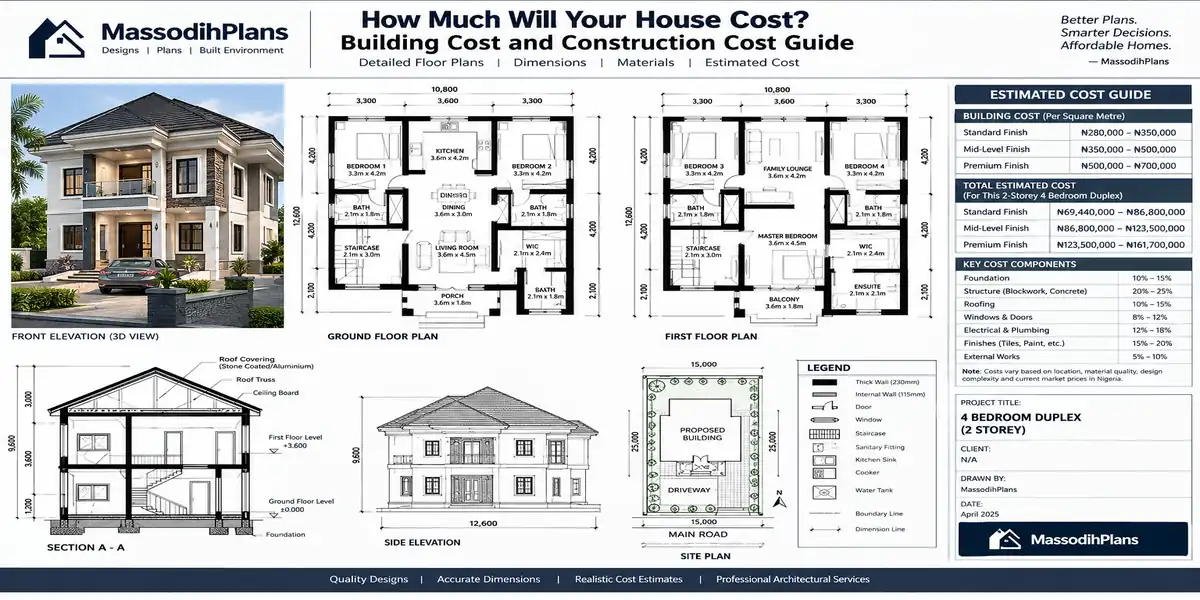
Bedroom count is a rough proxy for size, but it’s not a precise one a 4 bedroom house can range from 180 sqm to 350 sqm depending on how generously each room, and the surrounding public spaces, are sized. Here’s a realistic floor area range and resulting construction cost band for each, at standard/mid-range finish:
3 bedroom house: typically 150–220 sqm → roughly ₦39,000,000 – ₦83,600,000 in construction cost alone, before land, fees, and external works
4 bedroom house: typically 220–320 sqm → roughly ₦57,200,000 – ₦121,600,000 in construction cost alone
5 bedroom house: typically 300–420 sqm → roughly ₦78,000,000 – ₦159,600,000 in construction cost alone
These ranges are wide on purpose they reflect the real spread you’ll see depending on finish quality, soil condition, and design complexity. Don’t anchor on the low end of your bracket unless you’re deliberately building basic; anchor on the mid-point and treat the low end as best-case.
Take Note Please, Instead of asking “what does a 4 bedroom house cost,” ask “what floor area am I actually planning, and at what finish level.” Bedroom count is a conversation starter, not a budgeting tool two “4 bedroom houses” can differ in cost by ₦50 million purely on floor area and finish.
What Fifteen Years on Site Has Taught Me About Where Budgets Actually Go Wrong
Every self-builder thinks their project will be the exception. Almost none are. Here’s what I actually see, repeatedly, across real projects:
The budget usually survives foundation and block work intact. It starts cracking at roofing, because roofing materials are among the most price-volatile items and people budgeted them at last year’s rate. It cracks further at finishing, because finishing is where “just one more upgrade” better tiles, a nicer kitchen, imported fittings quietly adds 20 to 30% to a budget that felt comfortable at the structural stage. And it often breaks entirely at external works, because fencing, gate, compound paving, and landscaping get treated as an afterthought and left with whatever money happens to be left, which by that stage is usually not enough.
The projects that finish on budget almost always share one habit: they price the entire project, including external works and contingency, before laying the first block not after.
The Hidden Costs Nobody Warns You About
This is the layer that separates a real building cost conversation from a construction cost conversation, and it’s where most guides stop short.
Land documentation and title perfection Governor’s Consent, survey plan, and legal fees, which can run into millions depending on the state and process
Approval fees building plan approval through your state planning authority, which varies by state and plot size but is never optional
Soil test often skipped to save a few hundred thousand naira, and the single most expensive corner to cut if it turns out your soil needed a different foundation type than assumed
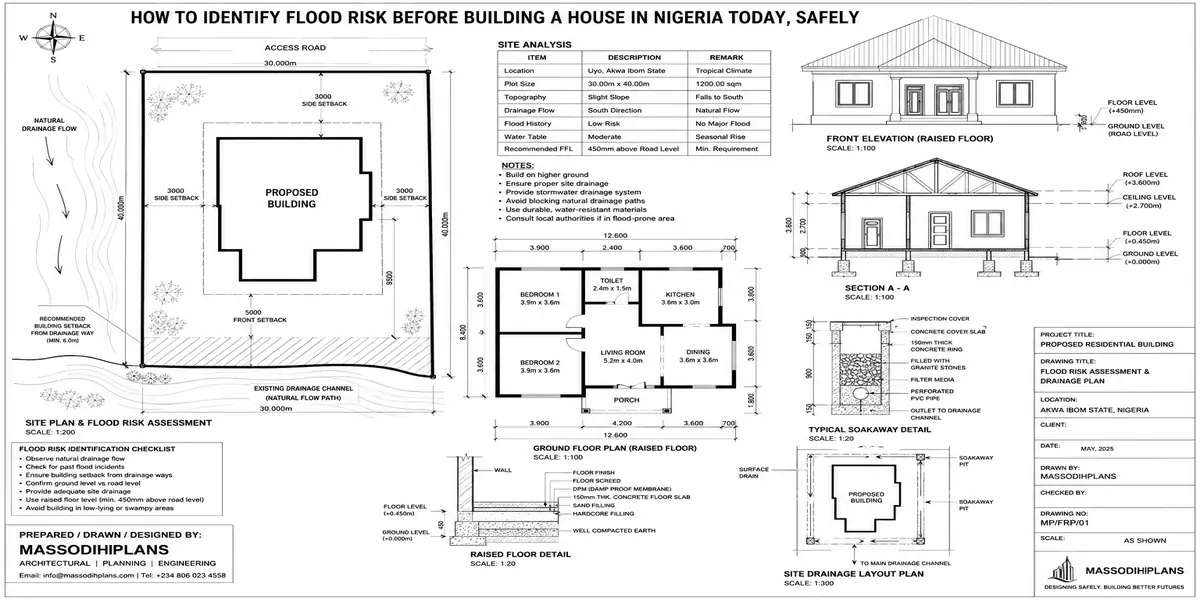
Site preparation clearing, access road creation if none exists, and sometimes filling on low-lying plots, which is a real and substantial cost on waterlogged sites
Professional fees architect, structural engineer, and quantity surveyor, typically 6 to 15% of construction cost combined depending on project complexity
Borehole and water supply genuinely necessary in most areas given inconsistent public water supply, and not cheap
Generator/inverter and power provisioning increasingly treated as essential rather than optional given grid reliability
Fencing, gate, and security often budgeted as an afterthought despite being a significant cost on larger plots
Artisan feeding and site welfare a genuinely real, recurring cost on Nigerian sites that almost never appears in any online cost table, but adds up meaningfully over a 12 to 18 month build
Add these together and you’re routinely looking at an additional 25 to 40% on top of pure construction cost to arrive at your real, total building cost. This is precisely the gap that catches people who budgeted only the construction figure they found online.
How Building Cost Actually Affects Your Family’s Life While You Build
Nobody talks about this part, but it matters as much as the money. Building in Nigeria rarely happens in one clean, funded sprint it happens in phases, often stretched across income cycles, sometimes years. That reality shapes decisions the cost tables never mention:
If you’re building in phases, sequence matters enormously. Get the structure weatherproof (foundation through roofing) before funds run thin, because a roofed, unfinished shell can sit safely for months or years waiting for the next phase of funding. A building stopped mid-foundation or mid-block-work is far more exposed to damage, theft of materials, and structural risk from exposure to rain.
If you’re living in a rented apartment while building, factor that overlapping rent into your total household budget, not just your construction budget many families underestimate how long the “double payment” period (rent plus building costs) actually stretches, and it quietly drains funds that were meant for finishing.
If you have children, timing school transitions around your move-in date, rather than the reverse, avoids disrupting their education around a construction schedule that construction, being construction, will almost certainly delay somewhat.
Building as an Investment: Why the Cheapest Cost Isn’t the Best Cost
Here’s a mindset shift worth making early. The goal isn’t the lowest construction cost it’s the best cost-to-value ratio over the life of the building.
Cutting corners on foundation, roofing, or plumbing to save money upfront routinely costs more within five years through repairs, water damage, or structural remediation than the amount “saved” during construction. A slightly higher upfront spend on a proper soil test, quality roofing, and correctly specified reinforcement is not a luxury it’s the cheapest insurance against far larger future costs.
On resale or rental value, buildings with documented approval, sound structural work, and decent finishing consistently command better prices and attract better tenants than similarly sized buildings built to cut costs. If you ever plan to sell, refinance, or rent out the property, the money spent on getting it right the first time shows up again on the other side.
Red Flags: How to Avoid Cost Padding and Budget Fraud
A few patterns worth watching for, because they show up often enough to name directly:
- A contractor who won’t itemize costs and only gives you a single lump figure always insist on a breakdown
- Quotes for materials significantly below current market rate, which often signals either substandard materials or a bait-and-switch where the real cost surfaces mid-project
- Verbal agreements with no written scope, payment schedule, or specifications get everything in writing, tied to a Bill of Quantities
- Pressure to release large upfront payments before any material is delivered or work begun stage your payments against verified progress, not promises
Listen Please, Before You Build: Never pay for a full stage of work upfront. Pay against verified progress and delivered materials, and keep your quantity surveyor or a trusted independent party involved in verifying that quantity supplied matches quantity paid for. This single habit prevents most of the cost fraud I encounter on Nigerian sites.
Ways to Reduce Construction Cost Without Reducing Quality
- Buy cement and other volatile-priced materials in bulk when prices dip, rather than piecemeal as construction progresses
- Choose a compact, efficient floor plan over one with unnecessary architectural complexity that adds cost without adding usable space
- Get your Bill of Quantities before construction, not a verbal estimate this alone prevents most overruns
- Use a fixed-price contract with a reputable, verifiable contractor rather than open-ended cost-plus arrangements
- Avoid design changes mid-construction, which is one of the most common and expensive sources of budget overrun
- Phase your finishing if needed tiling, paint, and fittings can be upgraded later; a compromised foundation or roof cannot
Frequently Asked Questions
How much does it cost to build a house in Nigeria right now?
For a standard mid-range finish, expect ₦260,000 to ₦380,000 per square metre in construction cost alone, before land, fees, and external works and always verify current material prices before finalizing, since this market moves fast.
What is a good cost per square foot to build a house?
Nigerian construction is typically priced per square metre, not square foot. Converting a per-square-metre rate (roughly ₦260,000–₦380,000 for standard finish) gives approximately ₦24,000–₦35,300 per square foot, but always source your rate from someone pricing local materials and labour rather than importing a foreign figure.
Is a construction cost calculator accurate?
Only as a rough starting estimate. Calculators use a basic floor-area-times-rate formula and cannot account for your specific soil, design complexity, or truly current material prices. Use one for early planning, then replace it with a proper Bill of Quantities once you have real drawings.
What’s the difference between a construction estimate and a construction budget?
An estimate (Bill of Quantities) is a professionally prepared, itemized list of materials and costs based on your actual drawings. A budget is your financial plan built from that estimate, with contingency added building your budget before you have an estimate is one of the most common causes of cost overruns.
Why do building material prices keep rising even when inflation is easing?
Because disinflation means prices are rising more slowly, not falling and materials like cement are additionally exposed to naira depreciation, energy costs, and import dependency on machinery and inputs, which keep pushing prices up even as headline inflation cools.
What percentage of total building cost should I budget for hidden costs?
Beyond pure construction cost, budget an additional 25 to 40% to cover land documentation, approvals, professional fees, borehole, generator, fencing, and site welfare treating construction cost alone as your total budget is the single most common planning mistake.
Conclusion
The honest answer to “how much will your house really cost” is that nobody can give you a single trustworthy number without knowing your location, your floor area, your finish level, and today’s material prices and anyone who gives you a confident flat figure without asking those questions is guessing. What I can give you, and what I hope this guide has actually done, is the method: understand the difference between building cost and construction cost, verify materials at today’s prices, get a proper estimate before you build a budget, and price the hidden costs before you break ground, not after.
If you’re ready to move from estimating to actual drawings, browse our Plans Library for house plans with realistic Nigerian floor areas already worked out, or visit Plan School to understand the planning and approval process before you commission a design. For direct support building your Bill of Quantities and budget, our Services page outlines how we work with clients from concept through construction. You can also explore more cost and building guides on our Homepage. Read the following also to guide you:
- House Plans and Floor Plans: How to Choose the Right Layout for Your Needs
- My Tenant Won’t Leave. What Can I Do? Legal Steps for Landlords in Nigeria and Beyond
- How Do I Evict a Tenant? 10 Legal Steps for Landlords in Nigeria and Beyond
- How Do I Screen a Tenant? 10-Step Tenant Screening and Verification Guide for Landlords
- How Do I Find Good Tenants? Complete Tenant Screening for Property Owners
Author
Massodih Okon is a Nigerian built-environment professional with academic and professional experience in urban and regional planning, geography, architectural design, Landscape Design, GIS and land development.
He holds a Master’s degree in Urban and Regional Planning from the University of Uyo and a first degree in Geography and Regional Planning.
Through MassodihPlans, he publishes practical guides on Nigerian house plans, building design, physical planning, site planning, development approval and residential construction. Read the full author profile →