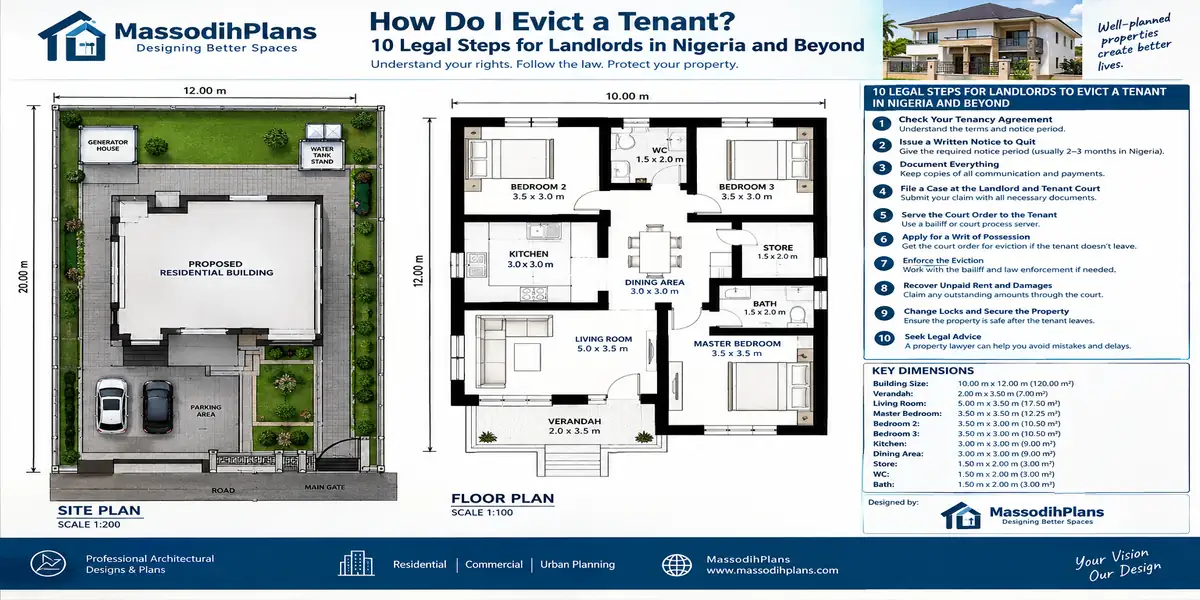
How Do I Evict a Tenant? 10 Legal Steps for Landlords
Introduction to How Do I Evict a Tenant? 10 Legal Steps for Landlords in Nigeria and Beyond
A client called me last year, genuinely panicked. His tenant had stopped paying rent five months earlier, changed the locks on the gate, and was now telling neighbours the house belonged to him “spiritually” because he’d lived there so long. My client’s first instinct and I understand it completely was to get some boys, wait for the tenant to travel, and change the locks back. I talked him out of it. Not because I felt sorry for the tenant, but because that one decision would have turned him from a landlord with a strong case into a criminal defendant with a weak one.
That’s the conversation I want to have with you here not a recycled list of “notice to quit, then seven days, then court” that every property law blog copies from the same source. I want to walk you through what actually happens, in what order, what it actually costs in time and stress, and more importantly what to do in the messy middle when the tenant is stalling, hiding, or turning aggressive, because that’s the part nobody writes about honestly.
I’ll say this upfront because it matters: I’m not a lawyer, and this isn’t legal advice for your specific case. I’m a Town Planner and Architectural Designer who has sat with enough landlord clients through actual eviction disputes to know where the process breaks down in real life. For court filings and anything contested, you need a property lawyer. What I can give you is the roadmap, the language, and the judgment calls so that when you do talk to a lawyer, you’re not starting from zero.
First, Understand What the Law Actually Protects
Every landlord asking “how do I remove a tenant” wants a fast answer. But before the how, you need the why-it-works, because that’s what stops you from making the one mistake that undoes everything else.
Nigerian law does not let a landlord physically remove a tenant, lock them out, or seize their belongings no matter how long the rent has been unpaid, and no matter whose name is on the title deed. This isn’t a technicality. Courts have repeatedly upheld that only a court order, enforced by the court’s own bailiff, can lawfully put a tenant out of a property, and this principle was reaffirmed by the Supreme Court in Iheanacho v. Uzochukwu. A landlord who forces a tenant out by breaking a lock, removing a roof, cutting off water, or hiring people to intimidate them isn’t taking a shortcut. They’re committing a criminal act, and in most of the eviction disputes I’ve watched fall apart, the landlord who did this ended up owing the tenant more money than the unpaid rent that started the whole thing.
Sit with that for a second, because it reframes everything else in this guide. The process below isn’t bureaucracy slowing you down. It’s the only path that actually ends with you legally back in possession of your property.
If you’re currently thinking about changing locks, cutting power, or removing a tenant’s property while they’re away, stop. Even a tenant who owes you a year’s rent can sue you for illegal eviction and win and Nigerian courts have awarded real damages in these cases. The legal route is slower, but it’s the only one that doesn’t expose you to a lawsuit yourself.
The Real Reasons Landlords Try to Remove a Tenant
Before the steps, let’s name the actual situations you’re probably dealing with, because the right approach depends on which one you’re in:
- Non-payment of rent the most common trigger by far
- The tenancy has simply expired and the tenant hasn’t renewed
- You need the property back for personal use or redevelopment
- The tenant has breached the tenancy agreement subletting without permission, running an unauthorized business from the property, or damaging the structure
- The tenant is a genuine nuisance to neighbours, to the property, or to your ability to manage it
Each of these affects your notice period and your grounds in court, so know clearly which one applies to you before you write anything.
Step 1: Confirm What Kind of Tenancy You Actually Have
This step gets skipped constantly, and it’s why so many eviction attempts collapse in court on a technicality. Your notice period depends entirely on the type of tenancy, not on how frustrated you are.
- Weekly tenancy or tenant-at-will (no formal agreement, occupying with your permission): 1 week’s notice
- Monthly tenancy: 1 month’s notice
- Yearly tenancy: 6 months’ notice
- Fixed-term lease that has simply expired: in many cases, the tenancy determines automatically at the end of the term, though courts still frequently expect a Seven-Day Notice to be issued for fairness before further action.
These periods come from the Recovery of Premises Act (applicable in the FCT and several states) and equivalent state tenancy laws such as Lagos State’s Tenancy Law. If your written tenancy agreement specifies its own notice period, that agreed period usually governs instead of the statutory default so check your agreement first, not the internet.
Pull out your original tenancy agreement before you write a single notice. If it states a notice period different from the statutory one, that clause is what a court will look at first. I’ve seen landlords serve the “correct” statutory notice, only for the tenant’s lawyer to point out the signed agreement said something else restarting the entire clock.
Step 2: Serve a Proper Notice to Quit
This is the actual starting gun of the tenant eviction process, and it has to be done right or everything after it is built on a weak foundation.
What the notice must contain:
- Your full name and the tenant’s full name
- The exact address of the property
- The tenancy type and the notice period being given, calculated correctly from the date of service
- A clear statement that you require possession of the property at the end of that period
- The date and your signature
How to serve it properly:
- Deliver it in person if possible, and have a witness present
- If delivered by hand, get a signature or acknowledgment of receipt
- If the tenant refuses to accept it or is avoiding you, deliver it to an adult at the premises, or send it by registered post/courier and keep the proof of postage
- Keep a copy of everything the notice itself, proof of delivery, and any witness details
This documentation feels excessive when you’re serving it, and becomes priceless the moment a tenant claims in court that they were “never properly notified.” I have watched a solid eviction case nearly collapse because the landlord served the notice verbally and had no proof.
Step 3: If They Don’t Leave, Serve the Seven-Day Owner’s Intention to Recover Possession
Once your Notice to Quit period expires and the tenant is still there, you don’t go straight to court. There’s a second notice the Seven-Day Owner’s Intention to Recover Possession and skipping it is one of the most common reasons eviction cases get thrown out or delayed.
This notice tells the tenant, in writing, that you now intend to apply to court for an order of possession if they don’t leave within seven days. Serve it the same careful way you served the first notice proof of delivery, witness if possible, copies retained.
Almost every article on this topic mentions this notice. What most don’t tell you: this seven-day window is often your best and last chance for a negotiated exit before things get expensive and public. A tenant who has ignored your calls for months will sometimes take this notice seriously precisely because it’s the first document that looks unmistakably legal. Use that moment. A calm final conversation not a threat, just clarity that court is the next real step moves more tenants than the notice itself.
Step 4: File for Recovery of Premises in Court
If the seven-day notice also gets ignored, this is where you formally hand the matter to the law. This is also the point where trying to represent yourself starts costing you more time than it saves get a lawyer for this step specifically, even if you’ve handled everything before it yourself.
What actually happens here:
- Your lawyer files a Recovery of Premises action (sometimes called an ejectment suit) at the appropriate court usually a Magistrate Court or, in Lagos, potentially the dedicated Rent Tribunal depending on the case
- The tenant is served with the court papers and given a chance to respond
- Both sides present evidence your tenancy agreement, the notices you served with proof, rent payment records, and any correspondence
- The court hears the matter, sometimes over several sittings depending on how contested it is
- If the court rules in your favour, it issues an order of possession
On timeline, honestly: an uncontested case with clean documentation can resolve in a few months. A contested one where the tenant fights it, claims improper notice, or raises a counter-dispute about the deposit or repairs can run considerably longer. This is precisely why Steps 1 through 3 matter so much: bad documentation early is what turns a fast case into a slow one.
Step 5: Enforcement How the Tenant Actually Leaves
A court order of possession doesn’t mean you go and physically move the tenant out yourself. It means the court’s bailiff does. Once the order is granted, your lawyer applies for a writ of possession, and it’s the bailiff an officer of the court who executes it, with police backup arranged if resistance is expected. This is the only lawful mechanism for physically ending a tenant’s occupation against their will.
Ask your lawyer to request police presence at the enforcement date in advance, especially if the tenant has shown any sign of resistance or aggression during the case. Bailiffs can execute a writ, but having police on-site prevents the kind of confrontation that can turn a legal win into a physical altercation.
What To Do When the Tenant Won’t Leave (The Part Nobody Explains Well)
This is the section I actually wanted to write this article for, because “tenant refusing to vacate” isn’t one problem it’s several different problems wearing the same description, and each needs a different response.
The tenant is ignoring your notices entirely.
Don’t escalate to angry phone calls or surprise visits. Escalate on paper. Move promptly and cleanly to the next notice or step, and let the documentation build. Emotional confrontation gives a difficult tenant leverage to later claim harassment; a clean paper trail gives you none of that exposure.
The tenant is disputing the rent amount or claiming repairs weren’t done.
Stop and actually check whether they have a point before you proceed. Courts do consider genuine landlord obligations habitability issues, unaddressed repairs you agreed to when weighing a case, and walking into court with an unresolved legitimate grievance on the tenant’s side weakens your position. Resolve or clearly document your side of any dispute before filing.
The tenant has simply vanished but left belongings.
Do not throw out or sell their property, even after a court order, without following the court’s specific direction on handling abandoned belongings. This is a frequent way “successful” evictions turn into new lawsuits over lost property. Have the bailiff’s enforcement process document what was left, and store it for a reasonable period per your lawyer’s guidance.
The tenant is threatening you or mobilizing people against you.
Document every incident with dates and, where possible, witnesses or recordings. Report threats to the police as a separate matter from the civil eviction case this is a criminal matter and shouldn’t be handled only inside the tenancy dispute.
The tenant claims a verbal agreement extended their stay.
Nigerian courts generally give more weight to written agreements, but a documented pattern of communication (texts, emails) can matter. This is exactly why every conversation about extending or changing a tenancy should happen in writing from now on, even a simple text message confirming what was agreed.
Is There a Legal Way to Evict Without Going to Court?
Every landlord asks this, and the honest answer is: not in the sense of forcing a tenant out that always eventually requires a court order if the tenant refuses to leave voluntarily. But there are legitimate paths that resolve the matter faster than a full contested court case:
A negotiated exit. Many landlords quietly offer a tenant a small cash settlement or a deposit waiver to leave by an agreed date, avoiding months of court proceedings entirely. This isn’t weakness it’s often the fastest, cheapest path back to possession, and I’ve advised several clients toward exactly this once the numbers were laid out honestly against legal costs and lost rent during a drawn-out case.
Mediation. Some state tenancy tribunals and community dispute resolution mechanisms offer mediated settlements that avoid full litigation while still producing an enforceable agreement.
A consent judgment. If the tenant agrees to vacate but you want it documented with legal weight, your lawyer can arrange a consent judgment in court faster than a contested trial, but still giving you an enforceable order if the tenant changes their mind afterward.
What doesn’t exist, and what I’d caution any landlord away from, is a genuinely “eviction without court” option that still involves physically removing a resistant tenant. Anyone offering that service is offering you criminal exposure, not a shortcut.
Notice Periods and Process by State: What Actually Changes
This is a layer almost no article on this topic breaks down properly, and it matters because “Nigerian law” isn’t one uniform statute here it’s a patchwork of state tenancy laws sitting alongside the federal-territory Recovery of Premises Act.
Lagos State: Governed by the Lagos State Tenancy Law, with notice periods closely mirroring the statutory defaults above, and a dedicated Rent Tribunal system in some jurisdictions that can move faster than a general Magistrate Court for straightforward rent disputes.
Abuja (FCT): Governed directly by the Recovery of Premises Act, with the notice periods described in Step 1 above.
Rivers State: Has its own Recovery of Premises Law with broadly similar structure and notice periods, administered through Rivers State courts.
Other states (including Akwa Ibom): Generally follow the Recovery of Premises Act framework or a state-specific equivalent with comparable notice periods, though local court procedure and how quickly matters are heard can vary meaningfully.
The practical implication: don’t assume a notice period or process you read about for Lagos applies identically where your property sits. Confirm the specific statute governing your state, ideally with a lawyer licensed there, before you serve anything.
What a Sample Notice to Quit Should Actually Look Like
I’m not handing you a copy-paste legal document a genuinely valid notice should be checked against your tenancy agreement and your state’s specific requirements by a lawyer. But structurally, a proper Notice to Quit reads something like this:
[Date]
To: [Tenant’s full name], [Property address]
I, [your full name], being the landlord/lawful agent of the above property, hereby give you notice to quit and deliver up possession of the said premises, which you currently hold as [weekly/monthly/yearly] tenant, on or before [exact date, calculated from the correct notice period]. Take further notice that if you fail to give up possession on the said date, further legal steps will be taken to recover possession of the said premises through the appropriate court.
[Your signature and full name]
Have your lawyer review the exact wording before you serve anything real small phrasing differences have decided real cases.
Mistakes That Cost Landlords the Most Time and Money
- Serving the wrong notice period for the tenancy type, restarting the whole clock
- No proof of service verbal notice, no witness, no signed acknowledgment
- Skipping the Seven-Day Notice and going straight to threats of court action
- Attempting self-help locks, intimidation, cutting utilities which can flip you from claimant to defendant
- Ignoring a genuine tenant grievance (unresolved repairs, disputed charges) that then becomes their defence in court
- Disposing of a departed tenant’s belongings without following proper procedure
- Representing yourself in the actual court filing once the matter is contested, to save legal fees, and losing far more time to procedural errors than a lawyer’s fee would have cost
How to Avoid Ever Being in This Position Again
The best eviction is the one you never have to start, and most of that comes down to decisions made before a tenant ever moves in:
Screen tenants properly verify employment or business income, get a guarantor, and check references from a previous landlord where possible
Use a clear, written tenancy agreement every time, specifying notice periods, rent due dates, and grounds for termination explicitly, rather than relying on statutory defaults you’d have to explain later
Keep every communication in writing, even informal reminders about rent a pattern of documented follow-up is powerful evidence if things go wrong later
Address maintenance requests promptly and keep records of when and how you responded this removes a common tenant defence before it ever becomes one
Review and renew agreements formally at the end of each term, rather than letting a tenancy drift into an undocumented month-to-month arrangement
The landlords who go through eviction fastest and cleanest are almost always the ones who kept boring, consistent paperwork from day one signed agreements, rent receipts, written maintenance responses. The eviction itself rarely takes long when the paper trail is already sitting there waiting.
How Tenant Eviction Works in Other Countries
If you are a landlord outside Nigeria, the basic principle is similar: you cannot simply decide that a tenant must leave and physically remove them yourself. However, the actual eviction procedure, notice period, grounds for possession, tribunal or court involved, and rules protecting tenants can be very different from the Nigerian process explained above.
This matters because a landlord searching for information online may see an eviction procedure from another country and assume that the same rules apply to their property. They do not.
The examples below give you a practical starting point for understanding how the process differs in several major rental markets. They are not substitutes for the tenancy law applicable to your property.
1. United States: Eviction Rules Depend on the State
The United States does not have one nationwide residential eviction procedure that every landlord follows. The rules can differ considerably between states and, in some situations, local jurisdictions.
A landlord generally needs a legally recognized reason for seeking possession, such as non-payment of rent, violation of the lease, or another ground permitted by the applicable law. The landlord normally begins by giving the tenant the required notice. If the tenant does not comply, the landlord may need to file an eviction case in the appropriate court.
For a landlord in the United States, the most important lesson is simple: do not copy an eviction notice from another state and assume it is valid in yours. Notice periods, forms, filing procedures, defenses and enforcement arrangements can differ.
The same practical principles that apply in Nigeria still make sense: keep the lease, payment records, communications, notices and evidence together, and use the formal legal process when the tenant refuses to leave.
2. Canada: Provincial Rules Matter
Canadian landlords also need to think in terms of provincial and territorial law rather than treating Canada as having one uniform eviction procedure.
For example, Ontario uses the Landlord and Tenant Board for residential tenancy disputes. A landlord generally uses the appropriate notice and, where necessary, applies to the Board for an order. A notice by itself does not mean that the landlord can personally remove the tenant.
This creates an important distinction for international landlords: ending a tenancy and physically enforcing an eviction are not necessarily the same step.
If you own rental property in Canada, identify the province where the property is located first. Then check the applicable residential tenancy authority before preparing an eviction notice.
3. United Kingdom: England Has Its Own Possession Procedure
The United Kingdom is another country where location matters because housing law differs between England, Scotland, Wales and Northern Ireland.
For England, the rules changed significantly on 1 May 2026. The Renters’ Rights Act 2025 changed the private-renting possession system, including ending the use of Section 21 for new possession notices. Landlords now need to follow the applicable possession grounds and procedures.
If a tenant does not leave after a valid notice, the landlord may need to apply to court for a possession order. GOV.UK also warns that landlords must follow the correct procedures because illegal eviction and harassment can be criminal offences.
For Nigerian landlords investing in England, this is a good example of why old online articles can be dangerous. An article explaining the former Section 21 process may now be outdated for notices served after 1 May 2026.
4. Australia: State and Territory Law Controls the Process
Australia does not have one single residential eviction system covering every state and territory.
For example, New South Wales requires landlords or agents to use the applicable termination process, and termination notices must contain prescribed information. The NSW Civil and Administrative Tribunal can deal with tenancy termination matters and can end a tenancy in certain circumstances.
Victoria uses its own rental framework. A rental provider can give a notice to vacate only for specified reasons, and where the renter does not leave, the rental provider can apply to VCAT for an eviction or possession order.
Therefore, an Australian landlord should begin with one question:
Which state or territory is my rental property located in?
That answer determines which tenancy authority, notice requirements and possession process apply.
5. New Zealand: Written Notice and Reason Matter
New Zealand provides another useful example of a structured tenancy system.
For periodic tenancies, landlords must provide the appropriate written notice. The current rules generally provide for 90 days’ notice when a landlord ends a periodic tenancy without relying on one of the specified shorter-notice grounds. Certain permitted reasons can allow a 42-day notice period, provided the requirements for that reason are met.
Fixed-term tenancies are treated differently. Generally, a fixed-term tenancy cannot simply be ended early by giving ordinary notice unless a permitted exception applies or both parties agree.
The lesson for landlords is straightforward: know whether you have a periodic or fixed-term tenancy before deciding what notice to give.
6. Germany: Do Not Assume a Landlord Can End a Tenancy at Will
Germany has a highly structured residential rental environment, and landlords should be particularly careful about assuming that owning the property automatically gives them an unrestricted right to terminate a residential tenancy.
A landlord considering termination needs to examine the applicable tenancy agreement and statutory grounds and should obtain local legal advice before serving a termination notice.
For international property owners, Germany illustrates an important principle: property ownership and the right to immediate vacant possession are not always the same thing.
Before taking action, a landlord should establish the legal ground for termination, calculate the applicable notice requirements and determine whether court proceedings are necessary if the tenant disputes the termination.
7. Switzerland: The Canton Can Matter
Switzerland is another country where a landlord should not rely on a generic “Swiss eviction procedure” found on an international property website.
Residential tenancy matters can involve federal rules together with cantonal and local procedures. The location of the property therefore matters when determining how a tenancy can be terminated and how possession can ultimately be recovered.
A landlord should keep the signed lease, payment records, correspondence, notices and evidence of any breach. If the tenant challenges the termination, professional advice is particularly important because the appropriate procedure can depend on the circumstances and location.
8. Norway: Follow the Formal Tenancy Process
Norwegian residential tenancies are governed by specific tenancy rules, and landlords should use the legally recognized process rather than attempting self-help eviction.
The practical lesson is familiar: document the tenancy, identify the lawful reason for termination, give the required notice and use the appropriate dispute-resolution or enforcement route if the tenant refuses to leave.
For landlords managing property remotely, this becomes even more important. A property manager or local lawyer can help ensure that notices are correctly prepared and served according to Norwegian requirements.
9. Sweden: Tenant Protection Makes the Process Important
Swedish rental law is another example of why international landlords should not assume that a simple landlord notice automatically produces vacant possession.
Landlords need to examine the tenancy arrangement, the applicable termination rules and the tenant’s legal protections before attempting to end the tenancy.
If the tenant contests the termination, the matter may need to proceed through the appropriate Swedish legal or tenancy dispute mechanism rather than being resolved through physical removal.
For an international investor, the safest approach is to treat the tenancy agreement and the applicable Swedish rules as the starting point not an eviction template copied from Nigeria, the United States or the United Kingdom.
10. Denmark: Check the Danish Tenancy Rules Before Serving Notice
Denmark is another established rental market where landlords should follow the formal tenancy framework when seeking possession.
The reason for ending the tenancy, the type of tenancy agreement, the required notice and the tenant’s rights can affect the procedure. A landlord should therefore establish the applicable rules before serving a notice.
As with the other countries discussed in this section, the safest approach is to keep detailed documentation and obtain local professional advice when the tenant disputes the landlord’s right to possession.
What Landlords Everywhere Can Learn From These Countries
Although eviction laws differ significantly around the world, several practical principles appear repeatedly.
First, identify the jurisdiction. Your property’s location usually determines which tenancy law applies.
Second, identify the tenancy type. A fixed-term lease, periodic tenancy, weekly tenancy and other arrangements can have different termination rules.
Third, identify the lawful ground for possession. Non-payment, serious lease breaches, expiry of a tenancy, owner occupation and other grounds may be treated differently.
Fourth, serve the correct notice. A notice that is legally defective can delay the entire process.
Fifth, preserve evidence. Keep the lease, rent records, messages, emails, inspection reports, photographs, notices and proof of service.
Sixth, do not confuse a notice with an eviction order. In many jurisdictions, a tenant who remains after the notice expires cannot simply be physically removed by the landlord. A court, tribunal or authorized enforcement officer may need to become involved.
Seventh, avoid self-help eviction. Changing locks, removing belongings, threatening the tenant or deliberately cutting essential services can create a separate legal problem.
Finally, use local advice when the matter becomes contested. A landlord in Lagos should not rely on an eviction procedure written for London. And a landlord in California should not copy a notice from Ontario. A landlord in Auckland should not assume that a Nigerian seven-day notice has any legal effect there.
The central lesson is therefore universal:
Use the law that applies where the property is located, document every stage, and never substitute physical force for the formal possession process.
Important note for international readers
This article is primarily written from the perspective of Nigerian landlords, and the Nigerian steps above should not be treated as legal instructions for another country. The international examples are included to show how the process can differ across major rental markets.
Tenancy laws change, and even within one country the rules can differ by state, province, territory, canton or other jurisdiction. Before serving an actual eviction notice, confirm the current rules applicable to your property with the relevant government tenancy authority or a qualified local property lawyer.
Frequently Asked Questions
Can I evict a tenant without going to court in Nigeria?
Not if the tenant refuses to leave voluntarily. The law requires a court order before a tenant can be physically removed. What you can do without court is negotiate a voluntary exit, which many landlords successfully use to avoid litigation entirely.
How long does the eviction process take in Nigeria?
An uncontested case with clean notices and documentation can resolve in a few months. A contested case, where the tenant disputes the notice or raises counter-claims, can take considerably longer sometimes over a year, depending on the court’s caseload and how the case is defended.
What happens if I lock out a tenant without a court order?
You expose yourself to a lawsuit for illegal eviction, and Nigerian courts have awarded tenants damages in such cases regardless of how much rent was actually owed. This is the single most common way a landlord with a strong case turns into a landlord who owes money.
Do I need a lawyer to evict a tenant?
You can serve the initial notices yourself if you’re confident about the correct notice period and proper service. Once the matter moves toward court filing, a lawyer becomes essential procedural errors at that stage are the most common reason cases stall or fail.
What if the tenant leaves belongings behind after being evicted?
Don’t dispose of or sell them independently. Follow the court’s or bailiff’s specific direction on handling abandoned property, and keep documented proof of what was left and when, to protect yourself from a later property dispute.
Can I refuse to renew a tenancy just because I want the property back?
Generally yes, provided you give the correct statutory or agreed notice period and the tenancy isn’t otherwise protected by specific terms in your agreement. Wanting the property back for personal use is a legitimate ground, but the notice and process requirements still apply in full.
Finally
If you take one thing from this, let it be this: the law isn’t your obstacle here bad paperwork and impatience are. Every landlord I’ve watched go through this successfully did the boring parts properly correct notice, proof of service, patience through the seven-day window, a lawyer at the court stage and every landlord I’ve watched get it wrong tried to skip straight to the result they wanted. The process is slower than you’d like. It’s also the only version of this that ends with your property back in your hands and no lawsuit waiting for you on the other side.
If you’re currently building or managing rental property and want the design and documentation side handled properly from the start, our Services page outlines how we support landlords beyond just the physical building. Browse our Plans Library if you’re planning your next rental property, or visit Plan School for more on the practical side of managing what you build. You can also explore more landlord and property guides on our Homepage. Please also read others guides below to help you understand the lesson:
- How Do I Screen a Tenant? 10-Step Tenant Screening and Verification Guide for Landlords
- How Do I Find Good Tenants? Complete Tenant Screening for Property Owners
- What Do I Do When My Tenant Doesn’t Pay Rent? Landlord Rent Recovery Tips
- How Do I Collect Rent From Tenants? Complete Guide for Property Owners
- How Much Does a Property Manager Charge? Property Management Fees Explained
- How Do I Find a Good Property Manager? Guide for Rental Properties
- How Do I Manage My Property? Complete Property Management Guide for Owners
- House and Home: Types of Houses, Homes, House Styles, Home Designs, and Modern House Designs
Author
Massodih Okon is a Nigerian built-environment professional with academic and professional experience in urban and regional planning, geography, architectural design, Landscape Design, GIS and land development.
He holds a Master’s degree in Urban and Regional Planning from the University of Uyo and a first degree in Geography and Regional Planning.
Through MassodihPlans, he publishes practical guides on Nigerian house plans, building design, physical planning, site planning, development approval and residential construction. Read the full author profile →