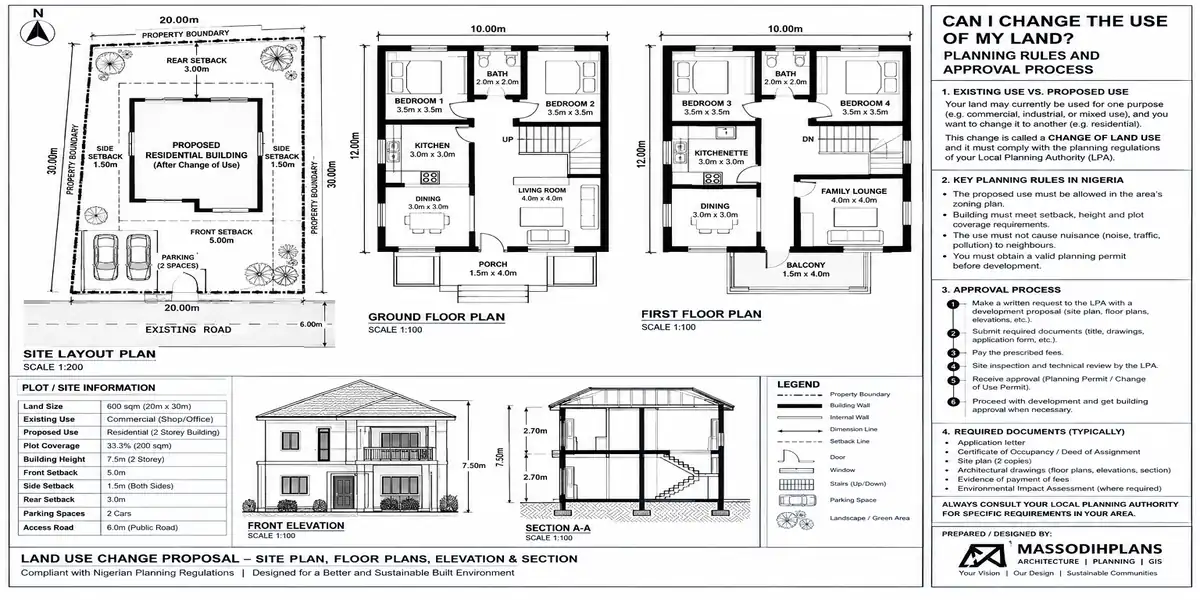
Can I Change the Use of My Land? Planning Rules and Approval Process
Someone asked me this exact question three weeks ago. He owns a plot in a residential layout, and he wants to put up a small shopping complex on it because a new road just opened nearby and the commercial potential is obvious to anyone with eyes. His question wasn’t really “can I” deep down he already suspected the answer was yes, in principle. What he actually wanted to know was: what happens if I just do it anyway, and what’s the “correct” way that won’t cost me more than it’s worth?
That’s the real question behind almost every version of this search “change of land use,” “rezoning application,” “change residential to commercial” and it’s rarely a yes-or-no question. It’s a “yes, if” question. So let me answer it the way I answered him, as a registered Town Planner who has sat on both sides of this advising clients who want to convert land, and reviewing applications where I could see exactly why some got approved and others got quietly buried in a file somewhere.
The Short Answer First
Yes, you can change the use of your land in Nigeria. Land use is not permanently fixed to whatever it was designated when the Certificate of Occupancy was issued or when the layout plan was approved. What’s fixed is the process you don’t get to decide unilaterally that your land now serves a different purpose and start building accordingly. The government, through the relevant state Ministry of Physical Planning and Urban Development (or its equivalent name depending on your state), has to formally approve the change first.
Here’s the part almost nobody explains clearly: under the Land Use Act of 1978, all land in Nigeria is technically held by the state Governor in trust for the people. That single fact is the root of everything else in this article. Your Certificate of Occupancy doesn’t give you unrestricted ownership in the way many people assume it gives you a right of occupancy for a stated purpose, on stated terms. Change the purpose without permission, and you’re not just breaking a planning rule; you’re technically operating outside the terms of the document that gives you legal standing on that land at all.
That sounds heavier than it needs to be for most everyday cases, but it’s why “just build it and hope nobody notices” is a genuinely risky strategy, not a shortcut.
Why People Actually Want to Change Land Use
Before the “how,” let’s be honest about the “why,” because I think most articles skip this and go straight to procedure, which makes the whole thing feel abstract. In my experience, it’s almost always one of these:
- A residential area has grown into an unofficial commercial corridor (a new road, a market, a school nearby), and the land is now worth far more as commercial or mixed-use than as a private residence
- Family land that was farmed for generations now sits at the edge of an expanding city, and the owners want to subdivide and build residential property instead of continuing to farm it
- Someone bought a house purely as an investment and wants to convert part or all of it into an office to rent out to a small business
- A homeowner on a busy street wants to open a shop at the front of their compound to generate side income, without necessarily moving out
- A landlord discovers that a “for-office” conversion rents for two or three times what the same space rents for as a residential flat
None of these reasons are illegal. What matters is whether the conversion is done through the proper channel, because the reason you want to convert has zero bearing on whether the government will approve it what matters is compatibility, documentation, and the state’s own planning framework for that specific location.
Change Residential Land to Commercial: What Actually Determines Approval
This is the single most common conversion request I get, so let’s go deep on it specifically.
Approval mostly comes down to three things:
1. Zoning compatibility with the surrounding area.
If your plot sits on a major or collector road, at a junction, or in an area where commercial activity has already organically grown around you, your application has a real chance. If your plot is deep inside a purely residential estate with no commercial precedent nearby, the same application is far less likely to succeed not because the rule is arbitrary, but because commercial activity inside a residential-only layout creates traffic, noise, and parking problems for people who bought into that layout specifically because it was residential.
2. The master plan or approved layout for that area.
Every properly planned district has a master plan or layout that designates zones residential, commercial, mixed-use, industrial. Your individual conversion request gets checked against that master plan. Where the master plan already anticipates commercial growth along your street (this happens more often than people realize, especially along roads slated for future widening or upgrade), your application is essentially confirming something the planning authority already expects. Where it directly contradicts the master plan, you’re asking for an exception, and exceptions are approved far less often and far more slowly.
3. Physical suitability.
Adequate parking, road access wide enough for commercial traffic and deliveries, and drainage capacity that can handle increased hard-surface runoff from a commercial development. A residential plot converting to commercial use without addressing parking is one of the most common reasons I’ve seen applications sent back for revision.
Before you even prepare an application, walk or drive your street and count how many other properties nearby have already converted to commercial use, formally or informally. If the answer is “several,” your application has organic support built in. If the answer is “none,” you’re not necessarily blocked, but you should expect more scrutiny and possibly a longer wait.
Change Agricultural Land to Residential: A Different Kind of Conversion
This one works differently because agricultural land conversion usually involves a bigger question than zoning compatibility it involves whether the land was properly acquired and documented as agricultural land in the first place, which in Nigeria is often murkier than people expect.
A lot of “agricultural land” on the outskirts of expanding Nigerian cities is actually family or communal land that was never formally surveyed, titled, or brought under a Certificate of Occupancy it was simply farmed under customary tenure for generations. If this describes your land, your real first step isn’t a change-of-use application at all. It’s regularizing the title itself getting a survey done, applying for a Certificate of Occupancy or at least a Governor’s Consent process started, and confirming the land isn’t sitting inside a government acquisition or a designated green belt/agricultural reserve that restricts residential development entirely.
If the land already has proper documentation as agricultural land, converting it to residential generally involves:
- A formal change of use application to the state planning authority
- Evidence that the area is within the urban expansion trajectory of the state’s development plan (many states periodically review and expand what counts as “urban” versus “rural/agricultural” zones, and your land might already technically qualify without you knowing it)
- A new layout plan if you intend to subdivide the land into multiple residential plots, which typically needs to go through the town planning department for layout approval before individual plot sales or development can happen
- Payment of applicable conversion fees and, in many cases, a requirement to set aside land for roads, drainage, and sometimes a portion for public use as part of the layout approval
If your “agricultural land” has never been surveyed or documented, do not start converting or subdividing it before regularizing the title. I have seen families invest heavily in laying out plots and selling land on undocumented family holdings, only to run into serious disputes later either from other family members with competing claims, or from the government itself if the land falls inside an area under acquisition. Get the title sorted first; the conversion is the second step, not the first.
Change Residential Property to Office (Or to Shop): The Conversion Most People Get Wrong
This is different from the two above because it’s usually not about changing the zoning of the land itself it’s about changing the use of an existing building on land that’s already residentially zoned, without a corresponding zoning change. People genuinely underestimate how often this specific mismatch causes problems.
Here’s the distinction that matters: converting a room or two of your house into a home office you personally use is generally low-risk and rarely triggers any enforcement, because it doesn’t meaningfully change traffic, parking, or neighbourhood character. Converting your residential property into a full commercial office that clients, staff, and visitors come to daily is a different matter entirely it’s a genuine change of use, even though you haven’t touched the zoning designation of the plot at all, because now the building’s actual function no longer matches its approved use.
The same logic applies to converting residential property into a shop. A small kiosk selling provisions from your frontage, common across Nigerian residential streets, exists in a grey zone that’s technically supposed to be regularized but is rarely enforced at that scale. A proper retail shop with signage, regular customer footfall, and stock deliveries is a genuine commercial use operating inside a residential approval, and it’s exactly the kind of thing that draws neighbour complaints, which is very often what actually triggers enforcement not proactive government monitoring, but a neighbour formally reporting it.
What this means practically: if you’re converting residential property to an office or shop at any meaningful commercial scale, you need a change of use application specific to that building’s use, even if you’re not touching the underlying zoning classification of the land itself. Skipping this because “it’s just my own house” is one of the most common and most avoidable planning violations I encounter.
The Change of Use Application: What It Actually Involves
Let’s walk through the application itself, because this is where most articles get vague and this is exactly where I want to be specific.
Documents You’ll Typically Need
- Copy of your Certificate of Occupancy or existing title document
- Current survey plan of the property
- A formal application letter stating the existing use, the proposed use, and your reason for the change
- A site plan and, where a new structure or significant alteration is involved, architectural drawings showing the proposed use
- Evidence of tax and land use charge payment up to date
- Passport photographs and identification of the applicant
- In some states, a sworn affidavit or a letter of consent from neighbours or the community/landlords’ association, particularly for commercial conversions in residential layouts
The Actual Process
Submit the application to your state’s Ministry of Physical Planning and Urban Development (naming varies by state some call it Lands Bureau, some Physical Planning Board, but the function is the same)
Site inspection a planning officer typically visits the site to assess physical suitability, surrounding land use, access, and drainage
Technical review against the master plan/layout checking whether the proposed use is compatible with the designated zone for that area
Neighbour or community input, in some states and for certain conversion types, particularly where the change could affect neighbouring properties
Assessment of applicable fees conversion fees, which vary significantly by state, plot size, and the nature of the conversion, and are typically higher for residential-to-commercial than for residential-to-residential adjustments
Approval, conditional approval, or rejection conditional approval is common, and usually comes with requirements like providing additional parking, setting back further from the road, or limiting operating hours
Issuance of an amended Certificate of Occupancy or a formal Change of Use/Rezoning Approval letter, which becomes your legal evidence that the new use is recognized
Realistic timeline: this is rarely fast. Depending on the state and how busy the planning office is, expect anywhere from two to six months for a straightforward case, and considerably longer where the application contradicts the existing master plan and requires a formal rezoning review rather than a simple change-of-use approval.
Engage a registered town planner or surveyor to prepare and submit your application rather than doing it yourself as a walk-in applicant. This isn’t just about paperwork quality a registered professional’s submission is processed through a different, generally faster track in most planning offices, because the documentation is expected to already meet technical standards, reducing the back-and-forth that slows down self-prepared applications.
How to Change Zoning vs. How to Change Use: A Distinction That Actually Matters
People use “change of use” and “rezoning” as if they’re interchangeable, and in casual conversation that’s fine, but they can mean genuinely different processes depending on your situation, and knowing which one you actually need saves you time.
Change of use typically applies when the proposed new use is already something the area’s zoning could reasonably accommodate, or where you’re seeking approval for a single property without asking the government to redesignate the whole area. This is the faster, more routine process.
Rezoning, properly speaking, is a request to formally redesignate an area’s master plan classification for example, asking the planning authority to officially reclassify a stretch of a residential layout as mixed-use or commercial. This is a bigger request because it doesn’t just affect your plot; it changes the planning designation for that zone going forward, which affects every property owner in it. Rezoning applications are reviewed more heavily, sometimes require public notice or a hearing process, and take considerably longer.
In practice, here’s the shortcut I give clients: if you’re the only property in your immediate area wanting this new use, you’re almost always filing a change of use application. If commercial activity has already organically taken over your street and you want the government to formally catch up and reclassify the whole corridor (which benefits everyone converting along it, not just you), that’s a rezoning request, and it’s often worth coordinating with neighbouring property owners to file it jointly, since a joint application demonstrating an already-changed area character carries more weight than one individual asking for an exception.
What Happens If You Just Convert Without Approval
I want to be direct about this because a lot of people quietly do this and get away with it for years, which creates a false sense that it’s a non-issue. It isn’t, and here’s specifically what’s at risk:
Revocation risk.
Under the Land Use Act, the Governor retains power to revoke a right of occupancy for breach of terms, and unauthorized change of use is a breach of terms. In practice, outright revocation over a minor unauthorized conversion is uncommon, but it is a real legal exposure, not a theoretical one.
Demolition or enforcement orders
Particularly where the unauthorized use generates neighbour complaints, safety concerns, or where the state is actively enforcing its master plan in that corridor.
Complications at resale or refinancing.
A buyer’s lawyer or a bank’s valuer conducting due diligence will check the property’s approved use against its actual use. A mismatch here is one of the most common reasons deals stall or banks decline to use a property as loan collateral, because they can’t be certain the buyer will be able to legally continue the current use.
No legal standing if a dispute arises.
If a neighbour, a tenant, or even a business partner disputes something about the property’s commercial use, and that use was never formally approved, you’re arguing your position from a much weaker legal footing than if the conversion had been properly documented.
Losing the value uplift you were trying to capture.
This is the one people don’t think about. The entire reason most people convert land use is to increase its value but an unapproved conversion doesn’t fully capture that value, because a sophisticated buyer’s due diligence will discount the price to account for the regularization risk they’re inheriting. You can end up doing all the work of an informal conversion and still not get the price premium you converted the land to achieve.
If Your Application Gets Rejected
This happens, and it isn’t necessarily the end of the road. Common reasons for rejection include incompatibility with the master plan, inadequate parking or access provision, insufficient documentation, or objections raised during neighbour consultation. Most states have an appeal or review process, and in my experience, a rejected application often just needs to be resubmitted with specific deficiencies addressed additional parking allocation, a revised site plan, or supporting evidence of area character change rather than abandoned entirely. A registered town planner reviewing the rejection letter can usually tell you quickly whether the issue is fixable or whether the location genuinely isn’t suited to the proposed use.
A Quick Gut-Check Before You Even Apply
Before spending time and money on an application, ask yourself honestly:
- Has the character of my immediate area already shifted toward the use I want, or would I be the first and only one?
- Can my plot actually accommodate the parking, access, and drainage needs of the new use, physically?
- Am I converting the land’s zoning, the building’s use, or both and do I know which one I actually need to apply for?
- Is my current title documentation (survey, C of O) solid enough to support a formal application, or does that need sorting out first?
- Have I budgeted realistically for both the conversion fees and the multi-month timeline, rather than assuming it’s a quick formality?
If you can answer all five honestly and the answers are favourable, you likely have a genuinely approvable case, not just a hopeful one.
Frequently Asked Questions
Can I convert my residential land to commercial use in Nigeria?
Yes, through a formal change of use application to your state’s planning authority, with approval depending on zoning compatibility with the surrounding area, the district’s master plan, and physical suitability like parking and access.
Do I need a lawyer or a town planner for a change of use application?
A registered town planner typically handles the technical planning submission (site plan, use justification, master plan compatibility), while a lawyer is more relevant for title regularization issues or if the matter involves a dispute. Many conversions need both, especially where the title documentation itself needs attention first.
How long does a change of use approval take in Nigeria?
A straightforward change of use application typically takes two to six months. Rezoning requests, which affect a wider area’s designation rather than a single plot, generally take considerably longer.
What happens if I change my land use without approval?
You risk enforcement action, complications during resale or bank valuation, weaker legal standing in any dispute, and, in serious or persistent cases, exposure to revocation of your right of occupancy under the Land Use Act.
Is there a difference between change of use and rezoning?
Yes. Change of use generally applies to a single property’s approved use. Rezoning is a request to formally redesignate an entire area’s master plan classification, which is a bigger process affecting every property in that zone.
Before You Go
If there’s one thing I’d want you to leave this article with, it’s this: changing your land’s use is very often possible, and it’s very often worth doing but it’s a process with a legitimate, government-recognized outcome, not a decision you make privately and hope holds up. Do the paperwork properly once, and the value you unlock is actually yours, fully and defensibly. Skip it, and you’re building value you may never be able to cleanly cash in on.
If you’re weighing a conversion and want someone to actually look at your specific plot, our Services page outlines how we support clients through change of use and rezoning applications from documentation through approval. Our Plan School has more on reading master plans and layout designations if you want to understand your area’s zoning yourself first. Browse our Plans Library if the conversion is part of a bigger plan to develop the land afterward, and you can find more land and planning guides on our Homepage.
Related Guides
- House Floor Plans: 3, 4 & 5 Bedroom Modern Home Plans With Dimensions and Practical Layouts
- Can I Build on This Land? How to Check the Plot Before Building a Home
- Planning Permission Explained: Everything You Must Know Before Building on Your Land
- Am I About to Overpay for This Property? A Simple Guide to True Value
- How Do I Know the True Value of a Property? Before You Buy or Sell It
- Is This Property Actually Worth the Asking Price? What to Check First!
- Is This Neighbourhood a Good Place to Live? What to Check Before Buying
- I Don’t Know Which Location to Buy In: How to Choose the Best Location
- What Can I Build On My Land? How to Find Out What You Can Build There?
- What Is the Zoning of My Property? How to Check Zoning Before Building
Author
Massodih Okon is a Nigerian built-environment professional with academic and professional experience in urban and regional planning, geography, architectural design, Landscape Design, GIS and land development.
He holds a Master’s degree in Urban and Regional Planning from the University of Uyo and a first degree in Geography and Regional Planning.
Through MassodihPlans, he publishes practical guides on Nigerian house plans, building design, physical planning, site planning, development approval and residential construction. Read the full author profile →