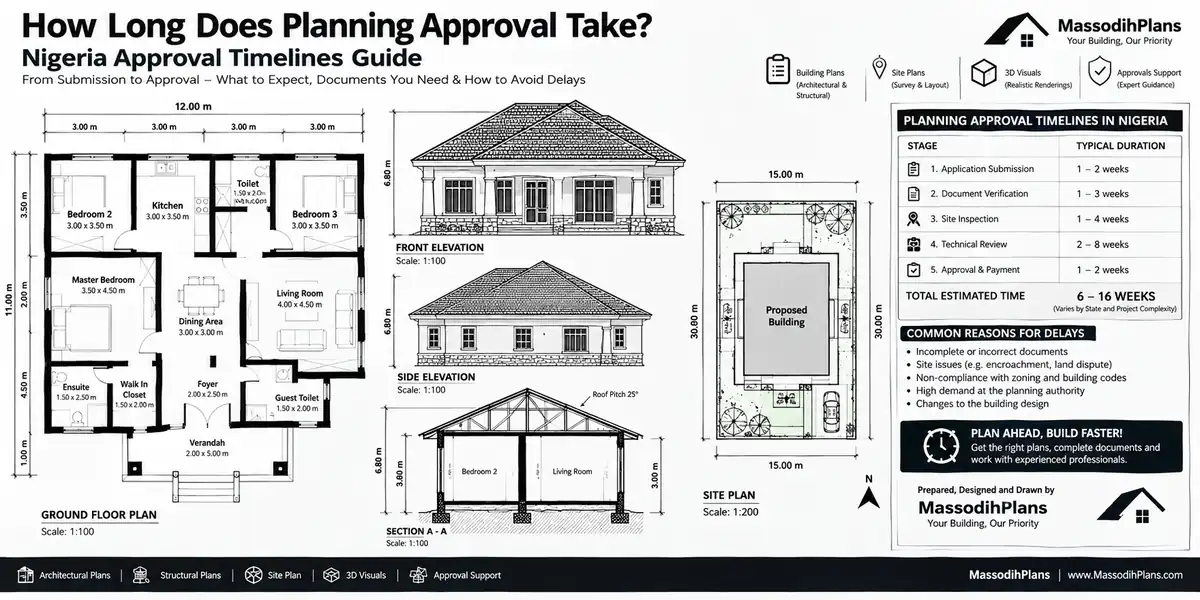
How Long Does Planning Approval Take? Nigeria Approval Timelines Guide
A client called me last month, almost shouting with joy: “Arc, my building plan don enter review o! Them say make I just wait small.” That “small” wait turned into eleven weeks of refreshing an email inbox every morning before his permit finally landed. He wasn’t impatient. He was simply never told, upfront, what “waiting” actually means in planning approval because almost nobody who writes about this topic bothers to explain it honestly.
So let’s actually sit down and talk about it the way I would with you if you walked into my office with a site plan under your arm, or the way I’d explain it to my planning students before they ever touch a real client file. Not a vague “it depends,” and not a scary “it could take forever.” Real numbers, real reasons, and a real plan for what you can actually do about it whether your plot is in Uyo, Lagos, London, Toronto, Dubai, Munich, Doha, Reykjavik, Luxembourg City, Zurich, Sydney, or Singapore.
First, Let’s Agree on What We’re Actually Talking About
People use “planning approval,” “planning permission,” “building approval,” and “development approval” like they’re the same thing, and that confusion alone causes half the frustration I see.
Planning permission / planning approval is permission to use land a certain way and to build a certain form on it — height, footprint, land use, how it sits on the plot. This is the planning authority’s job.
Building approval / building permit is a separate (sometimes parallel) check that your actual construction drawings are structurally safe and meet building code foundations, structural members, fire safety, services. This is often a different department, or even a different agency entirely, from the one handling planning.
Development approval is the umbrella term used in several countries (Australia especially) for the full package planning, building, and sometimes environmental sign-off bundled into one process.
Rezoning is different again it’s not approval to build on land zoned for your use; it’s a request to change what the land is legally allowed to be used for in the first place, before any building design conversation even starts.
Knowing which one you’re actually asking about changes the answer dramatically, so let’s go through each one properly.
If an agent or contractor gives you one single number for “how long approval takes” without first asking what type of approval you need, that’s usually the first sign they don’t fully understand your project’s requirements. A real professional will ask before they answer.
How Long Does Planning Permission Take?
This is the most commonly searched version of this question, and the honest answer has two layers: the official target, and what actually happens.
England
In England, the statutory target for most householder and minor applications is 8 weeks from the date your application is validated, with 13 weeks for larger “major” developments. Recent analysis of London council data found average elapsed decision times running closer to 9 to 11 weeks even for straightforward householder applications. For major schemes, the gap between target and reality is far wider government figures for early 2026 show only about 19% of major applications were actually decided within the statutory 13-week period. So when you hear “8 weeks” quoted as the UK answer, treat it as the floor, not the ceiling. urbanistarchitectureillustrarch
Germany
In Germany, the equivalent process is the Baugenehmigung, issued by your local Bauamt. Standard review typically takes 6 to 12 weeks depending on project complexity, though recent digital reforms aim to bring standard permits down toward six weeks for straightforward residential projects.
United Arab Emirates
In the United Arab Emirates, including Dubai, a straightforward residential villa’s full approval cycle from first submission through to permit issuance, including the utility and community clearances that run alongside it typically runs 4 to 8 weeks, though a clean first-time submission moves noticeably faster than one needing revisions. almujassam
The United States
In the United States, there’s genuinely no single national answer, because every city and county runs its own planning department. Small residential permits commonly clear in 2 to 4 weeks in faster jurisdictions, while major metros with heavier review backlogs can run 8 to 12 weeks or more for the same type of project.
Canada, Australia, Singapore, Switzerland, Qatar, Iceland, and Luxembourg
In Canada, Australia, Singapore, Switzerland, Qatar, Iceland, and Luxembourg, the pattern repeats with local variation: Australia’s standard development application process typically runs 4 to 10 weeks for straightforward residential proposals through local council assessment, with “complying development” fast-track pathways available in some states for simple, code-compliant builds. Singapore’s Urban Redevelopment Authority generally processes a straightforward Written Permission application within roughly 4 to 8 weeks for compliant residential submissions. Switzerland’s Baubewilligung process typically runs 2 to 4 months, largely because of a mandatory public objection period most cantons require regardless of how simple the project is.
Canada’s municipal planning timelines vary by city much like the US does, generally 4 to 12 weeks for straightforward residential approval, with far longer timelines where rezoning is also required. Qatar’s municipal approval processes for residential projects generally fall in a similar 4-to-10-week range for complete, compliant submissions. Iceland and Luxembourg, being smaller jurisdictions with lower application volumes, often process straightforward residential planning applications faster in practice frequently within 4 to 8 weeks though exact figures are less publicly tracked than in larger countries, so always confirm directly with your local authority.
Nigeria
In Nigeria, this process runs through your state’s physical planning authority LASPPPA in Lagos, KASUPDA in Kaduna, ANSPPB in Anambra, and their equivalents elsewhere. Lagos’s official minimum processing period is 60 days, extendable if the planning authority isn’t satisfied with the submitted drawings, with a fast-track option available for an additional fee. I’ve written dedicated, state-specific guides on exactly what each Nigerian authority requires find those linked below once we’re through this global picture.
Make I tell you true true: no matter which country your plot dey, if your drawings waka enter that office scatter-scatter, confusion plenty, missing signature, missing document no authority on Google go rank your file “number one” for speed. Order no dey, delay go surely come.
How Long Does Building Approval Take?
Building approval (sometimes bundled with planning, sometimes entirely separate) focuses on whether your actual construction structure, materials, safety systems meets code, regardless of whether the land use itself was already approved.
Where planning and building approval are handled by separate departments (as in much of Nigeria, the UK, and parts of the US), building approval can run concurrently with planning in some jurisdictions, or sequentially only starting once planning is granted in others. This single distinction is responsible for a huge share of the “why is my approval taking so long” confusion, because people assume the clock is running on one process when it’s actually two processes, one waiting for the other to finish first.
In practice, for a straightforward single-family home with complete, code-compliant structural drawings:
A simple residential building review alone (once planning/zoning is cleared) often takes 2 to 6 weeks across most of the countries covered here
Projects needing structural engineering review beyond a standard single-storey home a basement, a cantilever, unusual soil conditions routinely add weeks to that figure
Projects requiring revisions after an initial review restart part of the clock, which is why submitting complete, correct documentation the first time matters more than almost any other factor in this entire guide
Never assume “planning approved” means “cleared to build.” In most jurisdictions worldwide, you still need separate building/construction approval even after planning permission is granted, and starting construction before that second approval is issued is one of the most common and most expensive mistakes self-builders make internationally.
How Long Does Development Approval Take?
“Development approval” (DA) is the term you’ll hear most often in Australia, and increasingly as a catch-all term elsewhere for the combined planning-plus-building package.
For a standard residential DA in Australia, straightforward applications through local council merit assessment commonly take 4 to 10 weeks, while complying development certificates (for designs that meet pre-set code requirements exactly) can move significantly faster sometimes under 20 working days specifically because they skip the discretionary assessment stage entirely.
The broader lesson, wherever you’re building: a development approval that has to go through discretionary judgment calls by a planning officer or committee will always take longer than one that simply has to be checked against a fixed, objective checklist. This is true in Sydney, Lagos, Toronto, and everywhere in between it’s not a quirk of one country’s bureaucracy, it’s just how discretionary review works everywhere.
Planning Application Processing Time: What’s Actually Happening Behind the Scenes
Here’s the part almost no article explains, and it’s the part that actually helps you plan realistically. Your application isn’t sitting in one single queue it’s moving through a sequence of distinct stages, each with its own bottleneck:
Validation/intake confirming your submission is complete before the official clock even starts. Missing a single document here resets this stage entirely, and in many jurisdictions, an incomplete submission isn’t even logged as “received” until it’s complete.
Technical/desk review planning officers or technical reviewers check your drawings against zoning rules, setbacks, density, and (for building approval) structural code.
Consultation/notification in many countries, including the UK and much of Europe, neighbours or the public get a formal window (commonly around 21 days) to raise objections, and this period is often baked into the statutory timeline, not added on top of it.
Inter-agency referrals drainage authorities, fire services, utility companies, and environmental bodies may each need to sign off separately, and these run in parallel in well-run systems and in frustrating sequence in less well-run ones.
Decision and issuance the final internal sign-off and the physical (or digital) issuing of your permit or approval letter.
Multiply the slowest stage by however many of these steps apply to your specific project, and you get a far more honest estimate than any single “X weeks” headline figure ever will.
Ask your authority, specifically, which of these five stages your file is currently sitting in not just “how is my application doing.” A vague answer like “still processing” tells you nothing. A specific answer like “it’s with the drainage referral” tells you exactly what’s actually holding things up, and who to politely follow up with.
Why Is My Planning Approval Delayed? (The Real Reasons, Ranked)
I’ve sat on both sides of this as the person submitting drawings, and as the person reviewing site compliance. Here’s what actually causes delays, ranked by how often I genuinely see them:
1. Incomplete documentation.
This is, by far, the single biggest cause of delay everywhere in the world not corruption, not bureaucracy, not bad luck. A missing structural stability letter, an expired survey plan, an unsigned title document. Authorities worldwide are legally required to treat an incomplete file as not-yet-received, which quietly resets your position in the queue without anyone necessarily telling you clearly.
2. Non-compliant design submitted first, then revised after rejection.
Every revision cycle restarts part of the review clock. A design that violates setback rules, exceeds permitted plot coverage, or ignores height restrictions from the start isn’t saving you time by “just trying it” it’s adding a guaranteed extra review cycle.
3. Neighbour objections or public consultation pushback.
In jurisdictions with a mandatory notification period, a genuine objection can trigger additional review, a site visit, or even a hearing adding weeks to months depending on how the objection is handled.
4. Backlog and seasonal volume.
Planning departments everywhere experience predictable busy seasons (commonly spring and early summer in temperate climates, and the period right after rainy season in much of Nigeria), and your file simply queues behind everyone else’s during these windows.
5. Inter-agency referral delays.
When your file depends on sign-off from a drainage authority, fire department, or utility company that isn’t under the same deadline pressure as the main planning office, their response time becomes your bottleneck regardless of how fast the primary authority is working.
6. Using an inexperienced or unlicensed agent.
This one deserves its own paragraph, because it’s genuinely one of the most common delay causes I encounter, worldwide, not just in Nigeria someone unfamiliar with the specific authority’s current checklist submits a package that looks complete to the client but is missing something the reviewer immediately flags.
That agent wey dem send go submit your file, if e no sabi road, na your file go spend weekend for office like person wey miss last bus just dey there, waiting, nobody to carry am go anywhere.
How Long Does Rezoning Take?
Rezoning is a genuinely different animal from the approvals above, because you’re not asking “may I build this specific thing” you’re asking “please change what this land is legally allowed to be used for,” which is a policy decision, not a technical compliance check.
A straightforward rezoning application in a smaller jurisdiction with no organized opposition can move through in roughly 60 to 90 days, while a complex application in a large metro area, or one facing community pushback, can take one to three years or longer. In the US specifically, a typical rezoning process runs through pre-application review, staff technical review, and then scheduled planning commission and council hearings, commonly totaling three to nine months from pre-application to decision.
The reason rezoning takes fundamentally longer than standard planning approval is structural, not accidental: it almost always requires a public hearing, a vote by an elected or appointed body, and a formal public notice period none of which a standard planning or building approval application requires. If your project needs rezoning before planning approval can even be sought, build that entire extra timeline into your project schedule from day one, not as an afterthought once you discover the land isn’t zoned for what you want to build.
The Country-by-Country Quick Reference Table
| Country/Region | Planning/Building Approval (Typical Range) | Key Factor That Moves the Number |
|---|---|---|
| Nigeria (state-dependent) | 4–12 weeks official, often longer in practice | Document completeness; state authority backlog |
| United Kingdom | 8 weeks (minor), 13 weeks (major) statutory | Public consultation; committee scheduling |
| Germany | 6–12 weeks | Project complexity; Bauturbo fast-track eligibility |
| United Arab Emirates | 4–8 weeks | Community/utility NOC coordination |
| United States | 2–12 weeks (varies heavily by city) | Local jurisdiction backlog; project scope |
| Canada | 4–12 weeks (longer if rezoning required) | Municipality-specific process |
| Australia | 4–10 weeks (faster via complying development) | Discretionary vs. code-compliant pathway |
| Singapore | 4–8 weeks | Compliance with URA guidelines on first submission |
| Switzerland | 2–4 months | Mandatory public objection period |
| Qatar | 4–10 weeks | Completeness of municipal submission |
| Iceland / Luxembourg | 4–8 weeks (typical, less publicly tracked) | Lower application volume; confirm locally |
Treat every figure in this table as a planning assumption, not a guarantee always confirm current timelines directly with your specific local authority before committing to a construction schedule, since processes and backlogs genuinely shift year to year everywhere in this list.
The Small-Plot Angle Nobody Else Is Covering
Here’s where I want to connect this back to what actually matters for most of the people reading this because this entire topic changes shape once you’re working with a small urban or infill plot, which is exactly the situation most of my Nigerian clients, and a growing number of my diaspora clients, are actually in.
Small plots often qualify for simplified or fast-track review if you know to ask.
Many jurisdictions worldwide (Australia’s complying development pathway, Dubai’s standard B-permit process, and Lagos’s own fast-track option among them) offer a faster lane specifically for straightforward, code-compliant residential projects. Small single-family homes on regularly shaped plots are exactly the kind of project these fast-track pathways were designed for but almost nobody tells clients to specifically ask whether their project qualifies.
Small plots also face a specific, recurring complication
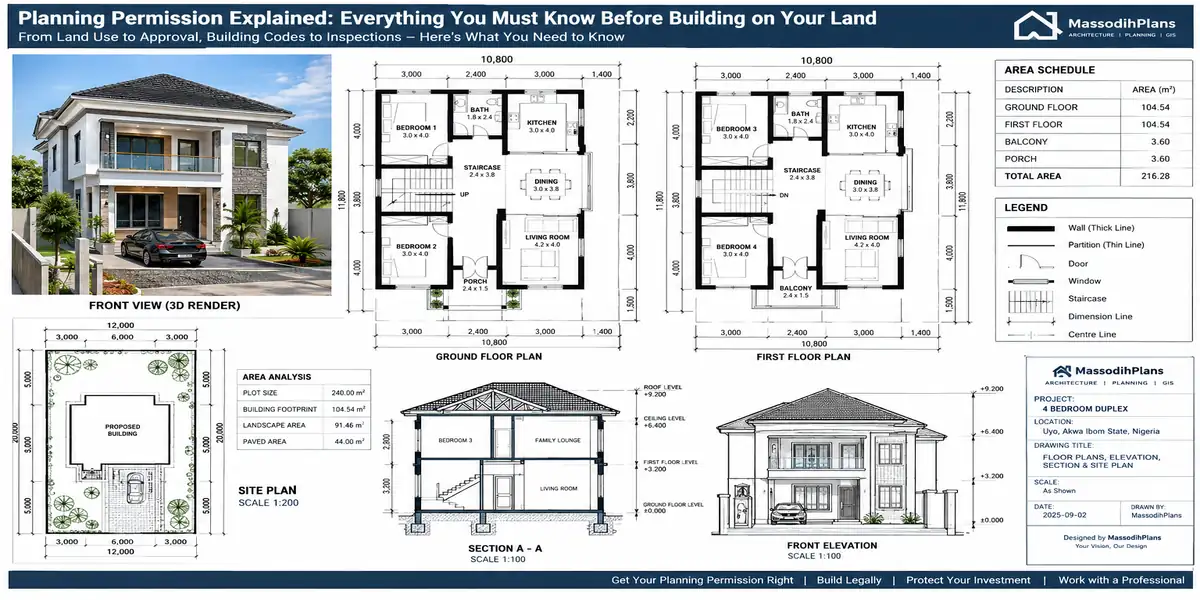
Tight setback compliance. On a generously sized plot, a few centimetres of setback miscalculation rarely matters. On a small urban infill plot, that same miscalculation can push your design out of compliance entirely, forcing a design revision and a fresh review cycle. This is, in my direct field experience, one of the single most common reasons small-plot building plans get sent back for correction not bad design, just a setback calculation that didn’t account for how little margin a small plot actually leaves you.
And here’s the one almost nobody mentions
On a small plot, structural and drainage referrals can actually move faster than on a large one, simply because there’s less to review less roof area to assess for stormwater, a simpler foundation footprint, fewer structural elements needing separate sign-off. If your documentation is clean, a small, well-designed home on a small plot genuinely has the best odds of moving through approval quickly, anywhere in the world.
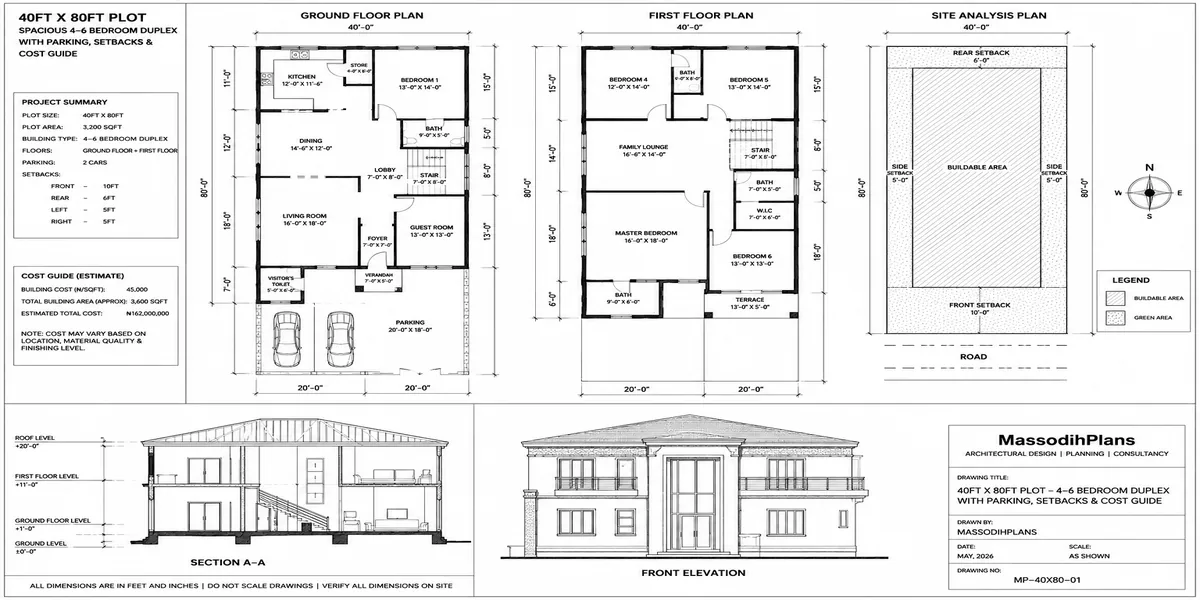
This is exactly why, at MassodihPlans, our focus has always been Nigerian house plans and building designs specifically built around small-plot realities because a design that’s already been thought through for tight setbacks, simple drainage, and clean structural logic isn’t just easier to live in. It’s measurably faster to get approved.
What to Do If Your Approval Feels Delayed
Instead of just waiting and hoping, here’s the actual sequence I walk clients through:
Confirm your application was formally validated, not just submitted. An unvalidated application isn’t officially “in the queue” in most systems, however long ago you sent it.
Ask specifically which stage your file is in validation, technical review, consultation, referral, or final decision rather than accepting a vague “still processing” answer.
Check whether a referral agency, not the main planning office, is the actual bottleneck. This changes who you should be following up with.
Review your own submission for completeness against the authority’s current checklist requirements do change, and an older checklist from a previous project is not a safe reference.
Ask directly whether a fast-track or expedited pathway exists for your project type, especially if you’re building something straightforward on a small, regularly shaped plot.
Escalate politely and in writing once you’ve exceeded the stated statutory or target period, referencing the specific regulation or published target your authority operates under.
Never start construction while an application is still pending, even if you’re confident approval is “basically guaranteed.” Building ahead of approval is one of the most common and expensive mistakes self-builders make internationally it risks stop-work orders, fines, and in some jurisdictions, demolition, regardless of how good your eventual design turns out to be.
Frequently Asked Questions
How long does planning permission take on average?
Globally, straightforward residential planning permission typically takes between 4 and 13 weeks depending on jurisdiction, with the UK’s statutory 8-week target and Lagos’s 60-day minimum sitting at roughly comparable real-world ranges once delays are accounted for.
How long does building approval take after planning permission is granted?
Where the two processes run sequentially, building/construction approval commonly adds another 2 to 8 weeks on top of planning approval, depending on structural complexity and documentation completeness.
Why is my planning approval taking longer than the stated timeline?
Almost always one of: incomplete documentation, a non-compliant design requiring revision, a neighbour objection triggering extra review, seasonal backlog, or a slow inter-agency referral rarely the “pure bureaucracy” explanation people default to.
Does a small plot get approved faster than a large one?
Often yes, provided the submission is complete and compliant smaller structures generally mean simpler structural and drainage referrals, though small plots carry a higher risk of setback non-compliance, which can offset that advantage if not carefully checked.
How long does rezoning take compared to standard planning approval?
Significantly longer in almost every jurisdiction commonly 60 days at the absolute fastest, and routinely 6 months to several years where public hearings, community opposition, or elected-body votes are required.
Can I speed up my planning or building approval?
Not by paying your way past legitimate technical review in most honest systems, but you can meaningfully speed things up by submitting complete, compliant documentation the first time, confirming fast-track eligibility upfront, and following up specifically rather than vaguely.
Finally,
If there’s one thing I want you to leave this article with, make it be this: the length of your planning approval is decided far more by the completeness and compliance of what you submit than by luck, location, or “how these things just are.” A clean, well-prepared application for a sensibly designed small home will consistently outpace a confused, incomplete submission for a far more modest project in Lagos, in London, in Dubai, or anywhere else on that reference table above.
That’s precisely the gap we try to close at MassodihPlans Nigerian house plans and building designs built around small-plot realities from the very first sketch, specifically so that the approval process becomes the smoothest part of your building journey, not the most stressful one. Browse our Plans Library for designs already shaped around small-plot setback and drainage realities, or visit Plan School to understand exactly what documentation your specific state authority requires before you submit. If you want direct support getting your file through approval cleanly the first time, our Services page outlines how we work with clients from design through to permit issuance. You can also explore our full library of state-specific Nigerian building approval guides on our Homepage.
- How Much Does Planning Permission Cost? Nigeria Fees & Approval Guide
- Why Was My Planning Application Rejected? Reasons and How to Fix It
- How Do I Do GIS Analysis for My Thesis? A Real Step-by-Step Guide
- How Do I Choose GIS Analysis? Find the Right Method for Your Research
- How Do I Get Building Approval? Steps, Documents & Fees in Nigeria
Author
Massodih Okon is a Nigerian built-environment professional with academic and professional experience in urban and regional planning, geography, architectural design, Landscape Design, GIS and land development.
He holds a Master’s degree in Urban and Regional Planning from the University of Uyo and a first degree in Geography and Regional Planning.
Through MassodihPlans, he publishes practical guides on Nigerian house plans, building design, physical planning, site planning, development approval and residential construction. Read the full author profile →